Chiapas Support Committee
Home of the Compañero Manuel blog on zapatistas & mexico
Prelude: Timepieces, The Apocalypse, and the Hour of the Small

By: Subcomandante Insurgente Galeano
April 12, 2017
Good afternoon, evening, day, morning.
We want to thank the compañeras and compañeros of CIDECI-UniTierra for having offered, with compañero generosity, this, their space, once again in order that we can meet here; as well as the support teams for the Comisión Sexta [Sixth Commission of the EZLN] who are in charge of transportation (we hope they don’t get lost again), logistics, and security for this event.
We also appreciate the participation of those who will accompany us with their reflections and analysis in this seminar that we’ve called “The Walls of Capital, the Cracks of the Left.” So thank you to:
Don Pablo González Casanova.
María de Jesús Patricio Martínez.
Paulina Fernández C.
Alicia Castellanos.
Magdalena Gómez.
Gilberto López y Rivas.
Luis Hernández Navarro.
Carlos Aguirre Rojas.
Arturo Anguiano.
Christian Chávez.
Carlos González.
Sergio Rodríguez Lascano.
Tom Hansen.
In addition, we’d like to offer special thanks and greetings to the free, autonomous, independent, alternative, or whatever they’re called media, for their efforts in giving words wings and allowing what is reflected on here to reach other shores.
-*-
We Zapatista men and women have decided that we should begin this seminar or meeting, which forms part of the world campaign “Against the Walls Above, The Cracks Below (And to the Left),” so that those who follow us in speaking here can distance themselves, criticize, or simply play dumb, according to their preference.
That’s why we’re alone on this panel, accompanied only by Don Pablo González Casanova. He is here for several reasons: one is that he is beyond good and evil, and, as he has demonstrated throughout the last 23 years, it doesn’t bother him one bit if he is criticized for hanging out with “bad company.” Another reason is that he always says what he thinks. He can tell you, and he’d be telling the truth, that we have never imposed on him a vision or a focus; that’s why not just a few times he’s not only disagreed with us, but been quite critical. This fact is so pronounced that the code with which we refer to him in our internal communications, so that the enemy doesn’t know we’re talking about him, is “Pablo Contrarian.” We consider him a compañero, another one of us who is what we are and how we are. We’re proud to be accompanied by his step, his critical words and, above all, his commitment free of duplicity and indifference.
With Subcomandante Insurgente Moisés, we’ve prepared our remarks today so that they are threaded together, or at least that’s what we’ve tried to do.
I know well that we have a reputation for not being serious and in fact quite irresponsible, not to mention, of course, irreverent, stubborn, and shameless trouble makers: often we start telling stories when the occasion merits solemnity and transcendence and the academy demands “concrete analysis of the concrete reality.” In sum, we’re transgressors of responsibility, good manners, and civilized urbanity.
But despite that, I’m going to ask you to get serious because what we say today is going to provoke a flood of attacks and disqualifications.
Well, one more attack, besides the one already carried out by the cultured hysteria of the institutional left which naively thinks it will take Power, finally, because it’s been able to achieve early on what was predicted, that is to say, it has become a clone of that which it claims to combat, corruption included. It is that cultured progressivism which has elevated as social science concepts categories like “conspiracy,” “mafia of power”[i] and which offers pardons, absolutions, and amnesty when it’s those above who are in question, and convictions and sentences where those below are concerned. That much is for sure, it must be recognized that the cultured left is brave in its dishonesty, unafraid to play the fool time and time again to convince itself and this season’s followers that “regeneration” is synonymous with “recycling” as far as the political and corporate class is concerned.
What we want to say to you today is brief, and we will begin by expressing it in a few of the original languages that become words along our path:
Chol will be spoken by Comandanta Amada.
Tojolabal will be spoken by Comandanta Everilda.
Tzotzil will be spoken by Comandanta Jesica.
Tzeltal will be spoken by Comandanta Miriam.
Spanish will be spoken by Comandanta Dalia.
What the compañeros and compañeras have said can be translated into Spanish as “Vete a la chingada Trump,” but I’m not going to say it that way so no one can accuse me of being vulgar. So we’ll translate it laconically as: “Fuck Trump.”
Having established the most important and serious thing we have to say in this seminar, or whatever you want to call this meeting which really has as its principal objective to give Don Pablo González Casanova a collective embrace, we can now proceed to that which is not so important: our thought.
-*-
Time Pieces
Time, always time. Clocks. Seconds, minutes, hours, days, months, years, lustrums, decades, centuries. The frenetic tic-tac of Capital’s bomb, terrorist par excellance, is now threatening all of humanity. But also time turned calendar and custom, according to each people, according to the struggle from below and to the left, resistance and rebellion.
Twenty-one years ago, in the so-called San Andrés Dialogues, exasperated because Zapatismo insisted on consulting the communities on even the smallest proposed agreements, the government delegation questioned the Zapatista delegation about its watches. Their complaint went more or less like this: “You all talk a lot about Zapatista time but you’re wearing digital watches that read the same time as our clocks.” The uproarious laughter of Comandantes Tacho and Zebedeo reverberated in the small room where the dialogues were taking place.
That was the Zapatista answer to the government’s questioning. Off to the side, several people bore witness as members of the National Intermediation Commission, among them Don Pablo González Casanova, and an artist of the word: the poet Juan Bañuelos, who passed away a few days ago. The latter, on one of the trips he made accompanying the delegation on the lengthy journey into Zapatista Reality [the village of La Realidad], together with the also now deceased SupMarcos, defended The Captain’s Verses by Pablo Neruda, which someone had attacked for being “poetry that’s too political.” “That’s not poetry,” the critic argued in his diatribe, “it’s a political pamphlet.”
Silence followed on the journey. Juan Bañuelos looked out at the mountains, perhaps stringing together in his mind the poem “El Correo de la Selva” [“Jungle Mail”] in which, contrary to what has been said, he is not talking about himself but rather about those who acted as couriers between the CONAI (National Intermediation Commission) and the EZLN, risking their lives, their freedom, and their possessions in that ill-fated time of the zedillista betrayal of 1995 (one of the betrayal’s operatives, Esteban Moctezuma Barragán, is today among those who have been absolved and elevated to strategic director of “real change”[ii]).
For his part, I imagine that the deceased SupMarcos breathed a sigh of relief upon catching sight of Zapatista territory and perhaps, in a prescient murmur, recited to himself the last lines of “La Carta en el Camino” [“The Letter on the Road”] by Pablo Neruda, the poem which concludes the book The Captain’s Verses.
“And so this letter ends with no sadness: my feet are firm upon the earth, my hand writes this letter on the road, and in the midst of life I shall be always beside the friend, facing the enemy, with your name in my mouth and a kiss that never broke away from yours.”
-*-
With regard to the topic of time (or “timing” [English in original] as the obese and lazy think tanks of above would say), they’ve wanted to criticize and categorize us. For example, they’ve told us that in the digital age, we Zapatistas are like those clocks that tell time with gears and clocksprings and which you have to wind by hand.
“Anachronistic,” they said. “The past that’s come to collect its dues,” they declared. “Historical backwardness,” they murmured. “An unfinished task of modernity,” they threatened.
Well, with our usual sense of good timing, we say to them that we’re not like a manually-wound watch in the era of the smart watch, which measures calories consumed and consummated, your heart rate, as well as telling you whether you’re moving well or badly in that encounter of naked bodies repeating that, now yes, anachronistic ceremony of the meeting of skins and humidity. Those watches are so modern and advanced that sometimes you can even use them to see what time it is.
It’s true, this is an age where virtual reality far outstrips real reality and any imbecile can act like he knows something thanks to social networks which allow him to find equally stubborn and cynical echoes; an age where the attempted originality of antipathy is made null and void when it becomes clear that impertinence, ignorance, and smugness are an “individuality” shared by millions of screen names, as if stupidity were none other than a single being with multiple accounts, and the misogyny of Calderón and la Calderona [iii] is paralleled in the whole universe of social networks, including by those who, with Master’s degrees and doctorates on the well-behaved and institutional Left, refer to the possible spokeswoman of the Indigenous Governing Council with the sarcastic nickname of “the Tonantzin.”[iv]
But what on the Right is a legally punishable crime, on the institutional Left is a funny comment that doesn’t deserve to be punished but rather celebrated. Although it might dress itself up as unique and unrepeatable, and may be the director of a newspaper pullout section, imbecility is the most run-of-the-mill of human characteristics on the political spectrum above where differences are diluted even in polls.
But in this technological era that looks upon us with mocking reproach, we Zapatistas are more like an hourglass. An hourglass that, although it doesn’t request an update every 15 minutes and doesn’t require you to have credit on your phone to work, does have to renew its limited countdown over and over again.
Although not very practical and somewhat uncomfortable, just like us Zapatistas, the hourglass has its advantages. For example, in it we can see the time that has gone by, the past, and try to understand it. And we can see, too, the time that is coming.
Zapatista time cannot be understood without understanding the gaze that keeps track of time with an hourglass. That’s why, on this one and only occasion, we’ve brought here for you, madam, sir, other [otroa], little girl, little boy, this hourglass that we’ve baptized the “You know nothing, Jon Snow”[v] model.
Look at it, appreciate the perfection in its curved lines that remind one that the world isn’t round and that despite that it moves, it turns, and, as Mercedes Sosa said in her time, “things change, everything changes.”
Look at it and understand that you do not understand us, but that it doesn’t matter: and, as they say, it’s no big deal, because it’s not toward our archaic customs (which, more than pre-modern, are prehistoric) that we ask you to look, no. It’s farther beyond where we need your vigilance.
Because we understand that they ask you to pay attention to that brief instant in which a tiny grain of sand arrives to the narrow passage in order to then fall and join the other moments that accumulate in what we call the “past.”
That’s what they insinuate, they advise, they ask, they order, they command you to do: live in the moment, live in the present which can now be even further reduced with the highest and most sophisticated technology. Don’t think about the time that already lies in yesterday, because in the vertigo of modernity, “a second ago” is the same as “a century ago.” And above all, don’t look at what’s coming.
Of course, we Zapatistas, stubbornly, against the grain, just to be contrary (without insulting anybody in particular, to each his own), are analyzing and questioning the tiny grain of sand that exists anonymously in the middle of all the others, waiting its turn to get in line in the narrow tunnel, and at the same time looking at the grains that lie below and to the left in what we call the “past,” asking each other what the heck they have to do with this presentation about the walls of Capital and the cracks below.
And we have one eye on the cat and the other on the meat hook, [vi] or rather the dog, with which the “cat-dog” becomes a tool of analysis in critical thought and ceases to be the constant company of a little girl who imagines herself without fear, free, a compañera.
But it’s not Zapatismo that we’re inviting you to try to understand or explain. Although, of course, if you want to reiterate your laziness, limitations, and dogmatism anti- or pro-, well who are we to stop you.
So we say to you that no, we’re not worth the trouble, that Zapatismo is just one struggle among many. Perhaps it’s the smallest in terms of number, impact and transcendence. Although it’s true, it is perhaps the most irreverent of them all if we’re talking in terms of the enemy it has chosen, in terms of its aspiration, its objective, its horizon, and its stubborn insistence on building a world where many worlds fit, all of them, those that exist and those yet to be born.
And all the while, with absurd obstinacy, we turn the hourglass over and over again as if we wanted to tell you, tell ourselves, that this is the struggle: something where there is no rest, where one has to resist and not open the doors of prudent cowardice which mark the entirety of the path with signs reading “EXIT.”
The struggle is something that requires you to pay attention to the whole and to the parts, and to be ready because that last grain of sand isn’t the last, but rather the first, and that the hourglass must be turned over because it contains not today, but yesterday, and yes, you’re right, tomorrow too.
So there you have the secret to the Zapatista method of analysis and reflection: we don’t even use a wind-up clock, but rather an hourglass.
Of course, it’s understandable, what can you expect from those who insist that in this day and age, not just the logic of money but also Donald Trump’s dear mother has been globalized because the whole world over is thinking of her and mentioning her, that is to say, insulting her.
Or maybe we use the hourglass because our passion for understanding is not an academic, scientific or descriptive interest, nor a feigned and sluggish tribunal that thinks it knows everything and can opine about everything because, as is well-known and as the social networks confirm, any foolishness finds followers and flocks are formed for the pastor who, in turn, is part of the flock of another pastor and so on.
No, our interest is subversive. We combat the enemy. We want to know what the enemy is like, its genealogy, its modus operandi we could say following Elías Contreras, a deceased EZLN investigator who insisted that capitalism was a criminal and that all of reality and the world were the scene of the crime and should be studied and analyzed as such.
It occurs to me now that the clues left by Elías Contreras and the now defunct SupMarcos, those that we Zapatistas now leave for you madam, gentlemen, otroa, little girl, little boy, young people not with regards to the calendar but rather with regards to the the gaze, are signs, all of them, to indicate a path.
The trick, the hustle as SubMoy says, the “magic” as SupMarcos used to say, is in the fact that those clues are not for you to find us, discover us, trap us. According to this note I’ve found in a trunk of SupMarcos’ memorabilia that I’ll reread disconcertedly now, they are not only so that you find a mirror, but rather for you to go about building an answer, your answer, to the apocalyptic question that will slap you across the face, irrespective of your color, gender or transgender, your belief or disbelief, your political and ideological philias and phobias, your customs, your time, your geography.
The question that announces the most terrible and marvelous apocalypse: And what about you?
It’s an apocalypse of gender, according to the little girl who calls herself Defensa Zapatista. “This is the fault of fucking men,” she declares at every opportunity, whether or not it has anything to do with the subject at hand, this little girl who dreams of completing her football team.
“It’s all going great, even though the ball is a little deflated, like it got hit a lot and it has a bunch of bumps on its head,” responds the girl to a question I hadn’t even thought of.
“And, of course, the team isn’t complete yet but don’t you worry Sup, soon there’ll be more of us, sometimes it takes a while but soon there’ll be more of us,” she says trying to calm me while we wait anxiously in the Caracol for them to find the support team that got lost.
Subcomandante Insurgente Moisés murmurs, “Son of a…I think we need to form a support team for the support team, because something always happens to them,” while Defensa Zapatista tries to convince me to look for, among you all, prospects for someone to run around behind a deformed ball in a pasture that today is full of ticks and a nauyaca snake here and there, and that just a few days ago was bright with water puddled after a rain whose watch is surely broken because April is not its time to fall.
The directions that I receive from the girl are far from simple. The team doesn’t need a goalie, a position which is occupied, I know, by an old one-eyed horse who is differentiated from the rest in that he has neither rope, nor brand, nor owner and who chews unconcerned on an empty plastic bottle on which you can no longer read the brand of a well-known soda-pop.
The defender position, obviously, is also already covered. And the team has a far left that actually looks like a cat… or a dog, that, well, there goes SubMoy’s computer mouse, and there goes el Monarca yelling “fucking dog!” and Insurgenta Erika clarifies that it’s not a dog, and el Monarca says “Cat, then!” “Not that, either,” says Erika, who just wants to make sure that the cat-dog escapes unscathed, which it manages to do.
Also part of the always-incomplete formation is Pedrito, who, as I understand from the diagram that Defensa Zapatista unfolds in front of me, is a sort of multi-position sweeper. “The thing is that Pedro hardly ever listens,” she clarifies for me, “one day he wants to be a goalie, the next day a forward, and he better not even dream of being defender” warns the girl. Then she adds: “but that’s just how men are, one minute they say one thing and the next minute they tell you to scram,” while she looks at me with narrowed eyes and puts on her best “Fuck Trump and get out of the way before you get pulled in and just wait and see what happens to you too” face.
Before leaving, Defensa Zapatista summarizes for me: “Hey Sup, not just anyone, huh? They have to be disciplined and committed to the struggle because otherwise they’ll go weak real fast and on the team it’s pure resistance and rebellion.” I didn’t want to disappoint her, but just the requirement of discipline eliminates all the support teams and all those present here [todoas], starting, obviously, with Pablo Contrarian here.
For the deceased SupMarcos, according to what I discovered after his death and by rescuing his papers, the apocalypse is neither the mirror nor the question, but rather the answer. “That,” he wrote with the awkward handwriting of an undisciplined schoolboy who always flunked penmanship, “That is where the world ends… or begins.”
I will return on another occasion to these papers stained with moisture and tobacco that, together with many others in a trunk of corroded and torn fabric, SupMarcos gave to me moments before his death, with a laconic: “See what you can do with that.”
He repeated the same phrase to me when he came down off the stage in La Realidad, the blood of my dead brother, the teacher Galeano, still warm on the earth, when, like a premonition of what was to come, the only light was that of the rain that broke the logic of that May some calendars ago.
No, I won’t talk about that writing, or al least not yet. Nor will I talk about the one I just found and which, defiant, has this brief title: “On how Durito decided to embrace the noble profession of Knight Errant and took to traveling the world righting wrongs, rescuing the vulnerable, aiding the oppressed, supporting the weak and conjuring libidinous sighs from rescued damsels as well as snorts of envy from macho guys. Information and no-obligation estimates at #69 Hojita de Huapac.”
Yes, I agree with you all, it’s a title as modest as its protagonist.
But I won’t read it to you now, and not because I don’t want to see the smiles that that story would bring you—written as it was by the deceased in his own hand and with only the place and the date as clarifications: you can just make out “Watapil encampment, Almond Mountain, April, 1986,” that is to say, about 30 years ago—but because it’s not related to the present topic.
Of course, now you’re getting mad because you’re thinking, why am I getting your hopes up if no-way-José-nada-zip-zilch-zero, if right now I’m not going to read you the story with the title as brief as it is clear, but let me tell you that those papers found in SupMarcos’ trunk reminded me of something that happened when, on the clocks of La Realidad, the hour of his death had not yet struck:
SupMoy and the now deceased SupMarcos returned from a meeting with the Indigenous Revolutionary Clandestine Committee-General Command of the EZLN, held in one of the warehouses of the Caracol La Realidad, and they sent for me.
I understood that the hour had arrived on the two watches that the now deceased had carried since the first of January 1994. Because I knew that his death had been decided, but not when. The fact that they sent for me only meant one thing: his passing was imminent and he would give me the final instructions before my birth.
SupMoy took his leave and I was left alone with SupMarcos. He gave me a small suitcase made of fabric, old and badly patched, without saying anything to me.
I asked what I was supposed to do with it and he only responded that I would know what to do when the time came. I nodded in silence.
Afterwards he gave me instructions for the location of a hidden mountain “mailbox” where, he said, he had stored several books.
They’re coming back to me now: the poetic anthologies by León Felipe and Miguel Hernández, the Romancero Gitano by García Lorca, the two volumes of Quijote, The Captain’s Verses by Pablo Neruda, a bilingual edition of Shakespeare’s sonnets, Cronopios and Famas by Julio Cortázar, and others that I don’t remember now.
It seemed strange to me that in his last wish he had room in his thoughts to recommend the rescue of some books that had probably already been destroyed by the humidity and the leaf-cutter ants.
I must have made a face because he felt obliged to explain: “There is no more desperate loneliness than that of a book with no one to read it.”
I didn’t say anything, I just wrote down, in code, the location of the “mailbox.”
Then, as was his was way after giving final directions, he asked me: “Doubts, questions, anxieties, disagreements, insults, or other?”
I thought for a moment. “I have a question,” I told him, not because I had one but rather to give me time to be able to think of something.
He waited in silence. And I don’t know why I asked him about Durito. Yes, I know, I should have asked him other things, for example, the reasons for his death, or the always urgent question, “What’s next?” But no, I asked him about Durito.
Why did you choose an insect as a character? The thing about el Viejo Antonio I get, the same with the boys and girls, but an insect? Worse, a beetle! The beetles around here make their nest in dung and that’s where they raise their babies.
He lit his pipe and responded between mouthfuls of smoke: “In the first place, as you will find out in a few minutes, it’s not they who are the characters, but I. And as far as Mr. Durito is concerned, he’s the little, weak and insignificant one who rises up, rebels and challenges everything, including the destiny that has been imposed on him.”
“In reference to the dung, beetles are not the only ones who in these parts work with dung and even use it for their houses. The indigenous do also. Well, that was before our uprising.”
Yes, we talked about other things, not because it was an interrogation but rather because the beginning of the funeral was delayed and SupMarcos was just like that, while he thought about something he would talk about anything or about what he was asked about, as if he needed to occupy his thoughts with several things at once to be able to resolve the most important thing.
Of those other things, I don’t know, perhaps, it’s a guess, maybe I’ll tell you on another occasion, or not. Who knows? But the part about the link between the beetle and the Zapatista indigenous, maybe you’ll understand it better in the stories that follow in the voice of SupMoy.
I cede the floor to our leader and spokesperson, Subcomandante Insurgente Moisés, who has just come from the deepest depths of the Lacandón Jungle, where he went in order to be able to explain to us why the capitalist world is like a walled plantation.
Thank you very much.
SupGaleano.
Mexico, April 2017.
[i]“The mafia of power” is a phrase used by the Mexican politician and now three-time presidential candidate Andrés Manuel López Obrador (AMLO) and his political party, Morena, to refer to a group Mexican politicians and businessmen who he claims have undue influence over the course of Mexican politics and the economy. http://expansion.mx/economia/2011/11/04/la-mafia-del-poder-segun-amlo
[ii]“Real change” is another of AMLO’s catchphrases; as of January 2017, Estéban Moctezuma Barragán had joined AMLO’s team: http://www.reforma.com/aplicacioneslibre/articulo/default.aspx?id=1031184&md5=425255fe226a900e78e74ef27c689968&ta=0dfdbac11765226904c16cb9ad1b2efe
[iii]“La Calderona” is a nickname given by the EZLN to the wife of ex-president Felipe Calderón (2006-2012), Margarita Zavala, a member of the National Action Party (PAN) who announced in June 2015 that she will run for president of Mexico in 2018.
[iv]Used here mockingly by critics of the CNI proposal, “Tonantzin” is the Aztec (Mexica) goddess worshipped at Tepeyac and which provided the syncretic basis for the Virgin of Guadalupe.
[v]A reference to the Game of Thrones TV series.
[vi] The saying “con un ojo en el gato y otro en el garabato,” literally with one eye on the cat and the other on the meat hook” is a metaphor (referencing meat canning and domestic cats around the kitchen) meaning to keep an eye on two things at once, to be attentive and vigilant of two things at the same time to avoid a possible risk or problem.
En español: http://enlacezapatista.ezln.org.mx/2017/04/12/preludio-los-relojes-el-apocalipsis-y-la-hora-de-lo-pequeno/
The Indigenous Government Council and the candidacy in progress

Subcomandante Moisés
By: Gilberto López y Rivas
The fundamental proposal of the seminar of critical reflection: “The walls of capital, the cracks on the left,” –convoked by the Zapatista National Liberation Army (EZLN, its initials in Spanish) in the installations of CIDECI-University of the Earth, in San Cristóbal de las Casas, Chiapas, from April 12 to 15 of this year–, was to analyze the international, national, legal, political and ideological context around the proposal to create an Indigenous Government Council for Mexico, from which will result an independent woman candidate for the 2018 presidential elections. Besides those invited to develop each one of the agreed upon themes, the EZLN’s Sixth Commission and three delegates from the National Indigenous Congress (CNI) participated actively in the sessions, contributing reflections that will be used as input for the CNI meeting next May.
Subcomandante Insurgente Moisés initiated the gathering remembering, clearly and dramatically, starting with conversations with indigenous elders, the fincas of the past, with their extreme forms of exploitation, which included the strenuous labor of men, women children and old ones, violent structures of domination, cruel physical punishment, the use of peons as beasts of burden [animalization] for transporting the woman of the plantation owner over the difficult roads of that time, the use of cattle bosses, overseers, majordomos as instruments of violence and the owner’s absolute control of their lives; all that Dantesque hell from which only some peons escaped that collectively founded a community in rustic and secluded territories. This description was useful to Sup Moisés as an allegory for signifying today’s capitalism, in which countries no longer exist as such, but rather exist as fincas on which the capitalist owner rules, while the governments are no more than overseers, majordomos and cattle bosses at its service.

Subcomandante Insurgente Galeano, rummaging in the papers of the late Subcomandante Marcos and in the last conversation, read an important text: “Kagemusha: April is also tomorrow,” in which he makes a sharp critique of the social science developed during the period in which the Soviet Union held itself up as the central command of revolution all over the world. “The science of history, political economy, stopped being science and abandoned scientific analysis, substituting it with the slogan. If reality didn’t coincide with the Central Committee’s vision, reality was catalogued as reactionary, petty bourgeois, divisive, revisionist, and many more “similar isms.” In this context of manuals and dichotomous visions of a bipolar world, the Cuban Revolution irrupted with its memorable leaders: Fidel, Camilo and Che. “After a long calendar of defeats in that pain called Latin America, an entire people organized and changed their destiny and extended their name. Since the failed mercenary invasion with United States sponsorship, Cuba was called Fidel and Fidel Castro had Cuba as the last name of resistance and rebellion, of struggle. The smallest country, the most despised, the most humiliated, rose up and, with its organized action, changed the global geography. The statesman that the Cuban people put in front, in a few years practically erased the other “world leaders” and, as had to be, extremes convoked around his figure: a few to flatter, others to attack. Only a few looked and learned that something new had emerged and that the Cuban Revolution not only had broken the domination that the empire of the stars and stripes imposed over all of America, the ‘rough and brutal north.’ It had also smashed the already gutted social theory that was shepherded by the managers that, in the whole political spectrum, are the constant and never the exception. […] Perhaps, it occurs to me now, the sand of this hourglass is Playa Girón [1] sand, which is how they call that crack in the wall of capital and that, with its persistence, taught us all that the great and powerful can be defeated by the small; and weak when there is organized resistance, impertinent boldness and horizon. Let me tell you that the late Sup Marcos, and not only him, felt a great admiration for the Cuban people and a profound respect for Fidel Castro Ruz.”
Carlos González, of the National Indigenous Congress, warned that neoliberal capitalism means a war of destruction of the indigenous peoples and of Mexico as a nation, also, taken to its ultimate consequences, the very destruction of humanity, because of which the Government Council and the indigenous candidacy respond to this possible drift of the capitalist system. In the seminar’s closing, Subcomandante Moisés reiterated the necessity of organizing to fight in the whole world against the new finqueros; [2] he commented that you don’t have to be much of an expert to know how capitalism exploits on other continents and he urged everyone to be experts in how to destroy capitalism; to not just study but to practice what you have studied in order to advance. He commented that revolution and change must be for all the men and women of the world, as well as justice, democracy and freedom must be for everyone. He pointed out that now the compañeros and compañeras of the CNI call to get organized in order to fight against capitalism in the countryside and in the city. He insists that the call is not for seeking the vote, but rather so that millions of poor people in the countryside and the city will organize to destroy capitalism in the world. The problem is not voting or not voting, the problem is capitalism; it is the exploitation that we suffer. “There is no other path, the remedy for these evils that we suffer because of capitalism is to organize ourselves; that’s what the tour of the candidate and the Indigenous Government Council is about, it’s like a commission that’s going to make its national tour, to call on each other to ORGANIZE OURSELVES.”
It’s everyone’s responsibility to put into practice the most adequate forms of struggle and to develop bodies centered on the Indigenous Government Council for Mexico and the candidate of the CNI and the EZLN. We certainly have no other option than to make the earth tremble at its core.
- Playa Girón is the beach on the Bay of Pigs, Cuba, where on April 17, 1961, 1400 Cuban exiles launched a failed invasion of Cuba.
- Finqueros are the owners of the estates or cattle ranches on which indigenous peoples were oppressed and exploited as serfs.
———————————————————–
Originally Published in Spanish by La Jornada
Friday, April 21, 2017
http://www.jornada.unam.mx/2017/04/21/opinion/017a1pol
Re-Published with English interpretation by the Chiapas Support Committee
Greetings Mister Trump
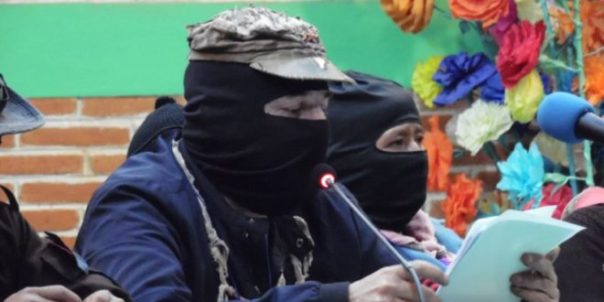
Subcomandante Galeano
By: Luis Hernández Navarro
One after another, five women take the word in their language. They are EZLN comandantas. Amada does it in Chol, Everilda in Tojolabal, Yésica in Tzotzil, Miriam in Tzeltal, and Dalia in Spanish. They send a greeting to the president of the United States: “Vete a la chingada, Trump!” Galeano is in charge of translating into English: “ Fuck you, Trump!”
That’s how the seminar The walls of capital, the cracks on the left began, realized by the EZLN in the portentous installations of Cideci/University of the Earth, in San Cristóbal de las Casas, Chiapas, between last April 11 and April 16. An event that had as its “main objective” giving collective hug to don Pablo González Casanova, of those who “are proud to accompany him, his critical word and, above all, his commitment without tepidness or bending over.”
The seminar was part of the global campaign: Faced with the walls of capital: resistance, rebellion, solidarity and support for below and to the left, convoked by the Chiapan rebels. Its objective consists of “calling for organization and worldwide resistance, facing the aggressiveness of big money and its respective overseers on the planet that already terrorizes millions of people around the world.”
Organized within the context of Donald Trump becoming president of the United States, it calls for “organizing with autonomy, resisting and rebelling against persecutions, detentions and deportations.” It maintains that: “every human being has the right to a free and dignified existence in the place that seems best to them, and has the right to struggle to stay there.”
The U.S. president was remembered throughout the seminar. In very interesting works, Gilberto López y Rivas, Tom Hansen and Sergio Rodríguez analyzed the nature of the Trump project. On April 14, while he read the paper Lessons of geography and globalized calendars, Subcomandante Galeano placed a wooden figure of Mister Trump on the table, which was brought down by a cloth doll that represents the little girl named Defensa Zapatista.
“When Trump talks about reclaiming U.S. borders –read Galeano– it’s the border with Mexico, but the finquero’s gaze aims at Mapuche territory. The struggle of the original peoples cannot not should be circumscribed to Mexico, it must raise the eye, the ear and the word, to include the whole continent, from Alaska to Tierra de Fuego.”
A couple of days before, at the start of the gathering, Subcomandante Moisés explained, in a speech titled The capitalist world is a walled finca, how the entire planet is being converted into a finca and the national governments into overseers that simulate power and independence. “Be cause he that governs –he pointed out– is no longer the one that commands. The one that commands is the capitalist owner. Those that say they are governments: the one of Peña Nieto, the one in Guatemala, that one in El Salvador and all the rest are overseers. The majordomos: the governors. The municipal presidents are the cattle bosses. Everything is at the service of capitalism.”
Trump’s arrival in power represents a new threat to those who have undertaken am exodus to the neighbor country to the north. Moisés himself, in a speech titled Organized coffee against the wall (https://goo.gl/CCcbG1) expressed his support for those who have emigrated to the United States, due to the poverty and violence in their place of origin, where they exploit, repress and dispossess them, like on a finca of one hundred years ago. “The migrants –he pointed out– didn’t leave because they wanted to, but rather because they could no longer stay on their finca, better known as a country.”
Faced with this emergency, the Zapatistas decided to be in solidarity with immigrants on the other said of the border. They will do it by donating 3, 791 kilos of roasted coffee (5 thousand kilos in parchment) to their struggles “They are just like us,” asserts Moisés. One must support those that supported us. It falls to us to tell them to struggle with resistance and with rebellion, because there’s nothing else left to do.
Café against the wall is a formidable example of how the Chiapas rebels are changing social relations, making them leaders. Coffee was for many a finca crop destined for export that has become a campesino and indigenous product because the day laborers that harvest it in conditions of barbaric exploitation grew it on their own plots of land; also, through the combined action of the agrarian reform and state extension.
Since almost three decades ago, the small producers started to appropriate the productive chain and to export their grain without intermediaries. Better organized, they were able to enter into cooperative relationships with conscious consumers from countries in the north to try to construct a just market.
The Zapatista coffee growers took a leap in these experiences to organize themselves and to function without receiving one single cent of government aid. Working collectively, they defeated the local coyotes and gradually began to acquire the infrastructure to industrialize their grain. For years, transnational collectives close to them, have acquired the coffee paying prices above those of the international market.
Today, the Zapatistas have given “the turn of the tortilla” to that relationship, and of being the beneficiaries of international solidarity, they have been converted, despite the scarce material with which they live, into generous donors. They don’t give them what’s left over. “Those of us below need to help each other, to show that we don’t need those who give conditioned aid,” Moisés pointed out.
On the way, they have formed cooperatives like Yach’il Xojobal Ch’ulchan (New Light of the Sky), with a presence in more than eight municipios of Los Altos, and with offices in San Cristóbal de las Casas. Besides coffee, they commercialize honey, cacao and lemon tea.
They explain the advance of their project as dreams that they are realizing. And, when they are asked how they make it so that the coffee, which is useful for not sleeping, produces so many dreams, they answer: we don’t rest, we are bat men, men of the night.
There they send a greeting you a greeting, Mister Trump…
———————————————————–
Originally Published in Spanish by La Jornada
Tuesday, April 18, 2017
http://www.jornada.unam.mx/2017/04/18/opinion/017a1pol
Re-Published with English interpretation by the Chiapas Support Committee
https://chiapas-support.org/2017/04/19/greetings-mister-trump/
Subcomandante Galeano: What’s coming will be worse

By: Isaín Mandujano
TUXTLA GUTIÉRREZ, Chis. (proceso.com.mx)
Subcomandante Galeano, of the Zapatista National Liberation Army (EZLN), called to close ranks and “all struggle collectively” because what’s coming is not even remotely the coldest point of what we’ve seen so far.
At the end of the seminar of critical reflection The walls of capital, the cracks on the left in the installations of Cideci-Unitierra in San Cristóbal de las Casas, Galeano sent a video message in which he exposed that it’s urgent to all struggle together because “the worst is yet to come and the individualities as very brilliant and capable as they seem will not be able to survive if they are not with others.”
“Zapatismo like libertarian thought does not recognize the Bravo and Suchiate Rivers as limits of its aspiration for freedom,” since its slogan of “everything for everyone, does not recognize borders,” because “the struggle against capital is global,” Galeano said.
He indicated that the struggle of the original peoples cannot nor ought to be circumscribed to Mexico; it must lift up the view, the ear and the word to include the whole continent, from Alaska to Tierra del Fuego.
In his video presentation, Galeano pointed out that it’s urgent to struggle, but “it’s better to do it collectively than individually; I cannot explain the reason to you scientifically and you have every right to accuse me of being esoteric or of something equally horrible. What we have seen on our limited and archaic horizon is that the collective can bring out the best in each individual.
“It’s not that the collective makes you better and individuality makes you worse. No. Each one is who he is: A complex bundle of virtues and faults, whatever one or the other may signify, but in certain situations one or the other will flourish. Try it just once, nothing will happen to them. In any case, if they are as wonderful as they think they are, then they will reinforce their position that the world doesn’t deserve them, but perhaps they will find within themselves abilities and capacities that they didn’t know they had,” Galeano added.
He expanded: “Try it, the whole thing, if you don’t like it you can always return to your Twitter account, to your Facebook wall and from there continue telling the entire world how it should be and what it should do.”
“We have seen how collective work not only has permitted the survival of the original peoples in several terminal storms, also advancing when they are a community and disappearing when each one looks after his or her own individual wellbeing,” he mentioned to sympathizers and adherents to the Sixth Declaration of the Lacandón Jungle.
In reference to the indigenous Zapatistas communities, he continued: “The EZLN did not bring about collective work, nor did Christianity; neither did Christ or Marx have anything to do with the fact that in moments of danger facing external threats, and also for the fiestas, the music and dancing, the community within the territory of the original peoples becomes a single collective.
“I would recommend that you take advantage of what the National Indigenous Congress (CNI, its initials in Spanish) is going to do starting in May of this year. We truly hope that the CNI fulfills its own mandate and doesn’t fall into the search for votes and positions, without lending a brotherly ear to the one below that is alone and in pain, which the call to organization relieves.”
He expressed that “the walking of these compañeras and compañeros is going to make barrios, communities, tribes, nations and original peoples visible. Approach them, the indigenous, abandon if you can the lens of the anthropologist that looks at them like rare and anachronistic insects, set aside the pity and the position of the evangelizing missionary that offers them salvation, help and knowledge. Approach as sister, brother, brothers, because when the time comes when no one knows where to go, those original peoples, those that are despised and humiliated today, will know where to pass and gaze, will know the how and the when. In sum, they will know how to respond to the most urgent and important question in those moments: What next?”
Galeano asserted that when president Donald Trump “talks about recuperating the borders of the United States he says that it’s about Mexico but the finquero’s view aims at Mapuche territory,” and therefore “the struggle of the original peoples cannot nor ought to be circumscribed to Mexico (…)
“When in the voice of Subcomandante Moisés we say that the whole world is being converted into a finca and the national governments into overseers that simulate power and independence when the boss is absent, not only are we pointing out a paradigm with consequences for theory, we are also pointing out a problem that has practical consequences for the struggle, and we’re not referring to the big struggles, those of the political parties and the social movements, but rather all the struggles,” he added.
He maintained that: “among the options our position has been and is clear: There is no good overseer but we understand that someone makes the majority of the time, like consoling therapy, a differentiation between the bad and the worst. Okay. One who makes do with little or nothing conforms, but they must try to understand that the one who risks everything, and for us Zapatistas everything is all of our freedom. We don’t want to choose between a cruel boss and a kindly one, we simply don’t want bosses!”
(Subcomandante Moisés’ talk that we already published is omitted here.)
——————————————————————
Originally Published in Spanish by Proceso.com.mx
Sunday, April 16, 2017
http://www.proceso.com.mx/482460/lo-viene-sera-peor-subcomandante-galeano
Re-Published in part with English interpretation by the Chiapas Support Committee
https://chiapas-support.org/2017/04/17/subcomandante-galeano-whats-coming-will-be-worse/
EZLN: “The capitalist enemy won’t let the people rule”
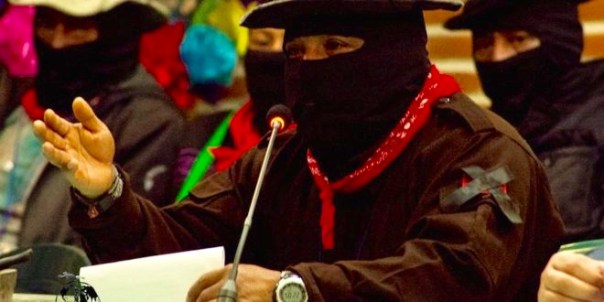
Subcomandante Moisés speaks at the seminar “The Walls of Capital and the cracks on the Left.”
San Cristóbal, Chiapas, April 13, 2017
“Migrants didn’t leave because they wanted to, but rather because they could no longer stay in their finca, better known as a country,” Subcomandante Moisés said this evening, upon reiterating his support to those who have emigrated to the United States, due to the poverty and violence in their place of origin; where they are exploited, repressed and dispossessed just like on a finca 100 years ago. Sup Moisés made these statements on the second day of the seminar “The walls of capital, the cracks on the left,” at Cideci Unitierra, Chiapas.
“One must support those who supported us. Now it falls to us to tell them to fight with resistance and rebellion,” is how Moisés explained the reason they are in solidarity with discriminated and exploited society. They helped us 23 years ago after our Uprising, the Zapatista spokesperson said and reported that they will support migrants in the American union with income from the sale of 3791 kilos of coffee.
The indigenous Zapatista called once again on society to organize because “the capitalist enemy is not going to let the people rule.” “The enemy is not going to negotiate and say, I’m going to half exploit,” the Subcomandante pointed out. “Those below must help each other, to demonstrate that we don’t need those that give conditioned aid,” Moisés added, in reference to the government and the political parties. “One must re-organize, re-educate what we thought was already educated,” he summoned.

For his part, the historian Carlos Aguirre Rojas, with his speech “the Latin American situation, seen from below and to the left,” invited learning what the Zapatistas have taught, which is to look at the world from below and to the left. “We cannot understand XXI Century capitalism without relying on Marx’s theory of value and history,” the academic also added.
How can we look at the above of Latin America, the social researcher began by asking, to which he answered that two elements exist. The first are the States: which can be of the ultra right, like that of Peña Nieto, which are anti-national, surrendered to another, repressive and anti-cultural; or they can be so-called “progressive” States, like in Venezuela, Bolivia or Ecuador, which at first don’t rely on repression, but rather on cooptation, and which despite their discourse are profoundly pro-capitalist, like in the case of López Obrador, he explained.
Another of the questions Aguirre Rojas posed was how the picture of those above is presented, answering with the analogy Subcomandante Moisés made yesterday, in that countries have become like fincas in charge of the international bourgeoisie, which it not interested its domestic market and is anti-nationalist, citing the case of Carlos Slim in Mexico. “The State is part of above, it will always be the enemy,” the historian said, therefore he recommended putting in place a government like that of the Zapatistas that rules by obeying.
The sociologist Arturo Anguiano was also at this evening’s session. He emphasized the vindictive character of the struggle of the peoples against the neoliberal policies of the governments. There are governments that cannot be defined as progressive or left, because they permit mining extractivism and agro-businesses, which set aside the parameters of sustainability and destroy the environment, the social researcher pointed out.
Anguiano asked: What can truly be characterized as left? He indicated that it’s only that which attacks discrimination, dispossession and oppression, in other words finishes with capitalism. “One cannot be more left than the anti-capitalist, someone below, who with the original peoples, campesinos and proletarians fights against power and capital, for true equality, for self-management and for autonomy,” he said.
For tomorrow, Friday, at 4:00 pm, we will have the participation of Paulina Fernández and Magdalena Gómez. Then, at 7:00 pm, Alicia Castellanos, Luis Hernández Navarro and the EZLN’s Sixth Commission will speak, which you can tune in to through the webpage http://enlacezapatista.ezln.org.mx
PHOTOS: Area of Communication Abejas of Acteal and Pozol
AUDIOS: https://radiozapatista.org/
—————————————————————–
Originally Published in Spanish by Pozol Colectivo
Friday, April 14, 2017
Re-Published with English interpretation by the Chiapas Support Committee
https://chiapas-support.org/2017/04/15/ezln-the-capitalist-enemy-wont-let-the-people-rule/
EZLN: “Peña, an overseer at the service of capitalism”

Photo of the EZLN’s Sixth Commission taken in Cideci. Pablo González Casanova is second from left.
The Zapatista National Liberation Army (EZLN) opened its participation in the seminar “The walls of capital and the cracks on the left” in Chiapas, with a “Fuck Trump” in the native languages of the women commanders on the Sixth Commission. “We Zapatistas are like an hourglass,” Subcomandante Galeano shared, since they see the time that has passed to try to understand what’s coming, the Chiapan insurgent added, who also remembered poets like Juan Bañuelos and Pablo Neruda.
How is it that we are now confronting those that exploit us, asked Subcomandante Moisés, who gave a detailed explanation of what the grandparents have told him about how they were exploited and how they organized to liberate themselves. “We were punished until being faint and dizzy,” but as a group they decided to leave the plantations (haciendas), Moisés remembered.
“Capitalism wants to convert the world into fincas. Peña is no longer the one that governs, he is an overseer at the service of capitalism,” Sup Moisés emphasized, and he added that the legislators didn’t approve the federal administration’s so-called structural reforms, but rather “their boss – capitalism.” To the latter, the Mexican, Guatemalan, Costa Rican and Haitian fincas exist to this very day, the insurgent Chiapan exemplified, at the same time that he questioned the indigenous and non indigenous: why do capitalists change how they exploit and we don’t change the way we fight?
In his second talk of the evening Sub Galeano mentioned that the deceased Sub Marcos remembered that former Cuban president, Fidel Castro, when he reproached former President Kennedy in a speech for telling another country what regime to have, which seemed absurd to him. It showed that he had no concept of respect for the sovereignty of peoples. Galeano also said that the same thing is happening now with Donald Trump.
Fidel Castro was the Maradona of international politics, said Sub Galeano, because he will never forgive the goals that the powers scored. “If they couldn’t kill him when he was alive, much less can they now that he’s dead,” the Zapatista spokesperson added. In this first work group the former rector of the UNAM, Don Pablo González Casanova, who will give his presentation on Saturday, April 15, accompanied the Chiapas rebels.
Tomorrow, April 13, starting at 4 pm the seminar will hear from Gilberto López y Rivas, Tom Hansen and Sergio Rodríguez Lascano. Later, at 7 pm, Arturo Anguiano, Carlos Aguirre Rojas and the Sixth Commission of the EZLN will share their word.
You can tune in to live transmissions (in Spanish) through:
http://enlacezapatista.ezln.org.mx/
AUDIOS: http://radiozapatista.org/
http://komanilel.org/2017/04/13/dia-1-los-muros-del-capital-las-grietas-de-la-izquierda/
PHOTO-REPORTING: http://espoirchiapas.blogspot.mx/2017/04/seminario-de-reflexion-critica-los.html
—————————————————————–
Originally Published in Spanish by Pozol Colectivo
Wednesday, April 12, 2017
Re-Published with English interpretation by the Chiapas Support Committee
https://chiapas-support.org/2017/04/13/ezln-pena-an-overseer-at-the-service-of-capitalism/
The Walls of Capital, the Cracks on the Left starts today
The WALLS OF CAPITAL, THE CRACKS ON THE LEFT,” a seminar of critical reflection, starts today
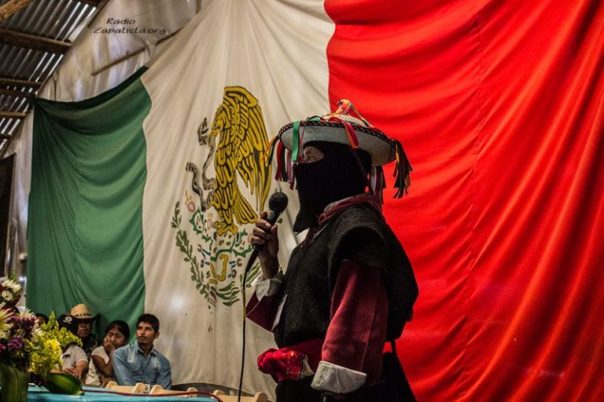
Registration began for “The WALLS OF CAPITAL, THE CRACKS OR THE LEFT,” a seminar of critical reflection started on Tuesday, April 11, 2017 at 10:00 am in the installations of CIDECI-Unitierra in San Cristóbal de las Casas. The gathering takes place within the context of the global campaign: “Faced with the Walls of Capital: resistance, rebellion, solidarity and support from below and to the left,” convoked by the Chiapan rebels, who rose up in arms on January 1, 1994.
The international campaign Facing the Walls of Capital, has the objective of “calling for organization and worldwide resistance, faced with the aggressiveness of big money and its respective overseers on the planet that now terrorize millions of people all over the world,” the indigenous Zapatistas communicated last February 14 on their official web page. “We call to organize with autonomy, to resist and rebel against the persecutions, detentions and deportations. If anyone must go, let it be them, those above,” the Chiapas rebels argued with respect to the mass deportation of migrants on a global scale. “Every human being has the right to a free and dignified existence in the place that seems best to him, and has the right to struggle to stay there,” they added.
“One must organize. One must resist. One must say “NO” to the persecutions, expulsions, prisons, walls and borders. And one must say “NO” to the bad national governments that have been and are accomplices of that policy of terror, destruction and death. Solutions don’t come from above because that’s where the problems are born,” the Zapatistas exposed, in a climate of constant demonstrations of non-conformity that have taken place in Mexico, with the administration of Peña Nieto and Donald Trump, in the American Union.
The speakers at the seminar of critical reflection held at CIDECI-UniTierra, from April 12 to April 15, 2017, will be: Don Pablo González Casanova; Carlos Aguirre Rojas; María de Jesús Patricio Martínez (CNI); Arturo Anguiano; Paulina Fernández C; Sergio Rodríguez Lascano; Alicia Castellanos; Christian Chávez (CNI); Magdalena Gómez; Carlos González (CNI); Gilberto López y Rivas; Luis Hernández Navarro and the EZLN’s Sixth Commission.
——————————————————
Published in Spanish by POZOL COLECTIVO
Monday, April 10, 2017
Re-Published with English interpretation and Updated by the Chiapas Support Committee
Tohono O’odham tribe files petition with IACHR against the wall
THE TOHONO O’ODHAM TRIBE GOES to the IACHR TO NOT BE DIVIDED BY THE BORDER WALL

View of metal wall along the border in Sonoyta, Sonora, between the Altar Desert in Mexico and Arizona, in the United States. Photo Afp
By: Roberto Garduño
The Tohono O’odham [1] (people of the desert), who live in territories of Sonora and Arizona, filed a petition with the Inter-American Commission on Human Rights (IACHR) for the purpose of impeding the wall from being built between the United States and Mexico, because “when completed, the construction of a wall on the border dividing both countries would affect the human rights to life, the protection of honor and dignity, family, private property and political rights.”
The petition was presented yesterday in the region of that people, signed by representatives Alicia Chuhuahua and Gemma Guadalupe Martínez Pino.
Among the arguments given to the IACHR, they warn that: “in recent decades the indigenous peoples have started to organize, since they have realized that they have to do something to safeguard and legally protect these lands.
“What is legally named indigenous customary law is not a structured body, much less codified; it’s a series of real practices that are carried out in different ways in different communities, in order to solve a series of problems in the administration of justice, conflict resolution, maintenance of internal order, normativity and their connection with the outside world.”
The Tohono ethnicity argues that the United States has shown evidence that by constructing a wall: “it will divide our indigenous territory; our right to life is not guaranteed, because of which there is a violation of Article 4 of the American Convention (on Human Rights), in connection with the general obligation to respect and guaranty the rights established in Article 1” of that document.
Thus, with the advice from the head of the Commission for Dialogue with the Indigenous Peoples of Mexico, Jaime Martínez Veloz, in the petition to the IACHR it warns of the need to respect the right to dignity, which is manifested in the inviolability of the human condition:
“No State activity can be founded on contempt for human dignity. This implies that the right to dignity is the most important value to respect, nor matter how despicable the crime may be that a person commits, their behavior or their attitudes.
“Therefore, with the construction of a wall that will divide our indigenous people, the dignity of all the members of our tribe would be injured, since it would break apart social relationships among each one of the members of the indigenous people that live in Sonora and Arizona.”
[1] According to the CNI Convocation, the Tohono O’odham tribe is sending one or more representatives to the Constituent Assembly of the Indigenous Government Council, which takes place in Chiapas on May 26, 27 and 28, 2017.
———————————————————–
Originally Published in Spanish by La Jornada
Sunday, April 9, 2017
http://www.jornada.unam.mx/2017/04/09/politica/013n1pol
Re-Published with English interpretation by the Chiapas Support Committee
Joint CNI-EZLN Comunicado denouncing repression in Arantepacua, Michoacán
JOINT COMUNICADO of the CNI and the EZLN DENOUNCING REPRESSION AGAINST the PURÉPECHA COMMUNITY of ARANTEPACUA, MICHOACÁN

To the Purépecha Community of Arantepacua, Michoacán:
To the alternative communications media:
To the peoples of the world:
The National Indigenous Congress, the peoples, nations and tribes that make it up, show our indignation over the bad government’s cowardly attack against the Purépecha community of Arantepacua, Michoacán, on the days of April 4 and 5, 2017.
While a commission of comuneros sought to hold a dialogue with the bad Michoacán state government, Governor Silvano Aureoles Conejo betrayed them. First they obstructed their passage with hundreds of riot police and dozens of buses when they were heading to Morelia to try to reach agreements would resolve an old agrarian conflict. Later, while the commission was negotiating with the government, large contingents of Michoacán Police and State Ministerial Police attacked the community jointly with federal forces, sowing terror, entering homes to arrest the comuneros and opening fire indiscriminately, taking the lives of three Arantepacua comuneros: José Carlos Jiménez Crisótomo (age 25), Luis Gustavo Hernández Cuenete (age 15) and Francisco Jiménez Alejandra (approximately 70).
There were also an unspecified number of injured, two of whom are in grave condition, while the Michoacán government arrested 38 comuneros on April 4 and 18 more on April 5, accusing them of crimes fabricated in order to criminalize the demand for their rights.
Brothers and sisters of Arantepacua, your pain because of the murder of the compañeros is our pain. We struggle because we are certain that punishment of the guilty will emerge from the dignity, resistance and rebellion of our peoples. Sowing truth and justice in the destruction that the powerful bring us is what the peoples know how to do.
The bad governments think that sprinkling terror in the indigenous territories of Michoacán, and in a large part of the national geography, is how they are going to silence the peoples and their word, but that won’t happen because the word that the original peoples shout collectively today is justly born from indignation, from being fed up and from the decision that we won’t kill, plunder, divide or buy off.
We pronounce together with the communal assembly of Arantepacua for:
- That the repressive escalation against Arantepacua and the region’s Purépecha communities cease immediately.
- The immediate release of the compañeros detained by the bad government.
- Justice for the victims of the cowardly aggression and reparation of all damages caused.
- Punishment of Governor Silvano Aureoles and all those responsible, materially and intellectually, for the crimes committed.
- That police and military forces be withdrawn from Arantepacua, because the harassment of comuneros will not stop while they are present.
Attentively,
April 6, 2017
Justice for Arantepacua
Justice for the Purépecha People
For the Full Reconstitution of Our Peoples
Never more A Mexico Without Us
National Indigenous Congress
Zapatista National Liberation Army
Convocation of the Constituent Assembly of the Indigenous Government Council for Mexico
NATIONAL INDIGENOUS CONGRESS
CONVOCATION

Considering that the V National Indigenous Congress (CNI, its initials in Spanish), in its second stage carried out on December 29, 30, 31, 2016 and on January 1, 2017, agreed:
FIRST. – “…To name an Indigenous Government Council with men and women representatives from each one of the peoples, tribes and nations that belong to it; and that this council proposes to govern this country. And that it will have as a spokesperson an indigenous woman from the CNI, who has indigenous blood and knows her culture. In other words, it will have as its spokesperson an indigenous woman from the CNI that will be an independent candidate to the presidency of Mexico in the 2018 elections…”
SEGUNDO. – “…[To call] the original peoples of this country, the collectives of the Sixth, men and women workers, fronts and committees in struggle of the countryside and the cities, the student, intellectual, artistic and scientific community, civil society that is not organized, as well as all good-hearted people to close ranks and go on the offensive. We call on you to dismantle the power of above and to reconstitute ourselves now from below and to the left, not only as peoples but as a country, to come together in a single organization where dignity will be our final word and our first action. We call on all of you to organize with us to stop this war, and to not be afraid to sow our seeds and build ourselves upon the ruins left by capitalism…”
THIRD: “…[to convoke] a constituent assembly of the Indigenous Governing Council for Mexico in the month of May 2017 to make the earth tremble at its core, to overcome fear and recuperate what belongs to humanity, what belongs to the earth, and what belongs to the peoples, to recuperate the territories that have been invaded or destroyed, for the disappeared of this country, for the freedom of all political prisoners, for truth and justice for all of those who have been murdered, for the dignity of the countryside and the city…making dignity the epicenter of a new world.”
We have agreed to convoke the authorities, representatives, delegates, and councilpersons named by the indigenous peoples, nations, tribes, barrios, communities, and organizations that participate in the CNI to celebrate the:
CONSTITUTIVE ASSEMBLY OF THE INDIGENOUS GOVERNING COUNCIL FOR MEXICO
To be held May 26, 27, and 28 of 2017 at the facilities of the Indigenous Center for Integral Learning (CIDECI-UNITIERRA) in San Cristóbal de las Casas, Chiapas, Zapatista territory, in accordance with the following schedule:
P R O G R A M
May 26: 1) Arrival and in-person registration of indigenous councilpersons, authorities, representatives, and delegates, as well as of press and guests invited by the Coordinating Commission of the CNI and 2) Traditional Ceremony.
May 27: 1) Inauguration and installation of the Constitutive Assembly of the Indigenous Governing Council for Mexico. 2) Working groups on the following topics: a) Proposals and strategies for the Indigenous Governing Council, b) Functioning and Organization of the Indigenous Governing Council , c) Links between the Indigenous Governing Council and other sectors of civil society, and d) Naming of the Spokeswoman for the Indigenous Governing Council
May 28: 1) Constitutive Plenary of the Indigenous Governing Council for Mexico and swearing-in ceremony of its members., 2) Discussion and approval of agreements, resolutions, and declarations, and 3) Assembly closing ceremony.
The naming of council members to the Indigenous Governing Council should be carried out according to the guidelines indicated in Appendix I of this Convocation and in the regions documented in Appendix II. Any concerns with regard to the proposed regions or necessary revisions should be communicated to the CNI coordinating committee.
Advance registration of indigenous delegates can be made through the CNI email: catedrajuanchavez@congresonacionalindigena.org. Those who are explicitly invited by the CNI coordination or the EZLN may participate as INVITED OBSERVERS. Members of the national and international Sixth who would like to attend as observers can register beforehand at the email: cni20aniversario@ezln.org.mx
Sincerely,
March 2017
For the full reconstitution of Our Peoples
Never More a Mexico without Us
National Indigenous Congress
Zapatista National Liberation Army
APPENDIX I
_________________________________________________________________
BASIS FOR APPOINTING THE COUNCIL MEMBERS TO THE INDIGENOUS GOVERNING COUNCIL FOR MEXICO IN ACCORDANCE WITH THE AGREEMENTS ADOPTED BY THE FIFTH NATIONAL INDIGENOUS CONGRESS IN ITS FULL ASSEMBLY ON JANUARY 1, 2017.
- The Indigenous Governing Council (CIG, its initials in Spanish) will be made up of two council members, preferably one man and one woman, from each of the participating indigenous regions in the National Indigenous Congress (CNI, its initials in Spanish) as indicated in the following appendix, with the exception of those peoples residing in the metropolitan zones of Mexico City and Guadalajara, who will name one council member from each people.
- The council members will be named through the assembly consensus of their people or in agreement with the traditions and customs of each people, and should be documented in writing.
- Those who are proposed as council members should obey the mandate of the people that named them and that of the CNI assembly, and work collectively under the seven principles of the CNI.
- Those who are proposed as council members should meet the following requirements: Have permanent membership in the CNI ; Practice the seven principles of the CNI; Belong to an original people ; Know the history and culture of their people and hold recognition and moral authority in their community; Be nominated, named, and confirmed in Assembly or in the decision-making body of their people according to its traditions and customs.; Have accompanied their people in struggle and have a congruent trajectory of struggle; they should be people who know how to work the land, who are humble, who listen to and serve their people, who know the path of the CNI and are anticapitalist, from below and to the left.
- The council members’ position will rotate over the time period decided by each people and is immediately revocable by the assembly or the body by which it was named.
- Council members should preferably be named before the CNI assembly programmed for May 27 and 28 in San Cristóbal de las Casas. That assembly will agree upon the organization and functioning of the council members and the CIG.
FOR THE FULL RECONSTITUTION OF OUR PEOPLES
NEVER MORE A MEXICO WITHOUT US
THE PROVISIONAL COORDINATION
APPENDIX II
_________________________________________________________________
LIST OF REGIONS FOR THE INDIGENOUS GOVERNMENT COUNCIL
| Region No.
|
People – Language |
| Baja California | |
| 1 | Cucapá |
| 2 | Kumiai |
| Campeche | |
| 3 | Castellano de Candelaria |
| 4 | Chol de Campeche |
| 5 | Maya de Campeche |
| 6 | Tzeltal de Campeche |
| Chiapas | |
| 7 | Castellano de la Costa de Chiapas |
| 8 | Chol |
| 9 | Mam de Chiapas |
| 10 | Tojolabal |
| 11 | Tzeltal de la Selva Norte |
| 12 | Tzeltal de los Altos de Chiapas |
| 13 | Tzeltal Zona Fronteriza |
| 14 | Tzotzil de los Altos de Chiapas |
| 15 | Tzotzil de la Costa de Chiapas |
| 16 | Tzotzil de la Región Centro de Chiapas |
| 17 | Lacandón |
| 18 | Zoque del Norte de Chiapas |
| Chihuahua | |
| 19 | Rarámuri |
| Ciudad de México | |
| 20 | Nahua del sur del Distrito Federal |
| Colima | |
| 21 | Nahua de Colima |
| Durango | |
| 22 | Wixárika de Durango |
| Guanajuato | |
| 23 | Chichimeca |
| Guerrero | |
| 24 | Afromexicano |
| 25 | Mephaa de la Montaña de Guerrero |
| 26 | Nahua Centro de Guerrero |
| 27 | Nahua Montaña de Guerrero |
| 28 | Amuzgo de Xochistlahuaca |
| 29 | Ñu Savi de la Costa de Guerrero |
| 30 | Ñu Savi de la Montaña de Guerrero |
| Hidalgo | |
| 31 | Nahua de Hidalgo |
| Jalisco | |
| 32 | Coca |
| 33 | Nahua del Sur de Jalisco |
| 34 | Tepehuano de Jalisco |
| 35 | Wixárika de Jalisco |
| Estado de México | |
| 36 | Matlatzinca |
| 37 | Nahua del Centro del Estado de Mexico |
| 38 | Nahua del Oriente del Estado de Mexico |
| 39 | Otomí- Ñatho |
| 40 | Otomí- Ñañhú |
| Michoacán | |
| 41 | Mazahua |
| 42 | Nahua de La Costa de Michoacán |
| 43 | Otomí de Michoacán |
| 44 | Purépecha |
| Morelos | |
| 45 | Nahua de Morelos |
| Nayarit | |
| 46 | Náyeri |
| 47 | Wixárika de Nayarit |
| Oaxaca | |
| 48 | Chinanteco de la Chinantla Alta |
| 49 | Chinanteco de la Chinantla Baja |
| 50 | Cuicateco |
| 51 | Ikoots |
| 52 | Mazateco |
| 53 | Mixe |
| 54 | Ñu Savi de la Costa Chica Oaxaqueña |
| 55 | Ñu Savi de la Mixteca Alta Oaxaqueña |
| 56 | Ñu Savi de la Mixteca Baja Oaxaqueña |
| 57 | Ñu Savi de la Mixteca Media Oaxaqueña |
| 58 | Triqui Alta |
| 59 | Binnizá de la Sierra Norte |
| 60 | Binnizá de la Sierra Sur |
| 61 | Binnizá del Istmo |
| 62 | Binnizá de Valles Centrales |
| 63 | Chontal de Oaxaca |
| 64 | Zoque de Chimalapas |
| Puebla | |
| 65 | Nahua de la Mixteca Poblana |
| 66 | Nahua de la Sierra Norte de Puebla |
| 67 | Nahua de los Volcanes Puebla |
| 68 | Totonaco de La Sierra Norte de Puebla |
| Querétaro | |
| 69 | Otomí- Ñañhú de Amealco y Tolimán |
| Quintana Roo | |
| 70 | Maya de Quintana Roo |
| San Luis Potosí | |
| 71 | Castellano de Wirikuta |
| 72 | Nahua de la Huasteca potosina |
| Sinaloa | |
| 73 | Mayo de Sinalóa |
| Sonora | |
| 74 | Guarijío |
| 75 | Mayo de Sonora |
| 76 | Seri |
| 77 | Tohono Odham |
| 78 | Yaqui |
| Tabasco | |
| 79 | Chol |
| 80 | Chontal de Tabasco |
| 81 | Zoque de Tabasco |
| Veracruz | |
| 82 | Nahua de la Huasteca |
| 83 | Nahua del sur de Veracruz |
| 84 | Nahua de Zongolica |
| 85 | Otomí- Ñuhú |
| 86 | Popoluca |
| 87 | Sayulteco |
| 88 | Tepehua del Norte de Veracruz |
| 89 | Totonaco de la Costa de Veracruz |
| 90 | Totonaco de la Sierra del Totonacapan |
| Yucatán | |
| 91 | Maya de Yucatán |
| Pueblos migrantes | |
| 92 | Pueblos residentes en el Valle de México |
| 93 | Pueblos residentes en Guadalajara |
 Chiapas Support Committee