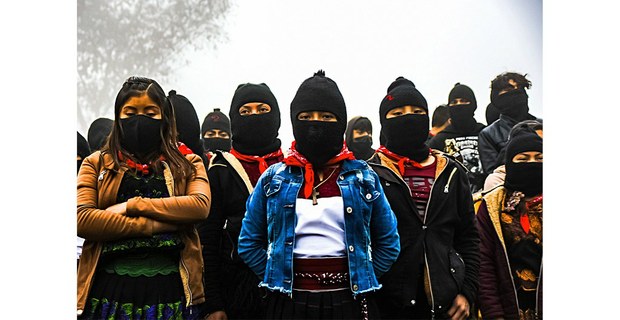
The horizon of the common and non-property is already in sight.
By Juan Trujillo Limones | Ojarasca in La Jornada
Oventic, Chiapas, January 1, 2026. “We are confirming that we will continue this struggle, but with the common good in mind, where we don’t want private property, because that is what has caused us to be divided,” declared the spokesperson for the Zapatista Army of National Liberation (EZLN), Subcomandante Insurgente Moisés, in the early hours of the morning and before the popular dance held to commemorate the 32nd anniversary of the 1994 indigenous uprising.
The fog thickened and the temperature dropped; the boots of a hundred militiamen and women in green caps descended the mountain like columns of serpents towards the basketball court. The rhythmic thud of their batons echoed through the mountains that shelter this community. This is the profound mystique of this rebellious space of the Tsotsil Maya people, where their persistent determination to preserve their struggle, culture, memory, and language resides.
The Sixth Commission of the EZLN had just come from the meeting “Seedbed of Pyramids, of Stories, of Loves and, of course, Heartbreaks,” held between December 26 and 30 of the previous year at the CIDECI in San Cristóbal de Las Casas. Here, in the thick fog, Subcomandante Moisés prepares to communicate with his army and support bases: “In 1994, the bad governments, the wicked, and the rich of the capitalist system closed the doors, the windows, and every crack to us. We had to resort to violence.”
Historical memory is invoked, also to address the injustice and impunity surrounding the femicides in Ciudad Juárez, and to touch upon the wound of the 43 disappeared students of Ayotzinapa. However, the special emphasis is placed on the new Zapatista strategy of struggle, undoubtedly centered on the concept of community, the common. And now, not only with its focus on komon a´tel b’a kalajtik (our common work in our milpa) for life, but also to reinforce the common use of the land in an attempt to detach the sense of private property from the collective consciousness of the Zapatista indigenous people. It is about the eradication of individualism as a political practice and a horizon of struggle.
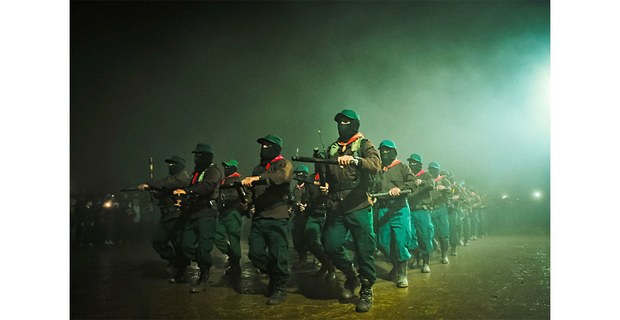
Before militiamen, support bases, and members of civil society and activists, Subcomandante Moisés reinforced his criticism of President Claudia Sheinbaum’s government: “It is not true what those who are foremen of these bad governments are doing, whose bosses who are the bankers and transnational businessmen. They are the ones who govern; everyone else is a foreman, a steward, a supervisor who obeys. So it’s not true that there is a fourth transformation here in Mexico. There is a fourth transformation of how they are going to improve how we are going to be dominated, trampled on, plundered, exploited, so that slavery returns—that is the fourth transformation.”
The strong criticism of the Mexican government stems from the welfare programs that have been distributing money to various social sectors of the population since 2019. These programs, such as Sembrando Vida, have even led to the division of communal and ejido land, although not the land recovered by the rebels in 1994, which represents an intervention that destabilizes families and communities.
The Zapatista perspective views the distribution of government resources as handouts and leftovers. Thus, Moisés stated that it is a “double-edged sword,” because on the one hand they give cash, and on the other hand they use it to maintain themselves in power in a State that reproduces the logic of capital accumulation and the dispossession of land from farm workers and Indigenous people. “(The government) that gives directly to the people, that is, (they) confirm that the municipal and state governments were stealing (the money) and that they want to stay in power,” Moisés explained.
While male and female militia members and international visitors listened attentively to the spokesperson of a movement that perhaps holds the most radical position within the indigenous movement in Mexico, he attempted to articulate the strategy “with the horizon of the commons, where we don’t want private property, because that’s what has made us the way we are, divided. The capitalist system has injected us with individualism.” This is nothing more than the expansion of capital through the neoliberal model, whose economic policies remained intact under the last two “progressive” governments.
The Zapatista strategy, which even proposes transcending the concept of private property to generate a new framework for peaceful coexistence among those who are not Zapatistas, aims to transform this paradigm, which is enshrined in the legal framework of the Mexican liberal state.
Dawn arrived with fireworks that exploded and illuminated the sky and mountains in this Tsotsil community, but not before inviting the Zapatista communities and their support bases to a series of music, art, and political gatherings that will be held throughout 2026. Amidst the capitalist lightning and storms that batter indigenous peoples and warn of a collapse, the Zapatista concepts of the commons and non-ownership are unfolding as the horizons to be reached in the next 10, 30, 50, and even 120 years.
_______________________________
Puedes leer la versión original publicada por La Jornada en su suplemento Ojarasca aquí.
You can read the original in Spanish, published by La Jornada in their supplement, Ojarasca here.
Translated by the Chiapas Support Committee.
_____________________
VIII. The Common against Mortal Boxes and Pyramids. An assembly of chiefs.
*
Himno Zapatista | Zapatista anthem (Listen to the Himno zapatista here.)
The horizon is already in sight
Zapatista fighter
The path will be marked
For those who follow behind
Let’s go, let’s go, let’s go, let’s move forward
So that we may prevail in the struggle
Because our homeland cries out and needs
All the effort of the Zapatistas
Men, women, and children
We will always make the effort
Peasants, workers
All together with the people . . .
Ya se mira el horizonte
Combatiente zapatista
El camino marcará
A los que vienen atrás
Vamos, vamos, vamos, vamos adelante
Para que salgamos en la lucha avante
Porque nuestra Patria grita y necesita
De todo el esfuerzo de los zapatistas
Hombres, niños y mujeres
El esfuerzo siempre haremos
Campesinos, los obreros
Todos juntos con el pueblo . . .
 Chiapas Support Committee