
Today our sorrow turns to seek a place in your hearts. Our thoughts ask little, only that you no longer hold back your desire to find that lost dignity. We only ask that a small piece of your heart be Zapatista. That it will never sell out. That it never surrender. That it resist. That you continue in your places and with your means, to struggle forever so that dignity and not poverty be the harvest in all corners of our nation.
–from an EZLN communique, 1994.
MaryAnn Tenuto Sánchez gave a big piece of her heart to the Zapatista cause. The last time she returned from leading a delegation to meet with Zapatista communities in Chiapas she shared a conversation she had with members of a Zapatista council of good government who asked her: How long do you plan on working with the Zapatista communities? She replied: Until I die.
And today our sorrow turns to that place in Zapatista hearts to mourn the loss and celebrate the life of MaryAnn Tenuto-Sánchez.
Founding member of the Chiapas Support Committee, MaryAnn Tenuto Sánchez passed away on October 1, 2023, after an intense battle with cancer in Oakland, California. She was accompanied by her family and closest friends. MaryAnn would have turned 87 years old this November.
Members of the Chiapas Committee express their most heartfelt condolences to her family and friends and send her courageous heart and activism to the Zapatista communities to hold with us.
MaryAnn’s passing is a deep loss to her family, our community and the Zapatista solidarity work in the U.S. Through her work in the Chiapas Support Committee, MaryAnn created and supported pathways and relationships between Zapatista communities across borders. She worked fervently to expose and stop the violence and wars that were waged against the Zapatistas since 1994. And she worked even more fervently to organize and express solidarity with the Zapatistas.
MaryAnn was the leading and founding member of the Chiapas Support Committee (CSC) in Oakland, California, and had been active in the Zapatista solidarity movement since the mid-1990s. She became active first in the Comité Emiliano Zapata during 1995-1998. The Comité Emilano Zapata (CEZ) was a founding member of the Zapatista’s National Commission for Democracy in Mexico (NCDM, a U.S.-based Zapatista grassroots support network that was started after the 1994 uprising).
MaryAnn participated in the work of the CEZ and in NCDM national gatherings. She attended the EZLN’s Intercontinental Encounter for Humanity & Against Neoliberalism, dubbed the Intergaláctica, in the Lacandón rainforest in July 1996 as part of an NCDM delegation. Then, she went on to found the Chiapas Support Committee in 1998 and forged, first, a sister-to-sister relationship with the San Manuel community in Zapatista territory. Then, with the CSC, she worked to organize, inform, educate and bring people together in solidarity with the Zapatistas. She helped raise funds to support the autonomous projects of Zapatista communities.
MaryAnn, with a collective of CSC members, also organized and led various delegations during 1998-2018 to Chiapas to meet with and learn from the Zapatista communities’ struggles for autonomy and land justice. With the CSC, she also facilitated exchanges and meetings in Oakland with Mexico-based Indigenous leaders and activists from the Congreso Indígena Nacional (CNI) and other solidarity and Zapatista support organizations in the Bay Area and U.S.
Over the last few years, she focused on closely following developments and events in Chiapas and Mexico. MaryAnn became quite knowledgeable and an authority on the dynamics of the Zapatista movement and the situation and developments impacting Chiapas and Mexico. She was a speaker on the Zapatistas, presenting analyses and information to a diversity of social justice movement meetings, conferences and organizations.
MaryAnn wrote continuously on Chiapas and Mexico. She published timely translations of reports, writings and analyses from key activists, writers, organizations and leaders in the Zapatista movement and community struggles on Compa Manuel, the CSC blog. MaryAnn scoured online reports, newspapers, interviews, videos and journals to read and study the Zapatistas’ organizing and analyses, their autonomous projects and the different movement-building initiatives and struggles that uplifted Indigenous power and voices.
MaryAnn wrote her own sharp analyses of the crucial struggles being waged by Zapatista and Indigenous communities. Even as she battled cancer, she continued translating articles and reports on developments in Chiapas right up to a couple of weeks before she became too ill to do so.
MaryAnn Tenuto-Sánchez, presente.
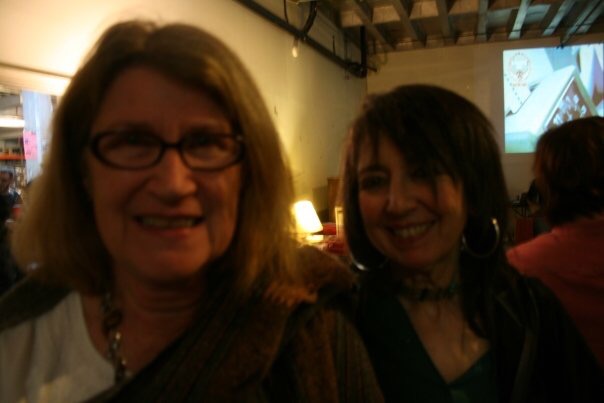
MaryAnn Tenuto-Sánchez was born on November 21, 1936 in Indianapolis, Indiana, and was adopted as a newborn by Catherine and Andrew Goes. Her parents raised her in a rural community and instilled in her lifelong values that shaped her lifetime commitment to working for justice in working class communities.
She spent her childhood in South Bend, Indiana and moved to Michigan with her parents. There, MaryAnn attended University of Michigan where she graduated with a bachelor’s degree in social work in 1958. She moved to Chicago where she married in 1959 and was a social worker for Catholic Charities. She gave birth to four sons: Frank, John, Michael and Robert.
Then, she returned with her family to Indianapolis where lived until 1968 before returning to Chicago once again.
In Indiana, she worked as a volunteer in Robert F. Kennedy’s 1968 presidential campaign, which spurred her activism. MaryAnn was inspired by the civil rights and anti-war movements of the late 1960’s and early 1970’s to become an active participant. MaryAnn divorced in 1971 and moved with her four sons to Oakland, CA later that year, with the express purpose of being close to one of the national organizing centers of the U.S. anti-war movement.
In California, MaryAnn continued being a social worker, providing services in Contra Costa county, and became involved in her union’s collective bargaining negotiations. Moved by her experience and also by different struggles facing her family and community, she decided to go to law school and become a lawyer. She received her law degree from Golden Gate University in San Francisco in 1979.
MaryAnn worked, first, as chief legal counsel for the Stanford University employees union for ten years. Then, she worked as an attorney for the National Treasury Employees Union (NTEU) for the next few years representing IRS workers until she retired in 1998.
After retiring, MaryAnn dedicated her life full time to the indigenous Zapatista movement in Chiapas until her death.
MaryAnn is survived by her husband, José Sánchez; her four sons, Frank, John, Michael and Robert; and five grandchildren and six great-grandchildren. (See her son’s testimony for more details.)
The Chiapas Support Committee will carry forward the work and dedication that MaryAnn Tenuto Sánchez showed. And, emulating her example, we will continue strengthening relationships between our communities here with Zapatista communities in Mexico.
MaryAnn Tenuto Sánchez, presente.
Tributes for MaryAnn Tenuto-Sánchez from her son and members of the Chiapas Support Committee
Yes, there are two paths you can go by, but in the long run
There’s still time to change the road you’re on . . .–Stairway to Heaven, Led Zeppelin
Michael Tenuto: I am the son of Mary Ann Tenuto- Sánchez. Below is our mom’s life story, We thought it would be appropriate to share this with the people, as we shared our mother with the people of Chiapas, Mexico.
MaryAnn Tenuto-Sánchez was born November 21, 1936. Adopted by Catherine and Andrew Goes in 1936 in Indiana. Her early childhood was spent in South Bend Indiana, where she attended Catholic grammar and high schools. She moved to Lake Charlevoix, Michigan with her parents and attended Michigan University which she graduated with honors in 1958. MaryAnn moved to Chicago to work as a social worker and married and had four children, all boys.
Mary Ann is survived by her sons Frank Tenuto 64, John Tenuto 62, Michael Tenuto 61, Robert Tenuto 60, and five grandchildren, Steven, Christina, Alyssa, Michael Jr., Daphne, and six great-grandchildren, Mason, Allison, Madison, Liam, Kenah, Halle and her second husband José Sánchez. MaryAnn and José were married in April 2001.
In 1971 MaryAnn moved to Oakland, California with her four boys. MaryAnn worked from 1972 until 1979 as a social worker for Contra Costa County, California. MaryAnn went to Golden Gate Law school in 1981 and was admitted to the California Bar in 1984. MaryAnn worked at Stanford University representing the workers at Stanford University between 1979–1989. MaryAnn retired in 1999, after working as an attorney with the National Treasury Employees Union (NTEU) for 10 years. At NTEU she represented federal workers at the IRS in Fresno, California and Ogden, Utah.
MaryAnn had a passion for helping the underprivileged and disadvantaged people, no matter who or where they were located.
MaryAnn took a special interest in the people of Chiapas Mexico in 1994. She started the Chiapas Support Committee in 1998. MaryAnn traveled to Chiapas many times between 1994-2015. She would raise money with the other members of the Chiapas Support Committee, bring the cash to the people of Chiapas Mexico to fund clinics, supplies for the clinics, a warehouse, trucks, toros.
A dear friend of our mother told us a great story about the toros. Our mom had brought a good deal of cash down to the people of Chiapas and they bought a bunch of toros (bulls). As the people needed cash to build the clinic, they would sell the toros. During the construction of the clinic the toros would mate and make baby toros, call it interest on the original investment. MaryAnn visited Chiapas and wondered where is the clinic and the leader of the community pointed to the toros. Mary Ann worried about what she was going to tell the Chiapas Support Committee. Eventually the clinic was built and the community in Chiapas Mexico had bulls left over, this is a good example of letting the community decide how to allocate their own resources.
Our mom loved the people of Chiapas Mexico, just as much as she loved her children, grandchildren, great grandchildren. She always chose the high road and told everyone she met, “you can always change the road you’re on,” a line from her favorite song Stairway to Heaven.
What an amazing life! You set the bar high. Rest In Peace, Mom.
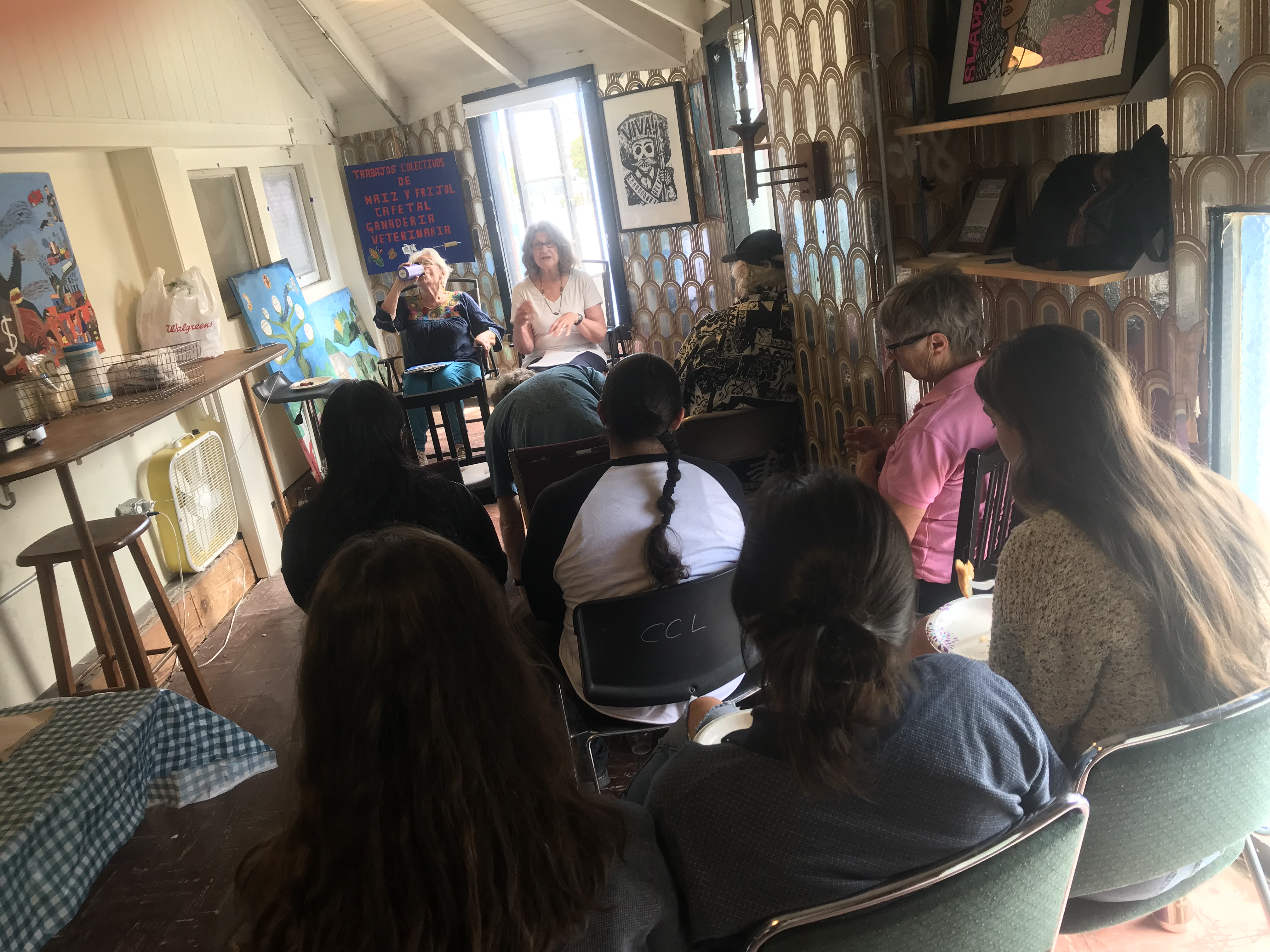
Evette Padilla: I’ll never forget the first time I encountered MaryAnn. It was during Winter of early 2018 maybe. It was for Waffles & Zapatismo on a Saturday morning in the cold basement of Omni Commons in Oakland. José was making waffles in the back and MaryAnn was presenting. MaryAnn’s clear, factual and serious presentation made me immediately know that she was a true real source of comprehensive Zapatismo and I’m positive I was not the only captivated audience member. Her presentation immediately let me know that her group, Chiapas Support Committee, was a Zapatista resource to be reckoned with. The wealth of Zapatista history MaryAnn has not only provided to my brain and spirit, but also to a vast amount of others in the Zapatista supportive community is real and of great note. She has so generously shared her wealth of knowledge with so many of us and I believe this to be a part of her legacy and I am so blessed to have been in her company. Blessings on the journey with the Ancestors, MaryAnn.
Roberto Martínez: It has a been a true inspiration to witness MaryAnn’s life-long dedication to the cause, to the struggle, to the compas Zapatistas. As a member of the Chiapas Support Committee, I had the opportunity to work alongside MaryAnn and learn so much about the hard work, rigor and corazón that underlies the powerful movement that MaryAnn helped put into motion. It is not a simple task to work within the capitalist hydra and its extractive structures and build a support network for the Zapatista struggle for autonomy. MaryAnn was a bridge between Chiapas and Oakland – both, places where la digna rabia lives and moves us to fight for a better world, both places similar but different in our struggles and approaches, but both places that MaryAnn called home.
MaryAnn led by example and showed us what strength and dedication looked like. For over 30 years she helped build the Chiapas Support Committee and now as she holds us in an ancestral embrace, we will continue to do the work of organizing locally, supporting the Zapatista projects for autonomy, and strengthening the bridge between las comunidades Zapatistas and us here in Oakland.
Mil gracias MaryAnn. Your legacy continues.
Elizama Rodas: I remember MaryAnn as a woman of stories. Through those stories she sought compassion and the pursuit of social justice, putting in countless hours and determination to let the world know of the suffering and constant attack against the people of Chiapas. Her memory and words will always live on. MAryAnn was a warrior till her death.
Rest in peace, MaryAnn
Todd Davies: I knew MaryAnn for about 21 years, from the time just before my first visit to Chiapas as a peace camper in December-January 2002-03 until her recent death. As an event attendee, then member of Chiapas Support Committee delegations to Zapatista territories, and as a member of the CSC Board for 9 years, I came to know MaryAnn like many did — as a fierce advocate and worker for the cause of Zapatista autonomy, and for solidarity from below across the US and Mexico. On a personal level, she was an extraordinarily kind friend and mentor to me as I learned from her years of experience as an activist. We traveled together, participated in countless meetings and events, and hung out with fellow activists for over a decade. And although she could not travel there herself in 2013, MaryAnn secured invitations for me and others to attend the life-changing Zapatista Escuelita that summer. I will never forget these experiences.
I think the greatest lesson MaryAnn taught me for my own life was the example of her retirement. When I met her, she was 65 and had been organizing with the Chiapas Support Committee for almost 5 years. She told me that she had retired early in order to devote herself to her greatest political passion. Starting with her prior involvement with the Comité Emiliano Zapata in the mid-90s, and continuing with the founding of the CSC in 1998, MaryAnn helped build a community and movement around Zapatista solidarity that has now outlived her. Through 25 years, the CSC has been a go-to organization for advocacy, material support, education, information sharing, and personal connections between Northern California and the Zapatistas, and as part of a network of solidarity activists from around the world. MaryAnn’s dedication to the work of the CSC — right up until her death — inspires me every day, as I near my own retirement. I hope I can use my own golden years in a similar way.
Although MaryAnn loved her family and her husband dearly and spoke of them often, she was also devoted to people and struggles far from where she lived. I came to understand her later-life work as a beautiful blend of unabashed love for a people and their land, and a belief that the Mayan struggle for freedom is our struggle too. MaryAnn knew and could convey the meaning of Zapatismo for our own lives in el area de la Bahía, and I endeavor to carry its principles with me in everything I do.
Thank you forever, MaryAnn. ¡La lucha sigue!
Arnoldo García: I remember the first time I spoke with MaryAnn on the phone. I was returning her call. This was in late 1995 or early 1996. And ever since then we were in public and house meetings, picket lines and marches, forums, the Zapatista intergalactic gathering in Chiapas in the summer of 1996–where she got the flu and I helped her get into the back of small truck that was packed with other activists from around the world heading back to San Cristóbal for the same reason.
MaryAnn’s dedication and sheer will to get things done was always impressive. Very few could keep up with her and there was no need because she knew the work that had to be done. MaryAnn did voluminous amounts of translations of timely analyses and news coming out of Chiapas and Mexico, literally keeping thousands of people fully informed with meticulous details. No one will be able to fill your shoes.
And MaryAnn did it. Last year she shared one of the last conversations she had had with Zapatista compas in San Manuel. When they asked her: How long will you do this work of solidarity and accompanying the Zapatista communities? MaryAnn replied: Till I die. Even in these last months MaryAnn never let up and kept the translations and her own analysis coming. I deeply appreciate her dedication and commitment to the Zapatista cause and their communities.
I believe MaryAnn will always accompany us in this life-long struggle and movements for life and liberation. Thank you, MAryAnn, for being you and for always pushing hard to make real in what you believed in
Sending you and all your loved ones, abrazos sin fronteras.

The Chiapas Support Committee would like to thank José Sánchez, MaryAnn’s husband, who contributed the details to MaryAnn’s story. And to her sons, grand-children and great-grandchildren for sharing their her life with the CSC and the Zapatista cause and communities.
The Tenuto Sánchez family made great sacrifices and showed deep love to MaryAnn, supporting her to share her and their heart with the Zapatistas.
______________
César Vallejo
At the end of the battle,
and when the combatant was dead, a man came towards her
and said: “Don’t die, I love you so much!”
But the corpse, oh! kept dying.
Two approached her and repeated:
“Do not leave us! Courage! Come back to life!”
But the corpse, oh! kept dying.
Twenty, one hundred, one thousand, five hundred thousand came to her
Crying “So much love, yet, powerless against death!”
But the corpse, oh! kept dying.
Millions of people surrounded her,
with their unanimous plea: “Stay sister! Stay brother!”
But the corpse, oh! kept dying.
Then all the women and all the men of the earth
surrounded her; the sad, emotional corpse saw them;
Sat up slowly,
hugged the first woman; and started walking…
From César Vallejo’s book Spain, Take this chalice from me (1939)
César Vallejo
Al fin de la batalla,
y muerto el combatiente, vino hacia él un hombre
y le dijo: «¡No mueras, te amo tanto!»
Pero el cadáver ¡ay! siguió muriendo.
Se le acercaron dos y repitiéronle:
«¡No nos dejes! ¡Valor! ¡Vuelve a la vida!»
Pero el cadáver ¡ay! siguió muriendo.
Acudieron a él veinte, cien, mil, quinientos mil,
clamando «¡Tanto amor, y no poder nada contra la muerte!»
Pero el cadáver ¡ay! siguió muriendo.
Le rodearon millones de individuos,
con un ruego común: «¡Quédate hermano!»
Pero el cadáver ¡ay! siguió muriendo.
Entonces todos los hombres de la tierra
le rodearon; les vio el cadáver triste, emocionado;
incorporóse lentamente,
abrazó al primer hombre; echóse a andar…
Del libro de César Vallejo España, aparta de mí este cáliz (1939)
 Chiapas Support Committee