By: Carlos Fazio
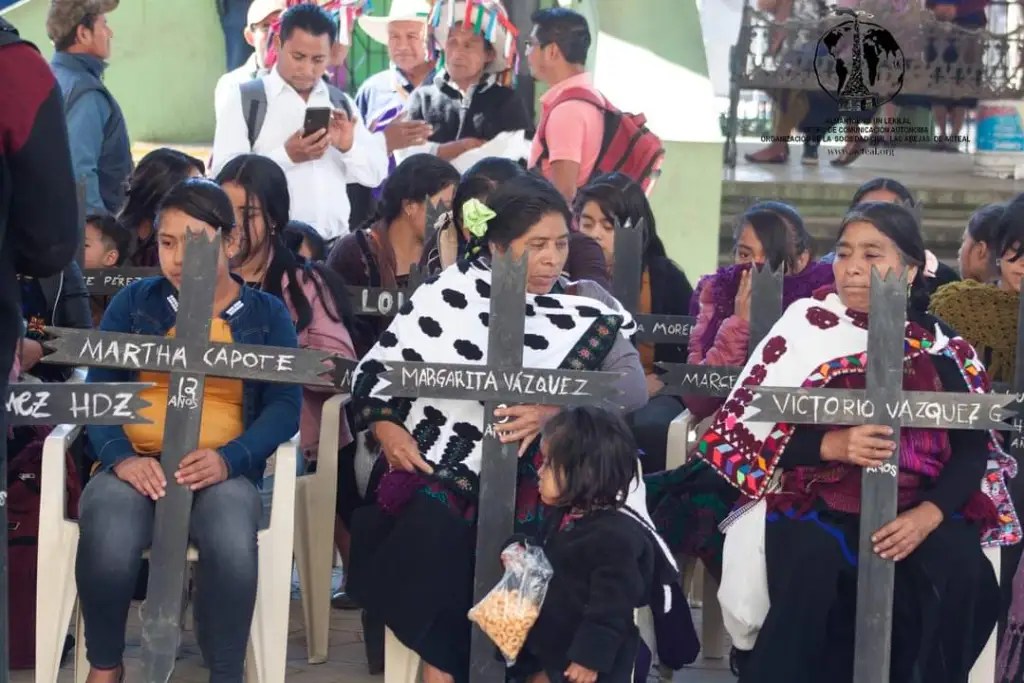
The Fourth Transformation’s “humanism” did not reach the Mexican southeast. Chiapas is a powder keg about to explode. And not because of the absence of the State: given that it is a territory of great geopolitical and geo-economic importance – and also bordering Guatemala – for reasons of national security there is a strong military presence there, as well as the National Guard and the different police forces, which was exacerbated after the imposition, by the governments of Donald Trump and Joe Biden, with the militarized control (by the Mexican State) of the migratory waves coming from Central America. Hence, by action or omission, collusion, cohabitation or acquiescence of the State, the current state and non-governmental criminal violence (paramilitary, criminal) against indigenous communities with support bases of the Zapatista National Liberation Army (EZLN) responds to another logic: that of counterinsurgency.
In Chiapas they knot, intertwine and/or confront a series of contradictions, concepts and categories that include, on the one hand: internal colonialism; neo-extractivism (the main axis of the capitalist megaprojects of the trans-Isthmus corridor and the misnamed Maya Train); diffuse war; necro-politics; racism; State terrorism; population control; forced displacement. And on the other hand: community; self-determination; autonomy; collective rights; anti-systemic and counter-hegemonic principles; organization; resistance; defense of land and territories; dignity.
The EZLN took up arms and declared war on the Mexican State on January 1, 1994. After 12 days of clashes, the government of Carlos Salinas decreed a ceasefire against the Zapatista peoples and negotiations began with the mediation of the then bishop of San Cristóbal de las Casas, Samuel Ruiz. After the San Andrés Dialogues, the regime of Ernesto Zedillo did not comply with the agreements and the EZLN dedicated itself to building de facto autonomy in its territory in a civil and peaceful manner, in addition to being a key actor for the advancement and exercise of the rights of indigenous peoples. But it remains an armed political-military actor.
Since 1995, the Secretariat of National Defense (SEDENA) began a phase of irregular warfare and para-militarization of the conflict, which responded to the guidelines of the so-called Chiapas 94 Campaign Plan. The strategic-operational objective of this plan was “to destroy the EZLN’s will to fight, isolating it from the civilian population and obtaining its support, for the benefit of the Army’s operations.” The tactical objectives of Plan Chiapas 94 included “destroying and/or disorganizing the political and military structure of the EZLN,” for which, along with intelligence, psychological, civilian population control and logistical operations, the organization, training, advice and support of “self-defense forces or other paramilitary organizations” (sic) were instructed. And he added: “If there are no self-defense forces, it is necessary to create them.” In a textual way, it was ordered “to secretly organize certain sectors of the civilian population – among others, ranchers, small landowners and individuals characterized with a high patriotic sense – who will be employed under orders in support of our operations.”
According to the plan, the Army provided training, advice and support of the “self-defense forces” (SDF) and other paramilitary organizations. The paramilitaries were to participate in SEDENA’s security and development programs. Among other tasks, they had to provide information that fed the branches of military intelligence (counter-information, combat intelligence, intelligence for the support of psychological operations, intelligence on the internal situation).
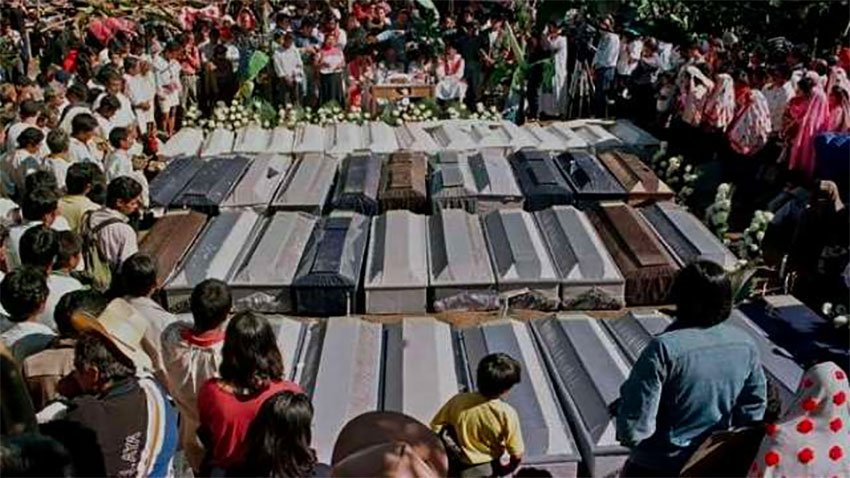
The Acteal Massacre, in December 1997 −when 45 indigenous Tsotsiles were murdered while they were praying in that community’s chapel in the municipality of Chenalhó by the PRI paramilitary group Máscara Roja (Red Mask) and undercover members of the Army−, was a military action that followed the guidelines of the Manual of irregular warfare, counter-guerrilla operations and restoration of order, published by SEDENA. It teaches how to fight the insurgency. Quoting Mao Tse-Tung, it stated that “the people are to the guerrillas as water to the fish.” But the fish, it adds, “can make life impossible in the water, agitating it, introducing elements harmful to its subsistence, or braver fish that attack it, chase it and force it to disappear.” Paramilitaries, then.
Almost 25 years later, the Regional Organization of Ocosingo Coffee Growers (ORCAO) fulfills the role of Red Mask in the Acteal massacre. And together with the ORCAO, criminal groups – in complicity, collusion or under the protection of State security agencies – execute in Chiapas the tasks of generating terror and chaos that organizations of the criminal economy developed in geo-strategic areas of Mexico, such as the states located on the Burgos and Sabinas basin (Coahuila, Nuevo León), rich in uranium, coal and hydrocarbons, considered “Zeta territory” during the diffuse war of Felipe Calderón or in the area of the “hot land” of Michoacán, where the Army armed a civilian self-defense group (Hipólito Mora, Juan José Farías, Miguel Ángel Gutiérrez, José Manuel Mireles and others) to face the Knights Templar of Servando Gómez, La Tuta.
In all cases it is a question of destroying the communal social fabric through necro-politics, a category that, according to Achille Mbembe, implies the decision of who can live and who must die at the hands of “war machines” (state and private) to generate mass death, which exhibits the logic of twenty-first century capitalism as “administration and work of death,” with the material destruction of human bodies and populations judged as disposable and superfluous (killable, says Agamben). The goal of terror and necro-power is social subjugation; the submission of the other as part of a predatory dynamic of dispossession, dispossession and territorial reordering for the purposes of economic domination.
Originally Published in Spanish by La Jornada, Monday, June 12, 2023, https://www.jornada.com.mx/2023/06/12/opinion/015a2pol and Re-Published with English interpretation by the Chiapas Support Committee
 Chiapas Support Committee