Chiapas Support Committee
Home of the Compañero Manuel blog on zapatistas & mexico
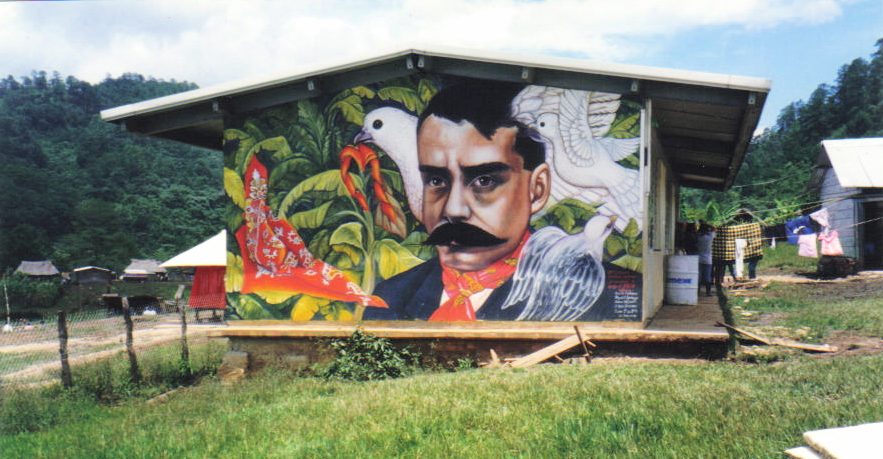
Gustavo Esteva: The New Era
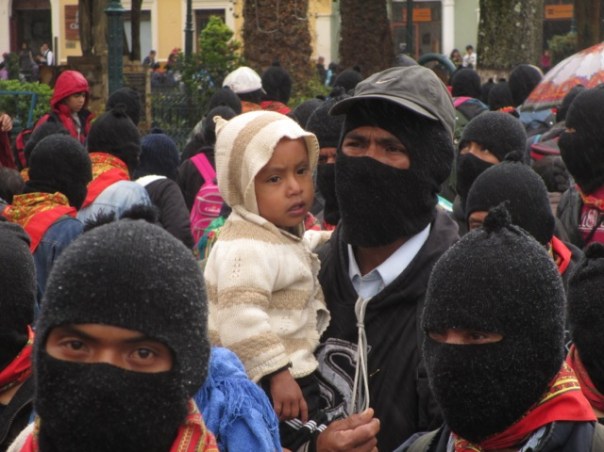
Baby Zapatista on Dec 21 in San Cristóbal
THE NEW ERA
By: Gustavo Esteva
And the band kept on playing.
The sinking of the Titanic was unavoidable. To ignore it was foolish. But the band kept on playing.
His performance on the first day is a blatant illustration of this peculiar kind of blindness. It shows the gap that has opened between the political classes and the people, and it also reveals their dangerous detachment from reality, the irresponsible and short-sighted way in which he is preoccupied with mafia-style interests in the short term, while ignoring the depth of the economic, social and political crisis in which we find ourselves.
His discourse about the country is currently showing the worst symptoms of a populist authoritarianism that has been installed against all odds. It is conceived as a triumph of optimism over irresponsible reality, with the evident intention of generalizing this blindness. The band will continue playing until the instruments and musicians sink with the ship.
It is particularly difficult not to hear the roar of the collapse, which is observed worldwide and has been precipitated very sharply in Mexico. Those who have climbed the ladders of political power, however, will persist in their self-interested deafness… while they can, for as long as they can.
But the rest of us cannot continue to be deaf. We need to respond.
“I hate to say I told you so, but I told you so,” Subcomandante Marcos said years ago. The Zapatistas have repeatedly warned us of what would happen if we did not respond. We did not respond. It happened. They described in various ways the mess we are in today. They anticipated, before anyone else, the series of crises that have been happening and the destruction that they would bring to the political classes, to the country itself, to the social fabric… They offered with strength and clarity options for change, without dogmatism or imposition. We did not take them.
The new call from the Zapatista National Liberation Army (EZLN) needs to be heard by all those who, from below, try to resist the dominant horror and to create another possibility. If only it could be heard by those who still harbor the fantasy that an electoral change might be enough to remedy it all, those who can only think and organize within the framework of the political parties and institutions and that still believe that anti-capitalism is a bad word.
It is useful to show again that the emperor has no clothes. They may see it and dare to say it out loud to those who believe it is possible to continue in denial.
While listening to the din of the collapse of the dying world is inevitable, no less because the noise is all-encompassing and is experienced daily through suffering in the flesh, it is not so with the sound of the world that re-emerges. You need different ears in order to hear that.
We are not looking at another version of what we know. It is not a new twist, a bend in a familiar path. It is something new and radical. Its deep roots in the past are not dedicated to reproducing the past, or even worse, making an impossible attempt to return to it. It is something different.
As was seen last Friday, the new world will be built with hope, joy and celebration, through the discipline that is learned through their own order, autonomy. Only then, through organic discipline, which is woven from below by their own will, it is possible to propose the elimination of coercive power and authority, the condition in which a hierarchical position is used to impose action.
In dark times like these it is a blessing to know we can rely on them. As Chomsky, Wallerstein, Gonzalez Casanova and many more said long ago, the Zapatista political initiative is the most radical in the world, and probably the most important. That was yesterday, that night of the first of January 1994, which triggered a wave of anti-systemic movements throughout the world and woke us all up. They continue doing so today, when they are once again an inspiration to do what is needed.
The end of an era has arrived. The evidence is accumulating daily. Nothing can stop its conclusion. But it will acquire an apocalyptic form, deepening the immense natural, social and cultural destruction that has been characterizing its agony, unless we are able to resist such horror. And in these circumstances, the only valid and effective way to resist is to create an alternative. We all have to do this, each in his or her place and way. We need to dissolve the economic and political relations which trap us in the old world, while being increasingly aware that the dignity of every man and every woman and every human relationship must of necessity defy all existing systems. That is what today is about.
Originally Published in Spanish by CGT Chiapas
En español: http://www.cgtchiapas.org/httpradiochimiablogspotcomes
English translation by the UK Zapatista Solidarity Network for the:
International Zapatista Translation Service, a collaboration of the:
Chiapas Support Committee, California
Wellington Zapatista Support Group
UK Zapatista Solidarity Network
The Zapatista Maya World: Collapse and Rebirth
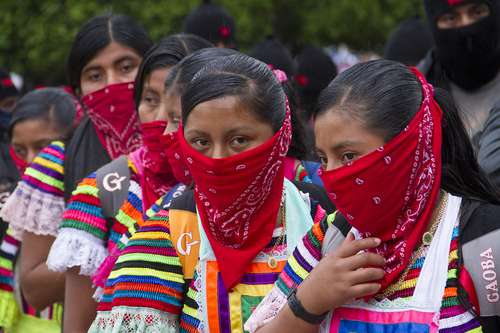
Women in the EZLN March
Collapse and Rebirth in the Zapatista Maya World
By: Luis Hernández Navarro
What has never gone away cannot reappear. What made the rebel Zapatista Mayas to occupy peacefully and in silence five Chiapas cities this December 21 was not to reappear, but rather to reaffirm their strength.
The EZLN has been here for more than 28 years. It has never gone away. For ten years it grew under the radar; it announced itself publicly more than 18 years ago. Since then it has spoken and guarded silence intermittently, but has never stopped. At one time or another its disappearance or irrelevance has been decreed, but it has always re-emerged with force and with a message.
This start of the new Maya cycle was no exception. More than 40, 000 Zapatista support bases marched in the rain in five Chiapas cities: 20, 000 in San Cristóbal, 8, 000 in Palenque, 8, 000 in Las Margaritas, 6, 000 in Ocosingo, and at least 5, 000 more in Altamirano. We’re dealing with the most numerous mobilization since the emergence of the rebels from the Mexican southeast.
The magnitude of the protest is a signal that their internal strength, far from diminishing with the passage of years, has grown. It is an indicator that the counterinsurgency against them, carried out by the different governments, has failed. It is sign that their project is a genuine expression of the Maya world, but also of a whole lot of poor Mestizo campesinos in Chiapas.
The EZLN never abandoned the national scene. Guided by their own political calendar, loyal to their ethical congruence and with the force of the State against them, it strengthened its forms of autonomous government, it kept alive its political authority among the country’s indigenous peoples and kept the international solidarity networks active. The fact that it has not appeared publicly does not mean that it is not present in many significant struggles in the country.
In the five Good Government Juntas that exist in Chiapas and in the autonomous municipalities the authorities of the Zapatista support bases govern themselves, exercise justice and resolve agrarian conflicts. Within their territories, the rebels have made their health and education systems function at the margin of the state and federal governments, organized production and commercialization and kept its military structure standing. They successfully resolved the challenge of the generational relief of their commanders. As if it were nothing, they efficiently dodged threats from drug traffickers, public insecurity and migration. The book Luchas “muy otras” Zapatismo y autonomía en las comunidades indígenas de Chiapas is an extraordinary window for looking at some of these experiences.
The Zapatistas marched this December 21 in order, with dignity, with discipline and cohesion, and in silence, a silence that was loudly heard. In the same way in which they had to cover their face in order to be seen, they now interrupted the word in order to be heard. We’re dealing with a silence that expresses a fertile generative capacity for other horizons of social transformation, a great potency. A silence that communicates the will of resistance in front of power: “He who stays in silence is ungovernable,” Ivan Illich said.
A cycle of the political struggle closed in Mexico this December 1, at the time that another opened. The EZLN has a lot to say in the nascent map of social struggles that begins to be drawn within the country. Their mobilization can impact them in a relevant way.
Among the contours that define the new stage of social struggles are: the return to Los Pinos of the old PRI dinosaur, manned by Salinismo and its authoritarian ways of exercising state command; the pretension of managing social conflict starting from a pact among elites that excludes the subordinate sectors; the crisis, decomposition and reorganization of the partisan left, and the emergence of new social movements.
The EZLN is a new player that, without invitation, sits down at the table of the party that recently came out in national politics.
The Pact for Mexico, subscribed to by the Institutional Revolutionary Party (PRI), the National Action Party (PAN) and, individually, by the president of the Party of the Democratic Revolution (PRD) seeks to agree on a program of reforms at the margin of broad social sectors. The EZLN’s mobilization makes evident that a very broad part of Mexican society is not included in that agreement, and that what its subscribers agree to does not necessarily have the endorsement of the citizens.
The party of the Aztec Sun (the PRD) is locked in an internal struggle that can provoke its rupture. The New Left’s pretension of yoking its destiny to the Peña Nieto government mortgages any possibility of a critical distance from power.
The National Regeneration Movement (Morena, its Spanish acronym) has been occupied with the organizational tasks for obtaining its registry. It is probable that the Workers Popular Organization (OPT, its initials in Spanish) continues the same path. It exists because there is a broad political and social territory that the partisan left is not occupying. The Zapatistas enjoy an indubitable political authority among those who people those latitudes.
In the last year and a half social movements have emerged that question power at the margin of the political parties. They don’t feel represented by any of them. The Movement for Peace with Justice and Dignity, #YoSoy132, the community struggles against public insecurity and ecological devastation, the student protests in defense of public education, among others, walk along different paths than those of institutional politics. The sympathies toward Zapatismo within those forces are real.
But, beyond the conjuncture, the marches of the Maya 13 Bak’tun are a novel “¡Ya basta!” similar to what they enunciated in January 1994, and a renewed version of “Never more a Mexico without us!” formulated in October 1996, which opens other horizons. They don’t ask for anything, don’t demand anything. They demonstrate the power of silence. They announce that a world is crumbling and another is reborn.
Originally Published in Spanish by La Jornada
English translation: Chiapas Support Committee
Saturday, December 22, 2012
En español: http://www.jornada.unam.mx/2012/12/22/opinion/004a1pol
More Than 40,000 Zapatistas Mobilize in Chiapas
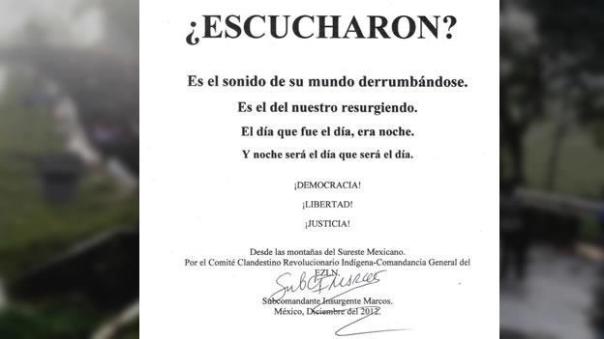
Above is a photo of the very brief message delivered to the media from the Zapatistas. It reads: “Did you hear? It’s the sound of your world crumbling and ours re-emerging… ” (obviously addressed to the new PRI government) Article from La Jornada is below.
More than 40,000 Zapatistas Mobilize in 5 Chiapas Municipalities
** In silence, they occupy the central plazas of Ocosingo, San Cristóbal de Las Casas, Palenque, Altamirano and Las Margaritas
** Later they disappear in an orderly way
[The indigenous wear a number according to the Zapatista zone to which they belong. Photo: Victor Camacho]
[Under the rain, thousands of indigenous marched through San Cristóbal de Las Casas, Palenque, Las Margaritas, Ocosingo and Altamirano Photo: Víctor Camacho]
By: Hermann Bellinghausen, Envoy
Ocosingo, Chiapas, December 21, 2012
More than 40, 000 Zapatista support bases filed silently this morning in five Chiapas cities, which results in the most numerous mobilization of said organization since the Zapatista National Liberation Army’s (EZLN) armed uprising on January 1, 1994.
Coming from the five Zapatista Caracoles in the Lacandón Jungle, Los Altos and the Northern Zone, the Maya peoples in rebellion (Tzeltales, Tzotziles, Choles, Tojolabales and Mames) and Zoques of Chiapas occupied the central plazas of Ocosingo, San Cristóbal de Las Casas, Palenque, Altamirano and Las Margaritas; in each case, in complete silence.
At 6:30 in the morning, about 6, 000 indigenous Zapatistas, the majority young, concentrated near the University of the Jungle, near the Toniná archaeological site. From there they marched to the central park of Ocosingo, where they stayed for a space of three hours in front of city hall, which the EZLN’s insurgents and milicianos took over with arms 19 years ago upon declaring war on the Mexican government.
On this occasion the action was civilian and peaceful, and the only ones that spoke were the raised left fists of all the Zapatistas, who filed in order onto a platform that they installed for that purpose. Toward 10:30 AM, the last of the demonstrators abandoned the plaza, on their way back to the Jungle.
In the same fashion, at the other plazas mentioned the Zapatistas placed platforms that all mobilization participants mounted with raised fist, in a parade of impressive brevity.
Some 20, 000 Zapatista men and women paraded in San Cristóbal de Las Casas. According to reports, at least 7, 000 indigenous congregated in Las Margaritas, and 8, 000 in Palenque. The number in Altamirano is not known. According to the testimony of a transport worker (driver) from the zone of Ocosingo, double the number of indigenous that arrived in the municipal headquarters of Ocosingo could have left from the Caracol of La Garrucha, but there were not enough vehicles, therefore only 6, 000 people were transported.
[The presence of youths and women was especially emphasized. Photo: Víctor Camacho]
Intermittently, throughout recent weeks, the Enlace Zapatista electronic portal has been announcing “the word” of the EZLN’s Indigenous Revolutionary Clandestine Committee-General Command (Comité Clandestino Revolucionario Indígena, Comandancia General del EZLN), as well as of the Sixth Commission and International Sixth Commission. It is foreseen that these communications could be announced soon, but that has still not occurred.
On the date on which many unwary in the world believed that the world would end, according to the opportunist interpretation of the “prophesies” (in reality, mathematical calculations) of the ancient Mayas, the EZLN’s support base communities, belonging to the contemporary Maya peoples, which in their languages are named “true men,” with face covered carried out a powerful demonstration of power and discipline, perfectly formed under a persistent rain (unusual in this time of the year) that accompanied the mobilizations in the different localities all morning long.
Able to “appear” quickly, the indigenous rebels “disappeared” as neatly and silently as they had arrived in the early morning in this city that, two decades after the EZLN’s traumatic irruption here on New Years 1994, received them with bewilderment and curiosity, without any expression of rejection. Under the arches of city hall, which suspended its activities today, dozens of Ocosingoans congregated to photograph with cell phones and cameras the spectacular concentration of covered faces that filled the park like in a game of Tetris, advancing among the gardening with an order that seemed choreographed, to go up to the platform installed rapidly since early on, raising their fist and saying, silently, here we are; one more time.
——————————————————
Originally Published in Spanish by La Jornada
English Translation: Chiapas Support Committee
Saturday, December 22, 2012
En español: http://www.jornada.unam.mx/2012/12/22/politica/002n1pol
Zapatistas Mobilize in 5 Chiapas Cities

Zapatistas enter San Cristóbal de las Casas
Zapatistas Mobilize in 5 Chiapas Cities
On the date on which the unwary awaited the end of the world, the EZLN’s Maya support base communities occupied the plazas of Ocosingo, San Cristóbal, Las Margaritas, Comitán and Altamirano in a peaceful and silent way.
By: Hermann Bellinghausen, envoy Published: 12/21/2012 09:15 AM
Ocosingo, Chiapas. Since the first hours of today, thousands of Zapatista support bases coming from the five Caracoles started to peacefully occupy the central plazas of the cities of las Ocosingo, San Cristóbal de las Casas, Las Margaritas, Comitán and Altamirano.
At 6:30 in the morning the bases that arrived in Ocosingo began to congregate near the University of the Jungle, and from there they started to a march towards the center of the city.
At this moment in the Ocosingo plaza the bases continue arriving and they occupy all the spaces without trees in the ample plaza from the municipal presidency (city hall) to the city’s parish church.
It is expected that the Indigenous Revolutionary Clandestine Committee-General Command CCRI-CG) of the Ejército Zapatista de Liberación Nacional (EZLN) will emit a message in the coming hours.
On the date that many unwary believed that the world would end, the EZLN’s Maya support base communities, with faces covered, the majority of them very young, wait in perfectly formed silence under a stubborn drizzle.
Unusually for these dates, it has rained all night.
———————————————————
Originally Published in Spanish by La Jornada
Friday, December 21, 2012
116, 100 Dead in Mexico Drug War!
Document 116, 100 Deaths Due to the Fight Against Drugs, “more than in a Country at War”
** The European grouping classifies Mexico as a nation of killings and unheard of barbarities
** It details in a report that there is corruption in police and Army; “authorities hide the evidence”
By: Alfredo Méndez
“Mexico is a country of killings, murders and unheard of barbarities. It is a nation of organized crime, of drug trafficking cartels, of journalists kidnapped and murdered,” the Italian civil organization Líbera maintains in a report.
This association’s report, formed by more than one thousand groupings of European activists and American human rights defenders, asserts that: “the invisible and absurd war” that ex president Felipe Calderón invented against organized crime “has provoked, from 2006 to the last moment of his government, the death of 53 people peer day, 1, 620 per month, 19, 442 per year, which gives us total of 136, 100 dead, of which 116, 100 (murders) are related to the drug war and 20, 000 murders linked to common crime,” the document details.
We’re talking about alarming numbers that place Mexico greatly on top of other countries at war, like Afghanistan, whose body count (from 2006 to present), according to numbers from the United Nations, reached 13, 000 deaths, in other words, bare 10 percent of the number of murders committed in Mexico.
The Líbera document –that includes governmental numbers, statistical data collected by non-governmental organisms, besides journalistic reports and analyses elaborated by academic experts in national and public security– was presented to the Mexican media this Monday during a press conference headed by journalists like Anabel Hernández and José Reveles; academics like Edgardo Buscaglia, president of the Institute for Citizen Action for Justice and Democracy, and members of different non-governmental organizations.
Starting with the premise of corruption as an irrefutable factor that nurtures crime, the report concludes that” “in Mexico there is corruption in the police, in the Army and, in the face of all that, the political power prefers to deny the evidence, dissimulate (lie) and hide.”
It adds: “in Mexico, representatives of the political class have not been capable of substituting the authoritarian mechanisms of the old and only State party with others with democratic characteristics. For this reason, in the political, judicial, legislative, administrative, patrimonial and social ambit one still observes power vacuums that are occupied by formal instances from the private sector and informal ones, like organized crime.”
As incredible as it seems, it established that: “it has been able to document that in the dance of the numbers, the National Institute of Statistics and Geography (Instituto Nacional de Estadística y Geografía, Inegi) from 2005 to July 19, 2012, established 116, 000 ‘alleged homicides’; but recent 2012 empirical-methodology investigations (The use, misuse and abuse of the crime statistics in Mexico, a document elaborated by James Creechan), published during the month of September by US and Canadian authors, make a different accuracy.
“In that study he calculates that the total number of malicious homicides 136, 100 individuals. Nevertheless, so as not to exaggerate for political motivations, one must remember that not all these lost lives are linked to the ‘war’ against organized crime. In the scientific study, of the 136, 100 people that have been murdered with firearms, decapitated, hung, burned in acid or found in narco-graves, “one can conclude that 116, 100 individual deaths are linked to the war against drug trafficking and 20, 000 have been murdered by common crime,” the Líbera report points out.
———————————————————-
Originally Published in Spanish by La Jornada
English Translation: Chiapas Support Committee
Tuesday, December 11, 2012
En español: http://www.jornada.unam.mx/2012/12/11/politica/015n1pol
Zapatista News Summary – November 2012
NOVEMBER 2012 ZAPATISTA NEWS SUMMARY
In Chiapas
1. The EZLN Celebrates 29th Anniversary – November 17 was the 29th anniversary of the Zapatista National Liberation Army (EZLN). In Chiapas, alternative media and other organizations celebrated. Nationally and internationally, the Worldwide Echo concluded with organizations and collectives holding demonstrations and delivering the Statement of Support for the Zapatista Communities to Mexican Embassies and Consulates. We thank all those who signed the letter. It is posted on our main website: http:// www.chiapas-support.org
2. La Realidad Denounces Unjust Imprisonment and Attempted Land Grab –
The Good Government Junta in La Realidad denounced that 2 Zapatista brothers and 2 more of their brothers have been in prison since June, falsely accused of crimes they did not commit. The detention stems from a 2011 incident when the 2 Zapatista brothers were severely beaten by people that are referred to as “criminals” and 2 other brothers came to their rescue. A year later, the aggressors lodged complaints against the 2 Zapatista brothers they beat up and also against the 2 who came to their rescue. The 2 Zapatista brothers are from the San Ramon section of Motozintla municipality. The same Junta also denounced an attempted land grab in Motozintla by members of the Mexico’s Green Ecologist Party (PVEM, its initials in Spanish) from Che Guevara community.
3. EZLN’s Word Expected Soon – The EZLN’s website posted an announcement on November 25 that said the EZLN’s word is coming soon. We assume that it will have to do with Enrique Pena Nieto taking power as president of Mexico and thereby returning the PRI to power. As soon as this communication is available, we will send it out.
In Other Parts of Mexico
1. Enrique Peña Nieto Assumes the Presidency on December 1 – On December 1st, Enrique Peña Nieto became President of Mexico amid violent protests from a broad spectrum of organizations opposed to the PRI’s return to power and the way Pena Nieto was elected. Pena Nieto inherits a Drug War in which approximately 90,000 have been killed, 25,000 are disappeared and tens of thousands displaced from their homes. As Pena Nieto takes office, the government reports that 4 out of every 10 Mexicans in the labor force are unemployed and poverty affects roughly 46 percent of the population. Finally, Mexico’s National Human Rights Commission (CNDH) reported a 500% increase in torture, as well has a huge rise in forced disappearances and arbitrary detentions.
2. US Vice President Joe Biden Attends Ceremonies – US Vice President Joe Biden headed the US delegation to the ceremonies for Pena Nieto’s swearing-in. In his first address to the nation, Pena Nieto announced measures geared to address the insecurity, hunger and to kickstart the economy. He says he will focus security forces in areas of high violence to protect the public, rather that focusing on capturing crime bosses. He is also proposing a Universal Social Security system. At least 100 people were injured in violent demonstrations around the country.
3. 14 Police and 5 Commanders Indicted In Ambush of 2 CIA Agents at Tres Marias – As previously announced, 14 federal police agents have been formally charged with the attempted murder of 2 CIA agents and a Mexican marine on August 24 near Tres Marias. They have also been charged with causing bodily harm, abuse of authority and damage to the property of another. Additionally, 5 police commanders have been charged as accessories after the fact for participating in an attempted coverup. The 14 police are in prison while awaiting a determination of their case. The five commanders are free on bond.
In the United States
1. President Obama Meets with Pena Nieto – On November 27, US President Barack Obama met with president-elect Enrique Pena Nieto at the White House. While the US press emphasized that the meeting focused heavily on economic issues, reports in the Mexican press stated that that the meeting also focused on immigration reform and security issues.
___________________________________
Zapatista Store at Toniná Provokes the Government’s Wrath
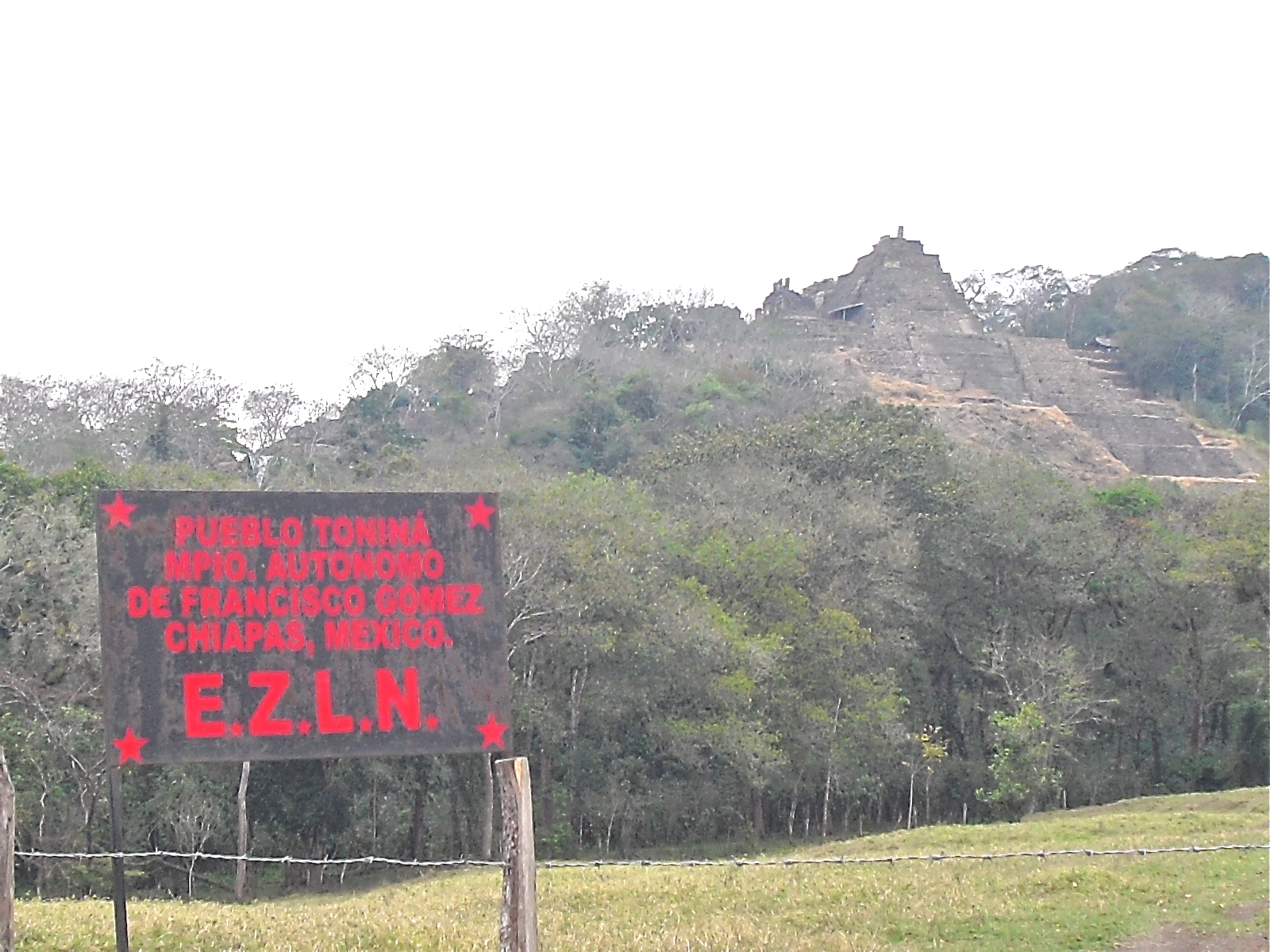
Photo taken of a sign at Toniná village during March 2012 delegation. Zapatista signs are seen by tourists who visit the well-known archaeological site.
———————————————
Zapatista Artesanía Store at Toniná Provokes the Chiapas Government’s Wrath
** There is an arrest warrant out for me and I have not committed crimes: José Alfonso Cruz
** It doesn’t want anything that says EZLN during tourist events for the end of the world, accuses the property owner
By: Hermann Bellinghausen
On the outskirts of the City of Ocosingo, Chiapas, near the Toniná archaeological site, Zapatistas from Francisco Gómez autonomous municipality recently installed a store with artesanía on a piece of recuperated land. That has unleashed a governmental rejection as much from the official municipality as the state, which issued an arrest warrant against the owner of the contiguous property, also a support base of the Zapatista National Liberation Army (EZLN, its initials in Spanish).
The essence of the conflict is the attractive hand painted sign that the Zapatistas put at their place, located at the Toniná entrance, a famous archaeological site where tourist activities will be celebrated next month, taking advantage of the “end of the Maya world” mode and the end of the year vacations. We’re talking about an investment of 5 to 8 million pesos by the municipal government of Octavio Elías Albores Cruz, a PRI member.
According to declarations to La Jornada from José Alfonso Cruz Espinosa, a Zapatista base that legally owns the Toniná lands up to the foot the foot of the pyramid, who resides near the archaeological zone and has repeatedly suffered harassment and attempts at plunder on the part of authorities, who have made it known that they don’t object to the store, only the sign that announces it, which only expresses that it is an autonomous store with artesanía from indigenous Zapatistas and it belongs to the Francisco Gómez rebel municipality.
“The state’s attorney general is already looking for me,” Cruz Espinosa declared via telephone. “Judicial police dressed as civilians want to search my house, and I had to take shelter in an autonomous community.” He insists that he has not committed any crime, and that his compañeros from the autonomous municipality are within their rights to establish their business and to announce it.
“The government doesn’t want anything that says ‘EZLN’ during the end of the world tourist events,” he added. Those events will be celebrated from December 21 to 23, with the participation of the resident archaeologist, and “almost owner” of Toniná, Juan Yadeum.
Weeks ago, the same Cruz Espinosa had denounced the construction of a bridge and a path inside the site, utilizing valuable archaeological material and “destroying a patrimony of humanity.” He placed responsibility on Yadeum, the current mayor Albores Cruz and principally on the former (mayor), Arturo Zúñiga Urbina, who with other associates wants to make use of the “end of the world” (events) and the expected tourist flow from such an emotional happening without the endorsement of the National Institute of Anthropology and History, which while it sanctioned the archaeologist, did not stop the work.
———————————————————-
Originally Published in Spanish by La Jornada
Monday, November 26, 2012
En Español: http://www.jornada.unam.mx/2012/11/26/politica/018n1pol
EZLN to Issue Pronouncement Soon!

Próximamente la palabra del Comité Clandestina Revolucionario Indígena – Comandancia General (CCRI-CG) del Ejército Zapatista de Liberación Nacional, Comisión Sexta y Comisión Internacional del EZLN.
http://enlacezapatista.ezln.org.mx
The Indigenous Revolutionary Clandestine Committee-General Command (CCRI-CG) of the Zapatista National Liberation Army, the EZLN’s Sixth Commission and International Commission will issue their word soon.
(We assume this announcement will be about Enrique Peña Nieto taking power.)
Zibechi: Colombia: Peace, Land and Rights
Colombia: Peace, Land and Rights
By: Raúl Zibechi
The social climate has changed. What was said before in a whisper is now pronounced openly in the streets, plazas and markets. The historic fears, which increased exponentially during the eight years of the Alvaro Uribe government, are slowly receding, although they are far from having disappeared. In the cities is lived a situation very different than that in the rural areas, where one is made to feel the armed power of the narcos and the big landholders.
The peace process is felt as something irreversible by a good part of the population. Hope is a sign of this time in which almost 80 percent support the negotiations between the Revolutionary Armed Forces of Colombia (FARC, their initials in Spanish) and the government headed by President Juan Manuel Santos. Hopeful lights and shadows exist that can once again abort the path to peace. Anyway, the current scenario is very different from the one we were familiar with decades ago.
The first difference is that the guerrilla comes to the negotiations very beaten up. The last conversations, initiated in 1999, were a consequence of hard tactical blows inflicted by the FARC on the armed forces, which took advantage of the detente to recompose and equip themselves with air capability and new technology contributed by Plan Colombia. Members of the Colombian Army, like a good part of the dominant class, continue aspiring to annihilate the insurgency, an old dream that now feels wounded in the realized conditions.
Within the country it is speculated that one of the military command’s objectives is to provoke a division within the guerrilla among those who would be added to the demobilization and a sector that would continue the conflict. It is also possible that they might launch a powerful attack to kill several commanders in the midst of the negotiations, as a way of pressuring for concessions.
The second question that differentiates these negotiations from the previous ones is that the so-called cacaos, the economic power elite, agree with Santos on the need to arrive at a negotiated end with the guerrilla. This sector, composed of an urban bourgeoisie linked to finance and industry, bet on international business and modernization as a way of consolidating power and profits. The image of a country in conflict does not usually seduce the capitalists.
Nevertheless, the archaic class of landholding ranchers, whose interests appear interlaced with drug traffickers and paramilitaries, do not seem happy with the negotiations. The recent massacre of 10 campesinos in a municipio to the north of Antioquia can be the beginning of an escalation impelled by this sector, which would lose power with the end of the conflict.
The key to peace is land for the campesinos. The class war that began towards the end of the 1940s turned around land: big landholders that grabbed it from campesinos armed in order to defender it. What began as a struggle for survival, for which they created campesino self defense, was prolonged into a four-decade war that was consumed in a real narco-landholder agrarian counter-reform,Alvaro Uribe is the incarnation of this sector.
The third difference is the international and regional reality. The victory of Barack Obama benefits the peace plans of Santos and prejudices the obstructionism of Uribe. In any case, the White House does not have a defined policy towards Latin America, except for the persistence of military pressure through the Southern Command. But the changes that continue to be produced in the region push towards the end of the Colombian war.
The consolidation of the Bolivarian process after the victory of Hugo Chávez implies that for a long period Colombian diplomacy will have to choose between conflict or cooperation with its neighbor. It’s clear that Santos opted for the second. In Ecuador, after four years Brasil once again has a decisive weight. These days the BNDES signs the first of a series of loans for big public infrastructure works that was won by Odebrecht, the same company that had been expelled in 2008.
The government of Rafael Correa had approached China in search of loans for public works, but the interest rates are very high and the Asian country demands oil to guaranty the loans. The government of Ecuador offered Brazilian companies that have BNDES credit a package of public works for 2,500,000 dollars (Valor, November12). The repositioning of Brazil in Ecuador represents another inflection in favor of regional integration, of the Unasur and of the South American Defense Council.
The fourth aspect is the difficult situations that pierce the social movements. They are what could weigh on the negotiating table in decisive themes like land, the working group that began this November 15 in Havana. Nevertheless, after some advances, a situation of stagnation and recession exists, above all in the cities, where the cultural and political hegemony of the right is overwhelming.
On October 12, the three principal groupings, the Patriotic March, the Congress of the Peoples and the Coalition of Movements and Social Organizations of Colombia, called a day of struggle collecting the principal demands of society. The response was scarce and they basically mobilized the universities. A political culture of a patriarchal, hierarchal and masculine cut, anchored in the disputes for spaces of power, continues dominating inside the movements and blocks being open to differences.
New times are open in Colombia. The end of the conflict is one possibility among others. All the actors have a “Plan B” faced with the eventuality of reinforcements for armed confrontation; all except the indigenous peoples, the Afro-descendants and the urban and rural popular sectors. As has been happening to the Nasa (tribe) in Cauca, they only win with peace, unlike multinational mining companies and armed combatants.
_____________________________________________
Originally Published in Spanish by La Jornada
English Translation: Chiapas Support Committee
Friday, November 16, 2012
En español: http://www.jornada.unam.mx/2012/11/16/opinion/025a2pol
October 2012 Resumen de noticias sobre los zapatistas
OCTUBRE DEL 2012 RESUMEN DE NOTICIAS SOBRE LOS ZAPATISTAS
En Chiapas
1. Las Abejas denuncian la reactivación de grupos paramilitares – Las Abejas de Acteal, una organización de la sociedad civil, denunció la reactivación del grupo paramilitar Mascara Roja en el municipio de Chenalhó. Ellos lo atribuyen al gran numero de paramilitares encarcelados por su participación en la masacre de Acteal que han sido liberados durante los últimos años. Las Abejas dicen que quienes han sido liberados se han reincorporado con quienes nunca fueron llevados a la justicia, y que ahora portan armas en las carreteras, en las montañas y en los senderos a las milpas de maíz y café. Las Abejas también dicen que hace un mes un priísta disparó a un zapatista en la espalda. Además denuncian el resurgimiento de Paz y Justicia, el grupo paramilitar que esta atacando a dos comunidades zapatistas en la región del caracol de Roberto Barrios, cerca de Palenque.
2. Alberto Patishtan se recupera después de neurocirugía – El 3 de octubre, Alberto Patishtan fue transferido al Instituto de Neurología y neurocirugía Manuel Velasco Suárez en la Ciudad de México, donde le operaron el 8 de octubre para extirpar un tumor cerebral. Se informó que la cirugía fue exitosa y que se está recuperando ahora en el hospital Vida Mejor en Tuxtla Gutiérrez. Sus amigos informan que ha recuperado el 70% de su vista. Mientras tanto, la corte suprema de México aceptó el pedido del abogado de Patishtan de considerar si la corte tiene la jurisdicción de realizar una audiencia y dictar una decisión sobre la inocencia de Patishtan. Amnistía Internacional mandó una carta a la Corte a favor de Patishtan.
3. Sigue el asedio contra las comunidades Comandante Abel y Unión Hidalgo – La Junta de Buen Gobierno de Roberto Barrios denunció el asedio continuo por paramilitares de dos comunidades zapatistas, Comandante Abel y Unión Hidalgo. En un comunicado publicado el 30 de octubre por Enlace Zapatista, la junta describe cómo los paramilitares ya han distribuido las tierras que robaron de los Zapatistas el 6 de septiembre. Han recogido y sacado toda la cosecha de maíz y frijol. Dispararon al aire durante la noche y la policía esta patrullando el área para proteger a los paramilitares. La junta insinúa, describiendo algunas acciones, que la policía estatal está entrenando a los paramilitares quienes están realizando ejercicios de tipo militar. también declara que las actividades de la policía y los paramilitares están siendo coordinados bajo el mismo comando. Además, parece que quienes se quedaron atrás para proteger las casas y pertenencias de los zapatistas permanecen en las comunidades bajo asedio.
4. Detienen a zapatista en Zinacantan en represalia por entregar una invitación – En principios de octubre, la Junta de Buen Gobierno en el caracol de Oventik denunció que las autoridades de Jechvo (Zinacantan) han usado la violencia otra vez para cortar el suministro de agua a los zapatistas. Uno de los zapatistas civiles, Mariano Gómez Pérez, pidió la ayuda de un juez autónomo y de la junta. El juez autónomo mandó una carta al agente del PRI, invitándolo a una reunión para discutir el problema. Cuando Gómez Pérez intentó entregar la invitación, el agente del PRI lo detuvo y lo llevó ante la asamblea comunitaria, la cual fabricó unos crimines en su contra y lo mandó al juez municipal en Zinacantan. El juez municipal dijo al agente del PRI que no debería aceptar la invitación. Esta situación repite la del 2004, cuando las mismas autoridades, en ese entonces miembros del PRD, cortaron el suministro de agua a los zapatistas. Cuando los zapatistas de toda la región les trajeron agua en una muestra de solidaridad, los del PRD les abrieron fuego.
5. Seis zapatistas detenidos en Guadalupe Los Altos – El 12 de octubre, la Junta de Buen Gobierno de La Realidad denunció que seis bases de apoyo zapatistas de la comunidad Guadalupe Los Altos habían sido encarcelados durante 12 dias, y que sus familias estaban siendo amenazadas con expulsión. Las autoridades comunitarias son parte de la organización CIOAC Oficial, y también miembros de los partidos PRD y PAN. Parece ser que hay una historia larga de provocaciones relacionadas con la participación en cuanto a asuntos comunales, en particular la contribución económica para proyectos como escuelas y carreteras. La JBG sostiene que los zapatistas tienen sus propias escuelas, sin embargo tienen actualizadas sus cuotas para el beneficio de la comunidad, siempre y cuando no sean proyectos del mal gobierno. Este es un punto común en los conflictos dentro de las comunidades divididas entre integrantes pro-partidos oficiales y bases de apoyo zapatistas.
Por otras partes de México
1. Continua investigación de la emboscada contra 2 agentes de la CIA – Las indagaciones continuan en el caso de lo que ahora se conoce como “intento de asesinato” contra dos agentes de la CIA y un marino mexicano, el 24 de agosto, cerca de Tres Marias. El juez correspondiente extendíó el periodo de detención sin cargos (el llamado “arresto domiciliario”) a los 12 elementos de la Policía Federal por 40 dias más. Además, otros dos agentes de la policía federal fueron arrestados en conexión con el caso. Marisela Morales, Procuradora General de la República en México, se refirió al incidente como “intento de asesinato” una semana después del testimonio de los agentes de la CIA quienes lo denominaran como un “ataque directo”. Morales estableció que todos los agentes actualmente detenidos enfrentarán cargos oficiales en dos semanas más.
2. Policías toman 3 normales rurales en Michoacán, 176 detenidos – Policías federales y estatales tomaron las normales rurales de Tiripetio, Cherán y Arteaga, Michoacán para acabar con las protestas estudiantiles. Detuvieron a 176 estudiantes que protestaban por la implementación de cursos obligatorios de inglés y computación. Protestas similares ocurrieron en normales rurales de otros Estados conforme el gobierno federal intenta severamente restringirlas y regularlas. Las normales rurales en México preparan estudiantes para enseñar en zonas rurales e indígenas. Muchos de estos estudiantes son indígenas. Las escuelas han enfrentado reducción de presupuestos, admisiones y de personal, al mismo tiempo que la educación superior en México se enfoca más y más en los intereses empresariales.
3. Urapicho organiza su policía comunitaria – Otra comunidad purépecha, Urapicho, vecina de Cherán, está construyendo su propia fuerza de seguridad ante la completa ausencia de protección policiaca del gobierno oficial . Urapicho difundió un video a través de YouTube enumerando los problemas que han enfrentado con el crimen organizado y los talamontes. Miembros enmascarados de la comunidad aparecen en el video hablando de las y los que han sido desaparecidos. Uno de ellos porta un sombrero con la imagen del Ché y un paliacate zapatista. El gobierno ha acordado enviar a la policía comunitaria a recibir entrenamiento en la academia estatal de policía. También ha incrementado los campamentos de policía en el área. Para las y los que participaron en la Marcha del color de la tierra en 2001, esta comunidad se localiza en el área general de Nurio. Puedes ver el video en: http://www.youtube.com/watch?feature=endscreen&NR=1&v=e851A-FoB_o
______________________________________________
Compilación mensual hecha por el Comité de Apoyo a Chiapas.
Nuestras principales fuentes de información son: La Jornada, Enlace Zapatista y el Centro de Derechos Humanos Fray Bartolomé de las Casas (Frayba).
_________________________________
Chiapas Support Committee/Comité de Apoyo a Chiapas
P.O. Box 3421, Oakland, CA 94609
Email: cezmat@igc.org
http://www.facebook.com/pages/Chiapas-Support-Committee-Oakland/86234490686
 Chiapas Support Committee