Chiapas Support Committee
Home of the Compañero Manuel blog on zapatistas & mexico
Indigenous communities meet in Chiapas about super-highway
LOS LLANOS OF LOS ALTOS, CHIAPAS ADDS ITS REJECTION OF THE SC-PALENQUE SUPER-HIGHWAY AND EXTENDS INVITATION
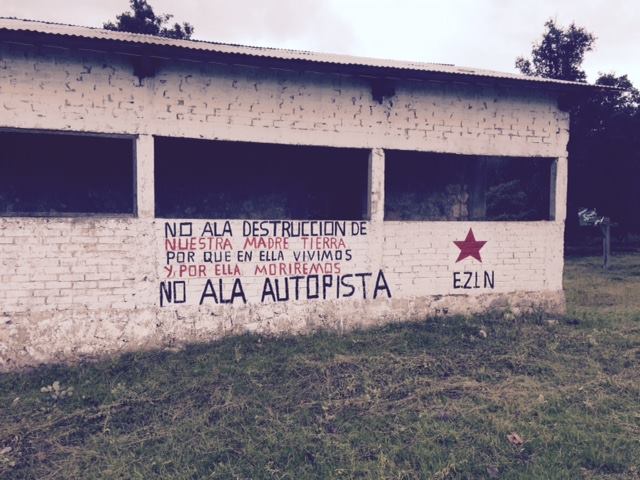
“No to the destruction of our Mother Earth because in her we live and for her we die. No to the super-highway,” painted on a building in Los Llanos Ejido.
Los Llanos Ejido, San Cristobal de Las Casas, adds itself to the resistance against construction of the Super-Highway, and extends an invitation to know its culture, to share the fruits that Mother Earth yields and to exchange ideas for walking to defend Mother Earth, on October 12.
After the mega-march of Believing People where 15,000 indigenous marched, 2,000 Bachajón ejido owners, and the almost 3,000 people of Candelaria that got together to reject the construction of the Super-Highway on their lands, passing through the sacred Laguna Suyul and the blockage of the Ocosingo-Palenque highway, the Los Llanos ejido owners add themselves to the rejection.
THE COMPLETE COMUNICADO
IN LOS LLANOS EJIDO, MUNICIPALITY OF SAN CRISTOBAL DE LAS CASAS, CHIAPAS, MEXICO , SEPTEMBER 21, 2014
TO THE INDIGENOUS COMMUNITIES AND PEOPLES IN RESISTANCE
TO THE COMMUNICATIONS MEDIA
TO BELIEVING PEOPLE
TO THE HUMAN RIGHTS ORGANIZATIONS
TO THE NATIONAL INDIGENOUS CONGRESS
TO THE ADHERENTS TO THE SIXTH DECLARATION OF THE LACANDON JUNGLE
Brothers and sisters, compañeros and compañeras, our people continue organizing in defense of our lands that the government has said publicly it wants to affect for the construction of the San Cristóbal de Las Casas to Palenque super-highway. We are making our struggle a legal and political one faced with the threat from the authorities that want to deprive us of our rights as indigenous peoples without respecting the Constitution and the international treaties, just as it wants to do with other Tsotsil, Tseltal and Chol peoples and communities without taking their opinion in to account. The government only wants to do what it wants without asking, by means of force and threats.
We are not in agreement that we are dispossessed of our territory only to serve the capitalist interests of the rich and to discriminate as always against poor campesinos, against we Indigenous that live from Mother Earth. The government must respect its own laws and respect the peoples that don’t sell their lands and dignity for a few pesos; the land has no price.
Our people want to share their struggle with other communities, peoples and organizations that are resisting in the defense of their territory and therefore our Peoples’ Assembly has made an agreement to celebrate the resistance of the indigenous peoples next October 12, 2014 at 8 o’clock, the hour of God, in our lands.
We want you to accompany us so that you know our culture, share the fruits of Mother Earth with us and exchange ideas for walking together to defend Mother Earth.
We await you on October 12, 2014 a las 8 AM, hour of God, in the place known as Chivero, located at kilometer 5+100 of the San Cristóbal de Las Casas Highway on the way to Ocosingo, one kilometer before arriving at the State Center of Social Re-adaptation Social Number 5 (CERSS 5) of San Cristóbal, in front of the GASCOM gas plant.
Tierra y Libertad!
Ejido Commission de Los Llanos, Municipio of San Cristóbal de Las Casas, Chiapas
Juan López López, Miguel Jiménez Díaz, Francisco Díaz Gómez, President, Secretary and Treasurer
Vigilance Council of Los Llanos, Municipio of San Cristóbal de Las Casas, Chiapas
————————————————————
Originally Posted in Spanish by Espoir Chiapas
Sunday, September 21, 2014
http://espoirchiapas.blogspot.com/2014/09/los-llanos-se-suman-al-rechazo-de-la.html
20,000 Zapatistas March for Ayotzinapa
SILENT MARCH of 20,000 ZAPATISTAS FOR AYOTZINAPA
Zapatistas March in San Cristóbal
By: Chiapas Paralelo
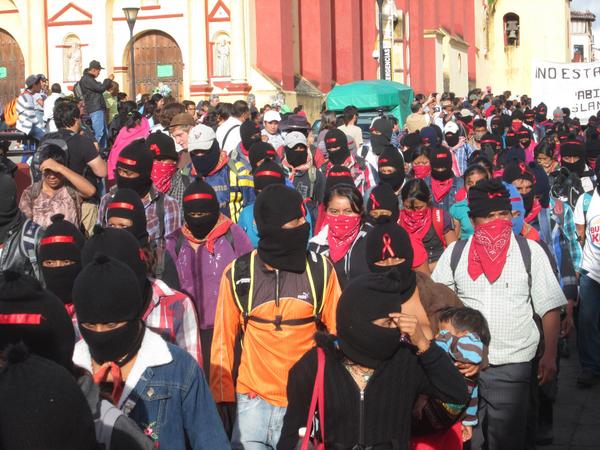
Some 20,000 indigenous men and women, milicianos and support bases of the Zapatista National Liberation Army (EZLN) among them, held a silent mega-march in solidarity with the students in Ayotzinapa, Guerrero.
With slogans like “your pain is our pain,” “you are not alone,” and “your rage is ours” on banners and signs, EZLN members came from the five Caracoles that bind the five Good Government Juntas together to San Cristóbal de Las Casas in dozens of trucks and got out in the west, at the exit for San Juan Chamula.
Some of the indigenous traveled up to 12 hours to get to this city from their communities in the heart of the Lacandón Jungle. Chols, Tsotsils, Tseltals and Tojolabals, milicianos and support bases of the EZLN arrived wearing ski masks and paliacates tied at the neck.
They formed five lines and headed towards the center of the city, entering through San Ramon Street until reaching the central park. They passed in front of the municipal presidency and returned on the parallel street to the city’s exit.
The EZLN flag and the Mexican flag were in front of the contingent. Among the Zapatista commanders, Comandante Tacho, a member of the Comandancia General del Comité Clandestino Revolucionario Indígena-General Command (CCRI-CG), could be seen with a radio in his hand for communication.
The Zapatistas did not make any stop or any pronouncement. All those wearing masks, men and women with babies in their arms, left the same way they arrived.
Like the Zapatistas, thousands of teachers added themselves to the solidarity march with the Ayotzinapa students, three of whom were murdered and 43 more are still disappeared.
In San Cristóbal, Tuxtla, Palenque, Comitán, Tapachula, Motozintla and other Chiapas cities, some 45,000 teachers from the National Coordinator of Education Workers (CNTE) went to the streets and chanted: “They took them alive, we want them alive,” “Guerrero endures, Chiapas rises up” and others.
Normal school students from all over the state of Chiapas joined them, in San Cristóbal, the Jacinto Canek Normal School, the School of Social Sciences, the National Front of Struggle for Socialism (FNLS), the Emiliano Zapata Proletarian Organization (OPEZ, its initials in Spanish) and other social organizations.
——————————————————————
Originally Published in Spanish by Chiapas Paralelo
Thursday, October 9, 2014
EZLN Support for the Students of Ayotzinapa
COMMUNIQUE FROM THE INDIGENOUS REVOLUTIONARY CLANDESTINE COMMITTEE—GENERAL COMMAND OF THE ZAPATISTA NATIONAL LIBERATION ARMY

October 2014
To the students of the Normal School (Escuela Normal) [1] “Raúl Isidro Burgos” in Ayotzinapa, Guerrero, Mexico:
To the national and international Sixth:
To the people of Mexico and the world:
Sisters and Brothers:
Compañeras and Compañeros:
To the students of the Escuela Normal of Ayotzinapa, Guerrero, Mexico, and to your family members, classmates, teachers, and friends, we simply want to let you know that:
You are not alone.
Your pain is our pain.
Your dignified rage is ours also.
-*-
To the compañeras and compañeros of the Sixth in Mexico and the world, we call on you to mobilize, according to your means and ways, in support of the community of the Escuela Normal in Ayotzinapa, and in demand of true justice.
-*-
We as the EZLN will also mobilize, within our capacities, on October 8, 2014, in a silent march as a signal of pain and outrage, in San Cristobal de las Casas, Chiapas, at 1700 hours.
Democracy!
Liberty!
Justice!
From the mountains of the Mexican Southeast
For the Indigenous Revolutionary Clandestine Committee—General Command of the Zapatista National Liberation Army
Subcomandante Insurgente Moisés
Mexico, October 2014. In the twentieth year of the war against oblivion
[1] The Normal Schools (Escuelas Normales) in Mexico are teaching colleges that principally train rural and indigenous young people to be teachers in their own communities.
Translated by El Kilombo
Raúl Zibechi: How the dominant class thinks
HOW THE DOMINANT CLASS THINKS
By: Raúl Zibechi

Chart depicting how much the dominant class keeps
The crisis continues revealing everything that would stay hidden in periods of normality. This includes the strategic projects of the dominant class, their way of seeing the world, the principal gamble they take to continue being the dominant class. That is, in broad strokes, their central objective, to which they subordinate all others, including the capitalist modes of reproduction of the economy.
One can think that the crisis is just a parenthesis after which everything would continue, more or less, to function as before. It’s not like that. The crisis is not only a revealer, but also the way in which those above are remodeling the world. That’s because the crisis is, in large measure, provoked by them to move out of the way or make disappear what limits their powers; basically, the popular, indigenous, black and mestizo sectors on our continent.
On the other hand, a crisis of this breadth (its about a group of crises that includes climate crisis/chaos, environmental crisis, health crisis and that which crosses through everything, the crisis of Western civilization) means the more or less profound mutations of societies, of the relation of forces and of the poles of power in the world, in each one of the regions and countries. It seems necessary to me to broach three aspects that don’t exhaust all the latest news that contributes to the crisis but are, to my way of thinking, those that can most have influence on las strategies of the anti-systemic movements.
In first place, what we call the economy has suffered fundamental changes. The chart [above] elaborated by the economist Pavlina Tcherneva, based on Thomas Piketty’s studies about inequality, reveals how the system has functioned since the 1970s, aggravated by the 2008 crisis.
The chart encompasses 60 years of the United States economy, from 1949 to present. It describes what part of income growth the richest 10 percent appropriate, and how much corresponds to the remaining 90 percent. In the 1950s, for example, the wealthy 10 percent appropriated between 20 and 25 percent of new annual incomes. A “normal” capitalist economy functions like that, consisting of a major appropriation by the impresarios of the fruits of human labor, which Marx called surplus value. It is the accumulation of capital through expanded reproduction.
Starting in 1970 an important change is produced that is very visible in the 1980s: the rich 10 percent begins to appropriate 80 percent of the wealth and the 90 percent remains with barely 20 percent of what is generated each year. This period corresponds to the hegemony of financial capital, which David Harvey has called “accumulation by dispossession” or (in Spanish) despojo.
But something extraordinary has been produced since 2001. The rich are left with all the new income and, since 2008, also grab a part of what the 90 percent had, as savings or wealth. What do we name this mode of accumulation? It is a system that no longer is capable of reproducing capitalist relations because it consists of robbery. Capitalism extracts surplus value and accumulates wealth (also by dispossession), but expanding capitalist relations, for that rests on wage labor and not on slave labor (I owe these reflections to Gustavo Esteva, who formulated them in the Zapatista Escuelita days and in the exchanges afterwards).
It is probable that we are entering into a system even worse than capitalism, a sort of robbery economy, more similar to the way the drug trafficking mafias function than to the business modes that we knew in the better part of the 20th Century. It is also probable that this has not been planned by the dominant class, but rather that it is the fruit of the extravagant search for profits in the financial period and the period of accumulation by dispossession, which has engendered a generation of vultures/wolves incapable of producing anything other than destruction and death around it.
In second place, that the system functions this way implies that those above have decided to save themselves at the expense of all humanity. At some time they made an affective rupture with other human beings and are willing to produce a demographic hecatomb [a slaughter of many], as the chart mentioned above suggests. They want it all.
Similarly, the way in which the system is functioning is more appropriately called the “fourth world war” (as subcomandante insurgente Marcos did) than “accumulation by dispossession,” because the objective is all humanity. It seems that the dominant class decided that with the current degree of technological development it can dispense with the wage labor that generates wealth, and no longer depend upon poor consumers for their products. Aside from the fact that this may be delirium induced by arrogance, it seems evident that those above do not seek to order the world according to their old interests, but rather to generate entire regions (and at times continents) where absolute chaos reigns (as tends to happen in the Middle East) and others of absolute security (like parts of the United States and Europe, and wealthy neighborhoods of every country).
In sum, they have renounced the idea of “a” society, an idea that is substituted by the image of the field of concentration.
In third place, this has enormous repercussions for the politics of those below. Democracy is hardly a weapon to throw against geopolitical enemies (starting with Russia and China), when it is not applied to the regimes of friends (Saudi Arabia). But, it is no longer that system to which they sometimes granted some credibility. The same must be said of the nation-State, scarcely an obstacle to overcome as the attacks on Syria violating national sovereignty demonstrate.
No other path is left to us than to organize our world, within our spaces/territories, with our health, our education and our food autonomy, with our powers to make decisions and accomplish them; in other words, with our own self-defense institutions, without depending on state institutions.
————————————————————————
Originally Published in Spanish by La Jornada
Translation: Chiapas Support Committee
Friday, October 3, 2014
En español: http://www.jornada.unam.mx/2014/10/03/opinion/026a2pol
Anatomy of a paramilitary attack on the Zapatistas
ANATOMY OF A PARAMILITARY ATTACK: A REPORT FROM SAN MANUEL
By: Mary Ann Tenuto-Sánchez
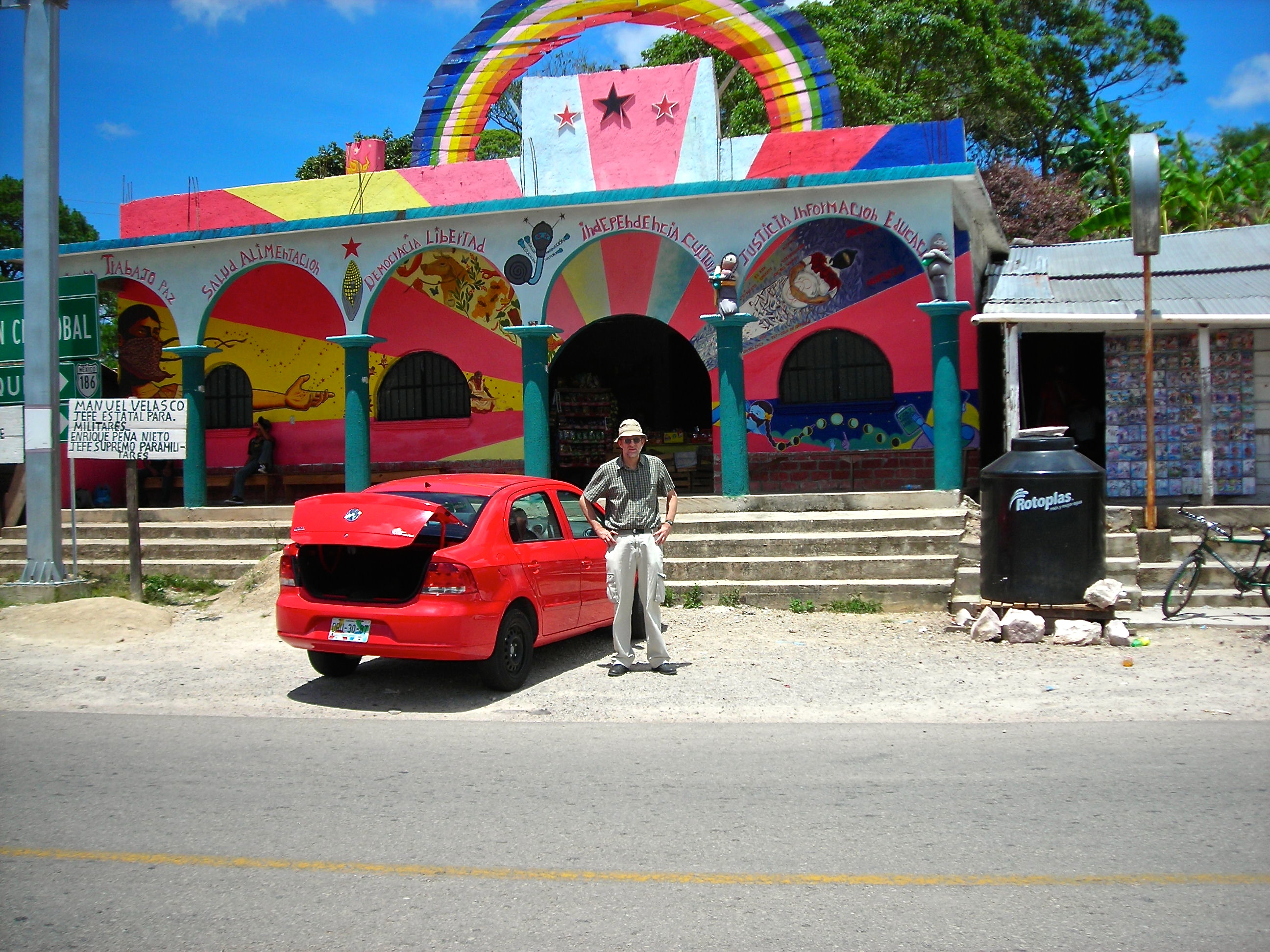
Zapatista store at the Cuxulja Crossing, Chiapas Mexico. Sept. 4, 2014
“Manuel Velasco state paramilitary chief, Enrique Peña Nieto supreme paramilitary chief”
That’s what the letrero (hand-painted sign) says in front of the Zapatista bodega at the Cuxuljá crossroads in Chiapas. Manuel Velasco is the governor of Chiapas, a member of the Green Ecologist Party of Mexico (PVEM). Enrique Peña Nieto is Mexico’s president, a member of the Institutional Revolutionary Party (PRI).
The front of the bodega is painted with an amazing mural representing the 13 demands of the Indigenous peoples that belong to the Zapatista National Liberation Army (EZLN): housing, land, work, peace, health, food, democracy, freedom, independence, culture, justice, information and education. The mural also depicts important aspects of life in the Zapatista communities: production, education, health and solidarity. It represents the collective work of various international artists in solidarity with the Zapatista Movement, including some from the United States.
Those peaceful demands and life in the Zapatista communities are in sharp contrast to counterinsurgency tactics the government applies against these communities. The paramilitary attacks on San Manuel autonomous rebel Zapatista municipio are only the most recent example. San Manuel is one of the 4 autonomous rebel Zapatista municipios (counties) belonging to Zapatista Caracol 3, La Garrucha.
On July 25, 2014, nineteen paramilitaries entered collective workspace in San Manuel armed with .22-caliber weapons. They burned the letrero saying: “Compañero Galeano lives,” fired shots into the air, constructed houses, threatened to dispossess the Zapatistas of Egipto and El Rosario of their lands, killed a young steer and then left.
A week later, on August 1, they returned and fired a few shots and killed another young steer. That night, when 32 civilian Zapatistas (women, young children and the elderly) living in the nearby Egipto autonomous community saw some of the paramilitaries coming towards the community in the middle of the night, they fled to save their lives and avoid another massacre like Acteal. The collective workspace is located on land recuperated as a result of the 1994 Zapatista Uprising.
A few days later another nearby Zapatista community, El Rosario, found a horse that belonged to one of the Zapatistas dead from abdominal injuries. And, when a Zapatista encountered one of the paramilitaries, the paramilitary said: “Be careful, because I’m going to kill you!”
The paramilitaries come from the Pojcol ejido, in the official municipio of Ocosingo. Pojcol is not located close to San Manuel. They are members of the Regional Organization of Ocosingo Coffee Growers, also known as ORCAO, its initials in Spanish.
On the morning of August 6, the paramilitaries arrived again with guns and a chainsaw. They cut trees and fired shots into the air. When they were leaving that afternoon, they fired 5 shots upon passing the house of a Zapatista. And, when passing Kexil (known by its inhabitants as Nuevo Guadalupe), they fired 2 shots over the house of another Zapatista.
One week later, on August 13, nine Zapatista families built houses (one containing a a grocery store) on the collective workspace, thereby founding the new autonomous Zapatista community of San Jacinto. Some 250 Zapatistas were also present to clear the land for planting.
The next day, August 14, in the wee hours of the morning, 18 paramilitaries, armed with shotguns and .22-caliber weapons, surrounded the collective workspace and fired their guns into the air for about 40 minutes. The attackers shouted: “these weapons we use are from the government;” and “this land is ours and does not belong to those fucking Zapatistas.” At the same time they warned the Zapatistas that they had 6 hours to leave. The 40 residents of San Jacinto left, together with the 250 Zapatistas clearing the land. The paramilitaries then destroyed the nine houses and stole the merchandise in the store. They also burned all the clothing left behind in the houses, destroyed 150 roofs made of nylon and canvas and stole the machetes that were being used to clear the land. When threats of violence continued, women and children also left El Rosario later that night.
Capitalism is responsible for the attacks in San Manuel
Two members of the Chiapas Support Committee, including this writer, visited the Caracol of La Garrucha on September 4 and 5 for several reasons, among them wanting to learn more about the San Manuel attacks and displacements described above. The Path of the Future Good Government Junta received us Friday morning and the conversation quickly turned to the San Manuel attacks.
“Each person in the region contributed a few pesos to the displaced families because they lost everything when they fled for their lives. They are trying to resolve the problem peacefully,” the spokesperson for the Junta told us. “Currently, the displaced are in ‘other communities.’ The government pays the ORCAO members to attack, but capitalism is responsible for the attacks in San Manuel,” he concluded. He also reported that San Manuel’s municipal government lost $460,000 pesos because of the attack (approximately $35, 380.00 US dollars). In response to our request to visit San Manuel and speak with the autonomous council, the Junta contacted San Manuel. We learned a little while later that San Manuel granted us permission to visit and, consequently, so did the Junta.
In a September 7 interview, the San Manuel autonomous council President said that the displaced women and children are still safe in other communities and that they continue discussions to resolve the problem peacefully, but that it was very difficult because the paramilitaries built houses on the land in question. Asked what the motive was for the attacks, the council president stated emphatically: “pure provocation. They (the paramilitaries) don’t need land; they have land in their ejido. They don’t need the trees. This was a pure provocation.”
Government retaliation for the Exchange
In its August 4 bulletin regarding the attacks in San Manuel, the Fray Bartolomé de las Casas Human Rights Center (Frayba) noted: “These new acts of harassment, territorial dispossession and attacks are presented within the framework of the First Exchange of the Zapatista Peoples and the Original Peoples of Mexico “Compañero David Ruiz García,” a meeting with the National Indigenous Congress, which began on Monday, August 4 in the Autonomous Community of La Realidad.” An understanding of this language was expanded in several San Cristóbal discussions.
Friends that attended the August 9 Report from the Exchange between the Zapatista Peoples and the National Indigenous Congress (CNI) say that Subcomandante Moisés announced to the crowd: “the government is attacking San Manuel in retaliation for us meeting here.”
Those of us that follow Zapatista events closely have seen the government’s competitive pattern of behavior. We will remember that when more than 40,000 masked Zapatistas marched in silence on December 21, 2012 in Chiapas, President Peña Nieto responded by announcing his “Crusade Against Hunger” one month later, January 21, 2013, in Guadalupe Tepeyac, deep in Zapatista Territory. He arranged with and paid for Indigenous peoples from all Chiapas municipalities to attend the event. He also brought government officials and his cabinet with him. The government claimed around 15,000 people in attendance. Marcos shot back with a comunicado addressed to “Ali Baba and his 40 thieves.” A graphic of a middle finger was included in the brief comunicado.
It’s important to remember that the PRI returned to power in December 2012, after a 12-year absence while the PAN governed. It is also important to remember that the Zapatistas rose up in arms when the PRI held power and smashed its claims to having achieved First World status. Counterinsurgency against the Zapatistas is real personal for the PRI!
The PRI’s behavior pattern turned repressive, vicious and excessively violent after the Escuelitas in December 2013 and January 2014. A friend that attended the Escuelitas during those dates said that the Zapatistas expected retaliation for the very popular and well-attended Escuelitas. It just didn’t come as quickly as the government’s answer to the resurgence of the Zapatistas on December 21, 2012. The government set it up slowly. On May 2, the CIOAC-H, a campesino organization turned paramilitary group, attacked unarmed Zapatista civilians in La Realidad and brutally murdered a Zapatista support base known as Compañero Galeano.
Finally, as the Zapatista peoples were meeting with the National Indigenous Congress, not only were the violent attacks on San Manuel occurring, but also on August 8, Enrique Peña Nieto headed a ceremony in San Juan Chamula, Chiapas, to celebrate International Indigenous Peoples Day. Hundreds of people attended, including representatives of 68 different ethnic groups.
It would seem that a clear pattern has emerged: When the Zapatistas hold an organizing event to extend and/or solidify their influence, the government either counters with a competitive response or retaliates with violent repression or both, part of its counterinsurgency plan. That plan has always had a strategy of containment; in other words, a strategy to prevent the Zapatistas from growing.
The Southern Border Strategy
In a visit to the Frayba Human Rights Center its director, Victor López, discussed both the San Manuel attacks and the Southern Border Strategy (referred to in Chiapas as ‘Plan Sur’). Frayba is working to mediate the negotiations for an agreement between San Manuel and ORCAO that would allow those displaced to return safely to their homes and communities. He echoed what we had heard about the difficulty of resolving the situation due to the fact that the ORCAO had constructed houses on the site, and he specifically said that the conditions were not safe enough to establish a peace camp. He also agreed that the attacks were in retaliation for the Exchange with the National Indigenous Congress.
“Plan Sur is a pretext,” López said, referring to the Southern Border Strategy recently implemented by the Mexican government. “The ‘containment posts’ are being used to encircle Zapatista Territory in order to contain the Zapatistas! An Army patrol even attempted to enter an autonomous community. The Zapatistas said they were autonomous and did not permit the Army to enter. The soldiers went away.”
The Plan Sur is also being used to severely repress Central Americans. It’s not really about stopping drug traffickers or human traffickers; it’s about repression and containment! It is also about criminalizing immigration-without-permission. Chiapas prisons are filling up with Central American migrants charged with crimes they did not commit. The US government of Barack Obama has pushed for the Southern Border Strategy and is providing some of the funding.
September 2014
September 2014 Zapatista News Summary
SEPTEMBER 2014 ZAPATISTA NEWS SUMMARY

In Chiapas
1. The EZLN Issued 2 Comunicados – The first is a joint demand with the National Indigenous Congress for the freedom of the Yaqui leader Mario Luna, arrested to repress the Yaqui struggle over water rights. The second comunicado is an anti-capitalist editorial by Subcomandante Moisés in the recent Zapatista Rebel Magazine. It is called: Beyond the Sharing.
2. Proposed Route for the San Cristóbal-Palenque Super-Highway – The proposed route is now public and we posted an article about the Super-Highway (with map) and the resistance to its construction from large numbers of Indigenous peoples. Written by Gaspar Morquecho, it’s a good read!
3. Three Sexta Adherents from San Sebastián Bachajón (SSB) Arrested and Tortured – They were arrested on false charges, tortured until they confessed and sent to prison while awaiting trial. The repression against SSB continues and is related to the the community resistance to a mega-tourist development and the Super-Highway.
Mexico’s Southern Border
1. Central American Migrants In Mexican Prisons – The Miguel Agustín Pro Juárez Human Rights Center (Prodh) released a report that concluded: In addition to the risk of being extorted, kidnapped, disappeared, tortured and murdered, Central American migrants run the risk of being criminalized and incarcerated by the Mexican State.
2. Immigration Agents Beat Migrant Rights Defenders and Steal Equipment – On September 18, migrant rights defenders from the “Brothers on the Road” organization, which maintains a shelter just across the Chiapas border in Ciudad Ixtepec, Oaxaca, were pulled off the train known as “The Beast,” beaten and robbed of their photographic and video equipment by Mexican immigration agents. The migrant rights defenders were investigating complaints of mistreatment from migrants at the shelter when they were pulled from the train, beaten and robbed.
In other parts of Mexico
1. Police Kill 6 Students in Guerrero; 22 Police Held – On September 26, in Iguala, Guerrero, municipal police and “pistoleros” killed 6 students of the Ayotzinapa Normal School that were organizing a collection of funds to attend the October 2 commemorative march in Mexico City. As of this writing, there is one student that is brain dead and on life support, 22 injured and 42 students listed as “missing.” Observers says that 20 of the missing were carried off in police trucks. Mexican analysts say that Iguala is a key drug trafficking city, where organized crime gangs operate. This is an ongoing story and the facts are still unfolding. According to the Los Angeles Times, 22 police have been held in the deadly attack.
———————————-
Compiled monthly by the Chiapas Support Committee.The primary sources for our information are: La Jornada, Enlace Zapatista and the Fray Bartolomé de las Casas Human Rights Center (Frayba).
We encourage folks to distribute this information widely, but please include our name and contact information in the distribution. Gracias/Thanks.
Click on the Donate button at http://www.chiapas-support.org to support indigenous autonomy.
_______________________________________________________
Chiapas Support Committee/Comité de Apoyo a Chiapas
P.O. Box 3421, Oakland, CA 94609
Email: cezmat@igc.org
http://www.chiapas-support.org
http://www.facebook.com/pages/Chiapas-Support-Committee-Oakland/
https://compamanuel.wordpress.com
3 more from Bachajón in prison on false charges
THEY SEND 3 INDIGENOUS TZELTALS TO PRISON ON FALSE CHARGES IN CHILON

Press conference in Bachajón
By: Hermann Bellinghausen
The Fray Bartolomé de las Casas Human Rights Center (Frayba), as well as the Tzeltal ejido owners of San Sebastián Bachajón, Chiapas, denounced the detention, torture and incarceration on false charges of Juan Antonio Gómez Silvano, Mario Aguilar Silvano and Roberto Gómez Hernández. The Frayba documented “cruel, inhuman, and degrading treatment, committed by members of the Chilón municipal police against indigenous adherents of the Sixth Declaration of the Lacandón Jungle.”
The organism says that on September 16, towards 4 o’clock in the morning, some 40 police arrested the 3 men while they were heading home. “Beginning at that moment they were punched and kicked, they sprayed gas in their eyes, they were handcuffed and put in a municipal police truck, already submitted and face down they stepped on their backs and hands to immobilize them.” The blows and the gas spray continued at the command post, “interrogating them about two firearms and injuries to a police agent.” The accused said that they knew nothing about the acts.
On September 17, now in the office of the Public Ministry (Ministerio Público, MP)[1] in Ocosingo, they were beaten in the presence of Rodolfo Manuel Gómez Gutiérrez, an MP agent. “They provoked asphyxia in Mario with a plastic bag and punched him in the head with the palms of their hand, insisting that he confess with respect to the firearm and incriminate himself about having shot and injured a police agent.”
The indigenous were obliged to put their fingerprint on a statement that they didn’t read to them. The Frayba emphasizes that they don’t know how to read or write, also that their language is Tzeltal. “They didn’t have a translator or a trustworthy lawyer.” On September 18, they were assigned to prison. “Upon rendering their preparatory statement before Judge Omar Heredia, they achieved that he would take judicial notice of their injuries, assigning it to the MP’s attorney to initiate corresponding investigations for probable acts of torture, supporting them within the State Law for Preventing and Sanctioning Torture.” The Frayba questions the behavior of the Chilón municipal police and the MP’s office in Ocosingo “for the use of torture as a method of police investigation.”
The organism asks the state’s Attorney General of Justice to investigate the behavior of the police agents and of agent Gómez Gutiérrez of the MP “for the crime of torture, codified in the Chiapas Penal Code.” Besides, it warns, “the judge that is familiar with the cause of action against Juan Antonio, Roberto and Mario, must throw out the illegal evidence obtained under torture.”
During the Independence Day festivities in the early morning of September 16, shots were heard in the municipal capital of Chilón and a police agent was injured. Juan Antonio, Roberto and Mario were at the festivities and were walking to their homes when they arrested and accused them of shooting the injured police agent, Alfredo Bernabé Aguilar Fuentes.
The Tzeltal ejido owners point out that the apprehension and torture of their compañeros were carried out on orders from municipal commander Francisco Sanchez Guzmán. Not any official agency recognized having the detainees for several hours. They were able to see them on September 17 in Ocosingo: “They were all beaten. We wanted to speak with them but the municipal police had surrounded the legal office and only let family members pass, not the community authorities.” The MP tortured them; he pointed a pistol at Mario’s head “so that he would incriminate himself.”
The prisoners identified among their captors the police agent Agustín Sánchez Jiménez, “a friend and neighbor of Sebastián Méndez Hernández, currently a prisoner because of the murder of Juan Carlos Gómez Silvano (on March 21, near Virgen de Dolores, where they fired more than 20 shots at him).” The ejido owners consider that: “it is revenge for seeking those responsible for the murder of our compañero.”
The ejido owners also demand the freedom of Santiago Moreno López and Esteban Gómez Jiménez, incarcerated at Playas de Catazajá (since 2009 and 2013, respectively) with false charges, as part of the constant persecution that the ejido owners suffer.
______________________
Translator’s Note:
[1]. The local Public Ministry is similar to a local District Attorney’s office.
———————————————————–
Originally Published in Spanish by La Jornada
Translation: Chiapas Support Committee
Thursday, September 25, 2014
En español: http://www.jornada.unam.mx/2014/09/25/politica/016n1pol
EZLN: Moisés: Beyond the sharing
EDITORIAL 3: BEYOND THE SHARING
[This editorial appears in Spanish in Number 3 of the Revista Rebeldía Zapatista.]
The Sharing is something beyond.
Compañeras and compañeros of the Sixth in Mexico and the world:
For us, the sharing [1] was a way to take each other’s hands, to see one another and how we are doing and what we are thinking.
It was a chance to get to know each other, those of us who are below and who are the original peoples of these lands.
And it wasn’t an exchange for representatives or leaders, but for the bases of our peoples, nations, and tribes who hadn’t had the chance to take each others’ hand and get to know each other and touch each others’ hearts for the last 520 years.
In the Zapatista Caracol La Realidad, our desire to be together, to exchange our words as indigenous men and women, became a reality.
When we speak to each other as [community] bases, not as leaders, we understand each other; we feel that we live in common.
And what allows us to understand each other so quickly is the life that we are living, a bad life, and a life that is no longer only ours but is now also that of poor men and women in the cities.
We talked about how capitalism has us cornered, how and why it has imposed itself on us, and what will happen to us if we continue on as capitalism has dictated.
In 5 days and across the 28 languages spoken among those who gathered, we came to agreement on what our path will be with the exploited people of the city and the countryside.
Our gaze became wide and we agreed that we must unite with people from the cities and countryside. We need to share with the compañeros of the Sixth in Mexico and the world in order to know about their struggles of rebellion and resistance. We want those compañeras and compañeros who are the actual [community] bases to come share with us.
We say the actual community bases from below because they are the ones who know how a new society will be born. They do not come from the political parties, or the new political parties, nor from politicians and political personalities, who are all servants of capitalism.
Peoples, nation, tribes, poor neighborhoods, poor workers, the exploited of the countryside and the city: these are the people who know how a new world should be, how a new system of governance could work. Why, because they are the ones that have suffered injustice, poverty and inequality. They have suffered sadness, pain, bitterness and loneliness. They have suffered imprisonment, torture and disappearance. They have suffered century after century of deceit, discrimination, horrible things, inhuman cruelties, humiliation, dispossession, and displacement. They have suffered centuries of mockery and a life without peace because of those above—the capitalist system. The political parties of the politicians are covered in the mud of that system. Our backs have been used as ladders for politicians to climb to power; our backs are well trodden from so much climbing up and down by that mafia.
We talked about many other things; there were hundreds of proposals and we have agreed on the most important one to work on: to return to our peoples, nations, and tribes and multiply and make this first exchange bigger; and to prepare another exchange with the compañeras and compañeros of the national and international Sixth.
Many other things, rich, clear and true, came from this exchange between the community bases of our peoples, nations, and tribes.
In the exchange it was said that there has always been someone else speaking for us, claiming to fight for us, during 520 years of lies and exploitation.
It was said that the large landowners used the struggle of the poor in Mexico in 1810 and 1910 in order to bring themselves to power, and it is their great grandchildren that are in power today, damaging and destroying our mother earth in this country that we call Mexico.
All of us returned to our homes with strength and dignity, like our compañeros GALEANO [José Luis Solís López] and DAVID [Ruiz Garcia], who will both always be with us, like all of our compañeros fallen in the struggle.
We returned with new tasks so that we may find a better path for our future.
We have met each other and learned, learned a lot, and there is much more to do to get to know each other as original peoples of this land, as well as nationally and internationally. That is where this path is headed.
We want to struggle together also with those who aren’t indigenous, with the compañeras and compañeros of the Sixth, brothers and sisters of the countryside and the city. We want to struggle together, because no one is going to struggle for us.
So, compañeras and compañeros, get ready for the Worldwide Exchange to be held December 22, 2014, through January 3, 2015.
There in that exchange our wisdom will tell us how our struggle will go forward.
Let it be our bases that run this exchange; let them be the ones who have the floor, who talk and explain our struggles in each place where we live, work, and struggle.
We have seen that it is best that the bases speak. This isn’t what we Zapatistas say; it is what became reality during the exchange in the Caracol of La Realidad. Let the people rule.
Subcomandante Insurgente Moisés
Mexico, August 2014. In the twentieth year of the war against oblivion
[1] Translator’s note: “Sharing” (which has also been translated as “Exchange”) is the English translation of the Spanish word “Compartición,” the Zapatistas’ name for the event held between the EZLN and the National Indigenous Congress from August 4th to 9th of this year. “Sharing” and “exchange” are used interchangeably in this translation in the sense that the indigenous peoples shared (exchanged) ideas, struggles, experiences and proposals with each other.
——————————————————————–
Originally Published in Spanish by Enlace Zapatista
http://enlacezapatista.ezln.org.mx/2014/09/19/editorial-3-mas-alla-de-la-comparticion/
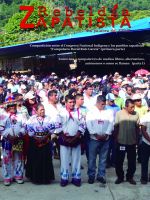
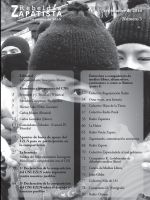
Cover page
Opposition to Chiapas Super-Highway
CHIAPAS INDIANS IN DEFENSE OF LIFE AND TERRITORY
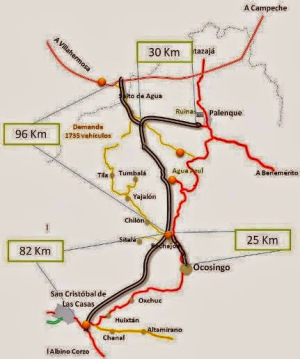
This shows the route of the super-highway from San Cristobal to Palenque.
By: Gaspar Morquecho
Laguna Suyul, San Juan Chamula, September 7, 2014
A little more than 2,000 people, between boys and girls, men, women and elderly people met in Laguna Suyul, convoked by the ejido members of La Candelaria. They were Tzotzils, Tzeltals, Chols and Tojolabals from the municipalities of San Cristóbal de Las Casas, Zinacantán, San Juan Chamula, Huixtán, San Pedro Chenalhó, San Pablo Chalchihuitán, San Juan Cancuc, Tenejapa, Amatenango, Chilón, Tila, Salto de Agua, Comitán and Las Margaritas. In this assembly of peoples they demonstrated their rejection of the San Cristóbal de Las Casas to Palenque super-highway project.
The activities started at 8 o’clock in the morning when Principales (traditional religious authorities) of La Candelaria ejido met to hold a ceremony at the Suyul Lagoon and in the temple that they have constructed every year to celebrate the Holy Cross. They burned incense, lit dozens of votive candles, played their music and prayed, “to give us strength, to not get tired in this struggle and to talk to Mother Earth so that it doesn’t let them come to destroy her.”
The place is a hollow with an environment of pines and some milpas. A small hillock stands in the center- an islet with trees and surrounded by waters from the place’s springs, the majority covered aquatic plants. At 10 o’clock in the morning, hundreds of people were waiting for the start of the assembly in that place.
The assembly started with the speech of a representative of La Candelaria ejido: “This is a very important meeting for us. We are in a sacred place and the government’s project comes to destroy it. They want the super-highway to pass close to this lagoon, like 500 meters away and we are not going to permit it. We will not let the government crush us. We have to join our voices and think what we are going to do to stop the government’s plans.
Two speeches followed him with information about the big neoliberal projects in Mexico, Central America, Chiapas, and in indigenous territories. Several of them are underway: mines, dams, ecotourist centers, exploitation of oil fields, highways, ports, airports; planting of GMOs and biofuels and the containment and counterinsurgency programs that started in Chiapas in the 1970s.
The work could not continue without holding community prayer. They planted a small cross, decorated with flowers. They planted a dozen candles and prepared the incense burner. They burned the candles and the burned incense perfumed the place; an offering to their God. There was the murmur of hundreds of people praying, of the petitions to their God, made from that space, from their sacred place… a place of communion.
That moment full of symbolism gave way the concrete. The figure of the Ejido and its ejido authorities that were made invisible for decades by the indigenous and campesino social movements once again occupied the place that is due them in this conjuncture. It is the organization of the farmworkers with the legal standing to defend land and territory, just like the Communal Lands and Communal Land Commissions are. The representatives of the Salto de Agua ejidos gave their word this way: “I come representing the San Miguel ejido, a place with Chol Maya speakers. On June 1, 2014, gathered together in an ejido assembly, we agreed to reject the super-highway project.” The representative of the Francisco I. Madero ejido continued: “God has given the land to us. We are not birds that live in the air, nor fish that live in the water. We live on the land and we must and we are going to defend it.” The representatives of Adolfo Ruiz Cortines ejido, also from Salto de Agua, affirmed that last September 15, the 70 ejido members of that place agreed: “to defend the indigenous peoples’ lands” and called for “joining efforts,” and proposed the construction of “a front of struggle” and raised the demand for a “consultation with the peoples.” In their speeches they reported that they have updated their internal rules to better guaranty the interests of the ejido owners.
The representatives of the San Jerónimo Bachajón ejido reported that in those hours, hundreds of their compañeros carried out a mobilization in Temó and that by agreement of their assemblies they reject the super-highway project. They added that they have named a commission to take the documentation and agreements from their assemblies to the Chiapas government and that “if they are not taken into account they will carry out new protest actions.” He called for unity and “to not let the big corporations conquer us.” They also reported that the ejido owners of San Martín Cruz have wanted to humiliate them for not signing the agreement for the super-highway and that in response the ejido owners took two municipal patrol cars that guard their community. He denounced that they are watched, persecuted and threatened for not accepting the super-highway project.
For their part, Indigenous representatives from Pueblo Creyente (Believing People) of Tenejapa announced that 52 communities in their municipality are not going to permit the super-highway’s passage; that the municipal authorities have called them but, they affirmed, “as Pueblo Creyente we are not going to fall into the deceit, we are not going to permit the passage.” Representatives of Huixtán and Chenalhó parishes agreed. Representatives of Matzam in the municipality of Tenejapa, denounced that “the super-highway is going to pass very close to their sacred mountain and they want to leave it as a tourist zone.” They warned they will not give passage to the highway and that they would continue: “to attend the meetings.”
The San Juan Cancuc representatives reported that: “their municipal authorities may be in agreement with the construction of the super-highway (but) we are against it” and they added that on September 16, in compliance with the agreement with the Movement in Defense of Life and Territory, they placed banners in “opposition to the government project,” and that the police pursued they and, nevertheless, they said: “we are going to continue united, because there are many communities in Cancuc struggling.”
The Ejido Commissioner of San Antonio Las Rosas, neighbor of La Candelaria warned: “We stay united with Candelaria. We are going to stay strong like all the communities that are here (present).”
In his talk the representative of La Candelaria ejido said: “We are seeing communities and ejidos that are willing to defend our life and our Mother Earth. It’s about defending it for our children. We invite the Bishop (Felipe Arizmendi) to place himself at the side of the poor; that he may defend the men and women that are in this union. We also call on all the pastors of the other churches to not abandon their faithful. May the pastors care for their sheep! May we not be divided b y parties or religions! The government’s project affects all of us, without distinguishing. We are gathered together here to begin walking although threats exist. They are not going to kill this movement. They cannot kill our spirit. We see that we can do it with the unity of the communities.
The assembly agreed to report: “the true word of the original peoples of Los Altos of Chiapas.
From the heart of the peoples we make known the true word of boys, girls, youth, the elderly, men and women in defense of life.
Mother Earth is the millennial gift that our grandparents have cared for and defended for generations. They cared for it and now it’s our turn to take care of it and defend it, if necessary with our own life.
We will defender the environment, the fabric and veins of Mother Earth, rivers, lakes, water holes, mountains, trees, caves, hills, the life of the animals, the sacred places, the ecosystem of m other nature and the life of human beings.
Our Mother is not for sale, the land is not for sale and has no price.”
The comunicado denounces: “the government’s lies to the peoples.” The offer of the “transnational mega-projects that bring death” that: “make the rich richer” and “the poor poorer.” They warn that they will not permit that: “they continue violating their rights.” They demanded respect for Convention 169 of the ILO, the “precise declaration on the collective and individual rights of indigenous peoples; their rights to land, wealth, vital resources, territory, culture, identity and language, to employment, education, and to freely determine their political condition and their economic development.”
They called on their brothers “to stay alert” facing the eventual government “repression, the purchase of leaders, and the threats;” alert facing a government that “murders” and “disappears people.”
“From this moment we hold the federal, state and state governments responsible for what can happen to us for defending our life, for caring for what is ours, for preserving what is the source of our food and our life.
For our Mother Earth and Life.”
The Tzotzils, Tzeltals, Chols and Tojolabals concluded their communion planting 260 trees on the outskirts of the small slope. The Zinacantecos’ outfits, and those of the Chamulans and the Tenejapans were confused there with the clothing of non-Indians. They left the place in a long line crossing the lagoon over a small wooden bridge and misty waters of Suyul.
————————————————————–
Originally Published in Spanish by Chiapas Paralelo
Translation: Chiapas Support Committee
Friday, September 19, 2014
CNI and EZLN Demand Freedom for Mario Luna
CNI and EZLN Demand Freedom for Mario Luna, Yaqui Tribe Spokesperson
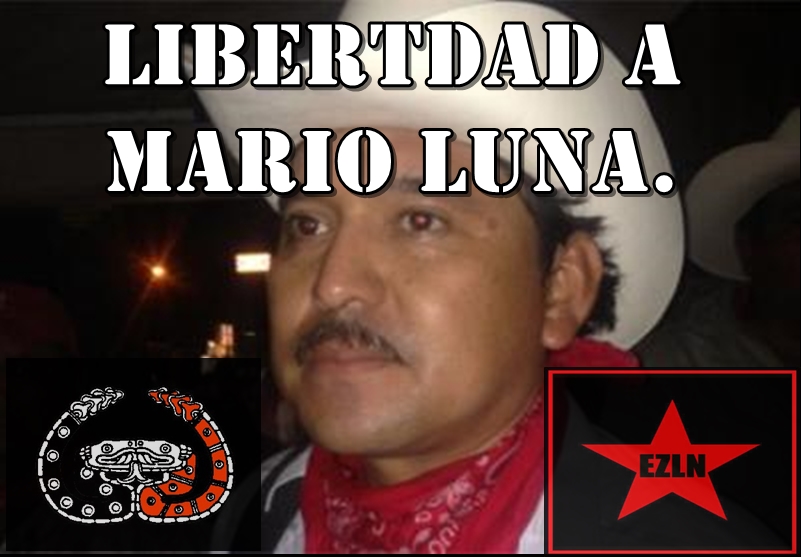
Mario Luna
September 2014
To the Yaqui Tribe:
To the People of Mexico:
To the National and International Sixth:
To the Governments of Mexico and the World:
“We demand the immediate cancellation of all arrest warrants and fabrication of crimes against members of the Yaqui Tribe, and we condemn the criminalization of their struggle. We say to the bad governments that come from the political parties: the Yaqui River has served as the historical carrier and ancestral continuation of the Yaqui Tribe’s culture and territory. We who make up the National Indigenous Congress reiterate that if you touch any of us, you touch all of us, and we will respond accordingly to any attempt to repress the Yaqui’s dignified struggle or any other struggle (Joint communiqué from the CNI-EZLN, July 7, 2013, Caracol of Oventic).
They have not been able to kill our peoples. Like seeds, we continue to grow. They tried to kill us with guns, and when they couldn’t, they tried to kill us with diseases, and again they failed. The powerful have tried many ways to kill off the indigenous.
Today they want to kill us with wind turbines, highways, mines, dams, airports, and drug trafficking. Above all, today in particular, we feel the pain of the attempt to kill us in Sonora, with aqueducts.
This past Thursday, September 11, people who apparently belong to the Sonora State Attorney General’s office detained our brother Mario Luna, spokesperson for the Yaqui Tribe, falsely accusing him of crimes that they themselves planted.
With this action they intend to imprison the very struggle of the Yaqui Tribe for defending its waters, which, after a long war, were recognized as theirs in 1940 by Lázaro Cárdenas. Since 2010, the money-owners want to again take these waters by way of the Independence Aqueduct, in violation of a resolution emitted by the Supreme Court of Justice of the Nation and violating all of the rights given us by International Conventions on such matters.
It is a joke to say that the Independence Aqueduct is so that the poor have water and progress, as those above say; it is so that the rich can take possession of the water that for centuries has belonged to the Yaquis. Instead of feeding fields and crops, they want to divert the water to large industrial companies in Sonora.
This plunder has been the banner of progress for the bad governments, with State Governor Guillermo Padrés Elías and Supreme Paramilitary Chief Enrique Peña Nieto at the head of the project. Just as the dictator Porfirio Díaz proclaimed the extermination of our peoples in the name of this kind of progress, in particular the extermination of the Yaqui Tribe, we know that the words of Padrés and Peña Nieto are lies. For these megaprojects to exist, we original peoples must disappear, and once and for all we tell those above that we have no plans to disappear. They detained our brother Mario Luna because he refused to sell out or give in, because he has been a brother in struggle to all of us who want this world to change below and to the left.
We don’t ask anything of the bad governments, and at this moment we want to tell them clearly one thing: our compañero Mario Luna’s freedom does not belong to them and they cannot take it away just like that. We want to make clear that his freedom belongs to him and his people, and that what was taken by force must be returned.
To our compañero Mario we want to say that we have walked together for more than 500 years. His tribe walks the path of struggle; even if the cowardly government sends them as slaves to the other end of the country, the Yaquis return to Vícam, Pótam, Tórim, Bácum, Cocorit, Huiriris, Belem and Rahum, because that is where their blood flows. We want to say that we are Yaquis, even though we might also be Zoques or Mames or Tojolobales or Amuzgos or Nahuas or Zapotecs or Ñahto or we speak any other language, and as the Yaquis that we are we will not let them rob us of our water or our freedom.
We demand Mario Luna’s immediate release, and we demand the cancellation of all arrest warrants and fabrication of crimes against members of the Yaqui tribe. We also demand the freedom of all of our prisoners, in particular our Nahua brothers Juan Carlos Flores Solís and Enedina Rosas Vélez, who were imprisoned by the bad government in April of this year and falsely accused of crimes in order to stop the struggle of the Peoples Front in Defense of Water and Land of Morelos, Puebla, and Tlaxcala, organized against the Integrated Morelos Project.
Mexico, September 2014.
Never Again a Mexico Without us! For the Holistic Reconstitution of our Peoples!
NATIONAL INDIGENOUS CONGRESS
INDIGENOUS REVOLUTIONARY CLANDESTINE COMMITTEE-GENERAL COMMAND OF THE EZLN
Originally Published in Spanish by Enlace Zapatista
 Chiapas Support Committee