Chiapas Support Committee
Home of the Compañero Manuel blog on zapatistas & mexico

Highway accident of Marichuy and her team in BCS; 1 dead and at least 8 injured

The Nissan CZV Van in which the indigenous pre-candidate to the Presidency and various council members were traveling turned over at kilometer 102 of the Trans-peninsular Highway of Baja California Sur, characterized by the danger that it represents for those who are not familiar with it. Photo La Jornada
By: Antonio Heras and Raymundo León
Mulegé, Baja California Sur (BCS)
One of the three vehicles on the caravan of María de Jesús Patricio, spokesperson for the Indigenous Government Council (CIG, its initials in Spanish) and an aspirant to be an independent candidate to the Presidency of the Republic, suffered an accident yesterday afternoon at kilometer 102 of the Trans-peninsular Highway, at a spot in the municipality of Mulegé. One person died and eight were injured, among them Marichuy.
Raúl Cepeda, a Red Cross aid worker in Vizcaíno, reported that the person who died responds to the name of Eloísa. Marichuy suffered a fractured left arm and council member Francisco Grado broke his hip.
The other injured have been identified as council member Lucero Islava, Juana Villa Poblano, Lorena Moreno, Ramona Avilés and Antonio Ciego.
Cepeda explained that the accident occurred around 4:30 pm, when the Nissan CZV Van left the highway and turned over on the San Ignacio-Vizcaíno stretch, in the state’s northern part.
The Trans-peninsular Highway is in pitiful condition, besides the fact that it is very narrow, because of which it is a risky road for anyone that does not usually travel on it.
Eleven members of the CIG were traveling in the unit del CIG; they were from the coordination of the National Indigenous Congress (CNI) and from the networks of support for the CIG in Baja California Sur.
The injured were moved to a Social Security clinic in Vizcaíno, where they received first aid. Minutes later, Marichuy was taken to a hospital in Guerrero Negro.
At night, all the injured were taken in an air ambulance to La Paz. The state of health of Francisco Grado, who belongs to the Cochimí ethnicity, one of the original peoples of Baja California, was reported as stable and out of danger.
Condolences from the President
On his Twitter account, President Enrique Peña Nieto lamented the accident that María de Jesús Patricio Martínez and her companions suffered.
The president published two messages in which he also points out that the Navy Secretariat is supporting to lend medical attention and land and air transportation to those affected. “I send my most sincere condolences to the family of the person that lost her life in this incident and I wish the injured a speedy recovery,” he wrote.
Meanwhile, the Secretary of Governance, Alfonso Navarrete Prida, reported that the blows that Marichuy suffered do not put her life at risk. On his Twitter account, the official wrote: La@SEGOB_mx will remain attentive to her evolution and the doctors will give the corresponding reports.”
The presidential pre-candidate of the Todos por México Coalition, José Antonio Meade, also published on that social network: “I lament the highway accident that the caravan of María de Jesús Patricio Martínez, Marichuy, suffered. My prayers go out to her and all of her team. We are attentive.” @JoseAMeadeK.
Ricardo Anaya, pre-candidate of the Por México al Frente alliance, published: “I lament the accident that María de Jesús Patricio and the members of her team suffered. I express my solidarity to Marichuy and all her compañeros.
Later that night, Andrés Manuel López Obrador, of the Together We’ll Make History Coalition, published on Twitter: “I lament the accident that María de Jesús Patricio Martínez, Marichuy, and her companions suffered. I express my condolences to the family members of the person that lost her life and I wish those who were injured a speedy recovery.”
(With information from Notimex)
————————————–
Originally Published in Spanish by La Jornada
Thursday, February 15, 2018
http://www.jornada.unam.mx/2018/02/15/politica/013n1pol
Re-Published with English interpretation by the Chiapas Support Committee
The strategy of the 1% and ours
 By: Raúl Zibechi
In recent days two facts illuminate the strategy of the richest 1 percent of humanity. Towards the end of January the media divulged an Oxfam study, wherein is asserts that of all the wealth generated in 2017 in the world, 82 percent went into the hands of the richest 1 percent, while half of the population received absolutely nothing. The economy only functions to benefit a tiny minority that concentrates more and more power.
The second fact comes from the Davos Forum, where the sector that represents the interests of the 1 percent meets. All the chronicles assure that the CEOS of the multi-nationals and the world’s most powerful men (there are few women), were happy and converted the annual gathering in the Swiss Alps into a real party. Almost all of them arrived in private jets; they paid $245,000.00 for the four days of meetings and conferences and access to the private sessions.
They actually have plenty of reasons to be happy. Things, “their” things, are going wonderfully. Stock market quotes on Wall Street have multiplied by three since the 2008 crisis. The Dow Jones index was at 8 thousand points during 2009 and these days it quotes at 26 thousand; a permanent scale, although the economies are stagnant or barely grow. There is no data about the real economy that supports the exponential growth of the stock markets, which shows its disconnection from production and its conversion into mere casinos.
The data that show the hoarding of wealth reveal the silent strategy of the 1 percent. More than 80 percent of the wealth that is generated in the world is for them. Around 20 percent goes to almost half of humanity, that which gazes into the mirror of wealth and aspires, with or without sense, to be close to the wealthiest hoping to get some of the crumbs. For the other half, nothing, there is no future, only poverty and repression.
Domination always seeks to support itself on three legs: the ruling classes, the middle classes and the popular sectors. The art of domination has always been to maintain itself based on hegemony, which is attained by offering a place to the middle and selling the illusion of progress to those most below.
In the golden periods of capitalism, between the end of the Second World War and the real crisis of socialism (approximately 1945 to 1991), society functioned integrating workers by means of a stable wage with full rights. That permitted them to obtain security for their families, who hoped (and often achieved) the so dreamed of social ascent. The middle classes were now in a more or less confortable position. Those were the years of development and the culture of consumption.
That strategy failed, for various reasons: decolonizing rebellions in the third world; factory rebellions against oppressive work in the first world; the rejection of patriarchy and machismo by women throughout the world, youth rebellions on the big cities; massive occupation of the cities by waves of migrant campesinos, and several revolutions like the ones in Cuba, Viet Nam and the red guards in China, among many others.
The truth is that the ruling class started to redeploy itself, to construct walls to defend its interests and to ignore the rest of humanity, in particular the poorest 50 percent and, at times, most rebellious. It set aside the integration of workers, a strategy that it has devised to neutralize the shock wave of the Russian Revolution (1917).
Now, the 1 percent hoists a strategy that consists of reducing the planet’s population in half, as some studies of the Bilderberg Club point out, another space of the wealthiest. It is true that they are more or less well-founded speculations, because the 1 percent does not risk publicizing its intentions, like they don’t do it each time they decide to undertake genocide against the popular sectors.
That strategy comes sweetened, as León Felipe would say, with stories. The cries of anguish and the weeping, writes the poet, “drown with stories.” One of those stories, the most terrible for efficiency, are the promises of rights, citizenship and respect for the popular will. “The Brazilian political system is a cadaver rotting in the open,” an analyst maintains after the sentencing of Lula. Maybe that’s why the Sao Paulo stock exchange breaks all records.
One of the preferred tactics of the strategy of the 1 percent is electoral fraud. There are three kinds, according to what experience tells us: post-electoral fraud, as happened recently in Honduras; fraud before, during and after the voting, a technique that has been applied in Mexico at least since 1988; and, the third is to accept the winner and then bribe him and/or threaten him with death. That latter is what happened in Greece, according to Yanis Varoufakis, the former minister of Syriza, who experienced it from the inside.
There are more techniques for ensuring the power of the powerful, the coup d’état with genocide (like in Chile and Argentina, among others) being the most extreme. What’s clear is that the 1 percent has been armored: it has the power of money, of legal weapons, illegal weapons and of the communications media. It accumulates more power every day.
It’s evident that, today, we cannot defeat them, neither by bad or good. So? Those of us below are the problem, because it’s up to us whether we continue to believe in the stories from above; stories that had some credibility when the system aspired to integrate us. The problem consists in continuing to trust in unsustainable strategies, because the material and social bases that made them possible no longer exist.
As we are not going to surrender, the path must be to construct the new. To survive in the storm, we have no other option than to construct two, three, many Noah’s Arcs (as Che said with respect to Vietnam), autonomous spaces for facing the collapse to which those above lead us.
———————————————————–
Originally Published in Spanish by La Jornada
Friday, February 2, 2018
http://www.jornada.unam.mx/2018/02/02/opinion/019a1pol
Re-Published with English interpretation by the Chiapas Support Committee
The word of Marichuy

Marichuy touring the Lacandón Jungle with Zapatista women.
By: Luis Hernández Navarro
We didn’t bring you caps, T-shirts, umbrellas, sandwiches or food supplies, María de Jesús Patricio says in some of the meetings on the tour she leads. What we bring is the word that they sent us to say.
María de Jesús Patricio –her family calls her Marichuy– is the traditional Nahuatl doctor that serves as a spokesperson and candidate to the Presidency for the Indigenous Government Council (CIG, its initials in Spanish). The word that she takes to the communities is what the original peoples that make up the council send her to say.
Since last October 14, Marichuy has toured a large part of the country. She doesn’t stop. As of now she has traveled to Chiapas, Campeche, Yucatán, Quintana Roo, Tabasco, Veracruz, Puebla, the state of Mexico, Morelos, Hidalgo, Colima, Jalisco, Aguascalientes, Zacatecas, San Luis Potosí, Querétaro and Ciudad de México. In the majority of those states she has not held meetings in the big cities, but rather in remote communities (many with difficult access) where the indigenous peoples live and struggle.
In those meetings, María de Jesús has talked, but also listened. Last January 9, in Desemboque, Pitiquito, Sonora, she summed up what those other voices have told her: “We have heard the different pains that these communities are experiencing, above all those of southern Mexico.”
The large number of women that participate, organize, lead and take the word in these events surprises her. Half of the sky, usually invisible in political campaigns of the institutional parties, occupies an immense space in the tour of the CIG’s spokesperson. It’s as if the walk of Marichuy had opened an enormous bouquet in the traditional ways of doing politics, through which the organized women of the Mexico of below have become involved to take control of their own destiny.
María de Jesús never speaks in her own name, but rather of the peoples that elected her as their spokesperson. She doesn’t use the word I, but rather we. In the meetings she doesn’t ask people to vote for her, she calls to organize. She doesn’t say you struggle, but rather let’s struggle together. She doesn’t ask that they support, help her or follow her: she invites us to think together in the Mexico that we want, to begin to walk together and not stop, to organize and struggle in common.
Why do María de Jesús Patricio and the CIG participate in the electoral conjuncture if they are not in agreement with political parties? Why do it if they consider that those parties have divided and confronted the communities? She has explained it time and again.
They participate in the electoral contest no to arrive in power or to be like those above, but rather because they want: “that they turn around to look at our indigenous peoples and listen to the problems that they have.” It’s because they seek to make clear “that the peoples are not in agreement with the way in which those who have power and those who have money are agreeing there above.” It’s because they need to denounce the imposition on the peoples of mega-projects that have brought destruction and death, contamination and deforestation. It’s because they must prepare to confront the war that’s coming from the corporations, the governments and the drug trafficker, together with the violence that always accompanies them, be it from their groups of police, soldiers or criminals. It’s because she urges them to stop the murders, the disappearances and the incarcerations that they suffer in order to defend their lands, territories and natural resources. It’s because they no longer want to be ignored, abandoned and humiliated. It’s because there are communities that are at the point of disappearing. It’s because it depends on them “that there is still life for those who come back.”
“We are going to participate in this process –the CIG’s spokesperson said last January 12 in Mesa Colorada, Guarijio territory– so that the media will turn around to look and they will see that our peoples are suffering, that they have land problems, that they have problems with contaminated waters, that they have problems with mines that come and contaminate with open sky (mining), that there are hydroelectric dams, that there are gas pipelines, that there are wind farms that contaminate the land, that there are GMOs that are contaminating our crops, our corm, our beans.”
Marichuy’s word is not directed only at the indigenous peoples, but also at workers of the countryside and the city, women, youth, students, workers, teachers, because –she explains– “this capitalist system is not only in our peoples, it’s everywhere, it’s all over the world.” In this struggle, which is a proposal from the peoples –dice– “all those fit that feel that this Mexico is ours, and that a few are appropriating it, the few that have the power and that have the money, and that we aren’t useful to then, we upset them.”
In few countries in Latin America are there as many resistance struggles as in Mexico. Nevertheless, they are mostly scattered and isolated, like beads of a necklace on which the thread that binds them has broken. On her path through the towns and communities in resistance, Marichuy and the CIG seek to re-string those beads so that they form a necklace capable of changing the direction of history.
The horizon of their proposal –Marichuy has insisted– doesn’t stop in 2018, but much beyond that. In the manner of the indigenous peoples that are accustomed to dreaming another way, they vindicate a power that must be below, capable of saying how the rulers should be; a power that tells the government what it must do and not the other way around.
At a time in which the group of parties with registry has run to the right, the CIG and its spokesperson are making a campaign below and to the left. While the majority of the candidates talk about inequality, corruption or insecurity, Marichuy names with all their letters what the others keep quiet: the dispossession, exploitation, racism and oppression provoked by capitalism, and the need to organize and struggle against them. That’s the reason she doesn’t bring caps, T-shirts, umbrellas, sandwiches or food supplies, but rather the word of the peoples, Marichuy must appear on the electoral ballot for electing the President of the Republic.
———————————————————–
Originally Published in Spanish by La Jornada
Tuesday, January 23, 2018
http://www.jornada.unam.mx/2018/01/23/opinion/017a2pol
Re-Published with English interpretation by the Chiapas Support Committee
EZLN: 24 years of dignity and ethical congruence

Sups Galeano and Moisés at ConSciences
By: Gilberto López y Rivas
Last January 1 one more anniversary was completed of the uprising of the Zapatista Mayas by which the existence of an insurgent group in the majority composed of Indigenous was made public, and which based on Article 39 of the Constitution declared war on the “bad government” of the usurper Carlos Salinas de Gortari. Twenty-four (24) years after that event of multiple historical meanings, which shook Mexico and the world, the First Declaration of the Lacandón Jungle, in which the Zapatista National Liberation Army (Ejército Zapatista de Liberación Nacional, EZLN) addresses the PEOPLE OF MEXICO (like that with capital letters), remains more valid than ever: “We, upright and free men and women, are aware that the war we declare is a last but just measure. The dictators have been applying an undeclared genocidal war against our peoples for many years, therefore we ask for your decided participation in support of this plan of the Mexican people that struggle for work, land, housing, food, health, education, independence, liberty, democracy, justice and peace.”
That genocidal war that the Zapatistas denounced in 1994 not only didn’t cease, but rather intensified until making Mexico the second deadliest country, after Syria, according to the International Institute of Strategic Studies of London, which identifies an “unrecognized armed conflict,” as a human catastrophe in which the prolongation of homicidal violence lasts for more than a decade, with constant intensity. At the same time, the structural reforms promoted by the governments of national betrayal that have succeeded each other during these years through the regime of State parties, that legalize re-colonizing dispossession and the de-nationalization of territories and strategic resources, as well as the Homeland Security Law, that legalize the militarization of the country and the heavy hand of the armed forces against the people, have provoked that the Zapatista demands are more current and legitimate all the time. Mexico starts this year of 2018 in the worst situation that has been recorded since that other armed conflict from 1910-1917, which cost the lives of a million peoples, when the total population was 16 million.
During these 24 years, the EZLN has persisted in its emancipatory plan, and time and again they summon us in different ways with different initiatives to all Mexicans to join their plan to radically transform the tragic national reality. We remember the opening of the San Andrés Dialogue to civil society, the National Democratic Convention, the March of the Color of the Earth, the Intergalactic Gatherings, the Escuelita, the seminars for stimulating critical thought in intellectuals, artists and scientists, and the multiple forms of being in solidarity with the struggles of those below and to the left. The Sixth Declaration of the Lacandón Jungle was the synthesis of the EZLN’s permanent search for the articulation of libertarian struggles in the national ambit: “We will continue fighting for the Indian peoples of Mexico, but not only for them and not only with them, but rather for all the exploited and dispossessed of Mexico, with all those in all the country (…) We’re going to listen and speak directly without intermediaries or mediations, with the simple and humble of the Mexican people and, according to what we are hearing and learning, we’re going to construct, together with that people that are like us, humble and simple, a national program of struggle, but a program that is clearly of the left; in other words anti-capitalist, or anti-neoliberal, that is for justice, democracy and the freedom of the Mexican people.”
During all these years, the EZLN has been the incorruptible critical conscience before the State and society. It has been the mirror in which the institutionalized left and the systemic intellectuals see reflected their loss of moral principles and anti-capitalist anchors, their autism in the face of the war of social cleansing against the people, their shift toward a comfortable alternation that doesn’t endanger in the slightest the system of exploitation of the cheapest labor force in the planetary ambit, nor the imperialist domination that the United States exercises over a country in ruins. From there the visceral hatred of the anti-Zapatista ex officio prosecutors of an intelligentsia that renounced critical thinking a long time ago, and that personifies and projects its frustrations and resentments onto the figure of subcomandante Marcos-Galeano.
During these years, the Maya peoples grouped together in the EZLN have set an example of pro-positive resistance building their autonomy, strengthening their governments in which they are obeying, and in which thousands of women and men have prepared to be authorities of a direct and participatory democracy. Girls and boys, young people of both sexes have been socialized, educated and trained on the basis of the Zapatista’s seven ethical principles: to serve and not to serve, to represent and not to supplant, to build and not to destroy, to obey and not to command, to propose and not impose, to convince and not win, to go down and not up; a conception of the world and of politics, of for all everything, nothing for us, which is situated in the pole opposite the individualist narcissism of the “selfie” generation.
The latest of the initiatives that emerged in the bosom of the Zapatista Mayas has been the proposal assumed by the National Indigenous Congress is to create the Indigenous Government Council, whose spokesperson, María de Jesús Patricio Martínez, Marichuy, is written on the ballot for the presidential elections of this year. Once again, they call upon us to organize ourselves for confronting the capitalist hydra, the bad government and the partidocracy that sustains it. Will Mexican civil society, workers, intellectuals, youth, principally, be prepared for this challenge that the Zapatistas and the CNI throw out to us? Will we let this opportunity pass for uniting to struggle against the bad government, for justice, democracy and freedom for the peoples of the Mexican fatherland-motherland?
Fraternal congratulations to the men and women insurgents, milicianos and support bases of the EZLN, on the 24-year anniversary of the war against oblivion.
———————————————————–
Originally Published in Spanish by La Jornada
Friday, January 12, 2018
http://www.jornada.unam.mx/2018/01/12/opinion/017a2pol
Re-Published with English interpretation by the Chiapas Support Committee
EZLN Words on 24th Anniversary
WORDS FROM THE INDIGENOUS REVOLUTIONARY CLANDESTINE COMMITTEE-GENERAL COMMAND of the ZAPATISTA NATIONAL LIBERATION ARMY, JANUARY 1, 2018

24th Anniversary of the start of the war against oblivion
GOOD EVENING, GOOD MORNING:
COMPAÑEROS, COMPAÑERAS WHO ARE ZAPATISTA BASES OF SUPPORT
COMPAÑEROS, COMPAÑERAS WHO ARE LOCAL AND REGIONAL AUTHORITIES IN THE THREE LEVELS OF AUTONOMOUS GOVERNMENT
COMPAÑEROS AND COMPAÑERAS WHO ARE PROMOTORES AND PROMOTORAS IN THE DIFFERENT AREAS OF WORK
COMPAÑEROS, COMPAÑERAS WHO ARE MILICIANAS AND MILICIANOS
COMPAÑEROS, COMPAÑERAS WHO ARE INSURGENTAS AND INSURGENTES, WHEREVER YOU MAY BE
COMPAÑEROS, COMPAÑERAS OF THE NATIONAL AND INTERNATIONAL SIXTH
COMPAÑEROS, COMPAÑERAS OF THE NATIONAL INDIGENOUS CONGRESS
COMPAÑEROS, COMPAÑERAS OF THE INDIGENOUS GOVERNING COUNCIL AND ITS SPOKESWOMAN, MARIA DE JESUS PATRICIO MARTINEZ, FROM WHEREVER YOU’RE LISTENING
BROTHERS AND SISTERS OF ALL THE ORIGINAL PEOPLES OF THE WORLD WHO ARE LISTENING TO US
SCIENTIST BROTHERS AND SISTERS WHO ACCOMPANY US FROM DIFFERENT COUNTRIES
BROTHERS AND SISTERS OF MEXICO, AMERICA, AND THE WORLD WHO ARE ACCOMPANYING US TODAY OR LISTENING TO US FROM WHEREVER YOU MAY BE
BROTHERS AND SISTERS OF THE FREE, ALTERNATIVE, NATIONAL AND INTERNATIONAL PRESS
Today, January 1, 2018, we are here to celebrate the 24th anniversary of our armed uprising against the bad government and the neoliberal capitalist system which are the causes of all manner of death and destruction.
Just as other original peoples, for more than 520 years we have been subjugated through exploitation, marginalization, humiliation, neglect, oblivion, and the dispossession of our lands and natural resources throughout the Mexican territory.
That’s why on January 1, 1994, we said ¡YA BASTA!, ENOUGH!—enough of living with so much injustice and death. We let the people of Mexico and the world know our demands for Democracy, Freedom, and Justice for all. We demanded land, work, dignified housing, food, health, education, independence, democracy, freedom, justice, and peace.
Now violence is everywhere, and it kills women and children, elders and youth, and even Mother Nature falls victim to it.
That’s why we say that our struggle is a struggle for life, for a dignified life.
And capitalism is a system of violent death, of destruction, of exploitation, of theft, of contempt.
That is what we, the original peoples, are lacking, as well as the great majority of the inhabitants of this country Mexico and all over the world.
Because I ask you: Who has a dignified life? Who isn’t wracked by worry that they might be murdered, robbed, mocked, humiliated, exploited?
If someone out there is calm and unworried, well, then these words aren’t for you.
But perhaps you do see and feel that things are getting worse every day.
These days it’s not just that work is poorly paid and the pay isn’t enough to get by on.
Now it’s also that organized crime, especially the governments, steal, or worse, kill us just because, because it makes them feel good.
So, if you think that this is happening because your god wants it that way, or because of bad luck, or because it just happens to be your destiny, well then these words aren’t for you either.
Our demands are just and, as we said publicly 24 years ago, they’re not only for us original or indigenous peoples; anyone who isn’t a criminal or an idiot or both knows that they are just demands which become more necessary and urgent with each passing day.
But the response of the bad governments was: here’s your handout, now get over it. And if you keep making demands, I’ve got my great armies, my police forces, my judges, my prisons, my paramilitaries, my drug traffickers—and all you have are cemeteries.
So we Zapatistas said to them: we’re not asking for handouts, we want respect for our dignity.
And the bad governments said they didn’t know what “dignity” was. They said it must be a Mayan word, or from another planet, because it’s not in their dictionaries, or in their heads, or in their lives.
Yes, they’ve been servile ass-kissers of the rich for so long, they’ve already forgotten what dignity is.
Since these bad governments are resigned to giving up, selling out, and giving in, they think that everyone is like that, that the whole world is like that, that there’s no one who speaks, thinks, struggles, lives and dies without giving up, selling out, or giving in.
That’s why they don’t understand Zapatismo. That’s why they don’t understand the thousands of forms that resistance and rebellion take in many corners of Mexico and the world.
And that’s what the system is like, compañera, compañero, brother and sister: whatever it doesn’t understand, it orders persecuted, imprisoned, murdered, disappeared.
Because it wants the world to be tamed, as if people were just beasts of burden who have to obey whatever the master or the boss says, and if they don’t obey, well then they get the whip, the stick, the jail cell, the bullet.
For capitalism, resistance and rebellion are like a disease that attacks it, makes it sick, gives it a headache, gives it a kick in the balls, spits in its face. I mean, resistance and rebellion make it really ill.
And the medicine capitalism uses against resistance and rebellion are the police, the prisons, the armies, the paramilitaries, the cemeteries if you’re lucky, but if not who knows where they’ll toss you.
And it’s the same even if you’re not in resistance and rebellion, if according to you you’re calm and content and a good citizen and you vote for whatever Trump your calendar and geography places before you.
It’s the same even if you criticize and complain about those who protest and rebel, and you declare “Get to work already and stop complaining,” when they protest over Acteal, or ABC Daycare, or Atenco, or Ayotzinapa, or the Mapuche, or over whatever the name of the next tragic thing to occur.
You think all of this is far from your home, your street, your community or neighborhood, your job, your school, your family…but no. All these known horrors, and many that are unknown, are right there, close to you.
Even if you think it won’t affect you, it will—you or someone close to you.
Because the system and its governments are out of control, they’ve gone mad, they got drunk on money and blood, and they’re coming to take everything and everyone, above all, women and people of other genders [todas and todoas].
So then, sister, brother, compañero, compañera, if you agree that the situation is very bad and that it’s become unlivable, then you’ve got to figure out what you’re going to do.
If you think that someone—a leader, a political party, or a vanguard—is going to solve all these problems and you just have to hand in a little piece of paper with your vote on it and that’s it, easy as that, then you need to think harder about whether that’s really what’s going to happen.
And if you do think that, than these words aren’t for you. Just sit tight and wait for the next mockery, the next fraud, the next act of deceit, the next lie, the next disillusionment. They’re not new—they’re the same ones as always, they’ve just changed dates on the calendar.
But maybe you think that something more can be done. And you ask yourself if it really can be done, or if struggle, resistance and rebellion only exist in songs, poetry, posters and cemeteries.
We’re telling you that we Zapatistas asked ourselves that same thing 24 years ago when we went out to die in the streets and plazas of your cities.
That’s when you saw us. That’s when the so-called great revolutionary leaders saw us, and they looked down on us then just as they do now. They found out about our struggle while they were dining and laughing at their new year’s celebrations. While we Zapatistas of the EZLN put our lives on the line, they just put up museums.
And so we responded. We responded that we were going to see if we could live with dignity without bad governments, without leaders and vanguards with all their Lenin and Marx and booze who won’t stand by us Zapatistas. They talk a lot about what we should or shouldn’t do, but without practicing anything themselves. There’s a lot of hot air about the vanguard this, the proletariat that, the party this, the revolution that, have a beer, some wine, a cook-out with the family.
Well, we thought, it seems the revolutionary vanguard is busy trying on outfits and trying out speeches for their victory, so we’ll have to do it our way, as indigenous Zapatistas.
They aren’t that many indigenous people, and even fewer Zapatistas, because not just anyone can be a Zapatista.
And that’s how we started what is now known as Zapatista autonomy, but we call it freedom according to the Zapatistas, with no master, boss, overseer, leader, or vanguard.
For these 24 years we’ve been constructing our autonomy, developing our different work areas, consolidating our three levels of autonomous government, formalizing our own health and education systems, creating and strengthening our collective work. And in all of these autonomous spaces we value the participation of all women, men, young people and children.
In this way, we are demonstrating that we as originary people have the power and the capacity to govern ourselves. We don’t need the intervention of any political party that will just cheat, make promises, and divide our communities; and we don’t receive any kind of support from official governments.
We also don’t accept anyone coming to tell us what we can or cannot do. Here we discuss and agree upon everything as a collective.
Because of that, sometimes things take a while, but what comes out of the process is a collective result. If it turns out well, it’s collective. If it turns out badly, it’s collective.
That’s our way—see for yourselves if it’s good or bad. Compare your poverty with ours, your deaths with ours, your diseases with ours, your absences with ours, your pain with ours, and you’ll see that you’re comparing your nightmares with our dreams.
We are living and struggling through our own individual and collective effort as Zapatistas, but yes, we recognize that we still have a lot to do, we still have to organize ourselves as communities even more. We still face many difficulties in developing our different work areas. We also fail and make mistakes like all human beings, but we correct ourselves and keep going.
Because we ourselves make up our organization. No one, unless they’re a shameless liar and opportunist, can say that they created us. And we’re not afraid to recognize what we do wrong, and to feel happy about what we do well, because the good and the bad that we are—it’s all ours. We are valued by our own people. It turns out that there are people who go off traveling around Europe, eating well and sipping drinks and claiming that it was they who made all this. Now they’ve even created their own “Frida Sofia”[i] to get attention and money, and they try to buy off consciences. They think that the struggle comes from having a particular last name rather than from real commitment, and even align themselves with drug traffickers to attack us. Really they’re just shameless liars.
Because, hand in hand with those supposed revolutionaries and their paramilitaries, the bad governments remain bent on destroying our struggle, our resistance and rebellion, with an economic, political, ideological, social and cultural war. They give out crumbs and handouts to those who are affiliated with political parties in locations they consider strategic—that is, they only give significant economic support, homes, food and projects (sometimes on behalf of the governments, sometimes as parties, and sometimes under the guise of human rights organizations) in areas where there are Zapatistas. And then they use the media to spread their lies, their bad ideas, their promises, their fancy tricks, all this with the goal of weakening Zapatista resistance and dividing, confronting and buying off indigenous and poor people’s consciences.
We Zapatistas are not beggars; we are people with the dignity, determination and conscience to struggle for true democracy, freedom, and justice. We are totally clear and certain that nothing good for the people will ever come from above. We cannot wait for the solution to our problems and needs to come from the bad rulers.
And we know who has and has not been with us Zapatistas, since before the beginning on that January 1st, and in these 24 years of resistance and rebellion.
The bad government, the paramilitary vanguard and the rich will never let us live in peace. They will seek a thousand ways to destroy and end the organization and the struggles of the people, because in these past few years there has been an immeasurable increase in the crimes, persecutions, disappearances, unjust imprisonment, repression, evictions, tortures and murders against our people. To name a few examples: San Salvador Atenco, Guerrero, Oaxaca, Ayotzinapa, etc. They’ve provoked more contradictions and confrontations between communities and municipalities and made it so that problems aren’t resolved in a good way, but rather through violence. That’s why they continue to maintain, protect and equip paramilitary groups, because the bad governments want us to kill ourselves by killing our own brothers, in our own communities.
Everything that’s going on demonstrates that there is no longer any government in our communities, municipalities, states, and country.
Those who say they govern are just thieves who get fat at the expense of the people; they’re criminals and murderers, they’re the overseers and foremen of the bosses who are the big neoliberal capitalists.
They’re stalwart defenders of the interests of their bosses in looting the natural riches of our country and the world—the land, forests, mountains, water, rivers, lakes, air, and the mines that are guarded in the heart of our mother earth—because the boss considers everything a commodity, and in this way wants to destroy us completely—that is, to destroy life and humanity.
That is why, as the original peoples of this country who make up the National Indigenous Congress, we have agreed to take a step forward and form the Indigenous Governing Council and to put forth our spokeswoman María de Jesús Patricio Martínez, who convokes, raises consciousness, informs, inspires, and calls upon all sectors of workers in the country and the city to organize ourselves, to unite and to struggle together with resistance and rebellion from our communities and our work sites, from our calendars and geographies, so that we can defend ourselves against the capitalist hydra which is already upon us.
But the governments and the bosses who are the big capitalists are imposing what’s called the Law of Internal Security, which means the militarization of our streets, our roads and our communities throughout the country.
And still they make us believe it’s purpose is to combat organized crime, when really their intention is to control, silence, divide, threaten, and commit more violence against the people, and with impunity.
That’s why we Zapatistas say that we should no longer trust in any way whatsoever the capitalist system we live in, because we realize that we’ve been suffering all of its evils for hundreds of years, without any distinction between which person or political party is in charge.
We must all organize ourselves and unite as workers in all sectors in the countryside and the city: indigenous peoples, peasants, teachers, students, housewives, artists, merchants, office workers, manual laborers, doctors, intellectuals and scientists of our country and the world. The only road left for us is to join together even more, to organize ourselves better to construct our autonomy and our own organization as peoples and workers. That is what will save us from the great storm that’s coming closer, or is already upon us, and which will sweep us all away.
That’s why today, on this 24th anniversary of our armed uprising on this Planet Earth, we want to speak to our compañeras of the national and international Sixth.
We also want to speak to our sisters of Mexico and the world.
So, compañeras and compañeros of the national and international Sixth:
Sisters and brothers of the world:
When we say that we’ve undergone 500 years of exploitation, repression, neglect and dispossession, we’re not lying.
We have gone through and suffered the wars of the bad governments and the rich.
No one can say it’s a lie. It was our great-great-grandmothers and great-great-grandfathers who gave their blood and their lives so that the great great-grandparents of those who are in power now could rise to power. No one can say that this is a lie, because there they are—they’re the ones who are guilty of destroying us today, and destroying Mother Nature too.
We will continue to struggle without ceasing, to the death if necessary.
And today we have an even greater will to struggle, with our compañeras and compañeros of the National Indigenous Congress.
We support compañera Marichuy and the compañeras and compañeros of the Indigenous Governing Council.
Whether some people like it or not!
We’ve been very clear since the beginning. I remember that at the National Democratic Convention in 1994 in Guadalupe Tepeyac, we said: “We’ll step aside, if you can show us that there’s another path and we can stop the armed struggle.”
And until now no one has shown us another path for defeating the system of death and destruction that is capitalism.
It is the compañeras and compañeras of the National Indigenous Congress, with compañera Marichuy and the Indigenous Governing Council, who are showing us the way. And we support them without ceasing to be what we are.
We don’t feel sad or ashamed to support them. Because we know well that they’re not seeking the seat of Power or to hold office, but rather that their work is to deliver the message that we have to organize ourselves to in favor of life. It’s as clear as that.
And of course there are some liars going around saying that now we’re “electoral.” It’s a vile lie, and these people speak Spanish and know how to read and write, but either they don’t read or they just go around and spread lies. What a shame, what a pity that they don’t understand and have no shame.
Nobody will take away what we are—not until we’re dead, or free.
Sisters and brothers of Mexico and the world, don’t be fooled!
In Mexico there’s no longer anywhere you can walk in peace; they’ll grab you and kill you anywhere.
Many of capitalism’s evils are here in Mexico and throughout the world.
This and many other things are what the compañeras of the National Indigenous Congress, their spokeswoman Marichuy and the Indigenous Governing Council are telling us.
People make fun of us, saying that compañera Marichuy doesn’t know how to govern, that she won’t be able to do anything. Sisters and brothers, what have the governments of the PRI and the PAN done for you? Have they not committed massacres, enacted corruption, and made bad decisions? Where does it say that only those who have studied know how to govern? Aren’t you able to see this?
This is what compañera Marichuy means when she says we should organize ourselves in the countryside and in the city and unite as indigenous and non-indigenous people, because look at the scope of what these bad governments have done to us.
What has this idiot currently governing given us? Peña Nieto is the worst cynic of all, inept and shameless, who hides behind the others who are just like him.
While nothing happens to them, the people are exploited and pay with their lives. What is keeping you from being able to see this?
Why do people only mobilize when the worst happens to them? Why do those who are unaffected act like they can’t see and refuse to mobilize; and then when something happens to them they start screaming, help, help me?
And when compañera Marichuy speaks, they say she doesn’t give good speeches, and that she doesn’t know how to talk. They say that the Indigenous Governing Council doesn’t know anything.
The Indigenous Governing Council is telling you the truth. You don’t want the truth? Ah, it’s that you don’t like it. You want them to speak to you nicely and make promises? And when pain comes knocking at your door, will you respond to it with promises?
Indigenous and non-indigenous sisters and brothers, we believe that no one will struggle for us, absolutely no one besides ourselves.
Let us wake up other exploited peoples, wake up those who claim to have studied. To do that, let us help and support compañera Marichuy and the Indigenous Governing Council.
Let’s organize ourselves so that Compañera Marichuy and the Indigenous Governing Council can go on their nationwide tour, even if she doesn’t get enough signatures to get on the ballot. Because the signature is not what struggles, it’s not what’s going to organize us, we’re the ones who have to listen to one another and meet one another and from there, once we feel we’re on a firm footing, from there our thoughts can emerge on how to organize ourselves better and what road to follow.
No one else will say what the CIG and the spokeswoman Marichuy are saying.
And since they won’t say it, all you’ll hear is noise, the same noise as always, and then the same disillusionment as always will follow.
Let ‘s not allow people to say to us, “poor little Indians, let’s help them with our leftovers,” just like the bad governments do to us.
Only by organizing will the poor people of the countryside and the city have freedom, justice, and democracy. If we don’t have those, what we’ll have is a world like a CAPITALIST PLANTATION, and that’s what’s already starting to happen.
If there is any woman or man who thinks and believes that what we’re saying about the capitalist hydra is a lie, well let them argue with us, let them tell us clearly how what we’re saying is a lie and let’s see if we believe it. Because what we feel and see and know is that things are terrible and they’re going to stay that way. Or maybe what people are seeing is that it’s difficult to struggle, to organize, but there’s no other way.
We know that what we’re saying is harsh, but do you think what’s coming from the capitalist hydra will be nice and soft and easy?
No, sisters, brothers, it will be horrible, terrible.
That’s why the Zapatista compañeras who are bases of support are calling on the compañeras of the National Indigenous Congress and on all women who struggle, to gather on March 8. To all the women who aren’t afraid, or who are afraid but have to control it, because the alternative will be even more horrible.
Because they, the Zapatista women, the women of the CNI, the women of the Sixth, the women who struggle throughout the world, are telling us that we have to organize, rebel, and resist.
And that’s what compañera Marichuy and the Indigenous Governing Council are telling us too.
So onward, compañera Marichuy! Walk, jog, and when necessary run, and stop, and then keep going. We have no other option.
Onward, compañeras of the Indigenous Governing Council!
Onward, compañeras of the National Indigenous Congress!
We are sure that if the people organize themselves and struggle, we will achieve what we want, what we deserve: our freedom. For this the most important force is our organization, our resistance, our rebellion and our true word, which has no limits or borders.
Now is not the moment for us to fall back, to get discouraged or tired. We must be even more steadfast in our struggle and firm in our word, following the example left by the compañeros and compañeras who have already died: do not give up, do not sell out, do not give in.
DEMOCRACY
FREEDOM
JUSTICE
For the Indigenous Revolutionary Clandestine Committee-General Command of the Zapatista Army for National Liberation.
Subcomandante Insurgente Moisés.
From Oventik Caracol II, Highlands of Chiapas, Mexico.
January 1, 2018.
[i]“Frida Sofía” dominated the news cycle following the September 2017 earthquake in Mexico City: she was reported to be one of several small children trapped under the rubble of a collapsed school. While coverage of her pending “rescue” was incessant over several days, local parents were finally able to denounce to the press that there was no student by that name at the school and that the “rescue” was a PR stunt designed to distract attention from the government’s grossly inadequate response to the disaster. The Mexican government eventually had to admit that “Frida Sofía” did not exist.
3 Dead in Oxchuc, Chiapas violence
THOUSANDS OF RESIDENTS DEMAND JUSTICE FOR THE INDIGENOUS PEOPLE THAT DIED IN AN ARMED ATTACK IN OXCHUC

Oxchuc bids farewell to the indigenous men that died in the armed attack. Photo: Proceso.
By: Isaín Mandujano
TUXTLA GUTIÉRREZ, Chiapas (apro)
Thousands of indigenous Tzeltals of Oxchuc, demanded justice within the framework of a homage held this Friday en la plaza central plaza for three of their compañeros that died from bullets last Wednesday fire by an armed group at the service of the María Gloria Sánchez Gómez, the mayor-in-exile, who was expelled from the town more than one year ago and who seeks to return to govern that municipality.
The bodies of Ovidio López Sántiz, Francisco Méndez López, and Víctor Sántiz Gómez, were presented in their caskets before some five thousand (5,000) indigenous that met on the central plaza and shouted slogans against María Gloria Sánchez, whose sympathizers shot at members of the Civilian Resistance Movement that Oscar Gómez López and Juan Encinos lead.
The ambush that the armed group perpetrated left the community lawyer Juan Gabriel Méndez López injured. Mendez López has legally defended in the courts the right of that indigenous town to be ruled and to govern itself under its uses and customs and not by the political party system.
Encinos and Gómez López, who headed the homage and afterwards the funeral procession of their three compañeros, demanded of the state and federal governments that Sánchez Gómez lose her legal protection, because of the crimes that her sympathizers committed last Wednesday.
The Chiapas Prosecutor for Indigenous Justice, Cristóbal Hernández López, announced that the agency of which he is in charge investigates the murder of the three men in the municipality of Oxchuc, and pointed out that another six people that suffered injuries were released from the hospital on Thursday.
He added that, according to the inquiry, the facts took place this Wednesday some 200 meters from the arch at the entrance to Oxchuc, because of which the FGE initiated Investigation Folder 57-078-1001-2017, for the crimes homicide, attempted homicide and attacks against the peace and the corporal and patrimonial integrity of the collectivity and of the state.
Ovidio López Sántiz, Francisco Méndez López, and Víctor Sántiz Gómez died the day of the attack from the gunshot wound they received.
Among those injured that already left the hospital are: Manuel Gómez López, 39; José Luis Gómez Gómez, 24; Rafael López Sántiz, 16; Rigoberto Gómez Sánchez, 30; Marcelo Sántiz Sántiz, 31 and Néstor López Gómez, 18.
Those who remain hospitalized are: Bonifacio López Gómez, 28; Edgar Yovani Sántiz Gómez, 24; Romeo Gómez López, 35; Juan Gabriel Méndez López, 35; Amílcar Sántiz Gómez, 27; César Sántiz Gómez, 29; Beltrán Sántiz Gómez, 26, and Mario Sántiz Méndez, 25.
They reinforce security in Oxchuc
The Prosecutor for Indigenous Justice affirmed that they are carrying out the investigative work at the place where the acts took place to define responsibilities and achieve the arrest of those responsible.
For its part, the Secretariat o Health (SS) announced that it supervises the state of health of the injured that have been receiving opportune medical attention since last Thursday.
Meanwhile, members of the Secretariat of Security and Civilian Protection (SS y PC), in coordination with the Mexican Army carry out tours on the highways for the purpose of guarantying the security of the residents.
For his part, the Secretary General of Government, Juan Carlos Gómez Aranda, reported that in coordination with the State Attorney General’s office (Fiscalía General del Estado, FGE) the SS y PC and the SS, they implemented precautionary and preventive measures for the protection and safeguarding of the physical integrity of the inhabitants of the municipality.
In this regard, the person responsible for the state’s internal policy explained that ever since he became aware of the confrontation between members of the Permanent Commission for Indigenous Peace and Justice of Oxchuc that sympathizes with the former substitute president Oscar Gómez López and the Independent Organization of Communities and Barrios, identified with municipal president María Gloria Sánchez Gómez, the FGE initiated an investigation notebook, the purpose of which is that those responsible are brought to justice.
Gómez Aranda added that he asked the state Prosecutor’s office to apply precautionary measures because of the events that happened on Wednesday in Oxchuc, in such a way that: “it be investigated and in his case, punish those responsible for the acts that could constitute crimes, at all times privileging the respect for human rights and constitutional guarantees of the peoples.”
The state functionary also specified that the Secretariat of Health was asked to provide all the medical, psychological and legal assistance that those injured and affected by the acts require, as well as to the relatives of the three people who lost their lives in the confrontation.
In this sense, the Secretary of Health, Francisco Ortega Farrera, indicated that per the instructions of Governor Manuel Velasco Coello the medical care that those injured receive was reinforced and he confirmed that this Thursday morning six people that no longer required hospitalization were released, while the remaining five are in stable condition.
On the other hand, as a complementary action to the precautionary measures decreed, members of the SSyPC, with support of soldiers ascribed to the 31st Military Zone of San Cristóbal de Las Casas began tours on the federal highway, for the purpose of guarding order and the tranquility in the municipality of Oxchuc.
Finally, the Secretary General of Government emphasized the importance of the fact that sympathizers of the confronted parties privilege respect for the Law and manage their differences through the path of dialogue to find solutions.
——————————————————————
Originally Published in Spanish by Proceso.com.mx
Friday, January 26, 2018
Re-Published with English interpretation by the Chiapas Support Committee
Advances in the Zapatista Women’s Gathering
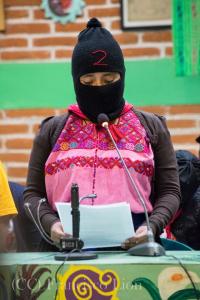
Zapatista woman at Conciencias/ConSciences
ADVANCES IN THE FIRST INTERNATIONAL POLITICAL, ARTISTIC, SPORTS AND CULTURAL GATHERING OF WOMEN THAT STRUGGLE
(NOTE: registration deadline for activities February 9, 2018. Registration deadline for attendance is March 8, 2018)
Compañeras, we want to share with you how the registration is going for the Gathering to be held on March 8, 9 and 10 in the Caracol of Morelia, Tzotz Choj Zone, Chiapas and Mexico.
In what we have advanced from the mail there are 651 people registered, with ages that range from 5 months to 75 years. 38 compañeras come with their offspring.
The places of the world they come from are Germany, Andorra, Argentina, Australia, Bolivia, Brazil, Canada, Chile, Colombia, Costa Rica, Cuba, Denmark, Ecuador, El Salvador, Estado Español, United States, France, Greece, Guatemala, Honduras, England, Italy, Mapuche Nation, Cree and Ojibwa Nation, Navajo Nation, Sweden, Nicaragua, Basque Country, Paraguay, Peru, Puerto Rico, Dominican Republic, Switzerland, Uruguay, Venezuela, and 27 states of Mexico.
In the political, artistic and sports participations hay 202 proposals that encompass the disciplines of music, dance, theater, circus, clown, poetry, story telling, book presentations, drawing, photography, cinema, football and volleyball. There are also workshops and talks with the following themes:
Workshops – Gender violence, yoga for children, stencil, genetic clay, feminist manifestos, cooperative games, evaluation and use of menstrual blood, gender, theater, dance and painting as a means of healing, sensitization, agro-ecology, corrective violations, cloth sanitary napkins, production of personal hygiene articles, decolonizing hips, workshop on the body and creative resistances, workshop on murals, women of color feminism, deconstructing genders, cyber-feminism, body work, workshop on self-massage, Reiki, abstract-figurative art, free writing, engraving, painting, creation of books starting from personal experiences, abortion, bio-construction, dance therapy, macrobiotic cooking, print making, humor and gender, aroma touch, reflexology.
Talks – Feminine lineage, the woman’s body, forms of resistance, human rights defense and promotion of culture, anti-machismo education, the experience of surviving violence, the women’s struggle in France and Italy, abortion, menstruation and deconstruction of the use of roles, femicides, experience of struggle of the Mapuche people, machismo in the communications media, lesbian existence in times of patriarchy, feminism in Cuba, romantic love and the eroticization of gender violence, sexual violence in the Colombian armed conflict, violence towards women, racism, anti-mining struggle, eco-feminism, indigenous and black feminisms, feminist economy and sustainability and feminist human security.
Many email messages still remain to process. We thank you for your patience and we’ll answer them soon.
On the other hand, we want to inform you that the deadline to register as participants is Sunday, February 9 inclusive. That deadline is to be able to organize the programming of your participations.
The deadline to register as an attendee will be March 8 inclusive. There will be registration in the Caracol de Morelia beginning March 7.
The email for registration is: encuentromujeresqueluchan@ezln.org.mx
Support team for the First International, Political, Artistic, Sports and Cultural Gathering of Women that Struggle.
January 25, 2018
SupGaleano: From the Diaries of the Cat-Dog
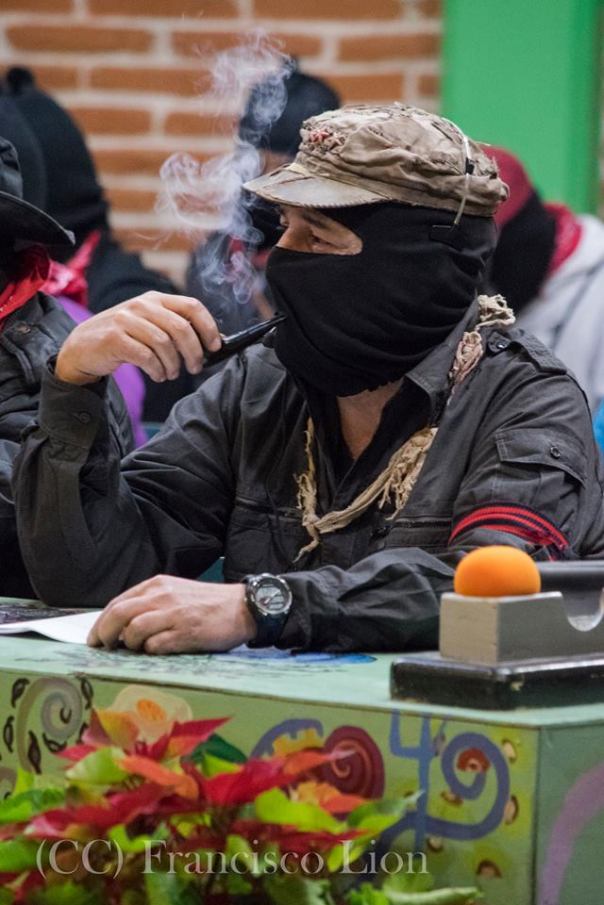
Subcomandante Insurgente Galeano at ConSciences
The EZLN’s Sixth Commission at the close of “Consciences for Humanity”: “From the Diaries of the Cat-Dog.” SupGaleano
From the Diaries of the Cat-Dog: the story of how two great detectives met, a fragment of what Elías Contreras and Sup Galeano talked about during the now not-so-mysterious case of the missing honeybuns, how Defensa Zapatista left the science of language in shreds, and some idle reflections from the Sup on the above subjects
December 30, 2017
Once again, good morning, good afternoon, good evening, good night,
First of all, we want to send an embrace to the Mapuche people who are still being attacked by the bad governments of the countries called Chile and Argentina. They have used legal ruses to again bring charges against Machi Francisca Linconao, along with other Mapuche men and women, proving once again that in this system, those who destroy nature are the good guys and those who resist, defending life, are persecuted, murdered, and imprisoned like criminals. Despite this, or precisely because of it, one word is sufficient to describe the struggle of the Mapuche people and all of the original peoples of this continent: Marichiweu—we will win, ten, a thousand times over and always.
Yesterday, one of the women scientists who spoke here told us about a contest to write the message that will be taken by spaceship to another planet, and that the reward for the winning message is a million dollars. The message that we propose, and which will most surely win, is: “Don’t let us come to your world. If we haven’t resolved the problems that we caused ourselves, we will make the same errors again. And in that case, we won’t come alone; we will bring a criminal system with us. We will be for your world an alien apocalypse, the much-feared eighth passenger that grows and reproduces itself through death and destruction.The motive for learning about other worlds should be the desire for knowledge, the necessity to learn, and respect for what is different, not the search for new markets for war nor for refuge from a murderous system.”
Please deposit the million dollars in the bank account of the organization named “The Time has Come for the Flourishing of the People” that supports the Indigenous Governing Council.
What I am going to read was going to be our contribution to the panel yesterday, but, like Pedrito, I was on the receiving end of a “gender equality” effort (knock on the head included) and “the women that we are” won the space. So here goes:
Doctor John Watson looks worriedly in the mirror. He brushes his hair to one side, then to the other, forward and then backward. He looks at himself straight on then studies his profile from the right, then from the left, and with a hand mirror from behind. He murmurs throughout this process: “Tortilla hair…why does she call me tortilla hair? Because of the color? The style? Maybe because of the gray that now competes with the brown? Or is it the way I wear it? Tortilla hair; that damned girl…”
He’s still in this process when Sherlock Holmes, consulting detective, suddenly jumps out of the hammock where he had been playing melancholy chords on the violin. Putting his coat on quickly, Sherlock urges the doctor:
“Quickly Watson, we don’t have much time.”
“Where are we going Holmes?” It’s cold already and the Junta [Good Government Council] says it’s going to get worse,” Watson says as he walks out the door of the small hut the autonomous authorities have provided them for their stay in the mountains of the Mexican Southeast.
Holmes doesn’t even bother to answer. He strides down the main street of the community toward the small building with a sign on the front reading “Vigilance Commission” and a mural behind it with vivid colors that bravely fight the humidity. Inside the building, a young indigenous woman is attentively focused on a computer monitor.
“Te´ oyot Tzeb” (“Greetings, señorita”), Sherlock Holmes says in his best Tzotzil. A few days have been enough for him to master the basics in order to be understood in the Mayan languages of these zones.
Watson is about to mock him when the young woman on the vigilance commission responds to him in perfect English: “Good Afternoon.” Her accent is not so much British as that of a Dubliner, Watson thinks.
Holmes ignores Watson’s sarcastic look and in impeccable Spanish asks,
“How can I find the person I am looking for?”
The young woman, indigenous, short, with long braids and lively black eyes, looks amused as she responds in perfect German:
“Und wie heißt diese Person?“ (“And what is that person’s name?“)
Holmes immediately catches on and asks in the French of an undocumented immigrant,
“Je ne connais pas son nom, mais sa profession est un enquêteur privé” (“I don’t know his name, but he’s a private investigator”)
“Non capisco niente” (“I didn’t get any of that”), says the young indigenous woman in the language of a rough and proud Italian neighborhood.
Doctor John Watson looks amused by Holmes’ predicament, but he is looking worriedly at the street, afraid that little girl is going to show up.
Sherlock Holmes is trying to think how to stay “private investigator” or “detective” in Russian, when Watson’s fears are realized.
Like a small hurricane, the little girl who calls herself Defensa Zapatista comes running down the street full of puddles and bursts in the door as Watson instinctively pats his hair and Sherlock is trying to decide whether to switch to Mandarin Chinese or Polish.
Defensa Zapatista hugs Sherlock shouting, “Hole-mase! Broomhead!”
Well, hug would be stretching it. The respective heights of Holmes and the little girl mean that he receives her hug around the knees.
The consulting detective looks disconcerted. In London the minimum height of a person with whom he comes into contact is 5’9”, although throughout this time in Zapatista territory he has had to lower that average to 4’11”. His experience with children, apart from distancing himself anytime he sees one and gesturing displeasure anytime he hears one crying, is almost nil. But for some reason, the taller detective likes Defensa Zapatista.
The little girl turns to the respected Doctor and blogger John Watson and throws her arms around his neck with a delighted “Waj-shton! Tortilla hair!” which does not delight the ex-military doctor.
Defensa Zapatista takes them both by the hand and pulls them toward the door: “Hurry, we’re going to be late!” The young woman of the Vigilance Commission, disappointed by the rather abrupt end of her linguistic internationalism, closes the 7 tabs on her browser that were open to Google Translate and returns to the blog she is reading about the activities of the Indigenous Governing Council spokesperson, María de Jesús Patricio Martínez. Holmes doesn’t need to hurry; for each one of his strides, the girl has to take several. Sherlock is holding in his right hand the small stick with which he is always poking around in the dirt and between the plants in search of insects. Watson purposely falls behind when he sees the so-called “cat-dog” bite the cuff of Holmes’ pants, probably to make him cut his stride and thus walk at the same pace as the little girl.
The girl stops suddenly and says, relieved, “We’re here.”
They’re at the pasture that serves, in addition to grazing land for the livestock collectives, as a soccer field for the teams that take turns working to widen and deepen the crack in the wall, as well as for festivals, dances, and celebrations, not to mention a training field for Defensa Zapatista’s as-yet incomplete team.
Watson, who still hasn’t learned his way around the small village where they spend the majority of their time, confirms unhappily that they have arrived at a pasture when he feels thick, warm cow shit underfoot.
Defensa Zapatista says, “You guys wait here, I’m going to go get the one-eyed horse,” and she runs off with the cat-dog behind her.
Just then an indigenous man of undefined age comes up to the British pair.
Sherlock Holmes sees him coming and with the precision and speed that he is known for, begins to construct a biographical sketch of the man. But before he can finish, the man says:
“Good morning Mr. Hole-Mase, Mr. Waj-shton. Don’t worry,” he says to Sherlock, “your tailor in London will be able to mend that rip without a problem. And I believe you’ll find some boots in your size in the Zapatista shoe store. You know how it goes here, sometimes it seems like there is nothing to do, but you should try not to smoke that pipe so much, it’s bad for your health. I recommend the violin over the pipe when the day gets long. And I warn you that in these lands they say all kinds of things about the women, it seems they get angry very quickly, especially Defensa Zapatista.”
Sherlock Holmes is speechless, and Watson turns to look at him with curiosity. Apparently the detective has been given a little of his own medicine.
Holmes snaps out of it and applauds with admiration, “Bravo! You’re right about almost everything, although allow me to demur on the question of misogyny.”
Watson, as usual, doesn’t understand anything that is going on.
It is the indigenous man who clarifies, as Holmes nods at each point:
“Elementary, my dear ‘Tortilla Hair’: the gentleman has donned his much-valued raincoat very quickly, and in the process tore slightly the left cuff. Someone who dresses as he does is clearly very careful with his things, so it is to be expected that he is thinking about going to the tailor to get the coat mended. That the tailor is in London is an easy guess, as the coat is half open and one can see the tag.
The nicotine stains at the bottom of his finger and on the palm of his hand reveal that he often smokes a pipe, as these are tracks left by the tobacco. About the boots—well those little ankle boots he’s wearing aren’t going to last long here, and one can assume that you have all thought about getting some boots like the ones we wear, made by insurgent cobblers and which can be purchased in the compas’ store.
Indeed, I forgot to say that Mr. Hole-mase is right-handed; he holds his pipe with his left hand because he uses his right to, for example, play the violin.
The violin, well, the way he is holding that small stick is the same as how Pablito, the Zapatista mariachi, holds the bow when he plays violin at our festivals, and the redness on the left side of his neck is because of the violin, either that or because some insect bit him there… or somebody gave him a hickey. That thing about talking badly about the women was just to see what he would do, but since he has male company, well, either he thinks poorly of women or just prefers men.”
Holmes applauds again. The indigenous man’s insinuation of homosexuality didn’t bother him a bit. But Watson is very defensive of his heterosexuality and tries to clarify:
“Pardon me, but Holmes and I are not a couple. That is, we are partners but not partners in the hickey-sense, but rather, I mean, that is, we have a… professional relationship.”
The indigenous man interrupts him: “Don’t worry Waj-shton, here we respect everyone’s preferences.” “I know,” Watson insists, “but this isn’t what it looks like, that is, not that I have anything against those kinds of relationships, I’m just clarifying that…”
Now Holmes interrupts him and nods respectfully, saying: “If I am not mistaken, you sir must be Elías Contreras, Investigation Commission.”
Watson takes off his bowler hat—with which he hopelessly tries to hide his “Tortilla hair,” and also nods in admiration.
Holmes adds: “Only someone like Elías Contreras could make that series of observations, reasoning, and deductions faster than me.”
Instead of accepting the praise, Elías Contreras smiles teasingly and says:
“Nah, the thing is that SupGaleano has some books about you two and they describe you—the pipe, the violin and all—and I saw your names on the visitor’s list in the Vigilance Commission office, and since you’re the only outsiders in the village right now, well..”
Watson puts his hat back on a little resentfully. But Holmes is beaming and happy to have run into the not-at-all-famous detective, the one they call the “eezeeelen investigation commission.”
“You are right, my dear Elías Contreras, or should I call you something else?” he asks extending his hand with affection.
“Elías is fine,” the Zapatista says as he offers them both a rolled cigarette, which both politely refuse. Sherlock speaks again:
“Do you know what? Something similar happened to me with Sir Arthur, who used to give me the drafts of the sorry chronicles of my discoveries, which he inexplicably attributed to doctor Waj-shton, here at my side.” Watson tries to protest but ends up just pulling his hat down a little further.
“And I saw how Sir Arthur embellished my work, unnecessarily in my opinion. And I say it was unnecessary because all I did was apply science to solve crimes.
And science and its explanation, my dear Elías, are far from the glamour attributed to them by novelists and regular people.
Furthermore, my work was full of errors, continuous and tiring experimentation, and serious and systematic study of the advances that are made in these fields in every corner of the world. Science and its application are difficult. Scientific rigor makes its implementation unexciting, and differentiates it from the intellectual laziness that is repeated in opinions, comments, and commonplace superstitions. For the same reason, when presented with the opportunity to study, some people opt for the poorly-named social sciences, or the humanities in general, which they think, erroneously, do not require the rigor, thoroughness, and complexity of scientific knowledge.
With regard to the arts, these demand not rigor in the sense of exactitude, but can, in contrast to the natural and hard sciences and the humanities, imagine not only other realities but also awe us with shapes, sounds, and colors that capture that imagination.
Perhaps that is why the arts are closer to the exact and natural sciences, as opposed to the so-called humanities. The looseness that a novel requires, for example, would be an unforgivable offense in the scientific realm and an outright violation of the ethical code that any scientist should include in their practice. But the problem that is always confronted sooner or later is that the fact of having adhered to a strict discipline in order to gain solid knowledge often leads those who practice science as a profession to take on a wretchedly pretentious attitude toward everybody else.
They tend to be arrogant and, not uncommonly, justify a certain frivolity and lack of common sense on their part with regard to daily matters. As if real life were a matter for us common folk, and that they [ellos, ellas, elloas], were above all that.
But sometimes despite the scientists themselves, the natural and hard sciences are indispensable, that much is undeniable. Any real and practicable possibility of getting out of the treacherous nightmare that is the current homogenous global system will have to have the natural and hard sciences as its principal foundation. And if it doesn’t, we’ll be stuck comforting ourselves with science fiction.”
Watson looks with surprise at Holmes as he thinks, “Incredible, Sherlock Homes is describing himself in a disapproving tone.”
Holmes notes Watson’s surprise and addresses him to clarify:
“You’re mistaken, Watson, I’m not being self-critical. Obviously that monologue is not my own; it has been assigned to me by SupGaleano. See, the Zapatistas think that recognition and a soft scolding will be better received by the scientific community if it comes from one of the best detectives in world history than if it comes from a masked nose who still uses the Dane Niels Henrik David Bohr’s model of the atom, describing it as “a little ball made of a lot of other little balls stuck together around which other little balls orbit.”
Sherlock Holmes shudders, in part due to the scandalous description of the atom, and in part because it seems that he has finally released the discourse imposed on him by Zapatismo and backed by “poetic license.” Elías Contreras, investigation commission for the eezeeelen, only spoke up with a “hmm.”
We know what happened next because Doctor John Watson took notes of what was said there—not with the intention of publishing it, but rather because it sparked his interest. Holmes would later be pleased at this, because what Elías Contreras said is still keeping him awake.
Sherlock Holmes took Elías aside, as Doctor Watson followed from a prudent distance. The little girl, accompanied by the the bark-meowing of the cat-dog, was busy trying to convince the one-eyed horse to get into position at the goal.
“Now we’re going to practice free kicks,” Watson heard her say, and he saw a little boy position himself, jokingly, under the bar that was supposed to be the goal.
Sherlock Holmes spoke in a murmur:
“My esteemed Elías, I come to you to see if you might have a case that requires the aid of my detective abilities. Of course, I promise to be discreet and claim no credit for myself should we be successful.”
Elías Contreras stopped and said in the same confidential tone:
“Well, in fact, yes. However, the problem that we are looking at is quite large and all we have is our minds in order to try to understand and address it. And then, well, what comes into my head I can talk about later with the compañeros and compañeras of the comité [Indigenous Revolutionary Clandestine Committee].”
“Excellent!” exclaimed Sherlock Holmes. “Abstract reflection requires extra effort that forces the brain to sublimate. Pay attention Watson, because now, I believe, we are about to encounter the biggest challenge for any detective: to solve a crime with only the tools of logic and scientific knowledge.”
Holmes looked as excited as could be. Watson couldn’t remember seeing him so excited since the case of “A Study in Scarlett,” which brought him fame and global prestige as a consulting detective.
Sherlock Holmes didn’t rush Elías Contreras. He lit his pipe, yes, but more in order to accompany Elías, who was rolling a cigarette, than out of a desire for the sharp taste of tobacco smoke in his mouth.
Elías Contreras began:
“All right: the problem is big but simple. We know the murderer, the victim, the weapon used, the timing, and the location of the so-called “scene of the crime”, that is, where the fuckery was carried out. So like the Sup says, we have the calendar and the geography.
The problem is big, though, because it’s all mixed up. And that’s where I don’t know if it’s all mixed up in reality or if it’s my thinking that’s confused.
So in this case, the crime was already committed, but it’s also being carried out and will be further carried out. That is, it’s not just some fuckery that already happened and that’s it, or that is happening now, but also something that is coming.”
Holmes looks even more interested, but he doesn’t interrupt Elías Contreras, who continues:
“So we have to find out what happened, what is happening, and what has yet to happen so we can to stop it from happening, because if it does, it’s going to be a tragedy so great you can’t imagine it.”
Sherlock Holmes waits for the the investigation commission to pause before venturing:
“I believe I understand: we have to understand the crime committed in order to understand the crime underway and thus be able to avoid another crime taking place: the greatest crime in the history of humanity.”
Elías Contreras nods and continues:
“The criminal doesn’t hide; on the contrary, it shows itself outright and brags about what it has done. It says that its crime of killing, destroying, and stealing was a good thing to bring itself into being. I think it is there, where it was born as a criminal, the point at which it developed its way of doing things, that we can learn how it carries out its fuckery and how it intends to do so in the future.”
“Of course,” interrupts Holmes, “we must reconstruct the genealogy of the crime which in this case, and if I understand correctly, is the genealogy of the criminal. But go on.”
“Okay,” Elías continues, “from there we see that the criminal became modernized, that is, it became a better criminal and is careful that no one finds out that it is a criminal; rather, it dresses itself up like a good guy, like it’s not plotting anything at all, just hanging around.
So it has partners in crime, and those partners in crime are responsible for being the pretty face for the criminal. But since what’s happening is so fucked up, these partners in crime have to come up with someone responsible. That is, their work is to blame somebody else.
So they go look for someone to blame for the tragedy. Sometimes it’s women who are guilty for not obeying, it is said, because they go around with skimpy clothing, or because they study and work, or even because they want to have “self-rule” over their own bodies and their path, to be autonomous, or maybe it’s because they think, and begin to act like they’re an autonomous municipality in rebellion.
But other times they blame those who have skin of a different color, or who have another way of being, like Magdalena who died fighting against the bad and those who carry it out, and who was a woman but like they say, God messed up and gave her the body of a man and Magdalena, well she didn’t hide it or accept it. She just didn’t give a fuck what other people thought; she was different, and since she had that other body she was other [otroa]. And she, or he, or s/he [elloa], fought to be what she was.
Brave, that Magdalena, she never gave in, never ever,” says Elías, his eyes filling up upon remembering the person who, in his own way, he loved and still loves.
Holmes and Watson maintain a respectful silence.
Elías composes himself and continues: “Well, they also blame us as indigenous people, saying that things are bad because we are not civilized and that we don’t allow progress, and so they put mines where there should be forests and lakes. And the thing is that we as peoples live where they pushed us to, because they stole everything and ran us off from where we were before. They also imprisoned and killed us, but here we are, still resisting. Before, the criminal didn’t want these lands, but now it does because now these lands are commodities too, they say; water can be bought and sold, as well as land, air, sunshine, trees, and animals, even the smallest ones; even what we use to make pozol is a commodity.
That’s what this criminal does, it makes everything into a commodity, even people, women, children, men, their dignity; and if something can’t be commodified, then the criminal isn’t interested because it can’t be bought or sold. But the problem isn’t exactly that, but rather that the criminal can carry out all this fuckery because it has a weapon called private property of the mode of production with which it runs its whole plan. So the problem isn’t that things are produced, but rather that there are some who have property which is used for that production and you only have your own labor for which they pay you, and badly, as a commodity. So the criminal destroys and kills thanks to its weapon of private property, and at the same time carries out all this fuckery so that that weapon can’t be taken away.
I don’t know how to explain it all exactly, even though I understand it perfectly well. I just don’t know the words in Spanish to explain it, or in the languages you use. But it’s more or less like I said: you have the criminal, you have the victim who is blamed for the crime in order to steal from them and fool others, and you have the weapon. And the crime scene is the whole world. That’s why I say everything is mixed up, because the world capitalist system provides everything: it creates the victim and then murders them, it provides the weapon that kills and destroys, and it provides the crime scene.
I talked about this all with SupGaleano when he committed the honeybun crime, and they punished him but now he’ll be charged with another crime because he took SupMoy’s phone. You think SupMoy isn’t going to realize that? But anyway, let’s get back to the problem because if we don’t stop the criminal, then the whole world will become its victim; not just people but everything—animals, plants, rocks, water, everything.
The other problem is that there is nowhere to lock up the criminal, so the only way to stop the crime is by destroying the capitalist system.
Of course, I’m not telling you everything we talked about. I mean, this isn’t the whole talk, but if I tell you everything then those who are listening and reading and watching this story are going to start nodding off or thinking about what they’re going to wear to dance at the festivities tomorrow because one year is ending and another starting, and maybe they think that the change in calendar will be enough to change things, but it’s not; in order to change things we have to struggle, a lot, everywhere and all the time, without rest.” Holmes and Watson remained quiet until Elías bid them farewell saying, “I have to go, take care and don’t be ashamed of other loves, if there is a tomorrow it will also be for, with, and because of them [elloas].” Elías looked at Watson and added, “If there’s no key to open the closet, break down the door. One has to come out without fear, like Magdalena. Or fearful but controlling it.”
Watson wanted to clarify again that he and Sherlock were not what it looked like they were, but Elías Contreras, eezeeelen investigation commission had already taken off down the road and the afternoon was drifting off to sleep, covered by the shadows of night that already promised to be cold.
There were a few days, not many moons ago, when the little girl Defensa Zapatista decided to express herself verbally only in colors. And not with expressions like, “this is blue,” or, “I felt orange” or things like that, but only by actually naming colors. All theories of language and discourse were threatened by the impertinence of a Zapatista indigenous girl.
One day she came to Sup Galeano’s hut and said, “yellow.”
The Sup didn’t even take his eyes off the computer screen, he just said: “in my jacket, right pocket.”
Defensa Zapatista went over to where the jacket was hanging and pulled a package of honeybuns out of the right pocket and ran out the door happily chirping, “purple.”
Despite what you might think, each color didn’t have a precise meaning. In order to understand Defensa Zapatista you’d have to take into account her tone, the context in which she spoke, where she was looking, the expression on her face, her gestures and even her body language.
One time she also said “yellow” while she was walking to school, as if she were on her way to the gallows. The Sup said that’s when he knew that Defensa Zapatista was a normal kid and not a cybernetic organism created by SupMarcos’ perverse mind to pester us all. The cursed inheritance of a Moriarty with an impertinent nose, the continuous and frustrating questioning packaged in the apparent innocence of a little girl barely a few feet high, a robot whose energy source was neither solar nor atomic but based in honeybuns.
One afternoon SupGaleano explained to Elías Contreras:
“She’s a child, no doubt about it. It’s totally normal that a little girl goes to school with all the weight, anxiety and desperation of someone marching into the slavery of letters, numbers, names, and dates. No one can say better than she can what it means to go to school, and I think the fact that she takes the cat-dog with her, albeit hidden in her book bag, is her way of clinging onto the world in which Defensa Zapatista is what she is—and I don’t have any idea what or who that is—but she is happy in that world and happy in her efforts to complete the team which, perhaps, is her way of saying “change the world.”
Because you can see that she does not dream of being a superhero, someone with superpowers or a Katana to cut down her enemies who, if you pay attention, are always masculine. You can see that she never talks about the goal she made with surprising technique and which has been passed off with other explanations. On the other hand, the late SupMarcos never stopped reminding everyone, usually in irrelevant contexts, that he had once made a goal in middle school. He never mentioned of course that he was always on the bench and that just once he was put in the game, when the coach was down a player, and he slipped and accidentally, as they say, “pushed the ball to the back of the net.”
Neither does Defensa Zapatista take on the role of defenseless princess waiting to be saved by masculinity astride a white horse. In fact, I think her relationship with Pedrito is just the inverse: she helps, orients, and rescues Pedrito, even if her method of knocks upside the head is not ideal.
No, Defensa Zapatista takes on her objective as something to carry out collectively and does not conceive of herself as a leader or a boss; in fact she has selected the position that shines the least—defense—and she does it in order to support the one-eyed horse playing goalie. Her job is to seek out and find who wants to join, who will play as a team and be not only a member of the team but also a bridge for others to join it. And when she values as equally important positions such as ball boy or the little dog or the cat-dog who run crooked and makes the only requirement the desire to play, that is her way of saying, “to want to struggle.”
In Defensa Zapatista we find not a new world, that’s true, but perhaps something even more terrible and marvelous: its possibility.
And when she talks in colors, perhaps she is trying out new forms of communication for that world that we can’t even imagine but that she already accepts as coming—not without the necessary and urgent struggle to bring it into being, from wherever it can be found, here into this reality that we are suffering through now. I can think of nothing more Zapatista than what this little girl’s efforts symbolize.
SupGaleano was commenting all this to a silent and attentive Elías Contreras when Defensa Zapatista appeared in the doorway of the hut with a ball in one hand and the cat-dog in the other and asked, “Pink?”
“We’re coming, we’ll catch up with you,” the Sup answered her. Defensa Zapatista just nodded and said “Black” as she ran out the door.
Elías Contreras asked the Sup: “What did she say?”
“Beats me,” answered the Sup as he debated whether to put on his Inter Milan jersey (which apparently the Chinese have bought), the Atlanta one (which is not in that player market called UEFA), or his Jaguars of Chiapas jersey (who knows where they are), all of which he found in the trunk left by the late SupMarcos. Finally he put on his EZLN T-shirt, the one worn in 1999 when a team of Zapatista support bases debuted at the “Palillo Martínex” stadium at the Sports Complex in Mexico City, a game in which they made only a single goal and which the late SupMarcos summarized thus: “We didn’t lose; what happened was that we didn’t have time to win. So, what’s missing is yet to come.”
“The truth is I just guess what she’s trying to say. Sometimes I’m right, sometimes I’m wrong. That is, I apply the scientific method of trial and error. Let’s go Elías, I think we have to go to the pasture because there’s a team to fill out. It can take a while, yes, but someday there will be more of us,” SupGaleano added as a kind of apology.
The one-eyed horse was already in the pasture stubbornly munching that same plastic bottle. Pedrito was arguing about something with the little girl, the cat-dog was trying in vain to bite the flashy ball that good ole Vlady had given to Defensa Zapatista, and two absurd figures lingered off to one side of the supposed soccer field. Nobody noticed, but a complicit smile passed between Broom Head, Tortilla Hair, Elías Contreras, and SupGaleano, as well as a slight nod of greeting.
Defensa Zapatista laughed as the cat-dog jumped up and down trying to take the ball away from her. The cold had lifted and the afternoon turned warm.
And everything that I narrated here occurred on whatever calendar, but in an exact geography: the mountains of the Mexican Southeast.
I testify: The cat-dog Ruff-meow. Thank you. From CIDECI-UniTierra, SupGaleano Mexico, December 2017
Indigenous activist murdered in Cherán, Michoacán
ORGANIZED CRIME “BEHIND THE MURDER” OF CHERÁN ACTIVIST

Photo of the activist Guadalupe Campanur on the front page of La Jornada
By: Ernesto Martínez Elorriaga
Cherán, Michoacán
Guadalupe Campanur Tapia, 32, “was very active in the community rounds, in the work of the forest guards and in the cultural workshops. And finally, she was a good woman,” remembers Margarita Tapia Capiz, her mother. The last time that she saw her daughter was last Sunday.
The body of a strangled woman was found Tuesday in a plot of land located 17 kilometers from Cherán, between Santa Cruz Tanaco and Carapan, at the side of the highway. It was a surprise to all the people of Cherán. No one imagined that that the cadaver was Lupita, as they found out. They knew that it was she because she was carrying identification, commented an uncle that refused to give his name.
Salvador Campanur, the former mayor, leader of Cherán and relative of Guadalupe, commented that it’s probable that organized crime is behind the murder, after remembering that she has had serious conflicts with the neighbors in Santa Cruz Tanaco, “but it’s not the time to talk.”
He commented that they observe Cherán from outside, “from the bad government, organized crime and the political parties;” they seek any detail to take over this community that governs itself under the principle of uses and customs; that is, it doesn’t have a mayor elected at the ballot box, but rather by a council designated in the communal assembly.
“There are no police, but rather a community round that guarantees security one hundred percent inside of the community, but outside of the town there is no control.”
People met in small groups on the municipal plaza personas and commented in a soft voice on the murder of the activist, who disappeared last weekend, but was not reported to the authorities because on occasions did guard duty with the community round or met with groups from the four neighborhoods of Cherán, Tapia Capiz commented.
Mario López Hernández, one of the council members of this Purépecha municipality, said that they didn’t want to talk much about the murder until the delegation from the Attorney General of the Republic (PGR) concludes the investigations. “We know that Guadalupe was kidnapped or “lifted up” (levantada), but we don’t have more details and we don’t know if anyone accompanied her.”
Pedro Chávez, president of the high council, said that although they don’t have indicia of threats, they don’t discard that crime is behind the homicide. “We don’t want to get ahead of ourselves, we are waiting for results from the PGR and the state attorney general, but we are also investigating.”
He said that it was a hard blow to the community to know that a compañera with the characteristics of Guadalupe “was found in that way on the outskirts of our territory; then the alert was definitely turned on, it worries us because we are vulnerable to situations of this kind.”
In April 2011, the town of Cherán faced organized crime that had looted its forests. Since then it disowned the municipal authorities that were colluded with the woodcutters and disarmed and fired the police. “Many interests were affected and they are not in agreement with how we do things,” Salvador Campanur said.
“Guadalupe was an “autodefensa,” part of the round the same as all the collectivity. We continue with the bonfires and we have four barricades at the accesses to the town. She participated in security and in social work. Whoever attacked her is provoking the whole community and they want us to say something, that’s why we’re on alert, despite the fact that we guaranty the tranquility within our territory there is insecurity outside of it, and Guadalupe’s death is a message from organized crime and from other fronts that are dedicated to dispossession,” Salvador Campanur emphasized.
“The same ones participated in defense of the forests as in the community round, but we also saw here in the delivery of supports to the most vulnerable groups, that’s why the attack of which she was the victim and that cost her life was (directed) against all of us,” said María Hurtado, a member of the council.
Guadalupe lived on one of the seven blocks at the center of Cherán. A humble home that she shared with her mother Margarita Tapia and her father Rubén Campanur, as well as her brothers Florentino, Juan and Francisco, all of them campesinos, although they also participate in the community rounds, which are nothing else than the Cherán police.
Of the approximately 18,000 inhabitants of Cherán, hundreds of them work in the United States; it has even been one of the indigenous municipalities that exported the largest number of people to the neighbor country of the north. Jesús, Gloria and Bertha, the brother and sisters of Guadalupe work on the other side of the border.
There is only a wooden table with a white cloth, flowers, a photo of her and a crucifix in the small room where Guadalupe’s body was waked. There is only sadness and pain among her closest beings, who at times come out of the two or three rooms onto the small patio to get a little sun on this cold day.
———————————————————-
Originally Published in Spanish by La Jornada
Saturday, January 20, 2018
http://www.jornada.unam.mx/2018/01/20/estados/023n1est
Re-Published with English interpretation by the Chiapas Support Committee
 Chiapas Support Committee