Chiapas Support Committee
Home of the Compañero Manuel blog on zapatistas & mexico
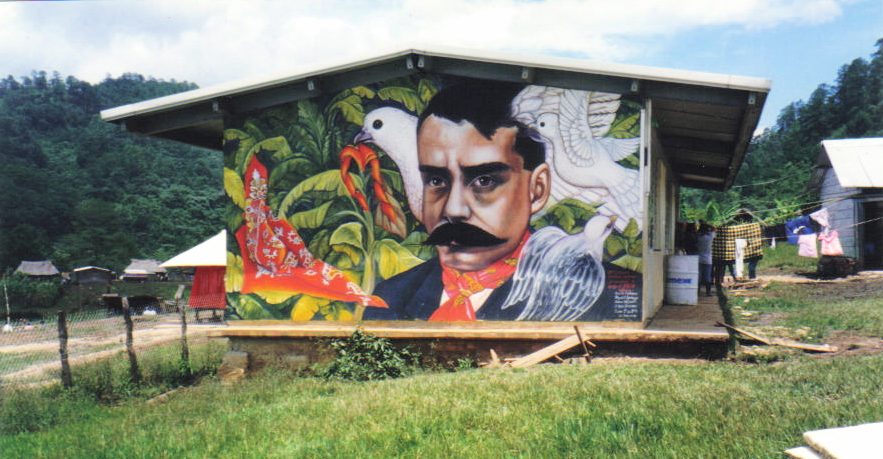
Declaration from Indigenous Congress
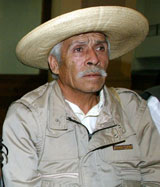
Compañero Juan Chávez Alonso
Indian Mexico Continues Standing Despite Extermination, Indigenous Congress Declares
We learned on this path that the powerful have no respect for the word; they betray and violate it.
By: Hermann Bellinghausen, envoy Published: 08/19/2013 18:05
San Cristóbal de las Casas, Chiapas
“Indian Mexico finds itself alive, standing and with a single heart that becomes large, as large as the pain that we suffer and as the hope for which we struggle, because despite the war of extermination that has become more violent than ever, we are here,” the National Indigenous Congress (Congreso Nacional Indígena, CNI) stated today.
After concluding its national gathering under the name Seminar Tata Juan Chávez Alonso, called for by the Zapatista National Liberation Army (Ejército Zapatista de Liberación Nacional, EZLN) and the CNI, they made public a broad pronouncement, which joined together the dozens of urgent demands of the original peoples throughout national territory that met over the weekend in this city.
“At this time as well as in our history with Mother Earth, Yaqui, Mayo, Náyeri, Wixárika, Rarámuri, Odam, Nahua, Purépecha, Nañu or ñuhu, Mazahua, Popoluca, Tzotzil, Chol, Tzeltal, Tojolabal, Zoque, Totonaco, Coca, Mame, Binnizá, Chinanteco, Ikoot, Mazateco, Chontal, ñu saavi, Chatino, Triqui, Afro-mestizo, Mehpa, Nancue Nomndaa, ñhato and peninsular Maya indigenous peoples, nations and tribes recognize each other in the struggle for the respect of our ancestral way of life, a struggle that we learned together and about which we have spoken, we have demanded and we have repeatedly been betrayed by the bad governments.”
Coming from 19 states of the Republic, the indigenous delegates expressed: “On this path of struggle we have learned that the powerful have no respect for the word; they betray it and violate it one time after another in the length and breadth of this country called Mexico, since the failure to recognize the Accords of San Andrés Sakamchén de los Pobres, the 2001 indigenous counter-reform and the countless betrayals of our peoples from different regions and struggles.” And they assert: “We are the Indians that we are, decided to reconstitute ourselves in another possible world.”
In a list of 29 demands, the first is the immediate liberation of the Tzotzil professor Alberto Patishtán Gómez and of all the country’s indigenous political prisoners.
And next, denunciations that “the bad governments and the trans-national corporations have availed themselves of paramilitary groups to impose extractive mega-projects.”
Drug trafficking, dispossession of rivers, mountains, corn and air and different repressions! The CNI warns: “an unprecedented attack on the world’s sacred pillars recognized and sustained by the original peoples, who defend it with assurance in the name of life in the Universe.”
The pronouncement concludes: “We recognize, support and encourage the struggles for autonomy and free determination of all the indigenous peoples that make up the CNI, from the Yucatán Peninsula to the Baja California Peninsula.”
————————————————–
Originally Published in Spanish by La Jornada
Monday, August 19, 2013
Los de abajo: Indigenous Dispossession
DISPOSSESSION of INDIGENOUS PEOPLES
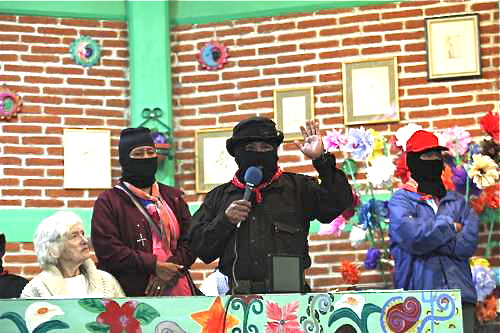
Moisés in the don Juan Chávez Alonso Seminar, San Cristóbal de las Casas, Chiapas
By: Gloria Muñoz Ramírez
The Indian Peoples of Mexico grouped together in the National Indigenous Congress (Congreso Nacional Indígena, CNI) this weekend will offer homage to the Purépecha moral leader Juan Chávez Alonso, a little more than one year after his accidental death in his Nurío birthplace, within the framework of the seminar that bears his name. We are also dealing with the re-launching of the indigenous organization that the Zapatista National Liberation Army summoned 17 years ago.
The meeting is presented within the context of one of the most violent offensives in history against their territories. Mines, aqueducts, highways, wind projects, hydroelectric dams, gas ducts and a symphony of megaprojects threaten their natural resources.
They want to dispossess the Yaquis of their water, the Zapotecs of their wind, the Wixárika people of their sacred sites, the Purépechas of their forests, the Nahuas of their milpas, the Cocas of their island (in Lake Chapala, Jalisco). We are dealing, as they said in their meeting in the Wixárika community of Bancos de San Hipólito, “with an integral pounding with multiple fronts against us, and the lootings of the territories on the part of caciques, companies and the bad governments have become more aggressive in their war of extermination, which began more than 500 years ago.”
Autonomy is the way in which many of these peoples confront the attempts at dispossession, although their resistance in not a few cases encounters the hidden and open repression of companies and governments. In these moments they give battles on many fronts, from legal defense to direct action with the blocking of highways and barricades so that the destructive machinery doesn’t enter.
There is no better way of honoring the figure of don Juan Chávez Alonso than re-launching the network of which he was a founding party. With “his view as the horizon,” the indigenous organizations meet today to “raise a tribune in which the original peoples of the continent are heard by those who have attentive and respectful ears for their word, their history and their struggle of Resistance.”
The CNI was called together in January 1996 and formed in October of that year, with Comandanta Ramona, the Jaramillista guerilla Félix Serdán Nájera and don Juan himself as moral pillars. In April 2001 the Mexican State betrayed the San Andrés Accords, signed with the EZLN in February 1996, and that led them, just like the Zapatistas, to the exercise of their autonomy in fact, without anyone’s permission.
More than 17 years later, the indigenous organizations, representatives of original peoples, communities and barrios will tell, “with their own voice their histories, sorrows, hopes and, above all, their struggle of resistance.”
————————————————————
Originally Published in Spanish by La Jornada
Translation: Chiapas Support Committee
Saturday, August 17, 2013
En español: http://www.jornada.unam.mx/2013/08/17/opinion/013o1pol
EZLN: Military Planes Fly Over the Zapatista Caracoles
The EZLN Denounces Nighttime Military Flyovers of the Caracoles

Comandantes David & Tacho Greet Students
By: Elio Henriquez
San Cristóbal de Las Casas, Chiapas, August 14, 2013
The Zapatista National Liberation Army (EZLN) denounced that on Monday and Tuesday of this week “military planes” made nighttime flyovers above the five Caracoles in which the course in Freedom According to the Zapatistas is being offered.
In a communiqué read this afternoon by Comandante Tacho, the rebel leader stated that: “perhaps it is that serving their master, the Mexican military personnel are spying for the gringo government or directly North American planes are doing espionage work. Or perhaps it’s that the soldiers want to see what is being taught in the Zapatista communities that they have attacked so much without being able to destroy.”
“We say to the (Enrique) Peña Nieto government that if his soldiers want to learn in the Escuelita that they may ask to be invited, (although) however we are not going to invite them, but that way they will have a pretext that they are spying because we did not invite them.”
Tacho read the brief communiqué at approximately 1:00 PM, in the auditorium of the Centro Indígena de Capacitación (Cideci) Las Casas, with headquarters in this city, before some 150 students that attend the Escuelita, with their respective Votanes (guardians).
Classes will end on Friday the 16th in Cideci and in the five Caracoles located in La Realidad, Las Margaritas municipality; La Garrucha, Ocosingo; Roberto Barrios, Palenque; Morelia, Altamirano and Oventic, San Andrés.
———————————————————————————————
Originally Published in Spanish by La Jornada
Translation: Chiapas Support Committee
Thursday, August 15, 2013
En español: http://www.jornada.unam.mx/2013/08/15/politica/017n2pol
Zapatistas Celebrate 10 Years of Good Government Juntas
FESTIVITIES END IN THE CARACOLES FOR A DECADE OF THE JUNTAS
By: Hermann Bellinghausen, Envoy

Oventik Celebration
** The Crusade against Hunger, a plan of attack on our autonomy: Zapatistas
San Cristóbal de las Casas, Chiapas, August 10, 2012
Celebrations for the Good Government Juntas’ tenth anniversary of “humble service” concluded today in the five Zapatista Caracoles. In Oventic, in the region of Los Altos, some three thousand people listened in Tzotzil, Tzeltal and Castilla (Spanish) to a message from the Juntas that celebrate that 10 years ago the Zapatista peoples “decided to reorganize their autonomy” and denounce “the bad government’s plans against autonomy,” like the National Crusade Against Hunger, “which is nothing but a counterinsurgency program.”
Despite that, “the Zapatista peoples and our autonomous governments are trying to strengthen our work in all las areas.” The Zapatistas called on national and international civil society: “to join together our rebelling.”
While only the alternative communications media were admitted, and not any of the “commercial (media),” the former report today that a woman, a member of the Central Heart of the Zapatistas Before the World Junta, read a message on Friday night: “These 10 years of practice and construction of our autonomy have not been easy, of our own way of living and thinking, of organizing and governing ourselves. It has not been easy for many reasons, due to a lack of experience or lack of more preparation.”
Nevertheless, she recognized, “what we have done is of much importance because we have learned and we continue learning to resist and confront all the evil things that the three levels of government do to us, which day by day increase their attacks against the peoples.”
In the event, where Comandante David also took the word to salute the Juntas as a representative of the Indigenous Revolutionary Clandestine Committee-General Command of the Zapatista National Liberation Army (Comité Clandestino Revolucionario Indígena-Comandancia General del Ejército Zapatista de Liberación Nacional, EZLN), the Junta reproached the regimes of Enrique Peña Nieto and Manuel Velasco Coello. Although the three levels “of the bad governments” talk a lot “about justice, freedom, democracy and respect for human rights,” they are “the principal violators of those rights and accomplices of the crimes that are committed in our state and our country. Therefore, the bad governments, past and present are seeking all ways of how to finish us off and destroy our struggle and resistance.”
The spokeswoman for the rebel autonomous government cited what’s called the National Crusade Against Hunger, “which is nothing more than a counterinsurgency plan with the purpose of dividing, provoking confrontations in the communities and destroying the resistance of the Zapatista peoples, because it is an economic, political, social, ideological and cultural attack against the construction of autonomy of the original peoples in our country.”
According to the Zapatistas, “Peña Nieto’s national plan will only bring more hunger, diseases and deaths,” since “the militarization and paramilitarization of all the indigenous territories are causing more insecurity, terror, fear and discontent for our peoples, who do not agree with seeing our communities invaded by thousands of federales, soldiers and paramilitaries that support human rights violations.”
And “despite this war of extermination,” they are trying to continue with their form of autonomy. Admitting to “mistakes” because “we lack a lot for improving our work for a more just, more dignified, more humane life,” the Zapatistas asserted that they still believe “in a better world, a world where many worlds fit.”
Lastly, the Junta called to the EZLN’s support bases that: “we continue forward; that we don’t go backwards or get discouraged,” because “our struggle does not end while we live in a situation of injustice, of exploitation, discrimination and sacking of natural riches from our lands.”
———————————————————
Originally Published in Spanish by La Jornada
Sunday, August 11, 2013
En español: http://www.jornada.unam.mx/2013/08/11/politica/011n1pol
Julio de 2013 resumen de noticias sobre los zapatistas

zapatistas comandantes
JULIO DE 2013 RESUMEN DE NOTICIAS SOBRE LOS ZAPATISTAS
In Chiapas
1. Violencia renovada en Chenalhó: Tres personas golpeadas y detenidas – El 20 de julio, dos zapatistas y un no-zapatista fueron detenidos en el ejido Puebla, municipio de Chenalhó. Es el mismo municipio donde ocurrió la masacre de Acteal. El municipio autónomo equivalente es San Pedro Polhó, donde varios campesinos indígenas Zapatistas todavía están desplazados como resultado de la violencia paramilitar que culminó en la masacre de 45 mujeres, niños y hombres en la comunidad de Acteal el 22 de diciembre de 1997. Los dos Zapatistas fueron golpeados y amarrados a unos postes en la cancha de basquetbol y fueron amenazados con rociarles gasolina y quemarlos vivos. Fueron acusados de echar veneno en la cisterna de la comunidad. El tercer hombre fue detenido y golpeado por protestar el trato dado a los zapatistas. Los tres fueron llevados ante el ministerio público en San Cristobal y encarcelados por tres días. No les dieron de comer ni les dieron tratamiento médico por sus heridas. Los tres fueron liberados el martes 23 de julio.
2. ¡9 presos políticos indígenas fueron liberados en Chiapas! – El 4 de julio, nueve presos políticos indígenas fueron liberados de la prisión estatal. Todos son adherentes a la Sexta Declaración de la Selva Lacandona y fueron miembros de la Voz del Amate y l@s Solidarios con la Voz del Amate. Así el gobernador cumplió el compromiso que hizo a los presos cuando los visitó poco después de tomar posesión. El gobernador personalmente entregó los documentos de liberación a los presos. Hay mas detalles aquí.
3. EZLN y CNI publican comunicado conjunto en apoyo a la tribu Yaqui en defensa del agua – El 9 de julio, el CCRI del EZLN y el Congreso Nacional Indígena (CNI) publicó un comunicado conjunto en apoyo a la defensa del agua de la tribu Yaqui y su movilización contra la implementación del Acueducto Independencia en el estado mexicano de Sonora. La tribu Yaqui ha estado organizando bloqueos de tráfico en la estratégica carretera internacional y ha obtenido una orden judicial a su favor debido al impacto ambiental del acueducto propuesto. A pesar de la órden judicial, el gobernador de Sonora pretende seguir con el proyecto y ha obtenido órdenes de aprehensión contra los lideres indígenas. El EZLN y el CNI exigen la cancelación de estas órdenes.
4. Nueva Información sobre las “escuelitas” Zapatistas en Diciembre/Enero – El 18 de julio, el Sup Moisés dió a conocer más información acerca de los cursos sobre Libertad que l@s zapatistas impartirán en sus “escuelitas.” Según el EZLN, las clases se van a volver a dar tanto en diciembre como en enero próximo, para que tod@s tengan la oportunidad de participar en ellas. Se darán las clases antes y después de la conmemoración del vigésimo aniversario del levantamiento de 1994. Véase aquí para más detalles sobre cómo solicitar una invitación para asistir a las “escuelitas” y sobre las conferencias en video.
5. El Estado de Chiapas Cancela Pacto de Carbón con California – El 8 de julio, el gobierno estatal de Chiapas anunció la cancelación de un pacto de comercio de carbón (REDD+) que se había firmado con California, similar al program de REDD de la Organizacion de Naciones Unidas. El programa comercial se iba a implementar en la Selva Lacandona de Chiapas, sin consideración por los derechos al territorio de l@s indígenas y campesin@s. En la propia Selva, tanto zapatistas como no-zapatistas se han opuesto a este proyecto. El gobierno estatal ha reconocido que fué un error. Haga un clíck aquí para leer más detalles.
6. La más recién y última visita de Janet Napolitano a México incluye a Chiapas – La secretaria del Departamento de Seguridad Nacional Janet Napolitano hizo una última visita a México antes de abandonar su puesto en Septiembre. Sostuvo una reunión en la frontera entre EU y México con el Secretario de Gobernación, Miguel Angel Osorio Chong, y otros funcionarios mexicanos antes de reunirse con el Presidente Enrique Peña Nieto en la Ciudad de México. Entre los acuerdos bilaterales que fueron hechos entre México y los EU durante su visita, hay uno tocante a la frontera sur de México. Informes en la prensa mencionan simplemente que los EU acordó “actuar” en esa frontera para asegurar un flujo migratorio regulado, pero no hay detalles sobre lo que eso significa. Tampoco existe una explicación del porqué los EU y México están entrando en un acuerdo sobre una frontera que los EU no comparte y sobre la cual México ya tiene acuerdos con sus vecinos del sur. Haga clíck aquí para leer el artículo completo.
7. Emite el sup Marcos 2 comunicados al finalizar Julio – El Subcomandante Marcos emitió dos comunicados a finales de julio: Votán I y Votán II. El escarabajo imaginario, Don Durito de la Selva Lacandona, regresa en Votan I. Haga un click aquí para leer en español. Votán II describe lo que se espera en las “escuelitas” zapatistas. Haga un clíck aquí para leerlos.
___________________________________
Compilación mensual hecha por el Comité de Apoyo a Chiapas.
Nuestras principales fuentes de información son: La Jornada, Enlace Zapatista y el Centro de Derechos Humanos Fray Bartolomé de las Casas (Frayba).
_______________________________________________________
Chiapas Support Committee/Comité de Apoyo a Chiapas
P.O. Box 3421, Oakland, CA 94609
Email: cezmat@igc.org
http://www.facebook.com/pages/Chiapas-Support-Committee-Oakland/86234490686
Zapatista Film: Heart of Time (Corazón del tiempo)
AWARD-WINNING FILM, CORAZÓN DEL TIEMPO (HEART OF TIME) 
Screening at La Palma Taquería, 4171 Macarthur Blvd., Oakland
Saturday, August 31, 2013 – 7:00 PM
One Night Only!
Corazón del Tiempo (Heart of Time) is a film about love in the time of Zapatista Resistance. Things get complicated when Sonia, a Zapatista civilian supporter living in an autonomous community, falls in love with Julio, an insurgente (rebel fighter), because she is already promised to Miguel, a young community leader. The film shows how the community deals with this romantic dilemma. In Spanish with English subtitles.
Corazón del Tiempo was filmed in Zapatista communities in the heart of the Lacandón Jungle of Chiapas, Mexico. The actors are all non-professional Zapatista actors who uncovered their faces and opened their communities for the world to see, much as they are doing with the Little Zapatista Schools (Escuelitas zapatistas). We’ll have a brief report on the Escuelitas from several folks who participated. Come at 7 PM and grab a bite to eat, hear the report and listen to music until we show the film outdoors around 8:30 PM. Bring warm clothes or a blanket for outdoors. Admission is FREE, but we’ll accept and appreciate donations! Lots of new artesianía from Chiapas! Come and enjoy the party.
Sponsored by: Chiapas Support Committee/Comité de Apoyo a Chiapas
P.O. Box 3421, Oakland, CA 94609
Tel: (510) 654-9587
Email: cezmat@igc.org
MARCOS: VOTÁN IV – D-Day Minus 7
VOTÁN IV
D-Day Minus 7
Revelations of what the Zapatista heart admires in others, announcement of some exemptions to the Zapatista Little School, and some pointless advice that no one is going to follow.
August 2013
Okay so, there’s not much left now. I mean that there are not many days left until the Little School starts, not that we don’t have much more to do and say.
If anyone out there can find a school that assigns each individual their own teacher, 24 hours a day, a school that is laicized [secular] and free of cost, that provides lodging and meals during the teaching and learning, well good luck.
As you already know, the educational backgrounds of those who are going to attend the Little School stretch from not even entering nursery school to holding a foreign doctorate (and by “foreign” we don’t mean countries other than Mexico, but rather places alien or foreign to us, meaning that many educational institutions in our country count as foreign). And the calendars lived [ages] of those who will come range from just a few months old to over 90 years old. All who come, whether they are going to a community, or staying at CIDECI, or are in another geography participating via videoconference, or waiting their turn to participate, are received and held in the collective heart that we are.
Perhaps you do understand the organizational effort that the Little School represents for the Zapatista peoples.
But perhaps you haven’t asked yourself how and why a group of indigenous communities decided to host, feed, live with and share their knowledge with a group of foreigners, those who are different, others. How is that the object of so much pity, charity, shame and all those words that hide racism, discrimination, and contempt—that is, the Zapatista people—have the audacity to declare that they have something to teach? And that in order to do so, they erect, upon what was before an absurd ark in the middle of the jungle, a school so big that it covers the entire world?
Or perhaps you have asked yourself these things. But then you must also ask yourself how it is possible that people from 5 continents, of the most varied nationalities (that cheap trick pulled by flags, borders, and passports), of very great or very small learning, decide that they do indeed have something to learn from people who are catalogued in important books and government discourses as “ignorant,” “backward,” “marginalized,” “poor,” “illiterate,” and the etcetera that you can find in INEGI “studies” (The National Institute of Statistics and Geography), in anthropology manuals, and in the words and gestures of disgust of those who say they govern the world.
Why is it that both renowned and unknown people take time to listen, to travel, to learn from the Zapatista peoples?
Now, we as Zapatistas are not astonished by our persistent path through the continuous ups and downs of our struggle for life, that is, for freedom. What we are surprised by is that people like you, who could have chosen friendlier, more comfortable and comforting destinations, have instead chosen to put your heart in the rebellious mountains of the Mexican Southeast in order to, by our side, illuminate like lightning an August in the last, the smallest, corner of the earth.
Why is this? Could it be because you intuit, think, or know that the light does not come from above, but that it is born and grows from below? That it is not the product of a leader, boss, caudillo, or wise man, but of the common people? Could it be because in your stories great things start small, and what every so often makes the world tremble always starts with barely a murmur, soft, low, almost imperceptible? Or perhaps it is because you can imagine the racket of a world that is collapsing. Perhaps it is because you know that new worlds are born with the smallest of them all.
In the end, what really should be surprising is that you will be here with us, on this side. And I think it should be clear that I’m not talking about this side of the calendar or the geography.
-*-
THE EXEMPT
We Zapatistas have the fortune of having the ear, word, and hand of men and women, compañer@s, whom we look up to for their moral height. Some of them have not said anything directly about us, for or against. But their words about how the world turns do.
And there are people who could easily be on the other side, with those above, or with those who from various places see us as a competitor, an obstacle, a bother, an enemy, or an animal that is impossible to tame or domesticate. There on that side they could receive honors and gallantry, homage and salutations. To get such things, it would be enough to create some distance from our path or add themselves to the complicit silence of others. Some of these people have accepted our invitation to the Zapatista Little School out of generosity. On the long path of their dignified walk, they always maintained bridges to the smallest, the most forgotten, to us.
Were there others, who also supported us, before? Yes, many. And later, on the crest of whatever wave was current, they demanded our submission and subjection to the new garments of those who have always pursued us, but now dressed as the “left.” They demanded that we bow down and thank them for their support, to be silent in the face of the same injustices as always, but now adorned with false words. Like He who Rules, they demanded our obedience. And just as we did with He who Rules, we responded with rebellion.
But these people, compas, men and women of different calendars and geographies, never demanded of us submission or surrender. And although it was not seldom that their gaze was and is critical of our path, it was and is a gaze of compañer@s. They are proof that support is not subordination (something the global left still does not understand).
We invited all of these people. But not as students. According to our understanding, these people understand what freedom according to the Zapatistas is. We invited them to include them as participants in this happiness of seeing that our path, although halting and disconcerting, continues and has one destiny, which is also theirs.
I am going to write some names. It won’t include all of them. But in naming them, we name those who should appear at our side and also those who won’t appear because death has already appeared on their path. But they are in our memory, which is our best and only weapon and shield. We will miss them, for example: the untiring activity of the compañera sister Chapis; the firmness of the compa Rosa de Querétaro; the gaze-as-bridge of Beverly Bancroft; the happy laughter of Helena, the determined struggle of Martha de Los Ríos, the clear word of Tomás Segovia; the wise ear of José Saramago, the brotherly sentiments of Mario Benedetti, the ingeniousness of Manuel Vázquez Montalbán, the serene consistency of Adolfo Sánchez Vázquez, the profound knowledge of Carlos Montemayor, the brotherly embrace of Andrés Aubry and Angélica Inda, among many others.
Although they, and some others, appear on the list of invited students, they are not that. They are, to use scholarly jargon, exempt.
It would be good to greet them with a hug, here or in the geography from which they generously watch and listen to us. Whether they come or not, they are with us as what they are, our compañeras and compañeros.
Here I will only put the names of a few. There are more. We will send to all of them, along with our embrace, admiration, and reiterated respect, a letter of exemption that is merely an academic simile to show our gratitude. So here are some of the exempt, with honor, from the course “Freedom According to the Zapatistas”:
| .- Our dear mothers and grandmothers, the Doñas of Chihuahua and Sinaloa, in the Mexico below and to the left.
.- Our grandmothers and mothers of the Plaza de Mayo, in the dignified Argentina. .- María Luisa Tomasini, our grandmother in Chiapas. .- Pablo González Casanova. .- Luis Villoro. .- Adolfo Gilly. .- Paulina Fernández C. .- Óscar Chávez. .- John Berger. .- Carlos Aguirre Rojas. .- Antonio Ramírez Chávez. .- Domi. .- Vicente Rojo. .- Immanuell Wallerstain. .- Gilberto López y Rivas. .- Noam Chomsky. .- María Luisa Capella. .- Ernesto Cardenal. .- Neus Espresate Xirau. .- Marcos Roitman. .- Arturo Anguiano. .- Gustavo Esteva Figueroa. .- Jorge Alonso Sánchez. .- Hugo Blanco Galdós. .- Miquel Amorós. .- Neil Harvey. .- John Holloway. .- Malú Huacuja del Toro. .- Armando Bartra. .- Michael Hardt. .- Greg Ruggiero. |
.- Raúl Zibechi.
.- Eduardo Galeano. .- Daniel Viglietti. .- León Gieco. .- Sylvia Marcos. .- Jean Robert. .- Juan Villoro. .- Mercedes Olivera. .- Bárbara Jacobs. .- Mayor insurgente honorario Félix Serdán. .- María Jesús de la Fuente Viuda de O’Higgins. .- Inés Segovia Camelo. .- Obispo Raúl Vera. .- Bárbara Zamora. .- El Mastuerzo. .- Rocko Pachukote. .- Francisco Segovia. .- Zach de la Rocha. .- Centro de Derechos Humanos Fray Bartolomé de Las Casas. .- Juan Carlos Mijangos Noh. .- Sindicato Mexicano de Electricistas (SME), México. .- Ignacio Del Valle. .- Confederación General de Trabajadores, Estado Español. .- Víctor Flores Olea. .- Magdalena Gómez. .- Brigada Callejera “Elisa Martínez”. .- the twitter crowd. .- the alternative media crowd. |
-*-
Idle Advice (because I know you’re not going to pay any attention to what I tell you).
On Chess and Nightmares.
Let’s say, for example, that you are sent to the Little School in the zone of the Caracaol of La Realidad. After a busy day, with blisters on your hands and feet but also with that happy pain that only comes with learning, you are sitting outside your shelter. You light a cigarette as you watch the light of the day cede to the shadows of the night. You see your surroundings as if in slow motion. There is a silence of everyday goings on, which allows you to notice the stubborn chirping of crickets, the playful light of fireflies, the buzzing of mosquitoes. You decide to take out your portable chessboard. As you’re setting up the pieces, a little girl or little boy approaches (you think abut 8 or 9 years old), and squats down beside you. The little girl or boy watches what you are doing with curiosity and asks, in total innocence, “what’s that?” You feel flattered to have this opportunity to teach something, especially because ever since you arrived, your Votán and the family with whom you are living have constantly corrected you. So you take a puff on your cigarette and say: “Ah, this is a game called chess.” And here is the decisive moment. You are tempted to say exactly what you should not say. You think that, after all, it’s just a little girl/boy and it would be fun to teach them this mysterious game of intelligence, tactics, and strategy. So you say the cursed words: “Do you want me to teach you how to play?” And it’s done. The die has been cast. The little girl/boy says, with total innocence, “okay, I’ll try.” Then comes the nightmare.
After the first explanations of “this one is a pawn,” “this is a bishop,” “this is a horse,” and so on, the girl/boy will sit down in front of you and it’s a done deal. You will spend the rest of the afternoon and part of the night listening to “checkmate” over and over again. And later, a little before the dreamt dream replaces the lived one, you will murmur, “Damned Sup, I should have paid attention to him.” I, from close and from far, will light my pipe, dig into my bag of animal crackers and think: “I hate to say I told you so, but I told you so.” I have heard cussing in dozens of different languages, when the children of the La Realidad Zone beat the chess “teachers.” After all, they call this place “Reality” for a reason, do they not?
On Soccer
Let’s say, for example, that you are assigned to the zone of the Caracol of La Garrucha. Same situation as the above. But this time the child has a ball in his hands. He says, asks and challenges you with, “Where you come from do they know how to play soccer?” You feel Pelé and Garrincha, Maradona and Cruyff, Ronald and Messi (it’s not a Table Dance, eh), Puskas and Di Stéfano (is that too far back?) or whoever corresponds to your geography and calendar beating in your veins. I recommend that you smile and ask about the weather or whatever, but… you begin to see red and well, knowing sports chauvinism is well tolerated even on the radical left, you dismiss my advice, adjust your boots, tennis shoes, sandals, toes, or whatever, and stand up saying, “Do we know how to play soccer where I come from? Let me show you, c’mon.” Later at night, as you begin to doze off, you will run through the damages in your mind and you will say it was the fault of the keeper, the defense, the midfielder, the forward, the referee, the steep field, the mud, the cow shit, that in the end the spanking you got wasn’t so bad really, that you’ll have a rematch tomorrow. But, with one last yawn, you will murmur: “Damned Sup, I should have listened to him.” And I, from both close and far, will light my pipe and lie back as I think: “I hate to say I told you so, but I told you so.”
I have seen multinational teams of authentic football masters succumb on the “soccer fields” of the Caracol of La Garrucha. In this zone, even the cows know the magic of dribbling a ball.
On Pozol Agrio (a sour corn drink).
Let’s say you are in whichever zone of the 5 caracoles you are assigned. “There’s a party!” you hear. You get up, even though your whole body hurts as if you had spend the whole day trying to get on public transport during rush hour in your own geography. You go over to where the noise is coming from. You hear a jubilant shout “pozol agrio!” Now pay attention to what I’m telling you: turn around on the spot and go back to the house where you are staying. If someone offers you some, pardon yourself with a “thank you, but I’m very full right now” as you rub your stomach with satisfaction. But, double or nothing, you say to yourself, “Well, I came to share, so I should also share the happiness that this pozol agrio appears to provoke,” and you ask for and receive your cup. As you spend the entire night in the latrine, you will have to light a cigarette, even though you don’t smoke, and with the flash of the lighter you will think, “Damned Sup, I should have listened to him.” And I, from not so close and perhaps quite far, will light my pipe, and, murmuring, “I hate to say I told you so, but I told you so,” I will go even further away because believe me, there is no tobacco that covers that odor.
On Food.
If you think that something might make you sick, or if you feel bad, or if something isn’t sitting right in your stomach, don’t eat it. Don’t feel obligated to eat what you can’t eat. You won’t be looked upon badly, or expelled from the Little School, and no one will criticize you or anything like that. On the contrary, you will be given medicine for your stomach and asked what you can eat that won’t make you feel bad. Because we know well that with regard to food, what pleases and nourishes is found in the word that seasons it. And yes, you can bring what you like to eat, as long as you share it.
And when I say share I don’t mean giving everyone a portion, but sharing the story of the food you bring, how it is prepared, how it is eaten. And no, sharing a stomachache is not part of community life.
On Recess.
Yes, you can bring a ball, a guitar, a theater piece, a movie, or a story to tell. Only remember, everything is done in collective. Not the collective you came with, but your collective here: your family and your Votán. If you hear someone say “what a happy ton,” they aren’t talking about the weight of the firewood or the water drum. It’s just one of those strange translations that abound here: “ton” (tonelada) means “tune.” You’re welcome.
On slogans.
There should be a sign at the entrance of any Zapatista community that reads, “Abandon any hope of rhyme.” If someone nearby is practicing a “slogan” for the welcome party or the farewell party, and you hear “hey hey, ho ho, there are a shitload of us and we will win,” don’t even think about saying that it doesn’t go like that or that it doesn’t rhyme. Because if you do, you’ll be bombarded with, “why not? You don’t think there are a shitload of us? You don’t think we’re going to win?? And finally, “well you understood me, didn’t you?”
-*-
Vale. And don’t forget to pack three basic things: something for the cold, something for the rain, and something in which to stockpile your memories.
From the mountains of the Mexican Southeast.
SupMarcos.
Mexico, August of 2013.
:::::::::::::::
From Alí Primera, the classic “No basta rezar” (It’s not enough to pray), in the voice of a Zapatista in the Festival of Dignified Rage, in Chiapas, Mexico.
——————————————————————-
Musical group of Zapatista compas from Los Altos of Chiapas.
——————————————————————-
Regional dance performed by Zapatista children in Chiapas, at the Festival of Dignified Rage.
VOTAN III. IAQ (Infrequently Asked Questions)
VOTÁN III.
IAQ Section (Infrequently Asked Questions).
What you always wanted to know (or be warned) about the Zapatistas, their renowned Little School, and the potential consequences of attending.
July 2013.
So, it seems it is becoming more or less clear what the hell the Zapatistas are thinking when we talk about the little school.
But it is as expected that you would now have more questions than answers. Perhaps you are no longer worried about your footwear, but now you have other questions. It occurs to you that perhaps it is true what they say about Zapatismo being a 21st century rebellion, that they are skilled in all things cybernetic (they even have a graffiti artist for virtual walls). So you go to the nearest Internet café, turn on the computer, and search “Zapatista little school, doubts, common questions, FAQ, etc.”
The screen makes, as they say, an “elegant cybernetic maneuver” to elude the National Security Agency, and enters the ultra secret server of those transgressors of the law: the ZPS (the English acronym for Zapatista Pozol Server). After a resounding “Fuck You XKeyscore,” appears on the screen, you are asked to enter a password. You try “MARICHIWEU” and the screen displays “No.” You try “NOSOTR@S” and the screen says “Nope.” You try “DURITO” and the screen says “Ah hell no.” Annoyed by these obstacles, you leave an insulting message directed at the North American government and, after you sign your name, the screen opens as if it were a door – in 3D, with Dolby surround sound and all that, and a sign appears that says “Zapatista Little School, IAQs – Infrequently Asked Questions. You may add yours at the end,” followed by a long list of questions and answers, such as the following:
Find the concern that most closely matches yours, link to its question and see the corresponding response:
– I haven’t gone to college/ I am not an artist/ I am not a well known person/ I don’t represent anyone/ I’m not a director or a leader of anything/ I am very young/ I am very old/ I have never been to school/ I am new to learning about the Zapatistas and I have never been in a community/ I wasn’t born yet or I was very young when you emerged in the public spotlight /I didn’t know anything about this until the day of the end of the world/ I just learned of you a few weeks ago and asked you to invite me/ I don’t know why you invited me, I don’t even like the Zapatistas, well okay I like the Zapatistas but Marcos is a clown who is taking advantage of those poor little Indians and I-will-tell-them-not-to-be-fooled-and-rescue-or-redeem-them-myself/whatever etcetera is in style/ ___________(your particular case)-
Questions:
Will I be treated the same as someone who knows the Zapatista anthem by heart, who has attended all the activities of/by/about Zapatismo, who has an EZLN t-shirt, who can recite perfectly that refrain of “it is an honor to be…” – ah no, that is from another channel-, who has fancy boots and mountain climbing equipment, who has been to community many times and has supported the indigenous people soooo much, I mean really so, soooooo much? Does this stuff matter in the Little School? Is it an impediment to being able to attend or to asking for an invitation?
Responses (in order of questions asked):
Yes. No. No.
Question:
Can I stay and live in a Zapatista community?
Answer:
No.
Argumentative Question:
But I have thought it through and I am very determined to stay, can I?
Reiterated Answer:
No.
Emphatic insistence:
Please? Please? Please? Can I stay?
Equally emphatic Answer (in the order of questions asked):
No. No. No. No.
Question:
Can I give more than 100 pesos for the education materials as a demonstration of solidarity with the Zapatista indigenous communities?
Answer:
Yes, but neither we nor others will know how much was given, nor by whom. At registration, you will see a bucket or a box (I don’t know what they will put out) and there you will deposit your 100 pesos or however much you would like to give. No one but you will know if you only gave 100 pesos, or more, or less, or if you put in a prepaid card, or a subway ticket, or an insult. After registration, the assigned compas will empty the bucket or box and to give its contents to a Zapatista Little School commission. So we also won’t know who gave or how much they gave. And this way no one can complain or demand special VIP treatment because “you don’t know who I am, nor all of the positions I have held and prizes I have received, nor how veeeerrrry much I have helped the communities/ and you are not going to humiliate me by putting me together with people who have never even been to community/ and besides, you have nothing to teach me and everything to thank me for/ and the only indigenous image that I can digest is that of those who bend on one knee to adore me; the image of rebellious indigenous people, that it to say, ungrateful indigenous people, gives me indigestion” (as has already been stated by one highly “illustrious” person from the artistic-cultural sphere).
Question:
Can I take gifts to the family that is going to host me?
Answer:
No.
Of course it is only natural that you will build a relationship of affinity with the people you stay with. But personal “gifts” distort the community balance and convert a political relationship into a personal one. In that case, you stop relating to a cause and start relating to a person, which in itself isn’t a bad thing, but you are not coming to make friends, rather you are coming to learn. What you can do, is to leave whatever you wish to donate at CIDECI, either at registration or after the course, and the donations will go to the Juntas de Buen Gobierno (Good Government Councils), who will distribute them EQUITABLY among all of the Zapatista communities. But remember that for us, that is, for the families who will receive you, what is important is the person, not what they have or what they give. And it should be the same for you also, what should matter is the Zapatista people as a whole, not the particular family or Votán with whom you relate most closely, because it is not a small group of people who are attending to you but rather the entire organized Zapatista people, synthesized for you in a family and a guardian.
Question:
Why isn’t it permissible for me to give something to the people who will open their home to me, feed me, take care of me, and teach me?
Answer:
Look, there are Zapatista families who aren’t going to host anyone, but they have participated in any case in this effort and are helping out with food, materials, and transport. They participate as much as any family who is going to host guests. So would it make sense that there is not gift for these families because you can’t see them? Would it make sense that to these families you won’t give your contact information in case some day they are in your geography, or so that they can call you or write you? Does it make sense that for those children you didn’t meet there won’t be any sweets, clothes, toys, or presents?
For example, there are Zapatista villages under paramilitary threat. They couldn’t host Little School students since security there is precarious and we wouldn’t have been able to properly care for our guests. But these families prepared like everyone else, supporting those who were going to serve as host families, building, sweeping, washing, mopping, painting, cooking, gathering wood, helping to provide the food that you will be served. You don’t know these people and you won’t meet them in the Little School. If the paramilitary and police aggressions increase, they may be displaced. You may or may not find out about it (for example, check the number of web visitors to the last Good Government Council denunciation), but for you they will have neither a face nor a name.
They will be invisible, just like hundreds of thousands of Zapatistas. Will anyone take them into account even though they are invisible to you and everyone else?
Yes, us, their compañeros and compañeras. That’s why we try to distribute anything we receive from outside equitably. The most and the best of what we receive is given to those most in need.
There’s something else we should mention about donations. We know very well that out there, the dominant stereotype of indigenous people is as objects of pity and charity, and that you should give them those things that you don’t need anymore and are about to throw away. It’s like one enormous telethon syndrome. Its equivalent can be found in the political class in charity photoshopping (i.e., there’s nothing that can’t be fixed with a “national campaign against hunger”… or a photocopier).
We Zapatistas call this “an aspirin to soothe the conscience.”
And in our long walk through the ups and downs of the struggle, we have seen many things. One of them is that in difficult moments, those who have the most give only what they don’t need; and those who have the least, give what they can’t spare. Someone who has money and goods donates the blankets that they don’t use, the clothes that don’t fit them, the shoes that went out of style, the change that they don’t really need. And those who have to struggle through every day to make a little bit of money in order to put something on the table other than a threadbare tablecloth, if even that, give the change that they needed to achieve their barest level of survival.
The indigenous Zapatista peoples do not deserve your pity. Despite the disdain expressed toward us for being out of fashion, and despite not being counted as part of the current “historic” movement of the conjuncture (whichever movement that may now be), we have risen up with dignity, just as we did 20 years ago, just as we did 50 years ago, just as we did 500 years ago. And we will keep doing so. Don’t insult us with your charity.
We have not asked you for anything else: all we have asked you for is the cost of the course material (one hundred pesos) and your willingness to learn. We will provide your lodging. We will provide your food. It won’t be a 7-star hotel nor will there be a grand buffet, but in every tortilla, dish of beans, vegetable, pallet, hammock, and rain poncho you can find the affection and respect of all of us for all of you, because you are our invited guest, our compañero, our compañera, our compañeroa.
You don’t and won’t owe us anything. The outcome of the Little School is not militancy, belonging, submission to command, nor fanaticism. What follows the Little School is something that you, and only you, can decide… and act upon. We didn’t invite you in order to recruit you, train you, un-train you, program you, or, like they say, “reset” you. We have opened a door and invited you to come in and see our house, to see what we have constructed with the help of people all over the world who gave us not their leftovers but the eyes and ears of compañeros, to whom it never would have occurred to expect our eternal gratitude, who would never have expected us to pay homage to them as homage is paid to those who have things and give orders.
You are who you are, and only you can decide whether to keep being that or something else.
Now, to round out this fragment of the Infrequently Asked Questions Section:
You aren’t a celebrity? You haven’t studied extensively? You have never been in a Zapatista community? You weren’t even born when the EZLN came out publicly? You didn’t know about any of this until the day of the end of the world, or even after that?
Don’t worry or even think about that. Here we don’t look at academic resumes, nor one’s history in life or in the struggle; we only look at the heart. There will be people who come to the little school who have multiple doctorates and other people who have never even been to nursery school; there will people over 90 years old and others who haven’t yet lived a year. We will receive everyone (todos, todas, todoas)[i] with the same affection of compañeros, and we will attend to everyone with the very best that we have, we will teach and show ourselves to all equally, and treat all of you with the same painstaking care.
So leave all of those qualms, traumas, and resentments for the television series of your choice.
Instead think about, for example, what you can tell your family and friends later, or put on your blog or your profile, something like this:
“I remember when Pablo (González Casanova), Luis (Villoro), Adolfo (Gilly), Immanuel (Wallerstein), Paulina (Fernández Christlieb), Oscar (Chávez), and this one guys we called “el Mastuerzo”[ii] because that’s what he was, and another we called “el Rocco,”[iii] I don’t know why, and a few other buddies that went by the odd names of Comando Cucaracha, SKA-P, and Louis Ling and the Bombs, and other compas that I don’t remember anymore, but we all studied together at the Little School and hung out during recess and got in trouble for not doing our homework. And one day we found Toño (Ramírez Chávez) and Domi (the only Domi there is) painting graffiti on a wall that faces out, toward our worlds, and so all of us together grabbed whatever was at hand and started painting. But just then the concierge came and we all ran. The concierge stood there looking at the wall, then left and came back with a bucket of paint and a brush. We thought he was going to paint over what we had made, which had lots of figures and colors. But he didn’t. You aren’t going to believe me, but the concierge took the brush and started painting on the wall. But it was a very different kind of painting, because he only drew a crack in the wall… and then he left. But the strangest thing was while we were at the school, the painted crack on the wall became real, and then each day got bigger and deeper. The last day of classes we all got together in front of the wall, watching and waiting to see if the crack would break the wall. We were there watching when a Zapatista compa in a bright multi-colored ski mask came by and said, ‘the school is over, what are you still doing here? Go back to your lands!’ And we all left. I’m telling you the story so you can see that I have in fact been to school. What’s that? What’s this aerosol paint can for? Nothing, I was just looking at that wall there in front of us, The One Who Rules lives on the other side. But that wall is so big, so well maintained, so solid, so powerful, so intimidating, so indestructible, so gray. And I was thinking, ‘That wall is missing something… a crack.’”
-*-
Vale. Cheers and you don’t need to buy paint and a brush, you will already bring those in your heart. Just search them out. What you decide to do with them is part of your freedom.
From the mountains of the Mexican Southeast.
El SupMarcos.
Concierge, night watchman, and street sweeper for the Zapatista Little School (don’t leave a mess behind!)
Mexico, July of 2013.
::::::::::::::::::
Watch and listen to the videos that accompany this text:
Fragment of a wonderful parody of the telethon and other charity festivals/fund drives. The entire cast of [the show] 31 Minutes campaigning for funds to rescue the arch-multimillionaire Señor Manguera, owner of the television station. I recommend watching the entire program, I didn’t put the whole thing here because it’s really long.
————————————————————————-
Women of Seville, Jeréz, and Andalucia, show their indignation with humor, talent, and sagacity. Dedicated to those who don’t scare easily.
——————————————————————————
Eduardo Galeano tells the story of how the world is, that is, those who are in the world, and warns us that… well, listen.
————————————————————————-
Oscar Chávez (one of those who has best known how to see us, that is, understand us) with “Los Paliacates,” accompanied by Los Morales.
————————————————————————–
[i] The EZLN often uses the suffix –oa (compañeroa, todoas) to provide a noun form that is not strictly feminine or masculine.
[ii] Best known as member and drummer of the Mexican rock band Botellita de Jeréz.
[iii] Lead singer of Mexican rock band Maldita Vecindad.
Marcos: Votán I. A Beetle in the Network
VOTÁN I.

Don Durito Riding Pegasus
A Beetle In The Network (Durito version freeware).
July 2013.
Before we explain how the Little School is going to work (at which point we’ll send a kind of “route manual” or “manual of bad manners” or “survival manual”), let’s take a look at what they’re up to “above.” Not because we’re a little scattered (which we are, no doubt), but because we look at their calendars and geographies above, that is, we try to understand.
So, please be kind and patient and accompany us in this gaze from here below to there above.
Let’s see… hmm…
Lots of commentaries on the historical conjuncture trying, in vain, to grab attention with newsy headlines. But the usual media slander is losing out to hashtags—or whatever they’re called—(viral, they say, but only because they are massive, not because they are harmful… or are they?)
Oh, the desperation of communicologists, political scientists, columnists, and news directors: they no longer mark or signal the topics of the day, nor impose their own analysis—which was not infrequently lubricated by bills of all colors. Now everyone has their own way [of getting/ spreading news], their own calendar and geography.
Let’s leave aside for the moment that pathetic relationship between media personalities and political personalities on all levels—royalty, ministry, presidents, governors, legislators—whose “transcendence” is only of interest to frivolous journalism (that is, all the paid media). The reflections of political commentators and journalists on this issue only of interest to those increasingly scarce “professional commentators” for their own columns.
In Durito’s twitter message: “Of the relationship between show business and politics, it must be said: photoshop creates both and they merge themselves.”
As it turns out, the people (that rebellious mass that doesn’t look where it is ordered to look, nor listen to what it is ordered to listen to), have acquired the particular mania of making daily life front page news: how one styles one’s hair, what happened to me in this particular place, what I like or don’t like, what I saw/ heard/ said and what was said to me, the crimes that don’t appear in the paid media, the ridiculous reiterations of governors (previously hidden by piles of money in the paid media’s closets) that are now exposed without their control.
What’s that? That the supposed champion of liberty and democracy – the North American government – spies with impunity, or commits barbarities all over the planet? Boom! The web becomes the irreverent hand that tears down the set design that is hiding Power’s great obsession: to control everything and everyone, to know everything.
And suddenly, when Power realizes that it wasn’t worth it to pay off their principal spotlights (the media) to either go dim or point toward the spectacle of idiocy currently in fashion, the self-respecting, the people, the plebes, the gang, turns on their own little lights, not to rhythmically accompany the ballad played above, but to show that the king/prince/ minister/ president/ governor/legislator has no clothes.
Realizing that it is exposed, Power only manages to blabber incoherently and, of course, criminalize those who have exposed it. What happens when this or that politician or official pathetically acts out his/her syndrome of “you-don’t-know-who-you’re-messing-with?” Boom, cybernetic slap upside the head and everyone has heard/seen/and spread what he/she did. And the legal and police response? The arrest of the twitterers of course, a legislative initiative to control the social networks, global airspace usurped by the North American government, the pathetic servitude of the European governments (“he’s just an Indian, detain him”).
Insert whatever name you want of those who are (or are trying to be) above: Peña Nieto, Obama, Berlusconi, Rajoy, Putin, or whoever you must endure wherever you live. Big, middle-sized, or small (but all bad) comedians dancing to the frenetic rhythm of the internet (is it excessive to note that they can’t even keep step?)
In sum: internet=(the same as) the immediate and massive globalization of the ridiculousness and incapacity of the political class.
But watch out! Because there above they have also realized that the instantaneous (as massive evidence of their incompetence) is also fleeting. And that the remedy for a scandal is a bigger scandal. That the best antidote for one viral “hashtag” is another. As long as those denunciations don’t move from “we have to do something,” to “we have to do this,” and from there to a calendar and geography (“we have to do this in this place on this day”), then there is no problem.
Power doesn’t have any problem with its absurdities being dinner table topics, but it does, for example, have a problem when the new “international terrorists,” that is, the social networks, move from ridicule to mobilization… then the “red telephones” begin to ring (okay I know they don’t actually use those, but you know what I mean) in the centers of Global Power—that is, in the financial centers. Because it’s one thing to get individually enraged at injustice; it is something very different to make a collective of the Enraged. In sum, problems become serious when the little hands in the network become defiant fists in the street… and in the countryside.
But there up above, the analysts insist on the cursed and doubly cursed “conjuncture” (that’s the “historical context” my dear). And it’s always the same spectacle. For example, the elections… Pre-electoral, electoral, and post-electoral fraud. The conclusion is almost unanimous: “they don’t work”… until the next electoral season and the next fashionable visionary offers the same as always: that yearned for freedom within reach of a vote. And just like that, salvation is found in making an “x” in a certain spot on a little piece of paper, fervently depositing it in a box, and waiting for that intangible being called “the majority” to appear as an ironic disguise for those who really make the decisions: a handful of people with money.
“The Society of Power,” we the Zapatistas call it, maybe only to point out that Power and its criminal practice do not reside in the traditional apparatus exalted by political science and politicians.
Ah, the political class and its accompanying spokespeople. As if they were light years away from reality, the politicians from above have not realized that what they think they are governing no longer exists. Their (bad) acting is merely the set behind which is hidden the rubble of a world… their world…
DURITO Version π (3.14159265 etc.)
A politician is like a zombie with a sign that says “radical vegetarian,” and whatever their campaign slogan, the real message is: “I’m still the same but now I’m going to behave myself,” Durito tells me. He says that Hannibal Lecter is nothing other than a zombie with good manners and gastronomic talent (by the way, two gastronomic specialists are coming to the Little School, surely intrigued by the ingredients of our dish, “Marco’s Special,” which is not appropriate for vegetarians and so successful that you can forget about Ratatouille. Do you think they want to steal the secret recipe?)
Yes, Durito is back. The self-designated “only superhero that doesn’t wear tights, or underwear over tights… nor under tights.”
Durito has been insisting for days that it is his turn to talk. In response to my argument that many people don’t remember him anymore and many more don’t even know he exists, Durito has given me his calling card and asked me to publish it. Since he insisted, I’m including it here, in case some scatterbrain (man or woman, don’t forget about gender equity) decides to cut it out and keep it in hand:
Don Durito of The Lacandón E.K. of V.M. of (u)L. (i)R. Errant Knight. Little Leaf of Huapác # 69. Mountains of the Mexican Southeast.
I know it was an error, but I asked him what the hell this “A.C. de C.V. of (i)R. (i)L” meant and he answered me: “Errant Knight of Versatile Mount and Unlimited Irresponsibility.” I told him that nobody uses calling cards anymore, that now there are “blogs,” “profiles,” and cybernetic equivalents. In response to my objections, Durito took the card back, scribbled something on it and gave it back to me. Now it says:
Don Durito Dot Com. Errant Knight and Cybernetic Graffiti Artist. At sign plus (triple) w dot #yosoy69yomiyomi. (Will graffiti Facebook and other walls. Free estimates.) Version 7.7b Free download only for linux. Say yes to free software.
I did not of course ask him what all of that meant.
So, Durito tells me, what better moment to make his reappearance than when a small, tiny really, number of people, from widely dispersed geographies and calendars, are awaiting the beginning of classes in the Zapatista Little School?
For those who don’t know him or don’t remember him, (or for those who, like the author of this text, have tried to forget him), Durito is a beetle. True, not just any beetle. He calls himself an errant knight (and tends to recite entire paragraphs of “The Ingenious Hidalgo Don Quijote de La Mancha”). He carries a badly straightened out paper clip as a lance, a piece of cacaté shell as a helmet, an old cap from a medicine bottle as a shield, and as a sword that, well that will take a little more explaining, because his sword is nothing other than “Excalibur” (although it looks an awful lot like a little twig). To top it off, his mount is not a horse, but a little turtle the size of your thumb, which he calls “Pegasus,” (“because he seems like he’s flying when he really picks up speed,” Durito explains).
Durito, or Don Durito of the Lacandón, says that his mission is, and I am transcribing here exactly what he dictates to me, to challenge the powerful, aid the defenseless, elicit lusty sighs from women, be a poster model, and… well whatever comes up along the way because there’s no sense in pigeonholing oneself, right? For example, I also do a bit of engineering—I’m a half teaspoon bricklayer, plumber, painter, counselor in romantic questions, pharmacist, webmaster, magician, connoisseur of pecan praline ice cream, writer, specialist in beauty treatments including wash, grease, weld and paint, etc. Don’t forget to put emphasis on the “etcetera.”
So, taking advantage of the fact that—just like millions of other people—the “historical conjuncture” doesn’t take us into account, and while we’re waiting for the fateful day on which the Zapatista little school begins courses, Durito is going to impart to us a preparatory course in “high political theory.”
To do so, Durito gets into his mode of “Massively Multiplayer Online –MMO-” (so that everyone hears about it, he says, at least everybody in World of Warcraft and Call of Duty-), and he begins with…
A Tweet?!
“The institutional political parties are the “bioshacker” of the struggle for freedom.”
(Durito gives a satisfied smile at his own capacity for synthesis, but feels the necessity to elaborate, and so we suffer…)
In order to understand the contemporary functioning of politics above, one must attend to its new cultural center: the paid communications media. Attention to this point: note that I didn’t use the traditional “mass communications media,” because there are alternative media (or free media or whatever you call them) that are massive and other media that are terrains of struggle (like the Internet).
Take television for example. Turn on your TV and you will see how reality imitates publicity. There are those commercials about marvelous devices that not only allow you to lose weight but also give you an appetizing figure.
If you get one of these devices, you can stuff yourself with garnachas, baked goods, carbohydrates, hydrocarbons, sugar, and sodium benzoate in generous portions, and on top of that you can throw yourself on the couch or bed or hammock or floor (there are still social classes) and play video games, read a novel, or watch a television series. In just a few days, you will have a figure like the young man or woman that at this very moment is on TV demonstrating how easy the device is to use, and how it also happens to be useful for hanging your clothes on to dry.
Okay, so that is how politics above work when they ask for your vote. It’s not necessary to organize, or to struggle every day everywhere to construct your own destiny. For that, all you need is this product [candidate]. And in this new version, we have included a reset button, and in addition, it now comes with a little bottle of floral-perfumed hair gel. It will take care of everything. You just sit there comfortably and you will see how the offers of dignified work and low-interest loans abound, as well as secular and scientific schools free of cost, culture available and accessible to everyone, housing complete with functioning, low-cost amenities, nourishing food, well-equipped hospitals and trained medical personnel, prisons full of real delinquents (that is, bankers, public officials, and police), land for those who work it and natural resource wealth as national property. In sum, the world you have always dreamed of, but without having to do anything but check a little box on your ballot. Nope, you don’t even have to bother to watch that they don’t cheat or don’t count the votes properly, we’ll do it for you!
Ah, the freedom “bioshacker”: lose weight without moving (let the device move for you); be free without struggling (let the leader struggle for you).
Now, don’t turn off your television. Let’s see what’s behind those commercials. No, those muscular young men and those lush young women don’t use these devices. If you ask them offstage they will tell you that they’re useless, that they would never buy one, that one only achieves a good figure through healthy eating and exercise. You follow me?
Well, it’s the same thing in politics: those who really rule in the world don’t believe in electoral democracy, they know perfectly well that nothing fundamental is decided there. They know that the true ruler, Power, is somewhere else, with them.
But whenever you’re ready to change the channel, or put in an “alternatively produced” DVD of “The Walking Dead,” another man, woman, young lady appears to tell you not to change the channel, that you should indeed vote for him or her, that now you really are going to get all that you so need and deserve, and in order to achieve it, look here, all you have to do is mark your ballot here next to this logo that… yes it’s true, it looks like junk food…
Now, a multiple choice exam to see if you pass our preparatory course:
Given the above situation, what would you do:
a) You listen to the man/woman/young lady and decide you should try it, that maybe now for real, what we have to do is try a different political party… with the same politicians as always.
b) You change the channel or push play on the DVD and start a conversation with your partner or your dog or your cat, or all three, about why the zombies always lose despite being the overwhelming majority.
“Well, not always, actually, hardly ever.”
“In the end the zombies win.”
“And in that film by Romero, where Riley Denbo [Simon Baker] appears, and at the end you see that the zombies are going to look for a place for themselves.”
“Ah, it’s called ‘Land of the Dead,’”
“Yeah, they leave, perhaps horrified by the bloody cruelty of the living.”
“Hmm, so you’re saying that the zombies are going to make their own, as they say, autonomous Zapatista municipality in rebellion?”
“Or that they’re going to go to the Zapatista Little School.”
“Because that is for sure going to be full of strange people.”
“Yes, like us (masculine),”
“And us (feminine), idiot,” (knock on the head)
“Okay, kisses.”
c) You don’t have a television or you turn it off, and you look online to see if anyone has rented a bus to go to San Cristóbal de las Casas, Chiapas, from August 8th through the 18th, in order to go the [anniversary of the Good Government Councils] party, to the Little School, and to the Seminar of the Native Peoples. While you turn on your computer, you try on those horrible boots that somebody told you would be good for when you went to Chiapas.
d) You didn’t read/understand the question.
Self-evaluation (no cheating):
If you chose option a, don’t even come, you’re just going to get mad. If you chose b, don’t worry, we look like zombies too… although, a little hair-styling wouldn’t hurt you. If your choice was c, you should know that those boots are not going to do you much good. If you chose d, start over at the beginning of the text (no, not this one, the one that was begun over 500 years ago).
Tan-tan. End of Durito’s preparatory course.
-*-
And the Zapatistas, what option would they choose? Would they use exercise machines or a balanced diet or both? Or neither—you know how the Zapatistas tend to just create their own option…
Perhaps you will find answers to these questions in the course “Freedom According to the Zapatistas.” I can’t guarantee it though. What you can be sure of is that, even if the answers are few, the questions will abound.
(Ah, Durito also brought a story, “the history of the cat-dog,” but I’ll leave that for another day). Vale. Cheers and believe me, anything worth doing can’t be easy, for example, climbing that hill so that you can see how the light slowly hides under the shadow of the dead of night.
(To be continued.)
From the mountains of the Mexican Southeast.
SupMarcos.
Mexico, July of 2013.
::::::::::::::::::::::::::::::::::::::::::
Watch and listen to the videos that accompany this text:
“Unedited Images of Durito.” Top Secret.”
:::::::::::::::::::::::::::::::::::::::::::::::::::::::::::::::
Written by León Gieco and performed by Carlos Karel, the track, “Señor Durito”.
:::::::::::::::::::::::::::::::::::::::::::::::::::
Parody of the television series “The Walking Dead”
::::::::::::::::::::::::::::::::::::::::::::::::
From the popular series, “Hitler finds out,” here his response to the electoral campaigns in Mexico and the new candidates, like Morris the Cat (note: contains strong words that may be offensive, but nothing you don’t hear on a daily basis in any part of the world).
::::::::::::::::::::::::::::::::::::
********************************
Traducción del Kilombo Intergaláctico.
*********************************
Zapatista News Summary for July 2013
JULY 2013 ZAPATISTA NEWS SUMMARY
In Chiapas
1. Renewed Violence in Chenalhó: 3 Beaten and Detained – On July 20, 2 Zapatistas and one non-Zapatista were arrested in the Puebla ejido, municipality of Chenalhó. That is the municipality in which the Acteal Massacre took place. The equivalent autonomous Zapatista municipality is San Pedro Polhó, where a number of indigenous Zapatista campesinos are still displaced as a result of the paramilitary violence that culminated in the massacre of 45 women, children and men in the village of Acteal on December 22, 1997. The 2 Zapatistas were beaten and tied to posts on the basketball court and threatened with having gasoline poured on them and then set on fire. They were accused of poisoning a water tank in the community. The 3rd man was arrested and beaten for protesting the treatment of the Zapatistas. All three were taken to the prosecutor in San Cristóbal and placed in jail, where they were held for 3 days. There were not fed and did not receive medical treatment for their injuries. All 3 were released on Tuesday evening, July 23.
2. 9 Indigenous Political Prisoners Free In Chiapas! – On July 4, 9 indigenous political prisoners were released from state prison. All of them were adherents to the EZLN’s Sixth Declaration of the Lacandón Jungle and were members of the Voice of El Amate and those in Solidarity with the Voice of El Amate. Thus, the governor fulfilled a commitment he made to these prisoners when he visited them soon after taking office. The governor personally delivered the release papers to those being freed. For more details, click here.
3. EZLN and CNI Issue Joint Communiqué In Support of the Yaqui Tribe’s Defense of Water – On July 9, the CCRI of the EZLN and the National Indigenous Congress (Congreso Nacional Indígena, CNI) issued a joint communiqué in support of the Yaqui Tribe’s defense of their water and their mobilization against implementation of the Independence Aqueduct in the Mexican state of Sonora. The Yaqui Tribe has been organizing roadblocks on strategic highways and has obtained a court order in their favor due to the environmental impact of the proposed aqueduct. Despite the court order (injunction), Sonora’s governor wants to continue the project and has obtained arrest warrants against the indigenous leaders. The EZLN and the CNI demanded the cancellation of the arrest warrants.
4. New Info About “Little Zapatista Schools” In December/January – On July 18, Sup Moisés released information about the classes where the Zapatistas will teach Freedom According to the Zapatistas. In the communiqué, the Zapatistas are offering the class again in both December and January so that everyone will have an opportunity to participate. They will be taught both before and after the New Years celebration of the 20th Anniversary of the Uprising. Click here for details about how to request an invitation to the escuelitas (little schools) and about videoconferencing.
5. Chiapas Cancels Carbon Deal With California – On July 8, the state government of Chiapas announced the cancellation of a carbon trading deal (REDD Plus) with California, modeled after the UN’s REDD program. The carbon-trading program was to be implemented in the Lacandón Jungle of Chiapas, without regard for indigenous and campesino land rights. In the Lacandón Jungle, Zapatistas and non Zapatistas alike opposed the project. The Chiapas government called the program a failure. Click here for more details and background links.
6. Janet Napolitano’s Latest and Last Visit to Mexico Involves Chiapas – US Homeland Security Secretary Janet Napolitano made one last visit to Mexico before she leaves her position in September. She met with Mexico’s Foreign Minister, Osorio Chong and other Mexican officials on the US-Mexico border before meeting with President Enrique Peña Nieto in Mexico City. Among the bi-lateral agreements that were reached between Mexico and the US during her visit is one concerning Mexico’s southern border. Press reports simply say that the US agreed to “act” on that border to assure an orderly immigration flow, but there is no description of what that may involve. Nor is there any explanation of why the US and Mexico are entering into an agreement about a border the US doesn’t share and about which Mexico already has agreements with its southern neighbors. Click here to read the article and view map.
7. Sup Marcos Issues 2 Comunicados at the end of July – Subcomandante Marcos issued 2 comunicados at the end of July: Votán I and Votán II. Votan I brings back the imaginary beetle named Durito and is not yet translated into English. Click here to read in Spanish. Votán II describes what to expect in the little schools. It has been translated into English and is posted on our blog here for you to read.
___________________________________
Compiled monthly by the Chiapas Support Committee.The primary sources for our information are: La Jornada, Enlace Zapatista and the Fray Bartolome de las Casas Human Rights Center (Frayba).
We encourage folks to distribute this information widely, but please include our name and contact information in the distribution. Gracias/Thanks.
Click on the Donate button of www.chiapas-support.org to support indigenous autonomy.
_______________________________________________________
Chiapas Support Committee/Comité de Apoyo a Chiapas
P.O. Box 3421, Oakland, CA 94609
Email: cezmat@igc.org
http://www.facebook.com/pages/Chiapas-Support-Committee-Oakland/86234490686
https://compamanuel.wordpress.com
 Chiapas Support Committee