Chiapas Support Committee
Home of the Compañero Manuel blog on zapatistas & mexico
3 more from Bachajón in prison on false charges
THEY SEND 3 INDIGENOUS TZELTALS TO PRISON ON FALSE CHARGES IN CHILON

Press conference in Bachajón
By: Hermann Bellinghausen
The Fray Bartolomé de las Casas Human Rights Center (Frayba), as well as the Tzeltal ejido owners of San Sebastián Bachajón, Chiapas, denounced the detention, torture and incarceration on false charges of Juan Antonio Gómez Silvano, Mario Aguilar Silvano and Roberto Gómez Hernández. The Frayba documented “cruel, inhuman, and degrading treatment, committed by members of the Chilón municipal police against indigenous adherents of the Sixth Declaration of the Lacandón Jungle.”
The organism says that on September 16, towards 4 o’clock in the morning, some 40 police arrested the 3 men while they were heading home. “Beginning at that moment they were punched and kicked, they sprayed gas in their eyes, they were handcuffed and put in a municipal police truck, already submitted and face down they stepped on their backs and hands to immobilize them.” The blows and the gas spray continued at the command post, “interrogating them about two firearms and injuries to a police agent.” The accused said that they knew nothing about the acts.
On September 17, now in the office of the Public Ministry (Ministerio Público, MP)[1] in Ocosingo, they were beaten in the presence of Rodolfo Manuel Gómez Gutiérrez, an MP agent. “They provoked asphyxia in Mario with a plastic bag and punched him in the head with the palms of their hand, insisting that he confess with respect to the firearm and incriminate himself about having shot and injured a police agent.”
The indigenous were obliged to put their fingerprint on a statement that they didn’t read to them. The Frayba emphasizes that they don’t know how to read or write, also that their language is Tzeltal. “They didn’t have a translator or a trustworthy lawyer.” On September 18, they were assigned to prison. “Upon rendering their preparatory statement before Judge Omar Heredia, they achieved that he would take judicial notice of their injuries, assigning it to the MP’s attorney to initiate corresponding investigations for probable acts of torture, supporting them within the State Law for Preventing and Sanctioning Torture.” The Frayba questions the behavior of the Chilón municipal police and the MP’s office in Ocosingo “for the use of torture as a method of police investigation.”
The organism asks the state’s Attorney General of Justice to investigate the behavior of the police agents and of agent Gómez Gutiérrez of the MP “for the crime of torture, codified in the Chiapas Penal Code.” Besides, it warns, “the judge that is familiar with the cause of action against Juan Antonio, Roberto and Mario, must throw out the illegal evidence obtained under torture.”
During the Independence Day festivities in the early morning of September 16, shots were heard in the municipal capital of Chilón and a police agent was injured. Juan Antonio, Roberto and Mario were at the festivities and were walking to their homes when they arrested and accused them of shooting the injured police agent, Alfredo Bernabé Aguilar Fuentes.
The Tzeltal ejido owners point out that the apprehension and torture of their compañeros were carried out on orders from municipal commander Francisco Sanchez Guzmán. Not any official agency recognized having the detainees for several hours. They were able to see them on September 17 in Ocosingo: “They were all beaten. We wanted to speak with them but the municipal police had surrounded the legal office and only let family members pass, not the community authorities.” The MP tortured them; he pointed a pistol at Mario’s head “so that he would incriminate himself.”
The prisoners identified among their captors the police agent Agustín Sánchez Jiménez, “a friend and neighbor of Sebastián Méndez Hernández, currently a prisoner because of the murder of Juan Carlos Gómez Silvano (on March 21, near Virgen de Dolores, where they fired more than 20 shots at him).” The ejido owners consider that: “it is revenge for seeking those responsible for the murder of our compañero.”
The ejido owners also demand the freedom of Santiago Moreno López and Esteban Gómez Jiménez, incarcerated at Playas de Catazajá (since 2009 and 2013, respectively) with false charges, as part of the constant persecution that the ejido owners suffer.
______________________
Translator’s Note:
[1]. The local Public Ministry is similar to a local District Attorney’s office.
———————————————————–
Originally Published in Spanish by La Jornada
Translation: Chiapas Support Committee
Thursday, September 25, 2014
En español: http://www.jornada.unam.mx/2014/09/25/politica/016n1pol
EZLN: Moisés: Beyond the sharing
EDITORIAL 3: BEYOND THE SHARING
[This editorial appears in Spanish in Number 3 of the Revista Rebeldía Zapatista.]
The Sharing is something beyond.
Compañeras and compañeros of the Sixth in Mexico and the world:
For us, the sharing [1] was a way to take each other’s hands, to see one another and how we are doing and what we are thinking.
It was a chance to get to know each other, those of us who are below and who are the original peoples of these lands.
And it wasn’t an exchange for representatives or leaders, but for the bases of our peoples, nations, and tribes who hadn’t had the chance to take each others’ hand and get to know each other and touch each others’ hearts for the last 520 years.
In the Zapatista Caracol La Realidad, our desire to be together, to exchange our words as indigenous men and women, became a reality.
When we speak to each other as [community] bases, not as leaders, we understand each other; we feel that we live in common.
And what allows us to understand each other so quickly is the life that we are living, a bad life, and a life that is no longer only ours but is now also that of poor men and women in the cities.
We talked about how capitalism has us cornered, how and why it has imposed itself on us, and what will happen to us if we continue on as capitalism has dictated.
In 5 days and across the 28 languages spoken among those who gathered, we came to agreement on what our path will be with the exploited people of the city and the countryside.
Our gaze became wide and we agreed that we must unite with people from the cities and countryside. We need to share with the compañeros of the Sixth in Mexico and the world in order to know about their struggles of rebellion and resistance. We want those compañeras and compañeros who are the actual [community] bases to come share with us.
We say the actual community bases from below because they are the ones who know how a new society will be born. They do not come from the political parties, or the new political parties, nor from politicians and political personalities, who are all servants of capitalism.
Peoples, nation, tribes, poor neighborhoods, poor workers, the exploited of the countryside and the city: these are the people who know how a new world should be, how a new system of governance could work. Why, because they are the ones that have suffered injustice, poverty and inequality. They have suffered sadness, pain, bitterness and loneliness. They have suffered imprisonment, torture and disappearance. They have suffered century after century of deceit, discrimination, horrible things, inhuman cruelties, humiliation, dispossession, and displacement. They have suffered centuries of mockery and a life without peace because of those above—the capitalist system. The political parties of the politicians are covered in the mud of that system. Our backs have been used as ladders for politicians to climb to power; our backs are well trodden from so much climbing up and down by that mafia.
We talked about many other things; there were hundreds of proposals and we have agreed on the most important one to work on: to return to our peoples, nations, and tribes and multiply and make this first exchange bigger; and to prepare another exchange with the compañeras and compañeros of the national and international Sixth.
Many other things, rich, clear and true, came from this exchange between the community bases of our peoples, nations, and tribes.
In the exchange it was said that there has always been someone else speaking for us, claiming to fight for us, during 520 years of lies and exploitation.
It was said that the large landowners used the struggle of the poor in Mexico in 1810 and 1910 in order to bring themselves to power, and it is their great grandchildren that are in power today, damaging and destroying our mother earth in this country that we call Mexico.
All of us returned to our homes with strength and dignity, like our compañeros GALEANO [José Luis Solís López] and DAVID [Ruiz Garcia], who will both always be with us, like all of our compañeros fallen in the struggle.
We returned with new tasks so that we may find a better path for our future.
We have met each other and learned, learned a lot, and there is much more to do to get to know each other as original peoples of this land, as well as nationally and internationally. That is where this path is headed.
We want to struggle together also with those who aren’t indigenous, with the compañeras and compañeros of the Sixth, brothers and sisters of the countryside and the city. We want to struggle together, because no one is going to struggle for us.
So, compañeras and compañeros, get ready for the Worldwide Exchange to be held December 22, 2014, through January 3, 2015.
There in that exchange our wisdom will tell us how our struggle will go forward.
Let it be our bases that run this exchange; let them be the ones who have the floor, who talk and explain our struggles in each place where we live, work, and struggle.
We have seen that it is best that the bases speak. This isn’t what we Zapatistas say; it is what became reality during the exchange in the Caracol of La Realidad. Let the people rule.
Subcomandante Insurgente Moisés
Mexico, August 2014. In the twentieth year of the war against oblivion
[1] Translator’s note: “Sharing” (which has also been translated as “Exchange”) is the English translation of the Spanish word “Compartición,” the Zapatistas’ name for the event held between the EZLN and the National Indigenous Congress from August 4th to 9th of this year. “Sharing” and “exchange” are used interchangeably in this translation in the sense that the indigenous peoples shared (exchanged) ideas, struggles, experiences and proposals with each other.
——————————————————————–
Originally Published in Spanish by Enlace Zapatista
http://enlacezapatista.ezln.org.mx/2014/09/19/editorial-3-mas-alla-de-la-comparticion/
Cover page
Opposition to Chiapas Super-Highway
CHIAPAS INDIANS IN DEFENSE OF LIFE AND TERRITORY
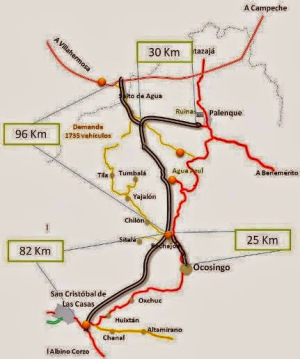
This shows the route of the super-highway from San Cristobal to Palenque.
By: Gaspar Morquecho
Laguna Suyul, San Juan Chamula, September 7, 2014
A little more than 2,000 people, between boys and girls, men, women and elderly people met in Laguna Suyul, convoked by the ejido members of La Candelaria. They were Tzotzils, Tzeltals, Chols and Tojolabals from the municipalities of San Cristóbal de Las Casas, Zinacantán, San Juan Chamula, Huixtán, San Pedro Chenalhó, San Pablo Chalchihuitán, San Juan Cancuc, Tenejapa, Amatenango, Chilón, Tila, Salto de Agua, Comitán and Las Margaritas. In this assembly of peoples they demonstrated their rejection of the San Cristóbal de Las Casas to Palenque super-highway project.
The activities started at 8 o’clock in the morning when Principales (traditional religious authorities) of La Candelaria ejido met to hold a ceremony at the Suyul Lagoon and in the temple that they have constructed every year to celebrate the Holy Cross. They burned incense, lit dozens of votive candles, played their music and prayed, “to give us strength, to not get tired in this struggle and to talk to Mother Earth so that it doesn’t let them come to destroy her.”
The place is a hollow with an environment of pines and some milpas. A small hillock stands in the center- an islet with trees and surrounded by waters from the place’s springs, the majority covered aquatic plants. At 10 o’clock in the morning, hundreds of people were waiting for the start of the assembly in that place.
The assembly started with the speech of a representative of La Candelaria ejido: “This is a very important meeting for us. We are in a sacred place and the government’s project comes to destroy it. They want the super-highway to pass close to this lagoon, like 500 meters away and we are not going to permit it. We will not let the government crush us. We have to join our voices and think what we are going to do to stop the government’s plans.
Two speeches followed him with information about the big neoliberal projects in Mexico, Central America, Chiapas, and in indigenous territories. Several of them are underway: mines, dams, ecotourist centers, exploitation of oil fields, highways, ports, airports; planting of GMOs and biofuels and the containment and counterinsurgency programs that started in Chiapas in the 1970s.
The work could not continue without holding community prayer. They planted a small cross, decorated with flowers. They planted a dozen candles and prepared the incense burner. They burned the candles and the burned incense perfumed the place; an offering to their God. There was the murmur of hundreds of people praying, of the petitions to their God, made from that space, from their sacred place… a place of communion.
That moment full of symbolism gave way the concrete. The figure of the Ejido and its ejido authorities that were made invisible for decades by the indigenous and campesino social movements once again occupied the place that is due them in this conjuncture. It is the organization of the farmworkers with the legal standing to defend land and territory, just like the Communal Lands and Communal Land Commissions are. The representatives of the Salto de Agua ejidos gave their word this way: “I come representing the San Miguel ejido, a place with Chol Maya speakers. On June 1, 2014, gathered together in an ejido assembly, we agreed to reject the super-highway project.” The representative of the Francisco I. Madero ejido continued: “God has given the land to us. We are not birds that live in the air, nor fish that live in the water. We live on the land and we must and we are going to defend it.” The representatives of Adolfo Ruiz Cortines ejido, also from Salto de Agua, affirmed that last September 15, the 70 ejido members of that place agreed: “to defend the indigenous peoples’ lands” and called for “joining efforts,” and proposed the construction of “a front of struggle” and raised the demand for a “consultation with the peoples.” In their speeches they reported that they have updated their internal rules to better guaranty the interests of the ejido owners.
The representatives of the San Jerónimo Bachajón ejido reported that in those hours, hundreds of their compañeros carried out a mobilization in Temó and that by agreement of their assemblies they reject the super-highway project. They added that they have named a commission to take the documentation and agreements from their assemblies to the Chiapas government and that “if they are not taken into account they will carry out new protest actions.” He called for unity and “to not let the big corporations conquer us.” They also reported that the ejido owners of San Martín Cruz have wanted to humiliate them for not signing the agreement for the super-highway and that in response the ejido owners took two municipal patrol cars that guard their community. He denounced that they are watched, persecuted and threatened for not accepting the super-highway project.
For their part, Indigenous representatives from Pueblo Creyente (Believing People) of Tenejapa announced that 52 communities in their municipality are not going to permit the super-highway’s passage; that the municipal authorities have called them but, they affirmed, “as Pueblo Creyente we are not going to fall into the deceit, we are not going to permit the passage.” Representatives of Huixtán and Chenalhó parishes agreed. Representatives of Matzam in the municipality of Tenejapa, denounced that “the super-highway is going to pass very close to their sacred mountain and they want to leave it as a tourist zone.” They warned they will not give passage to the highway and that they would continue: “to attend the meetings.”
The San Juan Cancuc representatives reported that: “their municipal authorities may be in agreement with the construction of the super-highway (but) we are against it” and they added that on September 16, in compliance with the agreement with the Movement in Defense of Life and Territory, they placed banners in “opposition to the government project,” and that the police pursued they and, nevertheless, they said: “we are going to continue united, because there are many communities in Cancuc struggling.”
The Ejido Commissioner of San Antonio Las Rosas, neighbor of La Candelaria warned: “We stay united with Candelaria. We are going to stay strong like all the communities that are here (present).”
In his talk the representative of La Candelaria ejido said: “We are seeing communities and ejidos that are willing to defend our life and our Mother Earth. It’s about defending it for our children. We invite the Bishop (Felipe Arizmendi) to place himself at the side of the poor; that he may defend the men and women that are in this union. We also call on all the pastors of the other churches to not abandon their faithful. May the pastors care for their sheep! May we not be divided b y parties or religions! The government’s project affects all of us, without distinguishing. We are gathered together here to begin walking although threats exist. They are not going to kill this movement. They cannot kill our spirit. We see that we can do it with the unity of the communities.
The assembly agreed to report: “the true word of the original peoples of Los Altos of Chiapas.
From the heart of the peoples we make known the true word of boys, girls, youth, the elderly, men and women in defense of life.
Mother Earth is the millennial gift that our grandparents have cared for and defended for generations. They cared for it and now it’s our turn to take care of it and defend it, if necessary with our own life.
We will defender the environment, the fabric and veins of Mother Earth, rivers, lakes, water holes, mountains, trees, caves, hills, the life of the animals, the sacred places, the ecosystem of m other nature and the life of human beings.
Our Mother is not for sale, the land is not for sale and has no price.”
The comunicado denounces: “the government’s lies to the peoples.” The offer of the “transnational mega-projects that bring death” that: “make the rich richer” and “the poor poorer.” They warn that they will not permit that: “they continue violating their rights.” They demanded respect for Convention 169 of the ILO, the “precise declaration on the collective and individual rights of indigenous peoples; their rights to land, wealth, vital resources, territory, culture, identity and language, to employment, education, and to freely determine their political condition and their economic development.”
They called on their brothers “to stay alert” facing the eventual government “repression, the purchase of leaders, and the threats;” alert facing a government that “murders” and “disappears people.”
“From this moment we hold the federal, state and state governments responsible for what can happen to us for defending our life, for caring for what is ours, for preserving what is the source of our food and our life.
For our Mother Earth and Life.”
The Tzotzils, Tzeltals, Chols and Tojolabals concluded their communion planting 260 trees on the outskirts of the small slope. The Zinacantecos’ outfits, and those of the Chamulans and the Tenejapans were confused there with the clothing of non-Indians. They left the place in a long line crossing the lagoon over a small wooden bridge and misty waters of Suyul.
————————————————————–
Originally Published in Spanish by Chiapas Paralelo
Translation: Chiapas Support Committee
Friday, September 19, 2014
CNI and EZLN Demand Freedom for Mario Luna
CNI and EZLN Demand Freedom for Mario Luna, Yaqui Tribe Spokesperson
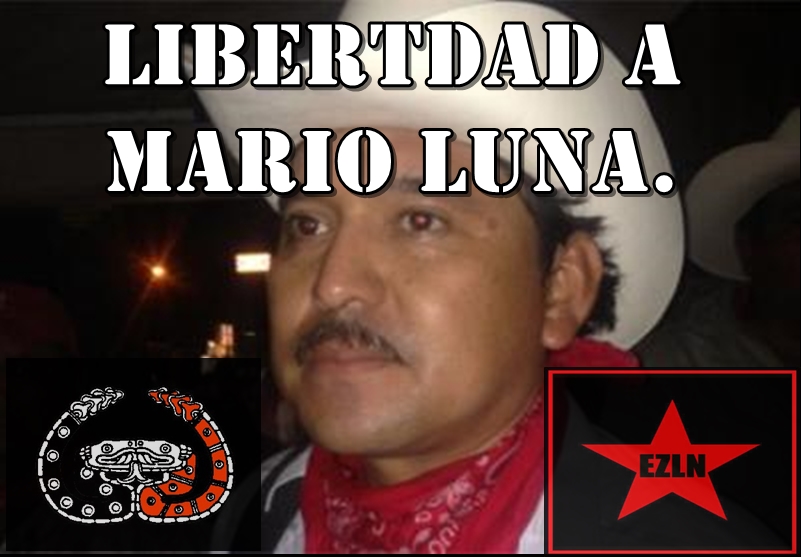
Mario Luna
September 2014
To the Yaqui Tribe:
To the People of Mexico:
To the National and International Sixth:
To the Governments of Mexico and the World:
“We demand the immediate cancellation of all arrest warrants and fabrication of crimes against members of the Yaqui Tribe, and we condemn the criminalization of their struggle. We say to the bad governments that come from the political parties: the Yaqui River has served as the historical carrier and ancestral continuation of the Yaqui Tribe’s culture and territory. We who make up the National Indigenous Congress reiterate that if you touch any of us, you touch all of us, and we will respond accordingly to any attempt to repress the Yaqui’s dignified struggle or any other struggle (Joint communiqué from the CNI-EZLN, July 7, 2013, Caracol of Oventic).
They have not been able to kill our peoples. Like seeds, we continue to grow. They tried to kill us with guns, and when they couldn’t, they tried to kill us with diseases, and again they failed. The powerful have tried many ways to kill off the indigenous.
Today they want to kill us with wind turbines, highways, mines, dams, airports, and drug trafficking. Above all, today in particular, we feel the pain of the attempt to kill us in Sonora, with aqueducts.
This past Thursday, September 11, people who apparently belong to the Sonora State Attorney General’s office detained our brother Mario Luna, spokesperson for the Yaqui Tribe, falsely accusing him of crimes that they themselves planted.
With this action they intend to imprison the very struggle of the Yaqui Tribe for defending its waters, which, after a long war, were recognized as theirs in 1940 by Lázaro Cárdenas. Since 2010, the money-owners want to again take these waters by way of the Independence Aqueduct, in violation of a resolution emitted by the Supreme Court of Justice of the Nation and violating all of the rights given us by International Conventions on such matters.
It is a joke to say that the Independence Aqueduct is so that the poor have water and progress, as those above say; it is so that the rich can take possession of the water that for centuries has belonged to the Yaquis. Instead of feeding fields and crops, they want to divert the water to large industrial companies in Sonora.
This plunder has been the banner of progress for the bad governments, with State Governor Guillermo Padrés Elías and Supreme Paramilitary Chief Enrique Peña Nieto at the head of the project. Just as the dictator Porfirio Díaz proclaimed the extermination of our peoples in the name of this kind of progress, in particular the extermination of the Yaqui Tribe, we know that the words of Padrés and Peña Nieto are lies. For these megaprojects to exist, we original peoples must disappear, and once and for all we tell those above that we have no plans to disappear. They detained our brother Mario Luna because he refused to sell out or give in, because he has been a brother in struggle to all of us who want this world to change below and to the left.
We don’t ask anything of the bad governments, and at this moment we want to tell them clearly one thing: our compañero Mario Luna’s freedom does not belong to them and they cannot take it away just like that. We want to make clear that his freedom belongs to him and his people, and that what was taken by force must be returned.
To our compañero Mario we want to say that we have walked together for more than 500 years. His tribe walks the path of struggle; even if the cowardly government sends them as slaves to the other end of the country, the Yaquis return to Vícam, Pótam, Tórim, Bácum, Cocorit, Huiriris, Belem and Rahum, because that is where their blood flows. We want to say that we are Yaquis, even though we might also be Zoques or Mames or Tojolobales or Amuzgos or Nahuas or Zapotecs or Ñahto or we speak any other language, and as the Yaquis that we are we will not let them rob us of our water or our freedom.
We demand Mario Luna’s immediate release, and we demand the cancellation of all arrest warrants and fabrication of crimes against members of the Yaqui tribe. We also demand the freedom of all of our prisoners, in particular our Nahua brothers Juan Carlos Flores Solís and Enedina Rosas Vélez, who were imprisoned by the bad government in April of this year and falsely accused of crimes in order to stop the struggle of the Peoples Front in Defense of Water and Land of Morelos, Puebla, and Tlaxcala, organized against the Integrated Morelos Project.
Mexico, September 2014.
Never Again a Mexico Without us! For the Holistic Reconstitution of our Peoples!
NATIONAL INDIGENOUS CONGRESS
INDIGENOUS REVOLUTIONARY CLANDESTINE COMMITTEE-GENERAL COMMAND OF THE EZLN
Originally Published in Spanish by Enlace Zapatista
Zapatista Resistance & Autonomy

Chiapas Support Committee/Comité de Apoyo a Chiapas
P.O. Box 3421, Oakland, CA 94609
Tel: (510) 654-9587
Email: cezmat@igc.org
www.chiapas-support.org
http://www.facebook.com/pages/Chiapas-Support-Committee-Oakland/
CNI and EZLN: United against Dispossession
CNI and EZLN: UNITED AGAINST DISPOSSESSION
By: Luis Hernández Navarro

Photo from the EZLN-CNI Exchange
Gatherings of popular organizations are celebrated practically every month in the most hidden corners of the country. In them it is sought to confront the dispossession of their lands, territories and natural resources, at the hands of oil, mining, wind farm, soft drink, tourist and construction companies; and also from federal, state and municipal governments.
The approval of the laws on hydrocarbons and “temporary occupation” of lands have multiplied the alarm signals in the rural world and the assemblies for confronting them. To the old spoliation that agrarian communities and nuclei have suffered are added new aggravations, which will be justified in the name of the country’s “energy modernization.”
Those gatherings and meetings are like small bubbles that are formed when water is at the boiling point. They are an indicator of the growing uneasiness that exists among Indigenous peoples and campesinos. They are moments in which information is exchanged, responses are analyzed and the reigning common feeling is exchanged. They are places in which what is believed are private problems are demonstrated as collective.
Many of these gatherings have an ephemeral life. For as much as their promoters propose to give them continuity, their zeal has an expiration date. On the other hand, others are watersheds of organizational processes of longer breath. Por more modest than they appear, they become foundational acts of long-term convergences. That is the case of the first Exchange (Sharing) of the Original Peoples of Mexico with the Zapatista Peoples, celebrated in La Realidad, Chiapas.
In this first sharing, representatives of 28 peoples, tribes, communities and indigenous organizations from almost all of the country met in rebel territory with the Zapatista National Liberation Army (EZLN). There, besides expressing their unconditional solidarity with the Palestinian people, the victim of the Israeli State’s aggression, a map was drawn of the resistance of the original peoples in the face of neoliberal dispossession and devastation and a dramatic inventory was given of their deaths and assassinations. “That blood, those lives, those struggles, that history are the essence of our resistance and of our rebellion against those that kill us; they live in the life and struggle of our peoples, ” the delegates pointed out.
Those that attended the sharing met with a central objective: confronting the plunder and pillage against their lands, in which they see their roots. “The dispossession of what we are as original peoples is the pain that unites is in the spirit of struggle,” they explained.
The first sharing takes on the impulse for reorganizing the National Indigenous Congress (CNI), the broadest and most representative organization of the ethnicities in the country, which had its “starting signal” in August of last year, in the Seminar Tata Juan Chávez Alonso. A reorganization that seals the alliance established more than 20 years ago now between the Zapatistas and the national Indian movement, and that profiles one of the most relevant and consistent networks of resistance against the dispossession on a national scale.
Different from other events, in which the attendees prepare for a struggle that they have not yet entered, all the attendees at the sharing carry many years fighting. Now they joined together not to be disposed to struggle, but rather to advance in the proposition of doing it a different way.
Their previous history of congruent and unwavering resistance gives this network a consistency and potentiality that other groupings do not possess. The combination between profound roots, genuine leadership and a horizontal faithfulness to their memorial of offenses augur a new stage in the resistance against the plunder. As they themselves point out in their declaration: “They have wanted to kill us many times, killing us as peoples and killing us individually. And after so much death we continue being the peoples alive and collective.”
We’re not dealing with a “sectarian” observation. Inside the re-emergence of the campesino movement that has emerged starting with the reform of the countryside and the opposition to the laws of hydrocarbons there are leaders that seek to assume before the State a representation of the indigenous world that they don’t have. Besides, one part of the organizations that make up this new convergence has formally rejected the dispossession of lands and territories only to negotiate other demands in exchange. That is not going to happen with the network formalized in the sharing.
According to the CNI and the EZLN, dispossession is diverse and has only one name: capitalism. That dispossession forms part of a new war of neoliberal conquest that has been declared on the peoples. We’re dealing with the new face of an old war of extermination that has now lasted 520 years.
“The current rulers –the EZLN and the CNI assert in the Sharing’s second declaration– are delivering our territories and riches that are in the name of the nation to the big national and foreign corporations, seeking the death of all the peoples of Mexico.
“All that –they add– while the bad governments don’t stop threatening to disarticulate indigenous self-defense as a right, by incarcerating or killing community leaders, which is a sign of destruction.”
As the second declaration of the sharing remembers, in the history of Mexico there is a long tradition of rebellion and resistance to exploitation and dispossession. In it, indigenous peoples have been in the first line of combat. It has no reason to be different in this new stage.
Twitter: @lhan55
———————————————————–
Originally Published in Spanish by La Jornada
Translation: Chiapas Support Committee
Tuesday, August 12, 2014
En español: http://www.jornada.unam.mx/2014/08/12/opinion/029a1pol
2nd Declaration from the EZLN-CNI Exchange
[This is the last of the documents from the Exchange between the Zapatista Peoples and the Indigenous Peoples of Mexico. The translation came out the day we left for Chiapas.]
2nd DECLARATION from the EZLN-CNI EXCHANGE: ON the DISPOSSESSION of our PEOPLES
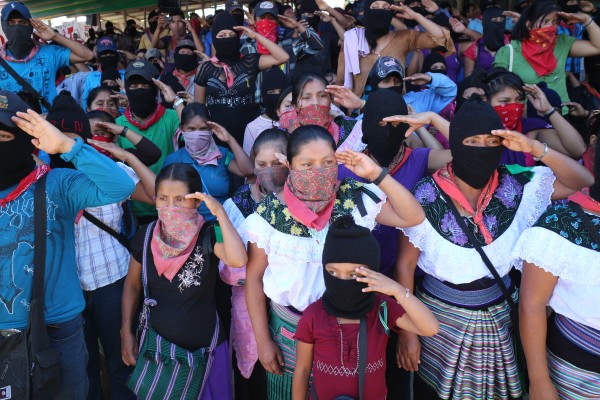
To the National and International Sixth:
To the peoples of the world who resist, giving bloom to rebellions:
The dispossession that we have faced as indigenous people is the pain that unites us in the spirit of struggle that we commemorate today in honor of our compañero David Ruíz García, who passed away while sharing the pain of the brothers and sisters from the Zapatista National Liberation Army after the murder of compañero Galeano. We become one in our history and in our hopes.
The death of the compañero, who is today collectively reborn among the 28 peoples, colors, and languages that are gathered in the Zapatista Caracol of La Realidad, inspires us as original peoples to share the happiness of encountering each other; of knowing each other to be as alive as are our peoples, our languages, our collective history that becomes our memory, our resistance, and our accountability to mother earth, who also lives and to whom we are indebted.
The struggle that we collectively represent is diverse, and we name our enemy dispossession because that is what we see, live, and die every day—an experience as collective as the corn, as our compañero Galeano, as our compañero David, and as our brothers and sisters whose lives have been taken in this war of extermination.
This dispossession is so diverse that it can only be called by one name: capitalism.
From the beginning, capitalism has grown through DISPOSSESSION and EXPLOITATION. PLUNDER and INVASION are the words that best describe the so-called conquest of America—plunder and theft of our territories, of our knowledge, of our culture. DISPOSSESSION, accompanied by wars, massacres, imprisonment, death upon death; these create a life in common because here we are as the peoples that we are, that we continue to be.
After the War of Independence, the emergence of the new nation, and the liberal reforms and dictatorship of Díaz, Mexico was born in denial of our peoples, through constitutions and laws that privatized our lands and sought to legitimize the looting of our territories. Thousands of our brothers and dozens of our peoples were exterminated and exiled en masse through military campaigns.
In spite of a million deaths of indigenous people and peasants during the revolution, the agrarian laws that appeared afterward were inspired by Venustiano Carranza and Álvaro Obregón—the ones who assassinated Emiliano Zapata—with the goal of protecting the large land owners, preventing the return of the people’s communal lands, water, and air, and converting communal property into ejidos. That is to say, they have wanted to kill us off time and time again as peoples and as individuals. Yet through all of this death, we continue on as living and collective peoples.
We have responded to our dispossession and extermination with rebellion and resistance. Hundreds of rebellions in Baja California, Sonora, Chihuahua, Nayarit, Jalisco, Guanajuato, Michoacán, Querétaro, Veracruz, the State of Mexico, San Luis Potosí, Hidalgo, Morelos, Puebla, Guerrero, Oaxaca, Chiapas, Yucatán, Campeche, and Quintana Roo, and notably, the Zapatista revolution, defied colonial society. All of these took place after the liberal reforms, giving rise to the armed movement of 1910 and the armed defense of communal lands up until the era of the agrarian reforms and Cardenista oil expropriation.
Currently, the neoliberal capitalists, with the assistance of all of the political parties and bad governments led by the criminal paramilitary boss Enrique Peña Nieto, are applying the same policies of large-scale dispossession applied by the nineteenth-century liberals—the Carranzas, the Obregons—propped up by militarization and paramilitarization and advised by U.S. intelligence in areas where there is resistance to the dispossession.
Just like the governments of that era, the current governments are giving our territories and the resources that belong to the Nation to large national and foreign corporations, seeking the death of all the peoples of Mexico and of our Mother Earth. But death among our people means collective rebirth.
We reiterate that our roots are in the land, and that the dispossession that we discussed in the Seminar Tata Juan Chávez Alonso in August 2013 is our pain and our rage; it is where our determination and rebellion are born. It is our unceasing and unfailing struggle and our very lives. These dispossessions continue in force today just as before, and have multiplied into new forms and onto new corners where new struggles and resistances are born that are reflected in the mirror that we are.
Mirror 1: On the Nahua coast in the state of Michoacán, the drive to extract natural riches has been the reason, since 2009, for the murder of 31 people and the disappearance of 5 at the hands of the Caballeros Templarios [Knights Templar, a drug cartel]. They rely on corruption within the structure of the bad government, which has provided cover for the plunder of the communal lands by small proprietors who are in turn the regional heads of organized crime, and for the illegal extraction of minerals and precious wood to be exported by Chinese transnational corporations from the Manzanillo and Lázaro Cárdenas ports, which are administered by the bad government. This corruption has left a wave of mourning, pain, and brutality for the community Ostula, which has strengthened itself with a growing rebellion that has allowed them to maintain security and detain the extraction of their resources. All of this while the bad governments threaten unceasingly to dismantle the indigenous people’s right to defend themselves by imprisoning or murdering their community leaders—a warning of more destruction to come.
Mirror 2: The Nahua and Totonaco territories in Totonacapan, Veracruz, have been destroyed by electric power plants, the release of flared gas, and toxic spills from damaged pipelines that have devastated the region’s water sources. All of this is part of the Proyecto Paleocanal de Chicontepec, now known as Tertiary Gulf Oil, where 29 oil fields are being exploited in an area of 3,875 square kilometers, with 1,500 oil wells across 14 municipalities in the region, destroying rivers and streams through hundreds of spills originating from 2,220 well overhauls that were made up until the year 2010. Currently there is a threat of 33,000 more well overhauls according to the National Commission of Hydrocarbons. Fracturing has been carried out through the detonation of dynamite, and hydraulic fracturing (fracking) in 1,737 wells in the entire zone. In that same area numerous mining concessions have been granted that put at risk the integrity of the territory.
Mirror 3: The Wixárika people, despite the fact that they encompass parts of the states of Jalisco, Nayarit, and Durango, have maintained their continuous territory and their autonomous organization is strong and ancestral. Today they face an onslaught on simultaneous fronts: past agrarian invasions which, despite restitution having been ordered in favor of the community San Sebastián Teponahuaxtlán, continue without enforcement of restitution due to blurry delimitations between states. Their territory has been subjected to the imposition of highways whose objective is the plunder of the region’s natural resources, as has been the case of the community of Santa Catarina Cuexcomatitlán, which since 2008 has mobilized large protests to halt the imposition of the Amatitán-Bolaños-Huejuquilla Highway. Currently the government of the state of Jalisco refuses to repair the damages caused to their forests, communal roads, and sacred sites, despite the fact that the community obtained legal rulings in its favor.
In the state of Durango, the Autonomous Wixárika Community of Bacos de San Hipólito continues their long struggle for recognition of their ancestral lands, exercising autonomy as their only option for their continuing existence as indigenous peoples.
For our peoples, territory is not only agricultural but also ceremonial. The principal sacred site of the Wixárika people is found in the Wirikuta desert in San Luis Potosí, which, in addition to being threatened by 5 mining corporations who have in their possession over 78 concessions, is currently undergoing the unauthorized extraction of antimony, uranium, gold, and silver in the zones of San José de Coronados and Presa Santa Gertrudis, in the Municipalities of Catorce and Charcas.
Mirror 4: In the Municipality of Villa Guerrero in Jalisco, the Autonomous Community Wixarika-Tepehuana de San Lorenzo de Azqultán, in spite of holding a viceregal title since the year 1773, have not received recognition for their own territory. On the contrary, the land that has always belonged to them has now been put at the mercy of the caciques [land bosses] and governments. The forest is being cut down, the territory invaded, and their sacred sites destroyed, such as in Cerro Colotlán where the bad government has given the landowners endorsement and money to carve up ceremonial stones for use as stone barriers supposedly to protect the soil. This is not only dispossession, but rather genocide.
Mirror 5: In the Isthmus of Tehuantepec, where the Ikoots and Binniza people of the communities of San Mateo del Mar and San Dionisio del Mar live, as well as the people of Juchitán and the inhabitants of the barrio Álvaro Obregón, the firms Endesa, Iberdrola, Gamesa y Unión Fenosa Gas Natural Fenosa, Demex (a subsidiary or Renovalia Energy), Eclectricte de France (EDF), Eolicas del Sur, Zapotecas de Energía, Grupo Mar, Preneal, and Ener green Power are plundering communal lands and destroying sacred sites throughout the region. They have illegally occupied more than 32,000 hectares and installed 1,600 wind turbines since 2001 on top of communal lands in Juchitan and Unión Hidalgo for the Biiyoxo and Piedra Larga II and II wind farms. Currently, the collective assembly of Unión Hidalgo is opposing the expansion of these parks to the communal lands of Palmar and El Llano, protected mangrove areas in the south of the Binizaa communities. This is territory defended by our compañeros from the Popular Assembly of the Juchiteco People and the Isthmus of Tehuantepéc Assembly of Indigenous Peoples in Defense of Land and Territory (APIITDTT).
In the same area of the Isthmus, Oaxaca’s region of San Miguel Chimalapas and Santo Domingo Zanatepec was invaded by three mining concessions granted to the Cruz Azul Cooperative for the mining lot they refer to as El Chincuyal, to Cascabel Mining for the mining lot called Mar de Cobre, and to Zalamera Mining for the mining lot called Jackita, a subsidiary of the Orum Gold Mining Corporation—whose reach stretches across 7,310 hectares of our peoples’ lands. The Chiapas state government, rich cattle ranchers, and the Mexican Army are carrying out the invasion.
To the north of the Isthmus of Tehuantepec, in the south of Veracruz, the Nahua Popoluca territory in the Sierra de Santa Martha is under threat from a mining project that stretches across three concessions called La Morelense 1, La Morelense 2, and La Ampliación. The project puts the environment and the integrity of this indigenous area at great risk.
Mirror 6: In the ñatho communities of San Francisco Xochicuautla and Huitzizilpan, as well as in a wide strip of land called Alto Lerma in the State of Mexico, a private road project called Toluca-Naucalpan is being imposed by the Autovan corporation. It will affect a total of 23 kilometers of forest, in addition to the construction of thousands of homes and golf courses as part of the project called Gran Reserva Santa Fe. Our brothers from the Indigenous Peoples Front in Defense of Mother Earth defend this territory.
Mirror 7: In the Nahua community of Tuxpan, Jalisco, under pressure by the bad governments and national and international investors, the indigenous people have had to lease out ejidal lands to transnational avocado companies headquartered in Michoacán. Foreign greenhouses such as Driscolt and Aguacates Los Tarascos, which are engaging in weather modification schemes that prevent rain, are dispossessing these communities.
Mirror 8: The coca community of Mezcala, Jalisco, continues suffering and defending their territory against the businessman Guillermo Moreno Ibarra, who has invaded and kept a plot in the community’s forest region. The community is preserving its possession and ancestral property over the sacred island that the bad governments can only see as a million dollar business that they can put up for sale to foreign tourist companies.
Mirror 9: In the territory Chinanteco, in the state of Oaxaca, ecological reserves have been imposed that have snatched territorial control from the peoples while, at the same time, the bad government implements projects of destruction and death, such as the Tuxtepec-Huatulco highway and the Chinanteco touristic corridor.
Mirror 10: In Huexca, Morelos, in the Eastern Nahua region of the state, one of the two thermoelectric plants that make up part of the Morelos Integral Project was constructed in a volcanic activity risk zone. This project is promoted by the Abengoa Company and the Federal Electric Commission (CFE) with the support of the three levels of government, the Mexican Army, and the state police. The same project seeks to construct an aqueduct for the extraction of water from the river Cuautla, which will affect 22 ejidos in the Municipality of Ayala. Mirror 11: In Amilcingo and Jantetelco in Morelos, the eastern Nahua region of the state and in the Nahua region of Valle de Puebla, in the communities San Geronimo Tecuanipan, San Lucas Atzala, San Andres Calpan, Santa María Zacatepec, San Lucas Tulcingo, Santa Isabel Cholula, San Felipe Xonacayucan, Santa Lucia Cosamaluapan, San Isidro Huilotepec, San Buenaventura Nealtican, San Juan Amecac, and in other communal regions of Puebla and Tlaxcala, the Integral Morelos Megaproject intents to construct a 160 kilometer pipeline in an area of volcanic risk. This Project is promoted by the CFE, the Spanish corporations Elecnor and Enagas, and by the Italian corporation Bonatti. Over the last two years, the three levels of government in their respective states have exerted brutal repression on all of these communities.
Mirror 12: In Tepoztlán, Morelos, belonging to the Nahua people, the expansion of the La Pera-Cuautla highway will dispossess the community not only of their lands but of their territory’s biodiversity and ancient culture. Ancient trees and sacred sites that have sat on that land for generations have been destroyed to allow the arrival of private companies and the industrialization of the most resource-rich areas in the state of Morelos. The response of the bad governments was a campaign to discredit the indigenous peoples in order to justify the plunder.
Mirror 13: In the Nahua territory of the community of Ayotitlan, in the Sierra de Manantlán in the state of Jalisco, the extraction of two million tons of iron and precious wood has been carried out with the support of organized crime and via assassinations and disappearances of the community and ejidal members.
Mirror 14: In the Nahua community of Zacualpan, in the state of Colima, over the past few months a businessman by the name of Verduzco, with the complicity of the state government and the Attorney General’s Agrarian office, tried to impose a mine for iron, gold, silver, and manganese in the Cerro Grande, whose forests produce all of the waters that supply Colima and Villa de Alvarez. Also in Cerro Grande, the government is promoting programs supposedly for ecological conservation but which serve as a pretext for the dispossession of the community from its communal waters.
Mirror 15: The community of Cherán, Michoacán, on the Purépecha Plateau, has suffered the devastation and the theft of thousands of hectares of forest at the hands of loggers linked to organized crime and with the complicity of the bad government. Violence without precedent has been unleashed against the community members who have exercised their ancestral right to defend their territory within a framework of autonomy and self-determination, constructing their own mode of government through traditional “uses and customs”.
Mirror 16: In the Maya territory of Campeche, dispossession is disguised through the leasing of land in the communities of the Chenes region by groups called Mennonites, to whom the bad government gives money in order to strengthen the plunder of the territories and impose the planting of transgenic soybean crops.
Meanwhile, in the indigenous regions of the so-called Riviera Maya, privatization processes have accelerated on behalf of national and international tourism projects which have destroyed countless sacred sites.
The people of Maya de Bacalar, in the state of Quintana Roo, are suffering the imposition of transgenic soy cultivation that poses great risk to the native seeds, health, and food of the indigenous people. Companies such as Monsanto, Singenta, and Pioneer do this with the complicity of the bad governments.
The Maya people of the Yucatan are threatened by various megaprojects, such as the Dzilam de Bravo wind farm, the planting of transgenic corn, the Trans-peninsular train project, and real estate development, which benefit a handful of businesses and corrupt politicians.
Mirror 17: In the Tzeltal village of Chilón, Chiapas, the construction of the San Cristóbal-Palenque highway is being imposed on the community’s territory.
Mirror 18: The Nahua community of San Pedro Tlanixco, in the State of Mexico, has been stripped of its springs and waters from the Texcaltenco River through concessions benefitting wealthy agro-industrial companies from the Municipality of Villa Guerrero, and has led to the imprisonment of the community leaders.
Mirror 19: In the State of Guerrero, in the Municipalities of Xochistlahuaca, Tlocoachistlahuaca, and Ometepec, hundreds of Amuzga, Mixteca, and Afromestiza communities are threatened by the pipe-laying projects that would send water from the San Pedro River to the City of Ometepec, violating the basic rights that we have as peoples.
Mirror 20: The surrounding areas of the sacred site of Xochicalco in the Nahua community of Xoxocotla in the southwest of Morelos, are threatened by the imposition of a mining project that holds 7 concessions in 3 municipalities that cover an area of 15,000 hectares in Xoxocotla, Temixco, Xochitepec, and Miacatlan in the communities of Tetlama, Alpuyeca, Coatetelco, La Toma, and Xochicalco.
Mirror 21: In the Yaqui territory in the state of Sonora, ambitions over the waters of the Yaqui River has historically motivated aggressions against the tribe. Currently the threat is for the waters to be diverted to the City of Hermosillo via the Independence aqueduct to the detriment of both the Yaqui and hundreds of hectares of the Mayo Yoreme tribe and the farmers of the Valle del Yaqui.
Mirror 22: The Náyari people, in the state of Nayarit, have historically been the guardians of the San Pedro River, home to their sacred site Muxa Tena. Today this site is threatened by the construction of the Las Cruces dam.
Mirror 23: In the state of Sonora, with the construction of the Los Pilares damn, the sacred sites of the Guarijío people will be destroyed.
Mirror 24: Bachajón, Chiapas, a Tzeltal community, is being stripped of its land, water, and culture through the construction of tourist resorts at the waterfalls of Agua Azul, in addition to highways and hotels. This is taking place through paramilitary repression.
Mirror 25: The Ch’ol people of Xpujil, in the state of Campeche, were displaced from their lands by decree for the Calakmul Biosphere Reserve. It was imposed on the community in such a way as to completely restrict their access to the territory.
Mirror 26: In the Nahua and Totonaco territory in the Sierra Norte of Puebla, in the Municipalities of Tlatlaqui, Zacapoxtla, Cuetzalan, Zoquiapan, Xochiapulco y Tetela, Zautla, Ixtacamaxtitlán, Olintla, Aguacatlán, Tepatlán, Xochitlán, Zapotitlán, Zoquiapan and Libres, the capitalist death projects seek to possess every corner of the territory through the extraction of minerals via open air mining and hydroelectric dams. Today, 18% of the territory in Puebla’s Sierra Norte has been conceded to mining companies, as the government has granted 103 concessions to the Mexican companies Gruop Ferrominero, Industrias Peñoles, and Grupo Frisco, as well as to the Canadian company Almaden Minerals. There also exist six hydroelectric projects that affect 12 rivers in an area of 123,000 hectares, distributed across 18 municipalities.
Mirror 27: The territory of the Kumiai people has suffered massive invasions stemming from the lack of recognition, the imposition of ejidos, and the declaration of their lands as national patrimony. Over the last few years, wind projects have been imposed on their lands as well as on the territory of the Kiliwa people.
Mirror 28: The community of Nurío Michoacán on the Purépecha Plateau was stripped of the majority of its territory through resolutions dictated by the Mexican agrarian authorities that provoked conflicts between neighboring communities resulting in numerous deaths.
Mirror 29: The Bochil, Jitotol, and Pueblo Nuevo communities, of the Tzotzil people of the Chiapas highlands, denounce planned dam projects that threaten this territory.
These are the dispossessions that we suffer, that we learn about during emergencies when attempts are made on our lives. And today we say to the powerful, to the corporations, to the bad governments led by the supreme criminal paramilitary boss, Enrique Peña Nieto, that we do not surrender, that we do not sell out, that we do not give up.
Our memory is alive because we ourselves are that memory to which we are indebted. We understand that there is no better memory than that of our peoples, and as we gather now in order to see each other we see that our struggle will not end; if they haven’t killed us off in these last 520 years of resistance and rebellion, they won’t be able to do it now, or ever. We are people of corn; we know that the milpa is collective and its colors are diverse—so diverse that we also want to give ourselves one name: rebellious and anti-capitalist, with the brothers and sisters of the National and International Sixth. Today, like the corn, we renew our decision to construct from below and to the left a world where many worlds fit.
“THE HEART OF OUR MOTHER EARTH LIVES IN THE SPIRIT OF OUR PEOPLES”
ANDIÜMAATS NANGAJ IüT MEAWAN NÜTs KOS NEJ ÜÜCH IKOOTS MONAPAKÜY (LENGUA OMBEAYETS/IKOOT) NA MA JOIIY RA PUIY Y RA VENI GUI JIINI (OTOMÍ) LADXIDO GUIDXILAYU NABAANI LU XQUENDA CA GUIDXI XTINU (LENGUA DIIDXAZA/BINNIZA) I PUJUK’AL LAK´ÑA LUM KUXUL TYI CHULRL LAK LUMALO’ (CHOL) TE YO TALN TEJ NANATIL LUM CUXUL SOL XCHULEL TEJ LUMALTIC (TZELTAL) LI YOON JMETIK BALUMILÉ KUXUL XCHULEL TAJ TEKLUMALTIK (TZOTZIL) JAS J’UJOL JAJ NANTIK LU’UM ZAK’AN JAB’AYALTZIL JAJ CHONA B’LLTIK (TOJOLABAL) IN YOLOTL TO TLALTICPAC NEMI IEKAUILKOPA TO ALTEPEUAN (NAHUA) TA TEI YURIENAKA IYARIEYA TAKIEKARIPA YEYEIKA (WIXARIKA) U KUXTAL K-LÚUMIL TÍAN TI U YÓOL LE KÁAJILO’OB. (MAYA PENINSULAR) JUCHARI MINTSÏTA P’ARHAKPINIRHU IREKASÏNI TSÏPIKUANIRHU JUCHARI IRETA (LENGUA PURE/P’URHEPECHA) TU TLAL UI NANA IYULO ISTOK I TUNAL PAN CHINANKOME (NAHUA) XNAKU KIN TSEKAN TIYAT STAKGNAMA CHI KGALHI LISTAKGNI NAK KIN PULATAMANKAN (TOTONACO) BI MAMA NAX BI TZOKOY JEJPA NETZANKUYJO BI KOXEN KUMKUYDE KAY JENAN (ZOQUE) UU JIAPSI Y iiTOM AYEE VUIAPO ITOM JIPSICO JIAPSA ITOM PUEBLOMPO (MAYO YOREME) NA’ T’SATS´OOM TYUAA MAYA NA’ M´AA NAQUII´ NTAAYA JA NA NNA NCUEE (ÑOMDAA/AMUZGO)
From Zapatista La Realidad, August 2014
FOR THE INTEGRAL RECONSTITUTION OF OUR PEOPLES
NEVER AGAIN A MEXICO WITHOUT US!
NATIONAL INDIGENOUS CONGRESS
ZAPATISTA NATIONAL LIBERATION ARMY
A Report Back from Zapatista Territory
[We’re back from an amazing visit to Zapatista Territory and have lots of news about the Zapatistas, the recent attacks on San Manuel, immigration on Mexico’s southern border and the southern border strategy (Plan Sur). We’re looking forward to seeing lots of folks. CSC]
FRIDAY, SEPTEMBER 26, 2014 – 7:00-9:00 PM
EAST BAY CHURCH of RELIGIOUS SCIENCE
4130 TELEGRAPH AVE., OAKLAND, CA 94609
(Two blocks from MacArthur BART)
PLEASE JOIN MEMBERS of the CHIAPAS SUPPORT COMMITTEE TO HEAR ABOUT THEIR RECENT VISIT WITH ZAPATISTA COMMUNITIES IN CHIAPAS, MEXICO.
REQUESTED DONATION: $5-10 sliding scale
No one turned away for lack of funds.
FOR MORE INFO: (510) 654-9587
Zapatista News Summary – August 2014
AUGUST 2014 ZAPATISTA NEWS SUMMARY

In Chiapas
1. Zapatista Exchange (Sharing) with the National Indigenous Congress (CNI) – The Zapatistas held an “exchange” (sharing) with the National Indigenous Congress (CNI, its initials in Spanish) in La Realidad between August 4 and 8. A 1st Declaration from the Exchange was issued on August 9 at the Closing, which was open to all Zapatista supporters. Sup Moisés also gave a progress report on school reconstruction. On August 10, both Subcomandantes Moisés and Galeano (formerly Marcos) met with the free media and gave presentations. We posted the English translation of Galeano’s talk in 2 parts because of the length:
1st part – https://compamanuel.wordpress.com/2014/08/26/sup-galeano-marcos-talks-to-free-media-part-1/
2nd part – https://compamanuel.wordpress.com/2014/08/26/sup-galeano-marcos-meets-the-press-part-2/
2. Paramilitaries Displace 72 Zapatistas in San Manuel – Armed members of the ORCAO fired shots into the air and at homes, and also made death threats against civilian Zapatista supporters in the communities of Rosario, Egipto, San Jacinto and Kexil, causing some of them to flee for their lives to some other Zapatista community. All communities belong to San Manuel autonomous municipality, which has been the Chiapas Support Committee’s partner since 2002. Aggressions began at the end of July and escalated during the first 2 weeks of August. Path of the Future Good Government Junta in La Garrucha and the Fray Bartolomé de Las Casas Human Rights Center (Frayba) issued reports and denunciations concerning the attacks, which as of the last report, have displaced 72 Zapatistas. Several of our members are visiting La Garrucha this coming week and will give a report on Friday, September 26.
3. Zapatistas Announce December/January Plans – The EZLN and the CNI announced: the “First Worldwide Festival of Resistances and Rebellions against Capitalism” with the slogan of “WHERE THOSE UP ABOVE DESTROY AND THOSE OF US BELOW RECONSTRUCT.” This big worldwide sharing will be held between December 22, 2014 and January 3, 2015 in different locations. For the complete schedule, click here. There will be a Fiesta of Anticapitalist Rebellion and Resistance in the Caracol of Oventic on December 31, 2014 and January 1, 2015.
Mexico’s Southern Border
1. The Southern Border Strategy Unfolds in Chiapas – Details of Mexico’s “southern Border Strategy” are being released little by little. As more becomes known about the so-called Southern Border Strategy, it is becoming obvious that its focus is on impeding (catching and deporting) Central American migrants. Police and military personnel are pulling migrants off the train called “The Beast.” And the federal government announced this month that it is investing $6.058 billion pesos to improve the tracks of the train known as La Bestia (The Beast) so that it can go faster and be more difficult for immigrants to board. Moreover, the government plans to investigate the train’s operators and see if they have ties to organized crime. The stories of human rights and immigrant rights activists in Chiapas are appearing in the press almost every day and many of their organizations have formed a coordinated observation program. Frayba is part of that formation. When the government arrests undocumented immigrants, it calls this “rescuing” them and purports to be saving them from the hands of criminals or injury on the train, although it will then swiftly deport them.
In other parts of Mexico
1. 100 Organizations Meet in Atenco in Defense of Land and Against “Reforms” – Representatives of 100 campesino, union and social organizations met in San Salvador Atenco over the weekend of August 16-17 to define an action plan in defense of land, water and against dispossession and the recently approved structural reforms. The action plan includes both mobilizations and legal actions. The final declaration describes that dispossession is caused by megaprojects that are imposed without consent from the communities that they affect. Mining projects, dams, highways and pipelines or ducts dispossess communities. Meanwhile, two political parties are collecting the signatures needed for a national referendum on the recent structural reforms.
_________________________________________
Compiled monthly by the Chiapas Support Committee.The primary sources for our information are: La Jornada, Enlace Zapatista and the Fray Bartolomé de las Casas Human Rights Center (Frayba).
We encourage folks to distribute this information widely, but please include our name and contact information in the distribution. Gracias/Thanks.
Sup Galeano (Marcos) talks to Free Media, part 1
[This transcript is very long and we have divided it into 2 parts. Here’s part 1. Part 2 is below in a separate post.]

SupGaleano (aka Marcos) wearing eye patch with skull.
Part I of Transcription of the EZLN Press Conference with the free, autonomous, alternative, or whatever-you-call-it media, August 10, 2014, in La Realidad Zapatista, Chiapas, Mexico.
The words of SubGaleano
Good morning Gotham City… whenever you finish taking pictures of the stage over there, we’re going to start the press conference over here.
Please take your seats so that we can start in a few minutes, and so that afterward you can take your departure. Please find your places compañeros, compañeras. Please sit down.
Good morning Gotham City (that is a greeting to a compañero who uses that as a twitter handle).
What you just saw a few moments ago is what in military terms is called a diversionary tactic, and in laymen’s terms is called magic. And what took just a few minutes to actually happen, took someone 20 years of work to make happen that way. [i]
We want to begin, taking advantage of the fact that we have the free, autonomous, alternative, or whatever-you-call-it media here, as well as compañeros from the national and international Sixth, by thanking you. And in order to thank you, I am going to tell you the story of a death.
This August 25 marks the 10-year anniversary of the death of Infantry Lieutenant Insurgente Eleazar. In 2004, really in 2003, he began to show signs of the kind of illness that only appears on Doctor House or stuff like that. It is called Guillain-Barré, and it consists of a gradual decline of all systems of the body until the patient dies. There is no cure, and the patient must be kept connected to life support.
When he began to get sick they took him to a hospital in Tuxtla Gutiérrez. They diagnosed him with this illness and told him that he should just go home, that it wasn’t that serious. But when I heard what he had I knew what they meant by those instructions. The doctors, when they saw that he was indigenous, knew he would not be able to pay for treatment. It’s really treatment for survival, not a cure.
#&*%^$*… let’s see if the milicianos can be moved into the shade, they’re going to be cooked alive out there, Lico…
The eye patch is so everybody thinks I have a glass eye, but I don’t. Me and my damned ideas! Now I have to walk around with this thing on.
So, this illness… in Chiapas, and I imagine in the rest of the country, doctors calculate whether the patient is going to be able to pay for treatment or not. If, according to their calculations, the answer is no, then the doctor tells the patient they don’t have anything, gives them a few placebos so they think they are going to get better, and sends them home to die.
But we refused to accept that. We began to spend from the war funds, the resistance funds, until we couldn’t maintain him any longer. At that point, we’re talking about 2003 when a certain artistic intellectual sector still loved us, we asked them for help so that we could keep our compañero alive. They laughed at us. Apparently the indigenous can die of smallpox, measles, typhoid, all these kinds of things, but not of such an, shall we say, aristocratic illness, as Guillain-Barré, which happens to only one in a million.
When we couldn’t maintain him any longer, we took Lieutenant Eleazar to Oventic and, with the equipment we were able to get there, we kept him alive until one August 25, ten years ago, when he died.
Ten years later, along with the tragic assassination of the compa Galeano, paramilitaries from the CIOAC-Historic destroyed the autonomous school and clinic here in La Realidad, the ones that belonged to the local Zapatistas. In order to rebuild, we didn’t go to those people [the artist-intellectual sector] for help, but to the people below, our compañeros, compañeras, and compañeroas of the national and international Sixth.
Compañero Subcomandante Insurgente Moisés, present here, and Comandante Tacho, along with the Zapatista authorities of La Realidad and the compañeros who do carpentry, calculated the necessary materials and came up with 209,000 pesos and some change. At that point we were thinking:
Well, this crowd is really down and out, maybe really scraping the bottom of the barrel they will be able to come up with half of the money and we can take the rest out of the resistance fund or ask for support from the other caracoles.
You already know the story of what happened next, because you are the protagonists. And by “you” I don’t just mean those of you who are here, but all of those who, through you, find out what happens here, that is, our compañeros, compañeras, and compañeroas of the Sixth all over the world. You quintupled the request; in the last accounting we did, the support that had come in quintupled the budgeted amount.
We want to say thank you for this; never before has the EZLN received so much support, and this support from below was more than those who do have money had ever given. Because we know that the compañeros of the Sixth didn’t give what they had leftover; they gave what they didn’t even have. We have been reading in your free media, your twitter accounts and on your Facebook pages, stories that fill us with pride.
We know that many of you struggled to come up with the funds to come here, that some even struggle to feed themselves every day and to have a fresh pair of—I was going to say underwear—of clothes, and that despite that you made the effort to find a way to come and demonstrate what support between compañeros looks like, as opposed to hand-outs from above.
So the first thing I want you to tell your compañeros and compañeras all over the world in your languages, tongues, ways, times, and geographies, is thank you, for real. You have given a beautiful lesson not only to those above who divvy up crumbs as hand-outs, to the governments who abandon their obligations and even promote destruction, but also to us; it is the most beautiful lesson that we Zapatistas have received since the Sixth Declaration was released.
The point of this press conference is to honor a promise. Originally this press conference was going to be held in Oventic, along with the exchange with indigenous peoples that was meant to happen there. Later it was going to happen when we had the funeral for compañero Galeano, the homage that is. And it was principally meant to say the last words or the farewell of Subcomandante Marcos, and the first words of Subcomandante Insurgente, now Galeano—at that point it was going to be another name.
It’s important that I tell you what this event was going to be, that is, how we had conceived it, in order to propose to you another possible reading of the homage to Galeano and this transition between death and life that was created by the disappearance of the late Subcomandante Insurgente Marcos, due to whom the devil is holding his nose. Now it must be said, that was one good-looking guy, to each their own… That was sarcasm, I don’t know if you got it… I can still distinguish these things.
Look, compañeros, in order to understand what happened in the wee hours of that morning of May 25, you have to understand what had happened before, what was going to happen. I have read and heard various interpretations that are more or less correct, and a whole bunch that are absolutely ridiculous, about what that May 25 morning meant. Some are quite clever, such as for example the one that proposed that it was all a trick to avoid paying child support.
But most accounts completely disregarded everything that had happened. For example, they said that the Zapatistas had said that the paid media don’t exist, that they were now the enemy, that this was an action aimed against the paid media, etc. But if you have even a little bit of memory, you’ll recall that in the original invitation the event was open to everyone, when it was to be held in Oventic. That meant the paid media could also attend.
What was gong to happen originally was that Marcos was going to die and bid farewell to the paid media, explaining how we viewed them and thanking them kindly and then he was going to speak and introduce himself to the free, alternative, autonomous, or whatever-you-call-it media. What I am implying is that one reading, perhaps not the most correct, is that what happened in the wee morning hours of May 25, 2014, meant that the EZLN was changing interlocutors. That is why I told you the history of the late Infantry Lieutenant Insurgente Eleazar, war veteran, who fought in 1994.
Yes, the Zapatistas have not only not said that the paid media don’t exist—somebody out there circulated that stupidity—but we said something entirely different: that what is happening with the paid media has nothing to do with us and has everything to do with the advance of capitalism at a global level.
The paid media present something truly marvelous within capitalism because they represent one of the few times that capitalism has managed to convert non-production into a commodity. Supposedly, the job of the communications media is to produce information and circulate it for the consumption of its various audiences or listeners. Capitalism has managed to pay the media to not produce, that is, to not inform.
What has happened over the past few years is that with the advance of mass communications media that are not privately held—that is, they are currently being litigated or disputed, such as the battleground of the internet—the traditional press has lost power—both the power of dissemination and of course, the capacity to communicate.
I have a few facts here and I am going to cite the author because he asks that he is cited any time his information is used, Francisco Vidal Bonifaz. He does an analysis of the print runs of the principal newspapers in Mexico (note: it is probable that the speaker is referring to the book “Los Dueños del Cuarto Poder”, published by Planeta editing house, where the author Francisco Vidal Bonifaz does an exhaustive analysis of the press in Mexico. In this book and in the blog “The Wheel of Fortune,” ruedadelafortuna.wordpress.com, you can find this information, the print run of each publication, as well as the economic and educational levels of their readerships, etc. The book and the blog are recommended for anyone who wants an in-depth understanding of the situation of the Mexican Press. Note courtesy of “Los Tercios Compas,” “The Odd Ones Out”). The newspapers classified as the principal newspapers in Mexico, in that inverse provincialism characteristic of Chilangos [people from Mexico City], are the ones that are produced in Mexico City, even though the print run of newspapers produced in the states may be greater.
In 1994 they put out, sometimes in a more than a figurative sense, more that a million copies of the principal newspapers. In 2007, production had fallen to 800,000, and the number of readers had gone down scandalously. One way or another, investigative journalism and journalistic analysis, which is the ground on which the paid media would have been able to compete with the instantaneous information possible through the internet, was abandoned or left aside.
The paid media, which really isn’t an insult, it’s a reality; it is media that lives off of money, right? Some may say “no, the thing is that “paid media” sounds really bad, it’s better to say ‘commercial media’.” But commercial media sounds worse than paid media.
Newspapers don’t live off their own circulation, that is, off the sale of their paper; they live off of advertisements. So in order to sell advertisements they have to show those buying advertising space what public they are targeting, who their readers are. For example, they say—and this is data from before and up to 2008 because after that all of the newspapers censured any information about their own publications—that El Universal and Reforma took about 70% of the paid advertising in Mexico City, and the other newspapers fought over the remaining 30%.
So each newspaper has a profile, we could call it, of its readers —a particular class strata and educational level it targets— and that is what it presents to companies buying advertising space. So if I am El Despertador Mexicano and my primary consumers are indigenous people, then I’m going to sell one page of advertising space to El Huarache Veloz [The Fast Huarache] in order to sell huaraches or pozol or whatever. [ii]
The thing is that all of the newspapers, absolutely all of them, including those that say they are leftist, present an analysis of their readership profile that has 60 to 70% of their readers in the upper ranges of buying power. The only ones who openly recognize that their readers are of low buying power and low educational background are Esto, Ovaciones, and La Prensa. All the others target the upper class, that is, those above.
It is evident that this class with high buying power can reach information via a more instantaneous route. Why wait for the newspaper to come to see what is happening in another part of the world if in an instant I can know what’s going on in Gaza, for example? Why I am I going to wait for the TV news or the newspaper if I can see it immediately?
There is no competitive terrain there, because what the super-high speeds of these forms of media means is that the idea of first or exclusive access to news vanishes in the face of high-speed competition. So all of these media outlets, including the progressive ones, are fighting for a rating, that is, for an upper middle class and upper class audience. There is another class that is very rich, beyond every measure; I think they’re the ones that produce the information.
Paid media have only two options in order to survive, precisely because they are paid. They can contract their survival with those who can still pay, that is, the political class, in return for its commercials and propaganda, but in its own way. You can see this in the fees that each newspaper charges for a full page ad, a half page, three quarters page, down to the smallest section you can buy, and there is a special charge for non-commercial advertising, which are the governmental advertisements, and another fee for the “miscellaneous” news, for example those interviews that no one knows why appear in the newspaper because nobody cares what that person has to say—those are paid. The highest fees are for the non-commercial ads, that is, the ones paid by the government, and the miscellaneous news—paid insertions disguised as information.
The other option they have is to develop investigative journalism and journalistic analysis that isn’t offered on the Internet. Well, it wasn’t offered on the Internet until spaces like what we now call free, autonomous, alternative, etc. media existed. What they could do is make an analysis, a dissection, of the information that is flowing through incoherently, and investigate what’s behind it, for example, the Israeli government’s policy in Gaza or Manuel Velasco’s policy in Chiapas and so on, wherever the case may be.
No one with even minimum standards informs themselves about what is happening through the newspapers. (You are all a bad example because you are neither upper nor upper middle class, if you were you wouldn’t be here.) But, who says, “well I want to understand what’s going on in Chiapas, I’m going to read the profound journalistic analysis of Elio Henríquez?” Nobody.
Nobody says, “What’s happening in Gaza?” I’m going to read Laura Bozzo to see how it is being explained.” No, that terrain has been completely abandoned [by newspapers], now it is webpages and blogs that cover that terrain.
This lethargic withdrawal or disappearance of the paid media is not the responsibility of the EZLN, nor of course of the late SubMarcos. It is the responsibility of the development of capitalism and the difficulty of adapting to the new terrain. The paid media are going to have to evolve into entertainment media, that is to say that if I can’t inform you, then at least I can entertain you. Because, as any honest reporter from the paid media will tell you, they can’t have an impact via investigative and analytical journalism, “the thing is if I write that, they won’t publish it.” And the newspaper earns more for not publishing those kinds of articles than for publishing them.
That’s what I mean about how non-production becomes a commodity; in this case, silence itself. Any reasonably decent journalist with even minimal ethical responsibility who does an investigation on the involvement of the state governments of Salazar Mendiguchía, Juan Sabines Guerrero, and Manuel Velasco with the CIOAC-Historic will find that there is a lot of money moving around there, including the money that Mrs. Robles distributes from the National Campaign Against Hunger.
But it is more marketable to not publish that article than to publish it, because who is going to read it, the enemies of these heroes of the homeland? On the other hand, keeping quiet about that and talking instead about how nice the capital Tuxtla Gutiérrez is looking with the new urban developments that municipal president Toledo and Manuel Velasco are putting into place will sell well, even if it’s all a lie. We check the twitter accounts of the paid journalists, those who work for the paid media that is, and they are in fact reporting on this, on the image of war presented in the Chiapan capital by these totally anachronistic and absurd constructions.
But for example, people from Veracruz come here, and I think if we said, “Well, if we want to see what’s going on in Veracruz we read the Xalapa Herald” (if that even exists), they would say, “Man, Sub, don’t fuck around, those people have nothing to do with anything.”
So the problem the whole world has is that if there is no longer information, nor analysis, nor investigation in the communications media – if there indeed at some point ever were – then where are we going to find these things? There is a gap, then, in the media sphere that is currently in dispute.
What we were also trying to signal in that farewell was that the media that had so prided themselves on creating media figures—they were so proud of having themselves created Marcos—now, despite their efforts, can’t manage to create an international figure much less a national one, even when they are paid to do so, as in the case of López Obrador.
It can’t be done. Now the figures that have emerged, that have moved people or moved information at a national level, are created not by the media but despite them. I don’t know if I’m saying it correctly, but Julian Assange became a referent when his revelation of documents showed the communications media at a global level that they were not reporting what was happening. Although he is part of a collective, the media only report on him. There is even a film about him as a person, even though we all know it is a collective at work.
The young woman Chelsea Manning, who underwent an operation to become Chelsea Manning, and Snowden—what all of these people have done is uncover what was hidden and what should have been the work of the communications media to reveal. But those who have truly disrupted the world of information are the collectives where the individual is completely dissolved, like Anonymous. You hear it said “but nothing is known about Anonymous anymore, they don’t show themselves,” which is absurd because if they are anonymous how are we going to ask them to show themselves.
In sum, what we have seen is that the anonymity of the collective is coming to replace and to put into crisis that penchant of those above to find, and make in the media, individuals and personalities.
We think that this has a lot to do with the form or structure of the media. If the structure of the paid media is the envy of any army in terms of verticality, authoritarianism, and arbitrariness, the media collective—that is the alternative, free, autonomous, etc. media—has another structure of being and way of working.
In the paid media, what matters is who does the reporting. If you look at what came out in the paid media on the 20-year anniversary of the uprising in January of this year, the majority of the articles were about what journalists did 20 years ago, not what happened during the anniversary: “I interviewed Marcos,” “I did such-and-such interview,” “I was the first to get in,” “I wrote the first book.” What a shame that in 20 years they haven’t done anything else worth remembering.
But this is the kind of thing that carries weight. The exclusive. You have no idea how important it is and what a journalist will do to get “the exclusive.” The exclusive right to have the last interview with Marcos or the first with Galeano has a value and a cost, even if it is not published, because as I said, keeping quiet is also a commodity and can be sold.
In contrast, I want to think that in the collectives to which you belong and in others that couldn’t come, the way you work makes the information more important than who produced it. There are of course those who still have to learn to write properly, but the great majority can compete with their ingenuity, analysis, depth, and investigation of what is happening.
What we see is that in this shitstorm that is the capitalist world, the question is, where do we get information? If we go to the Internet and Google something, such as Gaza, we can find there that the Palestinians are a bunch of murderers that are burning themselves alive just to demoralize the Israeli army, or the reverse. You can find pretty much anything. Where are you going to find information about what is really happening? Ideally, the Palestinians would tell us what was happening themselves, not through others.
In this case, for example, we say, wouldn’t it be better to know what the Zapatistas themselves are saying? Wouldn’t that be better than someone else saying what they think we should have said, not even what they think we said, but what we should have said. Like those who say that in the text “The Light and the Shadow,” Marcos says he’s not going to write anymore, which means Galeano isn’t going to be able to write. But they didn’t notice that when everyone else bid farewell, the cat-dog remains. There are a lot of things one can examine there, but that doesn’t matter right now.
What we want to point out is that the best information is that which comes from the actors themselves, not from the person who is reporting on the event. Those who can do this are the free, autonomous, and alternative media. What I am explaining to you, compañeros and compañeras and compañeroas, is still a tendency, not something that is happening right now. Meaning, don’t start acting like peacocks saying, “now we’re the shit and the whole world depends on us.”
It is a tendency that we see due to that curse we’re under of seeing things before they happen. We see that the paid media, as information media, are in free fall, not through any fault of their own, but because they embraced a political class that is also in decline. They did this in order to survive and that is understandable.
We do not criticize those who work for the press and make their living from this. We do think that dignity and decency have a limit and there are limits that are being crossed, but this is something for each person to evaluate on their own; we are not going to judge them. But what we do see is that the problem for the paid media is survival, and while their [long-term] possibilities for survival indicate one direction, they are going in another, one of more immediate concern.
In the long run that paid media, like anything you buy and consume, is going to disappear. Why would you buy the newspaper if you can check the internet? But additionally, you aren’t going to look for information there; you aren’t going to look there for analysis of what’s happening.
So we think, if we want to know what’s happening in Michoacán, ideally it would be people from Michoacán who would tell us. We think that if people in other parts of the world or the country want to know what’s happening with the Zapatistas, there should be at least some space where they can find out.
What I mean is that we are not looking for militants for that work, militants of Zapatista communication; for that we have the cursed idea of the “Odd Ones Out” Press [Los Tercios Compas]. What we want are listeners, so that people who want to find out what is going on can find something that is true, or they can find an in-depth analysis or a real investigation, keeping in mind that the important thing is the news or the information, not who produces it.
==============
 Chiapas Support Committee