Chiapas Support Committee
Home of the Compañero Manuel blog on zapatistas & mexico
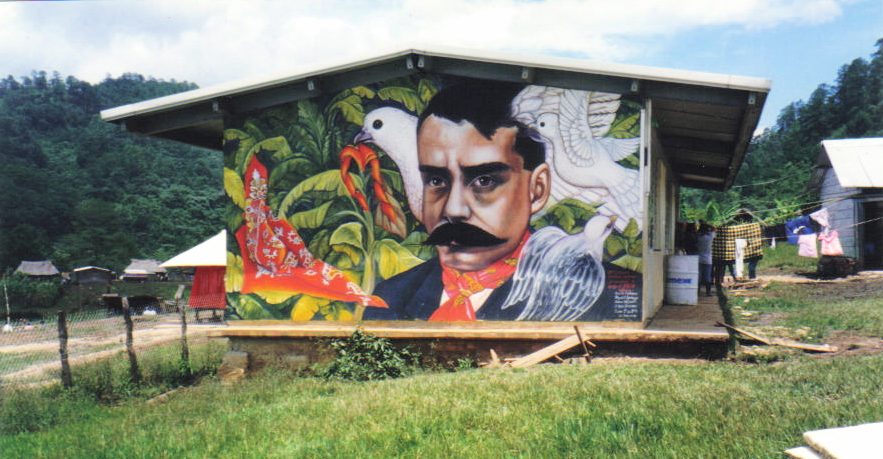
Thousands of Zapatistas Demonstrate in Chiapas on Oct 22
IN CHIAPAS, THOUSANDS OF ZAPATISTAS DEMONSTRATE IN SUPPORT OF AYOTZINAPA aND the YAQUI PEOPLE

Chiapas México. October 22, 2014
Just like in different parts of the country and the world, thousands of Zapatista support bases once again demonstrated in silence, now from the autonomous communities, to demand the presentation with life of the 43 Ayotzinapa students and for the freedom of Mario Luna and Fernando Jiménez of the Yaqui people, and political prisoners.
As they had announced, the Zapatistas demonstrated on Wednesday afternoon, October 22, in communities and along roads of the state where they have a presence, in solidarity with the Ayotzinapa students and the Yaqui people.
In the Caracol of Oventic and nearby communities, banners are seen with legends that demand the presentation with life of the 43 students of the Isidro Burgos Rural Teachers College, of Ayotzinapa, Guerrero, as well as punishment for those responsible for the murdered students and the forced disappearance.
The Zapatista bases also demand freedom for members of the Yaqui people, Mario Luna and Fernando Jiménez, prisoners for defending their land from the “independence” aqueduct, which the Sonora government wants to impose.
In the demonstrations the rebel Chiapanecos, are also seen making offerings and carrying candles for the wellbeing of the disappeared students.
In different Chiapas cities, students, teachers, social organizations and human rights centers carried out marches and meetings to demand justice for Ayotzinapa.
——————————————————————–
Originally Published in Spanish by Pozol Colectivo
Translation: Chiapas Support Committee
Thursday, October 23, 2014
Zapatistas join October 22 events
ZAPATISTAS JOIN OCTOBER 22 EVENTS IN SUPPORT OF AYOTZINAPA AND THE YAQUI PEOPLE

Communiqué from the Revolutionary Indigenous Clandestine Committee-General Command of the Zapatista National Liberation Army
Mexico
October 19, 2014
To the classmates, teachers, and family members of the dead and disappeared of the “Raúl Isidro Burgos” Normal School [1] of Ayotzinapa, Guerrero, Mexico.
To the Yaqui people:
To the National Indigenous Congress:
To the National and International Sixth:
To the peoples of Mexico and the world:
Sisters and Brothers:
Compañeras and Compañeros:
The Zapatista National Liberation Army joins the actions slated for October 22, 2014, at 6pm, in demand of safe return for the 43 disappeared students; in demand of punishment for those responsible for the murders and forced disappearances; and in demand of unconditional liberation for our Yaqui brothers Mario Luna Romero and Fernando Jiménez Gutierrez,
As part of this global day of action, the Zapatista people will shine our small light on some of the paths that we walk.
Along the highways, dirt roads, paths and potholes, the Zapatista people will add our outrage to that of our Ayotzinapa brothers and the heroic Yaqui people.
Although small, our light is our way of embracing those who are missing and those who suffer in their absence.
Let this light demonstrate that we are not alone in the pain and rage that blanket the soils of the Mexico below.
Because those of us below hurt with rage and rebellion, not with resignation and conformity.
We call on the Sixth in Mexico and the world and on the National Indigenous Congress to also participate, according to their abilities, in this day of actions.
Democracy!
Liberty!
Justice!
From the mountains of the Mexican Southeast,
For the Revolutionary Indigenous Clandestine Committee—General Command of the Zapatista National Liberation Army,
Subcomandante Insurgente Moisés.
Mexico, October 2014. In the twentieth year of the war against oblivion
————————-
[1] The Escuelas Normales (Normal Schools) in Mexico are teachers colleges that principally train rural and indigenous young people to be teachers in their own communities.
————————-
Originally Published in Spanish by Enlace Zapatista
Monday, October 20, 2014
Father Solalinde: State agents, kidnappers of the students
STATE AGENTS, KIDNAPPERS OF THE STUDENTS: ALEJANDRO SOLALINDE

Ayotzinapa Banner reads: Mexico=Narco-Grave and EPN Government Murderer #Justice Ayotzinapa’Tlatelolco
* Criminals did not participate in the acts, as they want to make you believe, the priest asserts
By: Fabiola Martínez
He pointed out that he is willing to tell what he knows to the Attorney General of the Republic (PGR), although he indicated that his informants want to remain anonymous because they are certain that upon denouncing, they will also be killed.
“I am going to tell it and I will repeat it as many times as necessary: it was painful even for me to receive the details of one of those testimonies, on Sunday, about how they had burned them; some of them were alive, some were injured, others already dead, but they burned them. The people that gave me (the information) are worthy of my credibility,” he said.
In an interview, the priest asserted that State agents kidnapped the students and in no way are we dealing with an organized crime action, as they want to make you believe, even when the line between one and the other gang can be imperceptible, he expressed.
“I don’t want to give more details, but they told me how (they burned them). Perhaps the people that did it were compromised.
“Other people looked for me on Tuesday, concerning youths that had been witnesses to the first and second attacks, how they saw that some were injured, others also fell. State agents carried away those that fell, those that attacked them and carried them away. They attacked them (the students) as if they were an Army and not students of a rural teachers college,” he pointed out.
Father Solalinde, director of the Hermanos en el Camino shelter for migrants, was interviewed before offering a short sermon on Bucareli Avenue, in front of the Interior Ministry, where the coffin of Sra. Margarita Santizo, mother of a federal police agent that disappeared in Michoacán in 2009, has been since the afternoon.
He said that people no longer want words from the authorities but rather deeds and “that they present the 43 students alive; if they were not burned, then demonstrate that it’s not so.”
———————————————————————-
Originally Published in Spanish by La Jornada
Translation: Chiapas Support Committee
Saturday, October 18, 2014
En español: http://www.jornada.unam.mx/2014/10/18/politica/005n1pol
Bishop Vera re: Massacre of Ayotzinapa Students
Raul Vera: Ayotzinapa / Acteal, “a message from the state to intimidate the insurgents”
Massacring social strugglers, “a habit” in Mexico: Raúl Vera
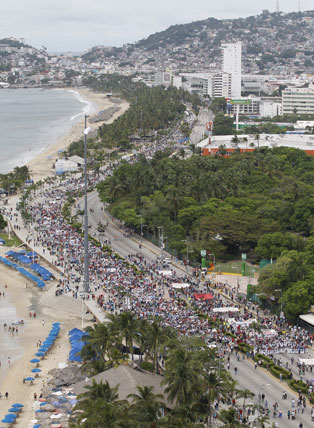
Another day of protests took place in 10 Mexican states on Saturday, October 18, demanding the presentation with life of the 43 students detained and disappeared 3 weeks ago. Marchers in Acapulco (above) also demanded the exit of Governor Angel Aguirre Rivero. Photo by Victor Camacho, La Jornada.
By fabbia @ desinformemonos
Mexico. “I don’t believe it is organized crime; it’s something else. This is a message to social strugglers; we have already seen it in many places,” accuses Bishop Raúl Vera [1] –who has carried out his pastoral work in conflictive sites of Mexico, from Coahuila to Chiapas, passing through Guerrero. The massacre of normalistas [2] at the hands of Iguala’s police, on September 26, has antecedents in other repressions “and the unmeasured use of force,” he indicates.
Vera compares the attacks on students –that as of today have a result of six people executed, 43 disappeared and 25 injured, two of them gravely- with the governmental repression in San Salvador Atenco in 2006. “We’re dealing with State terrorism tactics,” he sums up.
Acteal and Iguala: cruelty
The Bishop of Saltillo, Coahuila, finds as a coinciding point between the massacre of Acteal, Chiapas, in 1997, and the extrajudicial execution and forced disappearance of students, the cruelty with which it is enacted. In Chiapas, the treatment towards the murdered Tzotziles–“chosen pacifists, almost all women and children,” he clarifies”- was “Kaibilesque.” [3] The priest insists that it was a message from the State to intimidate the insurgents.
Another similarity between the massacres, which provoked inter-national condemnation of the Mexican government, is in the impunity that surrounds them. In Acteal, although the paramilitaries were captured, they are now free. And in Iguala, the kidnapping in June 2013 of eight activists and the murder of three of them, belonging to Popular Unity, also remains without punishment. According to a survivor, the one directly responsible for the execution was the mayor, José Luis Abarca, now a fugitive. The criminals continue to threaten the widow of one of the murdered leaders, Sofía Mendoza, continues to be threatened, the Dominican points out.
In Acteal, Raúl Vera insists, there are testimonies that the state police and the Army concealed and took care of the actions of the paramilitaries. “We see this kind of thing in Iguala,” he compares. The Bishop, as part of the organization called Decade against Impunity Network, participated in two human rights observation caravans to Guerrero, one for the Iguala case.
Vera abounds on the asesinato de Arturo Hernández Cardona, leader of the Popular Unity, which “disturbed” Abarca because he organized a “strong” demonstration to demand the application of government aid. He points out that he was captured, together with the other seven militants, and taken to empty land on the outskirts of Iguala, where the mayor threatened him and killed him, accompanied “by the criminals,” he relates. The survivor’s statement took place since March of this year, “and no one moved one single finger.”
“In these disappearances, another type of corps now participates,” the Bishop explains. And he insists that the criminals are the “arms” of the mayor. He classifies as “absurd” the versions that indicate that the normalistas could have disturbed, in any way, the criminals: “That is trying to legitimize what happened.”
“We no longer know where the cartels end and organized crime begins that is in the political structure and the apparatuses of justice. We are already fed up with this frightening connivance,” he laments.
______________________
Notes:
[1] Raúl Vera is the Catholic Bishop of Coahuila, a state in Mexico. He is Chair of the Board of Directors of the Fray Bartolomé de las Casas Human Rights Center in Chiapas.
[2] Normalistas are students that attend rural teaching colleges, which principally train campesino and indigenous young people to be teachers in their own communities.
[3] A Kaibil is a member of one of the army’s death squads in Guatemala during its long civil war. The Kaibiles used unusually brutal tactics to terrorize the civilian population.
——————————————————————–
Originally Published in Spanish by Desinformemonos
Translation: Chiapas Support Committee
Monday, October 13, 2014
Indigenous communities meet in Chiapas about super-highway
LOS LLANOS OF LOS ALTOS, CHIAPAS ADDS ITS REJECTION OF THE SC-PALENQUE SUPER-HIGHWAY AND EXTENDS INVITATION
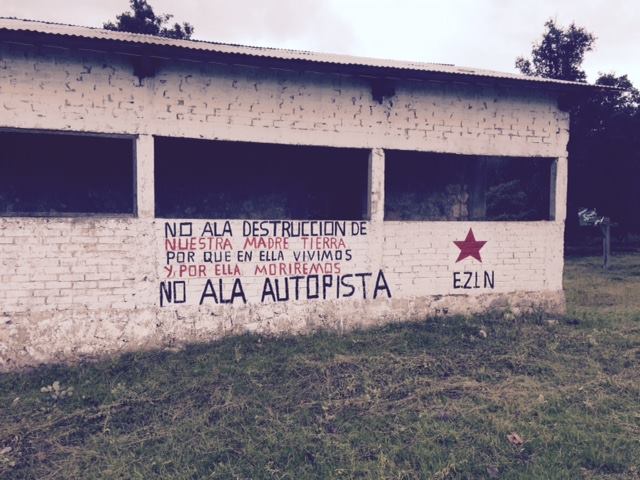
“No to the destruction of our Mother Earth because in her we live and for her we die. No to the super-highway,” painted on a building in Los Llanos Ejido.
Los Llanos Ejido, San Cristobal de Las Casas, adds itself to the resistance against construction of the Super-Highway, and extends an invitation to know its culture, to share the fruits that Mother Earth yields and to exchange ideas for walking to defend Mother Earth, on October 12.
After the mega-march of Believing People where 15,000 indigenous marched, 2,000 Bachajón ejido owners, and the almost 3,000 people of Candelaria that got together to reject the construction of the Super-Highway on their lands, passing through the sacred Laguna Suyul and the blockage of the Ocosingo-Palenque highway, the Los Llanos ejido owners add themselves to the rejection.
THE COMPLETE COMUNICADO
IN LOS LLANOS EJIDO, MUNICIPALITY OF SAN CRISTOBAL DE LAS CASAS, CHIAPAS, MEXICO , SEPTEMBER 21, 2014
TO THE INDIGENOUS COMMUNITIES AND PEOPLES IN RESISTANCE
TO THE COMMUNICATIONS MEDIA
TO BELIEVING PEOPLE
TO THE HUMAN RIGHTS ORGANIZATIONS
TO THE NATIONAL INDIGENOUS CONGRESS
TO THE ADHERENTS TO THE SIXTH DECLARATION OF THE LACANDON JUNGLE
Brothers and sisters, compañeros and compañeras, our people continue organizing in defense of our lands that the government has said publicly it wants to affect for the construction of the San Cristóbal de Las Casas to Palenque super-highway. We are making our struggle a legal and political one faced with the threat from the authorities that want to deprive us of our rights as indigenous peoples without respecting the Constitution and the international treaties, just as it wants to do with other Tsotsil, Tseltal and Chol peoples and communities without taking their opinion in to account. The government only wants to do what it wants without asking, by means of force and threats.
We are not in agreement that we are dispossessed of our territory only to serve the capitalist interests of the rich and to discriminate as always against poor campesinos, against we Indigenous that live from Mother Earth. The government must respect its own laws and respect the peoples that don’t sell their lands and dignity for a few pesos; the land has no price.
Our people want to share their struggle with other communities, peoples and organizations that are resisting in the defense of their territory and therefore our Peoples’ Assembly has made an agreement to celebrate the resistance of the indigenous peoples next October 12, 2014 at 8 o’clock, the hour of God, in our lands.
We want you to accompany us so that you know our culture, share the fruits of Mother Earth with us and exchange ideas for walking together to defend Mother Earth.
We await you on October 12, 2014 a las 8 AM, hour of God, in the place known as Chivero, located at kilometer 5+100 of the San Cristóbal de Las Casas Highway on the way to Ocosingo, one kilometer before arriving at the State Center of Social Re-adaptation Social Number 5 (CERSS 5) of San Cristóbal, in front of the GASCOM gas plant.
Tierra y Libertad!
Ejido Commission de Los Llanos, Municipio of San Cristóbal de Las Casas, Chiapas
Juan López López, Miguel Jiménez Díaz, Francisco Díaz Gómez, President, Secretary and Treasurer
Vigilance Council of Los Llanos, Municipio of San Cristóbal de Las Casas, Chiapas
————————————————————
Originally Posted in Spanish by Espoir Chiapas
Sunday, September 21, 2014
http://espoirchiapas.blogspot.com/2014/09/los-llanos-se-suman-al-rechazo-de-la.html
20,000 Zapatistas March for Ayotzinapa
SILENT MARCH of 20,000 ZAPATISTAS FOR AYOTZINAPA
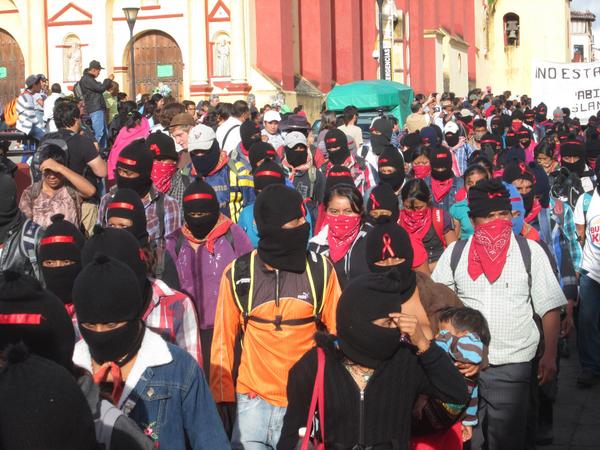
Zapatistas March in San Cristóbal
By: Chiapas Paralelo
Some 20,000 indigenous men and women, milicianos and support bases of the Zapatista National Liberation Army (EZLN) among them, held a silent mega-march in solidarity with the students in Ayotzinapa, Guerrero.
With slogans like “your pain is our pain,” “you are not alone,” and “your rage is ours” on banners and signs, EZLN members came from the five Caracoles that bind the five Good Government Juntas together to San Cristóbal de Las Casas in dozens of trucks and got out in the west, at the exit for San Juan Chamula.
Some of the indigenous traveled up to 12 hours to get to this city from their communities in the heart of the Lacandón Jungle. Chols, Tsotsils, Tseltals and Tojolabals, milicianos and support bases of the EZLN arrived wearing ski masks and paliacates tied at the neck.
They formed five lines and headed towards the center of the city, entering through San Ramon Street until reaching the central park. They passed in front of the municipal presidency and returned on the parallel street to the city’s exit.
The EZLN flag and the Mexican flag were in front of the contingent. Among the Zapatista commanders, Comandante Tacho, a member of the Comandancia General del Comité Clandestino Revolucionario Indígena-General Command (CCRI-CG), could be seen with a radio in his hand for communication.
The Zapatistas did not make any stop or any pronouncement. All those wearing masks, men and women with babies in their arms, left the same way they arrived.
Like the Zapatistas, thousands of teachers added themselves to the solidarity march with the Ayotzinapa students, three of whom were murdered and 43 more are still disappeared.
In San Cristóbal, Tuxtla, Palenque, Comitán, Tapachula, Motozintla and other Chiapas cities, some 45,000 teachers from the National Coordinator of Education Workers (CNTE) went to the streets and chanted: “They took them alive, we want them alive,” “Guerrero endures, Chiapas rises up” and others.
Normal school students from all over the state of Chiapas joined them, in San Cristóbal, the Jacinto Canek Normal School, the School of Social Sciences, the National Front of Struggle for Socialism (FNLS), the Emiliano Zapata Proletarian Organization (OPEZ, its initials in Spanish) and other social organizations.
——————————————————————
Originally Published in Spanish by Chiapas Paralelo
Thursday, October 9, 2014
EZLN Support for the Students of Ayotzinapa
COMMUNIQUE FROM THE INDIGENOUS REVOLUTIONARY CLANDESTINE COMMITTEE—GENERAL COMMAND OF THE ZAPATISTA NATIONAL LIBERATION ARMY

October 2014
To the students of the Normal School (Escuela Normal) [1] “Raúl Isidro Burgos” in Ayotzinapa, Guerrero, Mexico:
To the national and international Sixth:
To the people of Mexico and the world:
Sisters and Brothers:
Compañeras and Compañeros:
To the students of the Escuela Normal of Ayotzinapa, Guerrero, Mexico, and to your family members, classmates, teachers, and friends, we simply want to let you know that:
You are not alone.
Your pain is our pain.
Your dignified rage is ours also.
-*-
To the compañeras and compañeros of the Sixth in Mexico and the world, we call on you to mobilize, according to your means and ways, in support of the community of the Escuela Normal in Ayotzinapa, and in demand of true justice.
-*-
We as the EZLN will also mobilize, within our capacities, on October 8, 2014, in a silent march as a signal of pain and outrage, in San Cristobal de las Casas, Chiapas, at 1700 hours.
Democracy!
Liberty!
Justice!
From the mountains of the Mexican Southeast
For the Indigenous Revolutionary Clandestine Committee—General Command of the Zapatista National Liberation Army
Subcomandante Insurgente Moisés
Mexico, October 2014. In the twentieth year of the war against oblivion
[1] The Normal Schools (Escuelas Normales) in Mexico are teaching colleges that principally train rural and indigenous young people to be teachers in their own communities.
Translated by El Kilombo
Raúl Zibechi: How the dominant class thinks
HOW THE DOMINANT CLASS THINKS
By: Raúl Zibechi

Chart depicting how much the dominant class keeps
The crisis continues revealing everything that would stay hidden in periods of normality. This includes the strategic projects of the dominant class, their way of seeing the world, the principal gamble they take to continue being the dominant class. That is, in broad strokes, their central objective, to which they subordinate all others, including the capitalist modes of reproduction of the economy.
One can think that the crisis is just a parenthesis after which everything would continue, more or less, to function as before. It’s not like that. The crisis is not only a revealer, but also the way in which those above are remodeling the world. That’s because the crisis is, in large measure, provoked by them to move out of the way or make disappear what limits their powers; basically, the popular, indigenous, black and mestizo sectors on our continent.
On the other hand, a crisis of this breadth (its about a group of crises that includes climate crisis/chaos, environmental crisis, health crisis and that which crosses through everything, the crisis of Western civilization) means the more or less profound mutations of societies, of the relation of forces and of the poles of power in the world, in each one of the regions and countries. It seems necessary to me to broach three aspects that don’t exhaust all the latest news that contributes to the crisis but are, to my way of thinking, those that can most have influence on las strategies of the anti-systemic movements.
In first place, what we call the economy has suffered fundamental changes. The chart [above] elaborated by the economist Pavlina Tcherneva, based on Thomas Piketty’s studies about inequality, reveals how the system has functioned since the 1970s, aggravated by the 2008 crisis.
The chart encompasses 60 years of the United States economy, from 1949 to present. It describes what part of income growth the richest 10 percent appropriate, and how much corresponds to the remaining 90 percent. In the 1950s, for example, the wealthy 10 percent appropriated between 20 and 25 percent of new annual incomes. A “normal” capitalist economy functions like that, consisting of a major appropriation by the impresarios of the fruits of human labor, which Marx called surplus value. It is the accumulation of capital through expanded reproduction.
Starting in 1970 an important change is produced that is very visible in the 1980s: the rich 10 percent begins to appropriate 80 percent of the wealth and the 90 percent remains with barely 20 percent of what is generated each year. This period corresponds to the hegemony of financial capital, which David Harvey has called “accumulation by dispossession” or (in Spanish) despojo.
But something extraordinary has been produced since 2001. The rich are left with all the new income and, since 2008, also grab a part of what the 90 percent had, as savings or wealth. What do we name this mode of accumulation? It is a system that no longer is capable of reproducing capitalist relations because it consists of robbery. Capitalism extracts surplus value and accumulates wealth (also by dispossession), but expanding capitalist relations, for that rests on wage labor and not on slave labor (I owe these reflections to Gustavo Esteva, who formulated them in the Zapatista Escuelita days and in the exchanges afterwards).
It is probable that we are entering into a system even worse than capitalism, a sort of robbery economy, more similar to the way the drug trafficking mafias function than to the business modes that we knew in the better part of the 20th Century. It is also probable that this has not been planned by the dominant class, but rather that it is the fruit of the extravagant search for profits in the financial period and the period of accumulation by dispossession, which has engendered a generation of vultures/wolves incapable of producing anything other than destruction and death around it.
In second place, that the system functions this way implies that those above have decided to save themselves at the expense of all humanity. At some time they made an affective rupture with other human beings and are willing to produce a demographic hecatomb [a slaughter of many], as the chart mentioned above suggests. They want it all.
Similarly, the way in which the system is functioning is more appropriately called the “fourth world war” (as subcomandante insurgente Marcos did) than “accumulation by dispossession,” because the objective is all humanity. It seems that the dominant class decided that with the current degree of technological development it can dispense with the wage labor that generates wealth, and no longer depend upon poor consumers for their products. Aside from the fact that this may be delirium induced by arrogance, it seems evident that those above do not seek to order the world according to their old interests, but rather to generate entire regions (and at times continents) where absolute chaos reigns (as tends to happen in the Middle East) and others of absolute security (like parts of the United States and Europe, and wealthy neighborhoods of every country).
In sum, they have renounced the idea of “a” society, an idea that is substituted by the image of the field of concentration.
In third place, this has enormous repercussions for the politics of those below. Democracy is hardly a weapon to throw against geopolitical enemies (starting with Russia and China), when it is not applied to the regimes of friends (Saudi Arabia). But, it is no longer that system to which they sometimes granted some credibility. The same must be said of the nation-State, scarcely an obstacle to overcome as the attacks on Syria violating national sovereignty demonstrate.
No other path is left to us than to organize our world, within our spaces/territories, with our health, our education and our food autonomy, with our powers to make decisions and accomplish them; in other words, with our own self-defense institutions, without depending on state institutions.
————————————————————————
Originally Published in Spanish by La Jornada
Translation: Chiapas Support Committee
Friday, October 3, 2014
En español: http://www.jornada.unam.mx/2014/10/03/opinion/026a2pol
Anatomy of a paramilitary attack on the Zapatistas
ANATOMY OF A PARAMILITARY ATTACK: A REPORT FROM SAN MANUEL
By: Mary Ann Tenuto-Sánchez
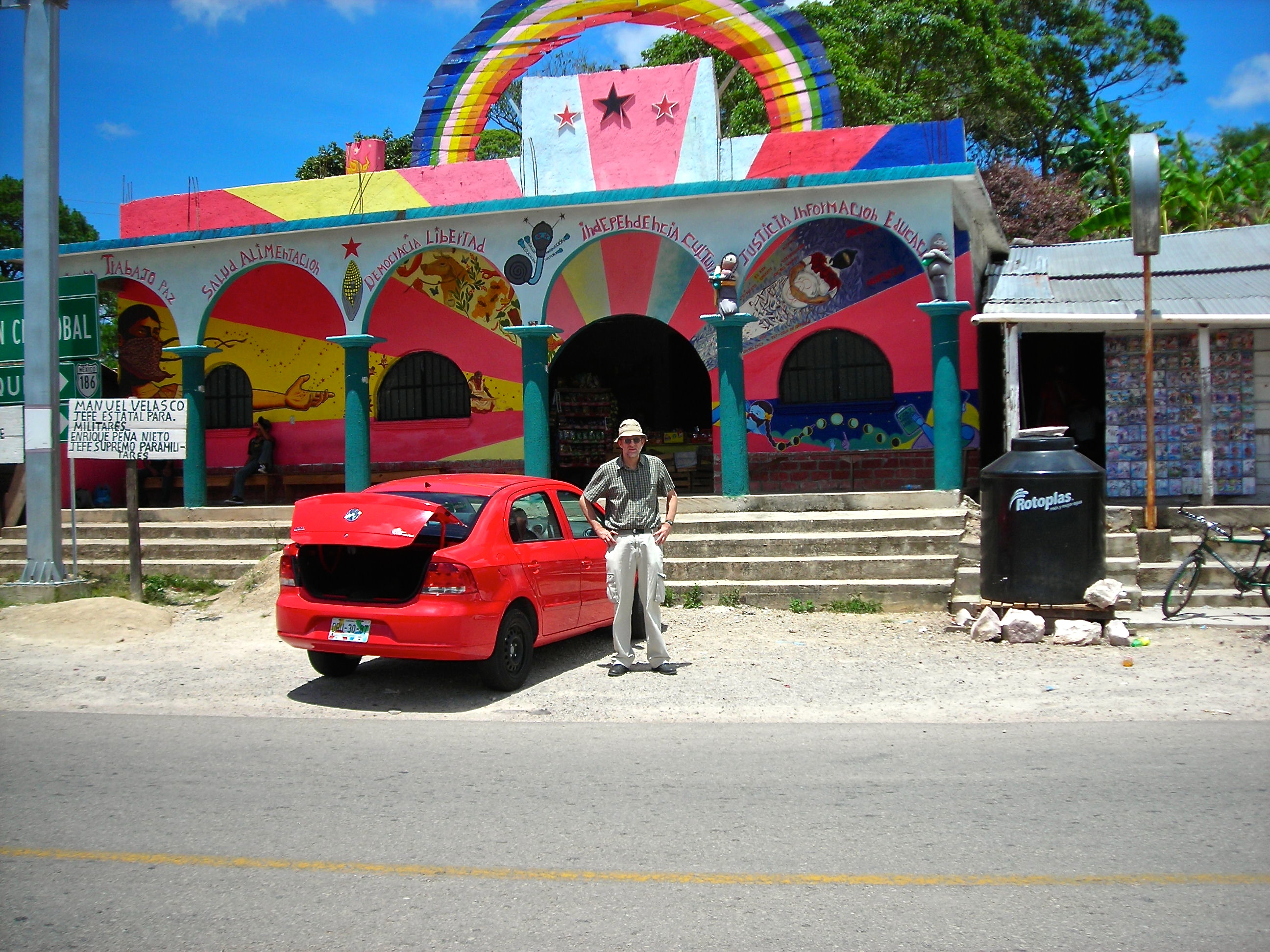
Zapatista store at the Cuxulja Crossing, Chiapas Mexico. Sept. 4, 2014
“Manuel Velasco state paramilitary chief, Enrique Peña Nieto supreme paramilitary chief”
That’s what the letrero (hand-painted sign) says in front of the Zapatista bodega at the Cuxuljá crossroads in Chiapas. Manuel Velasco is the governor of Chiapas, a member of the Green Ecologist Party of Mexico (PVEM). Enrique Peña Nieto is Mexico’s president, a member of the Institutional Revolutionary Party (PRI).
The front of the bodega is painted with an amazing mural representing the 13 demands of the Indigenous peoples that belong to the Zapatista National Liberation Army (EZLN): housing, land, work, peace, health, food, democracy, freedom, independence, culture, justice, information and education. The mural also depicts important aspects of life in the Zapatista communities: production, education, health and solidarity. It represents the collective work of various international artists in solidarity with the Zapatista Movement, including some from the United States.
Those peaceful demands and life in the Zapatista communities are in sharp contrast to counterinsurgency tactics the government applies against these communities. The paramilitary attacks on San Manuel autonomous rebel Zapatista municipio are only the most recent example. San Manuel is one of the 4 autonomous rebel Zapatista municipios (counties) belonging to Zapatista Caracol 3, La Garrucha.
On July 25, 2014, nineteen paramilitaries entered collective workspace in San Manuel armed with .22-caliber weapons. They burned the letrero saying: “Compañero Galeano lives,” fired shots into the air, constructed houses, threatened to dispossess the Zapatistas of Egipto and El Rosario of their lands, killed a young steer and then left.
A week later, on August 1, they returned and fired a few shots and killed another young steer. That night, when 32 civilian Zapatistas (women, young children and the elderly) living in the nearby Egipto autonomous community saw some of the paramilitaries coming towards the community in the middle of the night, they fled to save their lives and avoid another massacre like Acteal. The collective workspace is located on land recuperated as a result of the 1994 Zapatista Uprising.
A few days later another nearby Zapatista community, El Rosario, found a horse that belonged to one of the Zapatistas dead from abdominal injuries. And, when a Zapatista encountered one of the paramilitaries, the paramilitary said: “Be careful, because I’m going to kill you!”
The paramilitaries come from the Pojcol ejido, in the official municipio of Ocosingo. Pojcol is not located close to San Manuel. They are members of the Regional Organization of Ocosingo Coffee Growers, also known as ORCAO, its initials in Spanish.
On the morning of August 6, the paramilitaries arrived again with guns and a chainsaw. They cut trees and fired shots into the air. When they were leaving that afternoon, they fired 5 shots upon passing the house of a Zapatista. And, when passing Kexil (known by its inhabitants as Nuevo Guadalupe), they fired 2 shots over the house of another Zapatista.
One week later, on August 13, nine Zapatista families built houses (one containing a a grocery store) on the collective workspace, thereby founding the new autonomous Zapatista community of San Jacinto. Some 250 Zapatistas were also present to clear the land for planting.
The next day, August 14, in the wee hours of the morning, 18 paramilitaries, armed with shotguns and .22-caliber weapons, surrounded the collective workspace and fired their guns into the air for about 40 minutes. The attackers shouted: “these weapons we use are from the government;” and “this land is ours and does not belong to those fucking Zapatistas.” At the same time they warned the Zapatistas that they had 6 hours to leave. The 40 residents of San Jacinto left, together with the 250 Zapatistas clearing the land. The paramilitaries then destroyed the nine houses and stole the merchandise in the store. They also burned all the clothing left behind in the houses, destroyed 150 roofs made of nylon and canvas and stole the machetes that were being used to clear the land. When threats of violence continued, women and children also left El Rosario later that night.
Capitalism is responsible for the attacks in San Manuel
Two members of the Chiapas Support Committee, including this writer, visited the Caracol of La Garrucha on September 4 and 5 for several reasons, among them wanting to learn more about the San Manuel attacks and displacements described above. The Path of the Future Good Government Junta received us Friday morning and the conversation quickly turned to the San Manuel attacks.
“Each person in the region contributed a few pesos to the displaced families because they lost everything when they fled for their lives. They are trying to resolve the problem peacefully,” the spokesperson for the Junta told us. “Currently, the displaced are in ‘other communities.’ The government pays the ORCAO members to attack, but capitalism is responsible for the attacks in San Manuel,” he concluded. He also reported that San Manuel’s municipal government lost $460,000 pesos because of the attack (approximately $35, 380.00 US dollars). In response to our request to visit San Manuel and speak with the autonomous council, the Junta contacted San Manuel. We learned a little while later that San Manuel granted us permission to visit and, consequently, so did the Junta.
In a September 7 interview, the San Manuel autonomous council President said that the displaced women and children are still safe in other communities and that they continue discussions to resolve the problem peacefully, but that it was very difficult because the paramilitaries built houses on the land in question. Asked what the motive was for the attacks, the council president stated emphatically: “pure provocation. They (the paramilitaries) don’t need land; they have land in their ejido. They don’t need the trees. This was a pure provocation.”
Government retaliation for the Exchange
In its August 4 bulletin regarding the attacks in San Manuel, the Fray Bartolomé de las Casas Human Rights Center (Frayba) noted: “These new acts of harassment, territorial dispossession and attacks are presented within the framework of the First Exchange of the Zapatista Peoples and the Original Peoples of Mexico “Compañero David Ruiz García,” a meeting with the National Indigenous Congress, which began on Monday, August 4 in the Autonomous Community of La Realidad.” An understanding of this language was expanded in several San Cristóbal discussions.
Friends that attended the August 9 Report from the Exchange between the Zapatista Peoples and the National Indigenous Congress (CNI) say that Subcomandante Moisés announced to the crowd: “the government is attacking San Manuel in retaliation for us meeting here.”
Those of us that follow Zapatista events closely have seen the government’s competitive pattern of behavior. We will remember that when more than 40,000 masked Zapatistas marched in silence on December 21, 2012 in Chiapas, President Peña Nieto responded by announcing his “Crusade Against Hunger” one month later, January 21, 2013, in Guadalupe Tepeyac, deep in Zapatista Territory. He arranged with and paid for Indigenous peoples from all Chiapas municipalities to attend the event. He also brought government officials and his cabinet with him. The government claimed around 15,000 people in attendance. Marcos shot back with a comunicado addressed to “Ali Baba and his 40 thieves.” A graphic of a middle finger was included in the brief comunicado.
It’s important to remember that the PRI returned to power in December 2012, after a 12-year absence while the PAN governed. It is also important to remember that the Zapatistas rose up in arms when the PRI held power and smashed its claims to having achieved First World status. Counterinsurgency against the Zapatistas is real personal for the PRI!
The PRI’s behavior pattern turned repressive, vicious and excessively violent after the Escuelitas in December 2013 and January 2014. A friend that attended the Escuelitas during those dates said that the Zapatistas expected retaliation for the very popular and well-attended Escuelitas. It just didn’t come as quickly as the government’s answer to the resurgence of the Zapatistas on December 21, 2012. The government set it up slowly. On May 2, the CIOAC-H, a campesino organization turned paramilitary group, attacked unarmed Zapatista civilians in La Realidad and brutally murdered a Zapatista support base known as Compañero Galeano.
Finally, as the Zapatista peoples were meeting with the National Indigenous Congress, not only were the violent attacks on San Manuel occurring, but also on August 8, Enrique Peña Nieto headed a ceremony in San Juan Chamula, Chiapas, to celebrate International Indigenous Peoples Day. Hundreds of people attended, including representatives of 68 different ethnic groups.
It would seem that a clear pattern has emerged: When the Zapatistas hold an organizing event to extend and/or solidify their influence, the government either counters with a competitive response or retaliates with violent repression or both, part of its counterinsurgency plan. That plan has always had a strategy of containment; in other words, a strategy to prevent the Zapatistas from growing.
The Southern Border Strategy
In a visit to the Frayba Human Rights Center its director, Victor López, discussed both the San Manuel attacks and the Southern Border Strategy (referred to in Chiapas as ‘Plan Sur’). Frayba is working to mediate the negotiations for an agreement between San Manuel and ORCAO that would allow those displaced to return safely to their homes and communities. He echoed what we had heard about the difficulty of resolving the situation due to the fact that the ORCAO had constructed houses on the site, and he specifically said that the conditions were not safe enough to establish a peace camp. He also agreed that the attacks were in retaliation for the Exchange with the National Indigenous Congress.
“Plan Sur is a pretext,” López said, referring to the Southern Border Strategy recently implemented by the Mexican government. “The ‘containment posts’ are being used to encircle Zapatista Territory in order to contain the Zapatistas! An Army patrol even attempted to enter an autonomous community. The Zapatistas said they were autonomous and did not permit the Army to enter. The soldiers went away.”
The Plan Sur is also being used to severely repress Central Americans. It’s not really about stopping drug traffickers or human traffickers; it’s about repression and containment! It is also about criminalizing immigration-without-permission. Chiapas prisons are filling up with Central American migrants charged with crimes they did not commit. The US government of Barack Obama has pushed for the Southern Border Strategy and is providing some of the funding.
September 2014
September 2014 Zapatista News Summary
SEPTEMBER 2014 ZAPATISTA NEWS SUMMARY

In Chiapas
1. The EZLN Issued 2 Comunicados – The first is a joint demand with the National Indigenous Congress for the freedom of the Yaqui leader Mario Luna, arrested to repress the Yaqui struggle over water rights. The second comunicado is an anti-capitalist editorial by Subcomandante Moisés in the recent Zapatista Rebel Magazine. It is called: Beyond the Sharing.
2. Proposed Route for the San Cristóbal-Palenque Super-Highway – The proposed route is now public and we posted an article about the Super-Highway (with map) and the resistance to its construction from large numbers of Indigenous peoples. Written by Gaspar Morquecho, it’s a good read!
3. Three Sexta Adherents from San Sebastián Bachajón (SSB) Arrested and Tortured – They were arrested on false charges, tortured until they confessed and sent to prison while awaiting trial. The repression against SSB continues and is related to the the community resistance to a mega-tourist development and the Super-Highway.
Mexico’s Southern Border
1. Central American Migrants In Mexican Prisons – The Miguel Agustín Pro Juárez Human Rights Center (Prodh) released a report that concluded: In addition to the risk of being extorted, kidnapped, disappeared, tortured and murdered, Central American migrants run the risk of being criminalized and incarcerated by the Mexican State.
2. Immigration Agents Beat Migrant Rights Defenders and Steal Equipment – On September 18, migrant rights defenders from the “Brothers on the Road” organization, which maintains a shelter just across the Chiapas border in Ciudad Ixtepec, Oaxaca, were pulled off the train known as “The Beast,” beaten and robbed of their photographic and video equipment by Mexican immigration agents. The migrant rights defenders were investigating complaints of mistreatment from migrants at the shelter when they were pulled from the train, beaten and robbed.
In other parts of Mexico
1. Police Kill 6 Students in Guerrero; 22 Police Held – On September 26, in Iguala, Guerrero, municipal police and “pistoleros” killed 6 students of the Ayotzinapa Normal School that were organizing a collection of funds to attend the October 2 commemorative march in Mexico City. As of this writing, there is one student that is brain dead and on life support, 22 injured and 42 students listed as “missing.” Observers says that 20 of the missing were carried off in police trucks. Mexican analysts say that Iguala is a key drug trafficking city, where organized crime gangs operate. This is an ongoing story and the facts are still unfolding. According to the Los Angeles Times, 22 police have been held in the deadly attack.
———————————-
Compiled monthly by the Chiapas Support Committee.The primary sources for our information are: La Jornada, Enlace Zapatista and the Fray Bartolomé de las Casas Human Rights Center (Frayba).
We encourage folks to distribute this information widely, but please include our name and contact information in the distribution. Gracias/Thanks.
Click on the Donate button at http://www.chiapas-support.org to support indigenous autonomy.
_______________________________________________________
Chiapas Support Committee/Comité de Apoyo a Chiapas
P.O. Box 3421, Oakland, CA 94609
Email: cezmat@igc.org
http://www.chiapas-support.org
http://www.facebook.com/pages/Chiapas-Support-Committee-Oakland/
https://compamanuel.wordpress.com
 Chiapas Support Committee