Chiapas Support Committee
Home of the Compañero Manuel blog on zapatistas & mexico
Ayotzinapa Caravan meets with EZLN in Oventik
AYOTZINAPA PARENTS and EZLN AGREE TO ARTICULATE A NATIONAL MOVEMENT
By: Gabriela Coutiño
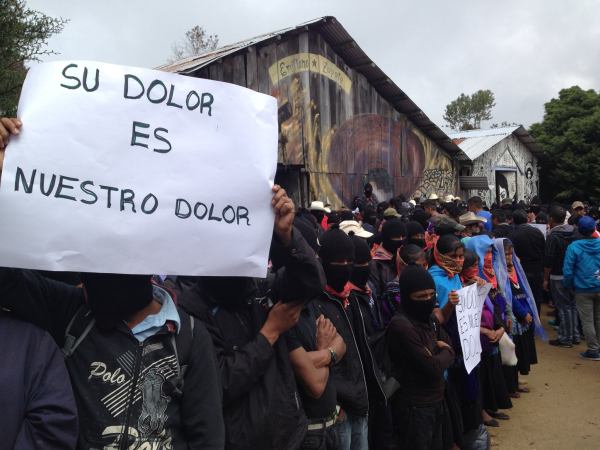
Zapatistas greet Ayotzinapa Caravan in Oventik. Photo: Frayba
San Cristóbal de las Casas, Chiapas, Nov. 15 – In their visit to Zapatista Territory, parents of the 43 students disappeared from Ayotzinapa Guerrero, agreed with the Zapatista National Liberation Army (EZLN), to articulate a national movement de fondo that questions forced disappearances and extrajudicial assassinations.
The meeting took place in the Caracol of Oventic in the [official] municipality of San Larráinzar. Subcomandante Moisés and Comandante Tacho attended. “They embraced our indignation and rage, gave us the best attention and expressed their total willingness to support us,” said Omar García, a student member of the Daniel Solís Gallardo Caravan.
In a press conference in the Fray Bartolomé de las Casas Human Rights Center (Frayba), Omar García clarified that at the meeting that was public for all Zapatista support bases, and that lasted four hours, “the Zapatista compañeros did not seek us, we sought them out because we are familiar with their political position and their forms of work. “They set forth from the beginning of the meeting that they do not seek to lead anyone; it is a position with which we are all familiar, and they told us that they do not seek to give us suggestions or orders to follow.”
What they did share with us, he explained, “is that we have to go to those who just like us have suffered forced disappearance and extrajudicial assassinations, which are not just a few people in the country, because they are the ones that can understand us and accompany us in our pain and fight, and they are the ones with which we can articulate a movement, a bigger and more powerful nucleus with all the social organizations that want to be in solidarity.”
Omar García said that one of the objectives of the National Information Caravan is to establish dialogue and agreements with social organizations for the purpose of articulating a movement on a national level with the objective of no longer fighting only for the 43 disappeared, and those extra-judicially murdered on September 26 and 27, but also for the rest, since forced disappearances have become a national problem.
María Inés Abrajan, Adán Abrajan de la Cruz’s aunt, indicated that in view of the fact that the authorities are proven to be incompetent, they have lost confidence in them and, therefore, they feel obliged to seek support from civil society and other forms of struggle that permits them to find the whereabouts of their children.
“We have come here because the president of the republic and the federal authorities have not been able or have not wanted to locate our sons; they know where the municipal police took our children, they know where they left them and to whom they were given.” She said that the attorney general of the republic, Jesús Murillo Karam, lied when he announced that their children were murdered, incinerated and thrown into the river, “because the three individuals they presented were tortured. We also saw in a Chilpancingo newspaper that those same three individuals had already been arrested before our children were taken away.”
The parents denounced that they are being harassed and threatened by state and federal police for struggling on behalf of their disappeared children, and that those threats also include the organizations that are supporting them. “We ask Enrique Peña Nieto that if he is not competent, we ask him to resign. First he goes to other cities to sell off our country vender, he goes to make negotiations and he doesn’t see his own people. We ask that if he is incompetent he leave the position.”
The parents made that statement because the president of the republic Enrique Peña Nieto and the ex governor Ángel Aguirre Rivero are judged politically. About the new governor of Guerrero they denounced that although he committed to finding the disappeared students he has not done it, “if he can’t handle the charge, he should resign.”
The parents and students of Ayotzinapa stated that they are not going to give up their fight. They pointed out that they are just beginning, because of which they need all the social organizations, “because this is no longer only our problem, but that of the whole country. We need the social organizations and the social organizations probably need us. What we no longer need are the State institutions that have demonstrated incompetence, corruption and impunity that covers all of the country; they are no longer useful to us and therefore we have decided to seek support in civil society and the social organizations.”
For this Sunday, the parents and students of Ayotzinapa have contemplated holding a demonstration in Tuxtla Gutiérrez where social organizations and students from the 19 state teachers colleges that are on strike in protest of the disappearance of the 43 youths would accompany them.
[Included in this article are 3 comunicados issued by the EZLN and read at the meeting with the Ayotzinapa Caravan. They can also be found in Spanish on the Enlace Zapatista website, the official web page of the EZLN. We will post the official English translations as soon as they become available.
——————————————————————
Originally Published in Spanish by Chiapas Paralelo
Translation: Chiapas Support Committee
Sunday, November 16, 2014
En español: http://www.chiapasparalelo.com/noticias/chiapas/2014/11/22167/
Ayotzinapa Caravan meets with Zapatistas today
Ayotzinapa Students to meet with EZLN
By: Gabriela Coutiño

Thousands of Chiapanecos participated in the meeting with students and family members of the 43 disappeared of Ayotzinapa. Photo: Moysés Zúñiga
The “Daniel Solís Gallardo” National Information Caravan, consisting of parents and relatives of the disappeared normalistas [1] in Iguala Guerrero, will hold a private meeting with comandantes of the Zapatista National Liberation Army (EZLN) and members of the Good Government Juntas.
Omar García, a student at the Raúl Isidro Burgos Teachers College said that they arrived in Chiapas for the purpose of meeting with all the organizations and groups that have shown solidarity and accompaniment to their demand that the 43 students kidnapped and disappeared last September 26 are located.
“One of the objectives of the caravan is the meeting with the Zapatista National Liberation Army, which has carried out two public demonstrations in solidarity with the parents and students of the Ayotzinapa Teachers College.”
In its first day in Chiapas, the Caravan maintained held a private meeting with civil society organizations and human rights defenders. They explained that sufficient evidence does not exist that permits recognizing that their compañeros were murdered and incinerated like Attorney General Jesús Murillo Karam said.
[A detailed description of the Peace Plaza rally and meeting with civil society follows this article.]
Before thousands of people that gathered in the San Cristóbal de las Casas Peace Plaza, one of the mothers of the disappeared said that they have received testimony from people that assures that their sons were taken from one place to another for days after their disappearance.
“The people that the attorney general pointed to as the alleged material authors were detained days before our children disappeared, it could not have been them. I saw it in the newspapers three days before, they could not have left the prison,” said the mother one of the 43 disappeared.
For their part, members of civil society and humanitarian organizations issued a pronouncement wherein they expressed their solidarity and accompaniment with the Ayotzinapa movement and locating of the 43 disappeared students.
“What happened in Ayotzinapa is not an isolated act; forced disappearance is a mechanism that the Mexican State has used to silence and contain social movements.”
Manuel de Jesús Mendoza Vázquez, representing Section 7 of the National Coordinator of Education Workers (CNTE, its initials in Spanish), called for “civil insurgency” actions in support of Ayotzinapa, among them not participating in the November 20 [2] parade.
[1] “Normalistas” are students at a rural teachers college.
[2] November 20 is a holiday in Mexico celebrating the Mexican Revolution
——————————————————————
Originally Published in Spanish by Chiapas Paralelo
Translation: Chiapas Support Committee
Saturday, November 15, 2014
Family members and students from Ayotzinapa walk with Chiapas Civil Society
By: Angeles Mariscal/Isaín Mandujano

Caravan meets with civil society organizations inside Cideci, San Cristóbal, Chiapas
To the clamor of “they took them alive, we want them alive,” fathers, mothers and students of Ayotzinapa, accompanied by thousands of people, held a march in San Cristóbal, Chiapas, where they made a call to the citizenry, so that they do what the Zapatista National Liberation Army (EZLN) has done, initiate a movement to end the illegitimate governments that disappear their citizens.
During the rally they held in Peace Plaza at the Cathedral, they made a call to civilian organizations, teachers and students to not take one step back and to add their forces to construct a new social movement that: “changes everything from below.”
“As our Zapatista brothers have said, it’s time to organize a movement from below that changes all of the government’s structure and to do justice by our own hand,” Raúl Isidro Burgos Rural Teachers College students said, in the Plaza of Resistance in this colonial city.
After marching for several kilometers from the shopping center where they closed all the doors for fear of the student throng, some three thousand students marched to the city’s central plaza, headed by mothers and fathers of the 43 disappeared and by students from the Ayotzinapa Rural Teachers College, which make up the Daniel Solís Gallardo Brigade Number 2.
After traveling 17 hours since Thursday afternoon in the four buses coming from Tixtla, Guerrero, the normalistas arrived in San Cristóbal de Las Casas and met first with civil society organizations at the University of the Earth, where they also ate and some of them slept because of their fatigue.
They arrived at the Soriana shopping center a little after 6 PM, where some two thousand students from different teachers colleges were waiting for them with banners and chants. Later they marched to the front of the crowd, guarded by a wall of students.
As they passed through the city’s streets, men and women applauded the passage of the contingent. “They were taken alive, we want them alive,” “Ayotzinapa, endures, Chiapas arises” and other slogans continued until reaching the plaza a little before 8 PM, where another two thousand people were already waiting for them.
Two of the mothers that have sons among the 43 disappeared spoke first in the meeting. They said that they no longer were afraid and that they are willing to reach the ultimate consequences to find their sons, because although the government may say that they are dead, they have a “hunch” that their children are alive.
They indicated that the federal government has told them that it has 10 thousand [security] forces looking for the students, but in reality “they simulate” searching, because they just walk around in the streets of Iguala with “laziness.”
They accused that the three levels of government together with the gunmen are responsible for their children’s disappearance and that Attorney General Murillo Karam lies and has lied to them in all his investigations and statements.
“We no longer believe them. Now we are going to do justice by our own hand. We told [interior minister] Osorio Chong that if they want war they will have war,” asserted the m other of one of the disappeared. “We are no longer afraid, we no longer have anything to lose,” she added.
Omar García said that this movement would not stop
Facing a crowd that gave a chanting ovation to members of the Daniel Solís Gallardo Brigade, Omar García, an Ayotzinapa student and one of the survivors of the massacre, was the principal speaker at the meeting. The young normalista called on those present to add forces because “if we start going backwards, the government and its police bodies and soldiers, as well as paramilitaries, are going to disappear us all. Not one step back!”
He said that nothing will change if Peña Nieto resigns, if the governor or the mayors resign; what must change is the structure from below, “like our Zapatista brothers have already said, from here in Chiapas, everything must change from below, we have to change the structures, the basis of the government, to have a government with identity of its Mexican people and not a corrupt government that foments crime and impunity.”
Manuel de Jesús Mendoza Vázquez, one of the spokespersons and leader of the National Coordinator of Education Workers (CNTE) called for a “teachers insurgency” for this coming November 20. “We must all go out in the streets, tell all the teachers and students that it’s not the time for parades, that these are times to go out and, to go out and protest, to go out and demand justice and the end of impunity,” Mendoza Vázquez said.
Víctor Hugo López Rodríguez, director of the Fray Bartolomé de Las Casas Human Rights Center, was the one responsible for reading the joint comunicado of the civilian organizations that showed their support and their demand for the live appearance of the 43 disappeared.
The Daniel Solís Gallardo Brigade No. 2 will have a meeting this Saturday EZLN comandantes and with members of the Good Government Juntas. They will hold a press conference at 6:00 PM and will go to Tuxtla afterwards, where they will hold another march and meeting on Sunday, and then leave for Oaxaca.
—————————————————-
Originally Published by Chiapas Paralelo
Translation: Chiapas Support Committee
Saturday, November 15, 2014
Ayotzinapa and the new civic insurgency
AYOTZINAPA AND THE NEW CIVIC INSURGENCY
By: Luis Hernández Navarro

In Chilpancingo, Guerrero, hundreds of people, principally students, stoned the headquarters of the state government and burned some 20 vehicles.
Fire devours a vehicle in front of the Chilpancingo government palace. On the chassis of another overturned (vehicle), above one of its sides, furious hands painted: “Justicia.” Guerrero is in flames.
The fire that devours public buildings and vehicles expresses the increasing rage and indignation of youths in the state. It is the thermometer of a civic and popular insurgency with generous encouragement that shakes its entire territory, and extends to more municipalities and sectors. It is the evidence of an ire that is radicalized more and more with each day that passes.
At first, the first protests centered on local authorities and the Party of the Democratic Revolution (PRD). Municipal buildings and offices of the Aztec Sun were burned. The flames of rage later extended to Ángel Aguirre, the governor on leave. Now they have reached President Enrique Peña Nieto. The demand for his resignation is a clamor throughout the length and breadth of the state and the country.
Around 22 of the 81 of the state’s municipalities are taken over. The count grows every day. Occupations on public plazas surge like mushrooms. The revolt not only places an obstacle to the good functioning of the municipal councils; the crowd analyzes jump-starting parallel governments.
As a result of the civil uprising, the local economy functions at a stumble. The hotels are empty. The interminable roadblocks strangle transportation of cargo and passengers. The ring around the large business centers stops commercial transactions.
This new civic and popular insurgency reminds what the state lived through between 1957 and 1962, against the despotic Governor Raúl Caballero Aburto and in favor of democratization, to which the federal government responded with two massacres (Chilpancingo in 1960 and Iguala in 1962), and that culminated, years later, with the formation of the Revolutionary National Civic Association (Asociación Cívica Nacional Revolucionaria, ACNR), led by the professor Genaro Vázquez Rojas.
The current revolt has its spinal column in the normalistas, teachers, community police and campesino organizations. Their long tradition of struggle and organizational experience are the substratum that maintains the mobilization. Nevertheless, the uprising goes well beyond that. Even business people participate in some hasta regions.
Insurgent organizations have existed in Guerrero for 45 years. According to a journalistic inventory, 23 of them have publicly shown themselves since 1994. There is serious evidence of the presence and activity of, at least, five. They have social implantation in several regions, the firearms capacity and experience in action. Several have reached agreement on forms of understanding and coordination.
The expansion of the Guerreran popular civic insurgency has been accompanied and sheltered by a very wide and growing national solidarity movement. The university world is boiling. At least 82 schools and centers of higher education went on strike demanding that the 43 disappeared rural college students be returned alive. In the social networks the shows of discontent against Enrique Peña Nieto are crushing.
The government strategy for confronting the crisis has been disastrous. Error after error, every step that the authorities take gets irremediably closer to the edge of the abyss. Incapable of comprehending the nature of the civic insurgency that they are facing, they have responded shaking the hand of petty politicians and vulgar maneuvers. Their gamble is to buy time and hope for a miracle that has more negative results all the time.
That’s how it happened with its latest stratagem. The version that the Ayotzinapa students would have been executed, burned in a Cocula garbage dump and their ashes thrown into the river, according to testimony of alleged members of the Guerreros Unidos cartel and published by the Attorney General of the Republic (PGR), has meant that spirits are even more exacerbated. Far from offering a convincing explanation of the facts, Jesús Murillo Karam’s conference caused more doubts and unrest. The arrogance of his response to the reports’ questions generated more indignation.
The federal government seeks to establish an “official story” about the massacre and a “legal truth” to escape its negligence and responsibility in the facts and be free from possible international demands against it. It seeks to hide the fact that we’re dealing with a crime of State and of crimes against humanity. Nevertheless, his “explanation” is full of omissions, inconsistencies and contradictions. It is not credible. [1]
Head on, Felipe de la Cruz Sandoval, spokesperson for the parents of the disappeared students, said to President Peña Nieto in the meeting in Los Pinos last October 29: “I believe that if you don’t have the ability to give us the answer, you must also be thinking just like the governor of Guerrero.”
It’s not the only thing that he thinks. Over and over, in the different mobilizations that take place in the country, the multitude chants two slogans that synthesize not just a state of transitory spirit, but also the deep convictions of those that voice them. By shouting: “It was the State,” they point out the one they consider responsible for the savagery. By demanding: “Peña Out!” they express what they see as a way out of the conflict. The civic and popular insurgency has entered a new stage.
[1] For the latest developments regarding the search for the missing students, including the Mexican Attorney General’s revelations and the reaction of the parents and other social organizations, see this excellent article in The Guardian:
———————————————————–
Originally Published in Spanish by La Jornada
Translation: Chiapas Support Committee
Tuesday, November 11, 2014
En español: http://www.jornada.unam.mx/2014/11/11/opinion/017a2pol
EZLN-CNI Statement on Arrests in Xochicuautla
Joint Declaration from the National Indigenous Congress and the EZLN on the Cowardly Attack by Government forces against the Ñatho Indigenous Community of San Francisco Xochicuautla on November 3, 2014

To the Ñatho Indigenous Community of San Francisco Xochicuautla
To the National and International Sixth
To the Peoples of the World
Today once again, our brothers and sisters of the Ñatho Indigenous Community of San Francisco Xochicuautla have defended their territory against the destruction and voracious ambition of those above who want to impose their highway project at any cost and in violation of Mexican and international law.
Not content with having laid waste to the forests, the bad governments of Enrique Peña Nieto and Eruviel Ávila Villegas have kidnapped our sisters Felipa Gutiérrez Petra (67 years old), Rosa Saavedra Mendoza (54 years old), and Francisca Reyes Flores (28 years old), and our brothers Armando García Salazar (50 years old), Venancio Hernández Ramírez (57 years old), Domingo Hernández Ramírez (57 years old), Mauricio Reyes Flores (28 years old) and Jerónimo Flores Arcelino (73 years old).
We warn those above, in case they have forgotten, that as peoples and communities who have walked a long journey of resistance in defense of what we are, what we were, and what we will be, we will not tire of planting rebellion where they cut the flowers, oaks, and firs; we will not tire of building resistance where they impose the machinery of destruction.
The roots of Xochicuautla and the other native peoples and indigenous communities reach deep into our hills and countryside, far deeper than their highways, and they are far stronger than attempts to uproot us from this Mexico that today cries for its young people, murdered and disappeared by the Bad Government.
This government, which is not satiated by filling the prisons with rebellious men, women, children, and elderly, has again taken by force the freedom of indigenous brothers and sisters. They have done this to our Yaqui brothers and our Nahua brothers from the volcano region, and to so many others whose pain we also share. To all of these brothers and sisters we want to say that we walk in the same struggle, as peoples and communities who call ourselves the National Indigenous Congress.
And to the deaf ears of the bad governments, we say that we know they are scared. They demonstrated this with the 500 riot cops and police helicopters they brought today to Xochicuautla, where next December we as indigenous peoples and communities will converge to share our rebellion, our struggle, and our seeds of resistance.
Their pain is our pain, their rage is our rage!
November 3, 2014.
Never Again a Mexico Without Us
National Indigenous Congress
Indigenous Revolutionary Clandestine Committee—General Command of the Zapatista National Liberation Army
Zibechi on Mexico: A Planned Failed State
A PLANNED FAILED STATE
By: Raúl Zibechi
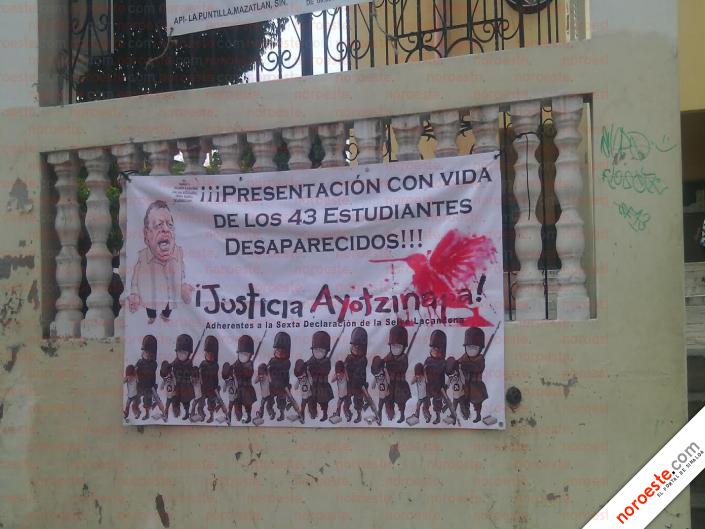
Banner by Adherents to the EZLN’s Sixth Declaration demanding that the 43 disappeared Ayotzinapa students be returned alive!
The State has been converted into a criminal institution criminal where the narco and politicians fuse to control society. A failed State that has been constructed in the last two decades to avoid the greatest nightmare of the elites: a second Mexican Revolution.
“Alive they were taken, alive we want them,” cries out María Ester Contreras, while twenty raised fists chant the slogan over the lane of the Latin American University of Puebla, upon receiving the Tata Vasco prize in the name of the collective Forces United for Our Disappeared in Mexico (Fuerzas Unidas por Nuestros Desaparecidos en México, Fundem), for its work against forced disappearances. The scene is overwhelming, since the family members, almost all mothers or sisters, cannot contain the crying and tears each time they speak in public at the 11th Human Rights Forum.
It has nothing to do with the genealogy of the disappearances that we are familiar with in the Southern Cone. In Mexico, it’s not about repressing, disappearing and torturing militants but something much more complex and terrible. A mother related the disappearance of her son, a communications engineer that was working for IBM, kidnapped by the narco to force him to construct a communications network at their service. “It can touch anyone,” she warns, saying that the whole society is within its sight and that, therefore, no one ought to remain at a distance.
Fundem was born in 2009, in Coahuila, and has achieved reuniting more than 120 families that look for 423 disappeared persons. It also works with the Truth and Justice Network, which looks for 300 Central American migrants disappeared in Mexican territory. “Collateral damage” former president Felipe Calderón called them, trying to minimize the tragedy of the disappearances. “They are beings that never had to have disappeared,” replies Contreras.
Worse than the Islamic State
A Fundem communiqué, for the purpose of the Third March of Dignity celebrated in May, emphasizes that “according to the Interior Ministry, as of February 2013, 26,121 persons were counted as disappeared,” since Calderón declared the “war against drug trafficking” in 2006. In May 2013, Christof Heyns, special relator on extrajudicial executions for the United Nations, said that the government recognized 102,696 homicides in the six-year term of Calderón (an average of 1,426 victims per month). But in last March, after 14 months of the current Peña Nieto government, the weekly Zeta counted 23,640 homicides (1,688 per month).
The information chain Al Jazeera published an analysis wherein it compares the deaths provoked by the Islamic State (IS) with the Mexican narco-massacres. In Irak, in 2014, the IS has ended the lives of 9,000 civilians, while the number of Mexican cartel victims in 2013 surpassed 16,000 (Russia Today, October 21 2014). The cartels carry out hundreds of decapitations every year. They have taken to dismembering and mutilating the victims’ bodies, to later expose them to intimidate the population. “For the same purpose, the cartels also attack women and children, and, just like the IS, publish graphic images of their crimes in the social networks.”
Many media outlets have been silenced through bribes or intimidations and since 2006 the cartels have been responsible for the murder of 57 journalists. The Islamic State murdered two US citizens, whose cases earned large media [attention], but few know that Mexican cartels murdered 293 US citizens between 2007 and 2010.
The question is not, nor should it be, who are the bloodiest, but rather why. Since we know that Al Qaeda and the Islamic State have been created by the United States intelligence services, it’s well worth asking question who is behind the drug trafficking.
Different studios and articles of investigative journalism emphasize the fusion between state authorities and narcos in Mexico. The magazine Proceso emphasizes in its latest edition that: “since the first trimester of 2013 the federal government was warned by a group of legislators, social activists and federal functionaries federales about the degree of penetration of organized crime into security areas of several Guerrero municipalities,” without obtaining the least response (Proceso, October 19, 2014).
Analyzing the links behind the recent massacre of the Ayotzinapa students (six dead and 43 disappeared), the journalist Luis Hernández Navarro concludes that the act “has uncovered the sewer of Guerreran narco-politics” (La Jornada, October 21, 2014). Members of all the parties participate in it, including the PRD, of the center left, to which José Luis Abarca, the municipal president of Iguala directly implied in the massacre belongs.
Raúl Vera was the Bishop of San Cristóbal de Las Casas when the hierarchy decided to separate Samuel Ruiz from that city. But Vera followed the same path of his predecessor and now exercises in Saltillo, the city in the state of Coahuila from where several mothers come that are members of Fundem. They don’t have their own place and they meet in the el Diocesan Human Rights Center. The Bishop and the mothers work elbow to elbow.
In 1996, Vera denounced the Acteal Massacre, where 45 indigenous Tzotziles were murdered while they were praying in a church in the community, in the state of Chiapas, among them 16 children and adolescents and 20 women. In spite of the fact that the massacre was perpetrated by paramilitaries opposed to the EZLN, the government attempted to present it as an ethnic conflict.
Controlling society
Because of his long experience, he maintains that the Ayotzinapa Massacre, “is a little message to the people, it is saying to us: see what we are capable of,” like happened in San Salvador Atenco in 2006, when members of the Peoples Front in Defense of Land, which participated in the Zapatistas’ Other Campaign, were brutally repressed with a result of two deaths, more than 200 detained, 26 of the women raped. The governor in charge of the injustice was Enrique Peña Nieto, the current president.
Those “messages” are repeated again and again in Mexican politics. The priest Alejandro Solalinde, who participated in the Forum on Human Rights, coordinates the Pacific South Pastorate on Human Mobility of the Mexican Episcopate and directs a shelter for migrants that pass through Mexico towards the United States, asserts that he received information that the students were burned alive. After being machine-gunned, the injured were burned, as police told him that they participated in the events and “longed for conscience” (Proceso, October 19, 2014).
If the style of murdering reveals a clear mafia message, the objectives ought to be discovered, to whom do they point and why. The answer comes from the hand of Bishop Vera. He emphasizes the intimate relationship between the cartels and the political, judicial and financial structures of the State, to the point that it is impossible to know where one begins and the other ends. To establish that reality leads him to assert that the leaders of his country “are organized crime” and that, therefore, “We are not in a democracy” (Proceso, October 12, 2014).
But the Bishop focuses his reflection towards a neuralgic point that permits untying the knot. “Organized crime has aided in the control of society and therefore it is an associate of the political class. They have attained that the people don’t organize, don’t grow.” Words more or less, but Subcomandante Marcos has pointed out the same thing.
Last, we’re not dealing with an accidental confluence but with a strategy. One of its constructors in the terrain is General Oscar Naranjo, who was one of the more outstanding “architects of the current Colombian narco-democracy” under the Álvaro Uribe government, as Carlos Fazio (La Jornada, June 30, 2012) would denounce. Naranjo, a DEA favorite and a “product of exportation” from the United States to the region, became an advisor of the Peña Nieto government.
Fazio emphasizes a Washington Post report where the newspaper asserts that: “seven thousand police and Mexican military members were trained by Colombian advisors.” It doesn’t take a great leap of the imagination to figure out where they began to manufacture the Mexican Failed State.
But there is more. “The United States government has helped some cartels through Operation Fast and Furious,” through which two thousand weapons were “involuntarily” placed in the hands of the narcos, the webpage antiwar.com reminds. It is possible, websites dedicated to strategic analysis reflect, like the European site dedefensa.org, that the Mexican chaos is favored by Washington’s growing paralysis and the cacophony that its diverse and contradictory services emit. Nevertheless, everything indicates that there is something deliberate. It should never be placed in doubt that it can boomerang across its extended and porous border.
From Puebla (Mexico)
– Raúl Zibechi is a Uruguayan journalist. He writes in Brecha and La Jornada and is an ALAI collaborator.
——————————————————
Originally Published in Spanish by ALAI, América Latina en Movimiento
Translation: Chiapas Support Committee
Tuesday, October 14, 2014
En español: http://alainet.org/active/78251
Zapatista News Summary for October 2014
OCTOBER 2014 ZAPATISTA NEWS SUMMARY

In Chiapas
1. Zapatista Solidarity with Ayotzinapa, 4 Comunicados, 2 Demonstrations – First, the Zapatistas issued a comunicado expressing solidarity with Ayotzinapa students and announcing that its members would participate silently in the October 8 marches throughout the country. It also urged
the Zapatistas issued a comunicado expressing solidarity with Ayotzinapa students and announcing that its members would participate silently in the October 8 marches throughout the country. It also urged adherents to the Sixth Declaration to participate in solidarity mobilizations. Some 20,000 Zapatistas marched silently on October 8.
Second, an October 20 comunicado announced that the EZLN would participate in the national and international October 22 actions in support of the Ayotzinapa students and also the Yaqui prisoners. On October 22, thousands of Zapatistas participated by lighting candles in their communities and on local roads, demanding the safe return of the 43 Ayotzinapa students, as well as the freedom of the 2 Yaqui prisoners, Mario Luna and Francisco Jiménez.
Third, On October 23, the EZLN and the National Indigenous Congress (CNI, its initials in Spanish) issued a strong joint statement on Ayotzinapa (accusing the bad governments of disappearing the students) and also on the Yaqui political prisoners. The EZLN and CNI concluded by calling Mexico a Narco-State. The EZLN and the CNI are not alone in analyzing Mexico as a Narco-State; Luis Hernández Navarro reached the same conclusion, and he named names.
Fourth – On October 29, the EZLN and the CNI issued a second joint statement, this time regarding a private company invading indigenous communal lands of the Ñatho and Mexica in San Francisco Xochicuautla, state of Mexico and the attack and threat made against Yaqui activist Lauro Baumea.
2. The San Cristóbal-Palenque Super-Highway – The route for the super-highway between San Cristóbal and Palenque has been finalized. The highway’s route will cut through the lands of many ejidos and, therefore, it continues to generate protest. The Los Llanos ejido extended an invitation to communities adhered to the Sixth Declaration to meet on October 12, Día de la Raza, regarding their rejection of the super-highway. On that date, those adherent communities sent some 800 representatives to Los LLanos. They raised many issues, including the fact that the super-highway would dispossess lands reclaimed by the EZLN, cause environmental damage to Mother Earth and affect food security. There were other affected communities that also demonstrated against the super-highway that day. The Candelaria ejido extended an invitation to a November 25 march in San Cristóbal de las Casas, where they will make clear their position of rejecting the dispossession of their lands for the super-highway project.
Mexico’s Southern Border
1. Plan Sur Militarizes Chiapas – The so-called Southern Border Strategy, called “Plan Sur” in Chiapas, to deter drug trafficking, human trafficking and provide for “orderly” immigration is proving to be a wolf in sheep’s clothing. “Orderly” immigration has meant stepped-up enforcement against Central American and other immigrants, as well as their abandonment by coyotes, deportation by immigration authorities and criminalization by the Mexican State. Moreover, the containment posts staffed by federal forces, allegedly to intercept the traffickers and immigrants, have increased militarization in the state and they just happen to surround Zapatista Territory!
In other parts of Mexico
1. Protests for Ayotzinapa Continue In Mexico – Protests have been taking place in various parts of Mexico in solidarity with the 43 Ayotzinapa students that were forcibly disappeared on September 26 and 27. The state of Guerrero is in turmoil as teachers, relatives of the disappeared students and social organizations join with students to protest against the Narco-State. Fires have been set in state and municipal office buildings, roads blocked and buildings occupied to protest the murders and demand that the 43 are returned alive and well. Several universities are on strike and solidarity demonstrations continue throughout the country. Government officials have denied that the bodies found in numerous clandestine graves are those of the disappeared students and continue asserting that they don’t know what happened to the 43. However, experts are conducting investigations on human remains found in a Cocula municipal garbage dump not far from Iguala. Meanwhile, Guerrero Governor Angel Aguirre has been replaced with Interim Governor Rogelio Ortega Martínez. Ortega was Secretary General of the Autonomous University of Guerrero before being appointed as the Interim Governor. Aguirre leaving the governorship has not decreased the protests. The Huffington Post published a very good Homero Aridjis article on the violence in Mexico with a graphic that parodies the Time magazine cover that showed Peña Nieto as “Saving Mexico.” The Huff Post graphic depicts him as the Grim Reaper “Slaying Mexico.”
2. The Permanent People’s Tribunal Announces Drug War Numbers – Here they are: In the last 7 years [end of 2006 to end of 2013] the “drug war” in Mexico has produced “over 125,000 civilian victims [civilian deaths], some 25,000 forced disappearances and more than 250,000 people who have been internally displaced or forced into exile.” The Permanent People’s Tribunal (PPT) is an international opinion tribunal independent of State authorities. It examines and provides judgements relative to violations of human rights and rights of peoples. The Tribunal was founded in Bologna (Italy), June 24, 1979, by legal experts, writers and other intellectuals. It succeeded the International War Crimes Tribunal, which, in 1967, exposed war crimes committed against the Vietnamese people. The Permanent Peoples’ Tribunal may use International human rights law, or the Declaration on the Rights of Indigenous Peoples adopted by the United Nations. The focus of the PPT’s Mexico branch is on the violence in Mexico. Two of its members recently published the tribunal’s findings on the San Fernando Massacre in Tamaulipas, Mexico, which included findings on Drug War numbers.
———————————-
Compiled monthly by the Chiapas Support Committee.The primary sources for our information are: La Jornada, Enlace Zapatista and the Fray Bartolomé de las Casas Human Rights Center (Frayba).
We encourage folks to distribute this information widely, but please include our name and contact information in the distribution. Gracias/Thanks.
Click on the Donate button at www.chiapas-support.org to support indigenous autonomy.
_______________________________________________________
Chiapas Support Committee/Comité de Apoyo a Chiapas
P.O. Box 3421, Oakland, CA 94609
Tel: (510) 654-9587
Email: cezmat@igc.org
www.chiapas-support.org
http://www.facebook.com/pages/Chiapas-Support-Committee-Oakland/
https://compamanuel.wordpress.com
CNI-EZLN denounce land invasion and attack on Lauro Baumea
Joint National Indigenous Congress – EZLN Declaration denouncing the invasion of the Communal Lands of the Ñatho Indigenous Community of San Francisco Xochicuautla and the attack on Indigenous Yaqui Lauro Baumea

To the Ñatho Indigenous Community of San Francisco Xochicuautla
To the Yaqui Tribe
To the National and International Sixth
To the Peoples of the World
Once more we express our pain and rage as the peoples in rebellion and resistance who make up the National Indigenous Congress. We unite our voices, our rage, and our pain in response to what is happening in the Ñatho Indigenous Community of San Francisco Xochicuautla and to the members of the Yaqui Tribe who are defending their water source.
Our brothers and sisters of Xochicuautla have defended their forests against the construction of the private highway between Toluca and Naucalpan, because they know that life itself emerges from these trees, mountains, and waters. They were granted legal protection prohibiting this work on communal lands, but since October 8 of this year, workers from the construction company under the protection of public “Citizen Security” Forces of the State of Mexico have been invading their lands and cutting down hundreds of trees. The bad government doesn’t care if we below use their laws to defend ourselves; they break those laws themselves in order to destroy us. They made them for the same reason.
There are currently acts of provocation, persecution, harassment, as well as illegal invasion of communal territory in this community. The construction company Autovan S.A. of C.V. run by one Fernando Ambriz invaded their territory, circulating the rumor that anyone attempting to obstruct their work would be arrested. But the company does not have legal authorization for its presence in that territory, as there is a court injunction (48/2014) nullifying the assemblies held to grant “permission” to the project and invalidating the previous permit and any other matters related project permission. This injunction was issued by Judge Jorge J. de Silva Cano of the Agrarian Tribunal headquartered in Toluca.
Once again the Mexican state, through governor Eruviel Ávila Villegas, is in flagrant violation of our rights and of the judicial orders handed down from the courts, constituting yet another misuse of power. They are against us as indigenous peoples because we pose an obstacle to their plans—plans that favor companies and capitalism but go against life.
We are also pained by what is happening to the ancient and heroic Yaqui Tribe, which is also defending life and water.
There has now been an attack on the life of Lauro Baumea; two cars parked at his house were set on fire, and the attackers said that the next time it would not be cars that they set alight.
These attacks on life and against our lives happen throughout this country, because the dangerous mafias that compose the Mexican State are against all of us who defend the land and its resources. They employ fear and terror because they think this will paralyze us, that it will keep us from organizing. But this war that we suffer will not annihilate us.
Rather, the pain and rage that we feel unites us, feeding our construction of rebellion and resistance and the dignity that nourishes our struggle.
We demand respect for the Otomí-Mexica Forest and the Ñatho Indigenous Community of San Francisco Xochicuautla!
We demand the cancellation of the Private Highway Project between Toluca and Naucalpan, and compliance with the injunction that protects Ñatho territory!
We demand safety for Lauro Baumea and the liberation of Mario Luna and Fernando Jiménez, our brothers of the Yaqui Tribe!
Never Again a Mexico Without Us
October 28, 2014
National Indigenous Congress
Indigenous Revolutionary Clandestine Committee-General Command of the Zapatista Army National Liberation Army
Originally Published in Spanish by Enlace Zapatista
October 29, 2014
Guerrero and Narco-Politics
[Comment from an administrator of this blog: As you read this article, it would seem appropriate to remember that the U.S. government has urged and participated in Mexico’s so-called “Drug War” and financially supports Mexico’s Narco-State with beaucoup bucks while U.S. corporations make millions or billions off of selling the guns!]
GUERRERO AND NARCO-POLITICS
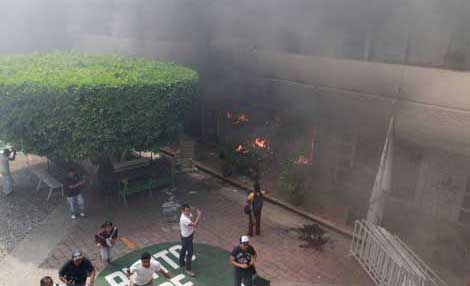
Guerrero protesters set Iguala’s municipal headquarters on fire during October 22 actions.
By: Luis Hernández Navarro
A narco-banner of two meters in length was found in the wee hours of October 16. It appeared in the rear fence of secondary school number 3 in Iguala, Guerrero, less than one kilometer from the 27th infantry battalion. On it, in a message written with letters printed in red and black paint, El Choky asks President Peña Nieto for justice. He denounces, with (first) names, last names and pseudonyms, those responsible for the murder and disappearance of the Ayotzinapa students.
The state’s attorney general, Iñaky Blanco, recently pointed to El Choky as chief of the Guerreros Unidos (Warriors United) gunmen, and the one responsible for ordering the massacre and disappearance of the youths last September 26, after the attack on them from police and gunmen.
The list of those associated with the criminal group and denounced in the banner is long: eight mayors, directors of Public Security, the Secretary of Agrarian, Territorial and Urban Development’s delegate and different personages. According to the denouncer, “they are the ones that the government lets walk around free and committing so much crime against the population.” Finally it clarifies: “I don’t have all the blame.” He signs: “Sincerely: Choky.”
The criminal climate denounced in the narco-message is not exclusive to Iguala and to seven municipal presidencies of Tierra Caliente. The kind of relationship between Mayor José Luis Abarca, his local police and organized crime, uncovered with the massacre of last September 26, is present in many Guerrero municipal governments. We’re dealing with a relationship that also involves important local politicians, state and federal legislators, party leaders, policía chiefs and military commanders. Thus, we are able to characterize the existing political regime in the state as a narco-state.
Denunciations like El Choky’s run from mouth to mouth among Guerrerans. Business leaders, social leaders and journalists have documented this nexus. Part of the local and national press has published it. In some cases, like in Iguala with the assassination of the Popular Union’s three leaders, formal accusations have even been presented to the relevant authorities. Everything has been in vain.
Those that have warned of the extent and depth of the narco-politics in the state have been eliminated and threatened. When the businessman Pioquinto Damián Huato, the leader of the Canaco in Chilpancigo, accused Mario Moreno, the city’s mayor, of having ties with the criminal group (called) Los Rojos, he was the victim of an attack in which his daughter-in-law died and his son was injured.
The politicians pointed to have invariably denied the accusations and have explained them as the result of political quarrels, or that they are not responsible for the behavior of their friends or relatives. They have said that the authorities ought to investigate them and that they are in the most willing to clarify things. But nothing g has been done. The pact of impunity that protects the political class has acted together time after time.
According to Bishop Raúl Vera, who was headed the Diocese of Ciudad Altamirano [1] between 1988 and 1995 impunity is the most lacerating characteristic of Guerrero and its most important challenge. Its extent and persistence –he points out– encourages crime and the violation of human rights and dignity.
But the violence is not only an issue of disputes between political-criminal groups for production centers, routes and plazas. It is also the result of the decision of the behind-the-scenes powers to get rid of opposition social leaders and to offer protection from (State) power to those that liquidate or disappear them.
The victims of forced disappearance and extrajudicial executions during the government of Ángel Aguirre are many. The correlation of murders and detained-disappeared during his administration is enormous.
Among many others, the ecologists Eva Alarcón Ortiz and Marcial Bautista Valle; the students Jorge Alexis Herrera and Gabriel Echeverría; the leaders of the Emiliano Zapata Revolutionary Agrarian League of the South, Raymundo Velázquez and Samuel Vargas; the environmentalist Juventina Villa and his son Reynaldo Santana; the Iguala council member, Justino Carbajal; members of the Popular Union Arturo Hernández, Rafael Banderas and Ángel Román; Rocío Mesino, who was the face of the Campesino Organization of the Southern Sierra; campesinos Juan Lucena and José Luis Sotelo, promoters of a self-defense group in Atoyac; the campesino organizers José Luis Olivares Enríquez and Ana Lilia Gatica Rómulo all make up part of it.
The narco-politics is not an issue exclusive to the old PRI. Members of various currents within the PRD have been pointed out as part of it. A member of the New Left [current] and president of the state Congress, Bernardo Ortega, has repeatedly been pointed to as boss of the Los Ardillos group. His father was in prison for the murder of two AFI agents del and was executed upon being released.
Servando Gómez, La Tuta, revealed in a video that Crescencio Reyes Torres, brother of Carlos, state leader of the Aztec Sun [meaning the PRD] and part of Grupo Guerrero [2], led by David Jimenez, is one of the principal “owners” of laboratories for the manufacture of synthetic drugs, allied with the Jalisco Nueva Generación Cartel.
At the same time, Governor Aguirre has repeatedly been linked with the Independiente de Acapulco Cartel. It is said that its leader, Víctor Aguirre, is the governor’s cousin. Of course, the governor as well as the rest of those accused have emphatically rejected and nexus with criminal groups.
Despite the multitude of denunciations against mayors and state officials, arrests have been scarce. Feliciano Álvarez Mesino, mayor of Cuetzala del Progreso, was arrested for kidnapping and organized. He was freed from blame as part of Grupo Guerrero. The official PRI mayor of Chilapa, Vicente Jiménez Aranda, was put in prison for kidnapping.
The murder and forced disappearance of the Ayotzinapa students has uncovered the sewer of Guerreran narco-politics. It remains to be seen whether they can put the lid back on.
[1] Ciudad Altamirano is a large city on the Guerrero side of the border with the state of Michoacán.
[2] Grupo Guerrero is a current, or faction, within the Party of the Democratic Revolution (PRD) in the state of Guerrero.
———————————————————–
Originally Published in Spanish by La Jornada
Translation: Chiapas Support Committee
Tuesday, October 21, 2014
En español: http://www.jornada.unam.mx/2014/10/21/opinion/021a2pol
EZLN & CNI Statement on Ayotzinapa
JOINT DECLARATION OF THE NATIONAL INDIGENOUS CONGRESS AND THE EZLN ABOUT THE AYOTZINAPA CRIME AND FOR THE FREEDOM OF THE YAQUI LEADERS
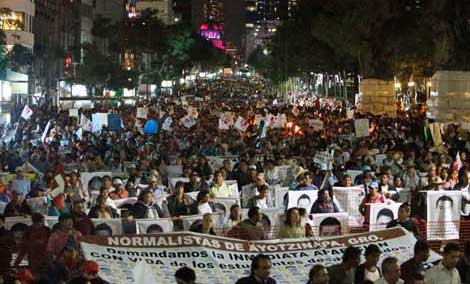
October 22 International Day of protests in Mexico City
(NOTE: CNI members read this text in some of the mobilizations that were held in Mexico on October 22, 2014, and not, as reported in the press for pay, by EZLN representatives)
Mexico, October 22, 2014
To students of the Isidro Burgos Rural Teachers College, Ayotzinapa, Guerrero
To the Yaqui Tribe
To the National and International Sixth
To the peoples of the world
BECAUSE IT IS WITH RAGE AND REBELLION, NOT WITH RESIGNATION AND CONFORMISM, HOW WE BELOW GRIEVE. EZLN. October 19, 2014
From the peoples that we are in our struggles of resistance and rebellion, we send our word as a mirror of that part of this country that we call the National Indigenous Congress, united because the pain and rage call to us because we grieve.
The disappearance of the 43 student compañeros of the Isidro Burgos Rural Teachers College of Ayotzinapa, Guerrero, kidnapped-disappeared by the Bad Governments, imposes a penumbra of mourning, anxiety and rage. Hope for the appearance of the compañeros is the pain that unites us and it is rage that becomes the light of the candle that mobilizes throughout the country bearing a cry of dignity and rebellion in the Mexico Below.
We know that while the criminals govern this country headed by the supreme chief of the paramilitaries, Enrique Peña Nieto, those that construct conscience by exercising and defending education are murdered and disappeared and those that defend the water for a heroic and millennial people like the Yaqui Tribe are in prison.
The Mexican government has sought to minimize the criminal repression towards the student compañeros as if they were more victims of crime, as they have done time and time again throughout the country. They may be just a few more deaths for the communications media, but we peoples that have suffered multiple forms of repression know that the criminals are in all the political parties, in the chambers of deputies and senators, in municipal presidencies, in government palaces.
Ayotzinapa pains us as native peoples. The 43 student compañeros remain disappeared and the State acts like it doesn’t know where they are, as if it had not been the State that took them away. They seek to disappear conscience and today the disappeared are present in this country’s thoughts, in the attentive gaze and the heart of those of us that are the National Indigenous Congress.
There are dangerous mafias in this country and they are called the Mexican State. We disturb them, we the peoples that struggle, we that have had no face and have had it torn away. We are nobody to them, we who see and feel the violence, we who suffer multiple and simultaneous attacks, we who know that something evil, very evil, is happening in this country in this country. It’s called war, and it is against all of us. It’s a war that we below see and suffer in its totality.
Today we reiterate that as long as our student compañeros of Ayotzinapa do not appear alive and in the state of Sonora our brothers Mario Luna Romero and Fernando Jiménez are in prison for defending the sacred water of the Yaqui River, as long as they remain kidnapped by the bad governments, we will continue responding accordingly.
The Narco State operates in the entire country, as in Guerrero, through repression against the peoples, extraction of natural resources and destruction of territories without scruples. It uses terrorism to manufacture pain and fear as its way of governing.
That pain and rage have been converted into dignity and rebellion against the war of extermination, because the opposite is waiting for death, dispossession and more pain and rage.
We demand the presentation with life of the 43 disappeared students and the dismantlement of the entire State structure that maintains organized crime!
We demand the immediate liberation of compañeros Mario Luna and Fernando Jiménez!
Your pain is ours! Your rage is ours!
October 22, 2014 Never More a Mexico without Us
National Indigenous Congress Indigenous Revolutionary Clandestine Committee-General Command of the Zapatista National Liberation Army
—————————————–
Originally Published in Spanish by Enlace Zapatista: http://enlacezapatista.ezln.org.mx/2014/10/23/declaracion-conjunta-cni-ezln-del-22-octubre-2014-nota-este-texto-fue-leido-por-miembros-del-cni-en-alguna-de-las-movilizaciones-que-se-realizaron-en-mexico-el-22-de-octubre-del-2014-y-no-como-re/
 Chiapas Support Committee