Chiapas Support Committee
Home of the Compañero Manuel blog on zapatistas & mexico
Mexicans connect anti-capitalist resistances
MEXICANS CONNECT ANTI-CAPITALIST RESISTANCES

Ayotzinapa presentation at the Festival of Resistances & Rebellions against Capitalism in Amilcingo. Photo: Arturo Vazquez
A surge of grassroots organizing for fundamental change is underway in Mexico. The September 26-27, 2014 police attack on students from the Ayotzinapa rural teachers college, which took place in Iguala, Guerrero, and the subsequent disappearance of 43 of those students, exposed the complicity and corruption between government officials, political parties, police and organized crime; it shocked Mexico’s conscience and left a deep wound in the nation’s heart. A few examples of the growing momentum for radical change are described below.
After the police attack and enforced disappearance of 43 students, the State Coordinator of Education Workers of Guerrero (Ceteg), the state affiliate of the National Coordinator of Education Workers, a lefty labor union, wasted no time in calling a meeting in Ayotzinapa. Participants in the October 15 meeting, held a mere 18 days after the attack, vowed to engage in various kinds of social protest and to organize in order to accumulate forces and grow the movement. The participants also formed the National Popular Assembly (ANP, its initials in Spanish), composed of 53 social and student organizations in the country. (Students also have a national organization.) Afterwards, parents, relatives, student survivors, teachers and friends of the 43 disappeared students attended meetings within Guerrero and in different parts of the country to gather momentum and support for their on-going search for the students and for truth and justice. The parents and student survivors split up in small groups and visited communities and social organizations around the country; it seemed like they were everywhere, and it still seems that way after five months.
One of their visits was to Chiapas, where they met with civil society in San Cristóbal and with the statewide teachers’ union in Tuxtla Gutiérrez, the state’s capital. On November 15, 2014 they met with the Zapatistas in Oventik, a Zapatista Caracol, the autonomous regional government center. The Zapatistas had also been busy organizing since their re-emergence on December 21, 2012. The Zapatista National Liberation Army (EZLN) initiated a new organizing phase with the Escuelitas Zapatistas (Little Zapatista Schools) in 2013, where folks were invited into Zapatista homes and communities to learn first-hand about autonomy. Escuelitas were held twice in 2013 (August and December) and the first week of January 2014. They also held a Seminar in honor of Juan Chávez Alonso, a very well known and highly respected indigenous leader that died. This was a step in renewing the relationship between the National Indigenous Congress (CNI) and the EZLN.
From August 4-8, 2014, the EZLN held a “sharing,” or exchange of struggles, thoughts and ideas, with the National Indigenous Congress in La Realidad. On August 9, they presented a joint report that, in addition to a long list of government plans to facilitate corporate takeovers of indigenous lands (dispossession), included plans to sponsor a joint global festival of resistances and rebellions against capitalism in several different locations between December 22, 2014 and January 3, 2015.
Following the November 15 meeting with the Ayotzinapa parents in Oventik, the EZLN issued a December 12 comunicado [1] in which it invited the parents to send a 20-person delegation to the Festival of Resistances and Rebellions Against Capitalism (R&R Festival) as honored guests. The EZLN stated that it would cede its spaces to speak to the parents. The parents accepted and were thus able to tell their story to indigenous representatives of many anti-capitalist struggles around the country, as well as to adherents of the Sixth Declaration that attended the Festival. The Zapatistas gave the parents their full support and urged members of the CNI to welcome the families of the 43 disappeared students into their communities and to listen to what they had to say. Besides urging everyone to struggle against capitalism and its destruction of Mother Earth, the EZLN also urged CNI members and adherents to the Sixth Declaration of the Lacandón Jungle to support the struggle of the Ayotzinapa families and students for truth and justice. Subcomandante Moisés stated:
“We understand that right now, truth and justice for Ayotzinapa is the most urgent demand.” [2]
After the Festival of Resistances and Rebellions against Capitalism

Congress of Morelos Towns forms and joins the Ayotzinapa struggle for truth and justice.
On February 1, representatives from 60 towns in the state of Morelos met to form the Congress of Morelos Towns in order to unite opposition to the Morelos Integral Project; a collection of energy and infrastructure projects intended to facilitate industrialization and mining. Some of the towns had sent representatives to the R&R Festival and one of the towns, Amilcingo, hosted the Festival. Representatives from Ayotzinapa spoke at the February 1 meeting, and the Congress of Morelos Towns voted to join their struggle.
An ambitious project called the Constituyente Ciudadana, which organizers had been working on for eleven months, made an important announcement on February 5. In Mexico City, human rights activist Bishop Raúl Vera López, [3] other activists, clergy, members of campesino, union and social organizations, as well as survivors of the violence that envelops Mexico presented the initiative of a Popular Citizens Convention, which will convoke a series of sessions throughout the country, and a March 21 meeting for discussing the political reality and to formulate a new Constitution. Reasoning that the current Constitution is “dead,” proponents of this project want citizens to agree on a new constitution that will provide economic, social and political justice to all citizens. This work takes place without political parties. [4]
Among the project’s proponents present at the Mexico City announcement, in addition to Vera López, were: the painter Francisco Toledo, Javier Sicilia, Father Alejandro Solalinde, the priest Miguel Concha, Gilberto López y Rivas, migrant defender Leticia Gutiérrez, as well as union representatives, among them Martín Esparza (Electricians Union) and members of different churches. At the start of the February 5 event, they remembered the events that occurred in Iguala, Guerrero, which resulted in 43 students from the rural teachers college at Ayotzinapa being forcibly disappeared.

Resistance to Federal and Military Police in Guerrero.
The ANP held a National Popular Convention (CNP) over the weekend of February 6-8. Two thousand (2,000) delegates from 244 social organizations coming from the interior of the country attended. A central purpose of the convention is to generate ‘‘a reflection within all the organizations that envisions the possibility of giving direction to the movement and grouping together and unifying all of the country’s political forces, respecting their diversity and natural dynamic, but giving it direction through a political program. [5]
The ANP held another meeting on February 22 with 153 delegates from 55 social organizations. Again headed by the Ayotzinapa parents, they agreed to make it their priority to enter military barracks to search for their missing sons and to hold a second National Popular Convention (CNP) on April 10 and 11. According to Vidulfo Rosales Sierra, a lawyer with the Tlachinollan Human Rights Center of La Montaña, “they are accumulating forces with the political movement, and will invite other actors like the National Indigenous Congress (CNI), and the Constituyente Ciudadana (Citizens Constitutional Convention) that the Bishop of Saltillo, Raúl Vera, impels, so as to be assembled in one single force that permits us to arrive at the convention with more strength.” [6]
The fact that the project for a constitutional convention had been worked on for eleven months demonstrates that the Ayotzinapa case is not what motivated that project. One possible motivation was the package of constitutional “reforms” the Congress passed last year. That package included an energy reform that now gives energy companies the right to “use” anyone’s land, whether private, ejido or communal land, for oil and gas exploration and exploitation; in other words, the right to poison indigenous and campesino land and thereby render it useless for producing crops. The package also included an education reform that takes union rights away from teachers and implements a system similar to the “no child left behind” policy in the United States. A “tax reform” requires small cooperatives and others previously not taxed to keep books and pay taxes. Collectively, these “reforms” were known as the Pact for Mexico, sponsored by the PRI.
Another major motivation was very likely the out-of-control violence and resulting insecurity caused by Drug War militarization and the actions of organized crime. At the February 1 Congress in Morelos described above, Javier Sicilia announced that organized crime has provoked the following number of victims in Mexico: “(…) more than 160,000 murders were committed in the eight most recent years and more than 30,000 disappeared and 500,000 displaced exist.” [7]
In addition to victims of organized crime, all the campesinos affected by the energy “reform” and teachers affected by the education “reform,” Ayotzinapa has added momentum for the citizens’ constitutional convention, grassroots anti-capitalist organizing and fundamental change in Mexico. What provides a hopeful sign is that so many diverse social organizations, unions and churches are coming together with a common goal: a citizens’ constitutional convention.
——————————————————————————-
By: Mary Ann Tenuto-Sánchez
[1] https://compamanuel.wordpress.com/2014/12/19/ezln-on-ayotzinapa-the-festival-and-hysteria/
[3] Raúl Vera López is the Catholic Bishop of Saltillo and the president of the Board of Directors of the Fray Bartolomé de Las Casas Human Rights Center (Frayba) in Chiapas. He also served as Assistant Bishop of the San Cristóbal de las Casas Diocese in Chiapas, under the late Bishop, Don Samuel Ruiz, the founder of Frayba.
[4] http://constituyenteciudadana.org/
[5] http://www.jornada.unam.mx/2015/02/06/politica/005n2pol
[6] http://www.jornada.unam.mx/2015/02/22/politica/007n1pol
[7] http://www.jornada.unam.mx/2015/02/01/estados/019n1est
Mexican Army harassing La Realidad
A Mexican Army convoy with trucks, hummers, jeeps and a motorized team harasses Zapatista Good Government Junta
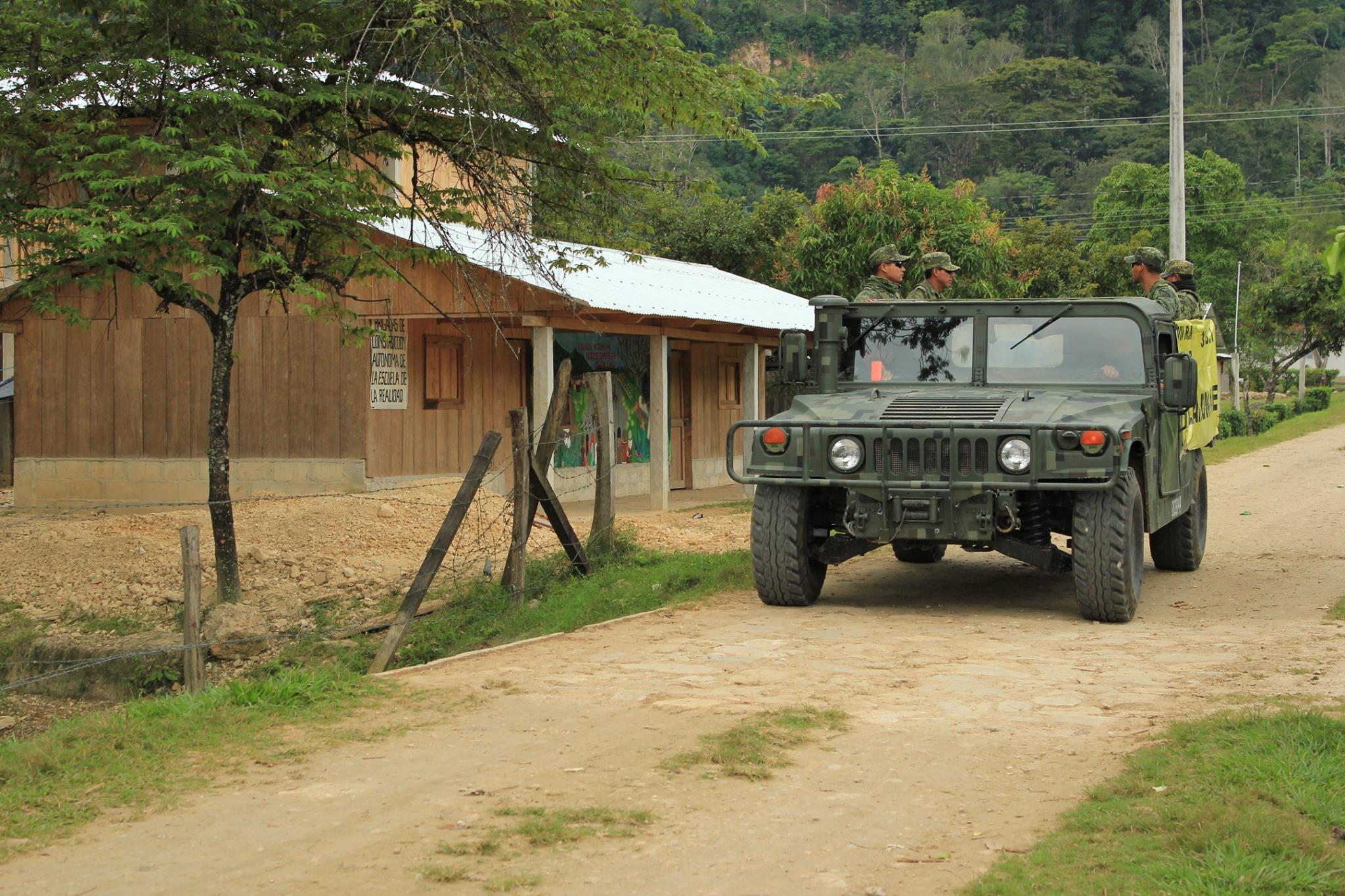
Mexican Army patrols La Realidad
Chiapas México. March 12, 2015. “The growing harassment that the Mexican Army is carrying out in Zapatista territory causes concern,” the Fray Bartolomé de Las Casas Human Rights Center (Frayba warns, after having observed the repeated presence of the Mexican Army, in territory of the Good Government Junta in La Realidad, in the Border Jungle Zone.
From the Civilian Observation Brigades (BriCO), the Frayba has documented since July 2014, “systematic incursions of the Mexican Army, which is harassing the Bases of Support of the Zapatista National Liberation Army (BAEZLN, their initials in Spanish).”
The human rights defense organization denounces low-flying airplanes and helicopters photographing and filming BriCO members, BAEZLN and the installations of the Junta. “These actions have been in increasing since last July, as much in the number of troops as in the frequency with which they happen,” they observe.
The military acts within the Junta’s territory, also consist of incursions in a convoy with trucks, hummers, jeeps and a motorized team; with members of the Mexican Army that range from four to 30 persons, indicates the Frayba and demands: “that the free determination and autonomy of the Zapatista peoples be respected; and that the harassment perpetrated by the federal government through the Mexican Army cease.”
As background to the gravity of the harassment of the BAEZLN, the non-governmental organism no points out that on May 2, 2014, members of the Independent Central of Farm Workers and Campesinos Historic (CIOAC-H), ambushed BAEZLN within the La Realidad Junta’s territory; during the attack the armed group extra-judicially executed José Luis Solís López, “Maestro Galeano,” and also destroyed the Autonomous Clinic and School.
The human rights center created by Bishop Samuel Ruiz, exposes that: “the CIOAC-H, is part of the Las Margaritas municipal government, with proven protection from the (state) government of Governor Manuel Velasco Coello, who has permitted them to carry out attacks, forced displacements and murders in the region.”
—————————————————–
Originally Published in Spanish by: POZOL COLECTIVO March 12, 2015 in Chiapas
English translation: Chiapas Support Committee
EZLN: Thank you, part III
THANK YOU PART III:
The Most Expensive Building in the World
Subcomandante Insurgente Moisés. Subcomandante Insurgente Galeano

The Baile (Dance) is part of the celebration for the inauguration of the school/clinic**
February-March, 2015
It is the eve of the big day… in the wee hours of the morning. The cold bites under the cover of shadow. On the solitary table that furnishes this small hut (which has no sign but is known to now be the headquarters of the Zapatista Command), there is a handwritten, wrinkled sheet of paper detailing the accounts for the construction of the clinic-school in the Zapatista community of La Realidad. A voice summarizes the gazes, silences, smoke, rage:
The accounts don’t balance. The life of any Zapatista is worth more than Peña Nieto’s white house and the houses of all of the rich in the whole world combined. The entirety of the funds required to construct the huge buildings where the powerful hide in order to organize their thievery and crimes would not be enough to pay for a even a single drop of Indigenous Zapatista blood. That is why we feel that this is the most expensive building in the world.
So must state clearly that what doesn’t appear in the accounts is the blood of our compañero Galeano. All of the papers in the history of the world would not be enough to balance that account.
And so that is how it should appear in those lists that come out in the press where they name the richest people, and where the poorest live. The rich have first names, last names, lineage, and pedigree. But the poor only have a geography and a calendar. So they should say that the most expensive building on the whole planet is in Zapatista La Realidad, Chiapas, Mexico. And that the Indigenous Zapatista girls and boys attend the most expensive school in the world. And that the men, women, boys, girls, elderly, indigenous, Zapatistas, Mexicans, when they get sick in La Realidad, will be treated in the most expensive clinic on earth.
But the only way to balance these accounts is to struggle to destroy the capitalist system. Not to change it. Not to improve it. Not to make it more human, less cruel, less murderous. No. To destroy it completely. To annihilate each and every one of the heads of the Hydra.
Even then there would be more to do, as what we want here is to construct something better: another system, one without masters, without patrons, without bosses, without injustice, without exploitation, without disrespect, without repression, without dispossession. One without violence against women, children, anyone who is different. One where work is paid justly. One where ignorance does not rule. One where hunger and violent death are just bad memories. One where no one can be above on the backs of others below. One that is reasonable, one that is better.
Then and only then, the Zapatistas can say that the accounts are even.
_*_
Thank you to the others, [1] men, women, children, elderly, groups, collectives, organizations, and whatever you call them inside and outside the Sixth in Mexico and around the world for the support you have given us. This clinic and school are also yours.
Now you know that there is an Autonomous Health Clinic and Autonomous School in the Zapatista La Realidad available to you.
We know that it’s a little far, but who knows, the world is round and keeps turning, and so maybe, who knows, could be… perhaps one day on some dark early morning you realize that, this thing about entering the struggle to balance the accounts is part of your own balance sheet.
From the mountains of the Mexican Southeast
Subcomandante Insurgente Moisés
Subcomandante Insurgente Galeano
La Realidad Zapatista, Chiapas, Mexico
March 2015
Section “From the Diaries of the Cat-Dog”
Notes on gender:
-(…) That is why as women of this country we need to organize ourselves, because there are many disappearances. Many of us are mothers, and we are suffering the pain and sadness of having our sons disappeared, our daughters killed. Now in this system, in addition to being humiliated, disrespected, exploited, in addition to all of that, they come to kill and disappear our children. This is what happened in the ABC case and now with the 43 disappeared from Ayotzinapa, the disappeared women in Ciudad Juárez, and the case of Aguas Blancas—all of this is the system’s doing.
This system will not resolve our problems; it will not provide us with any answer. That is why, brothers and sisters, we need to organize ourselves because it is the we who will decide, who will set out the path that we want as peoples. As communities of men and women, not only indigenous communities in the countryside but also you sisters in the city, we must learn to govern ourselves, alongside our men, together between men and women. This is how we will build a new system where we as women are taken into account and perhaps there, compañeras, sisters, we will find relief from the pain inside us and this collective rage that now unites us.
(…) Now, in the 21st century, there are just a few women who enjoy wealth—the wives of the rich, the wives of the presidents and governors, and the women who are congressional representatives and senators. But in our situation as indigenous women we continue to suffer pain, sadness, grief, rape, exploitation, humiliation, discrimination, imprisonment, disrespect, marginalization, torture, and much more, because for us there is no government. This is why the situation for the rest of the women in the country is still the same; they are living just as women lived before in previous eras [the time of the ejidos, the time of the colonies]. Our grandfathers adopted this bad culture from their colonial bosses and drug it along with them into the house, thinking that they were in charge, as if they were the little bosses of the house, insisting that “I rule”—and this from the father in the family. And the person he ruled over was his wife, and that is how the most horrible thing arose, that the women, that is, the daughters, the compañeras, were obligated to marry whoever the fathers chose according to whom the father wanted as a son-in-law. And they chose whoever offered more liquor or more money. That’s how things worked in the time of the ejidos, the woman was never taken into account. When the men organized themselves to work, women were left out.
(…) So many women have been disappeared, killed, raped, exploited, and nobody says anything about them. And a few rich women enjoy the wealth created by other exploited women. Those rich women do not suffer; they do not feel the pain and humiliation of being exploited because one is poor. But that is no reason for us to stop organizing and fighting as women, because for most of us women, this system only means pain, sadness, imprisonment, humiliation, and rape. This is the situation of the mothers of the 43 disappeared students, the ABC Daycare, the mine in Pasta de Conchos. It is the same thing in Acteal. But this does not mean we will stop organizing and fighting in the countryside and the city. This is why we are sharing with you for the first time in history.
(…) In this system, there are men who do work that is usually considered woman’s work, but this is not for the good of a new society like what we Zapatista are trying to create. Here is an example: in some places there are fancy restaurants where very elegantly dressed men do the work that usually women do, but they are exploited. Meanwhile, the women who previously held these jobs are taken elsewhere for other purposes, like commodities, where their photos are taken for magazines, movie covers, and Internet publications. So we see that life in this system in which we live is harder than it was 520 years ago, because it is the same bad government: the grandchildren are the same as the sons of the landowners of before, and they are the ones who continue exploiting us today in this country. So we see that there is never any change in the system and it is always the sisters and brothers suffering this same pain that the bad government causes us today. (Notes from the sharing/exchange of the Zapatistas in the First World Festival of Resistance and Rebellion Against Capitalism. Complete version found in “Zapatista Rebellion n.4,” next issue).
In this system, to be born, grow up, live and die as a woman can be like being dragged through a thicket of barbed wire. But this pain is just one of many stains on history. What brings relief is that women, more and more of them, decide to stand up and walk with their heads held high. Not as if the barbs were simply flowers, but as if the scratches, including the lethal ones, made them stronger, urging them to forge new paths. Not paths to change which gender is dominant, but to end domination. Not to have a place in the history from above, but so that history below ceases to be a wound that never heals or scars over. Neither dominator nor dominated. Neither queen nor plebian. Neither Khaleesi nor Jhiqui. Neither boss nor employee. Neither slave nor master. Neither owner nor servant. But the terrible part of this is not that every being born a woman must fight this racket on every page of the calendar in whatever political geography to come. What is terrifying is that those who strive for a better world often weave these injurious traps with their own hands. But every so often reality, which is feminine, lands a blow on the calendar of above from every geography below. I have faith.
[1] The text uses “otroas” meaning “other,” to give a range of possible gendered pronouns including male, female, transgender and others.
** The Spanish version of this series of comunicados has beautiful photos of the school/clinic construction, both in process and completed. I chose this photo because of its connection to International Women’s Day and also because it depicts how Zapatista boys meet Zapatista girls. The young women start dancing with each other and eventually the boys start asking them to dance. Lots of rejection happening at first, but then…
EZLN: Capitalism destroys, the people construct
GRACIAS II: CAPITALISM DESTROYS, THE PEOPLE CONSTRUCT
By: Subcomandante Insurgente Moisés

Inauguration of the autonomous Zapatista school and clinic. On the left is a painting of Subcomandante Pedro, who died in the January 1994 Uprising
The words of the EZLN’s General Command in the voice of Subcomandante Insurgente Moisés in the Zapatista community La Realidad at the presentation of the “Compañero Galeano” Zapatista Autonomous School and the October 26th “Subcomandante Insurgente Pedro” Autonomous Clinic to the Zapatista support bases on March 1, 2015.
Good morning to everyone, compañeros and compañeras of this zone, in this Caracol of La Realidad, Border Jungle Zone.
We are here with you today, compañeros, compañeras of this zone, to officially turn over these buildings to the compañero and compañera bases of support of this Zapatista community, La Realidad, Nueva Victoria, as we call it in our struggle as the Zapatista National Liberation Army.
Compañeros and compañeras, what we must make clear and understand is that the pain carried by each Zapatista continues, not only the Zapatistas in Mexico, but across the world, because we do not have with us the compañero whose name this new construction carries: compañero Galeano.
This construction was the fruit and the work, the efforts and the organization of the compañeros and compañeras of the National and International Sixth. Here we are demonstrating what we Zapatistas are, in Mexico and in the world.
What we are, what we think, and what we want, is life. We want them not to kill us.
The work of the capitalist system is to destroy what the poor people build. But the poor people will not stop building, because it is their life. The system destroys what the people build because it knows that one day the system itself will be destroyed, because it is based on exploitation and humiliation. Capitalism does not build life, and it leaves us, the poor, with nothing. All we have is what we build ourselves, we men and women who struggle, not anyone else.
That is why we are stating what we are, here at the construction site, here in the community of compañero Galeano, teacher of the Zapatista Little School, sergeant in the struggle, miliciano [1] in his organization, authority in his own life, an example for all of us.
Capitalism wants to put an end to this example and we will not allow it.
We want to say clearly here in this community, for those who are not on our side: we are not against them. We want respect; they know that. And we have said: if they respect us, we will respect them; we are not here to kill poor people. But if they let themselves be used by the system, they know that they are on the side of the criminal, the exploiter, the murderer; that is, capitalism.
We want to say clearly here, for the people who do not agree with us: we are not bothered if they are not in agreement with us, because one day this will be for them. Maybe not those who are mothers and fathers now because many of them are already fifty or sixty years old, but their children will see the fruits of what we are building.
We tell you from our hearts and in all truth: we are struggling for the people of Mexico, and maybe we will even be an example for the world. We want to make that clear, because what we want is life. We have said clearly that we are also struggling for the soldiers, for the police officers, because we know that they are also poor and that it is because of their poverty that they sell their bodies, their lives, their souls, their blood, their bones, their flesh; they sell out because capitalism buys them off so that they will defend it. We will never see a rich person, or the children of the rich, among the soldiers that come here to confront us. The children of the rich may be there, but as the generals who exploit their own soldiers.
We know this is how it works, the rich people’s trick they buy us off – the poor people of Mexico – by giving us little gifts so that we believe that the government is good. But the bad government of the capitalist system will never be good, and never ever will the rich be good. Take a simple example: if sometimes we fight among ourselves, as relatives, brothers, sisters, or uncles and aunts, even though we are family, from the same father and mother, how is it possible that we could believe what the rich say? How is it possible for us to believe that they are good when we don’t know even know them? For example, now that election time is coming, which of the candidates do we actually know?
We want to say clearly and make absolutely clear: we don’t have anything against our brothers, those who want to be brothers to those of us who are in struggle. Whether they want to [struggle] or not, it’s no problem either way. But just like we say there is no problem, we don’t want them to give us any problems. The person that goes looking for problems finds them. And when we say this – that those looking for problems find them – it is also true for us as Zapatistas. It is true for anyone who provokes conflict. That is why we are saying clearly here: we are not going to cause problems, because we don’t have anything against those who don’t want to struggle with us.
It is a shame and it makes us sad to see them fooled, exploited, and humiliated. They don’t have anything to teach their children for the future. For the Zapatistas, our children matter to us, and we want to show them a path to a future where there is no more exploitation or humiliation, where we can govern ourselves.
And so, compañeros, compañeras, this building that we are inaugurating is the fruit, the result of how our compañeros and compañeras of the Sixth understand us, but also of other brothers and sisters of Mexico and the world who still haven’t become part of the struggle of the Sixth, of the struggle convoked by our Sixth Declaration, but who support us in their hearts.
Perhaps here, on this long journey, they will realize what is happening and join us in struggle. But here we see part of the efforts, struggle, and organization of these brothers and sisters, of Mexico and the world who are not part of the Sixth.
But the greatest part comes from the efforts, the sacrifice, and the organization of the compañeros of the National and International Sixth.
Here we are demonstrating how when poor people organize themselves, the capitalist system is unnecessary. A system that dominates and humiliates is not necessary. Here, in practice, is an example of this fact. Capitalism, the bad government of this country, ordered the destruction of the autonomous school belonging to the Zapatista support bases. And they did destroy it – as destroying things is easy – just like they destroyed the community’s health clinic, as it is (inaudible).
And here is the result, the result of the strength and the organization of our compañeros and compañeras of the national and international Sixth. What the poor people of Mexico and the world re-built came out even better than it had been before.
So let this be clear: this is a demonstration that what matters for our compañeros and compañeras of the National and International Sixth is the struggle for life.
What pains us the most is that this construction cost us dearly, because this house is not worth the life of our compañero, teacher of the Little School, compañero Galeano. His life has no price. But unfortunately the bad government, the three levels of bad government and the people who sell out, who don’t consider their own children, did what they did to our compañero Galeano.
What we want to say here, because what we say here goes out to the world, is to tell our compañeras and compañeros of the International and National Sixth what we must realize: let’s not organize or do something just when a compañero or compañera is dead.
The truth is that we need to organize ourselves without waiting for something like this to happen. If we organize, we can demonstrate that the capitalist system and the bad government aren’t worth a thing.
We must build what has to be built even when we aren’t suffering deaths because we don’t want these kinds of things to happen. It is the fucking capitalist system that wants this.
We want to make it very clear once and for all that we do not hate poor people. What we want is an end to exploitation.
We want to make this clear, that we have to support other compañeros and compañeras, not only those who live in the Zapatista zones, but other compañeros who are missing.
This is how we demonstrate that we aren’t just saying that we are organized; our organization is demonstrated by doing what we say, carrying it out in practice.
There are many things that we want to say compañeros, which is why, for the next few days we will work here with you. Right now we are here to turn over to the compañero support bases of the Zapatista Army the building that our compañeros and compañeras of the Sixth have given us.
This building belongs to the people. The people have to think about and plan for how it will be used, because what they do with it will serve as an example for other compañeros and compañeras.
The hard part, the part that is hardest to wrap my head around, is that our compañero Galeano should be here with us.
But he isn’t here and we know who is responsible, and the question that we put to those responsible (for what was done to compañero Galeano) is how many millions of pesos did the people who you killed owe to you? What did compañero Galeano steal from you to make you do what you did? The people who did this can’t answer these questions because the truth is that he didn’t steal anything from them. He never stole anything from them or owed anything to them. In fact, they owe us.
That is why we want to make clear here that we are not against anyone. We ask them to respect us, but we aren’t only asking this of them; we Zapatistas also have to show respect, and so we’ll see who starts the problems.
Because we Zapatistas have to think of the little boys and girls, and so we also want to tell them to at the very least think of their own children. They know what happened in 1994. When the bad government decides to act this way, we know that the army won’t respect anyone; those citizen ID cards they talk about aren’t worth anything. The truth is that nothing will protect them. They [the bad government] will name and blame everyone as Zapatista; the people know this and we want to remind them of it.
That is why we are here asking them to listen, to open their hearts, to use their heads and think about this. There isn’t anywhere to go. Even if they flee this place, they will encounter the same death wherever they go. It makes more sense to be here, to live here and respect each other here as people, as Christians, as they say. This is something that even our animals understand, and they are just animals. We are not animals; we are men and women, boys and girls, with brains.
Everything that the indigenous receive now in Chiapas – those who take that little bit that the bad government gives out – is because the bad government doesn’t want us, the men and women, to organize. They give them these little handouts so that the people never think about organizing and struggling. This is the biggest problem that we have here because by accepting this, the people leave their children exploited, humiliated, and trampled.
This is exactly what we Zapatistas don’t want, and that is why we don’t take anything from the bad government, because we don’t want this system. The capitalist system will not be able to get rid of us. We are talking about capitalism, with its thousands of armies, and even so it won’t be able to destroy us. That is why out there they say that there aren’t very many Zapatistas left, but this is just part of the bad governments’ lies. But instead of talking the talk, as they say, we will demonstrate what we say in practice.
In the days to come, we will continue to think of, to remember, our compañero Galeano.
And so, compañeros and compañeras of this caracol of La Realidad, in the name of the compañeros and compañeras of the national and international Sixth, I turn this building over to you, for the good of our compañeros and compañeras of this community, La Realidad, so that the compañero and compañera health and education promoters can begin to do their work.
We just want to make clear that this building belongs to all of us, and so those above should think about whether they want to try to destroy it again. But we also want to say to the people from this village, let the bad government come destroy it if that’s what they want. Don’t allow yourselves, señores and señoras, to be used; don’t let the bad government use you to destroy this because you are poor people just like us, you know that.
Don’t let them use you, don’t sell out, because life cannot be bought and sold. Let the bad government come and do it. What about those verses in your church or temple, the ones that tell you to love others? How does that fit in? Think about it, señores and señoras, don’t be like the bad government that says one thing and does another. Don’t be like that, señores and señoras. What’s it worth to preach one thing and do the opposite? We don’t want to do this, to say one thing and do another.
As we say, we have compañeros and compañeras who are with us in struggle, and it is because of that that we are able to turn this building over to the community today, March 1. So with that, I formally turn this building over to the support bases, today, Sunday March 1, 2015, at 10:34, southeastern time.
Many thanks, compañeros and compañeras!
From the mountains of the Mexican Southeast
For the Indigenous Revolutionary Clandestine Committee – General Command of the Zapatista National Liberation Army
Subcomandante Insurgente Moisés
Zapatista Reality, Mexico, March 2015
Section “Entries from the Diary of the Cat-Dog”:
– It is not the same thing to search for a divine man to save us as it is to organize men, women and others [2] to collectively save ourselves. To delegate to someone else what is your own responsibility is, to say the least, irresponsible.
-Thoughtful warning: Are you depressed because the candidates from the PRI and the opposition make you nauseous? Does it scare you that, when you watch TV, you can’t tell whether you are watching the channel that shows congressional proceedings or the comedy channel? Are you sad because no one [someone] blocked you, un-followed you, or sent you looking for your cake? Stop suffering! Tweet something like the following and see how life smiles at you…okay, so it grimaces, but that’s something, isn’t it? Here goes:
Elections are to social transformation as homeopathy is to pandemics: they are expensive and entertaining, but don’t resolve the fundamental problem.
In Mexico, the difference between a vote and a garbage can is that the first is much more expensive…and the second more useful.
In order to lose weight: After eating, read the political party’s proposals. Hydrate after vomiting. Copyright in process at the INE [National Institute of Elections].
–Tips for foreign tourists: In Mexico, the quesadillas may be without cheese, the politicians without brains, and logic without weight. That’s it.
(To be continued…)
Notes:
[1] Member of the EZLN’s civilian militia or reserves
[2] The text uses “otroas” meaning “others,” to give a range of possible gendered pronouns including male, female, transgender and others.
Photos courtesy of Los Tercios Compas
En español: http://enlacezapatista.ezln.org.mx/2015/03/07/gracias-ii-el-capitalismo-destruye-los-pueblos-construyen/
If you click on the above link, there are photos of the inauguration. They enlarge if you click on them.
EZLN: Thank You Part I
THANK YOU Part I
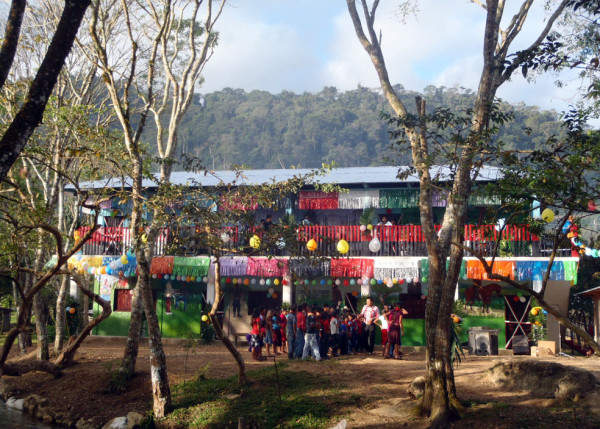
New Autonomous Zapatista School and Clinic in La Realidad
On Sunday, March 1, 2015, after more than six months of work, the building that houses a health clinic and a school was presented to the Zapatista bases of support of La Realidad. The solidarity of people and collectives throughout the world made this construction possible. Here we present to you the accounts, the words expressed during this event, and some photos from that day.
Clear accounts and thick pozol: [i]
-Construction began on July 31, 2014. It was finished at the end of February 2015.
-Work days: approximately 2015 compa/work days.Note from The Tercios Compas [ii] on the compa/work day, abbreviated CWD. CWD is a Zapatista unit of measure that could be thought of as equivalent to Socially Necessary Labor Time (SNLT). However, in addition to the fact that it is not measured in hours, CWD is not a unit of measure of value. CWD is a referent in order to compare the individual and the collective (an individual would have taken almost 7 years to do what a collective did in almost 7 months), and to contrast that which is done below and to the left with that which is done above and to the right (a government from above would have taken 14 years and still wouldn’t have finished the job). For example: with billions in their budget, the Chiapas state government cannot finish building hospitals in Reforma, Yajalón and Tuxtla Gutiérrez. The one in Tuxtla Gutiérrez is just one of the examples that abound of the corruption of the “leftist-PRDista-AMLOista” Juan Sabines Guerrero (who, as his predecessor Pablo Salazar Mendiguchía confessed, created and financed the paramilitary group known as CIOAC-H in Chiapas; the Aryan Velasco carries on those same politics). In 2012, to “inaugurate” the hospital in Tuxtla, they moved equipment there from other hospitals. After that psychopath Calderón and the criminal Sabines cut the ribbon, they dismantled everything. Now it is just a shell (information from “Chiapas Paralelo” chiapasparalelo.com and “Diario Contra Poder” diariaocontrapoderenchiapas.com). The Aryan Velasco hides his patron’s enormous fraud and follows in his footsteps. Meanwhile, the money paid out above is spent on media propaganda, binge parties, decor, and makeup and beauty salons. In addition, of course, to being spent on persecuting the small independent paid media that still exists in the state, and buying silence on social networks. It is one thing to use handouts to corral people into praising the Aryan rancher, and a very different thing to organize in order to build what the people need. More information on the concept of SNLT, in Capital, Volume 1, Section 1, Chapter 1. We don’t remember the author, but he was a Jew, so proceed with caution. More information on the concept of CWD later on. End of the note from the Los Tercios Compas, press that is neither free, nor autonomous, nor alternative, nor independent, but it is compa. Copyright still in process because the Junta de Buen Gobierno told us “more information later on” (sonofa….didn’t I tell you?).
-Accounting of money received. Total monetary support received: $1,191,571.26 (one million, one hundred ninety-one thousand, five hundred seventy-one pesos and 26 cents, national currency).
Total spent on construction: $370,403.84. (three hundred seventy thousand, four hundred and three dollars and 84 cents, national currency).
Total spent on materials for equipping the autonomous school and clinic: $102,457.42 (one hundred and two thousand, four hundred fifty-seven thousand pesos and 42 cents, national currency).
Cash remaining: $718,710.00 (seven hundred and eighteen thousand, seven hundred and ten pesos, national currency).
With the remaining cash, the Zapatista people of La Realidad propose to work collectively toward the following:
The purchase and sale of cattle: $200,000.00 (Two hundred thousand pesos, national currency).
The purchase and sale of coffee and corn: $100,000.00 (One hundred thousand pesos, national currency).
The purchase of a three-ton vehicle to serve the community: $200,000.00 (Two hundred thousand pesos, national currency).
Support for a store, cafeteria, and bakery for the compañeras’ collective work: $100,000.00 (One hundred thousand pesos, national currency).
For the Zapatista resistance fund: $118,719.00 (One hundred and eighteen thousand seven hundred and nineteen pesos, national currency).
Total cash remaining plus expenses: $1,191,571.26 (one million, one hundred ninety-one thousand, five hundred seventy-one pesos and 26 cents, national currency).
Thus the accounts balance and are now closed. Now all that is left is to continue struggling.
The words of compañero Jorge, Zapatista base of support for the EZLN. In Zapatista La Realidad, at the inauguration of the Autonomous Zapatista School “Compañero Galeano” and the Autonomous Clinic October 26 “Compañero Insurgente Pedro,” on March 1 2015.
Good morning compañeros and compañeras.
I would like to say a few words as the compañero in charge of this community.
The capitalist government wants to destroy our autonomy and put an end to the EZLN, but we know well that they will never be able to do this, because whatever the bad government destroys, our autonomy [re]builds.
We will continue to exercise and increase our autonomy and our resistance as the EZLN because we well know that the ones who don’t resist are those who are fooled by the bad government and paid to destroy things. But they won’t achieve anything with their depraved ideas. It is a shame that there are people who allow this, who let themselves be used by the bad government, and don’t realize how they are manipulated and deceived by the crumbs that the bad government throws them.
All of this that I am describing here is no lie, because what they destroyed is already reconstructed much better than it was before, so that the bad government can see that as Zapatistas, we [re]-build what they destroy.
And everything that happened on May 2 is not just about us here, but also shared by the national and international Sixth and the world. That is why we, as the EZLN, are here with the compañeros who are authorities in this zone to receive our new school and clinic, because what happed to our compañero Galeano is unforgettable.
We also thank the compañeros of the national and international Sixth who offered their support for the construction of our new school and clinic in this Zapatista community, La Realidad, with special thanks to the compañeros from France, Italy (inaudible) and the other compañeros who offered their support.
For all of this, for what happened on May 2, the government has not done justice, because we know that it is a corrupt and murderous government.
I also want to let you know that later on we will continue with another homage that will be held elsewhere, on May 2. Our compañero Galeano will never be forgotten because he struggled for the people and carried out his duty as a Zapatista.
Thank you, compañeros.
Words of the Indigenous Revolutionary Clandestine Committee of the EZLN, in the voice of Comandante Tacho
Good morning compañeros. Good morning everyone.
In the name of the Indigenous Revolutionary Clandestine Committee of this zone and of the other zones that accompany us in our homage to our compañero, I will allow myself a few words on behalf of all of the compañero bases of support, milicianos, insurgents, the General Command and the entire EZLN.
With your permission, compañeros.
Compañeros and compañeras of the Sixth in Mexico and the International Sixth across the world:
Brothers and sisters:
Today, March 1, 2015, the bases of support of our Zapatista National Liberation Army in the Selva Fronteriza (Border Jungle) Zone are witness to the conclusion of the construction of the autonomous school and the health clinic belonging to our compañero bases of support in resistance of the community Nueva Victoria, known as La Realidad, Chiapas, Mexico. Our school and clinic had been destroyed under the orders of the three levels of bad government, paramilitary boss Manuel Velasco, and supreme criminal boss Peña Nieto, and those who organized the destruction of the autonomous school and the health clinic of our compañeros and compañeras, along with the cruel and cowardly punishment of our unforgettable compañero Galeano, zone-level teacher for the Little School for Freedom According to the Zapatistas, on May 2, 2014.
The bad governments’ plan is to what it can everyday to destroy the autonomy of our Zapatista people in resistance, of the Zapatista Army for National Liberation. The rotting death of this bad neoliberal capitalist system has organized counterinsurgency methods to provoke confrontations between villages and Zapatista communities, which they then use to justify military intervention. It is clear to us that all of the acts of provocation by paramilitary groups paid and trained by these bad governments are meant to destroy the resistance of our people.
That is why today, March 1, 2015, we thank the compañeros and compañeras of the Sixth in Mexico and the International Sixth across the world, and all noble and good people who expressed solidarity with our struggle. On behalf of our Selva Fronteriza Zone, caracol Mother of the Caracoles, Sea of our Dreams, we give you our thanks. Because of your solidarity and economic support, we were able to rebuild the autonomous school and health clinic. We are very grateful that together we have been able to build what the bad governments dedicate themselves to destroying.
All of this is a fact, and provides more proof that when we are coordinated and organized we can change our lives, building from below and to the left new things for the good of the people, for and from the people. That is why today in this Selva Fronteriza Zone we accept your great support and solidarity in the construction of the school, called Companero Galeano Autonomous School, and the clinic, called 26 of October Compañero Subcomandante Insurgente Pedro Autonomous Health Clinic.
Thank you, compañeros and compañeras of the Sixth in Mexico.
Thank you compañeros and compañeras of the International Sixth across the world.
Thanks to the solidarity organizations who provided economic support.
Thanks to the noble and good people for your support and solidarity.
Thanks you to everyone.
La Realidad, Chiapas, Mexico. Caracol I “Mother of the Caracoles. Sea of our Dreams.” March 1, 2015.
Many Thanks.
PHOTOS, GOSSIP, CRAMPS, AND NON-SCIENTIFIC REFERENCES courtesy of Los Tercios Compas.
SECTION “ENTRIES FROM THE DIARIES OF THE CAT-DOG:”
I don’t know, maybe it’s just a supposition, but it could be more profitable to try to convince the millions that are going to vote anyway to vote for you, rather than attacking those who aren’t going to vote or who are going to cancel their votes or whatever. Because responding to skepticism with arguments along the lines of “peñabots”—”go get your sandwich and your juice box”; “not voting is a vote for the PRI,” and their equivalents—in addition to being the same arguments used by the PANistas and their PTistas and PRDistas allies and the rest of them, are, well, how to explain? Hmm…okay, in the nicest way possible: the level of argument is an indicator of the level of intelligence and the command of language. Or maybe it’s that you already see that you’re not going to come out ahead and you are looking for someone to blame? No come on! Get excited! The funding is set up, the [party] registration is filed, the right environment, press, leader, structure, and tribunals have been put in place, and there is a candidate for 2018, 2024, and 2030, and so on! Oh, what, you’re lacking ideas? Imagination? Shame? A politics of smart alliances? Oh well, “Quod natura non dat, INE non præstat“(from the Latin “that which nature has not given, the INE [National Electoral Institute] will not provide). But, that’s ok! There is always the option of creating another par…oh oh, there’s citizen Card—– raising his hand!
-Pst, pst. They should have appointed Deepak Chopra to a position or put him in charge of the party’s strategy for science and culture. It would surprise you how many cultured people would put aside their skepticism and vote. Hmm…although it’s true, it may be a vote against you.
-Another reason NOT to rely on Twitter as a source of information: reading about the topic on Twitter you would conclude that: Islamophobia = a fear of islands.
(to be continued…)
[i] Pozol is a highly nutritious drink made from ground maíz (corn) mixed with water. It is commonly consumed in the Mexican countryside as a midday meal.
[ii] Literally this would be something like “Odd Ones Out Compas”
En español: http://enlacezapatista.ezln.org.mx/2015/03/05/gracias-i/
EZLN: On the bulletin board the concierge
ON THE BULLETIN BOARD
The Concierge
ZAPATISTA NATIONAL LIBERATION ARMY

March 2015.
Early morning in reality.
Just here, as usual: watching and listening. The crack in the wall is barely visible from the other side. On our side it expands with persistence.
In the classrooms and in the huts of the thousands of Zapatista families who received, housed, fed, and cared for thousands of others,[1] men, women, and children from the five continents, the evaluations made by the teachers and votanes after you all left still resound.
Some of the evaluations were harsh, it’s true, but that probably won’t matter to those who claimed to have been moved by the experience and then continued on with their lives as if nothing had happened, avoiding looking in the mirror or editing that glance at their whim. Despite this, according to what I’ve heard, there were some, a few, that were evaluated as “pretty good.”
“Pretty good” is how the compas describe something good without making a fuss. “How are you?” “Well, I’m here, pretty good,” is how we greet each other.
Meanwhile time marches on just as we do, without fuss, just moving along, like shadows…
And the compa Galeano, who lit up these classrooms, houses, and schools with his word, now fallen and silent, murdered.
Then came the embrace of our compañeros, collective and sincere, from the Sixth.
The distinct and different colors that helped us paint death another way, the night sparkling, the rain coming down while a cat-dog howled-meowed, calling on the light to relieve the shadow.
And we, mocking death, playing with marked cards, deceiving it with names.
Death is losing here. Just as it has for hundreds of years, same as always.
But no, it’s not the same as always. Now that which is compa[2] is made with the figure 6, uniting against fucking death.
And the 6, overwhelming in its unprecedented stubbornness: you’re not alone, enough, not again, never again.
So then, back to reconstructing what was destroyed.
And then the peoples who are our teachers arrive, the native peoples, and they nourish us with their words, their pain, their rebellion, their resistance.
In the north, the Yaqui tribe is attacked once again and dignity is taken prisoner, as if the earth could be locked up behind bars.
And the system, the fucking capitalist system, paints history as horror. As it always does.
But we learn quickly that “Ayotzinapa” does not only name terror, and that injustice has many names in many times in all geographies.
“Ayotzinapa” also names the simplest kind of dignity—that is, the most powerful kind. The families of the 46 refuse to swallow a lie, reject bribes, and resist an oblivion that threateningly bears its teeth with each turn of the calendar.
This is the kind of dignity that moves our history forward, the kind that does not deserve biographies, studies, specialties, tributes, or museums: dignity from below, so anachronistic above, so incomprehensible, so persistent, so threatened.
When we see them, we see ourselves. And when we hear them, we hear ourselves. Our leadership spoke the truth when they embraced them and said, “Your pain is our pain, and your dignified rage is also our dignified rage.”
And when resistance and rebellion are convoked in calendar and geography, we are there just behind them, without making noise, making sure that it is the families who step up on stage, that they fuel other hearts with their pain, that their own hearts grow by listening to other words. We are just behind them, yes, but with a notebook and a pen: watching, listening, knowing, admiring.
And up above the competitions in the “protestadium:” the disputes over who gets the stage, over social networks, over broken glass, over good manners and bad manners, over a protest converted into a society page in the paper; and here below, the silent bridge of gazes.
Up there above they are making calculations over how much can be made off the movement; here below the questions are, “Where is truth? When is justice?”
There above, the so-called radicalism promises to itself that it will drive the new R-E-V-O-L-U-T-I-O-N (which in reality is quite old), programming activities that it will not attend (the assault on the Winter Palace can’t conflict with the holidays); and the families all alone, stiff with cold and rage.
And below, an anonymous hand offers something for the cold, the rain, the rage. A cup of hot coffee, a piece of bread to entertain the belly, a piece of plastic to keep out the rain, something for wet feet. And a murmur: “When they all leave, [those who are] no one will be left.”
Over there, outside and above, the well-behaved are still pointing out bad behavior. The captains of discipline installed throughout the media and social networks. Police without uniforms but with a platform and a congregation (they’re called “followers”)!
And there above, Power has its habits and customs: its mercenary pens, its slander, its lies, its enslavement through the media and the judiciary. The multiple death: killing life, killing memory, killing truth, killing justice: “The fault lies with the parents for sending them to study instead of sending them off to be braceros.”[3]
There above, the latest fads: the elections, the candidates and the “options.” And the common denominator: a profound disdain for truth, for people, for history, for reality.
There above, they know that they don’t know what they should know: the catastrophe advances. They think if they simply don’t name it, it will disappear. They talk about time, the media machine, the internal adjustments, the electoral season, registration, credit, foreign investment, Spain, Greece. Everything will be fine, nothing to worry about. Because if they were to point out the storm, they would also be pointing to their responsibility… and their utter uselessness.
But no!
In a letter to their reluctant brother, [ 4] somebody lets it slip: “Over here we think that everything is going to get worse for everybody everywhere.”
_*_
Meanwhile, here below, in reality, the truth is known. There is no justice. Carefully, so that the memory of it is not broken in the process, the part that was destroyed is moved off to one side. This isn’t to forget about it, but to raise upon it a new building. “Another, more better” building as they say here.
There is the coming and going of people and materials, the rain and the sun, the cold and the heat, the hunger, tiredness, sickness. And then the ruckus that comes when the announcement is made “cover your heads, we’re going to take a picture so that out there they know that here our word means something.”
One guy who didn’t get a handkerchief or a ski mask pulls his T-shirt over his head, leaving just a little slit to see through. Somebody jokes, “sonofa…even here there are infiltrators.”
They laugh. But you can’t see that they are laughing. I can hear them, but the photo isn’t going to have audio so you’ll only see that they have their faces covered, and you’ll see the shovels, the hammers, the saw, the wheelbarrows, the cement mixer, and behind them the skeleton of a house, or maybe of a whale, who knows.
Later the skeleton has eyes, although it isn’t clear yet what they are supposed to be, because someone has to explain, “this hole here is going to be a door, this other one here is going to be a window.”
Where the real suffering and sweat happens is in the accounting. “Because we have to make exact reports, so that nobody thinks the money went to liquor or stupid shit.” The accounts don’t balance, so once again they enter the money that came in, what was spent, and what’s left.
Then there are the “anti’s” from the Murderous CIOAC-Historic who send their spies. Their disappointment is audible: “man, they don’t get tired,” they say; “now they have the walls up already,” they repeat; “man, they’re already building the second floor,” they exclaim, scandalized; and then, “They just don’t stop,” in resignation.
I see that it is no longer the skeleton of a house, nor of a whale. Its eyes and its mouth can be seen clearly—that is, its doors and windows.
They paint murals on it. Someone says, “it would be cool if horses really looked like that.” They laugh. Even Selena laughs, and she’s about to get married.
I come closer to see what all the noise is about. They are setting a date for the inauguration. They get serious because the work won’t be done by the day they had been discussing.
Then there is laughter again.
Later, the rain comes during the dance after the grand opening, as it tends to do. Then there is mud and they keep dancing. They are not celebrating because there is a new school and clinic in La Realidad, but because there are compas in reality. That’s why all that dancing leaves the ground flat.
Somewhere else there is a meeting.
I hear clearly that the leaders, men and women, say, “we have an agreement.”
They call the concierge, that’s me. They ask me for an account of what I have seen and heard.
I say: “well, sometimes one can’t hear everything or see everything well, it depends…” There is silence. They know this isn’t the answer yet, that this is our way of talking, round and round until we get to the point.
So, after a few rounds, I give the answer. I don’t say a lot, nor a little, just what is necessary. They listen in silence. Then they speak. One says, “that is indeed what we are seeing where I come from.” “Same here,” says another. Others concur. More words are exchanged. In reality they haven’t asked in order to find out, but to confirm.
As I am leaving someone stops me and says: “this is what has been happening for 500 years. But what we really need to learn is algebra.”
The meeting continues.
I’m out in the cold, cursing, but being careful so that no one hears me. Well, maybe just the cat-dog. When I realize it’s there, it’s already too late. But the story it tells me will have to wait because I know that the leadership is putting calendars and geographies to its words.
It is the wee early morning hours when SubMoy comes and gives me a piece of paper.
“All at once?” I ask.
“Yes,” he says, and adds, “and say there will be more information later. This is so the ones who will come get can get started planning.”
Then he gives me some paintbrushes. I’m about to ask him, anxiously, if I have to sweep the floor with these, when he says: “those are for the crack in the wall.”
I wait a little and then ask, “and the colors?”
“Ah,” SupMoy says, already at the doorway of the hut, “our visitors will bring the colors.”
So I went to the bulletin board, and I wrote everything up in one go. Done.
(…)
Oh! You can’t see our bulletin board. Okay, okay, okay, here it is:
ANNOUNCEMENT TO THE SIXTH… alright, okay okay okay, TO EVERYONE:
Write this on your calendars and plan from your geographies:
–Various words to be shared about critical thinking, starting with a report on the completion and grand opening of the School-Clinic in La Realidad Zapatista. Date: to begin March 5, 2015, anniversary of the death of compañero Luis Villoro Toranzo. Place: wherever you are.
–The pending homage to compa Luis Villoro Toranzo and homage to compa Galeano on the first anniversary of his death. Date: May 2, 2015. Place: Caracol of Oventik. Special Invitees: family of Don Luis Villoro Toranzo, family of those absent from Ayotzinapa, and the Sixth.
–Beginning of the Seminar “Critical Thought Versus the Capitalist Hydra.” Date: May 3-9, 2015. Place: to begin in the Caracol of Oventik and continue in CIDECI, San Cristóbal de las Casas, Chiapas. Participants: families of the absent of Ayotzinapa, national and international critical thinkers, and the EZLN. Special invitee: the Sixth.
–From July to December 2015. Decentralized, diverse, simultaneous, selective, massive, etc. World Seminar: “Critical Thought Versus the Capitalist Hydra.” Place: Planet Earth. Participants: The Sixth and others.
–Second Grade of the Little School (only for those who passed the first grade).
Date: July 31, August 1-2, 2015. Place: locations to be specified later. Participants: only those who receive an invitation for the second grade and pass the admissions exam. More information later.
–Fiesta for the Caracoles: Date: August 8-9, 2015. Place: the 5 Zapatista Caracoles
–Third Grade of the Little School (only for those who pass the second grade). Date:
November-December 2015. Specific dates to be determined. Place: to be determined.
So there you have it. As we say here: “more information, later on.”
From this side of the crack in the wall of the Little School.
SupGaleano
Concierge until further notice.
Mexico, March 2015
Section “From the Journals of the Cat-Dog”:
–That deputized assassin, Mario Fabio Beltrones Rivera, was right when he said that: (the candidacy of) “Carmen Salinas doesn’t impoverish the political class.” It’s true, it actually encapsulates the political class better than any analysis: Carmen Salinas makes a living acting, as does the entire Mexican political class.
–The differences between the proposals of the various political parties are the equivalent of those between Tiger Balm and Aromatherapy. They are equally useless, but one is progressive and provides more intellectual prestige. Even in esotericism there are social classes, my dear.
(to be continued…)
[1] The text uses “otroas” meaning “other,” to give a range of possible gendered pronouns including male, female, transgender and others.
[2] Compa is short for compañero o compañera, like comrade.
[3] Cheap manual labor for the US.
[4] The author uses an explicitly ambiguous term, “bajo-protesta,” which in Spanish simultaneously means reluctance and/or “under oath.”
En español: http://enlacezapatista.ezln.org.mx/2015/03/04/en-el-tablon-de-avisos-el-conserje/
EZLN letter to Doña Emilia Aurora Sosa Marín
Letter from the EZLN to Doña Emilia Aurora Sosa Marín, compañera of Honorary Major Insurgent Félix Serdán Nájera
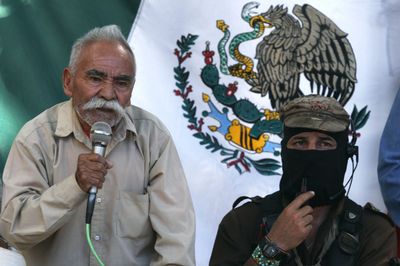
Félix Serdán with Sup Galeano
Zapatista National Liberation Army, Mexico February 2015 To: Doña Emilia Aurora Sosa Marín. From: Subcomandantes Insurgentes Moisés and Galeano EZLN, Chiapas, Mexico Compañera Emilia: We got the news just a few hours ago. We don’t know how long it will take for these lines to reach you, but we know that regardless of the date, you will be able to read in these words the collective embrace that we send you. That is because here we also feel the pain and sorrow of the death of Don Félix Serdán Nájera, honorary officer in our Zapatista National Liberation Army, this past February 22 in the early morning hours.
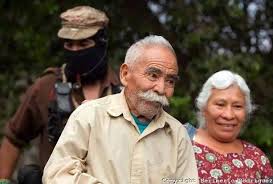
Félix Serdán and his compañera, Doña Emilia
We remember Don Félix’s firm and tender gaze, but we also remember your presence. It is as if between the two of you your journey was complete. That’s why we say that his absence brings us pain, but we also hurt for the pain that you feel in your heart today, Doña Emilia. That is why with these words we not only want to salute the memory of compañero Felix Serdán, but to embrace you as well. You and he have given us a living example that commitment and integrity are not something to boast about, that they are not measured on stages, in spotlights, through grand discourses or fateful dates. Because the struggle is not a conjunctural lightning bolt that illuminates everything and then disappears in an instance. It is a light that, although tiny, is nourished every day at all hours. It does not presume to be unique or omnipotent. Its objective is to join with others, not to light up a monument but to illuminate the path so we don’t get lost. In other words: the struggle doesn’t sell out, doesn’t give in, and doesn’t give up. Don Félix, like you, always spoke and speaks to us in the simple, true words of those who share dreams, pain, and determination. When we listened to him, we heard you both. And it was both of you that we saw and see at our side on the long path of resistance. Because although there are no words to soothe the pain, we have inherited from both of you the commitment to be Zapatistas until our last breath. This example that the two of you have given us, which is repeated and reflected in women, men, and others [1] in every corner of the planet, demands and obligates us to pursue the two things that we who struggle for justice, liberty, and democracy insist upon: resistance and rebellion. And just as we see you, in your gaze we see ourselves. This is because both of you have been on this side of things regardless of trends or circumstances. You are on this side because you saw that our path here and yours there have the same destiny. Without wasting time and energy on the words and gazes above, the two of you have always kept your heart open to those who are like us: those who have no faith in a system that oppresses us, deceives us, and attacks us; those who, with the same tender rage that one could see in the gaze of Major Insurgent Félix Serdán and in your own, Doña Emilia, construct a thousand mirrors of freedom, without fuss, without useless ceremonies, and without thunderous declarations. We saw that a flag, the red and black flag of the EZLN covered the final resting place of our compañero. With our flag, the women, men, children, and elderly of the Zapatista National Liberation Army were and are present there. With our flag we are with you, Doña Emilia. Your example will live on in all those who cover themselves with this flag. The struggle will continue with them. Because it is true that death finds no relief if our gaze stops at the end. But here we think that death is only cured by life, and that life is only worthwhile if it is lived in struggle. And the struggle is only fertile in collective. So we do not die with Don Félix. With his life we live. With his life and that of many others [2] who died resisting and rebelling. Because even though it might seem like nobody keeps an accounting of those who are now gone, there are some who are no one so that accounting will not be forgotten. We send you an embrace that, although it will not cure the loss, may bring relief in confirming, to you and to Don Félix, that here your gaze is reflected because we walk the same path. From the mountains of the Mexican Southeast, In the name of all of the women, men, children, and elderly of the Zapatista National Liberation Army, Subcomandante Insurgente Moisés Subcomandante Insurgente Galeano Mexico, February 2015
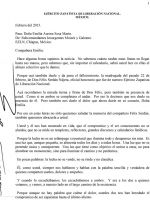
Signed Letter, part 1
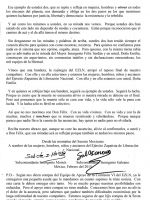
Signed Letter, part 2
P.S. According to what we are told by the Support Team for the EZLN’s Sixth Commission, you have already received a small contribution that we sent as soon as we learned this sad news. With this letter comes a little more. It is not a lot because our possibilities do not allow for much. But support between compas has no measure. We know well that this does not relieve the pain of loss, but we also know that you have suffered economic hardship due to the long illness of our compañero. We are certain that the compas of the Sixth everywhere in the world, like us, will support you with whatever they can. [1] The text uses “otroas” meaning “other,” to give a range of possible gendered pronouns including male, female, transgender and others. [2] The text uses “muchos, muchas, muchoas” to give a range of possible gendered pronouns including male, female, transgender and others.
——————————————————————
Originally Published in Spanish by Enlace Zapatista http://enlacezapatista.ezln.org.mx/2015/03/01/carta-del-ezln-a-dona-emilia-aurora-sosa-marin-companera-del-mayor-insurgente-honorario-felix-serdan-najera-subcomandante-insurgente-moises-y-subcomandante-insurgente-galeano/
Fracking in Mexico involves Halliburton
Neoliberal Ecocide
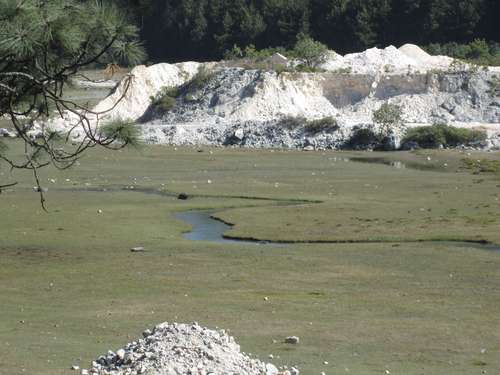
Photo: Hermann Bellinghausen
ALARM IN THE HUASTECA FACING THE ONSLAUGHT OF FRACKING
By: Hermann Bellinghausen
Huayacocotla, Ver.
Slow but relentless, alarm runs through the northern mountains and lowlands of the Huasteca: a threat hovers over the territorial rights of thousands of communities. And, it has a name, although it’s not the only one: “fracking,” or hydraulic fracture, a new and aggressive procedure for extracting gas and oil below and inside of large underground rocks. More than a hundred municipios (counties) in four states are threatened by fracking in phases zero and one of the Secretary of Energy, according to maps from Advanced Resources International of the Huasteca and of Totonacapan, according to what the Mexican Alliance Against Fracking has documented.
There are 49 municipios at imminent risk in Veracruz, 22 in Puebla, 21 in Hidalgo and 18 in San Luis Potosí (SLP): communities and agricultural fields of the Nahua, Tenek, Otomí, Tepehua and Totonaca Peoples. The representative of the Puebla municipio Francisco Z. Mena, one of the first affected by the two “phases,” describes the current arrogant presence of vehicles, machinery and personnel of the Schlumberger and Halliburton corporations. “Several wells already operate. They came offering the stars and they haven’t left anything. We demand that they fix the road that they left unusable; upon protesting, the Puebla government throws public forces at us and incarcerates us.”
As the comuneros and ejido owners see it, conscious of the future that awaits them, this is just the first of the horsemen of the Apocalypse let loose by the Constitutional reforms in energy matters that liberalize in the extreme who will extract hydrocarbons and how they will be extracted in indigenous and campesino territories “on top of any other social or productive consideration,” expresses Óscar Espino, a member of the mentioned alliance in Papantla.
The worries over what’s coming, accumulated on the already large quantity of serious things that are occurring (or even worse, have occurred), begin to appear under the brims of the campesinos’ sombreros. There is a shadow of concern in the faces of the representatives of diverse indigenous and campesino communities of Veracruz, Hidalgo and Puebla, gathered together in a small hotel of crazy architecture and half constructed in Huayacocotla, to discuss the imminence of large-scale hydraulic fracture in their towns and municipios.
The attendees come from Veracruz, Puebla and Hidalgo. They have in common being persons of age, whose lives have already been full, have been ejido or communal authorities, have dealt with governments all their lives, one was a mayor. Their commitment to the territories and rights of the communities is very mature and realistic. Esteban Mayorga, of Los Parajes, has concluded that: “autonomy is very important for being able to dialogue with people.” He says the same thing to his fellow campesinos that he says to the (government) functionaries and to the agents from the transnational corporations. “If there isn’t peace there isn’t anything. But above all, the idea that I carry is of being autonomous; without that they are going to finish us off and with us the forests, water, life that we still take care of.”
Fire in the water
With clarity and vehemence, Francisco Cravioto, from the Fundar organization and a member of the alliance, exposes to the community representatives the noxious effects of hydrocarbon extraction in shale deposits via hydraulic fracture and he illustrates with a United States video in which a housewife, a neighbor to extractions by means of fracture, opens his kitchen faucet and when he puts a match close to the water jet, it catches fire. You might say it’s an effect, but it’s real and proven. And that is only because of the escape of gas that confounds the water, which as Eutimio Mendoza exclaims, “seems like liquor.”
The perforation, Cravioto explains, uses large quantities of water, which contains up to 600 toxic substances, besides freeing heavy subsoil metals and acid substances. Although the extractor corporations assure having procedures to avoid that that waste water does not contaminate the communities’ water sources, it’s very probable that there are leaks in just months. Six years is the average time that extraction lasts on a site. Something frequent now where large-scale fracking is done is that water rises to the surface and floods the fields. “The technology doesn’t even exist for treating that water,” Cravioto maintains.
The Gulf of Mexico region on the whole “is the one that runs the most risk in the country.” After decades of traditional oil extraction, the scarcity and difficulty of getting the hydrocarbons out expands the territories to exploit, with much more aggressive practices against the territories and the inhabitants. According to what Manuel Llano has written (La Jornada del Campo, 86, 11/14), 13 indigenous towns would have their territory compromised, “in first place the Yoko Yinikob or Chontales of Tabasco, with 85 percent of their territory occupied, next the Totonaca with 38 percent, and the Popoluca with 31 percent,” both in Veracruz. That, in the phase zero! In phase one, this year, the Tenek, Nahuas and Totonacas will see 320,000 hectares of their territories occupied.
In his exposition, Cravioto says that the delivery of territories and resources to the transnationals dates at least from 2010, before the recent reforms. But the Chicontepec fossil channel, as a coveted and over-valued area is known that ought to be in oil splendor this year, is punctured. It ought to give off 22 percent of the national production, according to what the federal government and the five corporations to which the contracts were assigned predicted in 2009 (they no longer say “concession,” although it continues being so): Halliburton, Schlumberger, Baker Hughes, Weatherford and Tecpetrol. In agreement with Mauricio González González, also from the Mexican Alliance against Fracking, said “contracts for public works,” are a fiasco, besides being illegal, because it turns out that the “probable” reserves were not proven, barely 5.4 percent of Calderonismo’s initial joyous counts. As of 2012, around 3,000 wells had been perforated, and 2,347 operate.
This calculation error now justifies the application of fracking in Phase One, which offers corporations the extraction of shale gas. In Veracruz an assignation of 900,000 hectares is foreseen, and in Puebla some 90,000, adds González, a member of the Center for Rural Research and Training (Cedicar, its Spanish acronym).
“The institutions protect us less than ever”
Óscar Espino, from Papantla, says that Halliburton and Schlumberger “arrived in Tihuatlán and Papantla 13 years ago, getting ready to take advantage as soon as the changes to the Constitution were made ‘where it was never going to touch,’ as the federal governments promised, until they created new laws and reformed 12 existing laws, in the ‘pact against Mexico.’” [1] We’re dealing with the greatest threat to indigenous territories and the national soil in more than a century. “The new Constitution does not give rights, it takes them away,” says Espino. Facing the imminent “legal servitude to hydrocarbons,” he proposes to those in attendance: “taking care of ejido and other local authorities, because corrupting them or terrifying them is how they are going to enter, and the institutions protect us less than ever because they are in favor of the corporations, not of us.” The pueblos are “judicially defenseless,” and the only resources that remain are the international instruments signed by the State.
An orange seller from Alamo sums up everything in: “the need for creating a front of the peoples in defense of territory.” As González González of Cedicar expresses, they are facing genocide, because the new circumstances “will make life impossible for the people of those communities,” which constitute “a world, a humanity that will not now be possible without determined indigenous people.” An irreparable damage!
[1] The Pact against Mexico is a negative reference to the Pact for Mexico, a package of neoliberal structural reforms that included the energy “reform” referred to in the article.
———————————————————–
Originally Published in Spanish by La Jornada
Translation: Chiapas Support Committee
Sunday, March 1, 2015
En español: http://www.jornada.unam.mx/2015/03/01/politica/002n1pol/
Raúl Zibechi; The lefts, ethics and racism
THE LEFTS, ETHICS AND RACISM
By: Raúl Zibechi

Photo of Mural on West Oakland Wall.
“The police have to decide at every moment (…) to have the cool and calm necessary for making the right decision. It’s like the striker in front of the goal that attempts to decide, in seconds, how he is going to shoot at the goalkeeper. After the game ends, if it was a big goal, all the fans are going to applaud him” (Carta Capital, 2/9/15). Those were the public statements of the governor of the state of Bahía, Rui Costa, faced with the murder of 15 black youths in Salvador, the state’s capital.
On February 6, the Special Rounds (Rondesp), a corps of the Military Police, killed 12 youths in the Cabula barrio. They alleged that it was about an exchange of shots with delinquents, but witnesses asserted that they were executed, and videos that circulate in the Internet reinforce that version. On Saturday, February 7, the Rounds killed two other youths and in the wee hours of Sunday the 8th an exchange of shots in the Sussuarana barrio produced another death.
Amnesty International has been receiving complaints about abusive actions of the Rounds, with the use of excessive force, with enforced disappearances and summary executions. The official version of the Secretariat of Public Security of the state of Bahía is always the same: the youths were involved with drugs or others crimes, they shot at the police, who reacted in legitimate defense. The figure of “resistance followed by death” is the legal justification for the summary executions in the favelas and in any place where the police attack black youths.
According to the Pastoral of the Youth of Salvador, which is a member of the National Campaign Against the Violence and Extermination of Youths, deaths due to the special squadrons of Military Police are in the enormous majority black youths, poor and residents of the periphery. The Pastoral was able to verify that of 13 deaths 10 had no record and one had participated in a fight at Carnival. “This was the best case, but in several other barrios there were persecutions and executions of alleged traffickers,” a member of the Pastoral assures (Adital, 2/11/15).
The 2014 Map of violence, elaborated by the state, establishes that in 2012 more than 56,000 people were murdered, and that the majority of the victims are young black men hombres between 15 and 29 years old. Violent crimes increased 7 percent between 2011 and 2012 and 13 percent ever since the Workers Party assumed the government in 2003. A half a million people were murdered in one decade. The report reveals that the number of whites murdered diminished 25 percent between 2002 and 2012, but black victims increased 37 percent in the same period.
Hamilton Borges, one of the articulators of the React or you’ll be dead campaign, and a member of the Quilombo Xis-Action Cultural Community, maintains that the northwest “lives an unprecedented drama of black genocide” (Justicia Global, 2/5/15). The campaign has functioned since 10 years ago in Bahía, considered the second state of Brazil in the concentration of murders of youths in the 12 to 18 year range.
The Military Police have harassed and pursued Borges on various occasions; they entered his home by force at night, without a judicial order and without any concrete accusation, just to intimidate him. This enormous militant of the black cause articulates outside of political parties and institutions. “We don’t negotiate our lives for public positions, we are not frivolous because we know that we cannot perceive being in struggle if we collaborate with the enemy like many do,” he wrote a little before the latest crimes.
With the same energy that he denounces the police, he confronts those that he calls: “institutionalized blacks,” those that use the cause for getting positions and personal benefits.
Something similar happens in the state of Maranhao, where the human rights organization Justicia Global denounces that the new governor, Flavio Dino, signed a resolution that in fact is a “license to kill” for members of the repressive corps, since it guaranties the state defense of the agents involved in cases of summary executions.
One can say, not without reason, that a good part of the denunciations and mentioned events are not new in Brazil. Nevertheless, there is a difference. Governor Costa, who compares the murders of black youth with soccer goals, is a member of the Workers Party. Governor Dino, who sponsors and hides the genocide of blacks, belongs to the Communist Party of Brazil.
There is not only something new here, but also a true leap in quality. It’s not that the PT governor and the communist look away while the police murder under their orders. They are the ones that clutch the weapons that protect the killers and, like the governor of Bahía, scoff at the victims. The (political) parties, not the membership or the leadership, have not admonished anyone. How does one understand and name what is happening?
It is evident that we are facing an ethical bankruptcy of the electoral lefts. But no one stands to suddenly lose the ethical goal. It is a long process of deterioration, of concessions; small at first, enormous at the end of the road. In the most profound, if we undo “the flounces of the rhyme, the meter, the cadence and even the very idea,” as León Felipe write; in other words, if we toss out words and programs, discourses and gestures for the crowds, the only difference between left and right is, must be, ethics.
When Hamilton Borges says: “we are not lightweights, we don’t negotiate positions for lives,” he is pointing to the ethical recuperation of the commitment with those most below, in this case poor blacks in the favelas (ghettos). It is the only way that we know for overcoming the crisis of the lefts: leaving the positions and benefits, big and small, for accompanying, like one more, the struggles of the peoples.
———————————————————–
Originally Published in Spanish by La Jornada
Translation: Chiapas Support Committee
Friday, February 20, 2015
http://www.jornada.unam.mx/2015/02/20/opinion/023a1pol
Police kill migrant farmworker in Pasco, Washington
WASHINGTON POLICE SHOOTING IGNITES CROSS-BORDER CONTROVERSY
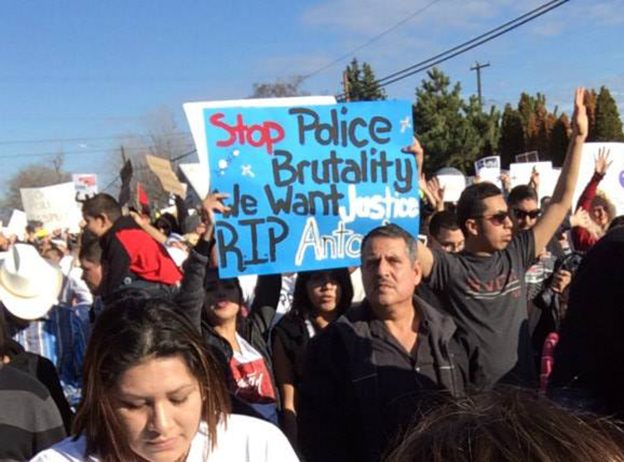
Demonstrators protest Pasco police killing of Mexican farmworker.
By fnsnews | Published February 16, 2015
The fatal police shooting of an unarmed Mexican migrant in Washington State has stirred renewed attention south of the border on the use of deadly force by U.S. law enforcement agencies. The February 10 shooting of Antonio Zambrano Montes by police in Pasco, Washington, is getting prominent coverage in both the print and electronic media in Mexico.
[An AP article, published yesterday (Feb. 21) in the NYTimes, has updated information, photos and important background info on Pasco.]
The Zambrano killing, which was captured on video and widely transmitted in cyberspace, has also drawn the involvement of all three levels of the Mexican government. President Enrique Pena Nieto, the Secretariat of Foreign Relations (SRE) and the Michoacan state government all condemned the shooting, while the official National Human Rights Commission urged the SRE to provide financial support, attention and guidance to Zambrano’s family. In a statement, the SRE not only criticized Zambrano’s violent death, but also called attention to “incidents in which disproportionate force is used, even more so when it results in the loss of civilians.”
An apple industry worker, Zambrano was shot and killed by Pasco police officers after he was reported throwing rocks at cars. According to police accounts, the 35-year-old man also threw rocks at officers before he was killed. Some eyewitnesses, however, said Zambrano had his hands up when he was shot. Zambrano’s mother, Acapita Montes Rivera, was granted a U.S. humanitarian visa this past weekend so she could travel from the family home in Michoacan to recover her son’s remains in Washington State. Montes said that the municipal government of Aquila, Michoacan, covered her travel and legal expenses. “He is my son, and he was always a good boy,” Montes was quoted. “He never forgot about us and always helped us out.” They expect that Antonio Zambrano’s body would be shipped back to Mexico this week.
In another communique, the SRE reiterated its disposition to provide all the necessary support to the slain man’s family. On Sunday February 15, Eduardo Baca, the Mexican Consul in Seattle met with Zambrano’s relatives. In rapid fashion, Zambrano’s family took the initial steps in an expected $25 million lawsuit against the City of Pasco for Antonio’s death. Cited by the Mexican press, Washington State media were credited for reporting that one of the officers involved in the deadly confrontation, Ryan Flanagan, was accused of excessive force and racism by a 30-year-old Latina woman in 2009, but escaped further consequences when a $100,000 settlement was reached with the complainant.
Similar to Albuquerque, Ferguson and many other U.S. communities, the Zambrano shooting sparked mass protests against police violence. On Valentine’s Day 2015, hundreds of demonstrators led by Zambrano’s family marched in Pasco chanting “Justice for Antonio.” Felix Vargas, chair of Pasco’s Consejo Latino, demanded a federal investigation of the shooting. Prior to the march, Vargas said he was “very perturbed” by an encounter that did not justify “even a single shot.” On Facebook, activists are publicizing a Seattle rally for Zambrano and against police brutality set for Westlake Park on Wednesday, February 18.
Pasco police have killed four people since last summer. About half of the estimated 68,000 inhabitants of the city are Latinos. Don Blasdel, the local county coroner, took the unusual step of ordering a public inquest into Zambrano’s death. The inquest, Blasdel said, would ensure an independent and transparent investigation. “I don’t want the situation to end up as another Ferguson,” the Franklin County official said.
In Mexico, Zambrano’s death recast the spotlight on the broader treatment of migrants by U.S. law enforcement officials.
According to the SRE, the Border Patrol and other U.S. law enforcement agencies have killed 74 Mexican nationals since 2006. Of the 74 deaths, 26 of them occurred at the hands of the Border Patrol, with the remaining 48 attributed to altercations with municipal, county and state police forces. More than half the cases, or 47, produced no consequences for the involved agencies, while 9 yielded some reparations of damages for family members. In addition to death by firearm, electric shocks, drowning and being crushed by a horse caused the fatalities, according to the SRE.
In 2014, the Border Patrol instituted new policies that put some restrictions on its agents from employing gunfire during rock-throwing incidents.
Reina Torres, general director of the SRE’s department dedicated to the protection of Mexicans abroad, expressed optimism that the Zambrano killing would produce accountability.
“In the case of Antonio, we are confident there could be difference,” Torres told the Mexican daily El Universal. “There are a lot of witnesses and a video that is very clear.”
Torres vowed the Mexican government will pursue legal follow-ups on all the outstanding cases involving police violence against Mexican nationals in the U.S. Michoacan state lawmaker Noe Bernadino said the local legislature would pass a resolution during its next session requesting that the federal congress demand greater respect for the civil rights of Mexican nationals in the U.S.
In the bigger scheme of things, Zambrano’s death has further propelled allegations of excessive use of force by U.S. police agencies into an increasingly thorny issue on the world stage.
——————————–
Sources: CNN en español, February 16, 2015. La Jornada, February 15 and 16, 2015. Articles by Fernando Camacho, Gabriela Martinez, Antonio Heras, Juan Carlos Flores, Ciro Perez Silva, and editorial staff. La Jornada (Michoacan edition), February 16, 2015. Article by Francisco Torres. SeattlePI.com, February 15, 2015. Associated Press, February 15, 2015. El Diario de Juarez/El Universal, February 14, 2015. Proceso/Apro, February 13 and 14, 2015. Articles by Mathieu Tourliere and editorial staff. Lapolaka.com, February 14, 2015. Milenio, February 14, 2015.
————————————————————–
Originally Published by Frontera NorteSur
New Mexico State University
http://fnsnews.nmsu.edu/washington-police-shooting-ingites-a-cross-border-controversy/
 Chiapas Support Committee