Chiapas Support Committee
Home of the Compañero Manuel blog on zapatistas & mexico
Ayotzinapa, 11 months of searching

August 26 demonstration for the 43 missing students in Mexico City
By: Emir Olivares y José Antonio Román
[This is an abbreviated version of the La Jornada article cited below.]
It has been 11 months of ‘‘rage, indignation, courage, dignity and search;” almost one year without knowing the whereabouts of their sons; 334 days since the municipal police of Iguala, Guerrero, attacked students from the Ayotzinapa Teachers College with firearms, leaving three of them dead, 43 others disappeared and five injured.
Yesterday, family members of the students realized the 15th Global Action for Ayotzinapa, which included presence at the embassies of several countries and a march from the Angel of Independence to the Zócalo. In both actions, the demonstrators demanded that the federal government extend the time for the Interdisciplinary Group of Independent Experts (GIEI, the Group’s initials in Spanish) from the Inter-American Commission on Human Rights (IACHR) to continue with its investigations on this crime for another six months.
The day concluded with a meeting in the Zócalo. From there, the parents announced activities to commemorate the first anniversary of the events, which will include a three-day fast, between September 24 and 26; preparation for the day that will be known as the “Day of National Indignation” or the “National Political, Strike,” on the 26th, as well as a “counter-report about the real situation that the country experiences,” between August 31 and September 1.
It was also announced that various U.S. social organizations will take steps so that within the framework of Pope Francisco’s visit to Philadelphia, from September 25 to 27, the Pontiff can receive a commission of Ayotzinapa parents.
Upon taking the word in the Zócalo, Emiliano Navarrete, father of the disappeared student José Ángel Navarrete, pointed out that in these 11 months the federal government has only shown: “that it has nothing to say,” because “it has not fulfilled the promises it made to the families.”
He reported that a few days ago they met with the Secretary of Governance, Miguel Ángel Osorio Chong, and demanded that the work period for the GIEI be prolonged. In principle, the functionary accepted the idea, “but we just found out through our lawyers that the government will not make the decision until after September 6, the day on which the group of experts will present their final report.”
Social collectives, union organizations and students, among others also participated in yesterday’s mobilizations. According to organizers, some 3,000 people participated in the evening march. On the final route towards the Zócalo, demonstrators made a stop at the “anti-monument” with the number +43, at the crossing of Reforma and Bucareli, where they called out the names of those absent.
The mother of the student José Álvarez Nava demanded that: “the corrupt government deliver our sons to us. We’re not asking for a favor, it’s their obligation to deliver the 43 and the thousands of disappeared in the country.”
In the morning, they divided into several contingents to visit the embassies of 30 countries and deliver a document in which they ask the diplomats for their intervention so that the Mexican authorities authorize an extension of the investigations that the GIEI are carrying out, because they considered that the investigations carried out by the Attorney General of the Republic “have been ineffective and that agency has been incapable of offering truth and justice.” They visited the representations of Portugal, Argentina, Spain, Belgium, France, Thailand and the European Union, among others.
———————————————————-
Originally Published in Spanish by La Jornada
Translation: Chiapas Support Committee
Thursday, August 27, 2015
En español: http://www.jornada.unam.mx/2015/08/27/politica/004n1pol/
Zibechi: Emancipating the peoples is necessary for a change
ZIBECHI: EMANCIPATING THE PEOPLES IS NECESSARY FOR A CHANGE IN THE POLITICAL CULTURE

Raúl Zibechi
By: Fabiola Palapa Quijas
The Uruguayan writer and journalist Raúl Zibechi (Montevideo, 1952) considers that the history of Latin America has been centered on the union, the party and the State. Nevertheless, he points out that those institutions difficultly can confront a process of profound change.
In that regard, he maintains that a change in the political culture is necessary so that the emancipation of the peoples is a reality, in which new collective subjects participate, and the woman has a relevant role.
We have been witnesses to the plunder of governments for favoring capitalist mega-projects, and from there the importance of achieving a change in the political culture, but with the security that: “human cultures, the ways in which human beings act and relate to each other, doesn’t change by decree and doesn’t change from one day to the next,” he explains to La Jornada.
The collaborator of this newspaper just published the book Decolonizing critical thought and rebellions: autonomies and emancipations in the era of progressivism [1], published (in Spanish) by Bajo Tierra Ediciones.
In that work he asks: why do revolutions reproduce the political culture of the dominant classes over and over again?
At the same time, he describes how the power still preserves a colonial form where the communitarian forms of the indigenous peoples and impoverished urban communities are maintained as resistances to the decomposition of life provoked by the mode of capitalist production.
Marxism and Euro-centrism
Regarding the idea of decolonizing thinking, Raúl Zibechi opines that: “capitalism in the world, what we call accumulation by dispossession, by plunder or by robbery, a category created by the Marxist theoretical geographer David Harvey, is an update of colonialism because today capitalism functions in that same way, appropriation of the water, of the land, expelling entire communities by means of mega-projects, big hydroelectric infrastructure works, open sky mining, soy mono-crop agriculture and a ferocious urban real estate speculation.”
He adds that it is one of the motives that led him to reflect on the political economic model that has created accumulation by dispossession, where the population, instead of being integrated, as occurred in previous periods, is an obstacle to overcome, as happens when a mega-work is carried out and the population is displaced.
Zibechi is also interested in the concept of decolonizing, because the hegemonic political culture in the Latin American lefts and in persons like him, who has a Marxist formation, is a Eurocentric notion.
“I trained in Marxism, in Lenin, and the Euro-centric thought that has much validity in Latin America must be textured with traditions that don’t come from elucidation, but rather from the Afro-descendent cultures, from the indigenous cultures and from the cultures of the popular sectors.
“In our culture, in the political culture that we need today the tequio (community work) and the tianguis (public markets), which were the hitching posts, must play an important role, because they are traditions, the political cultural traditions of resistance belonging to our continent, which have something to say in this history.”
Death, blood, violence
For the author, the social movements today are the central element and determinant in the political economic cultural change that we need. “They are the change makers and part of what I understand as decolonizing is that now the states are not the subject the changes, but rather the social movements.”
With respect to the Mexican situation, the Uruguayan activist expresses that: “somebody or somebodies decided to convert Mexico into a terrible place with deaths, with blood, with violence and militarization.
“I see that the movements and popular sectors of Mexico are experiencing a drama perhaps greater than that of the Mexican Revolution and the wars of Independence. I fervently wish that the popular movements are capable of overcoming this difficult peril, but one must not lose optimism because the ultimate thing that we could lose is the smile and the will that things be another way.”
___________________________________
[1] Descolonizar el pensamiento crítico y las rebeldías: autonomías y emancipaciones en la era del progresismo
———————————————————-
Originally Published in Spanish by La Jornada
Translation: Chiapas Support Committee
Wednesday, August 19, 2015
En español: http://www.jornada.unam.mx/2015/08/19/cultura/a05n1cul
EZLN: Truth and justice will never, ever come from above
ZAPATISTA NATIONAL LIBERATION ARMY
Mexico, August 16, 2015
To the National and International Sixth:
To the National Indigenous Congress:
To those below and to the left in the world:
To who in may concern:
It is remarked once again that neither truth nor justice will come from above.
Never.
Never.
One must expect only simulation, deceit, impunity and cynicism from above.
The criminal up above will always have absolution and recompense, because the one that judges him is the same one pays him. Criminals and judges are the same. They are poisonous heads of the very same hydra. And now we have a new example:
As the Zapatistas that we are, we have realized that two of the intellectual authors of the assassination of compañero teacher Galeano have returned to their homes in the village of La Realidad, fat and happy. They were supposedly prisoners because of the assassination of our teacher and compañero. We already know that the same ones that financed and supported them –the federal and Chiapas governments– have declared them innocent of the crime. The self-named “judge” Víctor Manuel Zepeda López, of the criminal branch of Comitán de Domínguez, Chiapas, on August 12 of this year, sentenced that Senores Carmelino Rodríguez Jiménez and Javier López Rodríguez are innocent, despite the fact that they and their accomplices of the CIOAC-Historic know that they are guilty of organizing the crime; not the only ones, but they are guilty.
They brought them back secretly to La Realidad. They told them not to be seen much and to be discrete, but the arrogance of one who knows he has impunity in front of justice from above loosens the tongue. There they state, to whoever wants to listen that they were not prisoners, but rather guarded in a house where they received all the attention and congratulations of the state government of Manuel Velasco and from the leaders of the CIOAC-Historic for the assassination of teacher Galeano, and that they told them that they had to wait a while to return to their village “and to continue with what remained pending.”
The only thing missing now if that their accomplices come out to declare in their favor: Pablo Salazar Mendeguchía, Luis H. Álvarez, Jaime Martínez Veloz, Juan Sabines Guerrero, Manuel Velasco, Manuel Culebro Gordillo, Vicente Fox, Felipe Calderón, Enrique Peña Nieto and Rosario Robles. These individuals are some of those who tamed the CIOAC-Historic and converted it into what it is now: a paramilitary gang useful for driving voters to the polls and for the assassination of social fighters.
It’s also missing that progressive journalists interview them and present them as victims of the “ferocious” Galeano (just him against more than two dozen criminal cioaquistas [1]), re-publish the lie about a confrontation, publish their rigged photos, and collect with the right hand for the service rendered, vehicles with chauffer included, while in their media they extol the “great” development of the southeastern Mexican state of Chiapas and, with the left hand, celebrate their “commitment to social struggles.”
But…
As the Zapatistas that we are, we see and hear not only to our rage, our rage, our hatred towards those up there above who feel that they are the owners of lives and destinies, of land and subsoil; and towards those who sell out, with their movements and organizations, betraying their history and principles.
As the Zapatistas that we are, we also see and hear other pains, other rages and other hatreds.
We see and hear the pain and rage, the complaint made by the families of thousands of citizens and migrants disappeared and murdered.
We see and hear the tenacious search for justice of the families of the little boys and girls murdered in the ABC nursery school in Sonora.
We see and hear the rage that becomes the dignified and rebel hunger strike of anarchist prisoners in Mexico and in other parts of the world.
We see and hear the rage in the tireless steps of the families of the 47 absent from Ayotzinapa.
We see and hear the rage of our Nahua brother community of Ostula, attacked by the army.
We see and hear the rage of our Ñahtó brother community of San Francisco Xochicuautla at the dispossession of their forests.
We see and hear the rage of the brother Yaqui people because of those unjustly imprisoned and because of the brazen robbery of their territory.
We see and hear the rage because of the joke that is the investigation is in the murder of Olivia Alejandra Negrete Avilés, Yesenia Atziry Quiroz Alfaro, Nadia Dominicque Vera Pérez, Mile Virginia Martin Gordillo and Rubén Espinosa Becerril, in Mexico City.
We see and hear the rage of the democratic teachers that resist the media, police and military war that they suffer for the crime of not giving up.
We see and hear the indignation of those who, in the unruly and brutal north, are attacked for the color of their skin and because of that color are sentenced and condemned.
We see and hear the rage and pain expressed for the disappeared women, murdered for the crime of being woman; for all those who are attacked because Power cannot tolerate anything outside of its narrow thinking; for the childhood that is destroyed before it even has the chance to become a macroeconomic statistic.
We see and hear that all of these people receive only lies and mockery from those who proclaim to administer justice and who in reality only administer impunity and encourage crime.
We see and hear everywhere the same promises of truth and justice, and the same lies. They don’t even bother to change the words; all those above already have a text that they read, and badly.
Now is the time in which, when the one from below asks why he is being attacked, the answer from the one above is: “for being who you are.“
It’s because in this world in which we feel pain, the criminal is free and the just are in prison. The killer is rewarded and the dead are slandered.
But we also see and hear that there are more and more voices all the time that don’t trust [those above], that don’t let themselves [be manipulated] and that rebel.
We as Zapatistas, women and men, did not trust those above before, nor do we now, nor will we ever, regardless of the color of their flag, regardless of their style of speech, regardless of their race. If one is above, it is because s/he is oppressing those below.
Those above have no trustworthy word, no honor, no shame and no dignity.
Truth and justice will never, ever, come from above.
We will have to construct them from below. And the criminal will pay until the accounts are paid.
Because what those above don’t know is that every crime that remains unpunished further inflames hate and rage.
And every injustice committed only opens the path for that hate and rage to become organized.
And on the Roman scale of our sorrows, we will weigh what they owe us.
And we will send the bill… and we will collect it.
We will then indeed have truth and justice. Not as a handout from above, but rather as a conquest from below.
Prison will then be for the criminals and not for the just.
And life, dignity, just and at peace, will be for everyone.
That’s it.
From the mountains of the Mexican Southeast
Subcomandante Insurgente Moisés Subcomandante Insurgente Galeano
Mexico, August 2015

Decolonizing critical thought and rebellions
By: Gilberto López y Rivas /I
Raúl Zibechi’s most recent book, Decolonizing critical thought and rebellions, autonomies and emancipations in the era of progressivism, recently published in our country (Mexico) by Bajo Tierra Ediciones (2015), constitutes a solid and profound contribution to the debate about ideas within the ambit of resistances and the anti-capitalist autonomic processes, as well as a large-scale critique of the progressivisms of the so-called institutionalized lefts, considered by the author as even a “new form of domination.”
It is divided into four sections preceded by an introduction: 1) Societies in movement, 2) Movements in the progressive era, 3) Progressivisms as new forms of domination, and 4) Below and to the left. The work is founded on the author’s experiential knowledge of important anti-systemic movements in Argentina, Brazil, Bolivia, Chile, Paraguay, Peru, Venezuela, Uruguay and, especially, in Mexico, starting with the Zibechi’s coexistence with the process of the Maya peoples grouped together in the Zapatista National Liberation Army (EZLN).
The introduction is key to comprehending the extensive 375-page text, and it begins with the impactful and little known story about the massacre of at least 200 Algerians and the arrest of another thousand in Paris in October 1961, as well as about the cost in human life and those tortured in the war for liberation, which according to reports from the National Liberation Front (Frente de Liberación Nacional), “of a total of between 9 and 10 million inhabitants, one million Algerians died, while another million were tortured.” Zibechi points out that there was never any punishment for murdering Algerians and that this is the climate in which Frantz Fanon reflected, considered as the “zone of non-being (…) where the humanity of those beings is violated day after day, hour after hour. The present state of Fanon’s thinking is recovered upon questioning hegemonic critical theory, in other words, Soviet Marxism of the 1950s and 1960s, and for thinking and practicing resistance and revolution from the physical and spiritual place of the oppressed: “there where a good part of humanity lives in situations of indescribable oppression, aggravated by the re-colonization that the neoliberal model supposes.” Zibechi maintains that a strategy continues being necessary that attacks the “inferiority complex” suffered by the colonized, and he asks: “Of what use is the revolution if the triumphant people are limited to reproducing the colonial order, a society of dominators and dominated? Because of that, broaching the question of subjectivity is a strategic political issue of the first order, without which the dominated repeat the old history: occupying the material and symbolic place of the colonizer, thus reproducing the system that it fights.” Criticizing the liberating role that Fanon attributes to violence, upon “elevating the people to the place of leader,” the necessity of bringing up the problem of subjectivity as a political priority is revisited, “thus breaking with the centrality of the economy and with the exclusive role conceded to the conquest of power and to the recuperation of the means of production and of change through the theory of revolution.”
Starting with these ideas, Zibechi develops aspects that he considers central, and that are certainly present in the texts that make up the volume: autonomy and dignity, power, reproduction and family, community or vanguard, identity, collective production of knowledge and the creation of a new world. He points out that those that live in the “zone of non-being” cannot be autonomous in an oppressive society, since violence is daily life and society doesn’t recognize them as human beings. Therefore, the colonized (Fanon), those below (Zapatistas), must create safe spaces to which the powerful cannot accede. At the same time, the autonomies of the indigenous peoples, campesinos and mestizos must be integral; that is, approach all aspects of life, from food production to justice and power. The dominated cannot appeal to State justice, but must create their institutions. In this way, the processes of change cannot be ordered around the current states. Autonomous processes are founded on democratic powers, not state (powers), and are anti-colonial because they destroy the subordinate relationships of race, gender, generation, inherited wisdom and power, constructing other new ones in which differences co-exist without any one of them being imposed.
The movements of the “zone of non-being” are counted in families. The fundamental political step is the passage from reproduction in the family home to collective reproduction in the movements, modifying the immobility of the dominated society, renewing their blood and their spirit (Fanon). Reproduction is where the society of those below can make “an effort on their own behalf.”
Fanon also continues in his denunciation of the elitism of the lefts, including the notion of a party that he considers “imported from the metropolis.” His rejection of an organization centered on the most conscious elites and organized on the basis of their ability to negotiate and become imbedded in the state apparatus. They have no need to destroy it, since they hope for a place in the system’s shadow. Zibechi emphasizes that Zapatismo, to the contrary, proposes to organize the entirety of the people. The EZLN inverted the colonial logic of the lefts, by placing itself at the service of the communities; that is, “from a revolutionary vanguard to governing by obeying; from the taking of Power of those above to the creation of power in those below; from professional politics to daily politics; from the leaders to the peoples” (sub Marcos). Zapatismo travels this path of decolonizing critical thinking, Zibechi maintains, revitalizing traditions of a community character, and starting from their wisdom, they teach that a revolutionary theory separated from reality and placed on top of it (reality) is not necessary for constructing a new world.
———————————————————-
Originally Published in Spanish by La Jornada
Translation: Chiapas Support Committee
Friday, August 14, 2015
En español: http://www.jornada.unam.mx/2015/08/14/opinion/020a2pol
Zibechi: Full time domination
FULL TIME DOMINATION
By: Raúl Zibechi
In every era it has been important to know the modes in which the dominant classes dominate. A good part of anti-systemic thought, in its most diverse sources, has been dedicated to the comprehension of those modes, in particular in periods of change and sharp turns, when those above create new forms of oppression, occasionally brutal, most of the time subtle and invisible.
Weeks ago, the Catalan historian Josep Fontana published a moving article entitled “The logic of the concentration camp” (Sinpermiso, July 19, 2015), in which he asserts that Greece has been converted into a concentration camp where the workers have no rights and will also have miserable pensions, which is the mode of “eliminating those that are no longer productive.”
Fontana is one of the most respected living historians, with vast production and a solid Marxist formation. He is not a person accustomed to agitating without foundation. In his short article (that deserves greater distribution) and based on the most recent works about the camps, he maintains that they were not only places of extermination, but also “industrial organizations managed with peculiar, but very rational, economic criteria for obtaining the maximum benefits.”
He says that even the annihilation of the Jews was thought out with economic criteria, and the prisoners were forced to work until they were exhausted and died on the construction of highways, coal mines, farms and even in the synthetic rubber factory of IG Farben.
To Fontana, it’s important “to think about the similarities that there are between the logic of the concentration camps and the austerity policies that are imposed on us,” since the fundamentals are the same: reducing the cost of labor to the minimum and eliminating those who don’t produce. It sounds very strong, but it is an invitation to reflect on the world in which we live, something that turns out to be urgent in Latin America.
In Homo sacer (sacred man), Giorgio Agamben warns: “The concentration camp and not the city is now the West’s political paradigm” (p. 230). He says more: “There is no possible return from the concentration camps to classic policies” (p. 238). He reaches that conclusion through the concept of “bare life,” devoid of true rights, flesh without more, “no distinction between law and fact, norm and biological life.”
Agamben tells us that today domination consists of our lives having been plundered of all human quality, as if human beings had been reduced to vegetables or animal meat.
It’s not about thinking about the concentration camp as a closed space with barbed wire and watchtowers, but rather as a (sometimes) more subtle mechanism, which reduces our lives to a mere going to and coming from work (like slaves) and to consumption (both in spaces hyper-watched with cameras). Biological life is where the subjects have taken away from them the least possibility of regulating their hours of work and reproduction. Heteronomy in a pure state, as happens now in the sweatshop, but in reality in all the spaces and times of daily life. Full time domination! Therefore, Agamben points out that bare life, born in the big totalitarian states of the XX Century, is today “normal” life.
Reaching this point, we must ask ourselves: how does one make policy in these conditions? How does one work for emancipation? The proper answer is that we don’t know, that we have to learn, reflect, examine and distrust anyone who already has the prepared answer.
The decisive question: what left, what kind of movements, for a reality of domination and control of this kind?
The recent experience of Greece can be a good start. Saying that Tsipras is a “traitor” is the worst path to follow because it suggests that everything consists of putting another in his place in order to resolve the dilemma, when the problem is precisely that whoever occupies that place can’t do anything different. In terms of the camp, the one that occupies those positions is not able but to play the role of guardian. Or they will annihilate him.
Starting with these considerations, for those that continue engaged in resistance and emancipation it seems necessary to reflect in two directions.
The first is to be able to discern about the different modalities that the paradigm of the concentration camp is assuming in our societies, how it is manifested, what the immaterial wires that encircle us are, who are the guardians, where the barracks are, and so on until having a clear panorama.
It is the central task, which will permit us to place ourselves where we are, to observe what characteristics domination has, but also what its weak points are. In principle, and save a contrary demonstration, state institutions ought to be considered part of the “dispositive camp.”
The second is to begin to construct a type of organization for operating inside the camp, with the perspective of escaping and, at any moment destroying it. Up to now the better part of the organizations, left parties and popular movements have acted more like guardians than as organizers of escapes, although not being conscious of it.
Organizations capable of constructing secure spaces “outside the control of the powerful” (James Scott) will be necessary, where it is possible to organize escapes and other actions. We are no longer in the factory era (discipline within closed spaces), when oppression is concentrated in the workplace, where they scoffed at the control of the overseers. The same prevails for women, who always created spaces of freedom within oppression. “Bio-politics –writes Agamben– makes vain any attempt to found political liberties in the rights of the citizen” (p. 231).
There are no manuals for traveling this path. Historic experience, that of the slaves and the Indians, can serve as an inspiration. The community and the quilombo seem inescapable references. The rest will have to be improvised; save the ethic and the desire for freedom.
—————————————————————————–
Originally Published in Spanish by La Jornada
Translation: Chiapas Support Committee
Friday, August 7, 2015
En español: http://www.jornada.unam.mx/2015/08/07/opinion/018a2pol
Ayotzinapa: discrediting the “historic truth”
LA JORNADA EDITORIAL

This banner in support of the 43 disappeared Ayotzinapa students was displayed by Mactumactza teachers college students in Chiapas.
Luis Raúl González Pérez, president of the National Human Rights Commission (CNDH), classified the investigation of the Attorney General of the Republic (PGR, its initials in Spanish) into the disappearance of the 43 students from the Raúl Isidro Burgos Teachers College in Ayotzinapa as “incomplete.”
In the report entitled Estado de la investigación del caso Iguala, [1] the CNDH indicates that errors and omissions were committed in the ministerial transactions to clarify the facts of last September 26, and therefore he called for carrying out an “exhaustive and integral investigation of the facts,” and “collecting statements and amplifications of statements” from some military members stationed in Iguala and Cocula, and for strengthening the scientific investigation of the remains found in the zone and to continue with the search actions that could find the whereabouts of the disappeared students.
Said report, in which are included 32 observations and proposals about the PGR’s work, was presented two days before another month is completed of the disappearance of the Guerrero teachers college students. This analysis of the work effectuated by instances for the procurement of justice strengthens the posture that the parents of the victims and their social environment of support have been maintaining in national and international forums: that the “historic truth” the federal government presented –according to which the 43 students of the Ayotzinapa rural teachers college, captured and disappeared in Iguala were executed and incinerated in the Cocula garbage dump– is improbable and lacking scientific support. In this sense, the lack of definitive proof about the supposed incineration of the bodies legitimizes the demand to deepen the investigations and continue with the search for the students until exhausting all the possibilities, as the parents of the victims have reiterated and the report presented by González Pérez corroborates.
The CNDH’s conclusions are consonant with the questionings previously emitted by the scientific experts and civilian human rights defense organizations, with a significant difference: on this occasion those assignations come from a constitutional organ of the Mexican State in charge of watching over the fundamental rights of all citizens, which places the officially held version on a new summit of discredit.
Given the weaknesses and inconsistencies of the official version, the obstinacy of authorities to reaffirm it before public opinion is, in the best of cases, a show of grave closure and lack of sensitivity of the federal government and, at worst, the reflection of an urgency of the federal government to close the tragic and indignant episode.
In recent months the federal government has energetically rejected the critical assignations about the human rights situation in the country, like those emitted by sources as relevant as the United Nations special relator for Torture. It would be lamentable to repeat that attitude facing the recommendations of the CNDH. It is fundamental that these are promptly attended to and that the responsible instances conscientiously carry out an investigation that leads to, beyond all doubt, an exact clarification of the facts. This investigation, to be credible and satisfactory, must include the possible responsibility, by action or omission, in which public servants of any rank and level of government before, during and after the acts on September 26 incurred liability.
[1] State of the Investigation of the Iguala Case
———————————————————————-
Originally Published in Spanish by La Jornada
Translation: Chiapas Support Committee
Friday, July 24, 2015
En español: http://www.jornada.unam.mx/2015/07/24/opinion/002a1edi
The blitzkrieg against the teachers

Oaxaca teachers block access to Pemex (the state-owned oil company) facility.
By: Luis Hernández Navarro
Pursued by the public ridicule provoked by El Chapo Guzmán’s escape, the uneven devaluation of the peso, the stagnant economy, the failure of the first oil round and by the incessant violation of human rights, the government of Enrique Peña Nieto decided to spread a cloud of smoke over its misfortunes and go ahead with giving a slap on the hand to Oaxacan teachers.
As if the teachers were a threat to national security, the Los Pinos [1] blitzkrieg moved thousands of uniformed forces to Oaxaca: 4,000 federal police, three brigades of military police with 660 members each, besides the 4 thousand soldiers from the Military Zone.
As if it was nothing, they occupied public buildings and strategic infrastructures, flew helicopters over the state’s capital, illegally froze the bank accounts of the teachers’ union and of some of its leaders and hung the sword of Damocles (possible detention) over their heads.
On the way, it disappeared by decree, without any notification, the State Institute of Public Education of Oaxaca (Ieepo, its initials in Spanish) and unilaterally broke the promises that regulated labor and professional relations between the state government and the teachers.
The Ieepo is the equivalent of the secretariats of Education that exist in other states. It was created in 1992, during the government of Heladio Ramírez, within the framework of the signing of the National Agreement for the Modernization of Basic and Normal [2] Education (Anmeb), impelled by then President Carlos Salinas in order to try to resolve the problems of gigantic growth and bureaucracy in the Secretariat of Public Education (SEP).
Despite the fact that the Section 22 teachers opposed the federalization of teaching, they accepted the institute’s formation as a decentralized organism. On October 28, 1992 they signed the principal memorandum. It is false that it (Section 22) has taken power over the institution. The governor always designated the institute’s director and its board of directors. The teachers chose some of the mid-level directors, with academic and professional criteria.
Los Pinos presents the disappearance of the old Ieepo as the measure that would allow the state government to recover the rectory of education. That is false. It already lost it to the hands of the federal government. In fact, the new organism abrogates the federalization of education and inserts its leadership group into the SEP. On the way, it incorporates into its leadership people as well informed in educational issues as the secretaries general of Government, Health, Finances, Administration, Social Development, Cultures and Arts, Comptroller and Transparency.
Ironic of the education reform, the director of the new Ieepo is the same one that was at the front of the old Ieepo since October 2014: Moisés Robles Cruz. Formed as a lawyer, a member of the group close to ex governor Diódoro Carrasco –with whom he collaborated as coordinator of Documentation and Management Control of the office when he was Secretary of Governance–, the one now responsible for basic and normal public instruction of Oaxaca is ignorant of the world of pedagogy.
More than heading up teaching, his trajectory is qualified for being chief of police: he was an agent of the Public Ministry in the Oaxaca State Attorney General of Justice and, afterwards, director general of Legal Issues for the Federal Police, in times of the ineffable Genaro García Luna.
According to the government’s media campaign, the representation of the leaders Section 22 comes from, not from the mandate of its bases, but rather from the alleged control that they have over the Ieepo. They have spread the idea that the strength of the National Coordinator Nacional of Education Workers (CNTE) depends exclusively on Oaxaca. And, on the way, they have made illusions to the fact that, starting with the blow at hand against the Oaxaqueños, protests in the rest of the country will stop.
But that’s not going to happen. The blitzkrieg will not stop teacher discontent on a national scale. The current uneasiness of the teachers is not limited to the CNTE, nor is the strength of the Coordinator (CNTE) constrained to Oaxaca, although its most consolidated contingent is there. It’s false that the legitimacy of the leadership of Section 22’s education workers depends on their influence on the Ieepo.
The democratic movement in the state emerged in May 1980. Between 1980 and 1992 –the date on which the Ieepo was formed– it acted on the state and national political scene with much vigor and capacity to convoke. It did that despite the fact that, at different times, it did not have formal representation, because, between 1985 and 1989, Carlos Jonguitud was opposed to the realization of its congress. The union did not have one cent of union dues for moving. And, despite that, it continued acting and it was a headache for the governors. Having or not having Institutional support was not an impediment to protest.
The current leadership of the union in Oaxaca is transitory; in fact, all of them have been ever since the first democratic committee was named in 1982. No representative is re-elected. At the end of their period in union office, they return to their school. Throughout the 35 years of life that the movement has, it has formed hundreds of leaders. Putting some of them in prison can be a misfortune, but it doesn’t decapitate the organization.
Oaxacan teachers have a political culture of struggle many decades long. It was nourished in part and developed through centuries of resistance from the indigenous communities. Their actual behavior has little to do with the caricature that the power has made of their movement. It knows how to advance and recede, to pressure and to negotiate intelligently.
The police and the Army are now in Oaxaca. How much time will they be able to stay in the state? It’s vacation season. Are they going to send a gendarme to each one of the schools when classes resume? The government has a lot of fronts to attend. It cannot concentrate forces there indefinitely. This movement has 35 years of life. And has survived everything that it has wanted to do. The party’s not over.
————————————-
Translator’s Notes
[1] Los Pinos (The Pines) is Mexico’s presidential residence, like the White House is in the United States.
[2] A “normal” in Mexico means a rural teachers college, like Ayotzinapa.
———————————————————-
Originally Published in Spanish by La Jornada
Translation: Chiapas Support Committee
Friday, July 24, 2015
En español: http://www.jornada.unam.mx/2015/07/24/opinion/007a1pol
Zibechi: the new great transformation
THE NEW GREAT TRANSFORMATION

The colors of Zapatismo
By: Raúl Zibechi
One of the few advantages of big crises is they help us pull back the curtain with which the system conceals and dissimulates its modes of oppressing. In this sense the crisis that Greece experiences can be a source of learning. For that I propose that we draw inspiration from the long path Karl Polanyi traveled upon writing La gran transformación. To comprehend the rise of Nazism and Fascism he went back to the origins of economic liberalism, situated in the England of David Ricardo.
Free market capitalism, unregulated markets, disarticulated social relations and destroyed communities subjecting individuals, torn from their peoples, to hunger and humiliation. Encirclement of the fields –the start of this process– was a revolution of the rich against the poor, Polanyi says. Afterwards, the Hundred Years Peace produced disintegration of the global economy and “totalitarian dictatorships replaced the liberal State in numerous countries” (La Piqueta, 1997, p. 62).
The transformation that we are experiencing in recent decades has been analyzed as the hegemony of accumulation by dispossession, as David Harvey points out in The New Imperialism (Oxford University Press, 2003). One must look for the roots of this process, following the steps of Immanuel Wallerstein and Giovanni Arrighi, in the workers’ struggles of the 1960s (and 1970s in Latin America), which disarticulated manufacturing discipline, thereby neutralizing Fordism-Taylorism, one of the bases of the welfare states. The dominant class decided to pass from the hegemony of accumulation by expanded reproduction to domination by means of accumulation by plunder.
Nevertheless, the concept of accumulation by dispossession doesn’t stop at the type of State suited for this stage. The political regimen for imposing the theft/plunder cannot be the same as in the period in which it bet on the integration of workers as citizens. This is, to my way of seeing, the nucleus of the lessons of the Greek crisis (and of the crisis in various Latin American processes).
We are facing the end of a period. A new grand systemic transformation, which includes at least three transcendent changes, must have their correlation in the adjustment of tactics and strategies of the antisystemic movements.
The first one was already mentioned: the end of the welfare state. Even in Latin America Latin in the second post-war period we attended to a relative industrial development, the adjudication of working class rights and their progressive and incomplete insertion as citizens. The de-industrialization and financing of economies, riding the horse of the Washington Consensus, buried that development.
The second transformation is the end of national sovereignty. Important decisions, the economic as well as the political, are now being made in ambits outside the control of the national states. The recent “negotiation” between the Greek government and the Euro-group clearly shows the end of sovereignty. It’s true that many rulers, of both the right and the left, shipwreck between the lack of scruples and the lack of a project. But it’s no less true that the margin of action of the Nation-State is minimal, if it exists at all.
The third is the end of the democracies, tightly linked to the end of national sovereignty. They don’t want to talk about this. Maybe it’s because those who live from the crumbs of public positions are many. But it’s one nucleus of our problems. When the one percent has kidnapped popular will and the 62 percent is subjected to the 1 percent; when this happens time and again in different countries, it’s because something doesn’t work. And, that something that doesn’t work is called democracy.
Believing in democracy, which is not synonymous with going to elections, is a grave strategic error. Believing in democracy is disarming our class powers (read it as workers, poor women, Indians, blacks and mestizos, popular sectors and landless campesinos, residents of the peripheries, in the end, all those below). Without those powers, the so-called “democratic rights” are wet paper.
Democracy functions by disarming our powers and here it is necessary to introduce several considerations.
One. Democracy is not the opposite of dictatorship. We’re living in the dictatorship of financial capital, of small groups that no one elected (like the troika) and they impose economic policies against the majorities, among other things because those who reach the government are bought off or threatened with death, as Paul Craig Roberts reminds us: “It’s very possible that the Greeks know that they cannot declare a suspension of payments and leave, because they will be murdered if they do. That has surely been made very clear to them” (http://goo.gl/rAoXbG). He knows what he says, because he comes from above.
Two. Ever since the bourgeoisie learned to manage the desire and will of the population by means of marketing, imposing the consumption of absurd and unnecessary merchandise, democracy is subjected to marketing techniques. The popular will never achieves expression in state institutions, in terms and codes that the popular classes use in their spaces-times, but rather measured and sifted until being neutralized.
Three. Class powers have been codified into laws. It’s not the same to meet, publish pamphlets or create credit unions, as it is to dodge repression. [Laws] let the states regulate and discipline those ways of doing things by means of subsidies. Repression is often the first step to obtaining “legalization.”
Now the problem is ours. We can continue, like up to now, putting everything into the elections, into marches and events, into regulated strikes, and things like that. None of the foregoing is disposable as a matter of principle. The problem is in constructing a strategy centered on those tools, regulated by those above. “The masters’ tools never dismantle the master’s house,” wrote the black feminist Audre Lorde.
———————————————————–
Originally Published in Spanish by La Jornada
Translation: Chiapas Support Committee
Friday, July 24, 2015
En español: http://www.jornada.unam.mx/2015/07/24/opinion/017a1pol
CNI and EZLN Support Xochicuautla
CNI and EZLN Support for Xochicuautla
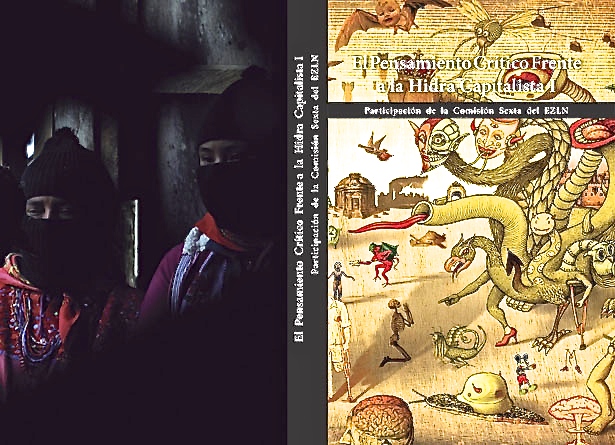
A new book of the EZLN’s participation in the Seminar on Critical Thought versus the Capitalist Hydra.
To the people of Mexico and the World
To the National and International Sixth
To the Ñätho indigenous community of San Francisco Xochicuautla
Faced with the dignified struggle that the Ñätho community of San Francisco Xochicuautla has maintained for the last eight years against the Toluca-Naucalpan toll road project which threatens the destruction of their sacred forest in order to connect the wealthy zones of Interlomas to the Toluca airport, the bad government, led by the murderer Enrique Peña Nieto, signed a decree of expropriation with which it intends to snatch up the communal territory of San Francisco Xochicuautla.
Throughout the years we have seen which interests the bad governments respond to, given that their security forces escort the Autovan machinery, a company belonging to the Higa Group, with which they plan to destroy the Ñätho forest. They believe that with this decree of expropriation they can impose plunder and destruction. Today we say that we know that the bad government has always trampled our rights as indigenous peoples, that they despise us, and that they may go to every corner of Mexico to impose their death projects, but they won’t be able to do so in San Francisco Xochicuautla.
The community has carried out a legal battle, appealing to different courts and agencies of the Mexican bad government, but most of those have proven partial to protecting the powerful.
We know that San Francisco Xochicuautla has defended and will defend their territory, as well as having accompanied many peoples and communities in their struggles.
So today we call upon the people of Mexico and the World, on the brothers and sisters of the National and International Sixth, to be attentive to what happens in the struggle of San Francisco Xochicuautla.
To San Francisco Xochicuautla, we say that you are not alone in this shared journey of indigenous peoples’ resistance.
Sincerely,
Never again a Mexico without us
National Indigenous Congress
Democracy, Liberty, and Justice
Zapatista National Liberation Army
July 2015
En Español: http://enlacezapatista.ezln.org.mx/2015/07/30/apoyo-a-xochicuautla-de-cni-y-ezln/
 Chiapas Support Committee