Chiapas Support Committee
Home of the Compañero Manuel blog on zapatistas & mexico
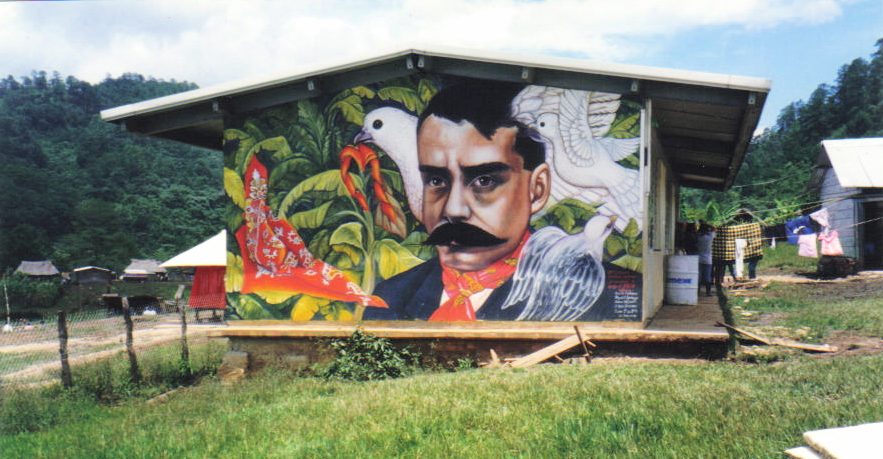
EZLN-CNI Joint comunicado on Álvaro Obregón community
EZLN-CNI JOINT COMUNICADO ABOUT THE ATTACK ON THE COMMUNITY OF ÁLVARO OBREGÓN, OAXACA
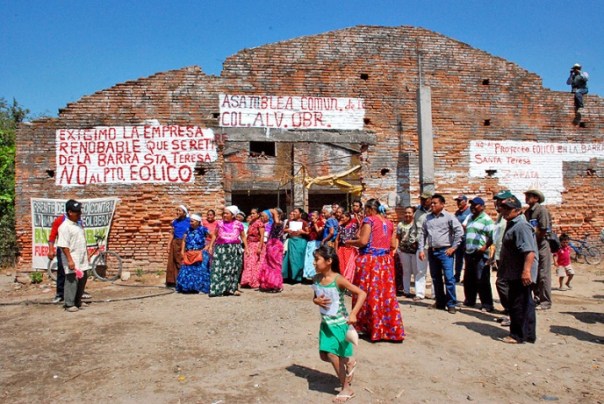
The autonomous community of Álvaro Obregón, Juchitán, Oaxaca
To the media
To the solidarity organizations
To the Human Rights organizations
To the dignified Binizza community of Álvaro Obregón, Juchitán, Oaxaca
Sisters and Brothers
Our peoples, tribes, communities, organizations, and neighborhoods see with rage and indignation how the bad government boasts its total lack of shame, through its political parties of every color, as it continues to attack our peoples and its political parties continue trying to divide our communities. Our voice will not tire of denouncing and shouting: Enough!
On May 14, brutally and shamelessly, the police and bodyguards of the PAN-PRD candidate Gloria Sánchez López dared to aim their murderous weapons at the dignified community of Álvaro Obregón, Juchitán, injuring the six compañeros who were in an assembly, defending their physical and political territory from deadly wind energy projects, whose “clean” energy is filthy with blood, corruption, and death. The candidates from all of the political parties—who even though they are only candidates feel they can already benefit from the impunity they are granted for belonging to the band of criminals badly governing the state of Oaxaca and the country—believe that with bullets they will manage to change the conscience and kill the dignity of the Binizza people.
National politics makes it increasingly clear that the political class has no shame. They believe that they can attack, threaten and intimidate the dignified struggle of the people. With aggressions and violence they try to sow fear in the dignified hearts that defend the land, the water, and the wind. From the four cardinal directions of our indigenous territories we say to them: you cannot! You cannot stop the rage in our hearts from turning into solidarity; you cannot strip us of the dignity of struggling to defend our territories and the life of our peoples; you cannot intimidate the dignified struggle of the Binizza people, who have honored the National Indigenous Congress by being a member for many years now.
Therefore, brothers and sisters of Álvaro Obregón, Juchitán, Oaxaca, from the four directions of our territories we say to you, you are not alone! You are not alone! We declare ourselves against the acts that the bad government of Mexico and Oaxaca, through their henchman Saúl Vicente Vázquez, municipal president of Juchitán, carry out against the rights to self-determination and autonomy of the people of Álvaro Obregón.
We denounce that the cowardly aggressions made with firearms on May 14 and the ongoing threats. These are an attempt to intimidate the community of Álvaro Obregón, which opposes the installation of wind energy projects in their territory. The politicians get angry when they cannot make their profits by installing these projects of death and who believe that by intimidating the people they will be able to. They are mistaken!
Because of all of this we declare that:
We hold the government of Gabino Cue and Saúl Vicente Vázquez responsible for the aggressions that have occurred and continue to occur against the assembly of the community of Álvaro Obregón, Juchitan, Oaxaca.
We demand the investigation and punishment of those responsible for the shots fired by the municipal police of Juchitán and the bodyguards of Gloria Sánchez López.
[We demand] the cancellation of the wind energy projects that they are trying to impose on the territory of the Álvaro Obregón community.
We demand that Gloria Sánchez López and all of the candidates stop trying to impose their party system on the community of Álvaro Obregón.
We demand that they respect the legitimate rights of the Binizza people to elect their own authorities in an autonomous manner.
To the community of Álvaro Obregón, Juchitán, Oaxaca, we say, you are not alone; as the CNI we will be vigilant to make sure these events do not happen again and we will make our voice heard from every corner of our blood-soaked country.
For the full reconstitution of our peoples!
Never again a Mexico without us!
National Indigenous Congress
Zapatista National Liberation Army
Zapatista autonomous justice
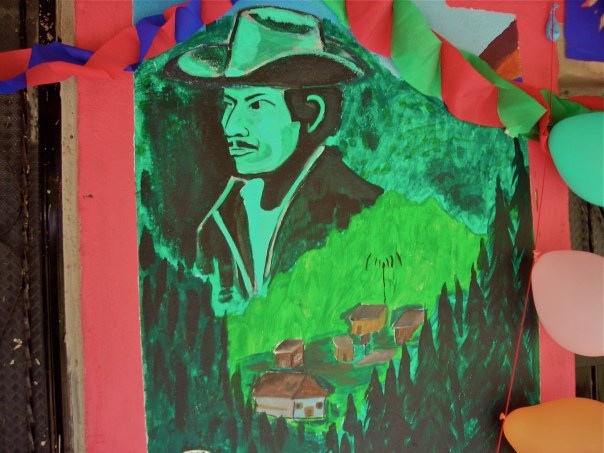
A mural on the front of the Good Government Junta’s offices in La Garrucha includes the image of Francisco Gómez, one of the EZLN’s early organizers in this Zone. He died in the bloody battle of Ocosingo in January 1994.
By: Luis Hernández Navarro
The notoriety that the Zapatista armed uprising acquired in the mass communications media during its first years has diminished noticeably. The rebels have stopped being daily news. There is one who even announces its extinction with approval.
Of course, that’s not true. The Zapatista National Liberation Army (EZLN) continues being a very relevant political force inside and outside of the country. However, the attention that the glitter of their guns attracted has been diluted before the epic of constructing from below and without asking permission, against all odds, another world.
Many books, theses and reports –some very good– were written about the indigenous insurrection of the Mexican southeast. Very few have been elaborated about the rebel feat of constructing a government and a system of autonomous justice in a broad territory under their control. Although thousands of people have visited and lived in the Zapatistas communities for varied lapses of time, literature that tells what happens there does not abound.
Certainly, there are some very notable works that give an account of the avatars of the rebel education project, from their experiences with collective organization to production on occupied lands or of the impact of their autonomic project on the struggles of the Indian peoples. Nevertheless, compared with the intellectual boom that accompanied the armed uprising, those that analyze and document day-to-day self-government are rather scarce.
One of those books is Zapatista autonomous justice: Tzeltal jungle zone, from Doctor Paulina Fernández Christlieb. It’s not just one more work, but rather by far the most complete and documented investigation about the way in which justice is imparted in four Zapatista municipios. [1]
Zapatista autonomous justice: Tzeltal jungle zone is a collective work with collectives, which gathers the voices of the rebel support bases. Very far from a classic academic essay, the book makes a passionate X-ray of the construction of alternative government and justice institutions born from the entrails of the rebel communities, a countercurrent to the logics of power.
Those institutions, already present in the January 1, 1994 Uprising and in the laws that it produced, started to take a finished form because of a government betrayal. On February 16, 1996, the federal government signed the San Andrés Accords on Indigenous rights and culture with the Zapatista National Liberation Army (EZLN). Nevertheless, the Mexican State as a whole (its three powers) betrayed its word and refused to convert them into laws. Far from shrinking in fright, the rebels decided to put them into practice, without the restrictions that the ones negotiated obliged.
They have done it, above all, within the autonomous territory established on the thousands of hectares occupied at the beginning of 1994, and distributed to work for the collective benefit. Three administrative spaces have been constructed in this territory in dispute: the communities, the Zapatista Rebel autonomous municipios (MAREZ) and the Good Government Juntas. Their jurisdictions are differentiated by the complexity of the problems that each one of them must solve. That is where justice is exercised, required not only by the rebels, but also, surprisingly, by the non-Zapatistas. Zapatista autonomous justice: Tzeltal jungle zone narrates and analyzes that challenge.
Paulina Fernández confesses that her book has a double proposition. The first is to show the ability of the Zapatista indigenous peoples to construct a project of autonomous life , government and justice, an alternative to the dominant ones in Mexico, on this space in dispute.
The academic idealization of the finca is in style. Some studies present it as a “harmonic” living space between housed serfs and landowners. Through the testimonies of those who suffered the savage exploitation of this productive unit and of their descendants, Zapatista autonomous justice: Tzeltal jungle zone de-mystifies this vision.
“For those who were born and worked on those fincas –Paulina Fernández writes–, what is still important to those old ones that were treated like animals, are the whip lashings that they received as punishment. There are also the more than 12-hour days without pay and the kilometers between the finca and the city where they had to go and from where they had to carry cargo on their backs.”
From that humiliating experience, from the life they came from on the fincas, from the abuse of women, was born the courage and the obligation to change things, the will to rebel against an order not only unjust, but also undignified.
In the midst of an era of soft coups against progressive governments in Latin America, of disenchantment with institutional politics on fringes of the population that are broader every day and of the sharpening of the policies of dispossession against the commons, the experience narrated and analyzed in Zapatista autonomous justice: Tzeltal jungle zone acquires enormous relevance. What the Zapatistas narrate in the book are not abstract ideas to fulfill, but rather another world that is being constructed.
Zapatista autonomous justice: Tzeltal jungle zone is an essential book, not only for comprehending what Zapatismo is today, but also what the struggle for emancipation can be.
[1] The four autonomous Zapatista municipios in the Tzeltal jungle zone are: Francisco Gómez, San Manuel, Ricardo Flores Magón and Francisco Villa. Their Caracol, or headquarters, is located in La Garrucha.
—————————————————————–
Originally Published in Spanish by La Jornada
Tuesday, May 17, 2016
Re-Published with English interpretation by the Chiapas Support Committee
Thousands of Chiapas teachers initiate a strike
THOUSANDS of CNTE TEACHERS in CHIAPAS INITIATE A STRIKE

Chiapas teachers march in the state capital of Tuxtla Gutiérrez.
By: Isaín Mandujano
TUXTLA GUTIÉRREZ, Chis. (proceso.com.mx). – This Sunday, on Teachers’ Day, thousands of members of the National Coordinator of Education Workers (CNTE) started an indefinite work stoppage to protest against the education reform.
Even with coercive economic measures like withholding paychecks and freezing the savings accounts, this Sunday teachers from Sections 7 and 40 of the National Education Workers Union (SNTE) carried out a mobilization that started on the east side of the capital and concluded at the central plaza, where they held a meeting.
The Financial Intelligence Unit of the Secretariat of the Treasury and Public Credit notified the teachers maestros in Section 7 of the SNTE by means of an official letter that “by disposition of the authority” the bank accounts of the Fund for Savings and Social Benefit were blocked, and therefore they would not be able to use them.
Alberto Mirón, one of the leaders of the CNTE in Chiapas, stated his rejection of this federal government arrangement and said that they would not stop the teachers movement in Chiapas, even with these repressive measures.
“To the contrary, they are only going to anger and disturb the Chiapas teachers more therefore, as was foreseen, beginning this Sunday we will be in an occupation and labor strike indefinitely,” Mirón said.
Thousands of teachers who had taken steps to obtain a loan prior to the strike were left without their checks, and therefore have to wait until the bank accounts are unfrozen.
They blamed the Secretary of Public Education (SEP), Aurelio Nuño, for being behind what they classified as a repressive measure, and because of which they will now radicalize their protest actions even more in the coming hours.
This measure is added to the withholding of their biweekly paychecks that thousands of teachers were not able to collect since last Friday. The teachers gave them until this Monday to pay them for the first two weeks of May, if not they will intensify their protests.
Pedro Gómez Bámaca, another leader of the CNTE’s teachers, said that faced with the arrival of Federal Forces in Chiapas, they would be on alert and that in case any teachers is arrested within the framework of their protests, they will start to retain functionaries and take them to the occupation located on the central plaza, where they will be displayed.
Gómez Bámaca asked the federal government to open the door to dialogue and negotiation, because “it ought to be clear that if in 36 years no previous government was able to make the CNTE disappear, even less will this government of Enrique Peña Nieto be able to do it.”
Other teachers’ unions from other levels and educational sectors accompanied the teachers, as well as campesinos and parents that were adding on to the march along its tour of some seven kilometers to reach the central plaza.
[More photos of the march here.]
As to the warning that they will be fired from their positions if they don’t present themselves at their workplaces in three working days, Gómez Bámaca said that the teachers would challenge the education authorities and would be in the occupation more than three days to see if they are able to fire them.
Whatever they do, whatever they attempt, for each one of us they fire we are going to respond with more spirit and organization, we are not going away, the teacher compañeros have no fear,” Gómez Bámaca said.
“All the members of Section 7’s Executive Committee have gone five months without pay, they haven’t paid us, and here we are, here we continue showing our face in the mobilizations,” Gómez Bámaca said.
He added that there are threats of capture and open preliminary investigations where they point to terrorists, but despite that he warned that they would in their movement.
Although the state government indicated that there were only 3,500 teachers; what’s certain is that there were tens of thousands that marched this Sunday in Tuxtla.
In Section 7 alone there are 45,000 teachers and 22,800 in Section 40; that’s without counting the thousands of workers from other unions that added onto the protest today.
——————————————————-
Originally Published in Spanish by Proceso.com
Sunday, May 15, 2016
http://www.proceso.com.mx/440716/inician-paro-miles-maestros-la-cnte-en-chiapas
Re-Published with English interpretation by the Chiapas Support Committee
Wikileaks: Temer was a U.S. Embassy informant in 2006
This morning, Saturday, May 14, 2016, La Jornada in Mexico published the Wikileaks news about Brazil’s new interim president, Michel Temer, having given information about the political situation in Brazil to the U.S. Embassy in 2006. La Jornada interprets this as having been a CIA informant. Other news outlets around the world are also publishing this story. http://www.jornada.unam.mx/2016/05/14/mundo/017n2mun
Meanwhile, Raúl Zibechi believes that the cause of Dilma’s impeachment was a fear of those below by Brazil’s 1%. See his article below.
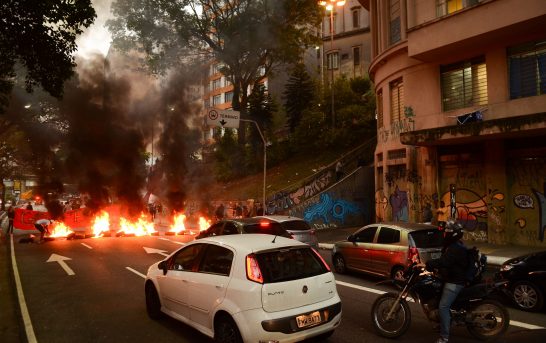
Anti-impeachment protests in Brazil.
CAUSE OF THE IMPEACHMENT: THE ONE PERCENT’S FEAR OF THOSE BELOW
By: Raúl Zibechi
In the face of the Brazilian crisis the decisive question must be: Why did the big financiers that had supported Lula and Dilma break with the governments of the PT and launch a potent offensive to obtain removal? The offensive of the Brazilian right against President Dilma Rousseff was the product of an abrupt turn, a consequence of the intensification of class struggles, in particular of the poor, blacks and inhabitants of the favelas.
In order to elucidate this hypothesis it’s necessary to reconstruct what happened in recent years. The events they say were the turning point in the tolerance of the bourgeoisie happened in 2013. With the distance of time it’s possible to show confluence among diverse sectors of workers and young people in a juncture that permitted giving an enormous qualitative leap in the popular sectors’ ability to mobilize. For that we see three events: the mobilizations of June 2013, the notable rise of strikes and the growing organization of the different los de abajos (those below).
We have talked a enough about the first point: in June 2013, millions of young people won the streets against the increase of urban transportation and police repression, in actions that ought to be understood as a gigantic denunciation against the inequality that the Workers Party governments did not modify, although there is a decrease in poverty. Now we know that inequality not only didn’t fall, but rather tends to increase, even in the periods of economic bonanza, when the one percent monopolized 25 percent of the wealth, percentages that will have risen during the present crisis.
The second is related to strikes. The workers’ struggles in Brazil had reached a peak after the exit of the dictatorship, in the period of approval of the new Federal Constitution in 1988 and the first direct presidential elections in 1989. In those years they reached an historic peak of 1,962 strikes in 1989, and something less in 1990, to descend abruptly in the neoliberal decade and stabilize under the two Lula governments to around 300 strikes annually.
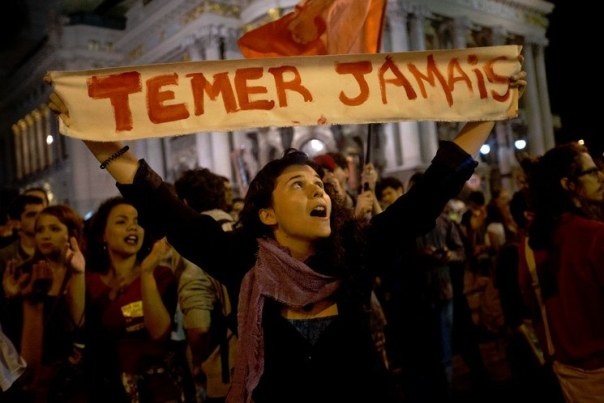
A Brazilian protester’s sign reads: “Never Temer.”
The year 2013 produced a sudden increase in strikes (although they had already increased in 2012), beating the record of the historic series of the last 30 years. According to a report from the Inter-Union Department of Statistics and Economic Studies, Balance of Strikes in 2013 (http://goo.gl/o35Wi6), there were 2,050 strikes that year. But quantitative growth is data that doesn’t show the strong changes in the protests.
The cited report emphasizes that there was an expansion of struggles to sectors that usually don’t mobilize. It maintains that there was an “overflow” of “the most fragile professional categories, as much from the viewpoint of remunerations as for working conditions, health and security.” It particularly refers to workers in the food and urban cleaning industries.
Some 800,000 people work in the cold storage industry, of which between 20 and 25 percent present health problems, since they realize between 70 and 120 movements per minute, when it’s recommended not to exceed 35. In 2010, 70 percent of the workers at the multinational Brazil Foods suffered pains because of the work, and 14 percent thought about committing suicide because of the pressure to which they are subjected (http://goo.gl/x0Bxfi). A youth that enters the industry at 25, already has irreversible injuries at 30.
The urban cleaning workers of Rio de Janeiro went on a memorable strike during Carnaval 2014 and got increases of 37 percent in their salaries. It was a massive and combative strike that was maintained based on direct democracy, unknown to the bureaucratic union (http://goo.gl/zvl58G). The immense majority of them are blacks and mestizos that live in the urban peripheries and in the favelas.
In 2014, the less qualified and lower paid layers of the working class irrupted, encouraged by the June 2013 mobilizations and impelled by the crisis that they started to feel in 2012.
The third question consists of the increase of organization and activism in the favelas, where the poorest Brazilians live. On June 24, 2013, while millions were peacefully demonstrating in the avenues, the police entered shooting into the Complexo da Maré [1] in Rio de Janeiro, and murdered 10 black youths. That’s common. What was different was the response of favela residents: 5,000 neighbors cut off the strategic Brazil Avenue for two hours. It was the beginning. In July, the actions multiplied because of the disappearance of the worker Amarildo de Souza at the Pacifying Police Unit, of the Rocinha favela.
The flash mobs, or strolls, (rolezinhos) happened in December and January, where thousands of poor youths met up in the shopping malls and, dancing, challenged the police. From there, there were dozens of reactions to the police brutality. Favela residents neutralized control and started to organize cultural groups in many favelas, for denunciations, human rights defense. Those groups are connected to other groups from other favelas. They have lost their fear.
Those below re-launched their fight for dignity and for life. It sounded the alarm for those above. In one of the world’s most unequal countries, where class coincides with skin color, classism and racism are expressed with the brutal violence that characterizes colonial societies. Thus, Brazil must be analyzed as a colonial society, where capital accumulation supports itself on segregation that supposes the non- recognition of the humanity of those below.
The crisis has devolved that democracy is barely the veil that those above use to hide their shames: the first and fundamental being that they are not willing to share the pie with blacks and mestizos; only the leftover crumbs are for them. But the problem is something else: we believed the story, some for convenience, and others because of slowness or fear.
[1] To read about the current situation in the Complexo de Maré, a group of neighborhoods in Rio, see: http://www.telegraph.co.uk/news/worldnews/southamerica/brazil/11515531/Rio-favela-still-wracked-with-fear-and-violence-as-Olympics-2016-approaches.html
—————————————————————————
Originally Published in Spanish by La Jornada
Friday, May 13, 2016
http://www.jornada.unam.mx/2016/05/13/opinion/015a2pol
Re-Published with English interpretation by the Chiapas Support Committee
A Dialogue with Raúl Zibechi
EXTRACTIVISM IS A WAR AGAIST PEOPLE

A dialogue with journalist Raúl Zibechi (left), who reviews the irruption of new social movements in Latin America within the framework of the end of the cycle of the progressive governments.
By: Mirko Orgáz Garcí, journalist
Bolivia, March 13, 2016
Journalist Raúl Zibechi was at the XXIV Marcelo Quiroga Free Seminar “Analysis and alternatives to dependence and extractivism [1] within the framework of the global economic crisis,” held on Tuesday, February 16 in the auditorium of the UMSA [2]. He asserts that extractivism is a global war from those “above,” from the multinationals and the States, against the peoples to appropriate land and water for themselves. “The particularity of Latin America in the last 10 or 15 years is that this extractive model, this accumulation by dispossession, is the fourth world war and it has been headed by progressive governments,” he says. He proposes getting out of extractivism, which not only is an economic model but also a political, social and cultural one, driving the financial system, “that 1% that dominates the world and every one of our countries.”
What are the characteristics of the current global political economic crisis?
We are not facing an economic crisis but rather a systemic re-composition, the system as such cannot continue without fundamental changes, and a civilizational crisis that basically affects Western civilization. The system rests on two pillars: the international division of labor, the fruit of creating a center and a periphery five centuries ago. The second transfers wealth to the first, through different mechanisms throughout time, from the unequal colonial trade to the financial system’s most recent transfers thanks to the petrodollar. But the strengthening of countries previously on the other side of the globe is provoking a collapse of that stability, affecting principally Europe and the United States. It’s the creation of the multipolar world that we are seeing.
The end of the progressive governments in Latin America is talked about. Why do these governments appropriate the banners of social revolution?
I prefer to talk about the end of a cycle, because in reality having progressive governments will continue but now they are becoming conservative governments. What happened is that one of the pillars of their governability, the high international prices of commodities, came down. It was a long cycle of super-high prices that permitted improving the material life of the majority of individuals without modifying the productive model and without touching the privileges of the richest 1% of the population.
They appropriate banners with the same logic as the system, which needs to subsume everything that rejects it as legitimate. Now Mauricio Macri talks about never again in reference to the violation of human rights. The system functions like this, independently of those who are at the head. We have discourses about green and sustainable mining and all of that.
Did Latin America live through a lost decade with the progressive governments?
I don’t believe that it is a lost decade. People learned a lot, in several senses. On the one hand, it has been gaining in self-esteem, happenings like the water war or the two gas wars leave sediments, as well as the march in defense of the TIPNIS, to mention the big events in Bolivia. Inverting the previous question, we can say that the peoples in movement are so strong that the governments need to appropriate the banners of those below in order to have a minimum legitimacy.
How does society confront this end of the cycle?
With much calm and a lot of patience. The pendulum is not only going from left to right, it’s also going from above to below. It is the common people’s turn, the Indian peoples’, the women, youth, all the oppressed, those that were quiet these years because they had to listen to those above.
There is a very strong contrast between what happened on the afternoon of October 17, 2003 in San Francisco Plaza, when the crowd cried out “Yes we can,” and what came afterwards. To whom did they cry out the day of the fall of Goni? [3]
No to the President that was already a political cadaver. They were shouting at themselves, it was a shout of self-esteem, “Yes, we can take the sky by assault,” as Mao would say. But in the following years that empowerment disappeared, in part because some leaders said what the people wanted to hear, but also because many people wanted to let them govern, which the governed the good or their own, which is always the easiest path.
But now the limits of government from above were shown. And now the pendulum goes down again, perhaps as in the decade of the 1990s, before the 1990 march when the peoples slowly started to self-organize. I believe that things are going in that direction, but one will have to follow things very closely because the professionals of discourse are going to do their job.
About what new subjects are we talking and what is their political horizon?
This is the million-dollar question that we are still not able to answer, except in the case of Brazil and even there only partially. I tend to think that old-style movements, those called social movements, championed the TIPNIS March. But June 2013 in Brazil, with the irruption of millions of youths in the cities, the new-new movements that are small collectives that function based on autonomy, decisions by consensus, outside the political parties and horizontally. They no longer want leaders or apparatuses that mark the path for them, they decide for themselves where to go and towards where they walk.
I believe that we are going to experience movements of a new kind, because the progressive cycle moved many things and demonstrated the inability of the big apparatuses to do anything better than permit their leaders to become palace lackeys. Those big structures are more empty shells, hierarchic and patriarchal all the time, incapable of promoting anything that has any relation to emancipation.
To the contrary, we see a infinity of small groups with young people, which express themselves through cultural forms opposed to the established powers. It’s still too soon to know the reach of these new subjects, but there is learning: “it’s of little value to organize for entering the palace because in a little while those who enter will be just like the ones we threw out.” In other words, we’re dealing with creating something new, different, on the basis of what we learned.
Toward what type of society does that society in movement lead us?
We cannot know that. We hope that it is toward a fuller life, democratic, free, not subject to states or parties that come to substitute for the old churches. We aspire to a society where people govern themselves in the greatest number of spheres possible, where others do not govern them. For that, one must create a communitarian culture, not in the image and likeness of the old ayllu [3] that is very useful as an inspiration but that must be reconstructed above other bases, overcoming patriarchate, generational hierarchies and strongmen. It won’t be anything simple because we’re dealing with a very profound cultural revolution that, necessarily, will be expanding gradually, because culture changes over long periods of time.
===============
Translator’s Notes:
[1] Extractivism – What David Harvey calls accumulation by dispossession Zibechi calls extractivism. It consists of financial speculators taking away something from the common people to obtain corporate profit; for example, the use of land, clean water, clean air, natural resources. Zibechi applies this concept to both rural and urban settings in South America. The urban setting often involves real estate speculation (flipping houses, replacing old single-family homes with condos, shopping centers, etc.). These are transfers of wealth from the poor or the working class to the rich, involving physical and cultural displacement.
[2] UMSA – Higher University of San Andrés, located in La Paz, Bolivia.
[3] “Goni” refers to Gonzalo Sánchez de Lozada, who served two terms as president of Bolivia.
[4] Ayllu – An indigenous local government model across the Andes region of South America, particularly in Bolivia and Peru.
—————————————————————————
Originally Published in Spanish by Movimientom4.org
Friday, April 6, 2016
http://movimientom4.org/2016/04/el-extractivismo-es-una-guerra-contra-los-pueblos/
Source: Página Siete
—————————————–
Re-Published with English interpretation by the Chiapas Support Committee
Los de Abajo: Chablekal Resists!
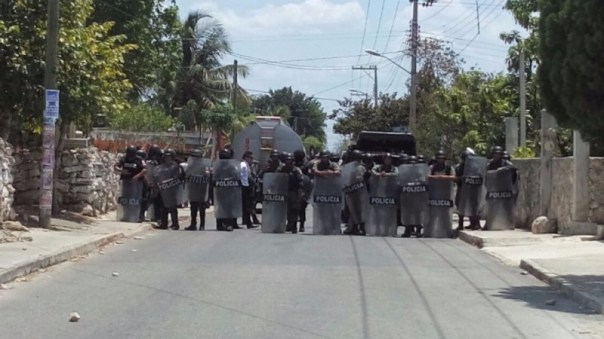
Yucatán police in Chablekal.
By: Gloria Muñoz Ramírez
Behind the police attack on the town of Chablekal, Yucatán, is found the savage dispossession that real estate and tourism investors have done in this peninsular community, and the putting into effect of Yucatán Shield, a security strategy at the service of the owners of capital, analyzes the team of Indignación A.C. human rights defenders, whose members were also attacked and detained.
Chablekal is territory under siege, a paradise for speculators since two decades ago, because its privileged location, just some 20 kilometers from Merida, makes it perfect for wealthy families that don’t want to live in the city, but close to it.
It was in this small community of barely 4,000 inhabitants, in which last May 3 between 30 to 40 patrols saturated with Yucatán police agents, two fire trucks and ambulances irrupted, for the purpose of executing an eviction order on a piece of land belonging to an elderly gentleman that faces a legal dispute with a relative that attempted to sell his property.
Chablekal is a tranquil town pueblo in which apparently nothing happens. But the violent irruption and disproportionate number of police woke up its inhabitants and made them confront them, because they were attacked with everything, firing tear gas against men, women, children and elders.
The arbitrariness and outrages, the detentions and violence, also convoked the solidarity and accompaniment of organizations throughout the country, including the Zapatista National Liberation Army (EZLN) and the National Indigenous Congress (CNI), who jointly denounced this act as: “an attempt at intimidation of the human rights defenders as well as the in habitants of the community of Chablekal, which has organized in the Union of Chablekal Inhabitants for the Right to Tenancy of the Land, Territory and Natural Resources, in order to defend what remains of their territory from the theft and dispossession that they have been suffering in recent years from speculators and new land owners.”
The four detained during the operation were released 48 hours later, but the Indignación Center specifies that multiple political, administrative and/or criminal responsibilities derived from the operation are pending. “This experience evidences that a police state cannot be the basis for combatting the situation of insecurity and social conflict that exists in Yucatán,” the team emphasizes.
The final result is a community more united and organized that proved to itself that it can defend its residents and that they are not alone.
————————————————————-
Originally Published in Spanish by La Jornada
Saturday, May 7, 2016
Re-Published with English interpretation by the Chiapas Support Committee
EZLN and CNI on Chablekal repression
JOINT COMMUNIQUE BY THE CNI AND EZLN ON REPRESSION AGAINST THE COMMUNITY OF CHABLEKAL
To the media
To the Human Rights organizations
To the Union of Inhabitants of Chablekal
To the people of Mexico
Sisters and Brothers
We, the peoples, communities, tribes, neighborhoods, organizations, and collectives who make up the National Indigenous Congress (CNI) denounce and condemn the events today in the community of Chablekal, Yucatán, where the police attempted to evict an elder of the community from his home. Upon learning of the unjust eviction, the inhabitants decided to protest to try to stop the action, to which state antiriot police responded with tear gas. Women, children, and elderly persons were present; as of now more than 40 canisters of tear gas have been found in the community.
Jorge Fernández Mendiburu and Martha Capetillo Pasos, in their role as human rights defenders and members of the Human Rights Center Indignación A.C. and the National Indigenous Congress, were arbitrarily detained, beaten, and handcuffed in an aggressive manner and against all due process. Although they were released shortly after, this constitutes an act of intimidation and criminalization of human rights observation and social protest.
In addition, we denounce this act as an attempt to intimidate not only the Human Rights defenders but also the inhabitants of the community of Chablekal, who organized the Union of Inhabitants of Chablekal in Defense of land, territory, and natural resources to defend what remains of their territory from the theft and displacement they have suffered over the last few years on behalf of speculators—new landowners who have the support of the municipal, state, and federal agrarian and political authorities. Their demand to halt the indiscriminate selling off of lands has been answered with this and other attempts at intimidation of their members and those who accompany them and defend their rights.
This abuse of authority and its associated crimes take place in the context of the imposition of the “Yucatán Shield” strategy. This strategy, carried out through large economic loans with unclear ends, is meant to render citizens defenseless against police actions. The Indignación A.C. team has presented a document denouncing this aspect and other irregularities in this strategy. This treatment of groups critical of police action is one of the digressions of this plan, which should be more closely analyzed before its implementation.
With regard to the above, WE DEMAND
–INVESTIGATION OF AND PUNISHMENT FOR THE POLICE OFFICERS RESPONSIBLE FOR THE ARBITRARY AND ILLEGAL DETENTION OF THE MEMBERS OF THE INDIGNACION A.C. TEAM
–THE IMMEDIATE RELEASE OF THE FOUR MEMBERS OF THE CHABLEKAL COMMUNITY STILL DETAINED
*Pedro Euan Flores
*Alfonso Tec
*Pedro Euan Santana—member of the MPDT of Chablekal and of the CNI
*A 15 year old
–INVESTIGATION OF THE AGGRESSION COMMITTED AGAINST THE INHABITANTS OF THE COMMUNITY OF CHABLEKAL
–SAFETY GUARANTEES FOR HUMAN RIGHTS DEFENDERS
–A HALT TO ACTS OF INTIMIDATION AGAINST THE UNION OF INHABITANTS OF THE COMMUNITY OF CHABLEKAL IN DEFENSE OF LAND, TERRITORY, AND NATURAL RESOURCES.
–THAT THE NECESSITY FOR AND DETAILS OF ANY SECURITY ACTION, INCLUDING THE “YUCATAN SHIELD,” THAT MAY VIOLATE HUMAN RIGHTS BE FIRST DISCUSSED WITH COMMUNITIES AND CITIZENS
Sisters and brothers of Chablekal,
YOU ARE NOT ALONE!
NEVER AGAIN A MEXICO WITHOUT US!
FOR THE FULL RECOGNITION AND VINDICATION OF OUR PEOPLES!
NATIONAL INDIGENOUS CONGRESS
ZAPATISTA NATIONAL LIBERATION ARMY
————————————————————-
Originally Published in Spanish by Enlace Zapatista
May 4, 2016
10 Years since the repression in San Salvador Atenco

Father Miguel Concha Malo officiated at a mass in memory of the individuals that died in the repression against the San Salvador Atenco ejido owners that opposed the construction of an airport on May 3 and 4, 2006. Photo: Javier Salinas
By: Javier Salinas Cesáreo, Correspondent
San Salvador Atenco, Mexico
Yesterday, the Peoples Front in Defense of Land (FPDT) commemorated the tenth anniversary of the repression and occupation of San Salvador Atenco community by federal forces. On that occasion they arrested more than 200 campesinos, and dozens of women suffered sexual abuse and two young men were murdered.
The FPDT assured that it would continue fighting until the project for a New Mexico City International Airport (NAICM) is cancelled.
“The torture that we experienced during the long night of May 3 to 4, 2006 is still fresh in our memory. Saying that 10 years have passed is only a reference for not forgetting all the pain and offense that we still have and relive today. The repression and political vengeance to which they subjected us still makes us angry,” said Adela Romero Núñez, a member of the FPDT.
On May 3, 2006, state police beat up on campesinos from the Frente that defended the eviction of a group of flower vendors from the Texcoco municipal market. Their leader, Ignacio del Valle Medina, was arrested during that action.
Hundreds of residents and ejido owners blocked the Texcoco-Lechería Highway and police arrested dozens. In the early morning of May 4, thousands of police agents irrupted in the community. They threw tear gas, broke into houses and arrested hundreds of the FPDT’s ejido owners, who five years earlier had achieved the suspension of airport construction.
The Atenco campesinos demanded that the material and intellectual authors of the repression be punished, as well as for the murder of the Autonomous National University of Mexico student, Ollín Alexis Benhumea Ramírez, and of the youth Francisco Javier Cortés. They warned that those who ordered the repression now occupy high positions, among them President Enrique Peña Nieto, then governor of the state of Mexico.
Since 15 years ago, they added, they have faced the threat of dispossession of their lands for the airport’s construction. “The Red May of 2006 was a cruel and condemnable vengeance. Now, in 2016, the government insists on the construction of its air terminal on our lands,” they pointed out.
They warned that they are not going to permit “more humiliation” and they will fight legally and with mobilizations to defend their lands against “the death project.”
The commemoration started with a mass that the priest Miguel Concha Malo officiated and with a press conference of the Atenco residents. Among those in attendance were the mothers of Martín Getsemany Sánchez, Jorge Antonio Tizapa and Abel García, three of the 43 Ayotzinapa students attacked in Iguala, Guerrero.
Miguel Concha stated that the FPDT has shared for a decade “hope and the fight for the defense of territories,” and is a symbol of “human rights defense in the face of violent repression” against the community.
“We don’t forget those who try to grab our land and our hope; they have made and now make a repressive use of State forces. We don’t forget that now justice must exist for the two murdered youths, the more than 30 sexually abused women and hundreds of people that suffered repression; we cannot forget and we are here because of that today,” he said.
Gilberto López y Rivas also participated in the name of the Committee in Defense of Mother Earth. He considered that the FPDT has become an “example of all the country’s struggles that are defending nature, land and all its life forms; and besides, Atenco has been a symbol in defense of human rights.”
At the same time it warned that the work of the Cypsa Vise company provoke tension and polarization in Tocuila, Texcoco municipality, where a superhighway to the airport is being built.
The commemoration continued in the afternoon with cultural and musical activities that the local PRI municipal council sought to boycott with an activity to celebrate the “Day of the Child,” for which it placed dozens of horns at full volume and a boxing ring on the esplanade.
———————————————-
Originally Published in Spanish by La Jornada
Wednesday, May 4, 2016
Re-Published with English interpretation by the Chiapas Support Committee
The GIEI’s Tsunami
By: Magdalena Gómez
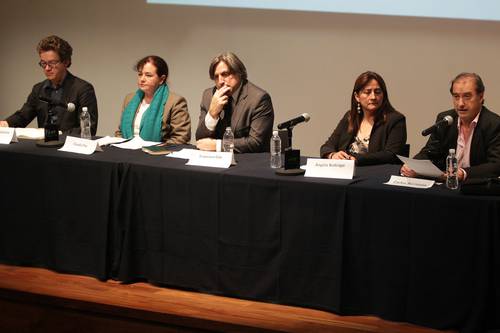
The second and last report of the Interdisciplinary Group of Independent Experts (GIEI, the Group’s initials in Spanish) opened with the assertion that there is no evidence that the normalistas had links with organized crime and discards that they went to boycott a political act in Iguala that day. On the whole, it shows the structural deficiencies of the system of procuring justice in the country. Its recommendations are a group of measures to take. They allow the government to assert that it will attend to them, in an escapist notion. The public presentation session of the GIEI’s report has a very singular attendance makeup: human rights and social groupings, academics, journalists and European diplomatic representations.
The president of the IACHR, James Caballaro, received the report and pronounced a harsh discourse, lamenting the absence of the federal government. It was, without a doubt, the evident ratification of the assumed decision on the distancing with the Inter-American space and the group of experts. It also showed that it is not willing to agree to any follow-up mechanism. But that wasn’t the terrain that generated an authentic tsunami for Peña Nieto loyalists. It was the revealing of a video that shows the presence of Tomás Zerón, head of the Criminal Investigation Agency (of the PGR), at the San Juan River, the place at which they supposedly would find some bags the following day, with the allegedly incinerated remains of the students, in the Cocula garbage dump. The grave question is that similar bags already appear in the video that the GIEI showed. The GIEI did not assert that they were planted, but it did point out that Zerón’s work was not listed in the case file. If we remember that the procedure of removing the bags from the river was the basis for the so-called historic truth announced by Murillo, we realize that not only is it in question whether the 43 students were reduced to ashes in the Cocula garbage dump, situated 40 kilometers from the river, but it also does not appear clear how and for what reason the alleged remains were taken to the river. All that was constructed from the statements of those arrested, whose signs of torture were also shown in the GIEI’s second report. That fact, eventually, would give standing for the liberation of the arrested declarants. The revelation of the video will permit the defense for the relatives of the disappeared to challenge the basis of the investigation that has been carried out as of today. They would already share a first analysis in that regard.
The Zerón factor impacted the past week and is determining; nevertheless, the Ayotzinapa Report II contains questions about intelligence activities, control of the C-4 cameras and the data they had at all times about the students’ movements. They precisely define the extended circles in the zone. They describe a concerted action of police bodies that goes beyond municipal levels to reach federal levels.
They also shared the questionnaire about the interviews that were going to be held with members of the Army, which they were denied. They reaffirmed the need for maintaining the line of investigation into the fifth bus, noting that they now doubt that the vehicle and the driver that they placed opposite them may be involved in the Iguala events. At the same time, it was concluded that the results from the third fire expert on the Cocula garbage dump have no scientific analysis or reasoning.
The GIEI convincingly confronted the statements of Tomás Zerón. The experts denounced him because he edited the video that he presented. The functionary sought to justify that he has the ability to do investigative work on a case underway without giving an account of the work in the case record of the investigation. Besides, he attempted to involve the UN office and to avoid the Argentine experts finding out about his visit to the San Juan River. The GIEI making the accusation that their second mandate was systematically blocked makes sense. Without a doubt their requests for specific work contributed to the government’s posture of cutting off the collaboration. Peña Nieto is enclosed by the international reactions of support for the GIEI, from the United Nations as well as from the U.S. State Department. Facing that, the statements from the PGR and from Governance appeared weak with common statements that “we continue investigating and we are going to review the recommendations,” before the avalanche unleashed by the accusation against Zerón. Now up against the wall, they indicated that he would be investigated. He, in turn, stated that he would not resign.
Deficiencies in the Ayotzinapa investigation are not motivated by technical reasons. There has been, in effect, an unknown hand up to now that blocked the GIEI with the support of the highest level. Where do they intend to take the conflict with the Inter-American bodies and those of the UN? That has been an ominous and authoritarian sign in South America in past decades.
———————————————————-
Originally Published in Spanish by La Jornada
Tuesday, May 3, 2016
En español: http://www.jornada.unam.mx/2016/05/03/opinion/018a2pol
Re-Published with English interpretation by the Chiapas Support Committee
Zibechi: Reflections on the Brazilian Crisis

In this March 13, 2016 photo, a demonstrator holds a poster with the photo of Brazilian President Dilma Rousseff and former President Luiz Inacio Lula da Silva in prison stripes during a protest on Copacabana beach in Rio de Janeiro, Brazil. (AP Photo/Silvia Izquierdo, File)
By: Raúl Zibechi
A relatively short time ago, the dominant classes of the world decided to unleash a war against the peoples in order to keep themselves in power in a period of acute change. They decided that democracies are an obstacle to unleashing that war, and they need, in whatever way, to neutralize them, put them at their service, as well as those elected to govern. On this point they don’t permit the least fissure.
To deduce the strategic thinking of those above one must put themselves in their place, since they don’t usually formulate it openly. We must ask ourselves what we would do if we were part of the one percent that has assured domination.
The first response is that there are too many people in the world and that the planet doesn’t allow that much population if they all want to live, not like the 1% lives now, but, for example, at a level of the 20-30% of higher incomes. The world designed for the domination of the 1% barely tolerates half of the planet’s current population. The rest are unnecessary and no longer even count as producers of surplus value, because the system accumulates by stealing. The question is what policies are derived from this fact.
The second is that the 1% abandoned the Welfare State (or similar substitutes like those that we had in Latin America) and it doesn’t enter into their plans to revive it. Therefore, the democracies we know are no longer necessary or useful for the kind of political systems facilitating accumulation by dispossession/plunder/robbery that we are suffering. The increasing militarization of the poor zones occupies their place, like in the urban peripheries and all those spaces that the big multinationals colonize, displacing entire peoples.
Of course, the 1% swears fidelity to democracy and its values, because it must create the illusion in a good part of those below about the importance of the vote and the party system. But, on top of that, it requires a rogues’ nest of individuals that perform as representatives and that act as intermediaries between them and the rest of the population. As Immanuel Wallerstein points out, domination is stable when it is established in three parts (classes) and is unstable when there are only two. The intermediate sectors are keys to the system: from the middle classes to the academics, along with the politicians and the big communications media.
As a consequence, occupying the higher rungs of the state apparatus supposes administering the current model of accumulation/war against the peoples. And, by the way, it’s useful to remember one of the principal lessons that the progressive governments leave us: given the current correlation of forces on a global scale, the governments are limited to administering extractivism, diverting (in the best of cases) resources to the popular sectors without touching the basis of the model.
The third big objective of the 1% is to neutralize all movements of resistance against it, from the leftist and progressive parties to the anti-systemic movements. Although in previous periods negotiating with unions predominated and it tolerated the social democratic lefts occupying government positions, in the new stage we live in it seems necessary to close ranks and avoid diversions in its plans and projects to keep those below at bay.
When parties or individuals arrive in government that –because of their trajectory or stated objectives– can depart from the extractive script, they create the conditions for neutralizing them. That happens in two ways. One is domestication, by inserting the new rulers into the elites, something that is not very difficult to attain, since the system possesses numerous ways to co-opt/buy off those who resist it. The other is the removal of rulers, in any way possible without appealing to classic State coups, but rather to legal, although illegitimate means.
These days in Brazil we can see a combination of both strategies. First it was domesticated, and then removed. The PT governed twelve years allied with super exploitive Brazilian multinationals (like the big construction companies), which financed its electoral campaigns, its leaders travel and numerous soft jobs.
Social policies are applied to the movements that seek to pacify those below with small monetary transfers that impact the poverty, but not the inequality, and avoid the realization of structural reforms. The PT delivered less land to the campesinos than the neoliberal government of Fernando Henrique Cardoso because it prioritized an alliance with the agribusiness that occupies now the Agriculture Ministry.
What should the strategies of the anti-systemic movements be in view of this panorama and in light of the experiences of the last 15 years?
In the first place, thinking long term. The few forces that we have should be used strategically, not for momentary and timely gain. If we conclude that we suffer a war against those below, we must think about how to eat away at the system and avoid that it eat away at us. It’s evident that the progressive cycle didn’t consume them, but it weakened the movements.
The second is the conviction that the worst path we can take is to administer the difficulties of the system. I have no doubt that at some time it will be necessary to aim at the State (to take it over or destroy it, depending on the different positions existing among us); but, while the system may be strong, the government is synonymous with managing accumulation by dispossession, or the war against the peoples.
I believe that the greatest strategic urgency lies in comprehending the extractive model of dispossession. In that we have committed gross errors (starting with the one who writes), since we have barely emphasized its environmental problems and we have broached it from the economy and not from the political. If we are really facing a war, administering any aspects of the concentration camp is not the best path, because it must be destroyed, since it cannot be reformed.
——————————————————–
Originally Published in Spanish by La Jornada
Friday, April 29, 2016
Re-Published with English interpretation by the Chiapas Support Committee
 Chiapas Support Committee