Chiapas Support Committee
Home of the Compañero Manuel blog on zapatistas & mexico
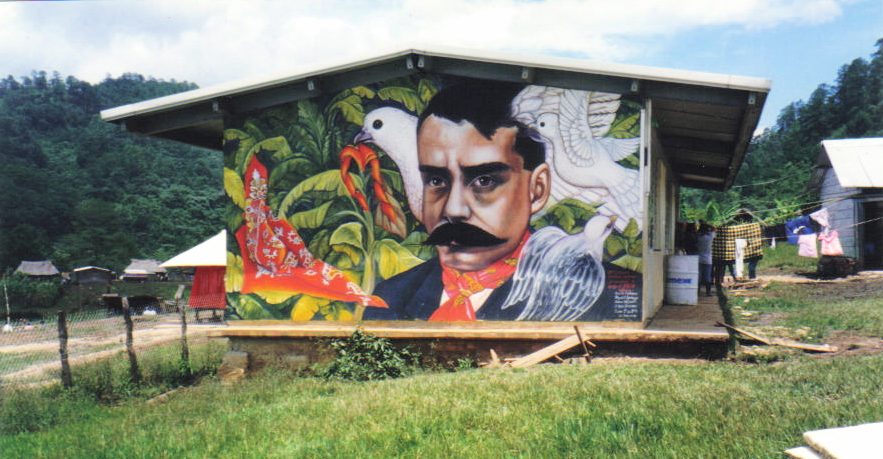
CNTE Chiapas: “The state sets the stage for repressing the teachers”

The sign reads: “Abrogation of the Education Reform. If there is repression in Chiapas, the just thing is to finish with the parasites.” Drawings of (president) Enrique Peña Nieto and Aurelio Nuño, Secretary of Education, are on either side of the banner.
Tuxtla Gutiérrez, Chiapas, August 27.
“The Mexican State sets the stage for openly repressing the teachers’ movement; therefore the government is realizing an atmosphere of lynching that generates a certain endorsement of police brutality in public opinion,” warn teachers adhered to the National Coordinator of Education Workers (CNTE) in a communiqué. They have been on strike for the abrogation of the self-named “education reform” since last May 15.
“The explanation for this new media lynching that we can read and hear every day, is that the Peña Nieto regime knows about the population’s discontent with its policy, and that an organization the size of the CNTE fighting can push the political awakening in the working class even further and throw out its structural reforms that have a privatizing character,” the teachers say in the face of the increasing media attack against them, and upon continuing with their strike and not starting classes last August 22.
“The lynching against the education workers is carried out daily by mandate of the Peña government, or through the servile action of the state governments,” the dissident educators evidence. “The Mexican State has unleashed a media lynching against the CNTE, making use of all its corporate communications media, aligned with los interests of the national and international oligarchy,” the teachers abound.
“To the people of Chiapas and the country we tell you that we will not cede in out defense of public education,” affirm the striking educators of Sections 7 and 40, and they demand that the federal government immediately reinstall the negotiating table with the CNTE, because “dialogue is the space for reaching agreements, and not the violent response that Peña Nieto wants to give to those that demonstrate peacefully,” they emphasize.
“We declare ourselves on permanent alert and in struggle against the misnamed education reform and against this authoritarian regime and we demonstrate for the joint construction with society of a real educational transformation,” CNTE members report.
Nevertheless, despite the media campaign against the teachers, the number of parents that are against the strike is minimal, as they have demonstrated in assemblies held all over the state where they continue offering social support to the teachers’ movement. At the same time, it has been evident in social networks that those supposedly in disagreement with the school closings are close to the government as in the much-publicized case of the state’s secondary school in the Chiapas capital.
—————————————————————–
Originally Published in Spanish by Pozol Colectivo
Saturday, August 27, 2016
Re-Published with English interpretation by the Chiapas Support Committee
Femicides, part of the Fourth World War

By: Raúl Zibechi
The August 14 page of Desinformémonos warned about the 31 femicides registered in Querétaro since January 2015, with a short and frightening story.
“The games, dreams, school, friends, family, birthdays, trips, security, freedom, dignity and life have stopped being rights because of being converted, shamefully, intolerably and lamentably into benefits that are acquired when ‘you moderate’ your manner of speaking, when ‘you are careful’ of how you look, the hours in which you go out, the places that you frequent, when you stop confiding in people and when your life stops being your life.”
The article emphasizes that: “femicides are clearly State violence;” it denounces “the impunity that covers them and favors the repetition of harm,” and it emphasizes that the majority of the victims are usually indigenous and poor women.
The information refers directly to Silvia Federici’s book, Calibán y la bruja: mujeres, cuerpo y acumulación originaria (Traficantes de Sueños, 2010); [1] a work of lasting influence, which contributes to illuminate reality permitting a better comprehension of a social conflict. It analyzes the witch-hunts in medieval society, and at the same time contributes to the comprehension of what happens in this period of history.
Federici maintains that feudalism was eroded due to the power and autonomy obtained by the popular classes, and that the response of the dominant classes was a violent offensive that seated the bases of capitalism: slavery and colonialism, the subjection of workers in production and the confinement of women in reproduction, the creation of hierarchies of race, gender and age, formed part of this new domination.
Capitalism not only arrived “dripping blood and dirt from head to foot” (Marx), but also creating “an immense concentration camp,” where slavery on the plantations and the mita [2] in the mines impelled capital accumulation (Federici, p. 91). The power of women was destroyed with witch-hunts, and the males (and the women, boys and girls) were subjected by means of salaried slavery and slavery, for appropriating the commons.
Today we cross through the crisis of capitalism and the dominant class again uses violence to perpetuate it. At the basis of this crisis is the power acquired by the popular sectors organized into movements, particularly since the 1960s, when factory workers disarticulated the employers’ power by overthrow Fordist (assembly line) discipline.
The capital offensive underway seeks to destroy that capacity for organization and struggle of those below. But the popular world is now very different than before, particularly because of the crisis of the old patriarchy.
Anyone who knows the antisystemic movements knows that women play a central role, even when they aren’t as visible as the men. They are the mortar of collective life; they are in charge of the reproduction of life and of the movements. Besides cooking, weaving and caring for the animals on their homes, they get together with other women to do the same thing, but collectively. They are the guardians of the commons, material and immaterial.
They, and their sons and daughters, are the sustainers of the popular world, of extended families and of the organizations, from urban to campesino and indigenous communities, from Chiapas and Cherán to Wall Mapu (Mapuche Territory) and the Andes. It’s no accident that we are facing a new witch-hunt when reproduction occupies such an important place in the resistance and in the power of women within their communities.
Women, and their sons and daughters, have disarticulated the nuclear patriarchal family, the power of the Church and the priest, the disciplinary role of the school, the barracks, the hospital and the workshop. They have created a world where collective relations prevail over family relations and the cooperation among them makes that “the sexual division of labor” is “a source of power and protection for women,” as Federici writes about medieval society (p. 41). Paying attention to what happens in a tianguis (outdoor market), an outdoor cafe or a popular barrio makes further comment unnecessary.
The violence to annihilate the popular sectors, through the narco, the femicide and the wars against the peoples, has been designed by the dominant classes to destroy our powers; not only the explicit ones. Federici reminds us that the workers of the 15th Century practiced multiple resistances: they stopped working when they had enough, they only accepted tasks for a limited time, and dressed ostentatiously, in such a way that they were “indistinguishable from the lords” (p. 78).
The new witch-hunt, now without trials or formalities, but rather a clean bullet, is part of capital’s Fourth World War to eliminate us as peoples. To triumph in the class struggle, the bourgeoisie must raze the autonomy of the peoples, of the communities and of the individuals; violence and social policies are, in that sense, complementary. The attack on women and their children is one of the crucial points of this war.
As in the dawn of the system, violence is again the principal agent of capital accumulation in its decadence. Far from any illusion, we must comprehend that the violence is neither an error nor a momentary deviation, but rather a systemic characteristic of capitalism in decadence, particularly in the zones where the dignity of human beings is not recognized.
For that reason, she urges clarifying strategies for confronting the systemic violence and the will to annihilate the peoples. If the femicide and the indiscriminate murder of young people and women are systemic, what sense does it make to elect governments from different parties that are going to maintain the standing system?
[1] Calibán and the witch: Women, body and original accumulation [Dream Traffickers, 2010]
[2] According to Wikipedia, mit’a, a Quechua word, meant collective free labor on public works required by the Inca Empire. After the Spanish invaded, the word became mita and the practice became an oppressive system. With respect to the mines, workers were paid very low wages, with which they had to buy their food (from company stores, of course) and pay taxes. They earned so little that they were often unable to pay their debts and were, therefore, not permitted to leave the mines and go home.
—————————————————————————-
Originally Published in Spanish by La Jornada
Friday, August 19, 2016
http://www.jornada.unam.mx/2016/08/19/opinion/021a1pol
Re-Published with English interpretation by the Chiapas Support Committee
CNTE Mega-march in Tuxtla
WITH A MEGA-MARCH IN TUXTLA, THE CNTE CHIAPAS RATIFIES THAT THE SCHOOL CYCLE DOESN’T START
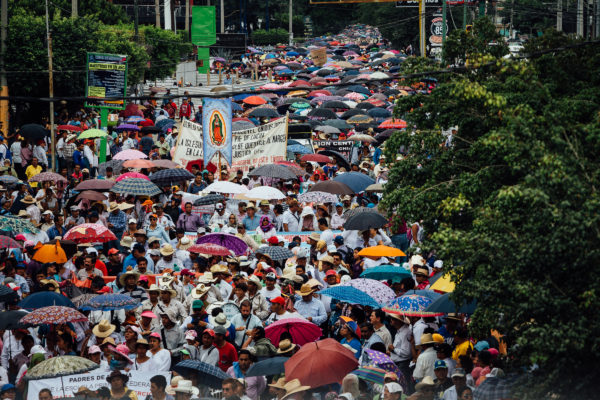
CNTE March in Tuxtla Gutiérrez. Photo: Carlos Rodríguez
“The school cycle ought to start today, but all the teachers are protesting here because of the government’s obstinacy,” said members of the National Coordinator Nacional of Education Workers (CNTE), after a march of more than 100 thousand teachers from the west to the Chiapas capital’s central plaza, 100 days after the teachers initiated their strike in protest over the self-named “education reform,” which the administration of Peña Nieto has wanted to implement in the country, even using public force to achieve his objective.
During the meeting in Tuxtla’s central park, upon welcoming the different contingents that participated in the mega-march, the question was if they were tired now, to which the teachers answered with a resounding NO, despite the long walk, despite the strong rain, despite the 100 days. The teachers emphasized that the reason for being of the teachers’ movement are precisely the students, parents and public education in Mexico.
“We are challenging the state’s authoritarianism; there is not one single educational level that is not in the movement,” they stated upon seeing the arrival of delegations of basic and middle higher education, as well as teachers’ college students, parents, retirees and social organizations in solidarity.
From Chiapas the CNTE spokespersons waved the checkered flag on stage three of the teachers’ movement magisterial that started last May 15, in which despite the fact that it will be critical and complex they will carry out more devastating actions, they assured. The CNTE movement called on the government to give an immediate response to the demand for abrogation of the “education reform,” the appearance with life of the teachers college students from Ayotzinapa Guerrero and the freedom of political prisoners in Mexico.
Members of Sections 7 and 40 of the CNTE affirmed that after more than three months, the movement remains alive and seeks a “democratic education, an alternative education project that goes from below to above.” They likewise warned that the media lynching against them would increase; therefore they will keep the parents continuously informed, who as of this date have been supporting them. “We have the support of all the aggrieved people,” they assured.
In his participation in support of the teachers’ movement, Father Marcelo Pérez representing the parish of the Simojovel community, asked those present if they were afraid, to which those present responded with a resounding NO, even after Peña Nieto’s threats to use public force against the dissident teachers. “In the face of tyranny, the people have the right to fight for the homeland and for liberty. If they touch the teachers they touch all of us,” the Chiapan parish priest assured. “They are on alert in the different communities to defend our teachers,” the religious man added.
—————————————————————-
Originally Published in Spanish by Pozol Colectivo
Monday, August 22, 2016
Re-Published with English interpretation by the Chiapas Support Committee
Chiapas: Oxchuc expels political parties
OXCHUC EXPELS POLITICAL PARTIES and WILL NOW ELECT ITS AUTHORITIES WITH USES and CUSTOMS

Oxchuc authorities, elected via uses and customs with their staffs of command.
By: Isaín Mandujano
Leaders of 105 Oxchuc communities agreed on the expulsion of the political parties from that municipio and from now on they will elect their authorities through [Indigenous] uses and customs; therefore they asked Governor Manuel Velasco Coello and deputies in the State Congress, for the recognition of current mayor Oscar Gómez López, because the mayor they removed, Maria Gloria Sánchez Gómez, is attempting to return to the position.
Coming from the 105 communities that make up that municipio in Los Altos of Chiapas, the indigenous authorities arrived in this city with their staff of command to show like that their rejection of the removed mayor and candidate of the PVEM, Maria Gloría Sánchez Gómez, who recently filed an appeal with the Supreme Court of Justice of the Nation (SCJN) with which she seeks to be reinstated in the position.
After several months of protest, last February, María Gloria Sánchez Gómez was expelled from the town and obliged to ask for a definitive leave before the State Congress, local residents named as a substitute Oscar Gómez López, a bilingual indigenous teacher that headed the movement to put an end to the 15 years of political bossism of the mayor and her PRI husband, Norberto Santiz Gómez, who controlled political power in the municipality.
“We are here to ask the State Congress and Governor Manuel Velasco to intervene and that the Oxchuc issue be definitively resolved, because María Gloria continues saying that she is the current mayor and that is not true, because starting on February 11 she asked for her abdication and the woman was politically finished there and on February 15 the people on the esplanade of the municipal presidency before some 30,000 residents elected the current substitute Municipal President, who is compañero Oscar Gómez López and precisely here are the compañeros agents and this is the best showing that what María Gloria says is not true,” said Juan Encinos Gómez, President of the Permanent Commission For Indigenous Peace and Justice of Oxchuc Municipio.
All the indigenous raised their staffs of command and chanted slogans against María Gloria Sánchez and others in favor of the new mayor Oscar Gómez López, who they said has the support of all of the people.
Nevertheless, they said, from the state capital the removed mayor has been incited to file an appeal before the Judicial Power of the Federation (PJF) to be reinstated in her position. They pointed out that they would not respect a decision that contradicts the decision of the people and that if necessary they would against take to the streets and the highway in order to be heard.
Juan Gabriel Méndez López, a lawyer and one of the leaders of the Oxchuc protest movement, said that the population agreed to expel all of the political parties from the municipio, and that they no loner want political parties that only divide the communities and provoke confrontation among indigenous brothers.
He exposed that from now on the municipal authorities would be elected by uses and customs, which will rescue the ancestral wisdom and knowledge to name their rulers like their ancestors did, because it has become clear to them that the parties only divide them.
He also said that on this occasion the people named Oscar Gómez López as mayor, and therefore the Executive, Judicial and Legislative Power in Chiapas must recognize the investiture that the new mayor represents.
They pointed out that if María Gloria Sánchez Gómez continues returning to Oxchuc to incite the population against the traditional authorities, she could provoke “another San Juan Chamula” and would then blame the authorities for not intervening.
It was the second time that María Gloria sought to serve in the position of mayor; the first time she did it on behalf of the PRI. Her husband Norberto Sántiz, also of PRI affiliation, twice occupied the position of mayor and was on one occasion a federal deputy.
——————————————————————-
Originally Published in Spanish by Chiapas Paralelo
Wednesday, August 17, 2016
Re-Published with English interpretation by the Chiapas Support Committee
Sup Moisés at the conclusion of CompArte
EZLN: “22 YEARS LATER WE ARE SHOWING THAT WE DON’T WANT TO USE THOSE WEAPONS, THAT IT ISN’T NECESSARY.”
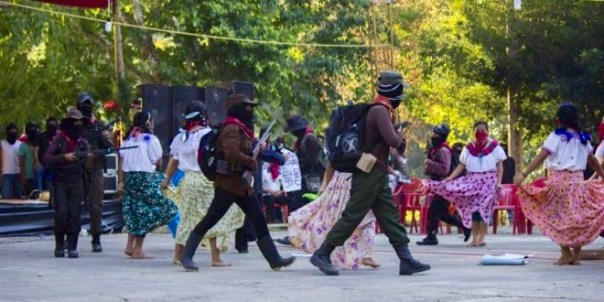
Dance performance at CompArte in Roberto Barrios
From the Desinformémonos Editors
Mexico City
Subcomandante Moisés, a commander and spokesperson of the Zapatista National Liberation Army (Ejército Zapatista de Liberación Nacional, EZLN), stated that: “the soldiers would not have to kill us because we have not wanted to kill them.” The example, he said, “the compañero support bases have demonstrated it (because) for 22 years we have preserved our weapons, like tools.”
During the clausura of the CompArte Festival in the Caracol of Roberto Barrios, in the Northern Zone of Chiapas, the Zapatista leader thanked the support bases for the demonstration of their art: “They have given us something great. For now we want to tell you that we understand that the word war is using a weapon, but here we are demonstrating, 22 years later, that we don’t want to use those weapons, that it isn’t necessary. We are demonstrating that there is [another] way to achieve freedom, justice and democracy; that it isn’t necessary to kill the soldiers that the rich, the capitalist has, with which he is defended.”
The CompArte Festival, according to reports from the alternative communications media that had access, toured the five Zapatista regions (Oventik, La Garrucha, La Realidad, Morelia and Roberto Barrios), in Los Altos (the Highlands), the Lacandón Jungle and the Northern Zone of Chiapas, with demonstrations of poetry, dances, songs, paintings and other artistic activities in which Zapatista support bases and organizations and collectives from Mexico and from many parts of the world participated.
Below is the whole comunicado published by the Free Media:
“Good afternoon bases of support, the Sixth, brothers and sisters that listen to us!
We really can’t find the words to say to you because of the big surprise that the EZLN’s bases of support artist compañeros have shown us.
You have given us a lesson, an instruction, a class; that’s how we, our comandante and comandanta compañeros, feel.
We are representing our Caracoles, you have helped us a lot; you have taught us a lot; you give us strength and, well, power. We have a big task that you have given us, a big job that you have given us, and because of our practice we have to think it through collectively with our compañera comandantas and compañero comandantes.
You have given us something great. For now we want to tell you that we understand the word war is to use the weapon, but here we are demonstrating, 22 years later, that we don’t want to use those weapons; it isn’t necessary. We are showing that there is a way to achieve freedom, justice and democracy; that it’s not necessary to kill the soldiers that the rich, the capitalist has, with which he defends himself.
The soldiers would not have to kill us, because we have not wanted to kill them. The example the support base compañeros have shown, for 22 years we have preserved our weapons like tools.
We want to construct our autonomy and we are showing our brothers of Chiapas, Mexico and the world, but you aren’t going to stop, because you won’t like capitalism. You oblige us and we have to look for the way in which that doesn’t happen, but if it’s necessary to defend, one must defend oneself.
We are able to understand without killing and without dying. To finish with capitalism we need to get organized, to construct a new house or to set capitalism aside. But for now that lesson that you have given us, there is a lot of work to do and to think about.
Here in Mexico they have us so divided, into the countryside and the city, they have us so distracted so that we don’t realize how w are subjected in manipulation, but this class that you gave us, EZLN support base compañeros from the five Caracoles, we are not able to say more right now, because it was more what you told us and presented to us.
It’s really recharging the battery for us and for the comandante compañeros. We are seeing the fruits of the labor of our compañero representatives that is the EZLN’s structure.
What would happen if the thousands of Zapatista artists from the five Caracoles were seen? Something much greater would come from it. There are many types of weapons, but not the ones that kill, but rather the ones that change the life, the thinking and the idea. In all the Caracoles that we have passed through, we have met and we didn’t find the words because we need to get deeper into it, but with that material that the compañeros from the tercios compas [1] are making, that will help us a lot.
For now we have enough material to get to work, to think about it and to concretize it so that if the bases approve it, it will be a real practice. That is the wisdom that we hear, see and later think about to put into practice, that is the spark of the art of seeing, of the art of listening, so that later it will be seen in practice for the benefit of one’s own people.
Art and science are really necessary to be able to destroy capitalism. We don’t know how, but we must think about it. There is no reason that we will see things differently, we are of the same original peoples in the countryside and also in the city. Our job is to think of how to unite because capitalism is going to destroy us.
And that is the importance of art and not only for Mexico. So, the instruction that you gave us hasn’t fit in our head, we have to go over it again, that is what we feel.
Thank you to the bases of support from the five Caracoles and the invitees for accompanying us. Our thinking about what we are going to tell you will arrive soon and you will decide if it’s so or not. We will look for the art of how to reach consensus on what will emerge in the practical work of what we said in this art of struggle.
Thank you brothers and sisters bases of support and compañeros of the Sixth.”
[1] The tercios compas – the Zapatista media team
——————————————————————–
Originally Published in Spanish by Desinformémonos
Monday, August 15, 2016
Re-Published with English interpretation by the Chiapas Support Committee
CNTE causes more economic damage that EZLN Uprising
ECONOMIC DAMAGE from the CNTE IS GREATER THAN THE ZAPATISTA UPRISING: Coparmex-Chiapas
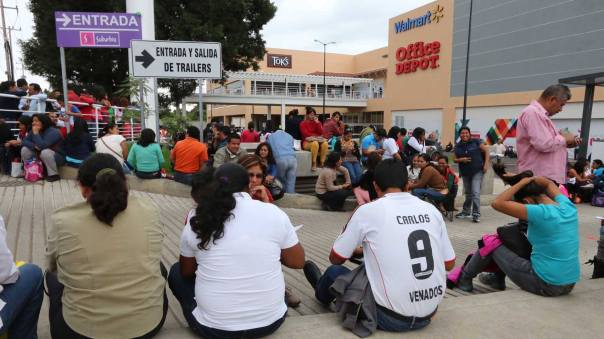
CNTE shutting down business in Tuxtla Gutiérrez, Chiapas.
By: Isaín Mandujano
TUXTLA GUTIÉRREZ, Chiapas
The president of the Employers Confederation of the Mexican Republic (Coparmex) in this state, Enoc Gutiérrez, said today that the economic damages caused by the teachers’ conflict “are worse than those of 1994,” after the armed uprising of the Zapatista Nacional Liberation Army (EZLN).
Enoc Gutiérrez reminded that on Tuesday August 2, the Employers Center affiliated with the Coparmex presented a legal demand for an amparo (protective order) to the Judicial Power of the Federation (PJF) against the state and federal authorities due to “omissions” in attending to the teachers’ conflict that, after more than 90 days, has allegedly caused million dollar losses in Chiapas and other states in the country.
Although the case could be resolved in the coming days or weeks, Gutiérrez maintained that: “this is one of the worst situations that reflect economic damages and affectations, we evaluate and tell you that they are even worse than those in 1994. And we have an international context much more complex and a devaluation in the Mexican economy.”
He also clarified that the business owners “are not enemies” of the government authorities or of those who head the institutions of the Mexican government, but neither will they be accomplices in permitting that conflict situations cause damages to third parties that affect the economy and above all that impair the education of the state’s children.
Later he said that they would not promote the repression of movements when they are conducted with unrestricted adherence to the law, and that they will always make use of the laws that they have at hand for defending their right to free movement and the free exercise of labor and free enterprise.
He also pointed out that the demand for an amparo is so that the Mexican State will act and re-establish the peace and respect the constitutional guarantees, like the right to education.
Lastly, he demanded that the federal government and the CNTE go further in their tables of dialogue and negotiations and produce concrete results to put an end to the conflict.
——————————————————————
Originally Published in Spanish by Proceso.com.mx
Tuesday, August 16, 2016
http://www.proceso.com.mx/451121/dano-economico-cnte-mayor-al-alzamiento-zapatista-coparmex-chiapas
Re-published in English by the Chiapas Support Committee
The children of Nochixtlán
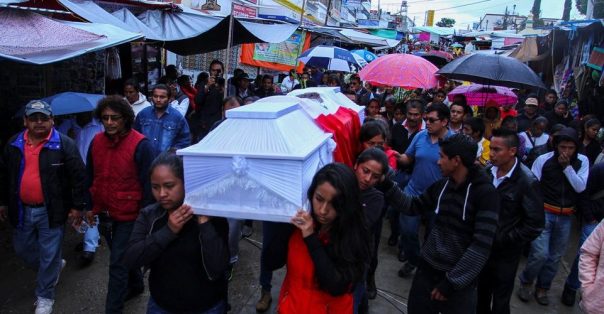
A funeral in Nochixtlán
By: Luis Hernández Navarro
When the helicopter flew over Casa Xitla, in southern Mexico City, the children from Nochixtlán that are temporarily housed there run to hide, terrified. The sound of the iron bird over their heads revives the fear and desperation that they experienced in their town on June 19, when the police massacred their friends and relatives.
Almost two months have passed since the attack, and the little ones haven’t forgotten what happened. The police violence appears in their drawings and in their dreams, in their conversations and in their future. When he’s big, says one of the boys, he wants to be the police to kill the other police that gassed him and crushed his relatives to death.
That June 19, 26 saw their fathers go out to defend their town from the aggression of the gendarmes and then run and hide. For days, in the esplanade of the Nochixtlán temple, two cardboard signs had the names of the minors that lost their fathers in the Federal Police attack.
That day, in the humble district of November 20, which doesn’t have water or electricity, some 30 police launched gas against houses constructed of metal sheets, cardboard, aluminum cans and scanty materials. 32 children were there, none older than 11. The little ones, seated on a mat told Arturo Cano how felt suffocated and vomited from the smoke of the tear gas.
One of them talked to him about how they heard the police barking: “Come here, you’re going to get fucked up here.” Another told him that they were shouting vulgarities and were provoking the teachers. Another one described how “they used their pistols and started to kill people.” And another boy said that they tossed a round thing behind a house, which “exploded, drew fire.”
In total, about 70 minors were direct victims of the police attack. The psychological damage that they suffered is skin deep. One must add to the count of the child victims the children of those murdered and disabled by the police attack. Starting now, without anyone to bring sustenance to the house, they and their mothers will have to work to earn a living.
The Nochixtlán Massacre left a tragic result of eight civilians murdered (11 in Oaxaca), 94 wounded by bullets, 150 direct victims and between 300 and 400 indirect. Those who suffered major injuries, who still have bullets in the stomach, from what will they live now? It certainly won’t be from cultivating the fields.
The vast majority of the Nochixtlán victims are humble people, who live without savings and with very few resources. Facing the government’s refusal to offer them medical attention and the fear of being persecuted, they had to spend their small incomes to heal poorly with private doctors.
Pain upon pain, tragedy upon tragedy, the families of the eight murdered today suffer not only the loss of a loved one, but also a heavy economic debt. They buried their dead as tradition commands, feeding those who for days accompanied them in their grief. A funeral like that costs at least between 100 and 150 thousand pesos, an expense that can only be paid with loans on which they must pay usurious interest rates.
Dozens of those victims gathered last July 31 in the emblematic Plaza de las Tres Culturas, in Tlaltelolco, with crutches and bandages. With rage and courage they narrated to the press their pain and showed their wounds. We are here –they said– we have a name, we have a face, we are afraid. We are here, we have come to demand justice, not money.”
Indignant because of the signals from PRI deputies like Mariana Benítez (assistant prosecutor when the 43 Ayotzinapa rural teachers’ college students were disappeared and co-author of the “historic truth”), they denounced that: “there were bullets that entered through the mouth and came out through the ear; shots that impacted in the legs, ankles, groin, as well as the stomach, chest, back, feet and toes.”
The anger of the Nochixtlecos with Deputy Benítez and with other members of the special legislative commission for investigating the facts in Nochixtlán comes from the enormous scorn with which they (commission members) have treated them. Their word has no value. Although that commission has been formed since last July 6, its members have been incapable of meeting with representatives of the Victims Assembly. They have talked to the PGR, the president of the CNDH [National Human Rights Commission] and the Oaxaca ombudsman, but not to those directly affected.
Moreover, various legislators have called the victims’ version of the facts into question. That’s what happened, for example, last July 26. That day, the head of Oaxaca’s Human Rights Ombudsperson, Arturo Peimbert, questioned before the commission that it’s not clear what the Federal Police (Policia Federal, PF) operation was pursuing in Nochixtlán, because “if they wanted to achieve the eviction from the superhighway in 15 minutes, they achieved it,” and he asked: “Why did they enter and raid the urban zone, the districts like November 20?” Several members of the commission responded angrily, placing the ombudsman’s version in doubt.
Almost two months have passed since the Nochixtlán Massacre, and the federal government has been incapable of offering a coherent and credible report about what happened. Nevertheless, versions have been leaked to the press that excuse the Federal Police and the Gendarmes of the repression, at the same time that it blames five popular organizations in the region. A new historic truth is underway.
It’s urgent to know the truth about what happened in Nochixtlán, to punish those responsible and to repair the damage. It’s urgent that the children and those affected are healthy. As the victim say: “if the government invested so much to murder them, they should now invest in healing us.”
———————————————————–
Originally Published in Spanish by La Jornada
Tuesday, August 16, 2016
En español: http://www.jornada.unam.mx/2016/08/16/opinion/017a1pol
Re-Published with English interpretation by the Chiapas Support Committee
Zibechi: New black movements in Latin America

Black lives matter art by Emory Douglas.
By: Raúl Zibechi
Last June 11, a group of neighbors from the Morumbi barrio of São Paulo demonstrated in support of the police that killed Ítalo, a 10-year old black boy. According to the demonstrators, the boy was just a delinquent that deserved what happened to him. Morumbi is the city’s richest neighborhood and is known for its mansions and luxury condominiums, where Brazil celebrities and important people live.
That same morning, 30 black activists from the urban periphery arrived with banners and photos of youths murdered by the Military Police, rebuking the demonstrators as “racist killers.” “I am here fighting against the bourgeoisie that goes into the street to make our death natural and banal, the death of black youths from the periphery,” a 21-year old youth from the east zone of São Paulo told the media (http://goo.gl/cdOYBE).
Certainly, it was a small but important response that places in evidence what to many is the current Brazil’s greatest contradiction: racism. It’s interesting to emphasize that the young black militants crossed the whole city, in a trip of no less than two hours each way, to challenge the dominant classes in the territory that represents the nucleus of their power; an attitude that reveals conscience, organization and courage.
That same week of June, the black Colombian communities that participated in the Agrarian, Campesino, Ethnic and Popular Minga carried out important actions, like the takeover of Port Buenaventura, in which 130 boats of fishermen and hundreds of demonstrators grouped together in the Process of Black Communities (PCN, its initials in Spanish) closed the port. “The sea belongs to us,” was the slogan with which they blocked the most important port of the Pacific, the region converted into territory where part of the black people live.
The Association of Community Councils of the Northern Cauca (Aconc) mobilized within the same context as the Minga demanding the defeat of the mining titles that were granted to transnationals, with mass marches in Quinimayó, in the municipio of Santander de Quilichao. One of their leaders, Víctor Hugo Moreno, emphasized that mega-mining “is displacing ancestral and artisanal mining, affecting water sources and breaking up our territories and organizational processes” (http://goo.gl/Loz21s).
The PCN is made up of 120 grassroots territorial organizations, from the Caribbean to the Pacific, and functions with their base in regional palenques (Afro-Colombian historic villages), with a national assembly that elects a council of all the palenques. The Aconc unites around 40 community councils in 10 municipios in the northern Cauca. Both participate in the Agrarian Summit that organized the national strike in June (http://goo.gl/DfboIk).
With big differences between them, the new movements of Brazil and Colombia are experiencing a new phase. After resisting an undeclared war, they show signs of going on the offensive. Of the 5 million black Colombians, terrorist actions of the paramilitary groups and the armed forces have forcibly displaced more than 700,000. In Brazil, violent death of blacks increased almost 40 percent since 2003, when Lula arrived in government, while the violent death of whites fell 25 percent. They are not, of course, the only countries where black resistance is entering into a new stage.
Dozens of collectives have been born in the favelas and urban peripheries of Brazil that represent a new generation of militants; many of them formed in secondary colleges and universities, with strong leadership from young women. One of the most significant is called Occupy Alemão, in the complex of favelas of Maré (Río de Janeiro). The collective groups together between 20 and 40 people; it was born in response to the military occupation of the Alemão favela in 2010, and the construction of cable cars so that tourists can photograph the poor, a real open sky panoptic for control of the population.
Occupy Alemão proposes that: “we occupy our favela with collective actions.” They reject the way in which the lefts relate to the favelas and don’t spare criticisms of the NGOs. Among their activities they emphasize cine-debates, games with children, graffiti workshops, the Occupy Rock Festival held in August 2015 and the annual Black Economic Fair, iteration between black spaces, for the purpose of spread the cultural and political resistance.
In the fairs, each exhibitor gives 20 percent of his earnings to a fund for fights and support for victims of the State. They maintain that: “economic blackness does not offer anything new for the favela or to black people, nor does it represent a new ideology”; to the contrary, “it is the quilombo (palenque) that teaches us about economic autonomy and self-management. The favela inherited it and makes its business of its space. Economic blackness is our best way of supporting ourselves collectively. Our own fair: Black Autonomy!” (https://goo.gl/AQ4Z5I).
The Occupy Alemão members recognize having passed through three stages. The first stage was with NGOs and it left a bad taste. Next, they linked with autonomous movements in other favelas and created the Popular Forum of Mutual Support. In the third stage, they tightened their ties with the React or Die campaign (Reaja ou Seja Morta, reaja ou seja morto), which was born in Bahia in 2005, with which they organized the March against the Genocide of Black People.
The React campaign is, probably, the most important creation of the black movement in Latin America (for its rejection of cooptation and the State, for its autonomous ways, for its radicalism), which we activists should know about (reajanasruas.blogspot.com). Hamilton Borges, founder of React, traces a balance of these 10 years based on what he calls the “theory of general failure, if success is promoting equality. If success is sitting down with the enemy faced with the blood of our people, then we prefer the failure of confronting terror in the streets.”
————————————————————
Originally Published in Spanish by La Jornada
Friday, July 22, 2016
http://www.jornada.unam.mx/2016/07/22/opinion/018a1pol
Re-Published with English interpretation by the Chiapas Support Committee
Critical thought versus the capitalist hydra II

Mural art at CompArte in the Zapatista Caracol of Morelia, Chiapas.
By: Gilberto López y Rivas / II
Continuing with commentary on the second tome of the work Critical thought versus the capitalist hydra, Sergio Rodríguez Lascano proposes that, faced with the diversity of rebellious processes, the idea of a vanguard becomes obsolete and he replaces it with meeting and sharing, which must also be present within the terrain of ideas. “Breaking with individualism in theoretical elaboration is a precondition of critical thought.” He proposes constructing a world in which the hydra cannot be reproduced. It’s not about conceiving other worlds, but rather about constructing them. “One cannot destroy the hydra if our political and ethical behavior counts on the same principles that the hydra has imposed, since domination is domination.”
Luis Lozano Arredondo begins with a criticism of the universities, which, he asserts, remain in the comfort of theory, while the knowledge of the communities in resistance advances in the construction of a world of self-management. He exposes how exploitation and dispossession in our country is expressed, to the extent that 85 percent of the population experiences poverty has lost all its labor rights and maintains high levels of unemployment and overexploitation. He proposes collaborating, cooperating and sharing our knowledge with other humans to imagine and construct another world.
Rosa Albina Garavito considers that the catastrophe that the Zapatistas announce in reality surrounds us, destroying everything in its path: our labor force –up to 60 percent of the occupied population swelling the ranks of informal employment–, labor stability, working conditions agreed upon bi-laterally, pension funds, salaries, savings accounts, the more than a thousand quasi-state companies, among them Pemex. Health services, education, housing, nutrition have deteriorated; in sum, the capitalist hydra has dismantled without effort social rights we won and the only thing left is our dignity and self-organization. She considers autonomy as the project of the future, with dignity and decision-making ability versus the State. With autonomy, the Zapatistas are cutting off many heads of the capitalist hydra. It is the seed of the new country.
Efraín Herrera, from the Callejero Collective, considers that they construct a distinctive esthetic discourse starting with a rebel attitude in capitalist society, starting with what Bertolt Brecht maintained; that “before being an artist, you are a social being.” It is in the field of rebellion where one finds creative character, imaginative and purposeful. This implies taking an attitude versus the State. They found that the pamphlet doesn’t provoke immediate reflection and opted for the metaphor as an effective tool that leaves the door open to a lasting reflection. They are convinced that there is no other alternative than to form more and more collectives.
Eduardo Almeida Acosta considers that we are experiencing the global apocalyptic situation, a capitalist nightmare, now neoliberal, globalizing and extractivist: “The narcissistic zeal or the effort to preserve one’s own existence at the expense of all the others… and to seek its perpetuation as a system without importance to whether it implies violence, war and death. That is reflected in our country, the mined Mexico: a bankrupt republic, a country at war with itself; a mafia State and a corporate waster, a dark government, about social control and aligned with speculative business elements and in collusion with criminals.” One head of the hydra is the perversion of politics; another has been the injustice in the treatment of different cultures; a third is the plunder of national sovereignty, of the individual rights and of social and community rights, and a fourth head forms the complex of misadventures that all Mexico suffers due to the impoverishing management of the macro-economy. The injustices of the financial markets are another big head. He wonders: what to do in the face of this devastation? Intensifying rage, putting the body (on the line), challenging everything, inventing new forms of struggle versus domination: another democracy, other forms of autonomy, another anti-imperialism. Dreaming, imagining, ideating other forms of weaving social cohesion.
Vilma Almendra, an indigenous Nasa-Misak woman from Colombia, confronts the four heads of the hydra: terror and war, structural adjustment, propaganda and cooptation and assimilation of struggles. Terror and war as the instrument for dispossessing the communities; structural adjustment between the transnationals and the States for defining all the laws of dispossession and for imposing the agendas of above; propaganda in the communications media, the churches, the schools that seek to dispossess distinctive and critical thought, and the cooptation that robs entire processes, stops the movements, even through concepts like multiculturalism. She criticizes negotiations with governments, which are executioners and that ultimately end up with meeting after meeting, committee after committee, confusing the political agenda of struggle and being subjected to the State’s agenda. Despite it all, she considers that the policies of the transnationals and the bad government are not winning, making a journey through the struggles for Mother Earth / Madre Tierra. “It’s important to see and to know that these struggles, resistances and freedoms, despite the politics of extermination and dispossession, continue flourishing, continue emerging, are there in front of us, versus the capitalist hydra.” She invites re-appropriating words into the walk, in what she names “palabrandar our path of the dignified word.” Revitalizing the assemblies as the maximum authority. She maintains that: “from the territories, and also from academia (it’s about), attaining harmonizing theory and practice, because at times from academia we imprison ourselves in the practices and we convert them into concepts, we are leaving them without wings.” Nevertheless, she rejects that essentialism constitutes a position of the peoples and the communities; “we are not pure,” she asserts.
———————————————————–
Originally Published in Spanish by La Jornada
Friday, August 5, 2016
http://www.jornada.unam.mx/2016/08/05/opinion/018a2pol
Re-Published with English interpretation by the Chiapas Support Committee
Art that is not seen or heard

Occupy (Okupa) art from CompArte! Note the remembrance of the black power protest during the 1968 Olympics.
(Note: the following are the comments made by Subcomandante Insurgente Moisés to mark the conclusion of the Zapatista’s contribution to the CompArte, in the Caracol of Oventik, on July 29, 2016. The threat of rain and the pressure of time did not allow for the compañero to fully develop some of his points and there were others that he was unable to touch on at all. Here we present the original version that he was going to give. In his voice is our Zapatista word).
THE ZAPATISTA NATIONAL LIBERATION ARMY
MEXICO
July 29, 2016.
Artists of Mexico and the world:
Sisters, brothers, and hermanoas:
For us, the Zapatistas, art is studied by creating many imaginations, reading the gaze, studying in listening, and practicing.
It is by putting it into practice, that is, by doing it, that you will begin to see the result of the science and the art of imagination – the art of creativity.
There is some science and art that is needed immediately, the kind that helps us imagine how to do it.
There can be medium term science and art, and there is long term science and art that improves over the course of time.
For example: To even make something tiny that will contribute to the new world requires that we involve ourselves profoundly in the science and art of imagination, in the gaze, in listening and in creativity, patience, and attention. It requires that we think about how to move forward while building and many other things that must be taken into account.
Because what we want, or what we think about, is a new world, a new system. We don’t want a copy of what we have, we don’t want to improve it a little bit. This is a problem, we say, because there is no book or manual that explains how to create this new world. This book or manual hasn’t been written yet, it is still in the heads of those with imagination, in the eyes that are ready to gaze at the new world that they want to see, in the ears that are attentive in order to hear the new world that they want.
This requires a lot of wisdom and intelligence, a good understanding of many words and thoughts.
We say that it works like this because this is how the development of our autonomy has been and will continue to be.
It was built by thousands of Zapatista men and women, with science and art, and for now it can be seen in the 5 zones of the caracoles.
The art that we are showing you, our compañeras and compañeros, had a crude birth, it emerged from the heads of those women and men who themselves decided how to present it to you, [it is] about how they have worked as Zapatistas and autonomous people, with their resistance and their rebellious ways.
The entire process was a chain of art – from the thinking about what they would present, whether it would be a dance number, song, poetry, sculpture, theater, or pottery, to the words, the ideas about how they would get from place to place, then where they were going to get the money for their rehearsal and performances, because they are collectives from the community, the region, the municipalities and the zone.
There were three rounds of selection. For the first round, the people got together in their regions; then the regions met as autonomous municipalities for the second selection; and the municipalities met in zones for the final round.
Their preparations took months.
For the communities of thousands of Zapatista men and women, it was another iteration of what we are, but in a different form, it didn’t happen through conversation or blah blah blah, but through the technique of Art, and everyone participated – children, teenagers, fathers, mothers, and grandparents.
In artistic form, in the art form of the Zapatista compañer@s, they were practicing their resistance and rebellion, their autonomous government of the Junta de Buen Gobierno, their MAREZ (Zapatista Autonomous Municipalities in Rebellion), their local authorities (comisariadas, comisariados, agentas, and agentes), their autonomous health systems, their autonomous education system, their autonomous radio stations, their 7 principles of lead by obeying in their new system of autonomous government, their democracy as communities, their justice, their freedom, their defense of mother earth, and their collective work on mother earth. This will all be the basis on which new generations of young women and young men will be formed, the basis for the Zapatista future.
This is what we presented to you, compañeras and compañeros of the national and international Sixth from Mexico and the world; only a small portion of the compañer@s that were going to participate actually participated. One day we will present the rest to you, but right now there isn’t time, because if we had all come, it would have taken over a month to do all of our presentations, and so that means that there is also an art and a science to how we planned to do a one-day presentation. Because collective mutual support is the most marvelous of all of the arts.
-*-
Compañeras and compañeros from the National and International Sixth:
Sisters and brothers of Mexico and the world:
The storm and the hydra of monstrous capitalism want to prevent us from seeing one another, but through our great effort we are seeing one another here and now.
The compañeras and compañeros from the thousands of Zapatista bases of support for the Zapatista National Liberation Army want to show you their art.
You have seen one part here and in other caracoles you could see other parts. Because more than two thousand artists have been selected and there were even more who didn’t come, not because they didn’t make it through the selection process, but because we didn’t have the money to transport thousands of compañera and compañero artists.
Our compañera and compañero artists aren’t professional artists, but rather their profession is what we call “Everythingologist [Todólogo]” because they are carpenters, masons, shop keepers, they work the land, are radio hosts, milicianos and milicianas, insurgentas and insurgents, autonomous authorities, teachers at the Zapatista little school, health and education promoters, and they still find the time to be artists.
They are true artists in the art of constructing a new system of governance, the autonomy where the people command and the government obeys.
It is an art that you can see, study, and that exists in practice, that you can know through its sharing.
But the compañeras and compañeros also make other art that you don’t know about, that isn’t disclosed in any press releases.
It is the art of solidarity, the support for the people who struggle.
Because the other art and science that the compañera and compañero Zapatista bases of support practice is their support for the struggle of the teachers movement.
You did not see this science and art, but the way it was delivered; the food support was like the art of a hornet’s nest, but there was also an art and science that preceded this.
This is what happened:
We realized that we needed to support this struggle by the teachers who are resisting the capitalist hydra and storm, which we have been talking about for a year.
So then we figured out how much support we were able to give. First we used our word to support them, to say that their struggle is a just one.
Then we tried to figure out how to support the resistance at the sites where they were putting up roadblocks and sit-ins and we realized that we could support them by providing food.
Then we assessed how much support we could send them, and first, how our compañeras and compañeros would respond if we supported them with food from the little that we have as a result of our collective labors.
We figured out how, for example, the food support could work—the delivery, the bags, and all of that. But what you don’t see is the organization of the food collection community by community, the division of how much each community was supposed to provide, figuring out how many tons they were going to be able to get together so that they could figure out how they were going to transport it. Then there was the timing, because the news was saying that the blockades were still there, and then that the teachers were going to take them down to avoid being forcefully evicted because what they were doing was really hurting the rich, and this put a lot of pressure on us because the food that we collected would spoil if there wasn’t any place to take it to.
They had meetings everywhere in order to come to an agreement, because all of the compañer@s said that the support that we needed to give to the teachers’ movement was just and necessary.
So they started to do the math (i.e division), the accounts as we say, say of how much each zone, MAREZ, region, and community was responsible for. There were a few zones where the commissions failed to meet their goal, they didn’t fail in a bad way, but in a good way, because they had reported that their commission would provided 2 tons of food and when the time came they actually provided 7 tons more than they had promised, which was the case with the Zapatista bases of support in the Northern Zone of Chiapas, from the Caracol of Roberto Barrios. And so, well, resolving the problem was Art, because no one had even imagined that they could provide 9 tons. We only had a 3-ton truck.
The compañeras’ work is really art, because they were asked how long it will take them to have 100 thousand tostadas ready – how could they calculate that when the corn is still on the cob?
Well the compañeras responded that the tostadas would be ready on x day at x time. Because they know how many hours it takes to cook the corn, and how many tostadas you can get from a kilo of corn.
And the compañeras even add flavor to the tostadas, from a little bit of beans, and salt, because they know that the tostadas are to support the teachers at the sit-ins and in resistance.
And that is how they did it and now it is done, but you can’t see it because it is already in people’s stomachs, or it has become fertilizer because the companer@ teachers have already consumed it.
Collective work, the common, made it so that they could move things easily, from one hand to another, others moved things on horses, others by foot and on their back, others by car.
Thanks to the collective work of the compañeras and compañeros.
It was all a mathematic calculation, from beginning to end.
All of this, it is all an expenditure, and the great majority is from collective work, communities, regions, autonomous municipalities. It is the real fruit of our work as organized communities of men and women.
But you didn’t see any of this and you wouldn’t know about it if we didn’t tell you about it, and it’s all the work of our Zapatista compañera and compañero bases of support, in order to show that we care about a people who struggles with resistance.
Why do we do this? Well, because we know and understand what it is to resist in struggle and how much work it takes to maintain a struggle in resistance.
Figuring out how to provide this support is an art of imagination by the Zapatista communities. The “resistance” of the compañeras and compañeros has gone on for 22 years, and that’s a lot of experience and solidarity is a great building block. It is the demonstration of collectivity. For 22 years we Zapatistas have been in resistance and rebellion against capitalism, and we’ve had, for 22 years, a new system of governing ourselves where the people command and the government obeys.
-*-
There are those who think that we should go out and struggle for the teachers. But if they think that way, then they haven’t understood anything at all. Because that would mean that I want someone to come and struggle for me. We, the Zapatista men and women, don’t ask anyone to come and struggle for us. Each person must struggle, and we should mutually support one another, but that support cannot replace each person’s struggle. Whoever struggles has the right to decide the direction of their path and with whom they walk that path. If others insert themselves, then they are no longer supporting that struggle, but supplanting it. Support is respect, not trying to direct or command. Just as we have understood that no one is going to give us what we need to eat if we don’t work for it ourselves – it’s the same thing. No one is going to liberate us except for ourselves.
That is how we peoples of Mexico and the world organize ourselves, how we struggle in the world where we are in order to change it, as workers, teachers, peasants, all kinds of workers, we don’t hold out hope that someone is going to come and struggle for us.
This is how we already live, and they [the bad government] only come to try to manipulate us, to fool us and to do the all of the things they do to us.
-*-
Art, brothers and sisters, compañeras and compañeros, is very important, because it is what provides us with an illustration of something new in life, something that illustrates something very different in real life—it doesn’t lie.
Art is so powerful because it is already real life in the communities where the people command and the government obeys, thanks to the art of the imagination and the knowledge of how to create a new society, how to create a life in common. Our art shows that it is possible to create another form of governing, one that is totally different, that it is possible to create another life working in common to benefit the community itself.
This makes me think of the deceased Subcomandante Insurgente Marcos, who often asked us questions when we were building a little house, there in the jungle, with Comandante Tacho. The deceased asked us, “These crossbeams, what are they for? Can you explain to me scientifically what they are for? And we were about to answer, when he hit us with another question, “Is it science, or is it custom?” Comandante Tacho and I looked at each other, and since he was in charge of the construction it was up to him to respond, “Well, I learned from my father, and my father learned from my grandfather, and so on,” said Comandante Tacho. The deceased responded, “Ah, well then it’s custom, and it’s not based on a scientific study.” So he explained to us why the sciences and the arts are so important. And now we are coming to understand this. But wait, I’ll tell you what the deceased scribbled down or wrote to us from the place where he now lives six feet under; we’re going to ask him to send it to us and we are going to publish it, those of us who are still alive here where he had been living before. So, compañeras and compañeros, sisters and brothers, we Zapatistas think that now more than ever, we need ART, ORIGINAL PEOPLES, AND SCIENTISTS in order to give birth to a new world.
So compañera and compañero artists from the National and International Sixth, get involved in the work of art with a lot of enthusiasm.
Join us, brothers and sisters of Mexico and the world, in dreaming of an art where the people command, for their own good and the good of the people themselves.
Thank you,
From the mountains of the Mexican Southeast,
Subcomandante Insurgente Moisés.
Mexico, July 29, 2016.
Song: “The Capacity of Women”. Lyrics, music, and choreography from the young, female and musical Zapatista group “Dignity and Resistance,” bases of support from the Altos Zone of Chiapas. When they performed in Oventik, on June 29 in the afternoon, the sound system failed and it made them a little bit sad. And so on June 30, in CIDECI, SubMoy asked the compañero musicians Panteón Rococó and Oscar Chávez to stop for a minute and they gave up a few minutes of their time (Thank you Don Óscar, thank you Panteones). The compañeras were able to present what they had been preparing for more than 5 months. When they finished they reported back to SupMoy. “We’re back,” they said. SupMoy said, “How did it go?” and they said: “We won.” SupMoy didn’t say anything but he was definitely thinking,” “All in all, 500 years is a short time, but I never thought that I would get to hear this.” They continued, “We felt a little bad because the people were asking for another. A lot of people were yelling ‘One more! One more!’ but we didn’t know another one. It took us a long time just to make this one. If they want another one, they are going to have to wait a another six months.” SubMoy asked, “And so what did you do?” “We left the stage quickly and hid ourselves among the compañeros.” That’s what they said and then they went to the dance floor for the Panteones’ ska.
https://www.youtube.com/watch?v=yqjLuz8drqs
Dance number: “The Dance of the collective work of Maize.” Choreography by the Zapatista bases of support of the Altos Zone in Chiapas. This is the version that they presented during the selection process. For the presentation on July 29 in Oventik they added a few more things, as those who were there got to see. Maybe in the compa media they have a video of July 29 in Oventik.
https://www.youtube.com/watch?v=KJWcAzH7N-Q
Poetry: “When the Horizon looks to tomorrow.” Written by a young Zapatista base of support from the Altos Zone in Chiapas. This is the version that he presented in the selection process. When he presented it, he was told that there would be a lot of people there, but not to get nervous. “Keep your eyes on your notebook and don’t look up,” they recommended. He said that he wasn’t scared but he was confused about one thing. “What is it?” they asked him. He said, “I don’t know if you are supposed to say ‘poem’ or ‘poetry’. And so we ask you for a reply to his question.
https://www.youtube.com/watch?v=9eb6qfbDowg
=====================
En español: http://enlacezapatista.ezln.org.mx/2016/08/03/el-arte-que-no-se-ve-ni-se-escucha/
 Chiapas Support Committee