Chiapas Support Committee
Home of the Compañero Manuel blog on zapatistas & mexico
CNI & CIG Declaration 3 years after Ayotzinapa
Declaration from the National Indigenous Congress and the Indigenous Governing Council Three Years after the Disappearance of 43 Students from the Isidro Burgos Rural Teachers College of Ayotzinapa

To the fathers and mothers of the 43 student compañeros of Ayotzinapa disappeared by the bad government:
To the people of Mexico:
To the people of the world:
To the National and International Sixth:
Three years after the Mexican government disappeared 43 sources of hope, we as the National Indigenous Congress embody the pain, indignation, and rage that lives and will continue to live until our student compañeros of the Raul Isidro Burgos Rural Teachers College of Ayotzinapa, Guerrero, are returned. The demand to find them alive maintains us in unity with their parents and compañeros.
The student compañeros are still disappeared and the State has merely placed its bets on their being forgotten and on disdain for memory. It has wagered on destruction, and from the ruins we, men and women, will reconstruct conscience, hope, and a new world.
Our call is for the reconstruction of this country, and in order to reconstruct ourselves along with it we need the return of our student compañeros of the Raul Isidro Burgos Rural Teachers College and the thousands of disappeared for whom Mexico below searches without ceasing, reconstructing from that effort truth and justice.
We repeat our words for those who are not with us, for those who are, and for those who are yet to come. We struggle and will continue to struggle for the return of our student brothers and sisters of Ayotzinapa to the end. They were taken alive; we demand them back alive!
We convoke all those who to make up the people of Mexico, the original peoples, barrios, nations, and tribes and non-indigenous peoples from the countryside and the city, to continue the struggle to bring them home alive and punish the guilty.
We call upon everyone to participate in the marches and mobilizations convoked by the mothers and fathers of the 43 disappeared from the Isidro Burgos Rural Teachers College of Ayotzinapa, Guerrero, three years after this crime committed by the State.
September 26, 2017
For the Full Reconstitution of our Peoples
Never Again a Mexico Without Us
National Indigenous Congress
Indigenous Governing Council
Donate to Express Solidarity with Mexico Earthquake Victims
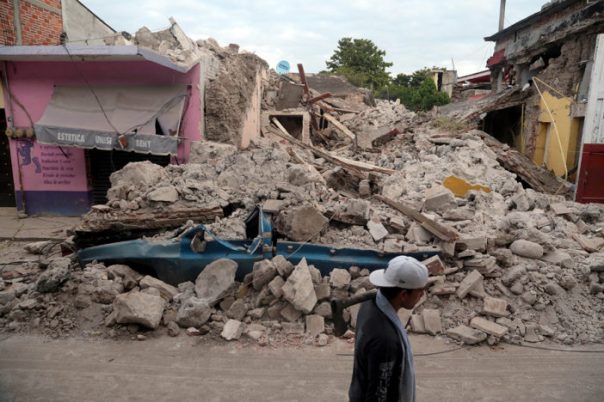
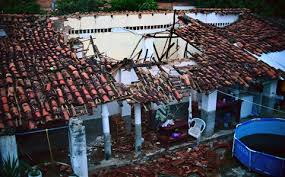
Earthquake damage in Jojutla, Morelos, Photo: Margarito Pérez
It began on September 7 off the Pacific coast of Chiapas with an 8.2-magnitude earthquake, the strongest ever recorded in Mexico. Both Chiapas and Oaxaca suffered extensive property damage and a loss of life. Homes, businesses, churches and highways are destroyed and/or damaged. Many residents of both states are now homeless and living outdoors with nothing but plastic tarps for shelter from the rain. Since then there have been continuing aftershocks and minor earthquakes, as well as heavy rain from tropical storms.
On September 9, the National Indigenous Congress (CNI) requested donations for those affected by the earthquake in Chiapas and Oaxaca. The Zapatista National Liberation Army (EZLN, its initials in Spanish) is a member of the CNI and has already donated money to the CNI for all the indigenous peoples and communities affected by the earthquake.
Meanwhile, Hurricane Jose battered Veracruz and a tropical storm caused severe flooding in Guerrero. On September 19 a major earthquake devastated parts of Mexico City and its surrounding states. Many of us have seen the loss of life and collapse of buildings in Mexico City on TV, but there is also extensive property damage and loss of life in the states of Mexico, Morelos and Puebla. The town of Jojutla, Morelos, near the epicenter, is almost totally destroyed. Many indigenous communities and organizations belonging to the CNI are located in these states.
Faced with this catastrophic situation affecting its member organizations, the National Indigenous Congress (CNI) again asked for donations to help the victims of ALL these disasters. It named the official organizations for receiving solidarity donations.
Now, according to the US Geological Service, a 6.1-magnitude earthquake struck close to Matias Romero, Oaxaca, on Saturday, September 23. Matias Romero is located on the Isthmus of Tehuantepec. Both Chiapas and Oaxaca have communities that are part of the Isthmus. This is the same area affected by the September 7 earthquake! A 6.1-magnitude earthquake can cause a lot of damage. Although reporting on this new earthquake is sparse so far, there is certain to be further damage to the farming communities and towns in that part of the Isthmus.
While reports of humanitarian aid not reaching those who need it are widespread, there are also reports of heroic citizen efforts to rescue earthquake victims and provide material aid. Social justice, community and international organizations are helping to provide food and shelter. And, as noted above, the Zapatistas made a monetary contribution.
The Chiapas Support Committee joins in these humanitarian efforts and renews and updates our original call for donations to a human rights center designated by the CNI, the Digna Ochoa Human Rights Center (Centro de Derechos Humanos Digna Ochoa) in Tonalá, Chiapas. We will send donations directly from our business account to the Human Rights Center’s business account via secure international wire transfer. Donations can be made via our PayPal donate button on our website. We are a 501 (c) (3) nonprofit organization so donations are tax deductible if you itemize, and we will acknowledge receipt of donations.
We thank you in advance for your solidarity.
Message from the National Indigenous Congress (CNI) and the Indigenous Governing Council (CIG)

September 20, 2017
To the people of Mexico:
To the people of the world:
To the national and international Sixth:
The Coordination and Follow-up Commission of the Indigenous Governing Council has received, via the EZLN’s Sixth Commission, our first monetary donation from the Zapatista bases of support to be sent to the original peoples, communities, barrios, nations, and tribes affected by the cyclones, hurricanes, and earthquakes in Chiapas, Oaxaca, Puebla, Guerrero, Morelos, Mexico State, Veracruz, and Mexico City.
For this task, the CNI and the CIG are currently organizing communication with the original brothers and sisters who have suffered the effects of these natural disasters, to deliver the aid collected in our own collection centers, and to set up a reconstruction fund that allows affected families to repair or rebuild their homes.
The CNI collection centers for original peoples can be found at the following locations:
Assembly of Indigenous Peoples in Defense of the Earth, Fraccionamiento IVO, Tercera Calle, Juchitán Oaxaca.
Totopo Community radio, Barrio de los Pescadores, Calle Ferrocarril 105, esq. Avenida Insurgentes, séptima sección in Juchitán, Oaxaca.
Digna Ochoa Human Rights Center A. C., Calle 1 de mayo No 73, between Granaditas and Churubusco, Col. Evolución, Tonalá, Chiapas
Unios headquarters, Dr. Carmona y Valle # 32, colonia Doctores, Del. Cuauhtémoc, Mexico City, C.P. 06720
Rincón Zapatista / Cafeteria Comandanta Ramona, Mexico City, Zapotecos #7, Col. Obrera, Delegación Cuauhtémoc, Mexico City, C.P. 06800.
We will later provide bank account information that can be used for solidarity donations to the reconstruction fund for indigenous peoples.
At this time, CNI and CIG delegates, women and men, are in contact with our sisters and brothers to find out their needs as well as their willingness and capacity to support those in need.
“For the Full Reconstitution of Our Peoples”
“Never Again a Mexico Without Us”
Attentively,
Coordination and Follow-up Commission of the Indigenous Governing Council | National Indigenous Congress
En español: http://enlacezapatista.ezln.org.mx/2017/09/20/mensaje-del-cni-y-el-concejo-indigena-de-gobierno/
———————————————-
Bank account for solidarity deposits for the indigenous reconstruction
Bank: BBVA
Name: Gilberto López y Rivas
Account number: 0462018950
Routing number: 012540004620189509
International deposits:
SWIFT code: BCMRMXMMPYM
ABA code: 02000128
Branch number: 0074 3916
Bank address: BBVA BANCOMER, PLAZA LAUREL, Av. Avila Camacho 274, San Jerónimo, 62170 Cuernavaca, Morelos
Schedule for the Indigenous Governing Council Tour in Chiapas
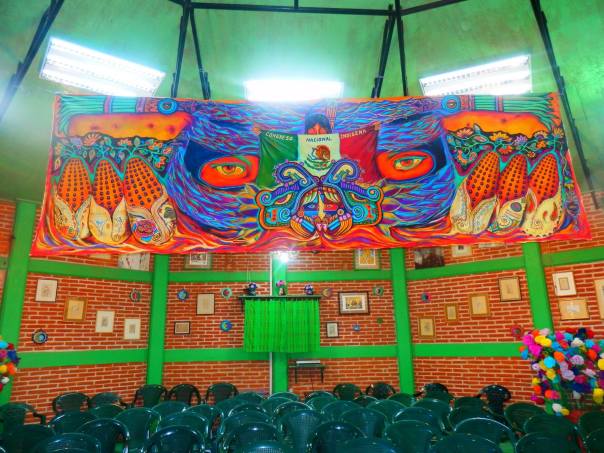
CIDECI auditorium in San Cristóbal de las Casas, Chiapas.
Schedule for the Indigenous Governing Council Tour in Chiapas, October 14-19, 2017
September 2017
To the National Indigenous Congress:
To the original peoples of Chiapas and Mexico:
To the Chiapan and Mexican people:
To the free, alternative, autonomous, or whatever-you-call-them media:
To the national and international press:
Within the framework of the National Working Assembly between the Indigenous Governing Council and the peoples who make up the National Indigenous Congress (CNI) to be held at CIDECI, San Cristóbal de las Casas, Chiapas, October 12, 13, and 19, 2017, we hereby inform you that individuals, groups, collectives, and organizations of the Sixth, Chiapas indigenous communities and organizations who belong to the National Indigenous Congress, and the Zapatista bases of support and EZLN Sixth Commission have organized a series of events to greet the Indigenous Governing Council—the voice, ear, and heart of the Native peoples of the CNI—which will be held in the Southeastern Mexican state of Chiapas according to the following schedule:
Saturday, October 14, 2017: Community of Guadalupe Tepeyac, MAREZ (Zapatista Autonomous Municipality in Rebellion) of “San Pedro de Michoacán.” Time is undetermined as it depends on how much time it takes to get from CIDECI to Guadalupe Tepeyac. The CIG delegation will spend the night there.
Sunday, October 15, 2017: Caracol of Morelia, MAREZ of “17 de Noviembre,” Tzotz Choj zone. Time is undetermined as it depends on how much time it takes to get from Guadalupe Tepeyac to the Caracol of Morelia. The CIG delegation will spend the night there.
Monday, October 16, 2017: Caracol of Garrucha, MAREZ of “Francisco Gómez,” Selva Tzeltal zone. Time is undetermined as it depends on how much time it takes to get from the Caracol of Morelia to the Caracol of Garrucha. The CIG delegation will spend the night there.
Tuesday, October 17, 2017: Caracol of Roberto Barrios, MAREZ of “Trabajo,” Northern Zone of Chiapas. Time is undetermined as it depends on how much time it takes to get from the Caracol of Garrucha to the Caracol of Roberto Barrios. The CIG delegation will spend the night there.
Wednesday, October 18, 2017: Bad government municipality of Palenque, Chiapas. 10:00am. Travel to CIDECI in San Cristóbal de las Casas. The CIG will spend the night at CIDECI.
Thursday, October 19, 2017. Caracol of Oventik, MAREZ of “San Andrés Sakamch’en de los Pobres,” Highlands (Los Altos) zone of Chiapas. Return to CIDECI where the work of the assembly concludes.
Entry is free. There will be no distribution of food provisions, t-shirts, buckets, cement, cisterns, aluminum sheeting, baseball caps, sandwiches, juice boxes, or promises.
The free media and the paid media should register at CIDECI in San Cristóbal de Las Casas, Chiapas, on October 11, 12, and 13, in order to have access to specially constructed areas where they can carry out their work under appropriate conditions (especially video and photography).
Attentively,
Individuals, groups, collectives and organizations that are adherents of the Sixth in Chiapas
Indigenous communities and organizations of the National Indigenous Congress in Chiapas
Sixth Commission of the EZLN
Mexico, September 15, 2017
A call to support the earthquake victims of Chiapas with tenderness

The casket of Anahí Cruz Hernández, 15, in San Cristóbal, Chiapas Photo: AP / Rebecca Blackwell
A note from the Chiapas Support Committee: We are asking you to make a donation to help the people who endured an 8.2-magnitude earthquake in Chiapas. The earthquake destroyed communities and created thousands of people who are now homeless.
“Solidarity is the tenderness of the people,” said the Nicaraguan poet Gioconda Belli, reminding us that solidarity is both an act of justice and caring for our communities who struggle for liberation across the world. And in this spirit of solidarity, we are asking you to be generous and help the people in Chiapas rebuild their homes and lives with a donation.
Funds will be sent, via international wire transfer, to the Centro de Derechos Humanos Digna Ochoa AC (Digna Ochoa Human Rights Center) in Tonalá, Chiapas. The Center works with adherents to the EZLN’s 6th Declaration in a region that was hit hard.
The National Indigenous Congress (CNI) has asked people of good will to help the earthquake victims and has approved the Digna Ochoa Center as a recipient of funds for Chiapas. The donate button (on our web-page) is on the bar at the top of this page for PayPal donations, or go to https://chiapas-support.org/home/donate/
In the alternative, you can mail a check payable to the Chiapas Support Committee to P O Box 3421, Oakland, CA 94609. Please write in the note section: Earthquake relief for Chiapas. Many thanks! Your donations are tax deductible if you itemize. Some details of the tragedy are described below.
A report on the earthquake devastation from Elio Henríquez via La Jornada
There are 50,582 homes in Chiapas that suffered damage from the earthquake; 16,826 are collapsed or uninhabitable and 33,756 are left with diverse damages.
The state’s civilian protection agency pointed out that the number of deaths remains at 16 and the number of injured remains at 27 in the municipalities of San Cristóbal de Las Casas, Jiquipilas, Villa Corzo, Pijijiapan, Tonalá, Suchiapa, Villaflores, Chiapa de Corzo and Cintalapa.
It reported that there are 8 temporary shelters that offer food and medical attention where 209 families (834 persons) are staying.
“It also estimates that 17,920 families are spending the night in the home of relatives, in order the to avoid sleeping in homes that were damaged by the earthquake.”
Wednesday, September 13, 2017
http://www.jornada.unam.mx/2017/09/13/politica/013n3pol
*Further information from Isaín Mandujano via Proceso.com.mx: Aftershocks continue!
One thousand schools are affected, 48 health buildings are damaged, 115 public buildings, 250 churches, 176 businesses, 92 highway stretches are affected and eight bridges damaged, as well as damages to 107 federal highway stretches and four federal bridges.
This Tuesday, Civilian Protection reported registering 1,357 aftershocks of the 8.2-magnitude earthquake and did not discard that more telluric movements will continue, which are normal as the tectonic plates re-accommodate.
http://www.proceso.com.mx/502951/damnificados-chiapas-claman-apoyo-osorio-chong-les-pide-paciencia

A mirror of the dispossession before the numbers dance
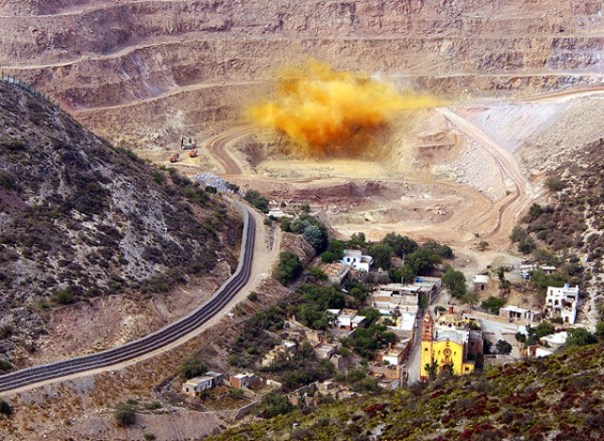
San Xavier Mining Company operates a mine on San Pedro Hill, in the state of San Luis Potosí, Mexico.
By: Magdalena Gómez
The fifth government Report offered no surprises, except that it grouped five years together rather than one, as appropriate. No doubt the numbers were important and, faced with that, I chose to look for the indigenous peoples; I found them converted into assistance numbers for indigenous individuals. With some schools at one hundred in some of their communities, scholarships, and perhaps, support for the so-called productive projects surely aids the beneficiaries’ survival, although not everyone. There was nothing about the systematic violation of the rights that the peoples have attained through struggles related to their autonomy, self-determination and territories, and nothing about the right to consultation. Nothing about forced displacements motivated by the violence or about the impact of the extractive policy that threatens indigenous peoples in the name of supposed progress.
Fortunately, we always have at hand mirrors of reality, chapters of a counter report with nothing imaginary. Yesterday, we presented one of them: the most recent book from the Mixtec intellectual Francisco López Bárcenas, La vida o el mineral (Life or mineral), in which he shows scenarios from mining dispossession in four cycles. He looks at historical reconstruction, in order to remember that mining in our country already existed in an incipient way before the Spanish invasion and continued during Colonialism and later in the stage from what’s called Mexican independence until the Porfiriato. [1] He places the third cycle after the triumph of the Mexican Revolution where the State, relatively, even becomes responsible for safeguarding the original property of the nation above natural resources. After that he arrives at the current and devastating cycle of open pit mining, in times of extractivism and of the State’s mutation into the protector of financial capital.
The book rigorously examines the ways in which companies with concessions can occupy the lowlands where minerals are found and forms of environmental protection, which is where confrontation with campesinos and indigenous peoples takes place. Among the first, it explains the purchase, leasing and expropriation, and their practical implications. At the same time, it also breaks down access to land so as to be able to extract the mineral, to locate the modalities for the authorization of the use of the soil; the impact on the environment is also analyzed. I highlight some of the theses, regarding the current cycle:
Mining is a flourishing industry, exceeded only by the oil industry, automotive industry and remittances from migrants. In the 1990s, after the reform to Constitutional Article 27 and the signing of the North American Free trade Agreement between Mexico, the United States and Canada facilitated access to the lowlands where one finds minerals, soil uses, water needed for processing the mineral, the prevention or remedying of environmental contamination and foreign investment in this rubric. For 2010, 28.58 percent of Mexican territory (the equivalent of 51.76 percent of the social property and a larger surface dedicated to food production) was granted to mining companies, the majority of transnational capital, and in large number Canadian, but also Australian, American, Peruvian, Russian, South African, Brazilian, Chinese and Chilean. Those companies are mostly engaged in the extraction of gold, silver, copper and zinc, although the tendency is that in the coming years they will migrate to exploit other minerals of strategic importance to the technology industry. The structure of the State was transformed to become an administrator of the interests of transnational capital.
On the possibility of changing the extractive model for another one that he names “indispensable or sensible,” he concludes that, for that to be possible would also require transforming the economic model on which it is maintained.
López Bárcenas lists the challenges for the indigenous peoples, some of whose resistances he noted and also pointed some out, obviously because mining dispossession is the central theme of the book. But we also know well that such mining dispossession in the four recent years was accompanied by the energy reform that gave entry to the arena of hydrocarbons as a direct source of dispossession and whose regulation is protected in order to convert public interest into private interest. The creation of Special Economic Zones constitutes the deepening of this policy. The peoples are already faced with that framework, and today it’s of little importance that one presidential term will end and another will begin, however progressive it may want to call itself. The country will be chained to mining concessions already granted for 50 years at a minimum, and renewable for another similar period. Behind the manifest destiny of the (welfare) assistance that is offered to the indigenous peoples, we can only say: “dispossession is hardly talked about, but it affects a great deal.”
[1] The “Porfiriato” refers to the period of time when Porfirio Díaz was president of Mexico (roughly, 1875-1911).
——————————————————————-
Originally Published in Spanish by La Jornada
Tuesday, September 5, 2017
http://www.jornada.unam.mx/2017/09/05/opinion/018a1pol
Re-Published with English interpretation by the Chiapas Support Committee
CNI comunicado on the earthquake in Chiapas and Oaxaca
CNI Comunicado for solidarity with the peoples affected by the earthquake and denouncing the continuity of capitalist dispossession
The earthquake has left at least 350,000 people homeless in Chiapas. Photo: Proceso.
To the National and International Sixth
To the free communications media
To the people of Mexico
The indigenous peoples, nations, tribes and barrios of the National Indigenous Congress express our support and solidarity with the compañeros of our brother peoples in the region of the Isthmus of Tehuantepec, Oaxaca, as well as our brothers and sisters of the coast of Chiapas, who faced the earthquake that occurred the night of September 7, which left destruction, injuries and death for compañeros in our communities.
We know that, as bad governments are accustomed to doing, they go only to mock our suffering, to take a photograph over the rubble and to profit from the pain of the peoples’ misfortune; therefore, we call upon the men and women of good hearts, to the collectives of the National and International Sixth and to all the people of Mexico, to be in solidarity and to collect blankets, non-perishable food and medicines in support of the peoples of those regions in the home of the Indigenous Government Council (CIG, its initials in Spanish) of the National Indigenous Congress located at Calle Dr. Carmona and Valle No. 32, Colonia Doctores, in Mexico City, a block and a half from the Cuauhtémoc Metro Station. At the same time we make a call to open collection centers throughout the national geography trying to channel the support through the CIG so that it will arrive directly to the affected peoples. For that we make available the official email address:
comunicacion@congresonacionalindigena.org
Our respectful accompaniment to all of them!
We denounce the continuation of the capitalist war to dispossess our peoples. Particularmente la comunidad autónoma Tepehuana and Wixárika autonomous community of San Lorenzo Azqueltan, in Villa Guerrero municipality, Jalisco, which is confronting dispossession of their lands by alleged small property owners and attacks on their agrarian authorities. Recently, the dispossessions of the communal lands and the harassment of agrarian authorities on the part of Municipal President Aldo Gamboa Gutiérrez have intensified. He has instigated the violence, dispossession, harassment and threats against the comuneros, because he has gifted cattle to individuals outside the community so that they will take possession of communal lands and threaten the community authorities with death, like the threats that they received on Monday, August 21 of this year upon leaving the municipal presidency where they met with the president to try to stop the aggressions. That followed the denial of municipal services to children of comuneros, such as transportation from the community to the municipal headquarters where they study the police harassment of the agrarian authorities.
Because of the foregoing, we place responsibility on the municipal president of Villa Guerrero, Jalisco, Aldo Gambóa Gutiérrez for the integrity and security of the authorities and comuneros of San Lorenzo Azqueltán and we demand that the dispossession of their lands cease.
We repudiate the violent events that happened last September 3 of this year in the Ikoot community of San Mateo del Mar, Oaxaca where gunmen working for the political boss Jorge Leoncio Arroyo Rodríguez, fired bullets at the population when they finished electing municipal authorities by uses and customs, an attack that left several compañeros injured.
Sincerely,
National Indigenous Congress
For the Integral Reconstitution of Our Peoples
Never More a Mexico without Us
September 9, 2017
———————-
Originally Published in Spanish by the Congreso Nacional Indígena
Saturday, September 9, 2017
Re-Published with English interpretation by the Chiapas Support Committee
The dispute for urban territory
Raúl Zibechi
By: Raúl Zibechi
Seated in a round in which more than 100 persons participate, Mari launches a sentence that is, at the same time, a whole political program: “If those below don’t look at ourselves, no one else looks at us.” Mari is a member of the Meeting of Organizations (Encuentro de Organizaciones, EO), one of the collectives with the most territorial work in Córdoba (Argentina), participates in Universidad Trashumante, is around 50 years old and is a popular educator “of those below.”
When two decades have been completed sinc the start of the cycle of Piquetero struggles (1997-2002), it seems like enough time to evaluate where we are, what remained and what evaporated from that promising experience, in which the unemployed occupied the center of the Argentine political stage to champion the days of December 19 and 20, 2001, which changed the country’s history.
One of the principal new things that contributed to the Piquetero Movement consisted of an enormous leap forward in territorial organization on the urban peripheries, which had suffered the de-industrialization of the 1990s. Later, an important part of the movement became disorganized or became incrusted in the institutions (via cooptation by the progressive governments or by turning towards the electoral terrain).
I am going to center myself in what can be seen, and learned, in the city of Córdoba (a little more than one million inhabitants) during meetings with different territorial organizations in recent months.
The first thing is to verify the power that maintains the territorial work. We’re talking about thousands off activists that dedicate all their time to the direct work or support for the land takeovers, the organization of self-managed production and service cooperatives, to education and health, to the support of assaulted women, to antisystemic communication and to food in popular barrios through snack bars and glasses of milk.
There is an enormous diversity of work and of organizations, with different styles but with common modes of work. Among the more autonomous sector are, besides the EO, the Front of Grassroots Organizations (Frente de Organizaciones de Base, FOB) and the Front of Organizations in Struggle (Frente de Organizaciones en Lucha, FOL). With tuning in the same work one would have to include La Dignidad, el Frente Darío Santillán, La Poderosa, Patria Grande and the Excluded Workers Movement (Movimiento de Trabajadores Excluidos, MTE), in addition to Barrios de Pie and the Movimiento Evita.
Between several of these collectives they have formed the Confederation of Popular Economy Workers (CTEP), a sort of union of “the millions excluded from the formal labor market,” cardboard collectors, campesinos, craftsmen, street vendors, peddlers, motorcyclists, cooperative workers, micro-entrepreneurs and those who work for recuperated companies (see ctepargentina.com). Said another way, those that don’t fit in the current capitalist system.
The second question, much more important than the quantitative one, is what they do in the territories. Taking over land is a first inescapable step for starting a new life. Half the population of Córdoba (according to research from the militant research collective “The Call in Flames,” it’s 48 percent) has housing problems. It’s the half of the population that the extractive model leaves out of the most basic rights.
It’s impossible to know how many acres they have recuperated, but there are dozens of spaces in the city and in nearby towns. In one of them, Parque las Rosas, there are 30 families that in just two years have built housing of solid materials after resisting the police.
Once housing is resolved, daily survival is the most urgent. There is enormous diversity on this point, but they usually create cooperatives based on governmental social policies, which work autonomously. There are cooperatives of drivers that collect waste. There are cleaning cooperatives and cooperatives that provide other services. The most interesting thing is that there is a lot of production: chickens and eggs, cereals, food distribution based on articulation with small organic producers (the essential rural-urban alliance), textile cooperatives of clothing, footwear and silk screening.
Among the groups mentioned above, there are in excess of 100 territorial and self-managed cooperatives just in Córdoba, in which two thousand people work, 80 percent of them women. Within the framework of the education campaigns launched at the beginning of every school year, cooperatives of several organizations manufacture tens of thousands of backpacks and pencil holders for children from the popular sectors.
A health brigade tours the neighborhoods to monitor the situation of the families. In one case, at least, they are starting to manufacture dentures, something that is out of reach of the popular sectors. In all the neighborhoods barrios outdoor restaurants function based on foods obtained with mobilizations; they are managed by the neighbors themselves and in recent months have grown exponentially because of the Macri government’s adjustment.
Hundreds of Córdoba women go each year to the National Women’s Gathering. Fruit of the grassroots work that they carry out in the outlying districts, a popular and plebeian feminism has grown for years, powerful and rebellious, which has not been coopted by anyone and sustains the resistances in the territories.
Autonomous communication would merit a special study, but here are two examples. The alternative and community radio Zumba the Turba (http://zumbalaturba.com.ar), has broadcast for seven years from the same space where the FOB works. The newspaper La Tinta (https://latinta.com.ar) born one year ago, is close to the EO and has a slogan that says it all: “Journalism to get involved” (Periodismo hasta mancharse).
The impression is that the Piquetero Movement, far from disappearing, has mutated into a potent urban territorial movement where the subjects are the poorest. Cari, an occupant of Parque las Rosas, synthesized in one sentence the causes of the “fourth world war” against those below: “They no longer impose how to live on us.”
———————————————————–
Originally Published in Spanish by La Jornada
Friday, September 1, 2017
http://www.jornada.unam.mx/2017/09/01/opinion/016a2pol
Re-Published with English interpretation by the Chiapas Support Committee
Popolucas, Nahuas and Mestizos organize in Veracruz
INDIGENOUS REGIONAL MOVEMENT IN DEFENSE AND RESPECT FOR LIFE
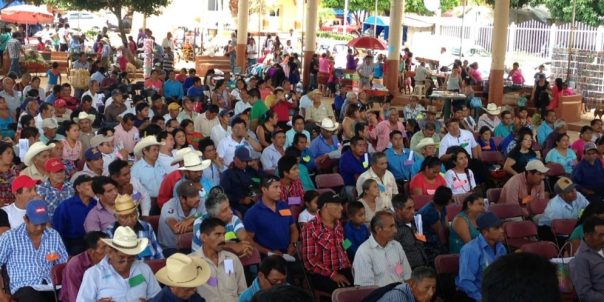
FIRST REGIONAL ASSEMBLY FOR THE DEFENSE OF TERRITORY AND THE RIGHTS OF THE PEOPLES OF THE SIERRA OF SANTA MARTA
Soteapan, Veracruz, August 27, 2017
COMUNICADO
The Popoluca, Nahua and Mestizo peoples of the Sierra of Santa Marta, met today, August 27, 2017 in the municipal capital of Soteapan, with the participation of around 400 people from 50 communities belonging to the municipalities of Hueyapan de Ocampo, Soteapan, Tatahuicapan, Mecayapan and Pajapan, besides visitors from the municipalities of Chinameca, Cosoleacaque, Coatzacoalcos, Acayucan, Chinameca, Minatitlan, Zaragoza, AguaDulce, Las Choapas and Sayula del Sur of Veracruz, from Xalapa and from a representation of the Zoque people of Northern Chiapas, in the struggle against fracking.
With the coordination of our Popoluca and Nahua council members of the Indigenous Government Council, named at the national level by members of the National Indigenous Congress, we hold our first regional assembly for making agreements in the follow-up to the process initiated years ago for the defense of our rights and our territories facing the onslaught of big transnational capital backed by corrupt and mafia-like politicians that characterize the political class and the governments of our country.
With their energy reform and other structural reforms, with the violence at the hand of organized crime that they have sown throughout the country and our region, they are violating all our rights and wanting to dispossess and destroy our territories: among other things, we refer to their refusal to recognize access to electric energy as a human right, their intent to dispossess and contaminate our territories and our waters with wind farm businesses, with mining activity, with conventional exploitation of oil and natural gas and through the deadly technology of fracking.
Today we make internal agreements for continuing with our struggle; we declare that we will continue with firmness our civilian resistance movement against the high cost of electricity and we demand that the CFE fulfill the agreements signed at the regional and national level.
We will also continue strengthening our movement for territorial defense and will demand the recognition of our community assembly minutes that constitute actions of self-consultation as indigenous peoples. We will not permit other supposed consultations impelled by the bad governments and their dependencies.
In coordination with many other movements at the national level, we will not permit the entry of wind farm and extractive companies in our territories nor will we offer our territories to big foreign capital as the bad governments seek to do with their Special Economic Zone Law; nor will we permit the privatization of water.
With the National Indigenous Congress and the Indigenous Government Council for Mexico, we will assert our right to self-determination and we will reconstruct our autonomy that the bad governments have stolen from us for decades; in other words, we will reconstruct our ability to govern ourselves in order to implement a good system of life for our peoples.
We also denounce the murders of human rights defenders and the criminalization of the social struggle and we demand the appearance with life of all the disappeared and the freedom of all political prisoners.
WE WON’T STOP!
NOW IS THE HOUR OF THE FLOURISHING OF THE PEOPLES!
—————————————————————–
Originally Published in Spanish by Pozol Colectivo
Tuesday, August 29, 2017
Re-Published with English interpretation by the Chiapas Support Committee
 Chiapas Support Committee