Chiapas Support Committee
Home of the Compañero Manuel blog on zapatistas & mexico
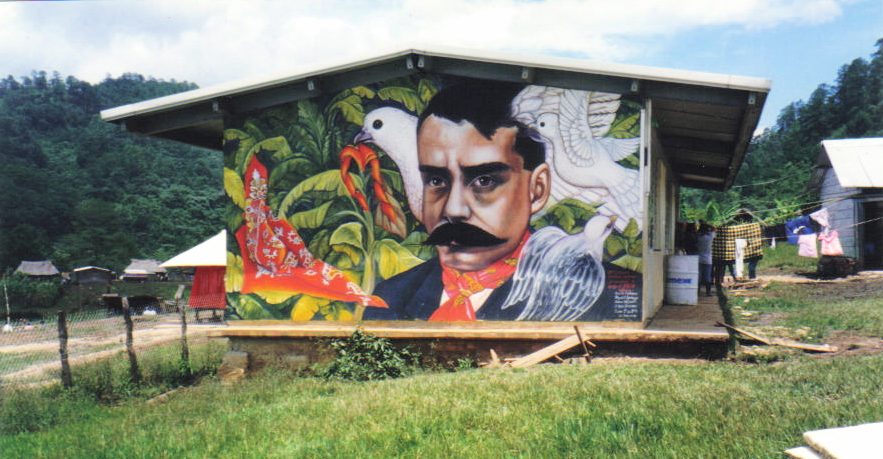
Marichuy, a very different campaign
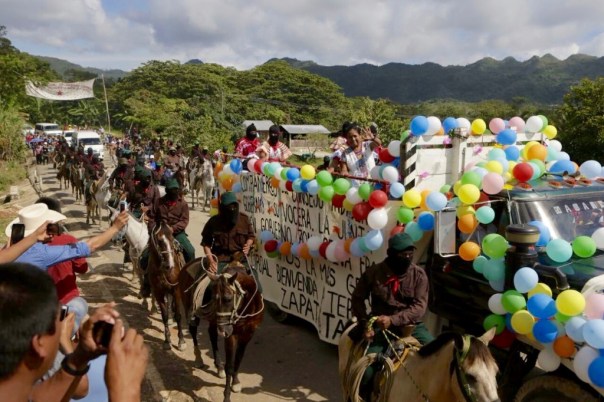
Marichuy and members of the Indigenous Council tour Zapatista Territory.
By: Luis Hernández Navarro
Some 21 years ago, on October 11, 1996, an indigenous Nahua from Jalisco read the political statement of the nascent National Indigenous Congress. In the name of more than 600 delegates coming from all over the country, she announced the decision of the recently founded organism of original peoples to construct a new homeland, “that homeland that never has been able to truly be one, because it wanted to exist without us.”
That speaker, a traditional doctor, was María de Jesús Patricio, the same one that is now the spokesperson and independent candidate to the Presidency of the Republic for the Indigenous Government Council (CIG, its initials in Spanish). There, she warned in the name of her compañeros: “We are standing up, we are standing up to fight. We are determined to risk everything, even death. But we don’t carry drums of war, but rather banners of peace. We want to partner with all the men and women who, upon recognizing us, recognize their own roots.”
Two decades, one year and three days after that day, last October 14, that same woman arrived in Guadalupe Tepeyac, Chiapas, a community of just 48 houses and 144 people, where she was received by 15,000 souls. The welcoming ceremony the Zapatista support bases, the authorities of the Good Government Junta Towards a new hope and the EZLN’s commanders gave her was a multicolor and diverse fiesta. Rebels motorized and on horseback, escorted her between walls of balloons and women dressed in their typical clothes.
Despite the time that passed since the founding of the CNI, Marichuy’s word, her commitment to the defense of life and to another world continues being the same as she had on that October 11, 1996. It’s only that now, after tirelessly touring the country, after seeing the suffering and the horrors that those below in Mexico suffer, after listening time and again to her different brothers and sisters, her vocation of service and delivery to the cause has matured and grown. That’s why now she doesn’t call only to indigenous peoples to organize to struggle against capitalism, but rather she summons all of those below to do it. “The (indigenous) peoples cannot do it alone,” she said in the Good Government Junta of Morelia, last October 15.
She doesn’t talk about hearsay, and it is noted. Her life has been spent very far from the glass bubbles that so many professional politicians inhabit. She names what she has suffered and experienced, something very similar to what so many other humble women have experienced in the country. She does it without being strident, with squelching simplicity, depth, conviction and knowledge.
María de Jesús Patricio is making history: she is the first indigenous woman in the history of Mexico, the mother of a family, to be a candidate to the Presidency of the Republic. She is carrying out a presidential campaign with a woman’s face, aroma and word. Although it was still not formally an electoral campaign act, the meeting that the CIG spokesperson held with the Zapatismo of the border jungle zone as well as the meeting a day later in the Caracol of Morelia in the Totz Choj Zone has an emotional gender charge. Everything turned around the woman. The speakers at the event were women, those in attendance at the event were overwhelmingly women and the speeches spoke of and to the women.
The multitudinous meetings of Marichuy, the delegates and council members of the CIG with Zapatismo in Guadalupe Tepeyac and Morelia have shown that the EZLN maintains a formidable force and ability to convoke. The fact that so many thousands of sympathizers traveled across the disastrous and precarious network of Chiapas roads and junctions is not easy. It requires organizational muscle, discipline and vehicular infrastructure. But is also requires genuine conviction that effort forms part of a just cause. Only in this way can rain, heat, long waits, heavy loads be prevented from becoming factors that inhibit massive participation. It shows that this mobilization born from conviction is the spontaneous mass expression of joy from the support bases before María de Jesús, adorned with the warm reception from the EZLN’s founders.
Several dozen council members and indigenous delegates from all over the country also participated in the tour of the CIG’s spokesperson through the Zapatista zone. They were transported in more that 10 trucks. As of now, the council is made up of 141 council members, from 35 indigenous peoples settled in 62 of the 93 regions that they have thought to constitute. Such a diversity of representatives of the original peoples had never encountered and lived in rebel territory.
The tour has had a marked anticapitalist character and also promotion of the popular organization of resistance. Besides the vindications of gender, the discourses of the speakers have combined personal and community testimony about the abuses of the powerful, the recuperation of the historic experience of the disgraces experienced on the finca, the rage before the catalogue of damages and humiliations suffered at the hands of the exploiters, the denunciation of the looting and devastation caused by neoliberalism, the so-called autonomous organization from below and appraisal of indigenous roots.
About this line of denunciation, Comandanta Miriam said, in the name of the CCRI-CG of the EZLN in the Morelia event, that it’s more important than ever to organize because, with the government’s support, the four wheels of capitalism, exploitation, repression, dispossession and scorn, are perfected every day to fuck more with those below.
María de Jesús Patricio, the same one that participated in the founding of the CNI 20 years ago, started walking in rebel territory with the proposition of inviting all those that are struggling against the monster that wants to devour everyone so that, together they get rid of it. She will continue walking through the country on a very different campaign to, as she announced more than two decades ago, construct a new homeland “that has never been able to truly be one, because it wanted to exist without us.”
———————————————————–
Originally Published in Spanish by La Jornada
Tuesday, October 17, 2017
http://www.jornada.unam.mx/2017/10/17/opinion/021a2pol
Re-Published with English interpretation by the Chiapas Support Committee
Marichuy in La Garrucha
WORDS OF MARÍA DE JESÚS PATRICIO MARTÍNEZ IN THE CARACOL OF LA GARRUCHA

The plaza in front of the Caracol’s elevated stage in La Garrucha was overflowing.
Brothers and Sisters, it is the time of the peoples, it’s time that we unite, it’s time that together we take out these big capitalists that have taken away our lands for years. They have divided us, they have made us fight with each other, and they have made us see that just by extending a hand we have to offer caravans to them. We must unite, we have that big task, removing this capitalist system that is destroying our communities, that is destroying our peoples, that is dispossessing us of what is ours, that is contaminating all these waters, and is cutting down all these forests; that’s why it’s necessary to unite and together be able to destroy this capitalist system that is not only going to destroy our communities and our peoples, but that is also going to destroy human life and that is in the indigenous communities and is also in the big cities.
Now is the time, brothers and sisters, of unifying, of thinking about what we are going to do together, of how we are going to construct that new Mexico and remove this Mexico that the people who have money have imposed on us, the people who only think about themselves, who don’t think about us, who don’t think about out lands, who don’t think about our waters, who don’t think about our trees; that’s why we have decided to unite and fight for everyone, for the whole world, not just for the indigenous peoples but for everyone.
Then, we must destroy this big capitalist that is destroying us and we can only do it organized, thinking together about how to do it, only with the indigenous peoples and their sister and brother workers of the countryside and the city shaking hands. It’s necessary that we walk firm, that our voice is heard, that our steps are seen, that those peoples that for y ears have been forgotten and stepped on rise up and say “We are no longer in agreement, we want to continue living and we want life for everyone;” that’s why it’s necessary to unify those efforts and demonstrate to the powerful that yes we can achieve it, that if we achieve uniting all the indigenous peoples and the workers of the countryside and the city, and clearly we can do it, then we can make the powerful that want to dispossess us of what we have tremble.
Let us feel it, brothers and sisters, let us trust the one at our side, she is not our enemy, we must unite so that we can free ourselves from this capitalist system.
Long live the indigenous peoples of Mexico and of the World!
Long live the workers of the countryside and the city!
Long live the EZLN!
Long live the National Indigenous Congress!
Long Live the Indigenous Government Council!
Gracias, brothers and sisters!
——————————————————————————–
Originally Published in Spanish by Actividades del CIG y su vocera
Monday, October 16, 2017
https://actividadesdelcigysuvocera.blogspot.mx/2017/10/palabras-de-maria-de-jesus-patricio.html
Re-Published with English interpretation by the Chiapas Support Committee
Words of Marichuy in Morelia, Chiapas
WORDS OF MARÍA DE JESÚS PATRICIO MARTÍNEZ IN THE ZAPATISTA CARACOL OF MORELIA ON OCTOBER 15, 2017

Zapatistas of Morelia greet Marichuy with their left fists raised on a rainy day in Chiapas
Well, we already listened to our council member compañeras that make up the Indigenous Government Council and before beginning (my talk) I want to report that as of right now we have 141 council members that are already making up the Indigenous Government Council; they are from 35 indigenous peoples from 62 regions of the country, out of the 93 that we had thought council members could come from, then we’re still walking, still organizing the different indigenous peoples to complete that large Indigenous Government Council.
Also, brothers and sisters, I am thankful to this organization for receiving us beautifully. On my way here I was looking at the hills, the rivers, the trees and I said: “it’s so good that they have not been contaminated here, that they have not permitted cutting trees here, and that you are organizing here.” And we see the work you have done and we want to promote that work in the different regions of the country, the ways of the indigenous peoples, their forms, their style, each one who we have to organize in order to take care of what our ancestors have left us, what they fought over for years and that they have wanted to take away from them.
It has cost some places deaths, incarcerations, disappeared, repressions, but nevertheless, I believe that all of us in the National Indigenous Congress know what awaits us and we’re going to continue moving ahead, and only with the organization of all indigenous peoples can we demonstrate to the power, to capitalism, that we can definitely take it away, that we can pull it out by the roots, because that is what is wanting to dispossess us of our riches, that is what is making us fight among ourselves to take advantage of our riches, that is what is thinking about how to remove us from our communities and be left with those riches that the communities have.
And we said: “we are not going to permit it,” but we can’t do it alone, so we think that we are going to go out to walk and tour this Mexico and that we are going to invite all our brothers of the city, all our brothers from civil society, all our brothers that are also struggling out there, so that together we will join hands and be able to get rid of this system that wants to destroy us, principally our peoples, our communities, our inhabitants. They are imposing programs on us, and those programs only bring division on the interior, bring death to our lands, bring contamination to our waters, and therefore we are no longer in agreement as indigenous peoples who are inside of the National Indigenous Congress.
And we want to walk together with all our brothers from the different peoples of Mexico; we must shake each other’s hand now to be able to defend ourselves, as Comandanta Miriam said. We have to f eel that trust with our brothers that are here and that together we will expose that great monster that wants to destroy us and that monster is not only in Mexico, it’s all over the world. Therefore we have to shake hands, get to know each other and struggle together; we must think about how to take care of our children, all the women and men, and we have to take care of that land jointly that our grandparents left us.
We must destroy this monster and we must do it all together, organized, and I think that if we all join hands, we will be able to do it, brothers. Yes, we can do it! And we have to trust that our voice will be heard, that our organization is going to look beyond, and then the powerful are going to tremble when they see all the original peoples of this country, who are the indigenous peoples, united and organized and defending this country that is ours, because we were here first and we must recuperate that, and we have to re-organize it to our way, because we already saw that how it is organized now doesn’t work, it brings u s death, it brings us destruction, it brings us division and brings us disputes. We have to shake hands with everyone, everyone who feels that it’s important to have a dignified life, a life that we have to transmit to all those who come after us.
We must achieve that, brothers, on this walk, indigenous peoples together, communities together, brothers together that are in the city, in civil society that is also thinking now about how to articulate these forces and together we are going to win.
Long live the National Indigenous Congress!
Long live the indigenous peoples of Mexico!
Long live the indigenous peoples of the world!
Thank you, brothers!
————————————————————–
Originally Published in Spanish by ACTIVIDADES DEL CIG Y SU VOCERA
Monday, October 16, 2017
https://actividadesdelcigysuvocera.blogspot.mx/2017/10/discurso-de-maria-de-jesus-patricio.html
Re-Published with English interpretation by the Chiapas Support Committee
Marichuy begins her tour in Guadalupe Tepeyac

“We live in oblivion and marginalization; we suffer triple oppression for being women, indigenous and poor,” the Zapatistas pointed out during the meeting with María de Jesús Patricio. Photo: José Carlo González
“THE TIME HAS COME TO DECIDE: DESTINY IS IN OUR HANDS and THOSE OF THE MEXICAN PEOPLE”
From the Editors
Guadalupe Tepeyac, Chiapas
The indigenous Nahua woman María de Jesús Patricio, known as Marichuy, spokesperson for the Indigenous Government Council (CIG, its initials in Spanish), met yesterday in the community of Guadalupe Tepeyac, Chiapas, with the Good Government Junta “Towards New Hope,” Border Jungle Zone, and with the support bases of the Zapatista National Liberation Army (EZLN).
The meeting in Guadalupe Tepeyac is the first stop on the tour that inside her proposal as an independent candidate to the Presidency of the Republic will be held in the five Zapatista Good Government Juntas between the 13 and 19 of this month. Different CIG members will accompany her during the tour.
Comandante Tacho participated in the reception for Marichuy. In the name of the Indigenous Revolutionary Clandestine Committee (CCRI, its initials in Spanish) Border Jungle Zone, Aurora welcomed her. In her speech she said that they were proud of the meeting attained by the original peoples for the first time in history. “The time has come –she explained– of everyone being represented, the countryside and the city, by a compañera that will fight for the people of Mexico.”
Comandanta Everilda spoke in the name of the EZLN’s General Command. She analyzed the situation of exploitation, oppression and discrimination that the Indian peoples, campesinos and workers in Mexico and in the world experience. She explained the existing cruelty against those below on the part of the bad governments and the neoliberal capitalists. She documented the process of privatization underway of communal and ejido lands, rivers, forests, jungles and mountains.
Comandanta Everilda warned that they have resisted death as indigenous and campesinos. “We are here –she said–, you and us, we came from the more remote times of this history and we must not ever permit that foreign invaders invade us again.”

Marichuy met in the community of Guadalupe Tepeyac with the Good Government Junta “Towards New Hope” and with the EZLN’s support bases. Photo José Carlo González
The conquest of liberty and justice, the comandanta explained, will only come from the people, and from no one else. It will not come from the parties, the corrupt politicians or the capitalists. The life of the people of Mexico, of the planet and of humanity depends only on the organization of the countryside and the city.
Upon talking about women, she asked for men to pay attention. “We (women) live in oblivion and marginalization in capitalist society. In the countryside and in the city our situation is worse than what we just heard. We suffer a triple oppression because of being women, indigenous and poor. As indigenous, we have never been taken into account in the countryside.”
To conclude, she said: “Now is the time to win our rights, to prepare ourselves, to stand up and demonstrate that as indigenous women we are capable of constructing a new and better world, but we will only achieve it organized from below and to the left, and thus achieve a Mexico where the people command and the government obeys.”
She said to the CIG, to María de Jesús, to the National Indigenous Congress and to the people of Mexico: “the time to decide has come. It’s time to organize! Destiny is in our hands and those of the people of Mexico.
The widow, the children and the family of Galeano, the Zapatista teacher that Cioac paramilitaries murdered on May 2, 2014 in La Realidad, who dedicated his life to fighting for humanity, participated in the meeting. In the name of the women of Guadalupe Tepeyac, Gloria Elisa Benavides gave a biographical sketch of the fighter and explained how his killers continue free with the government’s complicity, and they ridicule the family. Through her, they sent a greeting to the mothers and fathers of the 43 disappeared from Ayotzinapa and to all those who seek disappeared relatives.
———————————————————
Originally Published in Spanish by La Jornada
Sunday, October 15, 2017
http://www.jornada.unam.mx/2017/10/15/politica/010n1pol
Re-Published with English interpretation by the Chiapas Support Committee
Frayba and Sipaz will escort the Indigenous Government Council caravan
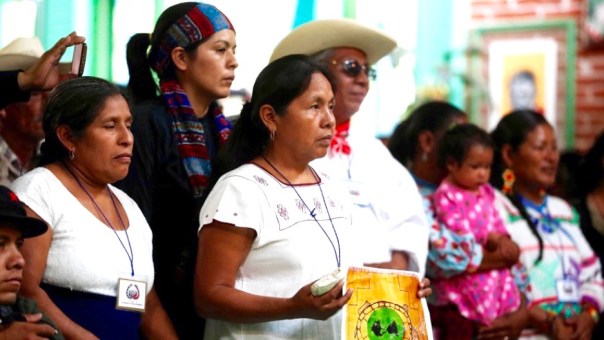
Marichuy and supporters.
By: Elio Henríquez
San Cristóbal de las Casas, Chiapas
The Fray Bartolomé de Las Casas Human Rights Center (Frayba) and the International Service for Peace (Sipaz) reported that they would accompany the caravan that starting from this Friday, October 13 until October 19 will be effectuated in Chiapas, organized within the context of the tour of the National Indigenous Congress and the Indigenous Government Council.
The contingent departed from this city towards the town of Guadalupe Tepeyac; the itinerary includes Morelia, La Garrucha, Roberto Barrios, Palenque and Oventik.
Separately, the Secretary of Gobierno of Chiapas, Juan Carlos Gómez Aranda, offered “all guaranties of free transit and security, “to the caravan of the Indigenous Government Council and its spokesperson, María de Jesús Patricio Martínez, through Zapatista Zones.” He said that: “on instructions from Governor Manuel Velasco Coello he has readied an operation for guarantying the security and free transit in the events and deployments that they are to carry out within the state.”
In a communiqué, Frayba and Sipaz reported that: “the objective of the accompaniment will consist of providing an observation and documentation presence for the respect of human rights on the passage of the caravan and in the convoked events.
“We consider it important that these activities be carried out peacefully, al ser parte de un peaceful organizational effort that aims at the defense of the rights of the country’s indigenous peoples,” they added.
They pointed out that: “the present communication is to inform the Mexican authorities and international human rights bodies, in order that within their ambit of jurisdiction, they provide guaranties of protection to the caravan, which we reiterate, is a civilian and peaceful action.”
Frayba and Sipaz requested that: “guaranties are fulfilled with respect to protecting the integrity and security of the caravan’s members, the right to life, and the individual and collective rights and freedoms, immediately guarantying the conditions necessary for the caravan’s development, without considering police accompaniment in the activities.
“Sipaz members will be present in the activities wearing vests with the organization’s logo and the words ‘International Observer,’” they expressed, while Frayba members will be accompanying the caravan in the role of human rights observers.
———————————————————–
Originally Published in Spanish by La Jornada
Saturday, October 14, 2017
http://www.jornada.unam.mx/2017/10/14/politica/010n2pol
Re-Published with English interpretation by the Chiapas Support Committee
“Defense of land has brought us repression, threats and murders,” they denounce in Chiapas
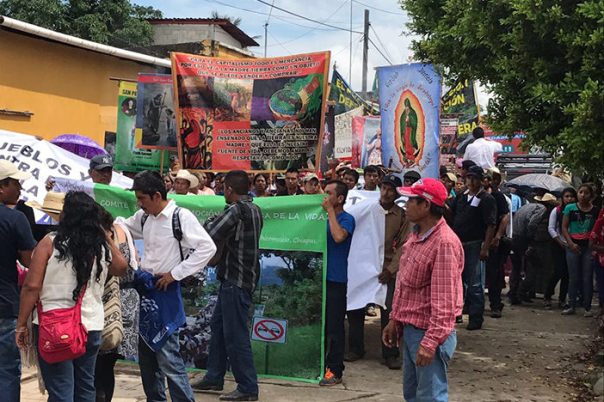
March against mining in Chicomuselo, in the Sierra Madre of Chiapas.
By: Isaín Mandujano
TUXTLA GUTIÉRREZ, Chiapas (apro)
Some five thousand men and women, members of San Pedro and San Pablo parishes of Chicomuselo, in the Sierra Madre of Chiapas, held a march-procession this Monday to protest against the extractive mining that threatens their territories and contaminates their rivers, streams and the social fabric in the region.
Coming from various communities, they congregated in Chicomuselo, the municipal capital, where an abundant contingent held the march with signs and slogans against mining companies that have started to provoke conflicts between the residents of different communities.
Men and women from different towns in resistance that today participated in the march called the “Movement against mining exploitation and the dispossession of land,” denounced their “systematic enslavement” on the part of the different levels of the Mexican State.
This march/pilgrimage took place after they held a regional meeting last Sunday to analyze the threat that extractive mining and the companies that have approached different communities to effectuate their mining concessions represent.
“After having listened to the problems of the different communities and organizations in resistance, we agree that our struggle in defense of Mother Earth has brought us as a consequence, omission, repression, intimidation, threats, persecution, incarceration and the murders of community human rights defenders in Chiapas and in other parts of the country and of the world,” residents said today that held a mass at the end of the procession.
They indicated that the private capital mining companies, national and transnational, together with the State and its three levels of government, are determined to increase and diversify their actions related to dispossession of natural wealth, displacement of the population, occupation of the territory and elimination of any organizational process that attempts to resist and defend itself peacefully, legally and in total exercise of their collective rights.
They pointed out that this insistence on the part of the mining companies continues provoking division and confrontation in the communities by taking advantage of the poverty of the residents and offering them economic resources so that they will accept the mining project.
They declared that they are in civilian resistance, but as part of a peaceful movement in favor of life, always willing to dialogue in search of solutions to their problems and to the “death plans” that damage their communities.
They denounced that those who have decided to defend life and Mother Earth are now in constant risk under threats from the impresarios, from organized crime and from the State and its three levels of government “that only favor the paths of impunity, injustice, inequality, dispossession, exploitation and scorn for the original peoples, communities and ejidos.”
They supported the struggle of the campesinos from Ricardo Flores Magón and Grecia ejidos in that same municipality of Chicomuselo, who have opposed mining in their communities and they denounced the repression, persecution, as well as threats of death and of dispossessing them of their agrarian rights in their respective communities.
They likewise stood in solidarity with the organization of ejido commissioners of Chicomuselo municipality in their social demands for the benefit of inhabitants of the Sierra Zone and rejected all forms of intimidation and threats against them, because in recent days some ejido representatives have received calls to threaten them with death if they continue involved in the movement against mining.
Therefore they demanded that the autonomy and self-determination of the peoples in Chiapas and in Mexico founded on Constitutional Articles 1 and 2 and on international conventions are respected, as well as the physical integrity of those who defend life, Mother Earth and nature be guarantied.
They demanded the cancellation of mining concessions in Chicomuselo and of “all the death projects” in their territories, which only bring destruction, dispossession, poverty, diseases, community conflicts and divisions.
They demanded a stop to the Mexican Army’s militarization and patrolling on the territory of Chicomuselo communities and hold the Mexican State at all three levels of government responsible for any aggression or attack against them and/or the towns and communities.
After the mass, they asked all the towns, communities, ejidos, grassroots organizations, and the men and women of this country “that they maintain their struggle firm, their resistance and that they organize, don’t give in, don’t sell out, and don’t let themselves be deceived.”
They emphasized the importance of articulating their struggles in all corners of the state, because the land is an inheritance from their ancestors and, therefore, must be taken care of and defended.
“Our peoples and organizations have decided firmly to defend life, territory and the environment because the future of our country is at risk,” they concluded.
Besides the priests and faithful from the parishes of San Pedro and San Pablo, Chicomuselo, members of the Vicariate General of the San Cristóbal Diocese, the Diocesan Coordination for Human Rights, Diocese of San Cristóbal, the Vicariate of Social Pastorate and the Vicariate of the Pastorate of Mother Earth were in yesterday’s meeting and today’s procession.
[A long list of other organizations in attendance]
————————————————————-
Originally Published in Spanish by Proceso.com.mx
Monday, October 2, 2017
Re-Published with edits and English interpretation by the Chiapas Support Committee
María de Jesús calls to organize the “pains and rages” of the peoples

María de Jesús Patricio Martínez shows proof of registration upon leaving the INE. Photo José Antonio López
By: Claudia Herrera Beltrán
María de Jesús Patricio Martínez, Marichuy, spokesperson for the National Indigenous Congress (CNI) and the Indigenous Government Council (CIG), presented her intention to be an independent candidate to the Presidency of the Republic with a call to “organize those pains and rages” of the peoples.
Upon delivering her documentation at the National Electoral Institute (INE, its initials in Spanish) announced that she would not receive “one single peso” of public money, given that her campaign will be done with collective support.
Surrounded with dozens of followers, she complained that the requisites for those who want to contend as independents next year are designed to place obstacles in the way of indigenous communities’ participation and she mentioned as an example that the HSBC Bank didn’t want to open an account for them and they had to go to another institution.
“They put a lot of obstacles in the way of us achieving this first step. They wanted to treat us top down, like those who rule up there above; like this structure is only designed for that, not for the people below, not for the working people, much less for the indigenous communities.”
She marked her distance with respect to other candidacies. “Our proposal is different, it’s collective.”
She insisted that the end purpose is to organize, for the purpose of “finishing with this capitalist, patriarchal, racist, classist system, because of what we are living in our own flesh.
“Thus we must organize all those pains that are happening to our peoples. We have to organize all those rages. That is our message. It’s necessary to organize those pains and rages. That’s the only way we’ll be able to continue forward.”
She offered that as a woman, as a mother and as a worker she would also struggle against the machismo and the patriarchal system predominant in the country.
Protected by officials of her government in her visit to the INE, she pointed out that in order to contend she first had to get the permission of the inhabitants of her state and promise that, if she achieves it, she will not use public money.
———————————————————–
Originally Published in Spanish by La Jornada
Sunday, October 8, 2017
http://www.jornada.unam.mx/2017/10/08/politica/003n2pol
Redacted and Re-Published with English interpretation by the Chiapas Support Committee
Peña Nieto decrees putting the first 3 special economic zones into operation

Aerial view of Puerto Chiapas where the cruise ships dock.
By: Alonso Urrutia
Tapachula, Chiapas
President Enrique Peña Nieto signed the decree by which the first three special economic zones: Tapachula, Coatzacoalcos and Lázaro Cárdenas, will enter into operation with a scheme of fiscal incentives to capture foreign and national investments in the country’s south-southeast region. The purpose is to reverse the unequal development of this region with respect to the rate of growth in the country’s center and north.
“We are not going to permit that the history of the south-southeast continues to be marked by poverty, marginalization and inequality. The Special Economic Zones will be a parting of waters in the development of this most affectionate region. They will mark a before and an after.” He asserted that Mexico would apply a successful scheme in other latitudes so that the regions that lay behind the most and with the most poverty are incorporated into the development and have the same rate of economic growth as the rest of the country.
In these first three zones they foresee investments of at least 5 billion 300 million dollars in the next three years and the generation of 12,000 jobs, anticipated Peña Nieto, who also indicated that the transformation would not be easy or fast, because of which the period of consolidation would transcend his administration. Nevertheless, he vindicated that this model is a sowing “on fertile ground.”
“We want to set aside welfare policy, which, inside the social policy, only seeks to bring economic support that at times only alleviates or mitigates the condition of poverty, but doesn’t get to the bottom of it,” he pointed out.
During the event they announced investments of impresarios from Nuevo León in the Coatzacoalcos special economic zone, while Lakshmi Mittal, president of the administration council of Arcelor Mittal, anticipated destining a billion dollars to Lázaro Cárdenas metallurgy.
After observing a minute of silence in memory of the victims of the earthquakes, Peña Nieto defined the Special Economic Zones as a territorial demarcation in which there would be private conditions by means of a public policy that fights to capture investments and detonate industrial development. Starting with fiscal incentives and training incentives for the formation of human capital they seek that these regions have a big development potential.
The scheme will permit a deduction of 100 percent in the payment of the tax on rent in the first 10 years and one half in the following five, special treatment of the value-added tax that can even apply a zero rate, and a special customs regimen to enhance export and import.
The Treasury Secretary, José Antonio Meade, maintained that there is clarity in the federal government, but that there are matters pending with Chiapas: in the short term to surmount reconstruction of the damage provoked by the earthquakes and historic matters pending because: “We know that poverty is a challenge that we fight everyday to overcome; but we also have long term matters pending.”
———————————————————–
Originally Published in Spanish by La Jornada
Friday, September 29, 2017
http://www.jornada.unam.mx/2017/09/29/politica/028n1pol
Redacted and Re-Published with English interpretation by the Chiapas Support Committee
Chiapas communities denounce abandonment after earthquake
AFTER THE EARTHQUAKE, THEY DENOUNCE ABANDONMENT OF THE COMMUNITIES OF ARRIAGA, TONALÁ and PIJIJIAPAN

The inside of a damaged home in Tonalá, Chiapas.
By: Isaín Mandujano
A dozen social and civilian organizations denounced today that hundreds of vulnerable families continue being completely abandoned in the municipalities of Arriaga, Tonalá and Pijijapan, three of the municipalities closest to the earthquake’s epicenter last September 7. [1]
They said that the authorities have not visited their homes to evaluate the damage, have not informed them of any reconstruction plan, have not facilitated access to a shelter, nor have given them food, medical or psychosocial attention.
And that after the emergency passed they demanded that the three levels of government respect in time and form the community reconstruction plan that we the peoples propose since we don’t want the experience of 1985 repeated, when the Mexican government delayed two years in reconstructing the homes of those affected.
After meeting on Saturday and Sunday, September 23 and 24 in El Fortín ejido, municipio de Pijijiapan, in the Coastal Zone, the activists and organizations that were convoked by the Regional Autonomous Council of the Coastal Zone of Chiapas announced a series of irregularities that have been recorded 18 days after the earthquake.
After the meeting where there were members of the Mexican Network of those Affected by Mining (Red Mexicana de Afectados por la Minería, REMA) and of the Movement of those Affected by Dams and in Defense of Rivers (Movimiento de Afectados por las Presas y en Defensa de los Ríos (MAPDER), they all went to observe the bridge that connects the community of La Conquista with the El Fortín ejido in Pijijiapan; there they verified that it presents large fractures and that two walls are at the point of collapsing.
“This, they said, represents a grave danger for the inhabitants but, as of this date, Civil Protection Civil has not come to evaluate the damages, nor has it fulfilled its function of preventing accidents in order to protect the population in general, principally the students that have to cross it to go to school,” the activists said.
They pointed out that El Fortín and La Conquista are not the only communities on the coast of Chiapas that the authorities have abandoned and forgotten after the earthquake.
They indicated that in Tonalá, there are 4,700 damaged homes, 4,300 in Arriaga, 2,100 in Pijijiapan, and thousands more throughout that Isthmus-Coast region.
They denounced that there are hundreds of vulnerable families that are totally abandoned, in other words, that the authorities have not visited in their homes to evaluate damages, that they have not informed of any reconstruction plan, who have not been given access to a shelter, nor given food, medical or psychosocial attention.
“The peoples of this region have been forgotten and ignored because we are far from the tourist and economic centers that interest the governments and the corporations. They only come around when our territories interest them for developing their projects and making profits, as is the case with the implementation of the Special Economic Zones (SEZ) on the coast of Chiapas and the Isthmus of Tehuantepec. If the government doesn’t come to our communities now, it’s because it is expecting our disappearance to be able to extract our natural wealth in the future,” said the participants in that forum held over the weekend.
They pointed out that it is despicable that the national political parties refused to dedicate their funds for financing political campaigns to the reconstruction and support of those affected by the earthquakes after the September earthquakes in Chiapas, Oaxaca, Morelos, Puebla and Mexico City.
At the local level, they continue to see that those who aspire to political positions are taking advantage of the situation by distributing aid to win votes for 2018. For example, in the municipality of Jiquipilas, the delivery of government and citizen aid is distributed only to those affiliated with the Green Ecologist Party of Mexico.
And thanks to the struggle of the organized peoples, support has been obtained from civil society in Mexico and other countries, through the Regional Autonomous Council of the Coastal Zone of Chiapas, the Tonalá Civic Front (Frente Cívico Tonalteco) and the Digna Ochoa Human Rights Center AC. [2]
This aid is being used to feed the affected population in community kitchens and to offer them medical and psychosocial attention. And in the coming days, they will be occupied with developing the community labor of reconstructing homes.
The Secretariat of Civil Protection said that 18 days after the 8.2-magnitude earthquake, they continue with the preliminary evaluation of damages, which will conclude with the delivery of results from the state committee for evaluation of damages on October 5, according to the regulations of the Natural Disasters Trust Fund (Fideicomiso Fondo de Desastres Naturales, Fonden).
And at this time, 4,326 aftershocks from the September 7 earthquake have been reported and they don’t discard that more telluric movements will continue, which are considered normal for the re-accommodation of the tectonic plates.
Preliminarily, according to the census the federal government’s Secretariat of Agrarian, Territorial and Urban Development (Sedatu, its Spanish acronym) carried out, a total of 58, 365 homes are affected, of which 41,569 have partial damage and 16,796 are totally destroyed.
At this time six temporary shelters are active, with 84 families and a total of 307 persons, who are offered a dignified place to sleep, as well as food and medical attention.
[1] These organizations signed a formal denunciation. It can be read in Spanish at:
[2] This is the human rights center to which the Chiapas Support Committee wired donations raised for earthquake victims and the 3 organizations mentioned in this paragraph are adherents to the EZLN’s Sixth Declaration.
——————————————————————-
Originally Published in Spanish by Chiapas Paralelo
Tuesday, September 26, 2017
Re-Published and redacted with English interpretation by the Chiapas Support Committee
Raúl Zibechi: What I learned from the Mexican people
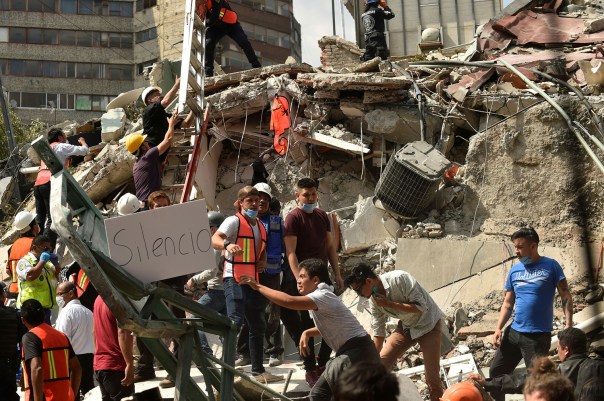
Mexico City rescuers ask for silence so they can listen for sounds from people trapped in the rubble. Photo by Pedro Pardo /AFP / Getty, Published in The Atlantic. Pedro Pardo
By: Raúl Zibechi
I had the immense good fortune of having been in Mexico City on September 19. At 1:15 pm we were with compañero and friend Luis Hernández Navarro near colonia Juárez. In the following days I was with compañeros and compañeras in Ciudad Jardín and in Zapata Street, where buildings had collapsed while others presented severe damages, we shared with the volunteers and neighbors their sorrows and eagerness to overcome the difficult time.
What I experienced and lived with those days in the Mexican capital, and then in the state of Chiapas inspire four reflections in me, brief and incomplete.
The first is to verify the solidarity of the Mexican people. The solidarity is massive, extensive, consistent, absolutely lacking self-interest, without the slightest desire for leaders. It’s not about charity but rather about responsibility, as Gloria Muñoz pointed out in a brief conversation. A profoundly political attitude, which told the authorities something like “go away, we take care of each other because we don’t believe you.”
At the points of collapse that I was able to visit there were up to three thousand volunteers that bought their shovels, helmets and gloves, who traveled dozens of kilometers with their motorcycles, on foot or on bicycles bringing blankets, water, food and everything they could. It’s probable that more than 100,000 persons had mobilized, just in the capital. Quantity and quality, energy and delivery that no political party is able to equal!
I interpret that marvelous solidarity as a hunger for participation to change the country, as a deep desire to be involved in the construction of a better world; as a political attitude of not delegating to the institutions or representatives, but rather of helping by putting their body on the line. In the political culture in which my generation was formed, that attitude was called “militant,” and it’s what permits us to intuit that a country as battered as Mexico still has a bright future.
The second is the role of the State, from the institutions to the armed forces and the police. They arrived at critical points the day after the earthquake day and they did it like a machine to impede, to block the participation of volunteers, to reject them and send them to other sites. They did this work of dispersing solidarity meticulously and with the discipline that characterizes armed bodies, which is not useful for saving lives, but rather serves to protect the powerful and their material wealth.
I was deeply struck that in the poor neighborhoods, like Ciudad Jardín (Garden City), the deployment of soldiers was much greater than in middle class neighborhoods, although the human drama in the face of collapsed buildings was similar. I would say that the soldiers rigorously watched the “dangerous classes” because their bosses know that revolt nestles there.
The third thing is the role of capital. While the armed forces and police were dedicated to dispersing the solidarity folks, businesses began to profit. Two thousand damaged buildings in the capital is an appetizing morsel for the construction companies and financial capital. The big companies made gurgles of solidarity. So great was the tide of solidarity that capital had to “do the same” and set aside its individualistic culture, in order to disguise itself from a culture that is alien and repugnant to it.
The division of labor between the State and capital is worth noting. The former disperses the people so that the latter can do business. Playing with words, we can say that solidarity is the opium of capitalism, as it neutralizes the culture of consumption and slows down accumulation. In those days of desperation and twinning, very few thought about buying the latest model and everything was focused on sustaining life.
We are the fourth question. The attitude of the Mexican people, that generosity that still makes me tremble with emotion, crashed against the levees of the system. Those above expropriated a good part of the donations gathered in the collection centers and diverted the solidarity: when it was about a below-to-below relationship, they inverted it to become charity from above-to-below.
We know that destroying relationships between those below maintains the system because those relationships dynamite the skeleton of domination constructed on the pillars of individualism. But we still have a long way to go in order that relations among those below are deployed with all their potency. It is a question of autonomy.
In the days after the earthquake I had long conversations with two of the city’s organizations: the Street Brigade and the Francisco Villa Popular Organization of the Independent Left. In both cases I found a similar attitude, consistent in avoiding the collection centers in order to work directly with those affected. “We held back,” said a leader of Los Panchos in the community of Acapatzingo, in Iztapalapa.
The solidarity is directed at those who need it, but functions through layers or concentric circles. It first attends to members of the organization, then to members of other organizations that are friends or allies, and also to individuals that are not in an organization, but in this case it is also direct, face-to-face, in order to avoid the diversion of aid.
The new world already exists. It’s small if compared to the world of capital and of the State. It’s relatively fragile, but it is showing resistance and resilience. Our solidarity must run through the channels of that other world, flowing through its veins, because if not it makes us makes us weaker. The storm is an especially delicate time, as we have seen since September 19. The system is determined to destroy us and, therefore, is even prepared to manufacture a “humanitarian” camouflage.
The incredible solidarity of the Mexican people deserves a better fate than swelling the pockets and the power of the powerful. But that depends on us, because we cannot expect anything from them. If it’s true that solidarity is the tenderness of the peoples, as Gioconda Belli wrote, we must care for it so that the oppressors don’t make it dirty.
———————————————————–
Originally Published in Spanish by La Jornada
Friday, September 29, 2017
http://www.jornada.unam.mx/2017/09/29/opinion/032a1pol
Re-Published with English interpretation by the Chiapas Support Committee
Bank account for solidarity deposits for the indigenous reconstruction
Bank: BBVA
Name: Gilberto López y Rivas
Account number: 0462018950
Routing number: 012540004620189509
International deposits:
SWIFT code: BCMRMXMMPYM
ABA code: 02000128 Branch number: 0074 3916
Bank address: BBVA BANCOMER, PLAZA LAUREL, Av. Avila Camacho 274, San Jerónimo, 62170 Cuernavaca, Morelos
 Chiapas Support Committee