By Raúl Romero | Published in Spanish in La Jornada here.
The journey has been long. Due to battered and privatized roads, we are running into sections under repair and accidents. The driver of our vehicle says: “You have to drive carefully, the devil is loose.” A trip that takes 14 hours, from Mexico City to San Cristóbal de las Casas, Chiapas, we do it in 21 hours.
The climate of violence in the country, that devil that has been unleashed since 2006, leads us to take all precautions: We leave a list with emergency contacts and a group monitors our trip from fixed locations. Every four hours they receive our location. If no report comes, they look for us. If they do not find us within a certain amount of time, they have to notify Frayba or the TDT Network, the independent organizations that accompany the “National and international Caravan to Zapatista territory.” No precaution is less necessary to cross this painful country and its geography of terror.
Then comes the second leg of the trip, from San Cristóbal de las Casas to the Caracol “Resistance and Rebellion: A New Horizon,” in the town of Dolores Hidalgo, a little more than an hour from Ocosingo. Here the dilemma is which route to take: the one that is usually taken by paramilitary groups and that charges a “right of way” fee, that has sections with landslides, or the longest one and full of curves. There is no discussion. We take the curvy road, some take dramamine, and we begin the journey.
Four and a half hours later, with pale faces and some stomachs emptied along the way, we arrive in rebel territory. We send the last report: “We have arrived.” In Zapatista territory we are not in danger. At the entrance to the Caracol, the compas – as we affectionately call the Zapatista people – have placed several banners from previous events such as the “dance-share,” “the women with rebel dignity”, “the capitalist hydra” . . .
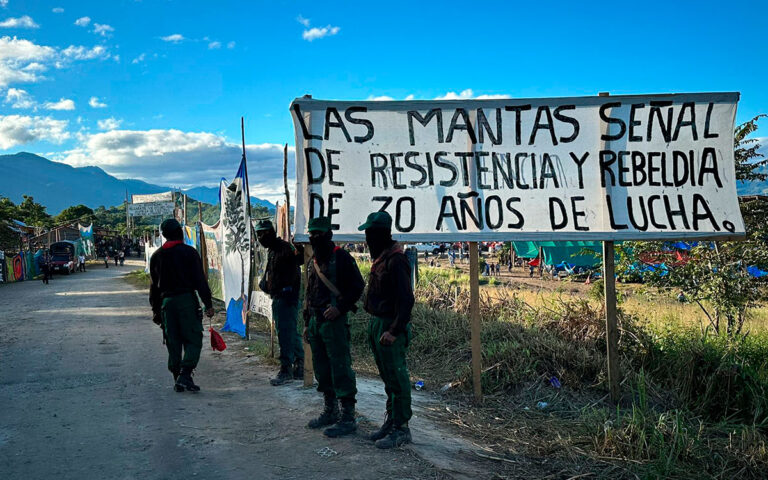
The entrance becomes a collective hug, hundreds of people traveling from different parts of the world meet again in Zapatista territory. The conversations last for hours. Hearts are happy. Collective projects begin to be planned. Diagnoses generate debates. Palestine and Kurdistan are present in the talks. New alliances are forged. The great network of global solidarity that is articulated around the EZLN is strengthened.
The celebration of 30 years of the war against oblivion is also the celebration of a new stage of internationalism. At the Caracol you meet the protagonists of the Zapatista movement. Marijosé, the compañeroa who more than two years ago traveled on the ship La Montaña from the Mexican southeast to Europe – and renamed it “Unsubmissive Europe” – now fulfills a new assignment: they are in charge of the kitchen that will feed the thousands of people.
Verónica, Chinto, Amado and other prominent members of the Palomitas Command – reinforced with new members such as Remigio – also roam around the Caracol. They ride dragons, unicorns and other fantastic creatures. Their laughter and pranks, one of the secret weapons with which Zapatismo seduced Rebellious Europe, now also call for hope.
A friend comments: “Zapatista territory is the only place where I do not have to keep my eyes on my daughters and I feel calm.” This is one of the objectives of Zapatismo: a world where a girl can play without fear. If in the past, theater and pastorelas were used in order to evangelize indigenous communities in the “new world,” today the Zapatista indigenous communities subvert their function and make theater a tool to pedagogically explain an extremely complex process: its history, the war against oblivion, leading by obeying, the autonomous Zapatista rebel municipalities, the councils of good government and what is its new horizon, the common and non-property.
On December 31, at 11:30 p.m., the EZLN shows its strength and organization. Thousands of militiamen, men and women, perform exercises to the rhythm of cumbia and ska. The message is clear, Zapatismo is an army that has chosen life, but is willing to defend its territories and project.
Contrary to what intellectuals, “specialists” and journalists forged in “lazy thinking” say, Zapatismo is full of youth. Among militiamen and militiamen, the faces and bodies of those who are beginning to leave adolescence behind can be seen. A new generation of Zapatistas and a new stage of Zapatismo. “The property must belong to the people and be common, and the people have to govern themselves,” says Subcommander Moisés, spokesperson for the EZLN, in his speech. Sketches that manage to draw the new theoretical and political horizon launched by the Zapatistas. 30 years after the war against oblivion, Zapatismo embarks towards the future of humanity.
* Sociologist @RaulRomero_mx
Translated by the Chiapas Support Committee from the original in Spanish; published January 7, 2024 in La Jornada: https://www.jornada.com.mx/noticia/2024/01/07/opinion/el-comun-el-nuevo-horizonte-5412
 Chiapas Support Committee