By: Raúl Romero*
Pablo González Casanova used to narrate with irony what his detractors said about him and his constant trips to Chile during his time as rector (1970 -1972): I traveled so much, that they told me that I was more in the Palacio de la Moneda than in the Rectory, and that is why what had happened to me had happened to me. Interviewed by Claudia Rojas, Hugo Miranda, who was director of the Casa de Chile in Mexico, will recall: the former rector of the National Autonomous University of Mexico (UNAM) Pablo González Casanova goes to Chile, has links with the University of Chile, gives conferences, has meetings with the intellectual world and all that is creating a friendship and a very close bond between Mexico and Chile.
For those years, don Pablo not only occupied the UNAM’s Rectory, in his works Democracy in Mexico and Sociology of Exploitationhe had expressed his commitment against inequality and exploitation, choosing as an alternative the struggles for socialism, democracy and liberation, which years later he would refer to as three alternatives in one. The experiences of the government of Jacobo Arbenz, the Cuban revolution and the world revolt of 1968 would deeply mark González Casanova in those years, and of course, he would follow with attention the rise of the Popular Unity to the government of Chile. From different spaces, it will be deeply committed to the Chilean road to socialism, and will also open spaces for the dissemination and strengthening of that experience. After the fateful September 11, 1973, don Pablo will devote his energies to help bring to Mexico intellectuals and political leaders who in Chile will be at risk of imprisonment, torture and death. His relationship with Pedro Vuskovic, who was Minister of Economy under Salvador Allende, and who after the coup d’état was exiled in Mexico, will be testimony to this solidarity.
With his great friends Luis Cardoza y Aragón and Lya Kostakowsky, don Pablo will approach a powerful network of intellectuals, artists and popular leaders committed to the struggles of Latin America. Thus, González Casanova will forge friendship with Pablo Neruda, who will also keep him informed about the details and particularities of the process in Chile.
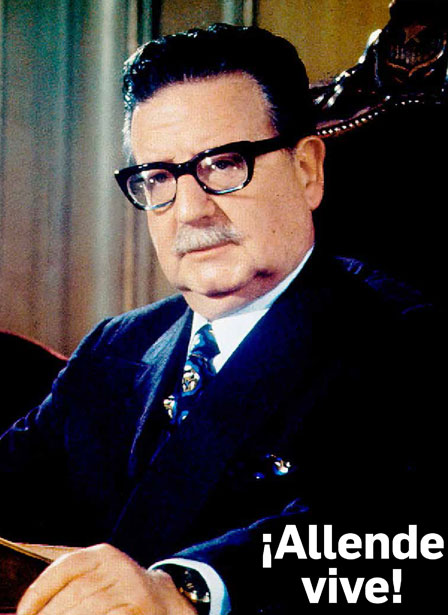
If the Cuban revolution summoned González Casanova to be in the front line of solidarity in the anti-imperialist struggle, Popular Unity and Salvador Allende will lead him to reflect on the peaceful, legal and democratic path to socialism, a socialism that at the same time posed the struggle against imperialism and for internationalism. The processes of the nationalization of copper, iron and coal allowed the rector of the UNAM to observe the difference of the Chilean process with other populists and revolutionary nationalists in the region.
But González Casanova not only recognized the feat of the Chilean people, he also had a deep respect for Salvador Allende, whom he saw as a great orator, a great politician and above all a revolutionary. Just a few weeks after having resigned from the UNAM, in November 1972, at Allende’s direct request, Don Pablo will participate by making contacts and relations for the historic trip that the Chilean president made in December of the same year to Mexico.
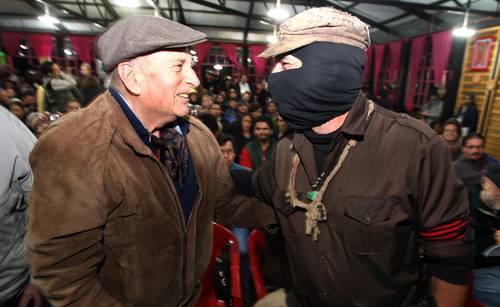
Don Pablo highlighted Allende’s congruence, of doing what he said and to what he was committed: He used the word as an exact announcement of the action. Salvador Allende, recognized that the author of Democracy in Mexico had a place next to Fidel Castro as leaders of revolutionary processes that theorized about their processes and that with their speeches and writings contributed to educate and arm the peoples with theory.
Six years after the coup d’état in Chile, Don Pablo will write: He died like no Latin American president, invested with the symbols that the people gave him, weapons in hand, the palace burned and destroyed, the project of defense of the law for the popular program alive, and a new history that they would write being born, as he thought, America and its people.
The neo-fascist and neocolonialist repression that would be unleashed first in Chile, and then in much of Latin America, would commit González Casanova to support exile and collaborate in safeguarding the heroic memory of the Chilean people. Thus, among other initiatives, he supported the Salvador Allende Center for Latin American Studies, which will promote the analysis of the Chilean road to socialism and recover writings of the former Chilean president.
Each people is free to choose its own path to socialism, said Salvador Allende, and González Casanova helped to understand that the path chosen by the Chilean people was a contribution to the struggles of Latin America and the world. Today Allende and Don Pablo walk through the great avenues of history, and sooner rather than later the peoples of our America will travel that path that they and so many other men and women helped to trace.
*Sociologist
Originally Published in Spanish by La Jornada, Sunday, September 10, 2023, https://www.jornada.com.mx/2023/09/10/opinion/006a1pol and Re-Published with English interpretation by the Chiapas Support Committee
 Chiapas Support Committee