Chiapas Support Committee
Home of the Compañero Manuel blog on zapatistas & mexico
“A call to all those who rebel in all corners of the world”
From the Zapatista Gathering in Morelia: “A call to all those who rebel in all corners of the world”
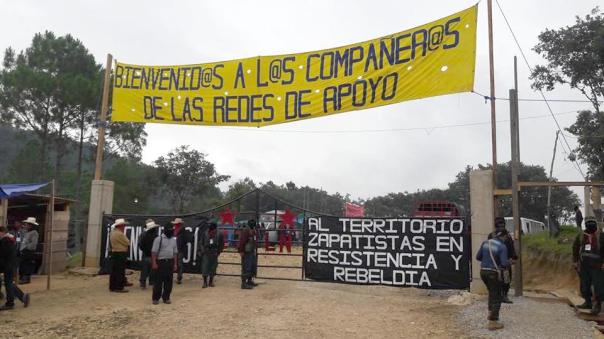
Banner welcoming support network compañer@s to the Gathering in Morelia.
Altamirano, Chiapas, August 6, 2018
The festival: CompARTE FOR LIFE AND LIBERTY, “Paint little caracoles to the bad governments, past, present and future,” convoked by the EZLN’s support bases, starts today in the Zapatista Caracol of Morelia. From August 6-9, in the Caracol located in the municipality of Altamirano, you will be able to appreciate musicians, actors, dancers, painters, sculptors, poets, etcetera, from the Zapatista communities in resistance and rebellion, the Sixth Commission of the EZ communicated. Artistic expressions from national and international attendees will also be presented.
This August 6, on the principal stage of the Caracol de Morelia, they will present theater works from the Zapatista Caracol of Oventic, Altos region: “The seven principles of Govern Obeying;” “Environmental and social destruction” and “The new way of Self-governing.”
From the Zapatista Caracol of Roberto Barrios, will entertain with mariachi music from the following groups: The Five Stars; Zapatista Pride; The People’s Voice; Rebel Youth and Chol Maya Renaissance. The soloists Chántee, The Rebel; King Being; Women’s Voice; Valero and My Root will also give presentations. We can’t lack a music trio, so therefore this Monday we’re going to hear the groups: The Flower and Seed of Freedom. In this start of the festival you will be able to enjoy the duo “Life’s Path” and the interpreters of Rap music: For Life and Here I Am.
Young men and women from the host Caracol will present a theater piece that invites reflection called: “Working to live or Working to Die?
From the Caracol of La Realidad, you can enjoy the music of groups like: Strugglers of the People; Cro Eleazar; Los Bamex; Cro Manayer; Touch me of you can, capitalist; Rebel Creators of the South; Rebel Dúc; Rebel Trio; Los Primos; Cro Yorch; Sons of the People; Butterfly of the South; Rebel Youth and Followers of the Struggle.
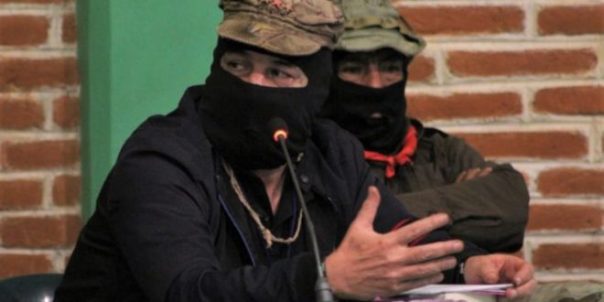
Prior to the start of the festival on Sunday afternoon August 5, at the end of the Gathering of support networks for the Indigenous Governing Council (Concejo Indígena de Gobierno, CIG), of the National Indigenous Congress (Congreso Nacional Indígena, CNI), upon speaking to those in attendance, Subcomandante Moisés repeated the reading about what the Zapatistas give to the current national and international context. The Zapatista spokesperson was blunt when he said that there is no “good boss,” in reference to the different forms of capitalist exploitation and dispossession and its representatives, who he equated with “Overseers” (neoliberal presidents), “Foremen” (governors) and “Supervisors” (municipal presidents).
Subcomandante Galeano, following the words of Subcomandante Moisés, indicated that any overseer “is going to be confronted;” that upon seeing that capitalism is returning to the methods that gave it origin, “war for the conquest of new territories.” By giving priority to consumption, the predatory global economy “will destroy as much as it can,” Galeano warned. He also pointed out that the new “merchandise” of capitalism, is in the territory of the Native peoples and includes: water, land and air, among others. Faced with the crisis that the system produces, like migration and natural catastrophes, “capitalism is testing an inward withdrawal as an anti-globalization to be able to defend itself,” the Zapatista spokesperson said. Different walls are going to continue to rise and will proliferate like archipelagos for separating the rich from the poor, he added.
Galeano also emphasized the role of the different collectives that worked in support of the CIG and its spokesperson María de Jesús Patricio Martínez, on collecting signatures so that “Marichuy” would attain her registration as a candidate to the presidency of the republic. “With everything against you, the collectives and the spokesperson, denounced the predatory system,” the insurgent expressed. Despite the fact that official registration was not attained, he said that together with the National Indigenous Congress (Congreso Nacional Indígena, CNI) and the support groups, they will now consult about how to make the Council larger, so that this initiative “doesn’t absorb and annul differences; but rather that it strengthens them,” on the international level. “Our call is not only to Native peoples, but rather to all those who are rebelling in all corners of the world,” the Chiapas rebel shared.
COVERAGE OF THE COMPARTE FESTIVAL: https://www.facebook.com/EnlaceZap/?hc_ref=ARQyLElgcLeOImLsA3GuE2NDoPY2lEpyipbCkLY_e0Gd2Z6Iy9-uQ7NoBu2uXZJXjnA&fref=nf
—————————————————————-
Originally Published in Spanish by: POZOL COLECTIVO
Monday, August 6, 2018
Re-Published with English interpretation by the Chiapas Support Committee
The strategy of the caracol
[Administrator’s Note: Today is the the 15th Anniversary of the birth of the Zapatista Good Government Juntas and Caracoles, a revolutionary model for organizing and self-government. The anniversary is being celebrated at the Gathering in Morelia.]

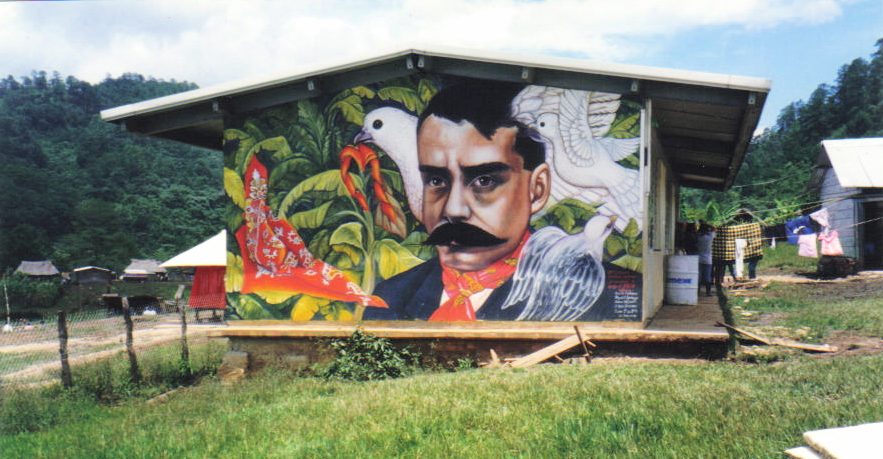
Mural on front of the first offices of the Good Government Junta in the Caracol of La Garrucha.
By: Hermann Bellinghausen
It has been fifteen years since the Zapatista National Liberation Army (Ejército Zapatista de Liberación Nacional) announced the creation of the caracoles and the Good Government juntas (Juntas de Buen Gobierno, JBG).
Today, when the in-coming government enunciates as its goal to “fulfill” said agreements (the San Andrés Accords, SAA) it would be good for it to find out that they were already fulfilled. Now more is needed, the SAA were only the first of four stages of interrupted talks to negotiate peace with the rebels and to fulfill the historic demands of the nation’s Native peoples. Faced with the neoliberal policies that established dispossession and aggressive extraction on their territories, many peoples stopped hoping. A risk of AMLO’s policy for indigenous peoples is that it starts from behind. It will be patronizing and directed at “poverty,” and it foresees a manner of “autonomy” and goes straight to the creation of important divisions. As if there were not too many already!
Slowly, quietly and efficiently, the rebel Caracol that has been functioning for 15 years accommodates and moves, updates, contracts and expands, and apparently has fun. Its demands don’t go through Sedesol waiting lines. Besides, its strategy went further and deeper, and embodies a culture that the State is obliged to respect.
Andrés Aubry, a great interpreter of the Chiapas rebel movement, wrote in Ojarasca that: “the fiesta of the Caracoles demonstrated that the rebels took seriously breaking the silence proclaimed by 30,000 Zapatistas and their comandantes on January 1, 2003 in San Cristóbal.
“Now we know that what filled this long silence in clandestinity was nothing other than a disciplined and progressive fulfillment of the San Andrés Accords.” Faced with the “heavy omissions” of the political class and the official powers, “the Zapatistas proclaimed that from here on this open rebellion would no longer be practiced in silence, but rather by means of a transparent resistance.”
In the heat of the events, Pablo González Casanova also wrote: “Among the rich contributions that the Zapatista movement has made to the construction of an alternative, the project of the caracoles unravels a lot of false debates from politicians and intellectuals.” In the words of Comandante Javier (the same one who had read the First Declaration of the Lacandón Jungle in San Cristóbal de Las Casas on January 1, 1994), quoted by González Casanova in his splendid Essay interpreting the caracoles, they open “new possibilities for the resistance and autonomy of the indigenous peoples of Mexico and of the world, which include all the social sectors that struggle for democracy, liberty and justice for all.”
After the creation of the Caracoles and the JBGs, formed by the EZLN’s civilian structure in the autonomous rebel Zapatista municipalities (that has been evolving since December 19, 1994), González Casanova points out that: “the project postulates that the communities and the peoples must practice the alternative in order to acquire experience, not wait to have more power to re-define the new style of exercising it. It is not constructed under the logic of the State’s power.” Nor is it constructed to create an anarchist society. “It is a project of peoples-government that is articulated internally and seeks to impose paths of peace… without morally or materially disarming the peoples-government.”
It’s fair to recognize that the JBG and its likenesses are both government and a school of government. They opened central participation to women and youth, and made community public service horizontal without anything to do with the political parties or the dominant system.
González Casanova’s conclusion was of long reach: “More than an ideology of the power of peoples-governments, the caracoles construct and express a culture of power that emerges from five hundred years of resistance of the Indian peoples of America.”
———————————————————-
Originally Published in Spanish by La Jornada
Monday, August 6, 2018
http://www.jornada.com.mx/2018/08/06/opinion/a08a1cul
Re-Published with English interpretation by the Chiapas Support Committee
The play on the Zapatista court
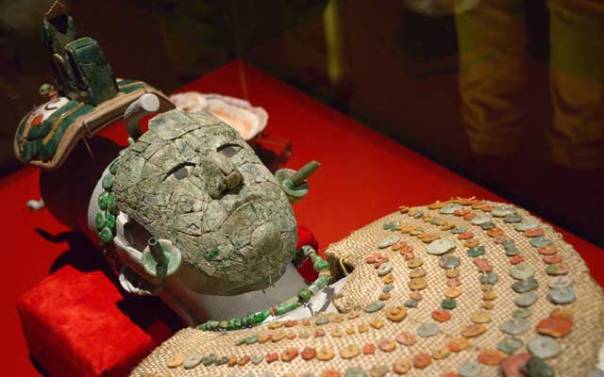
The Red Queen of Palenque (Chiapas) in Mexico City’s Templo Mayor. Photo: INAH
By: Daliri Oropeza*
A group of young women with ski masks collectively recite poems mixed with dance, slogans that make petals fly, fans raising corn, all in different circular formations, then linear, which encompass the space of the basketball court. The word of the rebel communities is also in performance art. With these representations they received María de Jesús Patricio in the five Caracoles of the Zapatista Rebel Autonomous Municipalities (Municipios Autónomos Rebeldes Zapatistas, Marez). They also receive indigenous communities of the country and of the world with art.
It’s no coincidence that the Zapatista communities represent the autonomy that they experience occupying the space of a court, not a theater. After the armed uprising, the Dialogues for Peace in San Andrés Sacam’chen began on a basketball court. To the government, a basketball court seemed like a strange place to dialogue, but no; according to the cross reference that the writer Juan Villoro proposes, the Zapatista communities, of Maya descent, carry in them the meaning of the ball game as the moment in which the wheel of the cosmos bounces on the courtyard of the world, a court that they called taste. There are even records of the importance of taste because of its direct association with the sacred landscape, with the spaces of daily life and collective activities, to the degree of symbolizing the community.
But now there is art on the Zapatista basketball courts and in this performance art there are very clear messages. In their works they recreate the exercise of political participation, their vision of autonomy, the strength of women, autonomous justice or about their history before and after the uprising. Everything that was dialogued on the San Andrés basketball court is first at practice and later in the representations. The Trans-disciplinary Collective of Critical Investigations (Cotric, its Spanish acronym) describes that in Zapatista art there is a system of “stable” signs and symbols and five recurring themes: The history of the past, from the colonial to the caciques; the revolutionary past up to the 1994 Uprising; the present in resistance and autonomy; the future with this distinct form of governing; and the trans-temporal that connects the different times.
What happens on the basketball courts of the Marez leaves in ridicule the idea that the team of the winning candidate of the presidential election offers: “fulfilling the San Andrés Accords,” because it would be not recognizing that entire indigenous nations already carry them out: “a catchy political discourse,” affirms the Ñuú Savi lawyer Francisco López Bárcenas, but as a government proposal it’s late. On the court, the Zapatista bases demonstrate the exercise of their cultural rights, signed in the Accords.
But now on the basketball courts they represent through art their political participation and the women in charge, but also the differences between the dynamics between neoliberal capitalism and Zapatista autonomy that they live day by day. Not only the Zapatista communities, hundreds of communities, from the north to the south of Mexico exercise one or all the points of the San Andrés Accords, with or without the laws approved in 2001, dozens never left their own organization. It is no coincidence that within the same communiqué where the EZLN criticizes the recently completed electoral political dynamics is the same one that invites us to the celebration of the 15 years from the start of the five Zapatista Caracols and to the third edition of the CompArte Festival.
The relationship between the country’s indigenous peoples, society and the State is not the same since the Zapatista Uprising or the activation of the five Caracols that function autonomously. They start from a different exercise of their identity in front of this new government. What’s going to happen if there’s no counterweight? That evidence that Marichuy’s campaign achieved by baring the dysfunctional electoral system, demonstrating that it’s the “left drunk with victory” that attacked the proposal of the CNI and the EZLN, with the argument that it was a “strategy to divide the left.”
With this performance art, the Zapatista support bases put the cultural rights of the original nations on a court. These rights are the most unprotected because of not being covered by international treaties. They are so broad that they encompass rituals, language, identity, current artistic creations of the communities and also the intangible cultural heritage, the meaning of ancestral practices and even the bio-cultural relationship, which give meaning to the autonomy that the peoples exercise. More than advisers, as Father Solalinde says, I see a court in the middle of the forest, women, children and grandparents struggling, in rebellions re-creating and exalting their own history with art. There are teams that play in dignity until the last minute.
*Journalist
———————————————————–
Originally Published in Spanish by La Jornada
Saturday, July 28, 2018
http://www.jornada.com.mx/2018/07/28/opinion/008a1pol
Re-Published with English interpretation by the Chiapas Support Committee
Did they listen?

Art from the Zapatista communities, part of the art on display at CompArte: the Emiliano Zapata Community Festival, August 11 at the Omni Commons in Oakland.
By: Raúl Romero*
It was 1995 and Ernesto Zedillo was president of Mexico. Violence and the economic crisis created a difficult atmosphere for his mandate. In order to gain legitimacy, Zedillo proposed resolving the conflict that had exploded one year before in the country’s southeast, where the Zapatista National Liberation Army (Ejército Zapatista de Liberación Nacional, EZLN) rose up in arms as a response to the genocide against the indigenous peoples and in demand of jobs, land, housing, food, health care, education, independence, liberty, democracy, justice and peace for all Mexicans; demands to which they would later add autonomy and information. The causes of the uprising remain in effect.
Zedillo’s strategy consisted in publicly simulating peace and dialogue, at the same time that he prepared the military operation with which it sought to arrest the Zapatista comandancia. Esteban Moctezuma Barragán, then Secretary of Governance, was a key piece in the operation: while he simulated dialogue, Zedillo ordered the revelation of the alleged identity of Zapatista leaders and unleashed orders of capture against them.
On February 9, 1995, the Mexican Army took several Chiapas villages. There were illegal arrests, searches, bombings, young children murdered and women raped. “The February betrayal,” as this event was known, failed in its final objective: arresting the Zapatista commanders.
Recently, Andrés Manuel López Obrador (AMLO) ratified that Esteban Moctezuma will be the Secretary of Public Education in his administration. He also named Alfonso Romo as one of those currently responsible for the transition in economic matters and his future cabinet chief. Romo has been an impresario spoiled by the system. AMLO himself denounced Romo several times.
Romo, just like Víctor Villalobos –proposed by AMLO to head the Secretariat of de Agriculture and who Víctor M. Toledo in these same pages classified as a “soldier of the transnationals” (https://bit.ly/2JtzIAZ)– openly promotes the use of genetically modified organisms and improved seeds, a measure that is rejected by campesinos in Mexico.
Likewise, to the express question of whether they will support the Special Economic Zones (SEZ), Romo stated last July 1 that they would make them bigger and that all of Mexico would have to be an “investment paradise.” The SEZs are true colonial enclaves, “new links to dispossession,” as Magdalena Gómez pointed out (https://bit.ly/2JwcJFA ). [1]
We could mention other names that represent the system of privileges, impunity and corruption and that will occupy key charges in the next cabinet. These examples are enough to point out that the doubts about a 180 degree change of the next government are legitimate, doubts that are fed by the rambling speeches typical of Salinismo, but now enunciated by mediators of the future government, like Alejandro Solalinde, who referred to the EZLN as “extremists,” “indigenous people influenced by mestizos” and a “radical minority.”
But the doubts about what will happen above do not underestimate what moved in those below last July 1. Of the more than 30 million people that voted for AMLO, many also or above all, voted against the war, against the impunity and against the femicides. They voted for the presentation of disappeared persons, for memory, for truth and for justice. They voted against the hikes in gas prices (gasolinazos), against the education reform and for dignified employment. The discontent accumulated over many years decided to manifest that day. The organizational experience of the victims movement, of the teaching profession, of youth, of the social-environmental resistances, of women, of sexual diversity, of journalists and of many others conquered fraud.
All those voices must be heard. And for that to be the case, social, critical and independent movements are necessary. Movements that will break the neoliberal consensus that the ruling classes seek to expand. The worst thing that could happen to us now is that we derive into a neoliberalism legitimized with the false argument of unity from the 30 million voters. You must listen well: many people voted against neoliberalism, voted against the system of death, dispossession and corruption that is called capitalism. A non-corrupt capitalism does not exist, nor does dispossession equal the wellbeing of the peoples.
In Mexico we know what happens when organizations of our peoples become an extension of the State. We don’t want to relive that history. Even worse, if democratic organizations of the left do not occupy that place soon, right-wingers from the hand of Claudio X. González will fill the vacuum.
They have to listen carefully to what those below said and will say these days. Now that the tsunami is over, the islands of the new world will continue being the horizon that guides the walking.
*Sociologist
[1] For more on the Special Economic Zones, see also: https://chiapas-support.org/2015/10/02/special-economic-zones-for-southern-mexico/
———————————————————–
Originally Published in Spanish by La Jornada
Tuesday, July 24, 2018
http://www.jornada.com.mx/2018/07/24/opinion/016a1pol
Re-Published with English interpretation by the Chiapas Support Committee
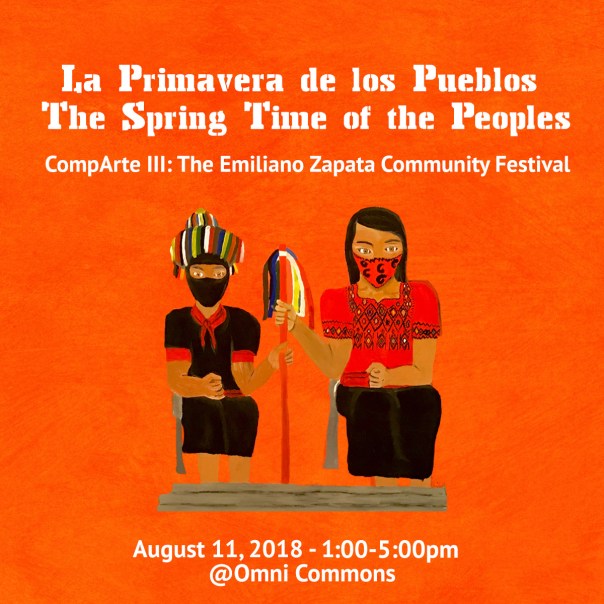
Join us for CompArte III: The Springtime of the Peoples
DEAR FRIENDS!
The Chiapas Support Committee is inviting you to the third annual CompArte: The Emiliano Zapata Community Festival, being held on Saturday, August 11, 2018, 1:00-5:00pm at the Omni Commons community center, 4799 Shattuck Avenue, in Oakland.
This year’s gathering is called “La primavera de los pueblos | The springtime of the peoples,” to celebrate our struggles and movements for justice, human rights and equality for all with music, art, poetry and community speakers to uplift solidarity with the Zapatistas and Indigenous people’s struggles for self-determination, autonomy and land justice in Mexico and the U.S
CompArte: Community, Art, Justice & Solidarity with the Zapatistas
Come enjoy an afternoon of great music, art, poetry, bread & the company of people dedicated to building a community of love, justice & solidarity!
The gathering is free and family friendly.
CompArtistas
Keynote Speaker:
Roxanne Dunbar-Ortiz, author & activist, An Indigenous People’s History of the United States and Loaded: A Disarming History of the Second Amendment.
Featuring artwork by;
Jesús Barraza
Derrick Bell
Anh Bui
Lisa Castellanos
Daniel Camacho
Melanie Cervantes
Emory Douglas
Yadira Gonzalez
Xóchitl Nevel Guerrero
Carlos Jackson
Priya Handa ,
Eddie Lampkin
Gilda Posada,
Zapatista community artists from Chiapas
Music
Madelina y Los Carpinteros, Latin American music ensemble
Francisco Herrera, Trabajo Cultural Caminante
Mogauwane Mahloele, South African master percussionist, vocalist and storyteller
Poetry
Arnoldo García
Antonieta Hensley
Taj James
uPhakamile uMaDhlamini
PoesíaMaríaArte
And others
Available at CompArte:
Artesanía from the Zapatista women’s collective, including hand-embroidered blouses, Zapatista items & art
Light food & refreshments will be provided.
CompArte III — La primavera de los pueblos
La primavera de los pueblos | The springtime of the peoples: CompArte III | The Emiliano Zapata Community Festival
Saturday, August 11, 2018, 1:00-5:00 pm
Omni Commons, 4799 Shattuck Avenue, Oakland, CA 94609
Free | Sponsored by the Chiapas Support Committee
BACKGROUND
Initially convened by the Zapatistas in July of 2016 to celebrate and strengthen the imagination and vision of the anti-capitalist movement and build the fight “For Humanity and Against the Walls of Capitalism,” CompArte is a space for the art of communities, social justice and liberation that brings together artists, painters, sculptors, musicians, rappers, hip-hop, muralists and cultural workers to showcase the deep cultural roots of our movements.
CompArte literally means “share art,” and for us it means to listen together to each others dreams and visions of a revolution against the winters of capitalism.
CompArte III will feature an art show that will be on display at the Omni starting August 1 and run through September 23.
Narco-states versus freedom

By: Raúl Zibechi
Wealth accumulated by the one percent is being protected by an alliance between drug trafficking networks and sectors of the state apparatus that serve the interests of large multinationals but at the same time have been formed as an important factor of power. This alliance operates by clearing territories for mining and energy undertakings, from which it benefits by creating broad spaces under its control that it uses to lubricate its illegal businesses.
Recently, analyses started to be published about this reality that, under the mane of drug trafficking (narcotráfico), designs a mode of domination and control of populations. We should not lose sight of the fact that the narco-states are not deviations from the tradition of the nation-states, but rather their new configuration in accordance with extractivism/fourth world war, which complicates both the resistances of popular sectors and the emancipatory struggle in general.
The formation of narco-states (and narco-institutions) seems to be increasing and the space is not restricted to Latin America. In some European countries the mafias allied with politicians achieve setting up camp in municipalities and even entire regions, reaching a decisive influence in the configuration of the political map, particularly in Italy.
In several Latin American countries this alliance operates together with the evangelical and Pentecostal churches, especially in Brazil and Colombia, where they support right-wing parties and candidates, although some of them arrived to sustain the government of Lula for years, only to then take a sharp a turn in the opposite direction.
In recent months a violent conflict reappeared over control of the city of Medellín (Colombia), which had been held up as a paradigm of the pacification of one of the most violent cities, thanks to a municipal management that used the urban architecture to generate a culture of peace. The outbreak of violence en this showcase city shows the limits of public policies for controlling drug trafficking, as well as baring its alliances and modes of operating.
An excellent report from the journalist Camilo Alzate about the war underway in Commune 13, assures that “the city of economic prodigies is under control of the mafias” and adds a revealing phrase: “The real power that formal power needs.” After the progressive management of Mayor Sergio Fajardo (2004-2007) the city had become the showcase of pacification and hosted international business forums for the global elites.
In some countries, like in Uruguay during the presidency of José Mujica, Medellín was held up as an example of the successful combat against crime, which would be solved constructing sports spaces, public libraries and meeting places where young people would discover the wonders of life and get away from the criminal gangs.
The basic idea is that good management can solve structural inequalities without touching privileges, including the endemic corruption of the state apparatus. The concept of “urban acupuncture,” which had functioned decades before in the Brazilian Curitiba was reclaimed to solve social problems through punctual interventions in the city.
What’s certain is that that experience for export failed without those responsible facing it. The social leaders of Commune 13 told authorities: “We don’t trust in the institutions, and above all we don’t trust in the police.” And they conclude: “If the community cannot trust in the police, what do we have left?”
This is the central point. There are no sectorial policies for solving the problem of drug trafficking, because it has already been integrated into the state apparatus, the real power that utilizes the institutions. In Medellín there are hundreds of people threatened and displaced by the criminal gangs that imposed a permanent curfew at night. The police limited themselves to attacking young people, who they always consider suspicious, while protecting the mafias.
On various visits to Medellín I was able to verify how in the communes this narco power controls transportation, forcing the drivers to pay them a fee, as well as all the businesses within a territorial limit that they control. The business of cans of gasoline, of cell phones and television, are all in the hands of the narcos, in a broad geography that goes from Medellín to Río de Janeiro, passing through a good part of the continent’s cities.
How is this narco-state power dismantled?
Impossible to do it from inside, as all known experiences show.
It is a central theme for the anti-systemic movements, since this power is dedicated to destroying all popular organization because they covet complete control of territories. Therefore we know that only by organizing ourselves at the margin of these powers will it be possible to construct solid and lasting emancipatory movements.
———————————————————–
Originally Published in Spanish by La Jornada
Friday, July 20, 2018
http://www.jornada.com.mx/2018/07/20/opinion/020a1pol
Re-Published with English interpretation by the Chiapas Support Committee
It’s capitalism!

María de Jesús Patricio Martínez (Marichuy)
By: Gilberto López y Rivas
Without a doubt, we’re experiencing an historic moment in contemporaneous Mexico, because for the first time in many decades the popular will expressed at the polls was respected; a State fraud was not imposed, nor the fall of the system, nor the cynical “it has been as it has been” of Felipe Calderón; this is a transcendent conquest of the Mexican people, without diminishing or underestimating, it’s necessary to analyze from the critical thinking and struggle of the original peoples in defense of territories, Mother Earth and life.
This transition is not due to a sudden democratic calling of the PRI regime, but rather to three interrelated factors that prevented the imposition of the traditional State fraud: 1) The extraordinary citizen participation of more than 60 percent of registered voters. 2) The fracture of the political class in the principal parties, the PRI and the PAN, which went to the election separately, and with internal divisions that deepened during the campaign. 3) The vote of punishment from millions of voters that spoke out for change.
However, it highlights the ability of the State to reconstitute itself: the triumph of the citizenry’s massive intervention was rapidly turned into a “victory of the institutions” and the “democratic system.” Gone was the violence deployed throughout and during the electoral process, and the 132 candidates murdered were quickly forgotten.
The recognition from the officialist candidate on election night, and the terse sequence of events that culminates with the message of Enrique Peña Nieto and the conciliatory speech of the winning candidate, suggests a concerted action starting with there will be no punishment for the outgoing government’s crimes of State and against humanity, or criminal litigation over the visible plundering of the treasury and the evident complicity of the three levels of government with organized crime.
At the same time, it is significant that in his first speech as the winning candidate, López Obrador sends a message to capitalist corporations to calm them that he will not take “radical measures,” “contracts will be respected,” “there will be no expropriations” and one must understand his preferred slogan in that context: “For the good of everyone, first the poor,” about which it’s appropriate to ask: Who is “everyone”?
Also, the guiding-almost-unique idea of the whole campaign that corruption is the matrix of all the country’s evils was reiterated, AMLO denying that it is inherent to capitalism, whose cornerstone is the expropriation of labor from the working class and the dispossession of strategic-natural-resources-territories by its corporations. The president-elect denies that the law of value-exploitation-surplus-value-class-struggle applies to Mexico, insisting on the corruption factor.
This peculiar perspective of López Obrador, which corrects the “classics” of Marxism, is very important for the direction that the resistance of the original peoples follows versus the process of re-colonization of the territories for the capitalist transnationals, which is made visible by the Indigenous Government Council (Consejo Indígena de Gobierno, CIG) and its spokeswoman, Marichuy, during the campaign. Mining companies, trans-Isthmus corridor, refineries, highway projects, bullet trains and a honeymoon with impresarios, are bad signs for the original peoples.
For their part, leaders of indigenous organizations around AMLO presented a programmatic document that, with the phraseology of Zapatismo, including the use of “govern obeying” (“mandar obedeciendo,” proposes, in sum, and as a principal proposal, a return to the indigenismo already overcome since the San Andrés dialogue, now under the leadership of an indigenous bureaucracy that would form a new State secretariat.
Marichuy declared that what’s really significant will come now and that the transcendent thing is to organize if you wish to take the country towards a real change; it’s about resisting the capitalist corporations and the governments that protect them, acting from where you are, in barrios, districts, cities or indigenous towns.
The limitation of representative democracy is that citizen participation is concentrated on just one day, and therefore, public issues are the monopoly of a class of professional politicians that ignore the electorate. The EZLN and the CIG, on the other hand, propose a new kind of democracy, an autonomist democracy that is founded on a construction of power and citizenship from below; as a way of everyday life, of control and exercise of power from what ought to be; that is, based on ethical terms. It is not a means or procedure of reproduction of bureaucratic estates, but rather a social and political pact, a constituent of everyday that operates unitarily in all spheres and orders of life.
The struggle for this democracy will continue, shoulder to shoulder with the peoples, below and to the left.
—————————————————–
Originally Published in Spanish by La Jornada
Friday, July 6, 2018
https://www.jornada.com.mx/2018/07/06/opinion/019a1pol
Re-Published with English interpretation by the Chiapas Support Committee
EZLN denies having contact with AMLO
Communiqué from the CCRI-CG of EZLN
Zapatista National Liberation Army
Mexico
To the People of Mexico:
To the People and Governments of the World:
To the Free, Alternative, Autonomous, or whatever they’re called Media:
To the National and International Sixth:
To the National Indigenous Congress and the Indigenous Governing Council:
To the National and International Press:
July 17th, 2018.
Since yesterday and during today, the media has been running a story backed by statements from Mister Alejandro Solalinde (who presents himself as a presbyter, priest, clergyman or however its said, Christian, Catholic, Roman Apostolic) about an alleged approach between the EZLN and Mister Andrés Manuel López Obrador and that “the EZLN already agreed to have a first dialogue” (textual words by Mister Solalinde). [An example of a media report is published below, following this communiqué.]
About this lie the EZLN declares:
First: The CCRI-CG of EZLN, the political, organizational and military directorate of the EZLN, hasn’t agreed to a first dialogue with anyone. As is well known by whoever has even minimum knowledge of the EZLN and its ways, a matter like this would have been made public well in advance.
Second: EZLN hasn’t received from Mister Solalinde anything but lies, insults, libel and racist and sexist comments, by assuming just like it was done during the days of Salinismo and Zedillismo, that we are poor ignorant indigenous manipulated by the -quoting his own words- “Caxlanes (outsiders) who administer Zapatismo” that don’t allow us to look down and kneel to the man who Solalinde considers the new savior.
Third: We understand Solalinde’s need to be in the spotlight and his demand for our submissiveness, but he is wrong about the EZLN’s Zapatismo. Not only he is wrong about that. We don’t know much about it, but it seems like one of the commandments of the church that Mister Solalinde supposedly serves, which goes: “Thou shalt not bear false witness against thy neighbor, and you won’t lie.”
Fourth: As anyone who knows Mexican Law would be aware, Mister Andrés Manuel López Obrador is not the President of Mexico, and he is not even President Elect. To become “President Elect” the Electoral Tribunal Of The Federal Judicial Branch needs to emit a declaration about it; afterwards the House of Representatives has to issue an edict on the Official Federal Gazette where it communicates to the population that now there is a President Elect. And according to those same laws, he is not a President in Office until he swears on the day of December 1st, 2018. By the way, according to the new Electoral Reform, he won’t rule for 6 years, but for 2 months less than that, unless the constitution is reformed and re-election becomes allowed.
Fifth: If the team of Mister Andrés Manuel López Obrador behaves as if they are the government its because that’s what the great businessmen made them believe (via YouTube, which must be a guarantee of veracity), Trump’s Administration (via its pharaonic visit), and the great media conglomerates, and its understandable; but maybe its not convenient to let everyone know their willingness towards breaking the law under the protection of a supposed “full car” (which is what PRI did during their long reign).
Sixth: The EZLN already had the bitter experience of accepting communication with a mister who afterwards was declared President Elect. We refer to Mister Ernesto Zedillo Ponce de León, who took advantage of the initial contact to plan the annihilation of the Zapatista leadership of back then. The person who operated such betrayal, Mister Esteban Moctezuma Barragán, its now one of the ones proposed to form part of the government that supposedly should take power on December 1st, 2018, and not anytime before. Now, we ignore if Mister Solalinde pretends to replace Mister Moctezuma Barragán in the same role he performed under Zedillo.
Seventh: It is not our business, but it is bad enough that those who call themselves “the true change” start off with lies, libel and threats. They already did it with the Pope, now with the EZLN. They are repeating the “customs and habits” of those whom they say they ousted from the government.
Eight: As it has been public knowledge from at least 16 years now, the EZLN hasn’t held any dialogue with the Federal Government after the indigenous counter-reform. Not with Fox after 2001, nor Calderón or Peña Nieto. Our goodwill for dialogue has always been received with lies, libel and betrayal. If you would be so kind, please lend Mister Solalinde some press clippings and books that tell about this in detail, cause he is doing just as those before him.
Ninth and Last: If we are “sectarian, marginal and radical;” if we are “isolated” and “alone;” if we are “outdated;” if we don’t represent anything or anyone; then why don’t they let us alone in peace and just continue celebrating their “triumph”? Why don’t they instead prepare better -and without lies- for those 5 years and 10 months they will be in the Federal Government? And organize yourselves, because even to fight for a bone (or crumbs) and to receive recognition from money it helps to be organized.
We Zapatistas? Well, we’ll keep on going on what we’ve been for the last almost 25 years:
Resistance and rebelliousness!
Because freedom can’t be awarded as a hand out, or as a human or divine favor; it’s won through struggle.
That is all.
From the mountains of the Mexican Southeast,
By the Clandestine Revolutionary Indigenous Committee-General Command of the Zapatista National Liberation Army
Subcomandante Insurgente Moisés. (100% Mexican, 100% native of the Tzeltal language (or “indigenous Tzeltal” to Mister Solalinde), and 100% Zapatista).
Mexico, July 2018.
***
AMLO sends letter to the EZLN inviting it to dialogue
By: Elio Henríquez
San Cristóbal De Las Casas, Chiapas
The priest Alejandro Solalinde affirmed that he would deliver a letter to the Zapatista National Liberation Army (Ejército Zapatista de Liberación Nacional, EZLN) from president-elect Andrés Manuel López Obrador, in which he expresses to the rebel group his willingness to dialogue.
“It’s an invitation from the president-elect to dialogue; we don’t know the where, when and how, they would have to agree on that without my participation,” he said in an interview.
He added that: the attitude of the EZLN is no longer useful” because “it no longer corresponds to the new era that we are beginning with president-elect López Obrador. They have to open up.
“We have a first approach tomorrow, the EZLN already accepted having the first dialogue, and tomorrow I will deliver the letter that expresses that the willingness is had to dialogue,” he stated and added that said meeting will be in this city, although he did not specify who would participate in the interview. “The president-elect’s willingness exists to maintain a dialogue with the Zapatista commanders. We are going to deliver the letter tomorrow (Tuesday) and we are going to chat with them. That is not secret, everything has to be transparent,” he emphasized.
He explained that one of the rebel group’s contributions is “having opened our eyes and awakened our consciences, and having become an anti-systemic organism; the problem is that now the attitude that they have is no longer useful.”
Solalinde came to this city to present the book Revelaciones de un misionero, mi vida itinerante (Revelations of a missionary, my itinerant life), which he co-wrote with the journalist Karla María Gutiérrez, and which is about the life of the priest, founder of the Hermanos en el Camino shelter, based in Ixtepec, Oaxaca.
During the presentation of the book, Solalinde stated that the current epoch is one “crucial for Mexico, because more than 30 million people opted in favor of change, but that is not a question of parties, which are left behind.”
———————————————————–
Originally Published in Spanish by La Jornada
Tuesday, July 17, 2018
http://www.jornada.com.mx/2018/07/17/politica/007n3pol
Re-Published with English interpretation by the Chiapas Support Committee
EZLN: Invitation to a Big August Zapatista Gathering
Invitation to a Gathering of Support Networks for the Indigenous Governing Council; to CompARTE 2018, “For Life and Freedom”; and to the Fifteenth Anniversary Event of the Zapatista Caracoles entitled, “Paint little Caracoles to the past, present and future bad governments [1]
July 2018
To the individuals, groups, collectives and organizations of the Support Networks for the Indigenous Governing Council:
To the National and International Sixth:
First and last:
The Grand Finale
You arrive at the grand stadium. “Monumental,” “colossal,” “an architectonic marvel,” “the concrete giant”—these and similar descriptors roll off the lips of TV broadcasters who, despite the different realities that they describe, all highlight the enormously proud structure.
To get to the magnificent building, you’ve had to wade through rubble, cadavers, and filth. Older folks say that it wasn’t always like this, that it used to be that homes, neighborhoods, businesses, and buildings were erected around the great sporting hub. Rivers of people would rush all the way up to the gigantic entrance, which only opened once in a while and on whose threshold was inscribed, “Welcome [Bienvenido] to the Supreme Game.” Yes, “bienvenido” in the masculine, as if what occurred inside was exclusively a men’s affair, as used to be the case with public bathrooms, bars, the machinery and tools sections of hardware stores…and, of course, soccer.
But from a bird’s eye view, the image below could very well be a simile for a universe contracting, leaving death and destruction in its wake. It’s as if the Grand Stadium were a black hole absorbing the life around it and, insatiable, burping and defecating lifeless bodies, blood, and shit.
From a certain distance the structure can be better viewed in its totality, although from that distance one can see that its erroneous architectonic features, structural and foundational deficiencies, and fluctuating decor based on the whims of the current team are covered by an elaborate scaffolding plastered with calls to unity, faith, hope, and of course, charity, as if to confirm the similarity of worship across spheres of religion, politics, and sports.
You don’t know much about architecture, but you’re bothered by the almost obscene insistence on a staging that doesn’t match up with reality. Colors and sounds proclaim the end of an era and the beginning of a new tomorrow, the promised land, that rest which not even death brings (as you are thinking this you make a mental count of all the people close to you who have been disappeared, murdered, or “exported” to other hells, and whose names are diluted in statistics and promises of truth and justice).
In religion as well as politics and sports, there are specialists. You yourself don’t know a lot about anything—the incense, psalms, and praises that accompany those worlds make you dizzy. You don’t feel capable of describing the structure because you walk in other worlds; the long and tedious paths you walk traverse what in the lofty balconies of the great stadium would be called “the underworld.” Yes, that underworld of the street, the subway, the bus, a car bought on an installment plan or paid for with credit based on other credit (a debt always postponed and always growing), a dirt road, backcountry trails that lead to the cornfield, the school, the market, the tianguis, to work, a job, the grind.
You’re uncomfortable, it’s true, but the optimism inside the great stadium is dominant, daunting, o-v-e-r-w-h-e-l-m-i-n-g, and it spills over to the outside.
Like in that song you vaguely remember, the spectacle that has just ended joined together “the nobleman and the petty criminal, the proud man and the worm.” For those few moments, equality reigned supreme—despite the fact that the final whistle sent everyone back to his or her place in the hierarchy. Enough pretending that everyone is one of many, and once more, “with their hangovers hanging heavy / the poor man returns to his hovel / the rich man to his riches / and the priest to his flock / Good and evil are back in their place / the poor whore returns to the doorway / the rich whore to the rose garden / and the greedy man to his accounts.” [2]
Now the noises and images before you indicate that the game has ended. The moment for the grand finale, so anxiously awaited and feared, has come, and the winning team accepts, with false modesty, the cheering of the crowd—“the respectable public,” as the political spokespeople and journalists call them. Yes, that’s how they refer to those who have participated with shouts, chants, hurrahs, insults and diatribes from the stands, like spectators who are permitted only at the very end to pretend that they have the ball and that their cheering is the kick that will send the ball to “the back of the net.”
How many times have you heard that one? So many that one wonders if it is even worth counting. The repeated defeats, the promise that the next time will be the one, and the excuses: the referee this, the field that, the weather, the lighting, the lineup, the strategy and tactics, and so on and so forth. At least today’s illusion softens the history of failures…a history to which a predictable (dis)illusion will soon be added.
Outside the stadium, a malicious hand has scrawled a sentence on its proud walls: “MISSING: REALITY.” Not satisfied with its heresy, the hand has added designs and colors to the letters with such variety and creativity that they no longer look like spray paint. It’s not even graffiti anymore, but rather an inscription, like an engraving chiseled into the cement, an indelible footprint on the indifferent surface of the wall. To top it all off, the last stroke of the last letter has opened a crack in the wall all the way to its foundation. A shredded and discolored poster with the image of a happy heterosexual couple with two children, a boy and a girl, and a title that reads “The Happy Family” tries in vain to cover the fissure which, perhaps due to an optical illusion, seems to tear also through the happy image of the happy family.
But not even the rumbling inside that shakes the walls of the stadium can hide the crack.
Inside, even though the game has ended, the crowds haven’t left the stadium. Though it won’t be long before they’re kicked back out into the valley of ruins, the cheering of the spellbound multitude echoes off the walls as people share anecdotes: who cheered the loudest, who told the best joke (they’re called “memes”), who told the most successful lie (the number of “likes” determine the degree of truth), who knew it from the beginning, who never doubted it would happen. In the stands, a few fans exchange analyses: “Did you see how the opposing team changed jerseys at half-time, and that those who started the game in the opposing team’s uniform are now celebrating the win?” “The referee (always the “sell-out ref”) truly lived up to his job this time—he really cleaned up this team’s victory.”
A few onlookers [algunos, algunas, algunoas], the more skeptical ones, notice with concern that members of rival teams are among those celebrating the triumph. They try to understand but can’t wrap their heads around it. Or maybe they can, but this is a moment for rejoicing, not understanding. To make things crystal clear, a giant screen glows with the visual jingle of the moment: “No thinking allowed.”
Night seems to be settling in late, you think to yourself. But you realize that it’s the neon reflectors and fireworks that simulate daylight. The light is not cast evenly, of course. Over there, in that corner, a set of risers has collapsed and the rescue teams aren’t attending to the accident, busy as they are in the celebrations. Nobody asks how many were killed but rather which team they were rooting for. Farther away, in that other dark corner, a woman has been attacked, raped, kidnapped, murdered, disappeared. But come on, it’s only one woman, or one elderly woman, or one young woman, or one little girl. The news media, always with their finger on the pulse, don’t ask the name of the victim, but rather whether she was wearing the jersey of this or that team.
But now is no time for bitterness; it’s time for parties, for toasts, for t-h-e-e-n-d-o-f-h-i-s-t-o-r-y my friend, for the beginning of a new championship title. Outside, the darkness seems like a metaphor for the devastated terrain. Like a battlefield, in fact, you think to yourself.
The din demands your attention again. You try to step back a bit to appreciate the impact of the spectacular triumph of your favorite team…hmm…was it your favorite team? It doesn’t matter now; the winner was and always will be the favorite of the majority. Now of course everyone knew that the triumph was inevitable, and in the stands the logical explanations emerge: “Yes, no other result was possible, only that of the intoxicating trophy cup crowning the colors of the favorite team.”
You try, without success, to take on the enthusiasm that floods the stands and balconies. It seems to reach the highest point of the structure, where the polarized windows of what we can only assume is a luxurious VIP box reflect the lights, chants and images below.
You struggle to navigate the risers; people are crammed into every aisle and flight of stairs. You’re looking for someone or something that won’t make you feel so strange, as if you’re an alien or a time-traveler who has touched down in an unknown calendar and geography.
You pause briefly where two elders are closely examining a sort of game board. No, they’re not playing chess. Now that you’re close enough, you can see that what they’re looking at is a jigsaw puzzle with only a few pieces put together, the final image not even outlined yet.
One of them says to the other: “Well, no, to me it doesn’t seem like fiction. After all, critical thought should start from a hypothesis, as crazy as it might seem. But it shouldn’t abandon rigor: it should confront the hypothesis and verify whether it can proceed, or if it’s necessary to find a different starting point.” Taking one of the puzzle pieces, the person holds it up and says, “For example, it could be that sometimes the smallest thing helps you understand the big picture. Like if in this small piece, we could guess or intuit the completed image.” You don’t hear what comes after that because the neighboring groups shout down that strange pair and drown out their words.
Someone has handed you a flyer. It reads, “Disappeared” and has an image of a woman whose age you can’t decipher. An old woman, a middle-aged woman, a young woman, a little girl? The wind rips the flyer from your hand and it gets pulled into the swirl of streamers and confetti that cloud the air.
Speaking of girls…
A little girl with dark skin and strangely colorful and adorned clothing is looking at the stadium, the stands, the multicolored lights, the happy smiles of the winners and the malicious smiles of the losers.
The little girl looks doubtful, you can tell from the expression on her face and her restless gaze.
You’re feeling pretty generous, after all, you have just won…hmm… have you won? Well anyway, you’re feeling generous so you ask her kind-heartedly what she is looking for.
Without turning to look at you the little girl responds, “The ball,” her gaze sweeping across the stadium.
“The ball?” you ask, as if the question came from another time, another world.
The little girl sighs and adds, “Yeah, well, maybe the owner has it.”
“The owner?” you ask again.
“Yes, the owner of the ball, and the stadium, and the trophy, and the teams—the owner of all of this,” the little girl replies, gesturing with her hands to the scope of the reality concentrated in the stadium.
You search for words to tell the girl that these questions are neither here nor there, but just then you remember that you haven’t seen the ball either. A fuzzy image comes to mind, from the beginning of the game you think, of a ball plastered with the logos of “our friendly sponsors.” But you can’t recall seeing it again, even when the goals were made.
But there they are on the scoreboard, noting the only reality that matters: who won, who lost. No scoreboard tells you who the owner is, not even of the scoreboard itself, much less of the ball, the teams, the courts, or the cameras and microphones.
Plus, this scoreboard isn’t just any scoreboard. It’s the most modern scoreboard that exists and it cost a fortune. It comes with a VAR [Video Assistant Referee] to help the employees add or subtract points from the score, and for instant replays of that moment when “Together we made history.” [3] The scoreboard doesn’t keep track of goals, but rather shouting: whoever yells the most wins. So who needs a ball?
But now as you ponder your memories of the game you note something strange: a few minutes before the end of the game, the fans from the opposing team went silent, and the shouting from the eventually victorious team continued unrivaled. What a strange retreat by the opposition, you think. But even stranger is that before the scoreboard even showed the final score, before even the halftime score, the opposing team came back onto the field to congratulate the winners…who hadn’t even won yet. Those in the VIP boxes at the top of the stadium erupted into jubilant celebration, their banners now displaying the colors of the winner. When did they switch favorite teams? Who really won? And who owns the ball?
“So why do you want to know who the owner is?” you ask the little girl, because her doubts aside, it’s a moment for confetti and noisemakers, not stubborn questions.
“Oh, well, because the owner never loses. It doesn’t matter which team wins and which loses, the owner always wins.”
You’re troubled by the seed of doubt this plants. What makes you even more uncomfortable is seeing how those who had before said that the now victorious team would do great harm if it won, are currently celebrating its triumph as if it were theirs. And just a few hours ago it wasn’t. In fact they aren’t acting at all like they lost; it’s more like they’re celebrating the victory as if to say “we won once again.”
You are about to tell the little girl to take her bitterness elsewhere—maybe it’s that time of the month, or she’s depressed, or she simply doesn’t understand anything that’s going on; after all, she’s just a little girl. But just then the crowd erupts in commotion: the losing team has come back to the field to thank the public for their support. The people are still in the stands and observe, entranced, the modern gladiators who have defeated the beasts… wait a minute! Aren’t the beasts the ones who are now embracing, celebrating, and carrying the winning team on their shoulders?
What the little girl said is making you think. You remember, with discomfort, that the opposing team, known for its boorishness, tricks, and deceit, left the game just before the final whistle. It was as if they feared that their own inertia could lead to their victory (fraudulent of course), and in order to avoid such an outcome they left the field entirely. Their followers and fans went with them, and now that you think about it, so did all their banners and flags.
The commotion continues. From the looks of it the people in the stands aren’t concerned by the absurdity that’s taking place at centerfield, where a podium has been set up for the final awards.
Timidly echoing the little girl’s question, it is now you who asks,
“Who owns the ball?”
But the noise of the crowd swallows your question and nobody hears you.
The little girl takes your hand and says: “Let’s go, we have to get out of here.”
“Why?” you ask.
Gesturing to the foundations of the huge building, the little girl answers,
“It’s going to fall.”
But nobody seems to realize this… Wait a minute, nobody?
(To be continued?)
-*-
With regard to the above, the Sixth Commission of the EZLN invites all of the individuals, groups, collectives, and organizations that supported and support the CIG, and who, of course, still believe that the changes that matter never come from above but rather from below (and who have not sent their letter of support and requests to their future overseer) to a Gathering of Support Networks for the Indigenous Governing Council with the following program:
—Evaluation of the process of support for the CIG and its spokesperson Marichuy, and of the situation according to each group, collective, and organization.
—Proposals for next steps.
—Suggestions for how to consult those proposals with attendees’ respective groups, collectives, organizations.
Arrival and registration: August 2, 2018. Registration and activities will be held Friday August 3, Saturday August 4, and Sunday August 5.
Register as a participant in the Gathering of Support Networks at the following email:
encuentroredes@enlacezapatista.org.mx
-*-
In addition, the Zapatista indigenous communities invite all those for whom art is a vocation and a longing to:
CompARTE for Life and Freedom
“Píntale Caracolitos a los malos gobiernos pasados, presentes y futuros”
August 6-9, 2018
Arrival and registration: any time between August 6 and August 9.
The event will close on August 9, the fifteenth anniversary of the Zapatista caracoles.
The program will be made according to who signs up, but there will almost surely be musicians, actors, dancers, painters, sculptors, poets, and etceterists from the Zapatista communities in resistance and rebellion.
Register to attend or participate at the following email addresses:
asistecomparte2018@enlacezapatista.org.mx
participacomparte2018@enlacezapatista.org.mx
All activities will take place in the Caracol of Morelia (where the Encounter of Women in Struggle was held), Tzotz Choj zone, Zapatista territory in resistance and rebellion.
Please note: Bring your own cup, plate, and spoon, because the women in struggle have advised against using disposable supplies that pollute the environment and leave a huge mess as well. It wouldn’t be a bad idea to bring a flashlight, your whatever-it-is-you-need to put between the dignified soil and your very dignified body, or a tent, a raincoat or poncho or something similar in case it rains, any medicine or special food you require, and whatever else you will need so that when you file your complaints we can respond with, “we told you beforehand.” For older people, “wise ones” as we call them here, we will, to the extent we are able, offer special lodging conditions.
Also note: men and other minorities will be allowed access.
For the Sixth Commission of the EZLN
Subcomandante Insurgente Moisés. Subcomandante Insurgente Galeano.
Mexico, July 4, 2018.
P.S. No, we Zapatistas do NOT join the campaign “For the good of all, first the distribution of cushy jobs.” [4] They can switch up the overseers, foremen, and supervisors, but the plantation owner remains the same. Therefore…
—————————————
[1] “Paint little caracoles” (pintar caracolitos) has a double meaning here. Caracoles are the name for the Zapatista centers of self-government. In Spanish, pintar caracolitos also refers to an obscene hand gesture which in this case is directed at “the bad governments, past, present, and future.” The effect is something like “Tell the bad governments, past, present, and future, to fuck off.”
[2] These are lyrics from the song “Festival” by Catalan singer-songwriter Joan Manuel Serrat. The song employs a depiction of a raucous night of partying as part of the festival of Saint John the Baptist (June 23), in which for a day social divisions are temporarily relaxed.
[3] “Juntos hicimos historia” or “Together we made history” refers to the electoral coalition “Juntos haremos historia” (“Together we’ll make history”) made up of Andrés Manuel Lopez Obrador’s party, the National Regeneration Movement (MORENA), the Labor Party (PT), and the Social Encounter Party (PES), an evangelical conservative Christian right party.
[4] The subcomandantes are making fun of one of Lopez Obrador’s campaign slogans, “Por el bien de todos, primero los pobres” (“For the good of all, first the poor”).
Privatization and dispossession will continue after the electoral process

Sign in Lomas de Venado says: Total rejection of the Security Law.
More than 300 women, men, children, and elderly indigenous and Ch’ol people of the North-Jungle region of Chiapas met on June 15 and 16 to hold the third regional gathering “In defense of life, land and territory for food sovereignty” in Lomas de Venado community, Municipality of Salto de Agua, in which they discussed themes like the current electoral process and the Homeland Security Law (Ley de Seguridad Interior).
More than than 300 people, among them women, children, men and elderly indigenous Tzeltals and Ch´ols of the Northern Jungle region coming from the communities of Rio Tulija, Lomas de Venado, Agua Clara, Yaxj´a, Chapayal, Monte Bello, Ruiz Cortines, Velasco, Achl´um Tulija, La Concordia, Galilea, Ranchería Primavera, San Jose Juxil, Chapayal, La Jacaranda, Palma Tulija, in the Municipality of Salto de Agua; Tim, Corostic, Jolmuculja, Alan Sacun, Coquiteel 1a. y 2ª Seccion, Piquinteel, in the Municipality of Chilón; and the community of Ignacio Allende, in the Municipality of Tumbalá, said that given the current electoral context in our country and given the country’s laws in complicity with the governments of other countries and transnational corporations, they seek to disarticulate our struggles in defense of land and life.
In this gathering they analyzed the causes and consequences that they are experiencing prior to the July 1 elections, as well as the Homeland Security Law and other laws and reforms that attack their life, culture and atmosphere where they live and cultivate foods and, therefore, conclude:
We are gathered together by conscience because we believe that we have to make the struggle for life and land ourselves, no one else will do it for us, not even the governments because they don’t govern for the people, but rather for the good of the transnational corporations, we don’t believe in them, nor in their promises because we know that when they come to power they forget about the people, but now that they are campaigning they come delivering gifts, food and money, thereby buying the vote and deceiving the people.
During this day we made the agreement to walk equally, men and women, to recognize each other in equality and rights. In this meeting we analyzed the problems, causes and consequences of the policies of privatization and dispossession that the neoliberal government has been executing and that will continue even after the coming federal, state and municipal elections. We know that when the neoliberal government and candidates talk about economic growth and investment, they’re talking about continuing and deepening commodification of sacred land, water, forests, minerals, knowledge, ancestral wisdom and promoting mono-crops like African palm and others.
We will promote the participation of women and men, young men and women, boys and girls in our communities, to defender our right to life, against the Homeland Security Law and all those laws that attack our people and our land.
Our struggle is from below and to the left. We know that they seek to divide us through the programs and projects. We tell them that we struggle against their individualist ideologies, strengthening our walking together, articulating and seeking forms of communication that construct solidarity among communities and ejidos because only that way will we be able to make a common front against all the forms of violence.
We also agreed that another form of struggling is to construct our ejido regulations, we have the ability to make our own laws as indigenous peoples, where we participate men and women participate equally, because in this gathering we analyze that the men alone will not be able to make a front against this system of death, and that the political and active participation of women is valuable and important.
We say to the governments that we are not afraid, that we will continue organizing and raising our voice denouncing all the violence that they do against our families and peoples.
Another form of our struggle is constructing our autonomy where we live in peace, where justice prevails in equality and together we are able to decide how we want to plant, cultivate and care for our Mother Earth.
As women and men we must strengthen our walk, knowing and defending our rights, struggling against the violence that we experience because of being women and because of being indigenous.
*We also say to the governments that are accomplices of the agro-toxic companies that through their farm programs and projects impose the use of agro-chemicals that are destroying Mother Earth and in this way affecting our health.
*We say that although we are hungry, cold and hot, our struggle will continue, because our grandparents let us know that we must not sell our Mother Earth because we live here and our history is here.
*We make a call to ejido and community authorities and to people in general to organize and to be articulate in the fight for the defense of life, lane and everything that gives us life.
——————————————————————-
Originally Published in Spanish by Chiapas Paralelo
Friday, June 22, 2018
Re-Published with English interpretation by the Chiapas Support Committee
 Chiapas Support Committee