Chiapas Support Committee
Home of the Compañero Manuel blog on zapatistas & mexico
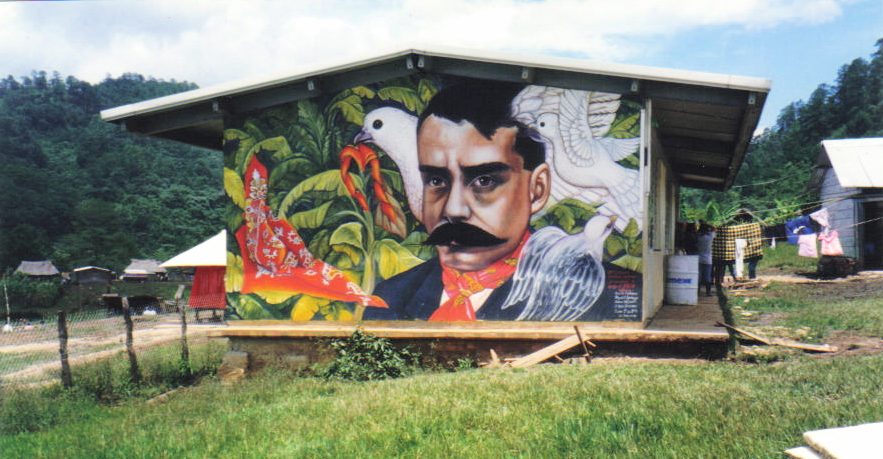
EZLN: 300, Part II: A Continent as a Backyard
EZLN: 300, Part II: A Continent as a Backyard, a Country as a Cemetery, Unique Thought as a Government Program, and a Small, Very Small, Ever So Small Rebellion Subcomandante Insurgente Moisés, Sup Galeano

Subcomandantes Moisés and Galeano (smoking pipe).
From our analysis of the world we move to the continental level.
If we look above…
We see the examples of Ecuador, Brazil and Argentina, where supposedly progressive governments have not only been removed from power but prosecuted, and the governments that have taken their place are ones that have been trained as good overseers—obedient to capital, that is—ready to take on a realignment of the world plantation (though, to be fair, even in their cynicism they’re still pretty clumsy). Take Temer in Brazil, Macri in Argentina, and that guy in Ecuador who was supposed to be good because he was chosen by the now-persecuted Correa (a man of the “citizen’s revolution,” “a leftist” according to the progressive intelligentsia who backed him) but who, it turns out, is actually on the right: Lenin Moreno (yeah, paradoxically his name is Lenin).
Under the watchful eye of the State that has become the policeman of the region—Colombia—threats are issued, destabilization efforts are undertaken and plans are made for provocations that would justify “peace force” invasions. In all of South America, we see a return to the brutal times of the Colonies, now characterized by a “new” extractivism—really just the same ancestral plunder of natural resources, categorized as “raw materials”—but endorsed and promoted among the progressive governments of the region as “Left extractivism”. This is supposed to be something like a Leftist capitalism or a capitalist Left, or who knows what it’s supposed to be because it destroys and dispossesses just the same, only it’s for a “good cause” (??). Any criticism or movement that opposes the destruction of the original peoples’ territories is written off as having been “promoted by Empire” or “backed by the right-wing”, among other equivalents to being “a conspiracy by the mafia of Power.” In sum, the “backyard” of Capital extends across the continent all the way to Cape Horn.
But if we look below…
We see resistances and rebellions, first and foremost among the original (Native) peoples. It would be unfair to try to name them all since there’s always a risk of leaving some out, but their identities are clear in their struggles. There where the machine encounters resistance to its predatory advance, rebellion dresses in colors so old they’re new again and speaks “strange” languages. Displacement, also disguised as the leasing of lands, tries to impose its commodity logic on those who refer to the Earth as “Mother.” Groups, collectives, and organizations that, while perhaps not themselves composed of original peoples, share the same effort and the same destiny, that is to say, the same heart accompany these resistances. That is why they suffer insults, persecution, imprisonment and, not infrequently, death.
As far as the machine is concerned, the original peoples are things—incapable of thinking, feeling, and deciding—so it’s no great leap in its automated logic to think that it is these other groups who “lead,” “manipulate” and “misguide” those “things” (the original peoples) who refuse to embrace the idea that everything is a commodity—everything, including their history, language and culture. For the system, the destiny of the original peoples is in museums, in specialized studies in the field of anthropology, in craft markets and in the image of a hand extended to beg. It must be quite exasperating for the machine’s lawyers and theoreticians to encounter a kind of illiteracy that doesn’t understand the words “consumption,” “profit”, “progress,” “order,” “modernity,” “conformity,” “commercialization,” “giving up” and “giving in.” To bring these illiterate, backward people up to speed with civilization, the system employs prison bars, bullets, disappearances, and aid programs that sow division and conflict. Sure there are those who sell out and turn their own people over to the executioner, but there are communities that remain firm in their rebellion because they know that they were born to live and that the promises of “progress” obscure the worst kind of death: that of oblivion.
Let’s continue on to Central America (where, in Nicaragua, Shakespeare’s texts are being rewritten and the Macbeth couple, Daniel and Rosario, is asking themselves, “Who would have thought that the old man (Sandino) had so much blood in him?” as they try in vain to wipe their hands on a black and red flag). Central America is beginning to be transformed from a forgotten territory (after being ruthlessly plundered) into a big problem for big capital because it is a significant source of and a “trampoline” for migrants. This means that Mexico, and in particular the Mexican Southeast, is going to be assigned the role of providing a wall. We decided to include Mexico in Central America because its history calls it to Latin America and, even on standard world maps, Central America is the arm outstretched between those united in pain and rage. But the various governments and the political class that this country has suffered under and will continue to endure are so captivated by other nations abroad that they admire, imitate, serve and seek to procure “the annexation of our American peoples to the turbulent and brutal North which despises them” (José Martí, “Letter to Manuel Mercado”, May 18, 1895).
When Donald Trump says he wants to build the wall, everyone thinks of the Río Bravo, but capital is thinking about the Suchiate, the Usumacinta and the Hondo. In reality, the wall will be in Mexico in order to stop migrants coming from Central America, and this, perhaps, can help us understand why Donald Trump came out on July 1st to greet Juanito Trump, who had just won the elections in Mexico.
A wall only makes sense as opposition to something. All walls are erected against that “something”—whether that be zombies, extraterrestrials, criminals, the undocumented, migrants, “sans papiers,” illegals, stowaways, aliens. Walls are like a simile for the closed doors and windows of a house, designed to protect the inhabitants from the outsider, the foreigner, the Alien whose difference carries the promise of a final apocalypse. One of the roots of the term “ethnic group” refers to “foreigners.” In capital’s grand plan, the wall against Latin America will take the shape of the impossible cornucopia and will go by the name of “Mexico”.
As we’ve already said, the first stage of Trump’s wall will be built in the Southeastern region of Mexico. The “National” Migration Institute will continue acting as a subordinate officer to the US Border Patrol. Guatemala and Belize are the last stop before entering US customs, and this makes the Mexican Southeast one of the top priorities for conquest and administration. This is why the new “geopolitical” plans call for the creation of a “cushion” or a “shock absorber,” a filter to drastically reduce migration. This offer is a placebo to alleviate capital’s nightmare: a horde of zombies (that is, migrants) at the foot of its walls, threatening its ways of life and scrawling on the indifferent surface of iron and concrete “graffiti” that reads: “Your wellbeing is built on my misfortune.”
-*-
In this country also known as the “Mexican Republic,” the recent national elections managed to hide reality… for a moment: economic crisis, social decomposition (with its long train of femicides), and the consolidation (despite supposed “mortal blows” to narco-trafficking) of parallel States (or those interwoven with the Nation-State) of so-called “organized crime.” The murders, kidnappings and disappearances of women of all ages moved into the background, although only briefly. And, the same is true of poverty and unemployment. But as enthusiasm over the election results wanes, reality rears its head once again, saying, “Here I am, you forgot my vote… and my scythe.”
We won’t say much about the horror that has turned Mexico into a cemetery and a limbo, the “nowhere” of forced disappearances. Even minimal attention to the media would give you a good enough idea, but a deeper description, analysis and evaluation can be found in the presentations by Jacobo Dayán, Mónica Meltis, Irene Tello Arista, Daniela Rea, Marcela Turati, Ximena Antillón, Mariana Mora, Edith Escareño, Mauricio González González, and John Gibler at the roundtable in April of this year at CIDECI-San Cristóbal de las Casas, Chiapas: “To Watch, To Listen, To Speak: No Thinking Allowed?” as well as in their writings, chronicles, columns and reporting. Even so, reading or hearing about these daily horrors is quite different than living them every day.
Big capital doesn’t care about disappearances, kidnappings, and femicides. What it cares about is its OWN security and that of its OWN programs. The only corruption that bothers it is corruption that affects its profit margins. That’s why what is proposed to big capital is: “I’m going to be a good overseer. I’ll keep the peons calm and happy, and you’ll be able to once again enjoy the security that past governments were too stingy to provide. You’ll be able to get your hands on whatever you want and I’ll skim nothing off the top.”
The Nation-State is getting in the way of the system, and increasingly the system is going to assign it the only function for which any State is created: the violent enforcement of the relationship between dominators and dominated. The development plans of new governments all over the world are none other than declarations of private wars in the territories where those development plans are to be executed. If those plans were described plainly, without so much hot air, it would be said that they are proposals to create wastelands and deserts and, at the same time, alibis that evade responsibility for that destruction: “We annihilated you, but it was for the good of all.”
-*-
I was wrong. We had predicted that there would be electoral fraud (and there was, but in another sense). We predicted that López Obrador was going to win but that the system was going to cheat him out of his victory, and we were thinking about what options the system would have following that fraud. According to our analysis, those above weren’t worried about a scandal because they’ve already survived the ones over the Casa Blanca, Ayotzinapa, the Estafa Maestra, and the many state government corruption scandals, so if people had made a fuss about fraud, Peña Nieto wouldn’t have batted an eye. We thought the dilemma the system faced was a choice between Meade and Anaya, a choice between which of them was farther to the right, which was more suited to their plans, which would be a better overseer.
The chances were slim that the then-candidate who was to be defrauded would wage a radical and sustained resistance, so there was no danger to the system,. But protests did seem inevitable. This is our apology to you all—thinking that was what was going to happen, we delayed the convocation for the Gathering of Support Networks. We thought there would be protests and blockades and all that and that if we had put out the invitation you may have gotten stuck somewhere along the way. That’s why the convocation was delayed, our apologies. We Zapatistas [nosotras, nosotros, nosotroas] always prepare for the worst. If it happens, we’re ready. If it doesn’t, well, we were ready anyway.
What we think and see now is that we weren’t wrong, that among the four candidates, they system chose the one who promised to be most effective: López Obrador. The signs of love that López Obrador is showing big capital (the plantation owner) are, among other things, promises to hand over indigenous peoples’ territories. The projects for the Mexican Southeast—in the Isthmus, in Chiapas, Tabasco, Yucatán, and Campeche, just to name a few—are in reality projects of dispossession.
The main thing concerning an outgoing administration is not its popularity, but rather its impunity. Thus the governmental “vote” is directed towards that person that guarantees that impunity. The new overseer should promise (and prove) that it won’t criminalize the last overseer; they must give their pledge that exile or prison for the outgoing government is not necessary to prove the legitimacy of the incoming one.
But don’t think that for that reason the new government will be like any other previous overseer; this one brings with him a “new” unique thought.
There is a kind of new religion in the works. It’s as if the religion of the market were no longer sufficient. This new religion has appeared everywhere that rightwing governments have come to power; it’s like a new set of morals imposed with recourse to a numerical argument [the number of votes received] that attacks science, art, and social struggle.
Within this framework, struggles are not understood to be about particular demands, but rather are thought to be either good struggles or bad struggles. To put it into more familiar terms: there are good struggles and then there are struggles that are just tools of the “mafia of power;” there’s good art and then there’s art that serves the “mafia of power”; there is “correct” science and then there is science that functions as a tool for the “mafia of power.” Everything that is not guided by the new and newly normalized unique thought is a tool of the enemy. And faith, at least this new faith that is being cultivated, needs an exceptional individual on one hand and on the other, a mass of followers.
This has happened elsewhere in other moments of world history, and now it’s going to happen here. That’s why when any of us express critiques or alternative points of view, the responses to these are not actual arguments, but rather accusations that we are either rude or envious.
We don’t doubt that there are people who honestly think that the change promised, in addition to coming at little expense (one only had to mark a ballot), would be a real change. It should be disturbing to them then that all the same names of the same criminals as before are popping up across the scene taking shape above, even if now they have take on different party initials.
The rightwing vocation of the new government is undeniable. Their “intellectual” and social surroundings shamelessly reveal their authoritarian tendencies. The same script that we pointed to 13 years ago, in 2005, is being followed to the letter of the law. He who was sleazy when defeated is sleazy when victorious. To say that the incoming government is leftist or progressive is just a lie. Back in 2005 we used the simile of the serpent’s egg. There is a film by that name, directed by Ingmar Bergman, and there’s a part in that film where a doctor (played by the way by the Kung Fu actor, David Carradine) explains that what was happening in Germany at the time—in the initial stages of fascism—could be seen as one would see a serpent’s egg: if you hold it up against the light, you can see what’s inside. We were seeing then—by holding the situation up to the light—what is happening now.
You all know that the efforts of the Movement for National Regeneration (MORENA) and of López Obrador and his team since July 1st have been attempts to ingratiate themselves with the dominant class and big capital. There are no indications that this is a progressive government—none. And nobody can claim that MORENA or López Obrador have lied about their intentions. The principal projects of this government (the million hectares of the Lacandón Jungle, the “Maya Train,” and the Isthmus Corridor that they want to build, among others) will destroy the territories of the original peoples. In addition, this administration’s sincere empathy with Donald Trump’s government has now been confessed publicly. And finally, the future administration’s honeymoon with corporate executives and financial capital is perfectly apparent when one analyzes who received key cabinet posts as well as what they consider to be their plans for a “Fourth Transformation.”
We think that it is clear that the consent and blessing López Obrador received from Power and Money upon his “triumph” goes far beyond mere recognition. Big capital is truly enthused by the opportunities for conquest presented by López Obrador’s government.
We have some hard data and a lot of gossip (which can’t be proved) about what happened in the recent electoral process. We aren’t going to reveal any of that information because it could lead to conclusions that there was fraud and the last thing we want to do is sour the euphoria of the “30 million.”
What nobody wants to acknowledge is that the media “jumped the gun”, exactly as happened in previous elections, specifically the elections of Calderón and Peña Nieto. It was not the officially assigned institutions that declared the winner, but rather it was the media. When the Preliminary Electoral Results Program (PREP) was barely beginning to make calculations, Televisa and TvAzteca were already declaring the winner. Just minutes after, with less than 1% of the votes counted, Meade, Anaya, and La Calderona all ceded victory to AMLO. Just a few hours later, the Trump team sent congratulations and by the dawn of July 2nd, the apparently now mentionable Carlos Salinas de Gortari himself added his congratulations. Without even knowing the official results, the customary bowing before the king that the PRI turned into a national rite had once again begun. And what, might you ask, was the National Electoral Institute [INE] up to? Doing the very job for which it was created of course: being the henchman of “electoral democracy.” The institutions responsible for the entire process took on the role of playing follow-the-leader to the media’s avalanche.
If all this hadn’t been in favor of their leader, the progressive intelligentsia who would have denounced the whole thing as a “media coup d’état.” Now they proclaim, with no shame whatsoever, that “however it happened, it happened,” and “we won, it doesn’t matter how.” Yet everything seems to point to a negotiated victory, agreed upon far from the ballot box and the electoral calendar. But nobody cares about that now—the much-heralded voter has decreed: “Habemus (We have) an Overseer, on with business!”
This new unique thought will replace reason with quantitative arguments: “30 million people can’t be wrong.” That was the line used by that priest, (what’s-his-name, Solalinde? sorry, I never pronounce it right and SubMoy is always correcting me), and which is now repeated frequently: “How can you oppose 30 million voters? You barely have 300 people and on top of that you’re dirty, ugly, evil and rude.” But he must be talking about you guys (the support networks), because me, I’m just rude.
It is through this new faith (in which we insist that no one has counted the only vote that matters, that of reality) that a new collective imaginary will be imposed in which quantitative arguments are prioritized over analysis and the arguments of reason.
Thus history is rewritten and transformed into a new official history, where all social and political movements of the past culminate in the presidential victory of López Obrador. We’ve already seen this same argument when it was said that the movement of ’68 was merely the beginning of “the end of history,” 50 years later. We’ve read that Manual Bartlett and other criminals of the same ilk have been purified by their proximity to this election’s victor. We’ve read that Alfonso Romo is an “honest” businessman whose only interest is to love his neighbor.
We’ve read that those who yesterday were part of the PRI, PAN, PRD, Verde Ecologista (Green Ecologist Party), or who made their name in show business, are now the illustrious leaders of the Fourth Transformation. We even read that the Zapatista uprising of 1994 was the prelude to the “citizen” uprising of 2018! Meanwhile, the new leader has already called for the development of theoretical frameworks explaining his rise to Power. We’re not far from the point where historians sympathetic to the new leader will start rewriting the history books.
We should warn you of the coming avalanche, the tsunami on the horizon, of frivolous and shoddy analyses, new secular religions, and minor (very minor) prophets, because all of that now has a platform. There will be all sorts of Kool-Aid to drink, and since we’re talking about a neo-religion, there will be an unbelievable belief for every taste, so that everyone can take communion.
A whole range of new boy scouts will appear, those little explorer boys ready to do good. Though you should always be careful to ask, good for whom?
The “citizen representatives” will promote citizenship: they will claim that what the “autochthonous” (yes, that’s what they call us) want is to be like is the very people who dispossess us: to be “equal” to them, even if only with regard to the fleeting temporality of the ballot box; or to be “free,” free to sign our rights away to the mine/hotel/railroad, free to sign the “employment” contract, free to sign the installment plan, free to sign the petition of “unwavering support for our president,” and free to sign the request form seeking “government aid.”
There will be a predictable boom in administrative activity, but instead of receiving resources you will get a sympathetic ear. And that will feel important even if you never see any money as a result. See, the “over-the-counter” model of administration will be decentralized: now you won’t have to go to a building, get in line, and then realize, after a long wait, that you’re missing that one slip. Now the counter will come to you: “just ask and we’ll be there; your voucher will come in the form of a promise.”
If there are some people out there who don’t have anything, it’s likely they still have hope. The new swindlers in power will take up hope-management, administrating its dosage and converting it into a fantasy that offers comfort but no solutions.
They will recycle the arguments of a certain sector of the movement that says it isn’t possible to change the system, that what one must do is administrate it properly or file down its sharp edges so that it isn’t so rough on people. They will argue that we can make our rulers into good overseers, we can even create a kindler, gentler capitalism, and that we can change the system from within.
Okay, so we can already make out what’s inside the shell: we know that it demands the surrender of reason and critical thought; it exalts nationalism built on a “benevolent” authoritarianism; it persecutes the different; its legitimacy is based on the noise of its own cheerleaders; it can be characterized by a secular neo-religion, it imposes unanimity, it shuts down criticism, and as a new national slogan, it imposes “No Thinking Allowed.” In sum: behind the shell lies the hegemony and homogeneity that undergird all fascisms that refuse to recognize themselves as such.
-*-
Are the concepts they present ones that allow us to understand (and act): Terms such as “citizenship,” “young people,” “women,” “progress,” “development,” “modernity,” “electoral democracy” (as a synonym for democracy)?
The term “citizen” is of no use in order to understand what is happening now: a “citizen” can be Carlos Slim or the peasant kicked off their land by the new Mexico City airport; it is Ricardo Salinas Pliego and the person living in the street after the September 2017 earthquake. It can be Alfonso Romo, as well as the members of the Tzeltal community that will be evicted from their lands so that a train with tourists taking “selfies” can pass through.
Another useless concept: “young people.” “Young people” includes Peña Nieto’s daughters as well as the students and workers who have been murdered.
And another: “women.” “Women” includes Aramburuzavala, Gonda, Sánchez Cordero, González Blanco, Ortiz Mena, Merkel and May, as well as the women slain in Ciudad Juarez, those raped in whatever corner of the world, those who are beaten, exploited, persecuted, imprisoned, and disappeared.
Any concept that eliminates or doesn’t help us to understand the class division between dominator and dominated is a sham and serves only to allow that division to live on within and between us. This transversality as they call it between capital and labor is of no use to us whatsoever, it explains nothing and only leads us to a perverse cohabitation between exploiter and exploited that, at least for a moment, makes it look as if they are the same, though that is clearly not the case.
Then there is also the attempt to return to the system from before, an impossible leap backwards into the “Welfare State,” including Keynes’ “Welfare State,” to the old PRI (which is why, as someone joked, the first transformation was the PNR; the second was the PRM; the third was the PRI, and now the fourth is PRIMOR)
And then comes the old discussion about reform and revolution: the “debates” between the “radicals” who struggle for revolution and the “liberals” who were in favor of gradual change, reforms that gradually evolve until they bring us into the reign of happiness. These discussions used to happen in cafés. The “public plazas” of today are social media and you can follow this autoerotic exercise via the “trendsetters” or whatever they’re called. We think that it’s not even necessary to discuss this topic because reform is no longer possible—what capitalism has destroyed is not salvageable; there can’t be a good capitalism (we think that possibility has never existed), and it must be destroyed entirely. Paraphrasing the Zapatista women in the Gathering of Women in Struggle: it isn’t enough to light the system on fire; you have make sure it burns until only ashes are left.
We’ll talk more about all that on another occasion. For now we just want to point out that social counter-revolution is possible. Not only is it possible, but it will constantly haunt us because those above will try to annihilate any struggle external to their planned process of domestication. They will try to raze everything outside their plan, and violently so. Note that by raze we don’t just mean marginalization or slander, but also military, paramilitary, and police attacks. For anyone who challenges these new rules, which are really the old rules, there will be no amnesty, no pardon, no absolution, no embraces, and no photo opps; there will only be death and destruction.
The struggle against corruption (which is nothing other than the struggle for a well-administered domination) not only does not include the struggle for freedom and justice but is in fact against it. The alibi of the struggle against corruption is the fight for a state apparatus able to act more efficiently in what is basically the only function retained by the Nation-Sate: repression. And soon not even that.
The government will cease to be the thieving overseer who keeps a few heifers and young bulls for himself. The new overseer won’t steal: he’ll deliver the profits to the boss in full. See, they want to return the Nation-State—in this case Mexico—to its true function. So when they talk about the need for security, they are talking about security for capital, the imposition and perfection of a new police state: “I’m going to do things well because I’m going to keep watch over everything.” The security demanded by “citizenization” is in fact the restructuring of a police system, a modernized and professionalized wall that knows how to distinguish between “the good guys” and “the bad guys.”
In Mexico City they will professionalize the police. Crime rates will fall and there will be “lovely” police officers who help old people cross the street, search for lost pets and make sure that traffic circulates in a friendly manner for the most important actors on the street: vehicles. On the periphery, the complicity between those who should prevent crime and those who commit it will continue. But, to make up for this situation, they will promote “extreme tourism”: Mexico City will host “tours” and “safaris” so that tourists can get a glimpse of those rare creatures that lurk in the shadows, so they can take a “selfie” with the young person who has been detained/beaten/killed, his blood mixing with the colors of his tattoos, dulling the shine of his piercings and studs and staining the green-purple-blue-red-orange of his hair. Who was he? Who cares? Anything in a “selfie” that isn’t “me” is just background anyway, an anecdote, an intense emotion that serves to boost one’s presence on Facebook, Instagram, in chats, or in autobiographies. Over the loudspeaker of the bullet-proof vehicle, the friendly tourist guide warns: “we remind you that the consumption of tacos, sandwiches, and other street food is on your own dime and at your own risk; the company is not responsible for indigestion, gastritis, or stomach infections. For anyone who stepped off the bus, here’s some antibacterial gel for you.”
The new government promises to recuperate its monopoly on the use of force (which had been wrested from it by “organized crime). But now this use of force will be available not only to the traditional police and military, but also to the new vigilantes: to the “brown shirts,” or the purple ones; to those who become the parishioners of this new secular religion; to the masses that will attack the social movements who refuse to be domesticated. The recycled “red battalions” (except now they’re purple, because of the Fourth Transformation) will have to undertake the “cleanup” of all those who are dirty, ugly, evil, and rude, as well as anyone else who resists order, progress, and development.
-*-
Let’s go down another level then, to see how our communities (alongside other organizations, groups, and collectives) are resisting. Here with us today is part of the EZLN’s collective authority, 90 comandantas and comandantes. There are more but these are the ones who are accompanying us today in order to honor your visit (that of the support networks).
We continue to walk with two feet: rebellion and resistance, the “no” and the “yes”, the “no” to the system and the “yes” to our autonomy, which means that we have to construct our own path toward life. Our path is based in some of the roots of the original (or indigenous) communities: the collective, mutual support and solidarity, care for the earth, the cultivation of the arts and sciences, and constant vigilance against the accumulation of wealth. These roots, along with the arts and sciences, guide us. This is our way, but we think that for other histories and identities, it may be different. That is why we say that Zapatismo can’t be exported, not even throughout the state of Chiapas. Rather, each calendar and geography must follow its own logic.
The results of the path we have walked are visible to anyone who wants to see, analyze, and critique them. Although, of course, our rebellion is small, so very small, that you might need a microscope, or better yet, an inverted periscope in order to see it.
And it isn’t a very encouraging exercise: our possibilities of triumph are absolutely minimal.
We don’t have anywhere close to 30 million people.
Maybe there are only 300 of us.
-*-
(To be continued…)
EZLN: 300, Part I: A Plantation, a World, a War, a Few Probabilities Subcomandante Insurgente Moisés, SupGaleano

Art from the Zapatista communities.
Words of the EZLN’s Sixth Commission at the Gathering of Support Networks for the Indigenous Governing Council (CIG) and its spokeswoman
(Expanded version)
Given time restrictions, we were unable to present these thoughts in full during the gathering. We promised you the full version, and we include the full transcription here, including the parts that were not read at the gathering. You’re welcome. Don’t mention it.
300
Part I:
A Plantation, a World, a War, Few Probabilities
August 2018.
Subcomandante Insurgente Galeano:
Good morning, thank you for coming, for accepting our invitation and for sharing your words with us.
We are going to begin by explaining our way of doing analysis and evaluation.
We start by analyzing what is happening in the world, then move to what is happening at the continental level, then to what is happening in this country, then to a regional and finally to a local level. From there, we develop an initiative and begin to move back up from a local level to a regional level, then to the national, the continental, and finally the global level.
We think that capitalism is the dominant system at the global level. In order to explain this system both to ourselves and to others, we use the image of a plantation. I’m going to ask Subcomandante Insurgente Moisés to explain this part.
-*-
Subcomandante Insurgente Moisés:
Compañeros and compañeras: we interviewed our own compañeros and compañeras who are our great-grandfathers and great-grandmothers, some of whom are still alive. The following is what they told us and what they helped us understand: how the rich, the capitalists, want to turn the whole world into their plantation.
There’s the plantation owner, or the landowner, who owns thousands of hectares of land. When he’s not around, he has his overseer watch over the plantation, and that overseer in turn has a foreman who’s the one who actually goes in person to force the people to work the land. The overseer, on orders of the boss, also has to name a supervisor who keeps watch over the plantation house itself. Our great-grandparents told us that there are different kinds of plantations: cattle ranches, coffee plantations, sugarcane plantations, as well as corn and bean plantations. These various areas of production are combined so that a 10,000-hectare plantation has cattle, sugarcane, beans, corn, everything. And the people who work on the plantation—who we call slaves or peons—live and suffer their whole lives there.
The overseer supplements his income by stealing some of what is produced on the plantation from the boss. That’s in addition to what the boss (the plantation owner) pays him. So for example, if 10 heifers and 4 young bulls are born on the plantation, the overseer doesn’t report them all, but tells the boss 5 heifers and 2 bulls were born. If the boss finds out he’ll fire the overseer and name another, but all of the overseers steal something. It’s part of the generalized corruption.
Our great-grandparents say that when the boss wasn’t around and the overseer wanted to go somewhere too, he’d name someone else to take his place while he was gone—always someone as much an asshole as himself. In other words, he’d pick a friend to cover his job until he got back to take it over again.
We see that that’s still the situation today: the real boss is off somewhere else, and the overseer in charge of what we used to call the country (but which we just call ‘the peoples’ now because we see there isn’t really a country anymore) is Peña Nieto. The state governors are the foremen and the municipal presidents are the supervisors. This is how the system of domination is structured.
We also see that it is the overseer, the foreman, and the supervisor who are in charge of controlling the people. Our great-grandparents say that every plantation had a store—the company store they call it—where the people working on the plantation accumulated debt. So those exploited people—slaves or peons we call them—would get used to buying their salt, soap, and whatever they needed from the company store. They didn’t use money; rather, the boss stocked there the things they needed—salt, soap, machetes, saws, axes—and the people would buy them not with money but with their own labor.
Our great-grandparents told us that women as well as men spent their entire lives that way—the boss would provide them with just enough to eat today so that they had to continue working for him tomorrow.
We know what our great-grandparents say is true because when we rose up in 1994 and took over the plantations in order to kick out the exploiters, we found those overseers as well as the people who lived there as slaves or peons and who were accustomed to getting supplies from the company store. And those people told us that they didn’t know what to do because once the boss was gone, where would they get their salt and soap? They asked us who the new boss would be so they could go find him because how else would they get ahold of soap and salt and things like that.
We told them: you are free! Work the land, it is yours! You can work the land like you did under the boss who exploited you but now that work is for you, for your family. But they resisted, saying no, this is the boss’s land.
That’s where we learned that there are people so deeply embedded in their slavery that they don’t know what to do with their own freedom; they only know how to obey.
This situation I’m telling you about is from over 100 years ago, because our great-grandparents—one of them would be about 125, 126 years old now, as it’s been more than a year since we interviewed that compañero—are the ones who told us these stories.
The way we see it is that this situation is the same today. They want to turn the whole world into a plantation. But now it’s the multinational corporations that says, “I’m going to my plantation—the Mexican one,” or, depending on their whim at the moment, “I’m headed to my other plantation—the Guatemalan one, or the Honduran one” and so on.
Then they organize their plantation production according to capitalism’s needs. Just like our great-grandparents said, some plantations would have everything—coffee, cattle, corn, beans—and other plantations would have just sugarcane or some other crop. That’s how the plantation owners organized and organize us.
And there isn’t a good boss; all of them are bad. Our great-grandparents tell us that a few of them were good, as they put it, but when we really analyze and think about it, when we see it clearly, by “good” they mean those bosses who didn’t physically abuse them, didn’t whip them. But there was no saving them from being exploited; that was a given. But yes, it’s true, on some plantations, in addition to being worked to exhaustion, if you didn’t do what they wanted you were whipped.
We think that all of this that happened to our great-grandparents is going to happen to us, now not only in the countryside but also in the city. Because the capitalism of today is different than the capitalism of 100 years ago, or 200 years ago; the forms of exploitation are different and exploitation occurs in the city as well as the countryside. That exploitation might look different today but it’s exploitation all the same. It’s the same cage, but they paint it a different color every now and then so it looks like something new.
Today too there are people who don’t want their freedom, but merely seek to obey. They’re only looking for a different boss, a different overseer, who isn’t such an asshole—that is, who exploits them all the same but is nice to them.
In other words, we haven’t lost sight of what’s coming, and we see that it’s already starting.
What interests us is this: are there others out there who see, think, and evaluate in the same way what’s coming?
And what are those sisters and brothers going to do? Will they be satisfied with a new overseer or boss or do they want freedom?
That’s the part that I wanted to explain to you because it comes from what we think, all the compañeros and compañeras of the Zapatista Army for National Liberation.
-*-
Subcomandante Insurgente Galeano:
What we see at the global level is a predatory economy. The capitalist system is advancing by conquering territories, destroying everything it can. At the same time, there is a glorification of consumption to the extent that it seems that capitalism is no longer even worried about who is going to produce—that’s what machines are for. But there are no machines that consume commodities.
In reality, this great exaltation of consumption hides the brutal exploitation and bloody dispossession of humanity which isn’t immediate visible in modern commodity production.
The highly automated machine that, seemingly without human participation, manufactures computers or mobile phones is built not on scientific and technological advances but on the plunder of natural resources (thus the necessity for the destruction/depopulation and reconstruction/reordering of territories) and on the inhumane enslavement of thousands of tiny, small, and medium-sized units of exploitation of human labor.
The market (that gigantic warehouse of commodities) contributes to the illusion of consumption: commodities appear to the consumer as “unconnected” to human labor (that is, to its exploitation) and one of the “practical” consequences of this illusion is to give the (always individualized) consumer the option of “rebelling” by choosing one market over another, one product over another, or by boycotting a particular type of consumption. You don’t want to eat junk food? No problem, organic items are also available, at a higher price. You don’t want to consume certain brands of cola because they are unhealthy? No problem, we have bottled water sold by the same company. You don’t want to buy from the big supermarket chains? No problem, the same corporate conglomerate supplies your neighborhood corner store. And so on.
Global society is being organized to give priority to consumption, among other things. The system functions with this contradiction (among others): it wants to rid itself of the labor force because its “use” brings with it various problems (for example: it tends to organize, protest, strike, sabotage production, and join forces with other workers); but at the same time the system needs that “special” commodity to consume other commodities.
Regardless of how hard the system tries to “automate” itself, labor exploitation is fundamental to the system. It doesn’t matter to what extent consumption is generated on the periphery of the production process, or how effectively the lengthening of the chain of production simulates its unmooring from human labor: without its most essential commodity (the labor force), capitalism is impossible. A capitalist world where consumption prevails and exploitation doesn’t exist is good for science fiction, social media ruminations, and the lazy dreams of the admirers of the suicidal aristocratic left.
It’s not the existence of work that defines capitalism, but the characterization of the capacity to work as a commodity to be bought and sold on the labor market. That means there are those who buy and those who sell, and above all, those who have only the option of selling themselves.
The possibility to purchase labor power is provided for by private ownership of the means of production, circulation, and consumption. Private ownership of the means of production forms the nucleus of the system. Built upon this class division (the owner of private property and the dispossessed), and hiding it as such, are a whole range of juridical and media simulations, as well as other dominant evidentiary forms: citizenship and juridical equality; the penal and police system; electoral democracy and entertainment (increasingly difficult to differentiate); neo-religions and the supposed neutrality of technology; social sciences and the arts; free access to the market and to consumption; and a whole spectrum of nonsense (with some versions more developed than others) of things like “change begins within oneself”, “you are the architect of your own destiny”, “when life gives you lemons, make lemonade”, “don’t give fish to the hungry, teach them to fish” (“and sell them fishing poles”), and, highly fashionable today, efforts to “humanize” capitalism by making it good, rational, and objective, that is, “capitalism light.”
But the machine wants profits and it is insatiable. There is no limit to its gluttony, and its eagerness for profit has neither ethics nor rationality. If it needs to kill, it kills. If it needs to destroy, it destroys; even if it has to kill and destroy the whole world.
The system advances in its re-conquest of the world without concern for what is destroyed, preserved, or made superfluous; anything is disposable as long as the maximum profit is obtained at maximum speed. The machine is returning to the methods of its origins—that’s why we recommend you read The Primitive Accumulation of Capital —which is to conquer new territory via violence and war.
It is as if capitalism left pending part of its global conquest during neoliberalism and now is trying to finish the job. As it develops, the system “discovers” new commodities that exist in the territories of the original peoples: water, land, air, biodiversity, everything that hasn’t already been damaged or ruined lies in the original peoples’ territories and that is where the system is headed. When the system seeks (and conquers) new markets, these aren’t just consumption markets—for buying and selling commodities—but also and above all, the system seeks and attempts to conquer territories and populations in order to extract from them whatever can be extracted, without regard for the wasteland left in its wake.
When a mining company invades the territory of Native (original) peoples—often with the alibi of offering “work opportunities” to the “autochthonous population” (yes, that’s what they call us), they aren’t just offering people wages to buy a new high-end cell phone: they are also discarding a part of this population and annihilating (in all senses of the word) the territory in which that population functions. The “development” and “progress” offered by the system in reality disguises what is truly its own development and progress and, more importantly, hides the fact that that progress and development are obtained via the death and destruction of populations and territories. That is how so-called “civilization” is founded: what the Native (original) peoples need is to “get out of poverty,” that is, they need a wage. So they are offered “employment,” that is, companies that will hire (exploit) the “aborigines” (yes, that’s what they call us).
To “civilize” a Native community is to convert its population into a salaried work force, that is, one with purchasing power. That’s why all the state programs claim to “incorporate the marginalized population into civilization.” As a consequence, the original peoples don’t demand respect for their ways of organizing their time and life, but rather “assistance” in order to “find markets for their products” and “to obtain employment;” in sum, the optimization of poverty.
And by the way, when we say “Native (original) peoples” we are referring not only to the poorly named “indigenous” but also to all of those peoples who originally cared for the territories that are now subjected to wars of conquest—the Kurdish people for example—and who are themselves subjected by force to the so-called Nation-States.
The so-called “Nation form” of the State is born with the ascent of capitalism as the dominant system. Capital needed protection and assistance for its growth, and the State assumed—in addition to its essential role (that of repression)—the role of guarantor of that growth. It was said of course that this was necessary to avoid barbarism, to “rationalize” social relations and “govern” for all, “mediating” between dominators and dominated.
“Freedom” became the freedom to buy and sell (oneself) on the market. “Equality” became the task of consolidating a homogenizing dominion; and “fraternity,” well, we are all brothers and sisters—boss and worker, plantation owner and peon, victim and executioner.
Later it was said that the Nation-State should “regulate” the system, taming its excesses and making it “more equitable.” Crises were the product of defects in the machine, and the State (and the government in particular) were the always alert and efficient mechanics, ready to repair imperfections. Of course it turned out that the State (and the government in particular) were part of the problem, not the solution.
But today the fundamental elements of that Nation State (police, army, language, currency, juridical system, territory, government, population, borders, internal market, cultural identity, etc.) are in crisis: the police don’t prevent crime, they commit it; the army doesn’t’ defend the population, it represses it; the “national languages” are invaded and modified (that is, conquered) by the dominant language of exchange; national currencies are valued in accordance with the currencies that maintain hegemony in the global market; national judicial systems are subordinate to international law; territories expand and contract (and fragment) in accordance with the new world war; the national governments cede their most fundamental decisions to the dictates of financial capital; borders vary in porosity (open to capital and commodity traffic; closed to people); the national populations “mix” with those from other States; and so on.
At the same time that new “continents” are “discovered” (that is, new markets from which to extract commodities and in which to generate consumption), capitalism encounters a complex crisis (complex in content, extent, and depth) that it itself produced via its predatory tendencies.
It’s a combination of crises:
One is the environmental crisis that is hitting every part of the world and which is a product of capitalist development: industrialization, consumption, and nature’s plunder have an environmental impact that alters what we know as “planet Earth.” The meteorite called “capitalism” has already hit and radically modified the surface and innards of the third planet of the solar system.
Another is migration. The impoverishment and destruction of entire territories obligates people to migrate in search of life. The war of conquest which is an essential part of the system itself no longer occupies territories and their populations, but rather classifies those populations as “surplus”, “ruins”, or “rubble”, destined to perish or emigrate to “civilization” which, we must not forget, is built on the very destruction of those “other” civilizations. If people neither produce nor consume, then they’re merely surplus, scraps. The so-called “migration phenomenon” is produced and fed by the system.
One more point, and one on which we coincide with various analysts around the world, is the exhaustion of the resources that make the “the machine” move: fossil fuels. What are referred to as the final “peaks” of oil and carbon reserves, for example, are very close. These energy sources are finite and limited; their renewal will take millions of years. Their predictable and imminent exhaustion means that those territories that hold reserves—however limited—of energy sources are strategic sites. The development of “alternative” energy sources is advancing too slowly for the simple reason that they are not profitable—that is, investment in them does not pay off quickly enough.
These three elements of this complex crisis place in question the continuation of existence on the planet.
Is this the terminal crisis of capitalism? Not by a long shot. The system has demonstrated that it is capable of overcoming its own contradictions, and even functioning with and within them.
Thus, in the face of this crisis that capitalism itself provokes, which leads to migration and natural catastrophes, approximating the limit of fossil fuel reserves (in this case oil and coal), it would seem that the system is testing out a kind of internal retreat, something like an anti-globalization, in order to defend itself, and it is using the political right as guarantor of that retreat.
This apparent contradiction within the system is like a spring pulling back so it can later expand. In truth, the system is preparing for war. Another war. A total war: everywhere, all the time, and through all means.
Capitalism is building legal walls, cultural walls and material walls in order to defend itself against the migration that it itself provoked, attempting once again to map the world’s resources and catastrophes, so that the former can be administrated for ongoing capitalist functioning and the latter don’t significantly affect the centers of Power.
These walls will keep proliferating, we think, until they create a kind of archipelago “above” where the owners—those who possess wealth—secure themselves on a series of protected “islands” while the rest of us are on the outside. Imagine something like an archipelago with islands for the bosses and different islands—plantations really—for specific kinds of labor. And then, far off in the distance, the lost islands for those considered disposable. And on the open sea, there are millions of barges wandering from one island to another, looking for a place to dock.
Sound like Zapatista science fiction? Google “Aquarius Ship” and you will see the distance between what we describe and current realty. The Aquarius was denied port in multiple European nations. Why? Because of its lethal cargo: hundreds of migrants from countries “liberated” by the West through wars of occupation and countries governed by tyrants with the blessing of the West.
“The West,” the self-designated symbol of civilization, goes out, destroys, depopulates, and then retreats and closes its doors, leaving big capital to continue on with its business: manufacturing and selling weapons of destruction, and then manufacturing and selling the machines for reconstruction.
In many locations it is the political right that is supporting this retreat. That is, they are the ones proving to be “effective” overseers who can control the peons and assure profit for the plantation owner…although there are a few [uno, una, unoa] who steal some of the heifers and young bulls, and whip excessively their peon population.
For the surplus populations: they must consume or be annihilated. They are, as we say, disposable. They don’t even count as “collateral damage” in this war.
This isn’t something that is changing; it has already changed.
Here we use the simile of the Native peoples because for a long time, in the previous stage of capitalist development, the Native peoples were forgotten. Before we used the example of the indigenous infants who were called “the unborn” because they came into the world and left it without anyone ever noticing. Those “unborn” lived here in these areas, in these very mountains for example, which at that time didn’t interest anyone. The plantations occupied the good lands (the “flatlands” we call them), and the large landowners that expelled the indigenous into the mountains. Now it turns out that these mountains are full of riches, commodities that capital now wants and so there is nowhere for the Native peoples to go.
They must struggle and defend these territories—to the death if necessary—because there is no other choice. There will be no boat that comes to pick them up when they are forced to navigate unprotected through the world’s oceans and territories.
A new war of conquest is underway in the Native peoples’ territories, and the flag under which the invading army marches is sometimes that of the institutional left.
This change in the machine’s functioning with regard to the countryside or “rural areas”—perceptible with even a superficial analysis—is also present in the cities or “urban areas.” The big cities have been reorganized or are in that process; they are in the midst or wake of a merciless war against their own marginalized inhabitants. Each city contains many cities, but one central one: that of capital. The walls that surround that city are made up of laws, urbanization plans, police, and shock troops.
The entire world is fragmenting; walls are proliferating; the machine advances in its new war of occupation; hundreds of thousands of people discover that the new home promised them by modernity is a barge on the high seas, the shoulder of a highway, or an overcrowded detention center for the “undocumented.” Millions of women learn that the world is a gigantic hunting club where they are the prey; children become literate as sexual and labor commodities; and nature hands over the bill with a long list of debts and a balance in the red, accumulated by capitalism in its brief history as dominant system.
Of course, we haven’t talked about the women who struggle, the others [loas otroas] from below (for whom—in contrast to the glamour of the half-open closets above—suffer disrespect, persecution, and death), those who go home to poor neighborhoods at night and spend the day working in the capital city, migrants who remember that that wall has not been there since the beginning of time, the families of the disappeared, murdered, and imprisoned who neither forget nor forgive, the rural communities who find they were deceived, the identities who discover they are different and replace shame with pride, and all [todoas] the disposable people who understand that their destiny does not have to be slavery, oblivion, or brutal death.
Because there is another crisis, largely unperceived, consisting of the emergence and proliferation of rebellion, of organized human groups who challenge not only Power but also its perverse and inhuman logic. With diverse identities, diverse histories that is, this eruption appears to be a systemic anomaly—it does not figure into the law of probability. Its possibilities of maintaining itself or growing are minimal, almost impossible. That is why they do not count in the calculations of those above.
The machine is not worried about those rebellions. There aren’t very many, barely 300 of them.
-*-
This vision of the world, our vision, is surely incomplete, and very likely erroneous. But that’s how we see the system at a global level. And based on this evaluation, what follows will be what we see at the continental, national, regional, and local levels.
(to be continued…)
The IACHR orders the Trump government to protect 572 immigrant children
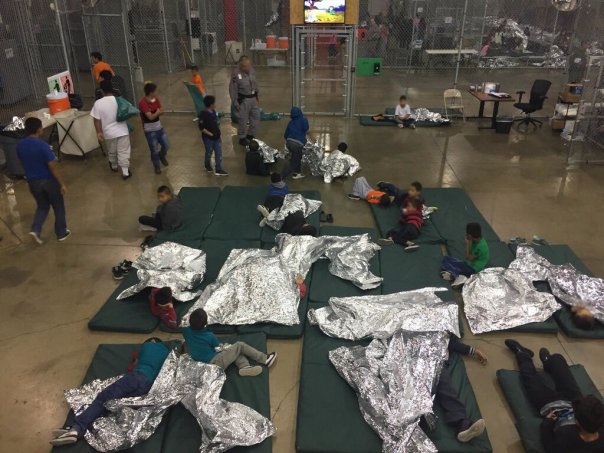
Child migrants held in cages in McAllen, Texas.
By: Emir Olivares Alonso
The Inter-American Commission on Human Rights (IACHR) [1] ordered the United States government to implement precautionary measures in favor of the 572 immigrant underage minors that have been victims of the “zero tolerance” policy implemented by the Donald Trump administration, with which hundreds of families have been separated.
The objective of these measures, which Mexico’s Nacional Human Rights Commission announced yesterday, is to protect immigrant children from the cruel and inhuman treatment to which they have been submitted as a consequence of the immigration policy of the United States government.
The inter-American organism gave the Trump administration 10 days to report to it about the adoption of the protection for these minors and to periodically update said information.
It ordered adopting the measures necessary for the protection of the rights of family life, personal integrity and identity of the proposed beneficiaries, particularly assuring that those rights are safeguarded through the reunification of the children with their relatives or their biological parents and in support of the higher interest of the children.
It is sought to protect human rights “that are essential to ensure that the infants enjoy an appropriate quality of life, such as their rights to personal integrity, health, family and personal freedom.
“These human rights must be protected, especially facing the inhumane situation in which the immigrant boys and girls are found, after having been separated from their families as a consequence of the ‘zero tolerance’ policy. Moreover, taking into consideration that the cruel conditions in which they find themselves could cause harm to their physical and psychological integrity.”
While family reunification is carried out, the IACHR ordered the United States government to adopt the necessary measures to immediately guaranty free and regular appropriate communication between the beneficiaries and their family members in accordance with their best interest.
The granting of these precautionary measures is the product of the alliance of six human rights defense institutions in the region, which for the first time joined together to ask for said protection and they set an important precedent. We’re talking about Mexico’s National Human Rights Commission, the Ombudsman of Colombia, the Ombudsman of Ecuador, the Human Rights Ombudsman of Guatemala, the National Commissioner for Human Rights of Honduras and the Ombudsman for the Defense of Human Rights of El Salvador.
[1] The Inter-American Commission on Human Rights (IACHR) is part of the human rights arm of the Organization of American States (OAS). The United States is a member of the OAS.
———————————————————–
Originally Published in Spanish by La Jornada
Tuesday, August 21, 2018
http://www.jornada.com.mx/2018/08/21/politica/013n2pol
Re-Published with English interpretation by the Chiapas Support Committee
AMLO announces an expansion of the Maya Train project

The headline says: The new train that will unite the Southeast.
By: Enrique Méndez and Nestor Jiménez
President-elect Andrés Manuel López Obrador announced the expansion of the project for the Maya Train, which pass through the states of Yucatán and Campeche, besides those of Tabasco, Chiapas and Quintana Roo on a 1500-kilometer route, with a mixed government-corporate investment estimated between 120 and 150 billion pesos.
At a press conference yesterday he reported that the project, which he expects to be completed in four years, would be financed with 28 billion pesos from the tourism budget and the rest with the participation of private initiative.
He said he’s talking about a modern passenger train that detonates jobs and tourism throughout the southeast, and he specified that the project is already being prepared, so that on December 1 –when he assumes the Presidency of the Republic– the call can be issued to the companies that will participate.
He explained that the special conditions for building the train were confirmed, because the right of way of the stretch from Palenque to Valladolid, of the old Southeast Railroad, was not granted in concession: “It belongs to the nation and that facilitates things because if we have the rights of way we can get to work immediately.”
López Obrador said that yesterday, during the work meeting with the next Secretary of Tourism, Miguel Torruco, it was agreed not to leave the Yucatán and Campeche out of the project.
“It’s no longer going to be Cancun to Palenque, but it’s also going to include Campeche and Yucatán. To be precise, there will be a station in Campeche, in Mérida and in Valladolid, Yucatán. The work is expanded from the 900 kilometers originally estimated, to 1,500 kilometers,” the Tabasco politician indicated.
He next offered details about the route: “For those that have more knowledge about this region of the country, and what the Train of the Southeast was, it’s Palenque, Candelaria, Escárcega –we’re going to talk about a branch to Xpujil, Campeche, which is very close to Calakmul, with an access to the archaeological zone–, and continues to the Caribbean, Bacalar, Tulum and Cancun. At the same time, the train will be built from Escárcega to Campeche, to Mérida and Valladolid, and then to Cancun. It’s kind of a ‘Y’, which includes all of the Yucatán Peninsula, plus Chiapas and Tabasco.”
He defined that we’re dealing with a relevant public work, because it will connect one of the regions of greatest mayor cultural importance in the world. “There is no other region with so much cultural richness as this one about the flourishing of the great Maya culture,” he said.
He said that almost 7 billion pesos per year would be used to finance the train from what is raised through the tourism tax.
However, since that is not enough to build it, a call will be issued to seek a partnership with private initiative and consolidate a mixed investment.
“We’re going to develop one of the most important regions. All this work is going to promote tourism and create jobs in the southeast, the country’s most abandoned region. That’s why we’re very satisfied with this agreement,” he added.
The president-elect reported that the calculations would be carried out, with an objective of having the project and the rules for bidding, in the next three months, so that when he assumes power the respective call is issued.
He insisted that by having the train’s right of way from Palenque to Valladolid, and by using the Federal Electricity Commission’s right of way and that of highways on the Valladolid-Cancun-Escárcega stretch, the Maya Train could be inaugurated “in four years, and it could be that we finish it sooner.”
He announced that the next director of the National Fund for Tourism Promotion will be Rogelio Jiménez Pons, who already exercised that position in the state of Tabasco, between 1977 and 1982, and the head of the Tourist Promotion Council will be Gabriela Cámara, chef and restaurant entrepreneur.
———————————————————–
Originally Published in Spanish by La Jornada
Tuesday, August 14, 2018
https://www.jornada.com.mx/2018/08/14/politica/003n1pol
Re-Published with English interpretation by the Chiapas Support Committee
Galeano: AMLO’s projects will destroy indigenous territories

By: Sandra Gayou
La Jornada Maya
Caracol of Morelia, Chiapas
“The government chose from the four candidates the one that is more right-wing,” Subcomandante Galeano, of the Zapatista National Liberation Army (Ejército Zapatista de Liberación Nacional, EZLN) pointed out upon considering that the programs that president-elect Andrés Manuel López Obrador wants to implement, like the plantation with a million hectares of trees, the construction of the Maya Train and the Isthmus of Tehuantepec Corridor, will only destroy the territories of the indigenous peoples.
After the meeting of the Networks in Support of the Indigenous Government Council (Concejo Indígena de Gobierno, CIG), in which the creation of an International Network of Resistance and Rebellion was proposed, the insurgent Subcomandante affirmed last August 5 in the Caracol of Morelia that the “fourth transformation” that López Obrador promises is in reality the fourth transformation of the PRI. “They can change the governments,” but the “system of domination is maintained,” and the same thing will happen, he criticized.
In that regard, Galeano alluded to the company that will provide exemplars for the project for one thousand hectares (247,000 acres) of timber and fruit trees, about which, he said, its property owner is Alfonso Romo, who will be head the cabinet during the next government.
He also talked about the wall that Donald Trump proposed, about which he said, is not one on the northern border, but rather on the southern border, the Suchiate River, with the denial of entry of Central Americans to Mexico. “That’s why Trump congratulated Juanito Trump for winning the elections,” he expressed.
At the same time, he condemned the abandonment that the indigenous peoples suffer, by pointing out that they were already sent to the mountains in the past, when they were stripped of their lands. Now it turns out that those mountains possess great wealth and they want them for the nation. “We must defend them to the death, because I fear that the government will defend itself with violence,” he sentenced.
Galeano reported on the proposal of consolidating an International Network of Resistance and Rebellion (Red de Resistencia y Rebeldía Internacional). Suppose that the National Indigenous Congress (Congreso Indígena Nacional) will cease to be a movement of exclusively of Native groups, since it seeks to add every group or individual external to this process of government that he classified as “domestication.”
Moreover, this network will also expand to other nations, seeking those in any corner of the world that resist their system of government.
Apart from this principal action, the insurgent subcomandante reported on seven others, among which is the integration of rural men and historic groups that struggle to a network of support for the CIG, the discussion of each one of the committees (comités) formed, so as to coordinate efforts among networks, as well as an international meeting in one of the five Zapatista Caracoles in December.
[1] Apparently, AMLO has proposed planting 1 million hectares of fruit and timber trees in the Mexican southeast over a 6-year period, and up to 200,000 hectares would be in Chiapas. See: https://www.animalpolitico.com/2012/04/amlo-propone-sembrar-1-millon-de-hectareas-de-arboles-en-6-anos/
—————————————————————–
Originally Published in Spanish by La Jornada
Wednesday, August 15, 2018
http://www.jornada.com.mx/2018/08/15/politica/006n1pol
Re-Published with English interpretation by the Chiapas Support Committee
After 15 years of the Caracoles and JBGs, “Zapatista Hope” continues
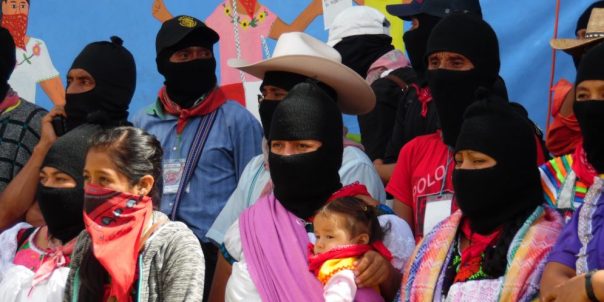
Zapatistas at the 3rd Annual CompArte Festival in the Caracol of Morelia.
Altamirano, Chiapas, August 9, 2018
The smiles of the grandparents, the reflection of the women, the curious looks of the children are images that stand out at the Zapatista CompArte Festival 2018. “Our Caracoles are flourishing.” “Our struggle is not going to end,” and “democracy, justice and freedom,” were heard in the melodies that indigenous Chiapanecos interpret in this also XV Anniversary in which they celebrate their decision to organize into The Caracoles and The Good Government Juntas (Juntas de Buen Gobierno, JBG).
From the Caracol de “Morelia,” with songs and theater pieces about daily situations are recreated by children, youth and adult Zapatistas Support Bases, to exemplify what the families that have decided to be in “resistance and rebellion” experience.
The assistance programs of the federal and state governments are a constant in the rebel dramatizations, about how the State “demobilizes resistance.” Faced with government harassment the indigenous peoples of Chiapas have responded with organization and proposals in areas that range from health to education, justice, food and security, among others.
In a playful and profound way, the Zapatistas expose in their theatrical works problems in which children, adolescents, youths, women, elders and men of the community see themselves reflected are reflected. Such situations have to do with consumerism and its repercussions on health, economic, social and cultural problems.
In one of the CompArte 2018 presentations, the line that the capitalist system follows to affect the communities is clearly dramatized: bad food sickens the population, which has to ask for expensive medical attention, which leads women and men to sell their few properties and even their land to pay off their debts. In the other face that the indigenous peoples in resistance act out in their presentations, health is for the entire population and large sums are not needed to be cared for in their autonomous clinics and hospitals. And collective work is also summoned to support the sick person.
History also becomes present inside of Zapatista CompArte, and passages from the Revolution to last July’s presidential elections are brought up. Social problems like unemployment, exploitation, repression, criminalizing of social protest are exposed in the gathering of the indigenous Chiapanecos with national and international attendees.
The children Amado, Defensa Zapatista, together with the Cat Dog (Gato Perro), Zapatista Hope together with his Bear (Oso) and Pablito all participated in the principal message of the EZLN Comandancia. Subcomandantes Moisés and Galeano were also found at the table, as well as the zone’s commander, Comandante Zebedeo. Sup Galeano exemplifies the current process of Zapatismo with the story: “The last slice of sweet bread (mantecada) in the Mexican southeast,” which is forthcoming.
“Caring for Zapatista hope” is the message that the EZLN emphasized, to the Comandant@s and thousands of Zapatista support bases, as well as national and international attendees. The Chiapaneco rebels indicated that if their “dreams and aspirations” don’t fit in one world, they would create another. “The world is not one,” they emphasized and they added that you can’t follow a single scheme or concept. The principal message to the “overseers (capitalist governments) past, present and future,” at the end of the participation of the insurgents, was the hand in the form of the Caracol.
RELATED INFORMATION:
https://www.facebook.com/EnlaceZap/
PHOTOS: POZOL COLECTIVO, in collaboration with https://www.facebook.com/karela.contreras
———————————————————————————-
Originally Published in Spanish by: POZOL COLECTIVO
Friday, August 10, 2018
Re-Published with English interpretation by the Chiapas Support Committee
The Trans-Isthmus corridor
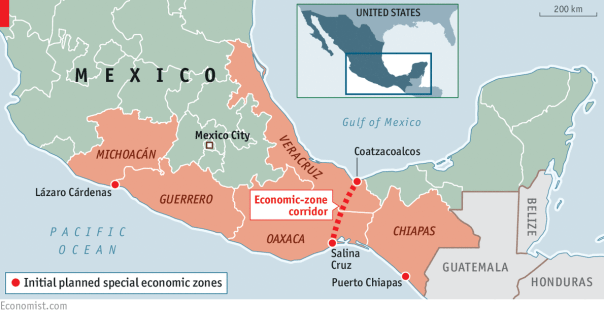
The Trans-Isthmus Corridor stretches across the Isthmus of Tehuantepec from Coatzacoalcos to Salina Cruz.
By: Luis Hernández Navarro
Many names; same project. The proposal to promote regional development through the construction of a dry canal that connects the Gulf of Mexico with the Pacific Ocean, linking the ports of Coatzacoalcos, Veracruz, and Salina Cruz, Oaxaca, has been baptized in many ways during the past 51 years. But, beyond what it’s called, the proposal is, in essence, the same.
The recent initiative in this direction came from the virtual president-elect, Andrés Manuel López Obrador (AMLO). He informed Donald Trump of this in a letter that he sent to him through Secretary of State Mike Pompeo. And that’s how he announced it, by announcing the priority infrastructure projects.
The modern history of this megaproject is long. In 1967, President Gustavo Díaz Ordaz formed a commission to impel the inter-oceanic transport of containers. In 1974, Luis Echeverría, projected the expansion of the railroad constructed during the days of Porfirio Díaz (el porfiriato), at the time that he built the Cangrejera Petrochemical Complex and the Salina Cruz Refinery. In 1977, José López Portillo launched the Alfa-Omega Plan, a trans-Isthmus transport system for cargo using containers. In 1985, Miguel de la Madrid put his hands on a public work: the Nueva Teapa-Salina Cruz pipeline.
With slight variations, the fantasy continued from one presidential term to the next. In 1996, Ernesto Zedillo announced the Comprehensive Economic Development Program for the Isthmus of Tehuantepec, which sought to integrate the region into the global development of goods and services, of course, by means of an interoceanic transport corridor. In 2001, Vicente Fox rewound the initiative promoting the Plan Puebla-Panamá. In 2007, Felipe Calderón announced the Logistical System of the Isthmus, to auction off the Coatzacoalcos y Salina Cruz container terminals, and the operation of a modern freight railroad. Three years later, he communicated the cementing of a multimodal corridor. Enrique Peña Nieto promoted this megaproject at two different times: first, in 2013, with the Port of America Isthmus Plan, and three years later, he re-launched it by incorporating it into the Special Economic Zones (SEZ). Each and every one of these initiatives failed in their attempt to constitute the Trans-Isthmus Corridor.
AMLO’s new plan also considers the corridor a free zone and part of the SEZ, which his future Cabinet chief, Alfonso Romo, wants to extend to the entire territory of Chiapas, Oaxaca and Guerrero.
An SEZ is an enclave where the regulatory framework in which the companies must function (for example, the payment of taxes or the fulfillment of administrative obligations) is minimized in relation those existing in the rest of the country.
The Isthmus of Tehuantepec is a region of enormous environmental and cultural wealth. According to the researcher Miguel Ángel García, the country’s most important humid tropical forests and jungles survive there, because of their biodiversity and preserved extension. It is a contact zone between the fauna and flora of North and South America, and is part of the group of ecosystems that still shelter between 30 and 40 percent of the world’s biodiversity. It is the region with the greatest availability of water according to its demand on a national scale and where the largest lagoon systems of the Mexican Pacific are generated. The project could damage the environment beyond repair.
The Isthmus is also a territory inhabited by 12 native peoples, who live in 539 communities: Chinantecos, Chochocos, Chontales, Huaves, Mazatecos, Mixtecos, Mixes, Zapotecos, Nahuatlacos, Popolucas and Zoques. Ancestrally they have resisted the “modernization” projects that seek to dispossess them of their lands, territories and natural resources in the name of “progress.”
The new government has announced that it will accompany the construction of the new Trans-Isthmus Corridor making those affected co-participants in its benefits, so (in the words of Tatiana Clouthier interviewed by Ernesto Ledesma) “that money falls into their pocket and that helps them to get better.” This would guaranty adding them to the project. Additionally, according to some analysts close to AMLO, a hypothetical approval of the San Andrés Accords would give the indigenous peoples tools for better defending themselves.
We’re talking about an excessively optimistic expectation. The federal government and the Zapatista National Liberation Army (Ejército Zapatista de Liberación Nacional, EZLN) signed the chapter on Indigenous Rights and Culture of the San Andrés Accords on February 16, 1996. The rest of the themes to be addressed remain pending. A lot of water has run in that river since then. The indigenous world has changed enormously in the last 22 years. The new mining and energy laws are a death sentence for the original peoples.
Beyond the will to transform and to struggle against corruption, the trans-Isthmus corridor, the extension of the SEZs, the pretension to convert Mexico into an investment paradise, announce the imminent clash of these projects with the indigenous peoples.
———————————————————-
Originally Published in Spanish by La Jornada
Tuesday, July 31, 2018
http://www.jornada.com.mx/2018/07/31/opinion/017a1pol
Re-Published with English interpretation by the Chiapas Support Committee
“A call to all those who rebel in all corners of the world”
From the Zapatista Gathering in Morelia: “A call to all those who rebel in all corners of the world”
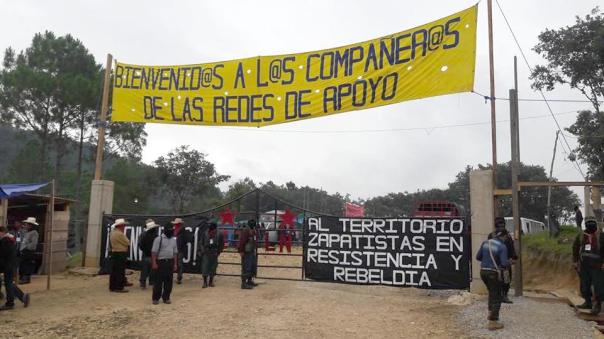
Banner welcoming support network compañer@s to the Gathering in Morelia.
Altamirano, Chiapas, August 6, 2018
The festival: CompARTE FOR LIFE AND LIBERTY, “Paint little caracoles to the bad governments, past, present and future,” convoked by the EZLN’s support bases, starts today in the Zapatista Caracol of Morelia. From August 6-9, in the Caracol located in the municipality of Altamirano, you will be able to appreciate musicians, actors, dancers, painters, sculptors, poets, etcetera, from the Zapatista communities in resistance and rebellion, the Sixth Commission of the EZ communicated. Artistic expressions from national and international attendees will also be presented.
This August 6, on the principal stage of the Caracol de Morelia, they will present theater works from the Zapatista Caracol of Oventic, Altos region: “The seven principles of Govern Obeying;” “Environmental and social destruction” and “The new way of Self-governing.”
From the Zapatista Caracol of Roberto Barrios, will entertain with mariachi music from the following groups: The Five Stars; Zapatista Pride; The People’s Voice; Rebel Youth and Chol Maya Renaissance. The soloists Chántee, The Rebel; King Being; Women’s Voice; Valero and My Root will also give presentations. We can’t lack a music trio, so therefore this Monday we’re going to hear the groups: The Flower and Seed of Freedom. In this start of the festival you will be able to enjoy the duo “Life’s Path” and the interpreters of Rap music: For Life and Here I Am.
Young men and women from the host Caracol will present a theater piece that invites reflection called: “Working to live or Working to Die?
From the Caracol of La Realidad, you can enjoy the music of groups like: Strugglers of the People; Cro Eleazar; Los Bamex; Cro Manayer; Touch me of you can, capitalist; Rebel Creators of the South; Rebel Dúc; Rebel Trio; Los Primos; Cro Yorch; Sons of the People; Butterfly of the South; Rebel Youth and Followers of the Struggle.
Prior to the start of the festival on Sunday afternoon August 5, at the end of the Gathering of support networks for the Indigenous Governing Council (Concejo Indígena de Gobierno, CIG), of the National Indigenous Congress (Congreso Nacional Indígena, CNI), upon speaking to those in attendance, Subcomandante Moisés repeated the reading about what the Zapatistas give to the current national and international context. The Zapatista spokesperson was blunt when he said that there is no “good boss,” in reference to the different forms of capitalist exploitation and dispossession and its representatives, who he equated with “Overseers” (neoliberal presidents), “Foremen” (governors) and “Supervisors” (municipal presidents).
Subcomandante Galeano, following the words of Subcomandante Moisés, indicated that any overseer “is going to be confronted;” that upon seeing that capitalism is returning to the methods that gave it origin, “war for the conquest of new territories.” By giving priority to consumption, the predatory global economy “will destroy as much as it can,” Galeano warned. He also pointed out that the new “merchandise” of capitalism, is in the territory of the Native peoples and includes: water, land and air, among others. Faced with the crisis that the system produces, like migration and natural catastrophes, “capitalism is testing an inward withdrawal as an anti-globalization to be able to defend itself,” the Zapatista spokesperson said. Different walls are going to continue to rise and will proliferate like archipelagos for separating the rich from the poor, he added.
Galeano also emphasized the role of the different collectives that worked in support of the CIG and its spokesperson María de Jesús Patricio Martínez, on collecting signatures so that “Marichuy” would attain her registration as a candidate to the presidency of the republic. “With everything against you, the collectives and the spokesperson, denounced the predatory system,” the insurgent expressed. Despite the fact that official registration was not attained, he said that together with the National Indigenous Congress (Congreso Nacional Indígena, CNI) and the support groups, they will now consult about how to make the Council larger, so that this initiative “doesn’t absorb and annul differences; but rather that it strengthens them,” on the international level. “Our call is not only to Native peoples, but rather to all those who are rebelling in all corners of the world,” the Chiapas rebel shared.
COVERAGE OF THE COMPARTE FESTIVAL: https://www.facebook.com/EnlaceZap/?hc_ref=ARQyLElgcLeOImLsA3GuE2NDoPY2lEpyipbCkLY_e0Gd2Z6Iy9-uQ7NoBu2uXZJXjnA&fref=nf
—————————————————————-
Originally Published in Spanish by: POZOL COLECTIVO
Monday, August 6, 2018
Re-Published with English interpretation by the Chiapas Support Committee
The strategy of the caracol
[Administrator’s Note: Today is the the 15th Anniversary of the birth of the Zapatista Good Government Juntas and Caracoles, a revolutionary model for organizing and self-government. The anniversary is being celebrated at the Gathering in Morelia.]

Mural on front of the first offices of the Good Government Junta in the Caracol of La Garrucha.
By: Hermann Bellinghausen
It has been fifteen years since the Zapatista National Liberation Army (Ejército Zapatista de Liberación Nacional) announced the creation of the caracoles and the Good Government juntas (Juntas de Buen Gobierno, JBG).
Today, when the in-coming government enunciates as its goal to “fulfill” said agreements (the San Andrés Accords, SAA) it would be good for it to find out that they were already fulfilled. Now more is needed, the SAA were only the first of four stages of interrupted talks to negotiate peace with the rebels and to fulfill the historic demands of the nation’s Native peoples. Faced with the neoliberal policies that established dispossession and aggressive extraction on their territories, many peoples stopped hoping. A risk of AMLO’s policy for indigenous peoples is that it starts from behind. It will be patronizing and directed at “poverty,” and it foresees a manner of “autonomy” and goes straight to the creation of important divisions. As if there were not too many already!
Slowly, quietly and efficiently, the rebel Caracol that has been functioning for 15 years accommodates and moves, updates, contracts and expands, and apparently has fun. Its demands don’t go through Sedesol waiting lines. Besides, its strategy went further and deeper, and embodies a culture that the State is obliged to respect.
Andrés Aubry, a great interpreter of the Chiapas rebel movement, wrote in Ojarasca that: “the fiesta of the Caracoles demonstrated that the rebels took seriously breaking the silence proclaimed by 30,000 Zapatistas and their comandantes on January 1, 2003 in San Cristóbal.
“Now we know that what filled this long silence in clandestinity was nothing other than a disciplined and progressive fulfillment of the San Andrés Accords.” Faced with the “heavy omissions” of the political class and the official powers, “the Zapatistas proclaimed that from here on this open rebellion would no longer be practiced in silence, but rather by means of a transparent resistance.”
In the heat of the events, Pablo González Casanova also wrote: “Among the rich contributions that the Zapatista movement has made to the construction of an alternative, the project of the caracoles unravels a lot of false debates from politicians and intellectuals.” In the words of Comandante Javier (the same one who had read the First Declaration of the Lacandón Jungle in San Cristóbal de Las Casas on January 1, 1994), quoted by González Casanova in his splendid Essay interpreting the caracoles, they open “new possibilities for the resistance and autonomy of the indigenous peoples of Mexico and of the world, which include all the social sectors that struggle for democracy, liberty and justice for all.”
After the creation of the Caracoles and the JBGs, formed by the EZLN’s civilian structure in the autonomous rebel Zapatista municipalities (that has been evolving since December 19, 1994), González Casanova points out that: “the project postulates that the communities and the peoples must practice the alternative in order to acquire experience, not wait to have more power to re-define the new style of exercising it. It is not constructed under the logic of the State’s power.” Nor is it constructed to create an anarchist society. “It is a project of peoples-government that is articulated internally and seeks to impose paths of peace… without morally or materially disarming the peoples-government.”
It’s fair to recognize that the JBG and its likenesses are both government and a school of government. They opened central participation to women and youth, and made community public service horizontal without anything to do with the political parties or the dominant system.
González Casanova’s conclusion was of long reach: “More than an ideology of the power of peoples-governments, the caracoles construct and express a culture of power that emerges from five hundred years of resistance of the Indian peoples of America.”
———————————————————-
Originally Published in Spanish by La Jornada
Monday, August 6, 2018
http://www.jornada.com.mx/2018/08/06/opinion/a08a1cul
Re-Published with English interpretation by the Chiapas Support Committee
The play on the Zapatista court
The Red Queen of Palenque (Chiapas) in Mexico City’s Templo Mayor. Photo: INAH
By: Daliri Oropeza*
A group of young women with ski masks collectively recite poems mixed with dance, slogans that make petals fly, fans raising corn, all in different circular formations, then linear, which encompass the space of the basketball court. The word of the rebel communities is also in performance art. With these representations they received María de Jesús Patricio in the five Caracoles of the Zapatista Rebel Autonomous Municipalities (Municipios Autónomos Rebeldes Zapatistas, Marez). They also receive indigenous communities of the country and of the world with art.
It’s no coincidence that the Zapatista communities represent the autonomy that they experience occupying the space of a court, not a theater. After the armed uprising, the Dialogues for Peace in San Andrés Sacam’chen began on a basketball court. To the government, a basketball court seemed like a strange place to dialogue, but no; according to the cross reference that the writer Juan Villoro proposes, the Zapatista communities, of Maya descent, carry in them the meaning of the ball game as the moment in which the wheel of the cosmos bounces on the courtyard of the world, a court that they called taste. There are even records of the importance of taste because of its direct association with the sacred landscape, with the spaces of daily life and collective activities, to the degree of symbolizing the community.
But now there is art on the Zapatista basketball courts and in this performance art there are very clear messages. In their works they recreate the exercise of political participation, their vision of autonomy, the strength of women, autonomous justice or about their history before and after the uprising. Everything that was dialogued on the San Andrés basketball court is first at practice and later in the representations. The Trans-disciplinary Collective of Critical Investigations (Cotric, its Spanish acronym) describes that in Zapatista art there is a system of “stable” signs and symbols and five recurring themes: The history of the past, from the colonial to the caciques; the revolutionary past up to the 1994 Uprising; the present in resistance and autonomy; the future with this distinct form of governing; and the trans-temporal that connects the different times.
What happens on the basketball courts of the Marez leaves in ridicule the idea that the team of the winning candidate of the presidential election offers: “fulfilling the San Andrés Accords,” because it would be not recognizing that entire indigenous nations already carry them out: “a catchy political discourse,” affirms the Ñuú Savi lawyer Francisco López Bárcenas, but as a government proposal it’s late. On the court, the Zapatista bases demonstrate the exercise of their cultural rights, signed in the Accords.
But now on the basketball courts they represent through art their political participation and the women in charge, but also the differences between the dynamics between neoliberal capitalism and Zapatista autonomy that they live day by day. Not only the Zapatista communities, hundreds of communities, from the north to the south of Mexico exercise one or all the points of the San Andrés Accords, with or without the laws approved in 2001, dozens never left their own organization. It is no coincidence that within the same communiqué where the EZLN criticizes the recently completed electoral political dynamics is the same one that invites us to the celebration of the 15 years from the start of the five Zapatista Caracols and to the third edition of the CompArte Festival.
The relationship between the country’s indigenous peoples, society and the State is not the same since the Zapatista Uprising or the activation of the five Caracols that function autonomously. They start from a different exercise of their identity in front of this new government. What’s going to happen if there’s no counterweight? That evidence that Marichuy’s campaign achieved by baring the dysfunctional electoral system, demonstrating that it’s the “left drunk with victory” that attacked the proposal of the CNI and the EZLN, with the argument that it was a “strategy to divide the left.”
With this performance art, the Zapatista support bases put the cultural rights of the original nations on a court. These rights are the most unprotected because of not being covered by international treaties. They are so broad that they encompass rituals, language, identity, current artistic creations of the communities and also the intangible cultural heritage, the meaning of ancestral practices and even the bio-cultural relationship, which give meaning to the autonomy that the peoples exercise. More than advisers, as Father Solalinde says, I see a court in the middle of the forest, women, children and grandparents struggling, in rebellions re-creating and exalting their own history with art. There are teams that play in dignity until the last minute.
*Journalist
———————————————————–
Originally Published in Spanish by La Jornada
Saturday, July 28, 2018
http://www.jornada.com.mx/2018/07/28/opinion/008a1pol
Re-Published with English interpretation by the Chiapas Support Committee
 Chiapas Support Committee