Chiapas Support Committee
Home of the Compañero Manuel blog on zapatistas & mexico
Chiapas earthquake victims claim abandonment by federal and state authorities
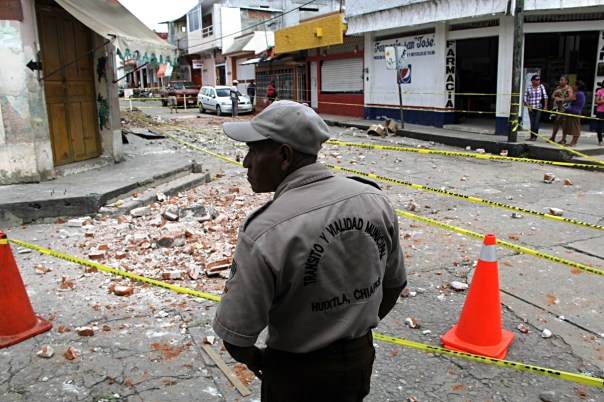
Damages from the September 7, 2017 earthquake in Unión Juárez, Chiapas. Photo: Xinhua
By: Isaín Mandujano
TUXTLA GUTIÉRREZ, Chiapas (apro)
One year after the 8.2-magnitude earthquake in Chiapas, there are only deception and protests, serious violations of the right to dignified housing, threats to block roads and international border bridges.
Friday, September 7, was the one-year anniversary of the earthquake that leveled part of Chiapas. Fernando Ríos of the All Rights For Everyone Network (RedTDT, as it is known in Spanish) announced that the state and federal governments have failed the earthquake victims.
According to that organization, the victims fear that faced with the change of government they will be left helpless, because thousands still wait for the promised aid.
He detailed that they toured four Chiapas communities: Paredón, Huizachal, Gustavo López and Nuevo Urbina, in the state’s coastal region, where they established the anguish that the families experience everyday.
Ríos explained that, in many cases, families were waiting for resources that never arrived, and in the best of cases they only gave them 85 thousand pesos and not the 120 thousand that they promised them.
The earthquake victims explained that the federal government blames the state for not contributing its share of resources; however, to those affected the one responsible is the Mexican State, because the government issued the orders to everyone who assumed the commitment to support them.
And it’s not only housing, in the border region of the Suchiate River, several municipalities continue hoping that the state and federal governments will intervene and reconstruct or rehabilitate at least 40 mainly basic level schools that were damaged by the September 7, 2017 earthquake.
Javier Ovilla Estrada, one of the leaders of the parents’ committees, said that they have marched, blocked highways and taken over international border bridges in order to make themselves heard; nevertheless, they have brought “pure minutes.”
“They promise, promise and never fulfill,” says Ovilla Estrada, who stated this week that, if the government does not fulfill, they would again take over the border bridges that connect Mexico with Central America.
Meanwhile, he exposed, thousands of children go to classes in very poor conditions in schools at the point of collapsing or under trees or improvised wagons.
He threatened a highway blockage this Friday on the stretch between Tuxtla and Chiapa de Corzo. Teachers, parents and students came out to place rocks, sticks and tires on the asphalt strip.
They denounced that Aurelio Nuño, as Secretary of Public Education and Governor Manuel Velasco Coello, came to this Multiple Attention Center as soon as the earthquake occurred. They promised aid for reconstructing the damaged school, but they continue waiting.
Children with different abilities come to this educational center. Even they, some in wheel chairs, had to sit themselves down on the highway.
“May the government turn around and see us! They are going to go away and they are going to leave us like this,” said Josefa López Flores, a mother of a child at that school.
After the September 7, 2017 earthquake, state authorities verified damages to 46, 773 homes. Of these, 14, 073 were found with total damage that required demolition and new construction and there were 32, 700 with partial damage.
They reported that up to now a total of 45, 216 BANSEFI debit cards have been delivered, of which: 13, 550 are for total damage and 31, 666 are for partial damage. It’s appropriate to point out that there are still 1, 557 cards pending of which, 41 cards are in plastic production on the part of BANSEFI for name changes and 1, 516 are in branch banks to be delivered.
The group of people that already received their card has deposited a total of 1,564,892 billion pesos, of which they have already withdrawn 1,525, 357 billion pesos. Of the 14, 073 houses with total damage that already received a card, 9, 889 had already initiated reconstruction, according to an April report.
According to Luis Manuel García Moreno, head of the Civilian Protection Ministry, with the delivery of resources through the prepaid debit cards, the government’s commitment to support the population that lost their home or saw their home affected by the earthquake is fulfilled.
The president of the National Human Rights Commissions, Luis Raúl González Pérez, was in Chiapas yesterday and he was questioned about this lack of fulfilling promises to the earthquake victims. He said that complaints have reached his agency from Mexico City about the September 19 earthquake as well as from victims in Chiapas and Oaxaca.
A year after the earthquake, he said that he ordered his agency to issue a detailed report and that he will urge state and federal authorities to fulfill their commitments, because grave human rights violations have been documented.
——————————————————–
Originally Published in Spanish by Proceso
Friday, September 7, 2018
Re-Published with English interpretation by the Chiapas Support Committee
They demand cancellation of Santo Domingo Hydroelectric project

Río Santo Domingo with Las Nubes Cascades in background.
More than 800 people met on Tuesday, September 4, in the community of Amparo Agua Tinta, municipality of Las Margaritas, Chiapas, to participate in the first “Forum against hydroelectric dams in the border region,” in which they analyzed the problem of the activity of the extractivist megaprojects in the state.
“Called because of the peoples’ pain and suffering over the dispossession of territories and the destruction of Mother Earth” it was how members of the parishes of the Diocese of San Cristóbal de las Casas, organizations and social movements, decided to meet to share and reflect on the large projects that are coming to Chiapas.
The participants referred to the Maya-Peninsula Train, a proposal of president-elect Andrés Manuel López Obrador, as “a plan that is centered on money, which seeks to loot nature and dispossess the peoples of their territory and culture.”
It was mentioned during the Forum that 26 of the 52 hydroelectric projects for the whole country are projected to be in Chiapas.
They also rejected realization of the “Santo Domingo Hydroelectric Project for Generation of Renewable Energy,” [1] which they want to construct near the localities of Loma Bonita and Las Nubes in Maravilla Tenejapa municipality, for attempting to invade the territory of the original peoples.
“This project is based on the interests of a few over the life of our peoples and it encompasses a large part of the region’s natural protected reserves,” describes a comunicado.
They also asked for the definitive cancellation Hydroelectric Project and respect for Mother Earth, territory and the peoples, in addition to the exigency of the right to have a secure, clean, transparent and informed consultation ratified by the peoples and communities faced with any other project.
—
PARTICIPANTS IN THE FORUM ARE LISTED BELOW.
Parishes and Missions of the Diocese of San Cristóbal de las Casas: San Juan Bautista, Nuevo San Juan Chamula, Misión de Guadalupe, Misión Tojolabal, San Pedro and San Pablo, Santa Margarita, San Fermín, San Sebastián (Comitán), Santísima Trinidad, Santo Niño de Atocha (Frontera Comalapa), Santo Domingo (Comitán) San Juan Cankuc, San Jacinto de Polonia (Ocosingo), José y María (Pico de Oro), San Andrés Apóstol (Larrainzar), Pueblo Creyente de Simojovel, illa Las Rosas, Asunción de María (Comitan).
Pastors of different Churches: San Rafael House of Prayer Church and New Life Church.
Organizations and social movements: OPEZ-Historical, Nueva Constituyente Ciudadana y Popular, Resistencia civil luz y fuerza del pueblo, EDUPAZ, SERAPAZ- Ocosingo. SIPAZ, Caritas San Cristóbal-social action Samuel Ruiz, Otros Mundos, SUEFOR (international observers from Sweden). COADHECH AC, autoridades Ejidales, Akib´al, a Chuj/Q´anjobal youth group [2] and SSS Los Lagos de Colores.
-*-
Notes:
[1] In August 2018, Mexico’s environmental agency rejected the environmental impact report on the project and denied the hydroelectric company authorization to build the dam. Participants in this forum demand the total cancellation of the project, rather than allowing the company to make some changes and continue trying to obtain a favorable ruling on another environmental impact report.
[2] It’s interesting to note the attendance of a Chuj/Q’anjobal youth group from Guatemala, where communities are also resisting the construction of dams.
——————————————————————
Originally Published in Spanish by Chiapas Paralelo
Thursday, September 6, 2018
Re-Published with English interpretation by the Chiapas Support Committee
Governors offer AMLO support for the Maya Train project

By: Alma E. Muñoz
Palenque, Chiapas
President-elect Andrés Manuel López Obrador received support from the governors of the southeast states for executing the Maya Train [1] project in the region, thus detonating its development. With this work, which will begin in Chiapas and Tabasco with a budget of 16 billion pesos in 2019, the next government will stimulate tourism, create jobs and even try to stop migration.
“With this project we are going to respond to the economic and social needs that the inhabitants of the southeast have. We are going to confront the paradox that the states of the southeast are rich in economic and cultural potential, (but) their peoples are poor,” the next head of the federal Executive explained.
After a private meeting with the governors of Chiapas, Manuel Velasco; of Quintana Roo, Carlos Joaquín González; of Tabasco, Arturo Núñez, and of Campeche, Alejandro Moreno, at a Palenque archaeological zone hotel, the latter pointed out that this opens a new opportunity for the Maya World.
“It is a great project that arrives in time, in form and at a moment, and we will have to assume our responsibility to decidedly start on December 1 with the formal commitment of supporting this work,” Moreno emphasized.
All those who are here, he maintained, “have reaffirmed our commitment to seeing it as an integral project of the government of the Republic and the five states” of the region –the state of Yucatán is in addition to those states mentioned, whose governor, Rolando Zapata, sent a representative to this Sunday’s meeting.
At the end of the meeting, which the governors-elect of Chiapas, Rutilio Escandón, and of Tabasco, Adán Augusto López, also attended, as well as members of the next cabinet, López Obrador ratified that the work will have both public and private investment –national and foreign– of between 120 and 150 billion pesos, and will be finished in no more than four years.
He thanked the governors for their support of this project that, he asserted, is one of nation.
He stressed that they have practically resolved everything related to the right of way, because for half of the 1,500 kilometer trajectory they will use the Palenque-Valladolid road, which the Secretariat of Communications administers; the electric lines, in charge of the Federal Electricity Commission, and the highway network.
He said that along the route, the next government will implement a reforestation program, with the planting of 50,000 hectares of fruit and timber trees [1], which will give jobs to 20,000 campesinos, ejido members and small communal farmers next year.
He also announced that there would be fiscal facilities for investors, and that regional transportation will have the lowest price.
The president-elect said that the outgoing governors of Chiapas and Tabasco would elaborate the basis of the bidding to initiate the works at the start of the next government, and that it will be the responsibility of their successors to inaugurate the train. He emphasized that he will personally supervise the work, so that it is not delayed.
Rogelio Jiménez Pons, next director of the National Fund for Promoting Tourism, explained that the train, which will be for both passengers and freight, is a project on which they have worked since two years ago.
The project is considering 17 stations for the route: Palenque, Tenosique, Escárcega, Calakmul, Xpujil, Bacalar, Felipe Carrillo Puerto, Tulum, Playa del Carmen, Puerto Morelos, Cancún, Valladolid, Chichén Itzá, Izamal, Mérida, Maxcanú and Campeche.
In one month, López Obrador will again meet with the governors of the southeast, in Campeche.
On the other hand, the president-elect also met with the coordinators of the program for planting of one million hectares in Chiapas, who he asked not to allow pressuring on behalf of group interests that seek to benefit from the project.
“We are not going to allow threats, that has to change. We don’t want intermediaries in the delivery of resources; we want the support to arrive directly to the people,” he said.
[1] https://chiapas-support.org/2018/08/21/amlo-announces-an-expansion-of-the-maya-train-project/
———————————————————
Originally Published in Spanish by La Jornada
Monday, September 10, 2018
https://www.jornada.com.mx/2018/09/10/politica/005n1pol
Re-Published with English interpretation by the Chiapas Support Committee
The Last Honeybun in the Mountains of Southeastern Mexico

By: Sup Galeano
(The story presented at the close of “CompARTE for Life and Freedom 2018,” in Morelia, Caracol “Whirlwind of our Words,” mountains of the Mexican Southeast.)
It may have been a string of random events, without any apparent relation between them, that brought about this tragedy.
It may have been merely a coincidence, a bit of bad luck, as if destiny decided to feed rumors of its existence by dropping pieces of a jigsaw puzzle onto the now-cracked open heads of humans and machines.
Or maybe the Storm itself (yes, that storm that Zapatismo insists on calling attention to and, like most things we say, no one else seems to notice) revealed a spoiler, a hint of what is coming. It was as if the incoherent software on which reality apparently runs suddenly flashed an urgent warning, an unexpected alert, a signal so subtle that it was only noticed by the most experienced lookouts, those who focus on examining horizons so distant that they don’t even appear as factors in the frenetic statistics of the global system. After all, statistics function to show tendencies deeper than the drama of the day-to-day. What’s one murdered woman? A number: one more statistic, one less woman. Statistically speaking, you’d need more, many more of these “gendered” murders to even suggest evidence of a tendency—which would be that of the system’s runaway gallop toward the abyss, skidding through blood, mud, ash, shit, and destruction. What’s on the horizon? War. What’s down the beaten path? War. In the capitalist system, war is the starting point, the ending point, and everything in between.
But maybe I’m just talking madness. After all, this is a story, and one has to be careful not to veer into biased reflections, dangerous ideas, morbid thoughts, idle musings, or provocations.
Those who had to suffer through watching a movie with the late SupMarcos can tell you that it was intolerable. The truth is he was intolerable in various respects, but for now I’m talking about watching movies. Any time a firearm appeared onscreen he’d hit pause and launch into a long and pointless discussion about trajectory, distance, force, firepower, and the various shorter or longer geometric curves a projectile could take en route to its “objective.” During that pause he didn’t care how the plot was going to play out, or if other viewers were anxious to know if the hero (or the heroine, musn’t forget gender equity) would be saved; he’d just delve into his hopelessly erudite explanations: “that one is a M-16 rifle, NATO 5.56-caliber—named as such to differentiate between munitions manufactured in countries belonging to NATO versus those of the Warsaw Pact, etc. etc.” The rest of the movie-watchers never knew what to do: if they showed interest, he might go on even longer; if they looked disengaged, he might think he hadn’t been sufficiently clear and thus expound further, always eventually ending up, of course, at the Cold War. At that point SupMarcos would always feel obliged to explain that the term “cold war” was an oxymoron, the system’s way to hide the death and destruction that characterized that period. From there he would delve into the “fourth world war” and on and on until the popcorn got cold and turned into mush with hot sauce.
Huh, looks like I’m doing the same thing now. The thing is that if SupMarcos came to watch a movie, you knew you’d have to watch it twice: once to suffer through the interruptions, and a second time to understand the plot. That’s why I always insist that a story is a story and not a political discussion, although “political discussion” is also used by Defensa Zapatista as a cover for the “gender violence” she inflicts on the stoic Pedrito who, without his knowledge or intention, has become the nemesis of the girl and her indefinable cat-dog.
What was I saying? Oh, right, I was telling you why I was going to tell you what I’m going to tell you.
It was in the wee hours of that fateful night that I confirmed what I had long feared to be true: the honeybuns were all gone. All of them. Even the strategic reserve—meant to withstand the predictable zombie apocalypse, an alien invasion, or a falling meteorite—was null.
How did this happen? Well, that’s just the thing, just like in Greek tragedies and Mexican corridos, everything’s okay…until it’s not.
Doña Juanita, holed up in the CIDECI kitchen in San Cristóbal de Las Casas, Chiapas, Mexico, had gone on strike: no tamales, no pork, no tacos or street food, no carb-rich, fat-laden or cholesterol-ridden milkshakes. And, heaven help us, no honeybuns. Now she was dead set on serving all healthy food: in other words, vegetables, vegetables, and more vegetables. She would have no discussion about it—she claimed it was part of resistance and rebellion: down with junk food and fast food.
When I found out, I sent an emissary to convince Doña Juanita to make an exception: to say that I understood her point of view, but that I had read a book about the nutritional value of honeybuns. Then I tried another tactic: that if she would make honeybuns, we’d keep it between the two of us—I wouldn’t tell anyone. The emissary came back looking totally defeated: he hadn’t even been able to talk to Doña Juanita. She and her compañeros had fortified their position in the kitchen and were singing, “We shall not be moved, and if there’s any doubt just try it out! We shall not be moved![i] I asked my emissary what he had done in the face of this. He said that the chorus was really catchy, so he had grabbed a guitar and started singing along. Me on the other hand, I don’t just roll over on issues that fall under the rubric of “gender.” After all, Doña Juanita is a woman and there are some things women just don’t understand.
At that point I resorted to the ee-zee-ele-en’s super-secret weapon: our compañero Jacinto Canek. Far, far from these mountains but deep in others, our compañero Jacinto Canek knows all about things pertaining to the kitchen. He works wonders with just a few pots and pans. But he has a special gift with regard to bread. It is said that people travel from all over the world to try his bread. As a demonstration of “another globalization,” his baking has delighted the palate of people across the five continents.
“The secret is that you have to put a lot of huevos[ii] into it,” Jacinto Canek confessed to me one day while we waited, me rather impatiently, for some honey buns to come out of the oven. He meant into the bread, but I said, “like with everything, Don Jacinto, like with everything.” I had faith that our compañero Jacinto Canek, as a matter of gender solidarity, would honor his nom de guerre[iii] and offer a solution to the very serious crisis at hand.
A mission of such transcendental importance required drastic measures. In order to ward off the criticism I could already see coming from the feminists, I sent Insurgenta Erika to the distant lands where Jacinto Canek protected his culinary secrets at all costs.
I told her she was on a very important mission, that she had to find Jacinto Canek and tell him about the legend of the first gods, the ones who gave birth to the world and created honey buns so that humans would have some idea of what paradise was. But then the fucking capitalist system showed up with its Bimbo-Marinela, Tia Rosa, Wonder Bread and all that, corrupting the sacred delicacies of the gods. Those who make artisanal bread are effectively the guardians of memory, protecting the Holy Grail that provided for communication between humans and gods.
Insurgenta Erika of course asked me what on earth a “Holy Grail” was. I told her it was something very important—sacred, in fact—and that the entire future of humanity depended on it. Erika scoffed, saying, “Oh, please, you for sure made that up, Sup: you’re just trying to get your hands on some honey buns.”
I put on my “I’m-so-offended” face and sent her off with a firm warning.
After what I imagine was an exhausting journey, Insurgenta Erika came back with a huge bag of homemade bread. I applauded, I couldn’t avoid it. I have to admit that my beautiful eyes teared up with gratitude. I didn’t even return Erika’s greeting, but grabbed the bag from her and emptied its context onto the table. Nothing. There were croissants, cupcakes, muffins, elephant ears, cinnamon rolls, long johns, cornbread, donuts, everything. But no honey buns, not a single one.
The horror.
I collapsed into my chair, bitterness filling my mouth.
Just then Insurgenta Erika took another bag out of her backpack, a smaller one. And there it was, all wrapped up in plastic and paper: a honeybun!
“He only managed to make this one,” Erika explained. “He couldn’t make more because he was about to go dancing with his wife. He said he didn’t know when he’d get around to making more.”
Erika left. With extreme care, as if it were fine crystal, I placed the honeybun on the table. With the Storm, the Hydra, and the All-Inclusive-Apocalypse on my mind, I assumed a formal posture and declared:
“Here lies the last honeybun in Southeastern Mexico.”
I didn’t know if I should eat it or put it on an altar, with a homage to what it represented: the end of an era, destiny’s non-appealable mandate, the anger of unknown gods, a glimpse of disdain from a desired eye, the collateral damage of the capitalist war.
I looked at it—oh, yes, I looked at it with undisguised lust. My fingers brushed lightly over its sugared curves, the circular cleft that gave rise to the single bosom of the unisex being, the voluptuous figure that not only spoke but shouted: “I am a honeybun, not just any honeybun, but the only honeybun.”
I was busy with that, and pondering whether the cooperative store would have that well-known cola with which I could honor this last honeybun, when, as if to complicate what was already a tragedy, Defensa Zapatista and the cat-dog appeared at the door. I stood up as quickly as I could, using my body to try to shield the obscure object of my desire as I stammered incoherently:
“Uh, no, there is no honeybun on the table. No, I’m not hiding it. Of course there’s nothing behind me. Wow, it’s hot, and the mosquitos are out in force: I think it’s going to rain. Do you think it’s going to rain?”
I think Defensa suspected something because she walked right up and around me and saw the honeybun. She looked at me sternly and declared:
“You have to share, Sup.”
The cat-dog barked or meowed or who knows what, but I suppose in agreement with Defensa Zapatista.
Out of the blue, apparently convoked by the very word “honeybun,” another little girl appeared, reaching over the table to try to grab the honeybun with one little hand while holding on to her teddy bear with the other. I pulled her away from the table and, in true SupMarcos fashion, asked her:
“Who are you? I don’t know you.”
“My name is Esperanza [Hope] and my last name is ‘Zapatista’ and this is my little bear and we’re hungry.”
Upon hearing the little girl’s name, I once again appreciated the continuous paradoxes of these lands.
Esperanza Zapatista backed away after various attempts at what new theoretical frameworks would call “accumulation by dispossession of honeybuns,” a still-developing phase of capitalism.
Defensa and the cat-dog looked at me with over 500 years of demands in their eyes, awaiting the impossible: that I share with them the last honeybun in the Mexican Southeast.
“I can’t,” I defended myself awkwardly, “there’s only one. If there were two or more we could divvy them up, but there’s only one, enough for one person, and that one person, well, he can’t share one honeybun.”
I emphasized the masculine pronoun to purposely leave out Defensa Zapatista, Esperanza, and the cat-dog—I mean, we don’t even know if it’s a dog or cat, much less if it’s male or female.
In accordance with the fifth law of the dialectic (note: the first law of the dialectic is “Everything is related to everything else”; the second law is “To share is one thing; don’t fuck with me is quite another”; the third is “Fuck matter and the universe”, and the sixth is, “There’s no problem too big to be turned around”)…
Anyway, I was telling them that the fifth law of the dialectic states that “There’s no problem so big that it can’t get worse”, and as if to ratify it right there on the spot, Esperanza Zapatista reappeared, now accompanied by two little Zapatista boys: one had on a cowboy hat that was bigger than he was and introduced himself as Pablito; the other had on a hat resembling that of Don Ramon on “El Chavo del Ocho”[iv], which also looked kind of like a wool helmet, and introduced himself as Amado [literally “beloved”], The Amado Zapatista.” (I wanted to swat him for trying to take over my role.)
Seeing that I was outnumbered, I evaluated my options:
I could, for instance, take the “finders-keepers, losers-weepers” approach, that is, grab the honeybun and flee, or in military terminology, execute a “strategic retreat.” But I had to discard this option: the Zapatista kid-commando had me surrounded.
I could plow through them, IMF-style (they’ve trampled both progressive and not-progressive governments), but I’d run the risk of stumbling and dropping the Holy Grail. That would give the cat-dog the advantage—its ability to scarf down whatever falls is demonstrated in another story that I’ll tell you another time.
So I opted for the current demagoguery in fashion and addressed myself to the kid-commando:
“Look, analyze the current historical conjuncture—the correlation of forces is not on your side. This is no time for radicalism; it is a moment of gradual transition. You should wait, for example, until there are more honeybuns, at which point, yes, of course you can have some. But right now you need to wait patiently. If there is a little girl named ‘Defensa Zapatista’ [Zapatista Defense] and another named ‘Esperanza Zapatista,’ [Zapatista Hope] well then maybe there’s another little girl named ‘Paciencia Zapatista’ [Zapatista Patience]. So go look for her, and when you find her, give her a political talking-to and then we’ll see.”
“There isn’t,” Defensa Zapatista responded, adding maliciously, “but there is a little girl named ‘Calamidad,’ so that would make her full name ‘Calamidad Zapatista’ [Zapatista Calamity]. You want us to bring her?”
A shiver ran down my succulent body. I realized with desperation that my arguments weren’t working.
I imagined the potential final cataclysm: a multitude of little Zapatista girls and boys surrounding my hut, the former General Command of the ee-zee-el-en, yelling insults in various Mayan languages. I could imagine Defensa Zapatista giving the order, “Bring the kindling”, Esperanza wielding a lighter (who knows where she got that) while her teddy bear, I swear it, transformed before my very eyes into “Chucky.” The cat-dog would be barking and meowing, Pedrito would be dancing with the education promotora, Pablito singing the “The Girl with the Red Bow” and Amado harmonizing (yeah I know, the guys are always off in outer space). The kindling would begin to catch, the first flames licking the walls and forming a circle of fire within the circle of kids, and there I’d be, heroically clutching my honeybun, willing to die rather than give up “my treasure” [English in the original] to this irreverent mob barely a couple feet tall.
It was pointless to try to divide and conquer them; the honeybun united them and I could not give it up.
I could have hurled it out to them and used the ensuing confusion to seek refuge. But I had my doubts that they would pounce on the honeybun—they would probably follow their tradition of sharing any little bit they had, just like the late SupMarcos’ kid-gang used to do after robbing the “Nana Zapatista” store in [the Zapatista community of] La Realidad.
Forget it, it was my honeybun: we were united by destiny. Ancient verses ran through my mind: “In the beginning, the gods created the honeybun and they saw that it was good. Then they created the Sup so that he could delight in the honeybun and scarf it down without sharing.” Ergo, the honeybun was my property by divine right and these disrespectful little midgets were trying to steal it from me, thus committing the gravest of sins: challenging private property rights over the honeybun, which is, as everybody knows because that’s what the history books say, the foundation of civilization, order, and progress.
The future of the world was at stake. If I shared the honeybun, humanity would return to the stone age, a world without internet, social media, films, streaming series’, and, horror of horrors, without pecan praline ice cream.
I realized then that within my beautiful and shapely body lay the last opportunity of humankind.
If I shared the honeybun, terrible things could happen. For example, women could rebel. Not one, not just a couple, but all of them: millions of Zapatista Defensas, Esperanzas, and Calamidades, rising up all over the planet.
The apocalypse. The destruction of the world as we know it. The end of time. The final catastrophe. I shivered.
Then I committed a mistake that I will always regret. I blurted out, completely unnecessarily:
“Plus, it’s the last one.”
“The last one!” Defensa Zapatista repeated with alarm. She fell silent, thinking, and another shiver ran down my voluptuous body. There is nothing more terrifying than a little girl deep in thought. Suddenly she broke the silence:
“Okay fine, then what we’ll do is play a game and whoever wins gets the honeybun.”
I wanted to object that I had no reason to play anything and gamble my honeybun because it was already mine, ALL MINE, my treasure, the fruit of my labor…(okay, the labor technically was Jacinto Canek’s, but in his place and out of gender solidarity, it fell to me). As I was preparing my legal defense, Defensa Zapatista added:
“In honor of the cat-dog [gato-perro] here, the game we’re going to play is ‘gato’ [tic-tac-toe]. Whoever wins gets the honeybun.”
Upon hearing this I paused the brilliant juridical-gastronomical defense I was developing in my head and asked:
“Gato? That game with the x’s and o’s where whoever makes a horizontal, vertical, or diagonal line wins?”
“That’s the one,” the little girl replied, and drew the tic-tac-toe pattern in her notebook. It was a game I remembered from my childhood, and which I knew from playing had no winner.
For those of you of the “digital generation,” I’ll save you the trouble of looking it up on Wikipedia: “Tic-tac-toe (also known as noughts and crosses or Xs and Os) is a paper-and-pencil game for two players, X and O, who take turns marking the spaces in a 3×3 grid. The player who succeeds in placing three of their marks in a horizontal, vertical, or diagonal row wins the game.”
I calculated quickly in my head and ventured:
“What if there’s a tie?”
Defensa Zapatista looked at the cat-dog. The cat-dog looked back at her. Esperanza looked at both of them. Pablito and Amado looked at the honeybun. After a moment the cat-dog bark-meowed. Defensa Zapatista paused, asking it, “Are you sure?”
The cat-dog snorted as if to say, “How could you doubt me?”
The little girl turned to me and said: “If there’s a tie, the person originally in possession of the honeybun keeps it.”
“Me, that is,” I said to make sure there were no juridical tricks in this agreement.
“Correct,” Defensa Zapatista said without concern.
“Deal,” I said, savoring my anticipated double triumph: the gender victory and the honeybun that wasn’t just any honeybun, but the last honeybun in the mountains of the Mexican Southeast.
“So who goes first?” I asked the little girl as I took out a blank page and my black indelible ink pen.
“Oh I’m not playing. I call for a trial by combat and declare the cat-dog my champion. He will fight in my place,” declared Cersei [v], I mean Defensa Zapatista.
“Fine,” I answered confidently. In the end, that arrangement would relieve me of all the gender-based critiques that would have plagued me for having beaten a little girl, and the cat-dog, well, it was just that, a cat-dog, so there was nothing to worry about.
In a single leap, the little animal landed on the table, disdainfully pushing the paper aside and, with what I’m almost sure was a mocking smile, extended its claws to draw on the surface of the table, lightning-fast, the battlefield:
Don’t get me wrong—I don’t care about the scratches on the table, I mean, it’s already covered with tobacco burns and ink stains, but it seemed to me a little unprofessional on behalf of the cat-dog. Nevertheless, I pulled out my pocket knife and switched open its blade with an evil gleam in my eye.
The entire universe seemed to rest on the metal blade, as if its future movement or lack thereof depended on what played out on this wooden table: heads or tails, life or death, shadow or light, honeybun or chaos.
Oh, fine, I’m exaggerating, but the cat-dog and I exchanged the same looks that have for centuries passed between opposing sides when they know that in this battle not only one’s life but the whole future is at stake.
The cat-dog gestured with its hand, well, its paw, as if to cede to me the first move. At least that’s how I interpreted it.
Firmly, emulating Kasparov,[vi] I drew my first circle in the center. I know of course that the center takes us absolutely nowhere, but I thought in this case a tie would be a victory because the honeybun would remain with its legitimate owner—my stomach.
SupGaleano’s move:
The cat-dog, as if trying to get the whole Sixth on his side, played below and to the left:
I wanted to keep the cat-dog’s suffering minimal, so I played the center again, but from below—you know, the progressive trend these days:
The cat-dog, as was to be expected and without hesitation, played the above center, as if to say that the center from above always neutralizes the center from below:
I attacked from the left flank, wanting to catch the cat-dog off-guard, but it blocked me again:
Finally, and seeing the tie shaping up, I tried for the diagonal route from above to below, left to right, you know, social democracy in decay style:
Another block from the cat-dog:
I filled in the above right spot, a mere technicality since the tie was imminent and my triumph uncontestable:
I was ready to stow the honeybun safely away in my possession when Defensa Zapatista exclaimed:
“Hey, wait a minute. The cat-dog still has one more turn.”
“But the diagram is full,” I said in protest.
The cat-dog smiled slyly and, with its sharpest claws, did something totally unexpected: as if drawing a new world, it added an extension to the diagram:
Slowly, with morbid pleasure, it scratched an “x” in the new space and, I swear it, the wooden table creaked in mourning as the cat-dog drew the diagonal line of triumph:
“We won!” Defensa Zapatista yelled and grabbed the honeybun as the little animal jumped up and down in circles.
They both ran out the door, with Defensa Zapatista holding the honeybun in the air as if it were a universal flag.
Before following them, Esperanza Zapatista, honoring her paradoxical name, came over to me and patted me on the back:
“Don’t worry, Sup. Later I’ll tell you how that honeybun the cat-dog won from you tasted.”
She left too, and with her my last hope.
As I watched them run off into the distance, I thought that this is precisely the problem with Zapatismo: believe me, if its dreams and aspirations don’t fit in this world, it imagines another…and surprises everyone with its attempts to bring it into being.
And it’s not just Zapatismo.
Across the whole planet are born and grown rebellions that refuse to accept the limits of diagrams, rules, laws, and norms.
There are not just two genders, nor seven colors, nor four cardinal points on the compass, nor one world.
Just like Defensa Zapatista, the cat-dog, and the gang made up of by Pedrito, Pablito, Amado, and us [nosotros, nosotras, nosotroas], we only have one objective: to take care of Esperanza Zapatista.
And if it can’t be done in this world, well then we’ll have to make another, one where many worlds fit.
With that thought in mind, I sighed and said to the mirror: “You should have just shared.”
-*-
The end.
From the caracol Whirlwind of our Words, mountains of the Mexican Southeast, Planet Earth.
SupGaleano.
August 9, 2018
15th anniversary of the Zapatista caracoles and the Juntas de Buen Gobierno [Good Government Councils]
NOTES:
[i] The African-American spiritual “I shall not be moved” was translated into Spanish as “No nos moverán” in the 1930s during the Chicano movement and has since become a protest song in its own right, “We shall not be moved”. The lyrics sung here come from a 1996 take on “No nos moverán” by Mexican punk bank Vantroi, in a song that references the Zapatistas.
[ii] Literally “eggs,” but used as slang for “balls.”
[iii] Jacinto Canek was an 18th century Mayan Revolutionary who fought against the Spanish in the Yucatan Peninsula.
[iv] Popular, widely syndicated Mexican sitcom.
[v] Cersei Lannister, the fictional character and unscrupulous queen of the series of fantasy novels by George R. R. Martin, A Song of Ice and Fire, adapted for TV as Game of Thrones.
[vi] Garry Kasparov, Russian chess grandmaster widely considered to be the best chess player in the world.
En español: http://enlacezapatista.ezln.org.mx/2018/08/26/la-ultima-mantecada-en-las-montanas-del-sureste-mexicano/
Neoindigenism versus the autonomies of indigenous peoples

Indigenous Triqui boys basketball team wins international tournaments. Photo: Chicago Tribune.
By: Gilberto López y Rivas
If anthropology, as a science, was born with the original sin of being strictly linked to colonialism, and to the efforts to impose capitalist relations in the global ambit, anthropological discipline in Mexico arises from its fundamental link with indigenism. Indigenism has its origins in the years after the revolutionary armed movement from 1910 to 1917, when the Mexican school of anthropology, headed by Manuel Gamio, began to elaborate the conceptual contexts that would give content to State policy for the indigenous peoples.
Starting with the first Inter-American Indigenist Congress that took place in Patzcuaro, Michoacán, in April 1940, indigenism, particularly integrationist, is extended to the Latin American level starting with its influence in countries like Peru, Ecuador, Guatemala and Bolivia, with the creation of national indigenist institutes, whose function was to devise and put governmental indigenist action into practice. Strictly speaking, indigenism tries to erase ethnic-cultural diversities and to incorporate indigenous peoples into the labor market, in the countryside and in the city.
Specifically, one of the victories of the indigenous movement headed by the Zapatista National Liberation Army (Ejército Zapatista de Liberación Nacional, EZLN) and the National Indigenous Congress (Congreso Nacional Indígena, CNI) has been to identify in the national debate the paternalistic, authoritarian and alienating nature of indigenism.
Antagonistic to the self-governments of peoples and communities, indigenism is developed from contradictory and complementary policies from state apparatuses and dominant national and regional groups that –according to needs and economic and political conjunctures– affirm an assimilationist integration policy of the states’ ethnicities differentiated from the “Mexican” nationality, or they establish a segregationist differentiation, both policies being deniers of indigenous cultures and peoples.
The verification of this thesis in the indigenous movement and the betrayal of the San Andrés Accords provoke a rupture with the Mexican State that gives way to autonomic processes of historic depth, like the Zapatista Rebel Municipalities-Good Government Juntas, and very different experiences in Oaxaca, Guerrero, Michoacán, Jalisco and Chihuahua, among other states. It was considered with all reason that the funerals for indigenism had taken place in the San Andrés dialogue. The recognition of free determination through autonomy breaks with the umbilical cord of indigenism and with the corporate policies of the State party’s regimen that for many years subjected the original peoples politically and ideologically.
Anthropologists have contributed to the theoretical and practical development of these policies, ever since Gamio defined anthropology as “the science of good government,” initiating an organic relationship between anthropologists and the Mexican State whose rupture begins with the 1968 student-popular movement, which created the conditions for critical anthropological currents to show themselves and denounce the ethnocidal processes contained in indigenism, defined by the beloved Rodolfo Stavenhagen as an “apparatus of bureaucratic and political control of the indigenous peoples on the part of state authorities… (And a) form of recreating hierarchic, authoritarian, state systems of clientelism.” [1]
The development of indigenism has passed through different phases and its ideologies adapt and persist in time; howeer, its specificity is that it’s about a creole-mestizo State policy towards indigenous peoples and, consequently, in all its variants, has been authoritarian and hierarchical in nature and constitutes a theoretical-practical system that is imposed on the peoples from bureaucratic apparatuses, as an objectively oppressive, manipulative and dissolving force. Indigenism is characterized by the use of the rhetoric of respect for indigenous languages and customs, with a practice of destruction of the ethnic structures of the Indian peoples.
With the coming National Institute of the Indigenous Peoples (Instituto Nacional de los Pueblos Indígenas, INPI) and its 132 “regional co-ordinations,” now, “in charge of members of the ethnicities themselves,” the old ghosts of indigenism return as forms of mediation of the State’s welfare assistance, imposed from above and from outside. These co-ordinations will divide the peoples and could hardly support the autonomous struggles against the re-colonization of their territories on the part of capitalist oil, mining, wind, water and tourist corporations, given that they hierarchically depend on a government agency.
What position would the brand new INPI take if mobilizations take place against the new government’s announced megaprojects? Will the voices of the indigenous peoples be heard or will State neoindigenism be imposed?
[1] Clientelism involves the giving of gifts (money, food supplies, productive projects or social programs) in exchange for something. The gifts may come from a government agency or a political party, but require something in return: political parties expect votes and attendance at rallies in return; government agencies of the State party in power also expect something in return.
———————————————————–
Originally Published in Spanish by La Jornada
Friday, August 24, 2018
https://www.jornada.com.mx/2018/08/24/opinion/021a2pol
Re-Published with English interpretation by the Chiapas Support Committee
CNI and CIG Convoke 2nd National Assembly
CONVOCATION OF THE SECOND NATIONAL ASSEMBLY OF THE INDIGENOUS GOVERNING COUNCIL (CIG) AND THE PEOPLES OF THE NATIONAL INDIGENOUS CONGRESS (CNI)

National Indigenous Congress
CONVOCATION
Given that:
First: The initiative of the National Indigenous Congress (CNI) to form the Indigenous Governing Council (CIG) and put forward its spokeswoman, Marichuy, as Mexican presidential candidate has reached yet another phase. The first phase was marked by the decision of the Fifth National Indigenous Congress, on its twentieth anniversary in October of 2016, to hold a referendum on that initiative with all of its peoples and communities. The second phase consisted of carrying out that internal CNI referendum, between October and December of 2016, on the formation of the CIG and the designation of its spokeswoman. The third phase culminated in the Constitutive Assembly of the CIG and the naming, by consensus of that assembly, of María de Jesús Patricio Martínez as CIG spokeswoman in May of 2017. The fourth phase was made up of the signature-gathering effort for our spokeswoman Marichuy, a process that we concluded this year. Our process of resistance, rebellion, and organization, however, continues.
Second: Our path continues. In contrast to previous phases, there are now far more original peoples walking together with us, and MOST IMPORTANTLY, there are more people, groups, collectives, and organizations seeking solutions by and for ourselves, solutions that we know will never come from above.
Third: Each day marks an increase in the capitalist war against mother earth, against our peoples and against all those below, while from above—from the capitalists and their overseers who poorly govern Mexico and the world—we receive only lies, exploitation, dispossession, disrespect, and repression.
Fourth: During the CIG’s Third Internal Work Session, held August 26, 2018, we agreed to convoke a second assembly of the CIG and the peoples of the CNI to be held in October of this year.
WE CONVOKE THE DELEGATES AND COUNCIL MEMBERS OF THE ORIGINARY PEOPLES OF THE CNI TO THE SECOND NATIONAL ASSEMBLY OF THE INDIGENOUS GOVERNING COUNCIL AND THE PEOPLES OF THE NATIONAL INDIGENOUS CONGRESS
To be held October 11-14, 2018 at CIDECI-UniTierra in San Cristóbal de las Casas, Chiapas, according to the following program:
October 11: Arrival and delegate registration for the CNI peoples and CIG council members.
October 12:
8am-9am: Breakfast
9:30am-10am: Inauguration
10am-2pm: Small group sessions. Balance and evaluation of the last phase of struggle, of the current situation in Mexico and around the world, and of the referendum, carried out in cooperation with the Civil Association “The Hour for the Peoples to Flourish Has Come”, among the CIG Support Networks, the National and International Sixth, and all those who decided to support the CIG’s proposal.
2pm-3pm: Lunch
3pm-8pm: Two-part plenary: 1) Balance and evaluation of the next steps in our struggle as the CNI and the CIG, alongside the CIG Support Networks, the National and International Sixth, and all those who decided to support the CIG’s proposal.
8pm-9pm: Dinner
October 13:
8am-9am: Breakfast
9am-11am: Commission and Working Group Reports to the Full Assembly
11am-2pm: Small group work sessions on the CIG’s 9 work areas and the strengthening of the CNI.
2pm-3pm: Lunch
3pm-4pm: Small group report backs and conclusions
4pm-8pm: Plenary on the CIG’s 9 work areas and the strengthening of the CNI
8pm-9pm: Dinner
October 14
8am-9am: Breakfast
10am-1pm: Final Assembly Plenary: Agreements and Resolutions
1pm-1:30pm: Closing
1:30pm-2:30pm: Lunch
We ask all delegations to immediately confirm their attendance via the email:
concejoindigenadegobierno@gmail.com
Only CNI delegates and CIG council members will be able to participate in the October 12 and 13 sessions. Those who have been specifically invited by the CIG/CNI Coordination Commission may also attend as observers.
The October 14 plenary session will be open to invitees of the CIG/CNI Coordination Commission, the former members of the Civil Association “The Hour for the Peoples to Flourish Has Come”, and to members of the CIG Support Networks and the National and International Sixth to participate as observers.
Sincerely,
CIG/CNI Coordination Commission
September 6, 2018
For the Full Reconstitution of Our Peoples | Never Again a Mexico Without Us
Who is Alfonso Romo?
ALFONSO ROMO

By: Luis Hernández Navarro
It’s not just a smile for the photo. No. The gesture of satisfaction that is seen on the face of Alfonso Romo in Agromod is genuine. It’s the sign of the winner. He is in Tapachula, Chiapas, at his business attired in an aseptic white lab coat, surrounded by his workers, as smiley as he is, just behind where the future president of Mexico is.
Agromod, the food technology company owned by the future head of the Office of the Presidency where the photograph was taken, is one key piece of his emporium. The presence of Andrés Manuel López Obrador there was not accidental, but rather part of the “field work” of the president-elect to re-forest one million hectares, an initiative that coincides with the view of development for the region that Romo has. According to him, forest investment in the southeast “is the cheapest way for Mexico to bring wealth to the countryside.” They are not just words. The magnate has invested in biotechnology and agribusiness in Chiapas since 1992. In 1996 he confessed that his project in that state “is the one that I like the most of all my businesses.”
But it’s not only Chiapas. The countryside is the countryside of Alfonso Romo. A “Regiomontano” [1] at heart, born in Mexico City, he felt a vocation for the rural world. He studied to be an agronomist at the Monterrey Technological Institute, “to modify Article 27.” In 1996, he told Expansion Magazine that this constitutional article “has been the most nefarious one that we have had in this country.” According to him: “while constitutional article 27 was in effect, 45 percent of the population did not see benefit from their lands for 60 years because the law didn’t permit it.”
His understanding of the campesino and indigenous world is very peculiar. “Mexican campesinos –he said– are not accustomed to fighting 10 hours a day.” He wants to see the indigenous peoples “morally responsible,” but he doesn’t tolerate “dishonors to the country, abortions, the lack of morals in the free right to life.” He asserts that: “there are tribes” in the Lacandón Jungle. And he wants “to help the indigenous be good Mexicans.”
His incursion into the world of agribusiness has been a kind of wheel of fortune. Sometimes it’s up; sometimes it’s down, but always mounted on it. In 1987 he acquired Cigarrera La Moderna, to sell it 10 years later, to British American Tobacco. He founded Seminis, which managed to control 22 percent of the international seeds market. But, in the midst of a scandalous lawsuit with his father-in-law, Antonio Garza Lagüera, he had to hand it over to Monsanto, to cover part of a million-dollar debt. He reached to controlling 22 percent of the international seed market.
His investments in the tobacco industry did not cause him moral doubts. According to him, “the tobacco campaigns have been very exaggerated […] It’s not possible that there is more publicity against tobacco than against drugs, homosexuality or pornography.”
Alfonso Romo admires John Paul II, Ronald Reagan and Margaret Thatcher, “the grand triumvirate that changed the world.” At the same time, he appreciates Porfirio Díaz, who he considers a great visionary, and Francisco I. Madero, his great grandfather’s brother. He did business with the Chilean dictator Augusto Pinochet and maintained that: “if Pinochet was being prosecuted, President Salvador Allende, who was also a murderer, should also be tried” (https://bit.ly/2OtDYn6). He is a counselor at the Atlantic Institute of Government, directed by the former Spanish president José María Aznar, together with Ernesto Zedillo and Mario Vargas Llosa.
He has successfully combined politics and business at the highest level. He opines that Carlos Salinas “was a great reformer and a great statist.” Ernesto Zedillo is –it seems to him– an honest man, moral and consistent in his economic program. He supported Vicente Fox with everything since 1997. He impelled the formation of the Citizen Option (Opción Ciudadana) political platform. In 2011 he approached López Obrador.
The coordinator of the nation project and future chief of staff has announced that AMLO’s government plan will be centrist, will defend free trade, will seek to convert Mexico into a private investment paradise and will convert all of Chiapas, Oaxaca and Guerrero into special economic zones.
Two figures close to him will occupy key positions in the next administration. One is Víctor Villalobos, the lord of the GMOs, announced as Secretary of Agriculture. The other is Tatiana Clouthier, efficient spokeswoman for the presidential campaign, director of the Monterrey Metropolitan University’s high school, Romo’s education business, designated as assistant Secretary of Governance (Mexico’s Interior Ministry). [2]
Ironies of politics, the conservative impresario Alfonso Romo, enemy of abortion and of social property in the countryside, will be the second most powerful man in a government that won the elections with the vote of those who reject the structural reforms, defend the right of women to decide about their bodies and vindicate the ejido and the indigenous community.
[1] Regiomontano is a resident of Monterrey, Nuevo León, Mexico.
[2] Clouthier declined the position.
———————————————————–
Originally Published in Spanish by La Jornada
Tuesday, August 14, 2018
http://www.jornada.com.mx/2018/08/14/opinion/015a2pol
Re-Published with English interpretation by the Chiapas Support Committee
The next imperialism

In the upper left corner it reads: “A revolutionary greeting from the Mexican southeast.”
By: Raúl Zibechi
Towards the end of this century China will be the new hegemon, replacing the United States as the world leader, the only question being whether there will be nuclear war during the process. It’s curious that a good part of the world’s left observes with sympathy or neutrality this ascent that tends to convert China into a new form of imperialism.
The ways in which China has been rising on the global stage are different than those that the United States maintained at a similar stage, particularly in the first years of the 20th Century, when it intervened militarily in its nearby zones or backyard, particularly in the Caribbean, Mexico and Central America. To the contrary, China is becoming a superpower without violence or wars, which marks a notable difference. According to the repeated statements of its leaders, it will continue on the path of peace.
In second place, the history of China is very different than that of previous hegemonic powers, the United States, England, the Netherlands and Venice. The country of the dragon suffered invasions of colonial powers during the 14th Century and from Japan and in the 20th Century, which speaks of a society that suffered the ravages of colonialism and imperialism.
In contrast, since 1823 when the Monroe Doctrine proclaimed that Latin America was the “sphere of influence” of the United States, the ascendant power carried out 50 military interventions in the region, half of them in the first part of the 20th Century. The objective was to overthrow governments that Washington considered enemies and to prevent personalities or parties opposed to its interests from coming to power.
The third question is that in its history China was never an imperialist power and was limited to defending itself more than to conquering territories. It was a relatively fragile empire with grave internal problems, which it had to come face to face with to resolve without the ability to project itself abroad.
Nevertheless, we must address other reasons that point in an opposite sense.
The first is that China has been converted into a great power present in all corners of the planet, into a great exporter of capital with powerful state and private monopolies, oriented on behalf of the State. Although a financial oligarchy still does not exist in China, like in the Western countries, which represents the domination of financial capital over productive capital, a strong tendency in that direction is noted, since Chinese capitalism is guided by the same logic as global capitalism.
However, the tendency towards the predominance of financial capital and to protect large investments abroad through forms of diplomatic intervention, register beyond the declared will of its rulers. The peaceful rise of China through initiatives like the Silk Road and the Made in China 2025 plan to become a global technology leader, are clashing with Washington’s response that has declared a trade war.
The Asian country is forced to enter into that war, in the same way that it must enter into the global financial sector to internationalize its currency, since it must play by the current rules. Throughout this long process of ascent, China is modifying its profile, constructing more powerful armed forces with the ability to intervene around the world, as the rapid construction of a fleet of aircraft carriers and fifth generation fighter planes demonstrates.
The second is that Chinese culture is profoundly conservative, with a very strong patriarchal bias. It is constructing a large State over this base to control its population, which will come to install up to 600 million surveillance cameras in order to form part of what William I. Robinson calls the “global police State.”
https://www.rebelion.org/noticia.php?id=234385
Chinese digitalized capitalism needs to surpass the United States in the industrial revolution underway, “based on robotics, 3D printing, the Internet of objects, artificial intelligence, machine learning, bio and nanotechnology, quantum computing and in cloud, new forms of energy storage and autonomous vehicles.” China is now the main pro-globalization force, which sharpens the tendencies towards the global police State.
Finally, I believe that it is essential to analyze the relationship of Chinese political culture to the anti-systemic movements of the world. The three dates that movements celebrate all over the world (March 8, May 1 and June 28), were born through popular struggles in the United States and in European countries, which ought to make us reflect.
I don’t pretend to insinuate that revolutionary traditions don’t exist in China. The cultural revolution that Mao Tse Tung arranged is a good example. But those traditions are not playing a hegemonic role in the movements. We are before a turn of history that requires us to seek references, deepening the struggles.
———————————————-
Originally Published in Spanish by La Jornada
Friday, August 3, 2018
http://www.jornada.com.mx/2018/08/03/opinion/018a1pol
Re-Published with English interpretation by the Chiapas Support Committee
EZLN: 300: Part 3: A Challenge, Real Autonomy, An Answer, Multiple Proposals, and a Few Anecdotes about the Number 300
300.
Third and last Part:
A Challenge, Real Autonomy, An Answer, Multiple Proposals, and a Few Anecdotes about the Number 300
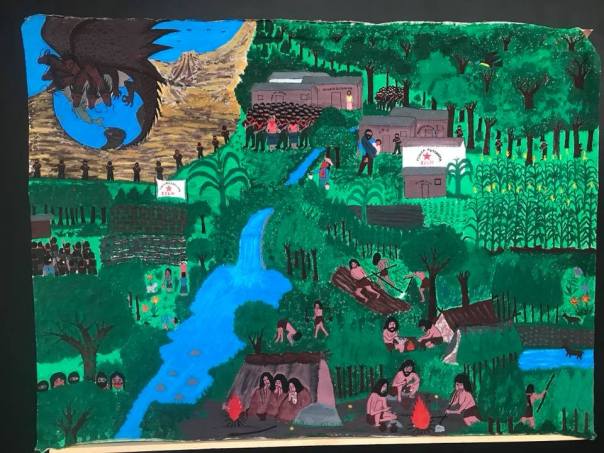
Art from the Zapatista communities.
So what’s next?
We’ll have to swim against the current, but that’s nothing new for us Zapatistas.
We want to reiterate—and we have consulted this with the Zapatista communities—that we oppose any and every overseer. We’re not just talking about those who insist they will administrate properly and repress correctly—as in the current proposal to combat corruption and improve security via impunity—but also those whose intentions for hegemony and imposed homogeneity lie just below their vanguardist dreams.
We will not exchange our history, our pain, our rage, and our struggle for a “progressive” conformity that is currently closing ranks behind its leader. We don’t forget, even when everybody else does, that we are Zapatistas.
With regard to our autonomy and the discussion that’s going on about whether it will be recognized or not, we make the following distinction: there is official autonomy, and there is real autonomy. Official autonomy is recognized by law, and this is its logic: “If you have an autonomous system and I legally recognize it, then your autonomy begins to depend on my law and not on your actual autonomous practices. When election season rolls around, you’ll have to support us, voting and promoting the vote for our party, because if another party takes office they’ll undo that law that protects you.” In that logic, we become political party peons, just as has happened to social movements all over the world. The actual function and defense of autonomy ceases to matter; the only thing that matters is what is recognized by the law. The struggle for freedom is in effect transformed into a struggle for the legal recognition of struggle.
-*-
We talked to our “bosses,” that is, the communities that determine our path, our route, and our destiny. We see what is coming through their perspective. We asked them: “if we take this position (what we believe is necessary), what will happen?”
And this is how we answered ourselves: “we’ll be alone and isolated in our position. People will say that we’re irrelevant—that we have placed ourselves outside the great revolution, the supposed fourth transformation, this new religion or whatever you want to call it—and we’ll have to swim against the current yet again.”
But being alone and isolated is nothing new for us. Then we asked ourselves: are we afraid to be alone in what we believe? Are we afraid to hold fast to our convictions and to struggle for them? Are we afraid that the people who previously supported us will turn against us? Are we afraid to refuse to give up, give in, or sell out? We asked ourselves each of these questions and we came to the conclusion that what we were asking was if we were afraid to be Zapatistas.
We aren’t afraid to be Zapatistas and that’s exactly what we are going to continue to be. That was what we asked ourselves, and that was our answer.
We think that, alongside all of you (the support networks), and with everything against us—because we know that throughout this process you didn’t have the support of the media or the masses, nor could you count on pay or popularity (we know you had to use your own money to carry out your work)—we organized ourselves around a collective of original peoples and a small, brown woman, the color of the earth, to denounce a predatory system and defend our conviction and our struggle. We’re looking for other people who aren’t afraid. That’s why we want to ask you (the support networks), are you afraid? You decide. If you’re afraid, we’ll look somewhere else.
-*-
We think that we should continue to walk closely with the original peoples.
Maybe some of you as support networks still think that what you’re doing is supporting the original peoples. As time goes by you’re going to see that it’s just the opposite: they will support you through their experience and their forms of organization. That is, you will learn, because if anyone is an expert in surviving a storm it’s the original peoples. They’ve had everything thrown at them and here they still are—here we still are.
But we also think, and compañer@s we want to make this very clear: that won’t be enough. We will have to incorporate into our horizon of struggle all of our own realities and the pain and rage they hold. We will have to move toward a new phase of this process: the construction of a Council that includes the struggles of all of the oppressed, marginalized, disappeared, and murdered, the struggles of political prisoners, of women who have been attacked and harassed, of children who have been prostituted, of all the calendars and geographies that delineate a map that is impossible within the laws of probability and illegible to polls and votes: the contemporary map of rebellion and resistance across the planet.
If we—all of us together—are going to challenge the laws of probability that say there is little to no chance that we will succeed, if we are going to challenge the polls and the millions of votes and the world-in-numbers that Power pulls out to try to demoralize us and make us give up, then we have to make the Council [Indigenous Governing Council, CIG] bigger. At this point this is just a thought that we want to share with you—that we think it is important to build a Council that neither absorbs nor annuls differences, but rather gives each of us the chance to be with others [otros, otras, otroas] who share the same struggle. This is why we think the Council should not be limited by a geography imposed by borders and flags, but should aim to become international.
What we are proposing is that the Indigenous Governing Council cease to be only indigenous and only national in scope.
To that end, as Zapatistas we put forward the following proposals, in addition to the ones already suggested during this gathering, to be consulted with all of your home collectives and organizations:
- To reaffirm our support for the National Indigenous Congress and the Indigenous Governing Council.
- To create and maintain open and transparent forms of communication among all of us who have come together on this path of the Indigenous Governing Council and its spokeswoman.
- To begin or continue our analysis and evaluation of the reality in which we live, and to share with each other these analyses and evaluations as well as our subsequent proposals for coordinated action.
- Without ceasing our support for the original peoples, we propose to double down on the work of the CIG Support Networks in order to open our collective heart to all of the rebellions and resistances that emerge and persevere wherever we might be, in the countryside or the city, without regard for borders.
- To begin or continue the struggle to grow both the demands and dimensions of the Indigenous Governing Council with the goal of extending it beyond original peoples to include workers of the countryside and city and all of those who have been discarded or marginalized but who have their own history and struggle, that is, their own identity.
- To begin or continue the analysis and discussion toward the creation of a Coordination or Federation of Networks which avoids any kind of centralized or vertical command and which spares no effort in building solidarity, support, and sisterhood/brotherhood among its participants.
- Finally, to hold in December of this year an international gathering of networks—we propose that for now we call ourselves the Network of Resistance and Rebellion (and then the name of each collective), but it could be whatever we decide to name ourselves. At that point we will have had the chance to hear, analyze, and evaluate what the National Indigenous Congress and the Indigenous Governing Council decide and propose during their meeting in October, and we will also have the results of the consultation process to be undertaken as a result this meeting we are in right now. We would like to offer one of the Zapatista Caracoles as a location for that upcoming meeting, if you are all in agreement.
Our proposal, then, is not only for the original peoples, but for all those [todoas, todas, todos] who resist and rebel in each and every corner of the world, and who challenge every rule, law, mold, dictate, number, and percentage imposed on us.
-*-
First anecdote: During the first days of 1994, the intelligence services of the Mexican army estimated that the self-designated “ee-zee-el-en” consisted of “only” 300 transgressors of the law. Second anecdote: That same year, as Ernesto Zedillo Ponce de León and Esteban Moctezuma Barragán plotted the betrayal and ambush to be carried out against us in February of 1995, the Nexos group (dedicated at that time to singing the praises of Salinas de Gortari and Zedillo), exclaimed, out of growing frustration and in so many words by Héctor Aguilar Camín, “Why don’t we just obliterate them? There are only 300 of them!”
Third anecdote: Information from the registration table at the Gathering of Support Networks for the CIG and its spokeswoman, held at the Zapatista Caracol “Whirlwind of our Words” August 3-5, 2018: “attendees: 300”.
Fourth anecdote: Profits of the 300 most powerful corporations on the planet: we have no idea, but it could be 300, or any other number, followed by a shitload of zeros, and ending with “millions of dollars”.
Fifth anecdote: “encouraging” quantities and percentages:
The quantitative difference between 300 and 30,113,483 (the number of votes López Obrador the candidate received according to the INE): thirty million, one hundred and thirteen thousand, one hundred and eighty-three. 300 is 0.00099623% of those more than 30 million votes. 300 is 0.00052993% of the total votes cast (56,611,027) 300 is 0.00033583% of the total number of registered voters (89,332,032) . 300 is 0.00022626% of the total Mexican population (132,593,000, minus the 7 women who, on average, are murdered daily. Over the past decade, a girl, young woman, adult woman, or elderly woman has been murdered, on average, every 4 hours) . 300 is 0.00003012% of the population of the American Continent (996,000,000 in 2017) The probability of destroying the capitalist system is 0.000003929141%, which is the percentage of the world population (7,635,255,247 at 7:54pm on August 20, 2018), represented by the number 300 (that is, of course, if those supposed 300 people don’t give up, give in, or sell out).
Oh I know, not even the tortoise beating Achilles would be consolation.
What about a caracol?
La Bruja Escarlata?
The cat-dog?
All right, enough of that. What keeps us Zapatistas awake is not the challenge presented by this infinitesimal probability of triumph, but the question of what the world that follows, the one that begins to emerge from the still smoking ashes of this system, will be like.
What will be its ways?
Will its colors speak?
What will its theme song be? (Huh? “The Girl with the Red Bow?” No way).
What will be the lineup of Defensa Zapatista’s (finally) full team? Can Esperanza Zapatista’s teddy bear join the lineup and team up with Pedrito? Will they let Pablito wear his cowboy hat and Amado Zapatista, his crocheted helmet? Why doesn’t the damned referee blow his whistle on the Cat-dog who is so obviously offside? Above all, and most importantly, how will that new world dance? This is why, when we Zapatistas are asked, “What’s next?” Well…how can I explain it? We don’t answer on the spot; it takes us a bit. The truth is, you’ll see, that dancing a new world is less problematic than imagining it. Sixth anecdote: Oh, you thought the thing about “300” was because of the film by that title and the Battle of Thermopylae, and you were ready to get dressed up like Leonidas or Gorgo (to each their own) and start shouting “This is Sparta!” while decimating the “immortal” troops of the Persian King Xerxes? Man, haven’t I been saying? Those Zapatistas, always watching another movie; or, worse yet, watching and analyzing reality! What can you do…
-*-
That’s all…for now. From the mountains of the Mexican Southeast,
Subcomandante Insurgente Moisés. Subcomandante Insurgente Galeano. Mexico
August 2018
Permit for hydroelectric project in the Lacandon Jungle denied
SEMARNAT DENIES PERMIT for HYDROELECTRIC PROJECT in the LACANDÓN JUNGLE

The Las Nubes Cascades are a tourist attraction close to where they wanted to build the dam.
By: Isaín Mandujano
TUXTLA GUTIÉRREZ, Chiapas (apro)
The Secretariat (Ministry) of Environment and Natural Resources (Semarnat) denied the Generación Enersi SA de CV company authorization to construct a hydroelectric dam in a region of the Lacandón Jungle.
After several weeks of discussion, last Monday, August 20 the federal agency decided to reject the Environmental Impact Report (EIR) on the hydroelectric project on the Santo Domingo and Lacantún Rivers, between the communities of Las Nubes and Loma Bonita, in the border municipality of Maravilla Tenejapa.
In a press conference, Ricardo Hernández Sánchez, state Secretary of Environment and Natural History, detailed that last June 20 the Generación Enersi SA de CV Company sent Semarnat the project’s regional EIR for its corresponding evaluation and decision.
He said the project consisted of the construction and operation of a hydroelectric power plant, with a total capacity of 110 MW, for which it would use the flow of the Santo Domingo and Lacantún Rivers, principally in the municipalities of Las Margaritas and Maravilla Tenejapa, in the Lacandón Jungle Region.
After several weeks of analysis, last Monday Semarnat’s General Directorate of Environmental Impact and Risk (DGIRA) decided to deny the project’s authorization: “since it contradicts what is stipulated in different legal regulations, among which are the National Waters Reserve Decrees, signed by President Enrique Peña Nieto on June 6, 2018, the Program of Ecological Ordering of the State of Chiapas and the Management Program of the Lagunas de Montebello National Park.”
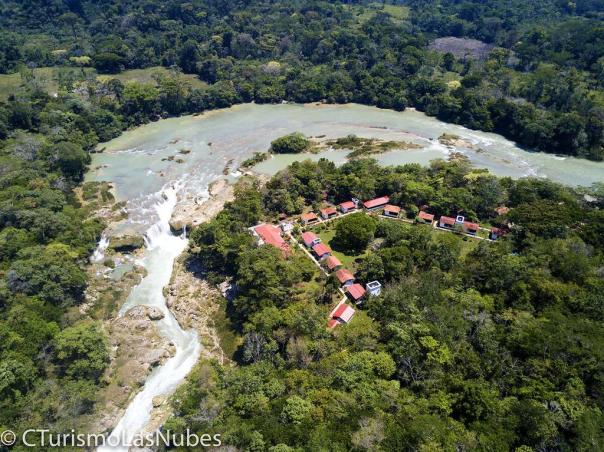
The red roofs are the ECOLODGE LAS NUBES
According to the state official, the project was also notoriously unviable from a technical and environmental point of view, as corroborated by the negative opinions -emitted during the environmental impact assessment procedure- of the National Water Commission (Conagua), the Mexican Institute of Water Technology (IMTA), National Commission of Natural Protected Areas (Conanp), la National Commission for the Knowledge and Use of Biodiversity (Conabio), the Chiapas Ministry of Environment and Natural History (Semahn), the State Water Institute (Inesa) and the Maravilla Tenejapa municipal council.
With this resolution, he said, the federal government reiterates its commitment to the conservation of the Lacandón Jungle, the protection of the ecological basin for the preservation of biodiversity and the coordination with the different levels of government so that legality and the state of law prevail.
The region’s indigenous communities had started an information day among the inhabitants to protest against that hydroelectric dam that, they emphasized, was going to disrupt life in the zone.
————————————————————-
Originally Published in Spanish by Proceso.com
Thursday, August 23, 2018
Re-Published with English interpretation by the Chiapas Support Committee
 Chiapas Support Committee