Chiapas Support Committee
Home of the Compañero Manuel blog on zapatistas & mexico
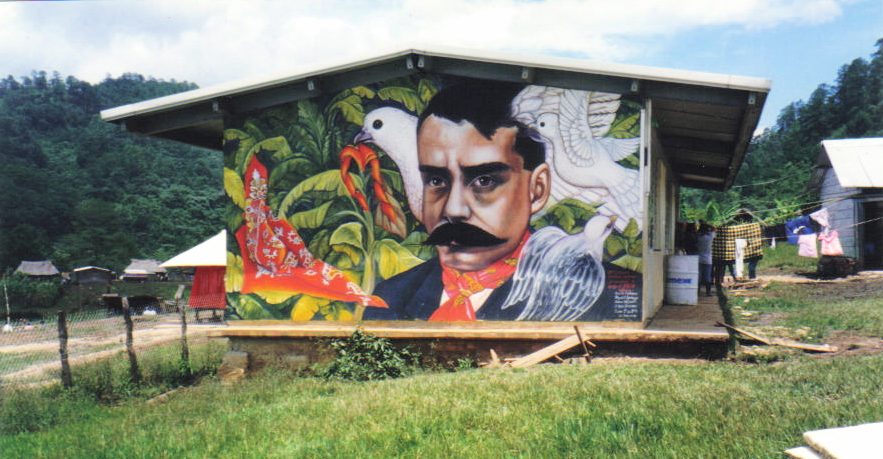
Subcomandate Marcos, EZLN: We Don’t Know You?
WE DON’T KNOW YOU? ***
Zapatista National Liberation Army
MEXICO
December 29, 2012.
To Whom It May Concern Up There Above:
They think that they are in the winning party… so that, besides being traitors, they are idiots. Tyrion Lannister in A Song of Ice and Fire. Volume II: “Clash of Kings.” George R.R. Martin.
” —A reader lives a thousand lives before dying —John said—; one who never reads lives only one,” Jojen Reed in A Song of Ice and Fire. Volume V: “Dance of Dragons.” George R.R. Martin. (Jojen Reed will appear in the third season of the HBO series “Game of Thrones.” Thomas Brodie-Sangster will interpret the character. Note contributed by Marquitos Spoil).
—If anyone draws a bull’s eye on their chest —Tyrion said after sitting down and drinking a sip of wine— he has to be conscious of the fact that sooner or later they are going to launch arrows at him.
—We all need to make fun of ourselves from time to time, Lord Mormont —Tyrion replied shrugging his shoulders—. Otherwise, we start to take ourselves too seriously. Tyrion Lannister with the commanders of the Night’s Watch. In “A Song of Ice and Fire,” Volume I: “Game of Thrones.”
“An end to the handsome men / it’s better being ugly but tasty / than being handsome and driveling” Botellita de Jerez.
Ladies and Gentlemen?
When we saw the note we thought that it was a December 28 joke, but we saw that it is dated the 24th of the same month.
So, we don’t know you? Hmm… hmm… let’s see:
Enrique Peña Nieto. Wasn’t he born in Atlacomulco, State of Mexico? Is he not related to Alfredo Del Mazo and Arturo “long hands” Montiel?
Is he not the one who decided, colluded with the PRD municipal government of Texcoco, the dislodging of the flower vendors and the apprehension of the leader of the Peoples Front in Defense of Land, Ignacio del Valle, in May 2006?
Is he not the one who launched his bulldog and criminal, Wilfrido Robledo Madrid, to attack the town of San Salvador Atenco and ordered his police to sexually assault women? Is he not the intellectual murderer of Javier Cortés and Alexis Benhumea? Was it not the Supreme Court of Justice of the Nation that determined that the 3 levels of government (note: federal government: PAN; state government: PRI; municipal government: PRD) did indeed incur grave violations of the population’s individual rights?
Is he not the one who tragically ridiculed the case of the little girl Paulette, better known as “the case of the mattress murderer?”
Is he not the one who bragged about the police violence in San Salvador Atenco with an arrogant attitude, forgetting that he was in front of critical youth and not a television set, from his command post located in the Ibero’s bathroom, ordered slandering dissenters and thus detonated the student/youth movement later known as #yosoy132?
Is he not the one who, as his first act of government, now collusion with the PRD government of Mexico City (DF), ordered the repression against the December 1, 2012 demonstrations, which resulted in the arrest, torture and incarceration of innocent people?
Is he not the one who does not read well, even with the teleprompter that still accompanies him, even with the July 1, 2012 media coup?
Is he not the one that now wants to hide behind the skirts of alleged kin of the repeatedly deceased, as if from he’s dealing with crummy telenovela (soap opera)?
Hey, and now that we’re talking about the telenovelas, what will the fashion be for the next six years? I mean, with Echeverría it was the guayabera; with López Portillo, aguas frescas; with De la Madrid, the grey rat; with Salinas de Gortari, Prozac; with Zedillo, the bad jokes; with Fox, the wisecracks; with Calderón, the blood… and with Peña Nieto? ”True love?” Wooo… for sure!
Okay, sorry, we continue with our ignorance:
Emilio Chuayffet Chemor. Was he not Enrique Peña Nieto’s boss and “teacher?” Was he not Secretary of the Interior (Gobernación) with Ernesto Zedillo? Is he not the drunkard that, in 1996, told the Cocopa that the federal government accepted its legal initiative and later withdrew it while hung over? Was he not one of those intellectual authors responsible for the Acteal Massacre in December 1997? Was he not the one that wanted to impose the “flirty pompadours” fashion among PRI members and the only one that seconded him was his then pupil Enrique Peña Nieto?
Pedro Joaquin Coldwell. Was he not the government’s peace commissioner in Chiapas when the Acteal Massacre occurred who remained silent and continued to get paid by doing nothing?
Rosario Robles Berlanga. Was she not the head of the Mexico City government for the PRD? Did she not boast about the repression that her police undertook several times against young students during the UNAM strike in 1999-2000? Is she not the one, while presiding over the PRD, who sold out her party in every way? Is she not the one now in charge of the fight against the corporatism of the Bejaranos in Mexico City and throughout the republic?
Alfonso Navarrete Prida – Was he not the first who covered up the organized crime score-settling that resulted in the murder of Enrique Salinas de Gortari (psss, you guys don’t really get along, do you?) and then exonerated Arturo “long hands” Montiel?
Miguel Angel Osorio Chong. Was he not accused of diverting government funds to the PRI? Didn’t the PGR [Attorney General’s Office] open the criminal investigation PGR/SIEDO/UEIDORPIFAM/185/2010 to investigate his ties to the “Los Zetas” criminal organization? (Ah, a change of strategy in the fight against drug trafficking?)
(Oops, I see now that one of the brothers of the undersecretary of Migration, Population, and Religious Affairs in the Interior Ministry, which Mr. Osorio Chong heads, has not one but several criminal investigations (pending). Several of them have the stamp “closed due to death of the accused,” then another stamp “was never dead,” and then another “well it turns out he is really dead” and so … um … 18 times. The last stamp “there goes the condemned” is dated on December 21, 2012, and a handwritten note says: “pending activation, await instructions from CSG.” … hmm … what would those initials stand for? Did they change the abbreviation for the Attorney General’s Office from PGR? Anyway, let the guy from Tampico know, ok?).
Ok sure, you all will tell me that these people are not in charge, but in reality it is Carlos Salinas de Gortari who dictates what Enrique Peña Nieto does (ah, what would become of this country if the teleprompter were not invented?).
Ok, ok, ok. Carlos Salinas de Gortari. Is he not the one who plundered like no other the national wealth during his administration? (Yes, I know they are all thieves, but let’s say there are amateurs and professionals). Is he not the one who devastated the Mexican countryside with the reforms to the Constitution’s Article 27? Is he not the one whose New Years toast we ruined in the dawn of 1994? Is he not the one who saw his dictatorial dreams shattered by wooden rifles? Is he not the one who ordered the assassination of Luis Donaldo Colosio Murrieta? Is he not the one who looked ridiculous with his hunger strike in 1995? Or the one who, on December 21, frantically asked for the red phone: “What did they say, what did they say?” And who felt a chill in his back when they told him: “nothing, they are in absolute silence?”
Are you all not the ones who have always chosen violence over dialogue?
The ones who always use force when there is no reason?
The ones who pioneered corruption and contempt in all the political parties?
Are you all not those who have refused to comply with the San Andrés Accords that would mean the constitutional recognition of indigenous rights and culture, and an end to evictions disguised as mining, water, dams, resorts, roads, and subdivisions?
Are you not the ones who, along with your friends in the political class, resemble those security advisers in large buildings, trying to convince the tenants of the middle floors, and high penthouse, that there is no danger while you dynamite the lower floors, the ground floor and the basement? By the way, does anyone believe them?
You, who have killed me so many times, declared me dead, extinct, defunct, deceased, disappeared, beaten, defeated, surrendered, bought, annihilated, do you think anyone will believe you when I truly, like in love, am delivered body and soul to death and am just a little bit more earth on this globe?
If you have answered “no” to any of the questions, then you are right: we do not know you.***
From the mountains of the Mexican Southeast,
Subcomandante Marcos.
Mexico, December 2012.
P.S. To reiterate – I know you already know, but it’s convenient that you remember: we’re not afraid. Oh, and we’re not the only ones.
P.S. WHO GENEROUSLY OFFERS THE BAD GOVERNMENTS A 10 STEP MANUAL (note: easy read, do not be frightened), ON HOW TO IDENTIFY A ZAPATISTA AND TO KNOW IF THEY CAN SAY OR NOT THAT “THEY HAVE CONTACTS WITH THE EZLN:”
1. – If he asks for money or projects from any of the 3 levels of government, HE IS NOT ZAPATISTA.
2. – If he establishes a direct line of communication without announcing it publicly beforehand, HE IS NOT ZAPATISTA.
3. – If he asks to speak or speak directly with any of the three levels of government without announcing it publicly beforehand, HE IS NOT ZAPATISTA.
4. – If he wants an elevated position, appointment, honors, awards, etc., HE IS NOT ZAPATISTA.
5. – If he is afraid, HE IS NOT ZAPATISTA.
6. – If he sells out, surrenders or gives up, HE IS NOT ZAPATISTA.
7. – If he takes himself very seriously, HE IS NOT ZAPATISTA.
8. – If he does not cause chills when being seen, HE IS NOT ZAPATISTA
9. – If he does not give the impression that he says more with silence then HE IS NOT ZAPATISTA.
10. – If he is a ghost of those that vanish, HE IS NOT ZAPATISTA.
P.S. APOLOGIES. – Oh, I know you expected something more serious and formal. But isn’t the style and tone of this “proof of life” letter better than a photo or video? And it’s even signed.
P.P.S. I LEAVE YOU WITH A HAIKU WRITTEN BY MARIO BENEDETTI TO SUPMARCOS: “I do not want to see you / for the rest of the year / or till Tuesday.”
————————————————–
Originally Published in Spanish by Enlace Zapatista
English Translation: Chiapas Support Committee
December 29, 2012
En español: http://enlacezapatista.ezln.org.mx/2012/12/30/no-los-conocemos/
————————–
*** Translator’s Note: The title of this letter is a response to the federal government’s statement: “You don’t know us yet; don’t anticipate.” That statement was made by Interior Minister Osorio Chong in response to the December 21, 2012 communiqué directed at the new (PRI) federal government.
Letter to Luis Hector Alvarez Alvarez from S.I. Marcos
A Letter to Luis Hector Alvarez Alvarez*
ZAPATISTA NATIONAL LIBERATION ARMY
MEXICO
November – December 2012
“Almost all men prefer to deny the truth before confronting it,” Tyrion Lannister to Jon Snow.
“If he has nothing to fear, a coward doesn’t distinguish himself in anything brave. And we all fulfill our duty when it costs us nothing. At those moments, following the path of honor seems very simple to us. But in the life of all man, sooner or later, a day arrives in which it’s not so simple, on which one must choose,” Maestre Aemon Targaryen to Jon Snow.
For: Luis Hector Alvarez Alvarez, someplace in Mexico (I hope).
From: Subcomandante Insurgente Marcos. Chiapas, México.
Señor Álvarez…
Errr… Permit me a moment, Señor Alvarez, this part is to explain a little about where the epigraphs come from: The quotes are from the book: A Song of Ice and Fire. Volume I: Game of Thrones. 1996. George R.R. Martin. The television series Games of Thrones, which takes its name from the first volume of the saga, no está nada mal (Peter Hayden Dinklage, who gives image and voice to Tyrion Lannister, stands out, paradoxically, above the other actors and actresses; Jon Snow is interpreted by Kit Harington, and Maestre Aemon Targaryen by Peter Vaughan) and the first 2 seasons can be had a moderate price with your favorite film seller (say yes to piracy).
The DVD that I saw was an involuntary gift of the informal commerce on Eje Central, México D.F., (in other words, someone bought it there and sent it to me)… oops, the DF’s government of the “left” is going to apply Article 362 to me, because, accepting it, it applies to everything (they would be the envy of Gustavo Díaz Ordaz… oh, oh, that Article was proposed in 2002 by the then head of the DF’s government, Andrés Manuel López Obrador, and approved by the ALDF with a PRD majority… hmm… don’t put in this part… they are not going to say that I am at the service of the right… they already see that it has always worried me in the extreme what is said about me.)
The image has a lot of pixels, but you can see and hear it well. A good price, they tell me; anyhow, cheaper than paying for HBO, and without the anxiety of having to wait for the following week to know what happened with little Bran (Isaac Hempstead Wright), or with the dazzling Daenerys Targaryen (Emilia Clarke).
Nevertheless, I would also recommend reading the books -yes, I already know that the six-year fashion is not to read books and that hair gel is cheaper-, but an advantage is that one can take a course in practical philosophy (ah, las paradoxes) with the dialogues of Tyrion Lannister (according to what they tell me, is a literary projection of Mr. George R. R. Martin). Another advantage is that you can “spoilear” [1] (or how do you say it) without risk on his favorite blogs. Although the enmity of many will be earned, your points (although negative) for postear [2] will go up appreciably. That so, do not abuse, because if it occurs to them to say that in “Dance of Dragons”… ok… ok…ok… l shut up… say no to spoil.
You’re welcome.
Sincerely: Marquitos Spoil.
Now then:
Señor Alvarez Alvarez:
This is not only to reaffirm what the multitudinous silence of December 21 ought to have made clear to you, to the political class and to the National Action government, in general, and to Felipe Calderón Hinojosa in particular: You failed.
Oh, there is no drama. Other governments had already attempted it before… and they will continue attempting it.
But, Señor Alvarez, you should not look for your failure in us, not even in the little professionalism of your not intelligent intelligence service (although now you know that they were and are shameless). To whom does it occur that a Zapatista, any of us, would go to a government of criminals to ask for help if he were sick? Who can rationally think that the Zapatistas rose up for money?
Only the mentality of a passé conquistador (whose best example is Diego Fernández de Cevallos) that you implant in your political party, National Action, could have permitted swallowing that mill wheel with enthusiasm.
And intelligence was not needed, but just minimally reading the newspapers or listening to the news: the rascals that introduced themselves to you as “close friends of Sup Marcos,” are the same ones that simulated a surrender and “delivery of weapons” to the ominous Croquetas Albores in 1998, simulating being Zapatistas, and that some are known swindlers that no longer deceive anyone… well, you yes. How much did they get? The difference is that Croquetas knew that it was a pantomime and paid for it (and so that the media would present the Jataté bathing spa, on the outskirts of the municipal seat of Ocosingo, as if it were “in the Lacandón Jungle”), and they not only deceived you, but you even put it in your book.
And not content with that, you invite Felipe Calderón Hinojosa to the presentation of that book, drunk with blood and alcohol, who not only babbled incoherencies, he also distributed the stenographic version to the media. For sure the media charged double: not for publishing it, but for not publishing it, since the state of inebriation of the one who proffered those words was made patent. I believe that it’s clear now that Felipe Calderón Hinojosa lied up to the last minute and that it was a brazen invention that he points to in his last government report. The only approach that his government had with “representatives and commanders of the EZLN” was that of his armies, police, judges and paramilitaries.
But, good, now you know, Señor Alvarez, what it is to be scorned for what the implacable calendar wears.
As indigenous, the elderly are scorned. And as a symbol of that scorn, goes the money for alms, or, in their case, the offense of deceit, the insult of being ignored and the behind-the-back jokes.
But there is a difference, a small difference, but one of those that make the wheel of history go round: while you paid (with money that wasn’t yours, by the way) for being ridiculed (and even made a book); we, indigenous and Zapatista, we punish their scorn with our silence and prolonged moving.
Because we know very well that they also sold you on the idea that you will be remembered for your struggle for democracy (in reality, your struggle for power, but there above they are accustomed to inverting both terms), but no. Although small, you could also be remembered for having been an accomplice (or an official, it’s the same) of the most criminal government that, since Porfirio Díaz, this country has suffered.
And around here, in indigenous Zapatista lands, you could be remembered as part of a government that mostly tried to make us give up (or buying us off, it’s the same) and, as has been evident by the thunderous silence of San Cristóbal de Las Casas, Altamirano, Las Margaritas, Palenque and Ocosingo, you failed once more.
Because the political class and those who live from its stupidity, will have died off without anyone taking them into account (if perhaps, just to give thanks that they no longer obstruct), and there will be nothing, but one more number on the long list of those duped by the dream of being “historic.”
And you see that we do not question your morality. It is known that all criminal gangs, like the one that you served all these years, look for one who would present a good and kindly face, so that, with that face as an alibi, they hide their predatory identity.
I believe that you already knew that Señor Alvarez. In the above of every political spectrum, all are equal. Although some ingenious ones will even come to discover that they suffer injustice in their own flesh, while they ignore it when that injustice was being distributed daily in other geographies near or far.
Your compañeros in the party, who profited from the blood of innocents, and now lament that for the market there was one who paid-cost more, all of them, are nothing but a row of criminals that made and make grotesque contortions to the foolish rhythm that the media frame for them.
Are you filled with pride at having been part of a team with a thug like Javier Lozano Alarcón, who had to be hidden in the Senate so as not to be called into account by justice? Do you feel good for having been the compañero of Juan Francisco Molinar Horcasitas, a criminal with his hands spotted with the blood of infants?
And, although at times the paradoxes are comical, others are tragic.
Your political party, National Action, was one of those who headed, since the dawn of 1994, the hysterical cries against our asking that we not be annihilated because we were threatening to plunge the country into a bloodbath. And it turned out that the acts of your government were those that extended the terror, the anguish, the destruction and death to all the corners of our already battered country.
And what do you say about when the members of your party’s bench (together with the PRI and PRD benches), voted against the San Andrés Accords for which you worked, warning that those accords meant the fragmentation of the country. And it has been your party, Señor Alvarez, who delivers a nation broken to bits.
But console yourself, Señor Alvarez, your zeal for passing into history will be compensated. You will have a place in line, yes, among those swindled by the jokers.
But also in the pages of the history and geography books, in the Zapatista schools, one paragraph will read:
“The bad government of Felipe Calderón Hinojosa is known as the one that brought absurd death to all the corners of Mexico, offered injustice to victims and victimizers, and left, as a bloody self-homage to the crime made co-government, his monument. If Porfirio Díaz left the Angel of Independence, Felipe Calderón left the Trail of Light (Estela de Luz). Without wanting it, both thus announced the end of a world, although they delayed and they will delay in understanding it.”
I suggest that you add an epilogue to your book. Something like: “I ought to recognize that one can be an extremely bad student of the indigenous Zapatista communities. Nevertheless I say, after listening to their thunderous silence, that I learned the principle: that it’s not important that we use bombs, bullets, clubs, coups, lies, projects, money, that we buy media so that they shout falsehoods and quiet the truth, the result is always the same: the Zapatistas don’t give up, don’t sell out, don’t surrender and… surprise! They don’t disappear.”
Because history, Señor Alvarez, will continue repeating itself once in a while: rebels will reappear in every corner and, perhaps, with them, their Marios Benedetti, their Marios Payeras, their Omars Cabezas and their Carlos Montemayor will appear. And perhaps the Eduardos Galeano of those rains will manage their accounts or not.
And there will also be windows, with or without frames.
And you, Señor Alvarez, will continue looking out, looking at us without seeing us, and hardly realizing that, in that looking out at the world to come, they are irremediably out.
I believe that you did not put it in your book, but you remember that once I told you the Zapatistas are worth a lot, but we don’t have a price. And “one must not confuse value and price” (no, that’s not what Karl Marx said, but rather Juan Manuel Serrat).
Nevertheless, Señor Alvarez, in memory of the moments of firm dignity that you had, and of which I was a witness when you worked on the Commission of Agreement and Pacification, you can still change that:
Leave your party and what it represents, abandon that political class that has done nothing but become an insatiable parasite. You are from Chihuahua. Go to the Sierra Tarahumara and ask that they give you entry to one of the Rarámuri communities. Perhaps they won’t let you stay. The very affectionate Ronco is no longer there to ask. But perhaps they let you be there a few days. There, with them, you will learn the fundamentals of the indigenous heart, about the struggle and hope of the original pueblos of Mexico. After all, isn’t that what your book is called?
Go, Señor Alvarez Alvarez, to that or any indigenous town that will accept you after renouncing what you are now. You will be respected there (not badly tolerated) for your age, and, above all, you will learn that, for the Indian peoples of Mexico, “dignity” is a verb that is conjugated in the present since more than 500 years ago… and what they lack.
Go, perhaps this is the day in which one must choose. And in your case it is not easy, because it’s about choosing between one world and another. May age or bad advice not stop you! Look at us, we are more than 500 years old and we are still learning.
If you don’t do it, at least you will have known for yourself the truth that is enclosed in the 17 syllables of that Haiku of Mario Benedetti:
“Who would say it, the truly weak never surrender”
Vale. Health and did you hear it? “There are few things / as deafening / as silence” (yes, also Haiku and also from Mario Benedetti).
From the mountains of the Mexican Southeast,
Subcomandante Insurgente Marcos.
Mexico, December 2012.
———————————————————–
* Luis Hector Alvarez Alvarez (aka Luis H. Alvarez) is a Mexican politician belonging to the PAN political party. He was the federal government’s “Peace Commissioner” to Chiapas during the Vicente Fox presidency. During that time he distributed assistance funds to non-Zapatista and anti-Zapatista communities to either entice people away from the Zapatista organization or keep them from joining it. He published a book critical of the Zapatistas in 2012.
1. “Spoilear” is Spanglish for the verb to spoil.
2. “Postear” is Spanglish for the verb to post.
———————————————————
Originally Published in Spanish by Enlace Zapatista
English Translation: Chiapas Support Committee
En español: http://enlacezapatista.ezln.org.mx/2012/12/30/carta-a-luis-hector-alvarez-alvarez/
Zapatista News Summary – December 2012
DECEMBER 2012 ZAPATISTA NEWS SUMMARY
In Chiapas
1. More Than 40,000 Zapatistas March in Chiapas – On December 21, at the end of the Mayan Long Count Calendar (13 Baktún) and the beginning of a new calendar, more than 40,000 Zapatista support bases marched silently into 5 Chiapas cities (Ocosingo, Palenque, San Cristóbal, Las Margaritas and Altamirano). They set up platforms in the central plazas of each city and then filed onto the platform, raised their fists, came down off the platform and returned to the Caracoles from which they came. Zapatista commanders (the CCRI-CG) sent a communiqué signed by Subcomandante Insurgente Marcos to the media. It read in part: “DID YOU HEAR? It’s the sound of your world crumbling and ours re-emerging…” This sent a brief, but pointed message to the new government: We’re still here. We have resisted your counterinsurgency and we’re stronger for having learned how to resist and construct our autonomy. Our world is re-emerging. This show of force sent a few shock waves through those above and waves of hope through those below. Check out the video:
http://www.youtube.com/watch?v=5K_z_ceSlwE&feature=youtu.be
2. EZLN Issues 3 More Communiqués – On December 30, the EZLN released 1 new communique and 2 letters. The communiqué is about the EZLN’s next steps. One letter is addressed to members of the new government (“those above”) and the other letter to Luis H. Alvarez, the former “Indigenous Commissioner” that went around Chiapas giving money to non-Zapatistas and anti-Zapatistas in order to buy their consciences. We’ll have more on these recent EZLN communications shortly.
3. Las Abejas (The Bees) Commemorate the 15th Anniversary of the Acteal Massacre – Between December 20 and 22, Las Abejas held ceremonies to commemorate the 15th anniversary of the Acteal Massacre. Among the many speeches they gave, the Bees criticized the new government for the violent repression in Mexico City on December 1 and for appointing Emilio Chuayffet to the cabinet position of Secretary of Education. He was the Interior Minister at the time of the massacre and Las Abejas consider him to be one of the unpunished intellectual authors of the massacre. Las Abejas also pointed out that they were stronger for their struggle and resistance. The Movement for Peace with Justice and Dignity’s Indigenous Commission attended the ceremonies in Acteal and, while in Chiapas, visited Zapatista and Other Campaign prisoners in the San Cristóbal prison.
4. New Chiapas Governor Takes Office – On December 8, 2012, Manuel Velasco Coello took the oath of office as Governor of Chiapas. He is a member of the Partido Verde Ecologista de México (Green Ecologist Party of Mexico, PVEM). Upon taking office, Velasco Coello greeted the EZLN and the Good Government Juntas, saying he recognized their contributions and that he wanted good relations with them and also wanted to cool down the conflict. We’ll see! In a good will gesture, Velasco Coello released the 2 Zapatista Lopez Monzon brothers and their 2 non-Zapatista brothers from prison in Motozintla and withdrew the arrest warrant issued for Alfonso Cruz Espinoza, a Zapatista support base and the property owner of private land adjacent to the Toniná archaeological site. When a collective from the Caracol of Morelia built a roadside artesianía stand with a sign saying it was a Zapatista stand, the previous state government issued an arrest warrant for Cruz Espinoza. Apparently, the old Sabinas government anticipated tourism around the end of the Mayan Long Count and wanted no evidence of the Zapatistas in front of tourists.
In Other Parts of Mexico
1. Injuries and Detentions in December 1 Protests – As we reported last month, Enrique Peña Nieto took the oath of office as president of Mexico on December 1, amid protests that turned violent and in which many people were injured, apparently by rubber bullets fired by police or tear gas cannisters. Several people suffered serious injuries. A young man affiliated with #YoSoy 132 lost an eye. Another man, an adherent to the EZLN’s Other Campaign, suffered severe brain damage and remains in a medically induced coma. Some of the demonstrators were arbitrarily detained, many of them young and from the #YoSoy 132 Movement, and 70 were sent to prison. Most were released shortly thereafter, however 14 remained in prison facing charges for which bail was denied. Video footage of arbitrary detentions and inappropriate charges is alleged to exist. There were more demonstrations for the release of the 14. The latest news on this front is that the Mexico City Congress passed legislation that changed the severity of the crime of “attacks on the public peace” (disturbing the peace?) so that the 14 could make bail. And, on December 27, as soon as the new legislation was officially published, all 14 were released on bond. They still face court cases for those charges and there are now more protest actions asking that the charges be dropped. Notwithstanding Mexico City’s legislation, the violent repression and detentions have only solidified opposition to the new PRI government of Enrique Peña Nieto.
2. Death Toll Due to Drug War Reaches 116,100! – An Italian civic organization, Libera, reports that it calculated 136,000 malicious deaths between 2006 and December 1, 2012. Of those, 116,000 are attributed to the “Drug War.” Libera is a grouping of more than one thousand human rights organizations and activists from Europe and America. Its figures were compiled from Inegi (Mexico’s government statistics agency) and from human rights defenders. Prior to this report, the Chiapas Support Committee had confirmed a figure close to that from sources in Chiapas.
___________________________________
Compiled monthly by the Chiapas Support Committee.The primary sources for our information are: La Jornada, Enlace Zapatista and the Fray Bartolome de las Casas Human Rights Center (Frayba).
We encourage folks to distribute this information widely, but please include our name and contact information in the distribution. Gracias/Thanks.
Click on the Donate button of www.chiapas-support.org to support indigenous autonomy.
_______________________________________________________
Chiapas Support Committee/Comité de Apoyo a Chiapas
P.O. Box 3421, Oakland, CA 94609
Tel: (510) 654-9587
Email: cezmat@igc.org
http://www.facebook.com/pages/Chiapas-Support-Committee-Oakland/86234490686
https://compamanuel.wordpress.com
EZLN Announces Next Steps
The EZLN Announces Next Steps: Communiqué of December 30, 2012
Communiqué from the Indigenous Revolutionary Clandestine Committee – General Command of the Zapatista National Liberation Army
Mexico
December 30 2012.
To the People of Mexico:
To the People and Governments of the World:
Brothers and Sisters:
Compañeros and Compañeras:
In the early morning hours of December 21, 2012, tens of thousands of indigenous Zapatistas mobilized and took, peacefully and silently, five municipal seats in the southeast Mexican state of Chiapas.
In the cities of Palenque, Altamirano, Las Margaritas, Ocosingo, and San Cristóbal de las Casas, we looked at you and at ourselves in silence.
Ours is not a message of resignation.
It is not one of war, death, or destruction.
Our message is one of struggle and resistance.
After the media coup d’état that catapulted a poorly concealed and even more poorly costumed ignorance into the federal executive branch, we made ourselves present to let them know that if they had never left, neither had we.
Six years ago, a segment of the political and intellectual class went looking for someone to hold responsible for their defeat. At that time we were, in cities and in communities, struggling for justice for an Atenco that was not yet fashionable.
In that yesterday, they slandered us first and wanted to silence us later.
Dishonest and incapable of seeing that it was within themselves that there was and still is the seed of their own destruction, they tried to make us disappear with lies and complicit silence.
Six years later, two things are clear:
They don’t need us in order to fail.
We don’t need them in order to survive.
We, who never went away, despite what media across the spectrum have been determined to make you believe, re-emerge as the indigenous Zapatistas that we are and will be.
In these years, we have significantly strengthened and improved our living conditions. Our standard of living is higher than those of the indigenous communities that support the governments in office, who receive handouts that are squandered on alcohol and useless items.
Our homes have improved without damaging nature by imposing on it roads alien to it.
In our communities, the earth that was used to fatten the cattle of ranchers and landlords is now used to produce the maize, beans, and the vegetables that brighten our tables.
Our work has the double satisfaction of providing us with what we need to live honorably and contributing to the collective growth of our communities.
Our sons and daughters go to a school that teaches them their own history, that of their country and that of the world, as well as the sciences and techniques necessary for them to grow without ceasing to be indigenous.
Indigenous Zapatista women are not sold as commodities.
The indigenous members of the PRI attend our hospitals, clinics, and laboratories because in those of the government, there is no medicine, nor medical devices, nor doctors, nor qualified personnel.
Our culture flourishes, not isolated, but enriched through contact with the cultures of other peoples of Mexico and of the world.
We govern and govern ourselves, always looking first for agreement before confrontation.
We have achieved all of this without the government, the political class, and the media that accompanies them, while simultaneously resisting their attacks of all kinds.
We have shown, once again, that we are who we are.
With our silence, we have made ourselves present.
Now with our word, we announce that:
First – We will reaffirm and consolidate our participation in the National Indigenous Congress, the space of encounter with the original peoples of our country.
Second – We will reinitiate contact with our compañeros and compañeras adherents of the Sixth Declaration of the Lacandón Jungle in Mexico and the world.
Third – We will try to construct the necessary bridges toward the social movements that have arisen and will arise, not to direct or supplant them, but to learn from them, from their history, from their paths and destinies.
For this we have consolidated the support of individuals and groups in different parts of Mexico, formed as support teams for the Sixth and International Commissions of the EZLN, to become avenues of communication between the Zapatista bases of support and the individuals, groups, and collectives that are adherents to the Sixth Declaration, in Mexico and in the World, who still maintain their conviction and commitment to the construction of a non-institutional left alternative.
Fourth – We will continue to maintain our critical distance with respect to the entirety of the Mexican political class, which has thrived at the expense of the needs and desires of humble and simple people.
Fifth – With respect to the bad governments – federal, state, and municipal, executive, legislative, and judicial, and the media that accompanies them, we say the following:
The bad governments, which belong to the entirety of the political spectrum without a single exception, have done everything possible to destroy us, to buy us off, to make us surrender. PRI, PAN, PRD, PVEM, PT, CC and the future political party RN have attacked us militarily, politically, socially, and ideologically. [i]
The mainstream media tried to disappear us first with opportunist and servile lies followed by a complicit and deceptive silence. Those they served, those on whose money they nursed are no longer around and those who have succeeded them will not last any longer than their predecessors.
As was made evident on December 21, 2012, all of them failed. So, it’s up to the federal, executive, legislative and judicial governments to decide if they are going to continue the politics of counterinsurgency that have only resulted in a flimsy simulation clumsily built through the media, or if they are going to recognize and fulfill their commitments by elevating Indigenous Rights and Culture to the level of the Constitution as established in the “San Andrés Accords” signed by the Federal Government in 1996, which was at the time led by the very same political party that today occupies the executive office.
It will be up to the state government to decide if it will continue the dishonest and despicable strategy of its predecessor, that in addition to corruption and lies, used the money of the people of Chiapas to enrich itself and its accomplices and dedicated itself to the shameless buying off of the voices and pens of the communications media, sinking the people of Chiapas into poverty while using police and paramilitaries to try to brake the organizational advance of the Zapatista communities; or, if instead, with truth and justice, it will accept and respect our existence and come around to the idea that a new form of social life is blooming in Zapatista territory, Chiapas, Mexico. This is a flowering that attracts the attention of honest people all over the planet.
It will be up to the municipal governments if they decide to keep swallowing the tall tales with which anti-Zapatista or supposedly “Zapatista” organizations extort them in order to attack and harass our communities; or if instead they use that money to improve the living conditions of those they govern.
It will be up to the people of Mexico who organize in electoral struggles and resist, to decide if they will continue to see us as enemies or rivals upon which to take out their frustration over the frauds and aggressions that, in the end, affect all of us, and if in their struggle for power they continue to ally themselves with our persecutors; or if they finally recognize in us another form of doing politics.
Sixth – In the next few days, the EZLN, through its Sixth and International Commissions, will announce a series of initiatives, civil and peaceful, to continue walking together with other original peoples of Mexico and of the continent, and together with those in Mexico and the world who struggle and resist below and to the left.
Brothers and Sisters:
Compañeros and Compañeras:
Before we had the good fortune of the honest and noble attention of various communications media. We expressed our appreciation then. But this has been completely erased by their later attitude.
Those who wagered that we only existed in the communications media and that, with the siege of lies and silence they created we would disappear, were mistaken.
When there were no cameras, microphones, pens, ears, or gazes, we continued to exist.
When they slandered us, we continued to exist.
When they silenced us, we continued to exist.
And here we are, existing.
Our path, as has been demonstrated, does not depend on media impact, but rather on comprehending the world and all of its parts, on indigenous wisdom that guides our steps, on the unswerving decision that is the dignity of below and to the left.
From now on, our word will be selective in its destination and, except on limited occasions, will only be able to be understood by those who have walked with us and who continue to walk without surrendering to current or media trends.
Here, not without many mistakes and many difficulties, another form of doing politics is already a reality.
Few, very few, will have the privilege of knowing it and learning from it directly.
19 years ago we surprised them taking with fire and blood their cities. Now we have done it once again, without arms, without death, without destruction.
In this way we have distinguished ourselves from those who, during their governments, distributed and continue to distribute death among those they govern.
We are those, the same, of 500 years ago, of 44 years ago, of 30 years ago, of 20 years ago, of just a few days ago.
We are the Zapatistas, the very smallest, those that live, struggle, and die in the last corner of the country, those that do not give up, do not sell out, those that do not surrender.
Brothers and Sisters:
Compañeros and Compañeras:
We are the Zapatistas, receive our embrace.
DEMOCRACY!
LIBERTY!
JUSTICE!
From the mountains of the Mexican Southeast
For the Indigenous Revolutionary Clandestine Committee—General Command of the Zapatista Army for National Liberation
Subcomandante Insurgente Marcos.
Mexico. December 2012 – January 2013.
________________________________________
[i] PRI (the party of the 70 year dictatorship and home of former president Carlos Salinas de Gortari); PAN (the right-wing party of recent president Felipe Calderón which oversaw the total devastation and the deaths of tens of thousands of Mexicans due to its “war on drugs” during the last twelve years); PRD (the institutional “left” party which joined the PAN and the PRI in blocking constitutional reforms on Indigenous Rights and Culture and which until recently was the party of Andrés Manuel López Obrador); the PVEM (Partido Verde Ecologista de México), PT (Partido del Trabajo), CC (Convergencia Ciudadana) and RN (Regeneración Nacional, the political party that is now being built by Andrés Manuel López Obrador after his friendly exit from the PRD).
Translation by El Kilombo Intergalactic
Gustavo Esteva: The New Era
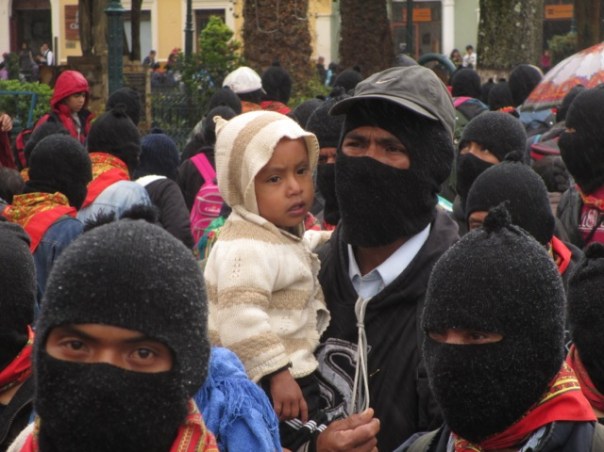
Baby Zapatista on Dec 21 in San Cristóbal
THE NEW ERA
By: Gustavo Esteva
And the band kept on playing.
The sinking of the Titanic was unavoidable. To ignore it was foolish. But the band kept on playing.
His performance on the first day is a blatant illustration of this peculiar kind of blindness. It shows the gap that has opened between the political classes and the people, and it also reveals their dangerous detachment from reality, the irresponsible and short-sighted way in which he is preoccupied with mafia-style interests in the short term, while ignoring the depth of the economic, social and political crisis in which we find ourselves.
His discourse about the country is currently showing the worst symptoms of a populist authoritarianism that has been installed against all odds. It is conceived as a triumph of optimism over irresponsible reality, with the evident intention of generalizing this blindness. The band will continue playing until the instruments and musicians sink with the ship.
It is particularly difficult not to hear the roar of the collapse, which is observed worldwide and has been precipitated very sharply in Mexico. Those who have climbed the ladders of political power, however, will persist in their self-interested deafness… while they can, for as long as they can.
But the rest of us cannot continue to be deaf. We need to respond.
“I hate to say I told you so, but I told you so,” Subcomandante Marcos said years ago. The Zapatistas have repeatedly warned us of what would happen if we did not respond. We did not respond. It happened. They described in various ways the mess we are in today. They anticipated, before anyone else, the series of crises that have been happening and the destruction that they would bring to the political classes, to the country itself, to the social fabric… They offered with strength and clarity options for change, without dogmatism or imposition. We did not take them.
The new call from the Zapatista National Liberation Army (EZLN) needs to be heard by all those who, from below, try to resist the dominant horror and to create another possibility. If only it could be heard by those who still harbor the fantasy that an electoral change might be enough to remedy it all, those who can only think and organize within the framework of the political parties and institutions and that still believe that anti-capitalism is a bad word.
It is useful to show again that the emperor has no clothes. They may see it and dare to say it out loud to those who believe it is possible to continue in denial.
While listening to the din of the collapse of the dying world is inevitable, no less because the noise is all-encompassing and is experienced daily through suffering in the flesh, it is not so with the sound of the world that re-emerges. You need different ears in order to hear that.
We are not looking at another version of what we know. It is not a new twist, a bend in a familiar path. It is something new and radical. Its deep roots in the past are not dedicated to reproducing the past, or even worse, making an impossible attempt to return to it. It is something different.
As was seen last Friday, the new world will be built with hope, joy and celebration, through the discipline that is learned through their own order, autonomy. Only then, through organic discipline, which is woven from below by their own will, it is possible to propose the elimination of coercive power and authority, the condition in which a hierarchical position is used to impose action.
In dark times like these it is a blessing to know we can rely on them. As Chomsky, Wallerstein, Gonzalez Casanova and many more said long ago, the Zapatista political initiative is the most radical in the world, and probably the most important. That was yesterday, that night of the first of January 1994, which triggered a wave of anti-systemic movements throughout the world and woke us all up. They continue doing so today, when they are once again an inspiration to do what is needed.
The end of an era has arrived. The evidence is accumulating daily. Nothing can stop its conclusion. But it will acquire an apocalyptic form, deepening the immense natural, social and cultural destruction that has been characterizing its agony, unless we are able to resist such horror. And in these circumstances, the only valid and effective way to resist is to create an alternative. We all have to do this, each in his or her place and way. We need to dissolve the economic and political relations which trap us in the old world, while being increasingly aware that the dignity of every man and every woman and every human relationship must of necessity defy all existing systems. That is what today is about.
Originally Published in Spanish by CGT Chiapas
En español: http://www.cgtchiapas.org/httpradiochimiablogspotcomes
English translation by the UK Zapatista Solidarity Network for the:
International Zapatista Translation Service, a collaboration of the:
Chiapas Support Committee, California
Wellington Zapatista Support Group
UK Zapatista Solidarity Network
The Zapatista Maya World: Collapse and Rebirth
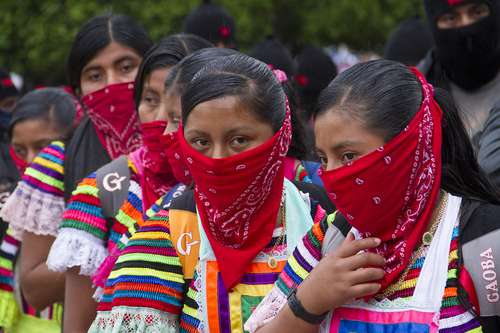
Women in the EZLN March
Collapse and Rebirth in the Zapatista Maya World
By: Luis Hernández Navarro
What has never gone away cannot reappear. What made the rebel Zapatista Mayas to occupy peacefully and in silence five Chiapas cities this December 21 was not to reappear, but rather to reaffirm their strength.
The EZLN has been here for more than 28 years. It has never gone away. For ten years it grew under the radar; it announced itself publicly more than 18 years ago. Since then it has spoken and guarded silence intermittently, but has never stopped. At one time or another its disappearance or irrelevance has been decreed, but it has always re-emerged with force and with a message.
This start of the new Maya cycle was no exception. More than 40, 000 Zapatista support bases marched in the rain in five Chiapas cities: 20, 000 in San Cristóbal, 8, 000 in Palenque, 8, 000 in Las Margaritas, 6, 000 in Ocosingo, and at least 5, 000 more in Altamirano. We’re dealing with the most numerous mobilization since the emergence of the rebels from the Mexican southeast.
The magnitude of the protest is a signal that their internal strength, far from diminishing with the passage of years, has grown. It is an indicator that the counterinsurgency against them, carried out by the different governments, has failed. It is sign that their project is a genuine expression of the Maya world, but also of a whole lot of poor Mestizo campesinos in Chiapas.
The EZLN never abandoned the national scene. Guided by their own political calendar, loyal to their ethical congruence and with the force of the State against them, it strengthened its forms of autonomous government, it kept alive its political authority among the country’s indigenous peoples and kept the international solidarity networks active. The fact that it has not appeared publicly does not mean that it is not present in many significant struggles in the country.
In the five Good Government Juntas that exist in Chiapas and in the autonomous municipalities the authorities of the Zapatista support bases govern themselves, exercise justice and resolve agrarian conflicts. Within their territories, the rebels have made their health and education systems function at the margin of the state and federal governments, organized production and commercialization and kept its military structure standing. They successfully resolved the challenge of the generational relief of their commanders. As if it were nothing, they efficiently dodged threats from drug traffickers, public insecurity and migration. The book Luchas “muy otras” Zapatismo y autonomía en las comunidades indígenas de Chiapas is an extraordinary window for looking at some of these experiences.
The Zapatistas marched this December 21 in order, with dignity, with discipline and cohesion, and in silence, a silence that was loudly heard. In the same way in which they had to cover their face in order to be seen, they now interrupted the word in order to be heard. We’re dealing with a silence that expresses a fertile generative capacity for other horizons of social transformation, a great potency. A silence that communicates the will of resistance in front of power: “He who stays in silence is ungovernable,” Ivan Illich said.
A cycle of the political struggle closed in Mexico this December 1, at the time that another opened. The EZLN has a lot to say in the nascent map of social struggles that begins to be drawn within the country. Their mobilization can impact them in a relevant way.
Among the contours that define the new stage of social struggles are: the return to Los Pinos of the old PRI dinosaur, manned by Salinismo and its authoritarian ways of exercising state command; the pretension of managing social conflict starting from a pact among elites that excludes the subordinate sectors; the crisis, decomposition and reorganization of the partisan left, and the emergence of new social movements.
The EZLN is a new player that, without invitation, sits down at the table of the party that recently came out in national politics.
The Pact for Mexico, subscribed to by the Institutional Revolutionary Party (PRI), the National Action Party (PAN) and, individually, by the president of the Party of the Democratic Revolution (PRD) seeks to agree on a program of reforms at the margin of broad social sectors. The EZLN’s mobilization makes evident that a very broad part of Mexican society is not included in that agreement, and that what its subscribers agree to does not necessarily have the endorsement of the citizens.
The party of the Aztec Sun (the PRD) is locked in an internal struggle that can provoke its rupture. The New Left’s pretension of yoking its destiny to the Peña Nieto government mortgages any possibility of a critical distance from power.
The National Regeneration Movement (Morena, its Spanish acronym) has been occupied with the organizational tasks for obtaining its registry. It is probable that the Workers Popular Organization (OPT, its initials in Spanish) continues the same path. It exists because there is a broad political and social territory that the partisan left is not occupying. The Zapatistas enjoy an indubitable political authority among those who people those latitudes.
In the last year and a half social movements have emerged that question power at the margin of the political parties. They don’t feel represented by any of them. The Movement for Peace with Justice and Dignity, #YoSoy132, the community struggles against public insecurity and ecological devastation, the student protests in defense of public education, among others, walk along different paths than those of institutional politics. The sympathies toward Zapatismo within those forces are real.
But, beyond the conjuncture, the marches of the Maya 13 Bak’tun are a novel “¡Ya basta!” similar to what they enunciated in January 1994, and a renewed version of “Never more a Mexico without us!” formulated in October 1996, which opens other horizons. They don’t ask for anything, don’t demand anything. They demonstrate the power of silence. They announce that a world is crumbling and another is reborn.
Originally Published in Spanish by La Jornada
English translation: Chiapas Support Committee
Saturday, December 22, 2012
En español: http://www.jornada.unam.mx/2012/12/22/opinion/004a1pol
More Than 40,000 Zapatistas Mobilize in Chiapas
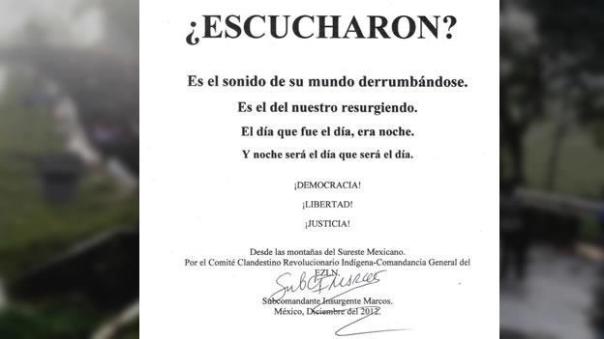
Above is a photo of the very brief message delivered to the media from the Zapatistas. It reads: “Did you hear? It’s the sound of your world crumbling and ours re-emerging… ” (obviously addressed to the new PRI government) Article from La Jornada is below.
More than 40,000 Zapatistas Mobilize in 5 Chiapas Municipalities
** In silence, they occupy the central plazas of Ocosingo, San Cristóbal de Las Casas, Palenque, Altamirano and Las Margaritas
** Later they disappear in an orderly way
[The indigenous wear a number according to the Zapatista zone to which they belong. Photo: Victor Camacho]
[Under the rain, thousands of indigenous marched through San Cristóbal de Las Casas, Palenque, Las Margaritas, Ocosingo and Altamirano Photo: Víctor Camacho]
By: Hermann Bellinghausen, Envoy
Ocosingo, Chiapas, December 21, 2012
More than 40, 000 Zapatista support bases filed silently this morning in five Chiapas cities, which results in the most numerous mobilization of said organization since the Zapatista National Liberation Army’s (EZLN) armed uprising on January 1, 1994.
Coming from the five Zapatista Caracoles in the Lacandón Jungle, Los Altos and the Northern Zone, the Maya peoples in rebellion (Tzeltales, Tzotziles, Choles, Tojolabales and Mames) and Zoques of Chiapas occupied the central plazas of Ocosingo, San Cristóbal de Las Casas, Palenque, Altamirano and Las Margaritas; in each case, in complete silence.
At 6:30 in the morning, about 6, 000 indigenous Zapatistas, the majority young, concentrated near the University of the Jungle, near the Toniná archaeological site. From there they marched to the central park of Ocosingo, where they stayed for a space of three hours in front of city hall, which the EZLN’s insurgents and milicianos took over with arms 19 years ago upon declaring war on the Mexican government.
On this occasion the action was civilian and peaceful, and the only ones that spoke were the raised left fists of all the Zapatistas, who filed in order onto a platform that they installed for that purpose. Toward 10:30 AM, the last of the demonstrators abandoned the plaza, on their way back to the Jungle.
In the same fashion, at the other plazas mentioned the Zapatistas placed platforms that all mobilization participants mounted with raised fist, in a parade of impressive brevity.
Some 20, 000 Zapatista men and women paraded in San Cristóbal de Las Casas. According to reports, at least 7, 000 indigenous congregated in Las Margaritas, and 8, 000 in Palenque. The number in Altamirano is not known. According to the testimony of a transport worker (driver) from the zone of Ocosingo, double the number of indigenous that arrived in the municipal headquarters of Ocosingo could have left from the Caracol of La Garrucha, but there were not enough vehicles, therefore only 6, 000 people were transported.
[The presence of youths and women was especially emphasized. Photo: Víctor Camacho]
Intermittently, throughout recent weeks, the Enlace Zapatista electronic portal has been announcing “the word” of the EZLN’s Indigenous Revolutionary Clandestine Committee-General Command (Comité Clandestino Revolucionario Indígena, Comandancia General del EZLN), as well as of the Sixth Commission and International Sixth Commission. It is foreseen that these communications could be announced soon, but that has still not occurred.
On the date on which many unwary in the world believed that the world would end, according to the opportunist interpretation of the “prophesies” (in reality, mathematical calculations) of the ancient Mayas, the EZLN’s support base communities, belonging to the contemporary Maya peoples, which in their languages are named “true men,” with face covered carried out a powerful demonstration of power and discipline, perfectly formed under a persistent rain (unusual in this time of the year) that accompanied the mobilizations in the different localities all morning long.
Able to “appear” quickly, the indigenous rebels “disappeared” as neatly and silently as they had arrived in the early morning in this city that, two decades after the EZLN’s traumatic irruption here on New Years 1994, received them with bewilderment and curiosity, without any expression of rejection. Under the arches of city hall, which suspended its activities today, dozens of Ocosingoans congregated to photograph with cell phones and cameras the spectacular concentration of covered faces that filled the park like in a game of Tetris, advancing among the gardening with an order that seemed choreographed, to go up to the platform installed rapidly since early on, raising their fist and saying, silently, here we are; one more time.
——————————————————
Originally Published in Spanish by La Jornada
English Translation: Chiapas Support Committee
Saturday, December 22, 2012
En español: http://www.jornada.unam.mx/2012/12/22/politica/002n1pol
Zapatistas Mobilize in 5 Chiapas Cities

Zapatistas enter San Cristóbal de las Casas
Zapatistas Mobilize in 5 Chiapas Cities
On the date on which the unwary awaited the end of the world, the EZLN’s Maya support base communities occupied the plazas of Ocosingo, San Cristóbal, Las Margaritas, Comitán and Altamirano in a peaceful and silent way.
By: Hermann Bellinghausen, envoy Published: 12/21/2012 09:15 AM
Ocosingo, Chiapas. Since the first hours of today, thousands of Zapatista support bases coming from the five Caracoles started to peacefully occupy the central plazas of the cities of las Ocosingo, San Cristóbal de las Casas, Las Margaritas, Comitán and Altamirano.
At 6:30 in the morning the bases that arrived in Ocosingo began to congregate near the University of the Jungle, and from there they started to a march towards the center of the city.
At this moment in the Ocosingo plaza the bases continue arriving and they occupy all the spaces without trees in the ample plaza from the municipal presidency (city hall) to the city’s parish church.
It is expected that the Indigenous Revolutionary Clandestine Committee-General Command CCRI-CG) of the Ejército Zapatista de Liberación Nacional (EZLN) will emit a message in the coming hours.
On the date that many unwary believed that the world would end, the EZLN’s Maya support base communities, with faces covered, the majority of them very young, wait in perfectly formed silence under a stubborn drizzle.
Unusually for these dates, it has rained all night.
———————————————————
Originally Published in Spanish by La Jornada
Friday, December 21, 2012
116, 100 Dead in Mexico Drug War!
Document 116, 100 Deaths Due to the Fight Against Drugs, “more than in a Country at War”
** The European grouping classifies Mexico as a nation of killings and unheard of barbarities
** It details in a report that there is corruption in police and Army; “authorities hide the evidence”
By: Alfredo Méndez
“Mexico is a country of killings, murders and unheard of barbarities. It is a nation of organized crime, of drug trafficking cartels, of journalists kidnapped and murdered,” the Italian civil organization Líbera maintains in a report.
This association’s report, formed by more than one thousand groupings of European activists and American human rights defenders, asserts that: “the invisible and absurd war” that ex president Felipe Calderón invented against organized crime “has provoked, from 2006 to the last moment of his government, the death of 53 people peer day, 1, 620 per month, 19, 442 per year, which gives us total of 136, 100 dead, of which 116, 100 (murders) are related to the drug war and 20, 000 murders linked to common crime,” the document details.
We’re talking about alarming numbers that place Mexico greatly on top of other countries at war, like Afghanistan, whose body count (from 2006 to present), according to numbers from the United Nations, reached 13, 000 deaths, in other words, bare 10 percent of the number of murders committed in Mexico.
The Líbera document –that includes governmental numbers, statistical data collected by non-governmental organisms, besides journalistic reports and analyses elaborated by academic experts in national and public security– was presented to the Mexican media this Monday during a press conference headed by journalists like Anabel Hernández and José Reveles; academics like Edgardo Buscaglia, president of the Institute for Citizen Action for Justice and Democracy, and members of different non-governmental organizations.
Starting with the premise of corruption as an irrefutable factor that nurtures crime, the report concludes that” “in Mexico there is corruption in the police, in the Army and, in the face of all that, the political power prefers to deny the evidence, dissimulate (lie) and hide.”
It adds: “in Mexico, representatives of the political class have not been capable of substituting the authoritarian mechanisms of the old and only State party with others with democratic characteristics. For this reason, in the political, judicial, legislative, administrative, patrimonial and social ambit one still observes power vacuums that are occupied by formal instances from the private sector and informal ones, like organized crime.”
As incredible as it seems, it established that: “it has been able to document that in the dance of the numbers, the National Institute of Statistics and Geography (Instituto Nacional de Estadística y Geografía, Inegi) from 2005 to July 19, 2012, established 116, 000 ‘alleged homicides’; but recent 2012 empirical-methodology investigations (The use, misuse and abuse of the crime statistics in Mexico, a document elaborated by James Creechan), published during the month of September by US and Canadian authors, make a different accuracy.
“In that study he calculates that the total number of malicious homicides 136, 100 individuals. Nevertheless, so as not to exaggerate for political motivations, one must remember that not all these lost lives are linked to the ‘war’ against organized crime. In the scientific study, of the 136, 100 people that have been murdered with firearms, decapitated, hung, burned in acid or found in narco-graves, “one can conclude that 116, 100 individual deaths are linked to the war against drug trafficking and 20, 000 have been murdered by common crime,” the Líbera report points out.
———————————————————-
Originally Published in Spanish by La Jornada
English Translation: Chiapas Support Committee
Tuesday, December 11, 2012
En español: http://www.jornada.unam.mx/2012/12/11/politica/015n1pol
Enrique Peña Nieto Takes Office in Mexico
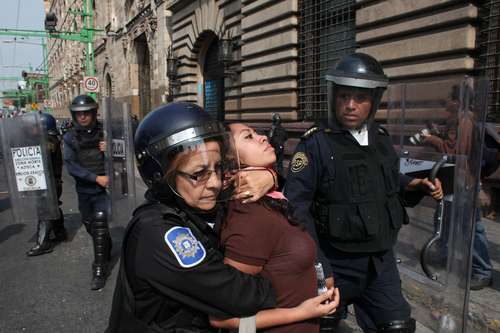
A woman is arrested during the December in protests in Mexico City Photo: La Jornada
Mexico’s presidential inauguration marked by vows and violence
By: Laura Carlson
The official broadcast showed smiling legislators from the Party of the Institutional Revolution (PRI), uniformed in red shawls and red ties, welcoming the triumphant arrival of the president-elect amid cries of “Enrique, Enrique!” It was an almost flawlessly choreographed production, despite occasional cries of protest from the opposition. The presidential mantle was passed from one party to the next, the handsome new president delivered a well-polished speech designed to please all, and there was the obligatory visit to address the armed forces. The official version of the inauguration of Mexico’s 57th president seemed to go off with only minor glitches.
That’s pretty much all you could see from your television screen. Some stations showed a few jarring scenes of rioters in the streets being beaten back with tear gas amid the crack of rubber bullets. But they only lasted a few seconds before returning to the comforting pomp and circumstance of the change of powers. Television networks were not allowed to film the inauguration and acceptance speech. Flipping from channel to channel produced the simultaneous repetition of the official signal, with its official selection of shots and official narration.
A city under siege
Social media and the streets themselves told a different story. From the pre-dawn hours, battalions of police barricaded the area blocks away from both the Congress where the official swearing-in took place and the National Palace where the new president would present his first speech. Protestors left for the legislative center at San Lázaro in the pre-dawn hours. Arriving, small groups attacked police lines to gain entrance into the security perimeter surrounding Congress.
The situation heated up quickly. Police responded hurling tear gas canisters and firing rubber bullets, enraging the protestors. Images show young people, mostly men with hoods and masks, attacking police lines with rocks and sticks. Some Molotov cocktails and bottle rockets were reported. Soon it became an all-out battle, with youth hurling back the gas grenades. Students reported “bombs, pepper gas, tear gas and rubber bullets”, all confirmed by the press.
This is not a common method of reacting to demonstrations in Mexico City. It reflects a decision to crack down hard, regardless of the consequences, particularly within the ranks of the Federal Police. After clashes, some people destroyed lamp- posts, vandalized buildings and parts of the expensively remodeled Alameda Park and vandalized buildings along Mexico City’s main streets. News stories have reported the presence of paid provocateurs among the vandals.
The movement reports that anti-Peña Nieto protestor José Uriel Díaz reportedly lost an eye and Juan Francisco Koytenal (spelling according to YoSoy132) [1] is in a coma after receiving direct hits from rubber bullets. The use of rubber bullets is prohibited in Mexico.
Mainstream media allied with the new president throughout the campaign and subsequent lame duck period, immediately blamed Andrés Manuel López Obrador and the youth movement #YoSoy132 for the violence. López Obrador came out against violence, stating that the “mafia in power” desires violence to justify authoritarian measures. He condemned the violent response of the police:
“There was no reason to use brute force… and rubber bullets against the youth and students. As the first action of defense of HR and citizen liberties, we demand destitution of the current Secretary of the Interior (Miguel Osorio Chong) the guilty must be punished there are youth seriously wounded, and there must be justice.”
The YoSoy132 movement communiqué reports 101 people arrested and calls for a demonstration today, Dec. 3. Their message of Dec. 3 reads:
“We declare our complete opposition to the criminalization of social protest and of youth that became clear in the speech of the Federal Government and the Government of Mexico City. To consider that expression of the right to freedom of assembly justifies violence is to judge that no citizen or group can demonstrate without being the object of violence.”
They call for freedom for those arrested and guarantees of human rights for all involved and for future demonstrations. While the violence captured headlines and marked inauguration day, the vast majority of the demonstrators stuck to instructions of non-violence of the organizations and protested peacefully.
After the clashes, I drove downtown to do a television commentary on the day’s events. The walls along one of Mexico City’s main thoroughfares were covered with spray-painted messages: No to the Imposition, Mexico has no president, Peña–Fraud, Peña Out!
On the Zocalo, seen from the bird’s-eye view of a hotel balcony, a drama played out between security forces and protestors. Shielded police cordoned off the area from several blocks away. A group of about two to three hundred protestors who managed to be inside screamed anti-Pena Nieto slogans outside the Palacio Nacional long after the new president had finished his speech and headed off to address the armed forces. They had no rocks or sticks and made no aggressive moves. Other people walked through the central plaza like on a normal Saturday.
Rows of police began streaming into the plaza from both sides, marching in twos. Fourteen truckloads of soldiers pulled into the square and unloaded. You could hear cries and feel the fear from below. A group of police broke the line of contention and advanced on protestors. Protestors and bystanders screamed and ran.
Eventually the police retreated and the soldiers did nothing. The scene flowed back into young people heckling police at the doors of the Palace. But I was left with an unsettled feeling, that something was gravely wrong. Why the gratuitous shows of intimidation? Do we read the events of this ominous inauguration as a particularly paranoid response or a pattern for the future?
Controlling the opposition
In the House of Deputies, the incoming government was determined to avoid a takeover of the podium and the disruptions that characterized the inauguration of Felipe Calderón six years ago. The PRI positioned its members at the two entrances to the podium, stating that “there aren’t enough seats” to explain their presence there.
Members of Congress from all parties were given ten minutes to present speeches before the president-elect arrived to take office. There were relatively few interruptions, but a huge banner along the sidewall proclaimed “Consummated Imposition. Mexico in Mourning.” The opposition also had images of Monex back cards and Soriana grocery coupons as a statement against vote buying during the PRI campaign and signs saying “Presidency Bought”.
During his speech, Ricardo Monreal of the PRI called the alliance between the PRI and the PAN a sign of “transaction, not transition” and noted an increase of 12 million people below the poverty line. He vowed to “defend our oil and energy resources”, and “work against femicides and forced disappearances.”
In a completely different tone, Arturo Escobar of the Green Party, part of the Peña Nieto coalition, heralded the “maturity of the majority of Mexico following the results of the elections” and of the electoral institutions. He predicted that Mexico would change and grow, eradicating its enemies of violence and extreme poverty.
Other notable moments: As Calderón entered the hall, journalists covering the event cried out, “God forgive you for the journalists killed!” Others called out, “Assassin” and “Murdered by Felipe” as the PAN began a counter-cry of “Very good, Felipe!”
As has often been the case in Mexican history, the victors and the vanquished seemed to live in two, very different Mexicos.
Laura Carlsen is a political analyst and Director of the CIP Americas Program in Mexico City at http://www.cipamericas.org.
http://www.cipamericas.org/archives/8449
CSC Notes
————-
[1] Kuykendall is the correct spelling of the last name. He is known as “Kuy” and is a theater director and an adherent to the EZLN’s Other Campaign.
 Chiapas Support Committee