Chiapas Support Committee
Home of the Compañero Manuel blog on zapatistas & mexico
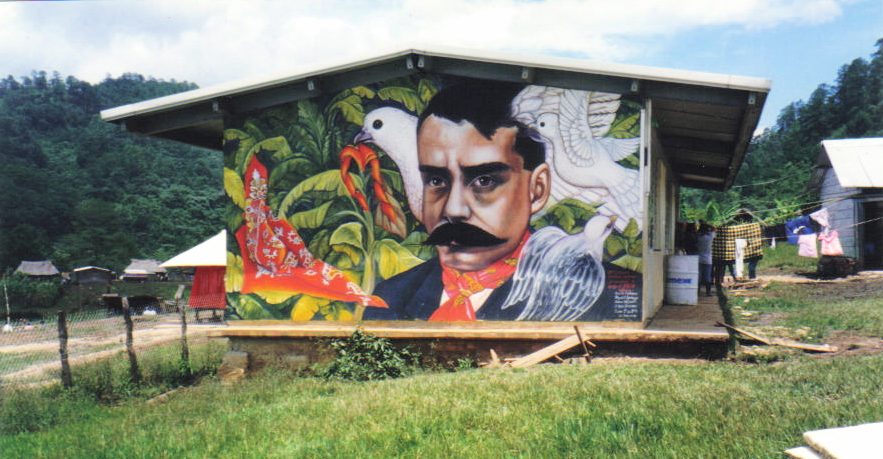
EZLN: Marcos: THEM AND US VII – The Smallest Ones 6 – The Resistance
THEM AND US VII.
The Smallest Ones 6.
The Resistance.
March 2013.
NOTE: The following fragments talk about the resistance of the zap… wait! There’s a Zapatista Airforce?! The Zapatista health system is better than the health system of the bad government?! For over 20 years, the Zapatista communities have resisted, with their own ingenuity, creativity, and intelligence, all of the various counter-insurgency efforts waged against them. The so-called “Crusade against Hunger”[i] of the current PRI overseers does nothing but reiterate the fallacy that all that indigenous people want is a handout rather than Democracy, Liberty, and Justice. This counter-insurgency campaign does not come alone, but is accompanied by a media campaign (the same type of media campaign that today in Venezuela once again shows its desire for a coup against a people that will know how to gain strength from their pain), the complicity of the political class as a whole (in what should be called the “Pact against Mexico,” [ii]) and, of course, a military and police escalation: in Zapatista territories the paramilitaries are emboldened (with the consent of the state government), federal troops intensify their provocations during patrols “to locate the Zapatista leadership,” the “intelligence” agencies are reactivated, and the justice system reiterates its ridiculousness (which rhymes with Cassez[iii]) in denying freedom to teacher Alberto Pathistán Gómez, thus condemning him for being indigenous in Mexico in the 21st century. But the teacher resists, not to mention the Zapatista indigenous communities…
-*-
Good morning compañeros, good morning compañeras. My name is Ana, from the current Junta de Buen Gobierno [Good Government Council], fourth generation 2011-2014, from Caracol [iv] I in La Realidad. I am going to talk to you a bit about ideological resistance, the subtheme that the two of us—the compañero and I—are to talk about. I am first going to talk about the ideology of the bad government. The bad government uses the mass media to control and misinform the people, for example via television, radio, soap operas, cellphones, newspapers, magazines, even sports. They insert commercials on television and on the radio to distract people, and soap operas to hook people and make them think that what happens on television is going to happen to us. In the bad government’s education system, those who aren’t Zapatistas are ideologically managed so that their kids are in school, properly uniformed, every day, but just for the sake of appearances, it doesn’t matter if they learn how to read or write. They also get them scholarships for school, but in the end this just benefits the companies that sell supplies or uniforms. How do we resist all of the bad government’s ideological wrongs in our Caracol? Our principal weapon is autonomous education. There in our Caracol the education promoters are taught the true history of the people, so that this knowledge can be conveyed to the children, along with the knowledge of our [Zapatista] demands. We also began giving political talks to our young people so that they are awake and aware and don’t fall easily into government ideologies. We are also giving talks to the people on the 13 [Zapatista] demands, via the local authorities in each village. That is the little I can explain to you, next the compañero will talk to you.
(…)
-*-
(…)
There are also programs, part of the government projects. The government began to bring in projects so that our brothers and sisters would accept these projects and believe they are good and forget about their own work; so that these brothers and sisters now don’t depend on themselves but rather on the bad government.
What do we do to resist these things? We began to organize ourselves to do collective work, as some of the compas have already said, we do collective work at the village, region, municipal, and zone levels. We do this work to satisfy our own needs, different types of work, it is how we resist falling into the bad government’s projects and how we work to depend on ourselves, not on the bad government.
-*-
There [in our zone] there is a huge hospital in a community called Guadalupe Tepeyac, and right now a children’s hospital is being constructed very close by, about a half hour or an hour away, in the center of La Realidad. But what is happening, what have we seen in that hospital in Guadalupe Tepeyac? In spite of the fact that the government has a lot of equipment, people arrive from different communities, from different municipalities, and what happens? Let’s say they need to do an ultrasound, for example, or a lab analysis. As the doctors there know, our hospital is very close by, our Hospital-School “The Faceless of San Pedro.” The doctors at the government hospital know that they can’t do the analysis there because they don’t have the trained staff to do it, they have the machine but not the staff. So what they do is give the consultation there and send the patient to our hospital, to the Zapatista hospital-school. So [the patient] goes [to the Zapatista hospital] to do the analysis—just look at the level we’re reaching, compañeros— and of course there are rules in this hospital to charge this person a fee, and they do the analysis for them.
Then people begin to realize, begin to admire, that while in the official hospital there isn’t a solution to their problems as many would expect, when they come to our hospital, although humble, as we say, they are told what problems are detected with the ultrasound or in the laboratory analysis. The hospital of Guadalupe is there but there is just one lab analyst and there are many things that that lab analyst can’t do, so they send the patient to our hospital-school. There we have a compañero who is trained and who has now trained various other compañeros, so he does the different analyses. But not just that, this compañero has an advantage over the lab analyst in the official hospital, who just does the lab test and that’s it, and then sends the patient to another doctor to receive treatment. What the compañero in our hospital does when people are sent from the hospital in Guadalupe is perform the lab analysis and at the same time provide the prescription and the treatment for the illness, because our compañero has a lot of knowledge in that area of lab work.
-*-
(…)
To explain a little more about the rural city [constructed, with media applause, by the “left” government of the corrupt Juan Sabines Guerrero], at the beginning houses were constructed. According to what the compañeros have told us, the materials that they used in construction were those things called triplay [3-ply, or plywood], very thin boards, not like the planks that we have here. Currently the constructions are inflated like balloons; when there are strong winds and when it is the hot and in the rainy season the materials with which the houses are built are essentially rubbish. That’s the way it is. So in some communities in that municipality, families went to live [in the rural city] for a few days, and according to the media there’s a kitchen that was constructed with the dimensions of 3×3, really small, and a little room, a living room on the side. But it’s not possible to do anything because if they made their hearth there, well how would they put their hearth or its fire there? They couldn’t.
Currently it is not functioning, the families went for a few days, but what we know is that they had to return to their community. Some families are still there but the conditions are very bad conditions. They say that on a little hill above where the houses are, they made water tanks but these are not working, compañeros, they’re not working. They say that there is a bank there to invest money—I don’t know if it’s a world bank, or a state or municipal bank, I don’t know, but it’s not working. There are just empty shells, already rubbish. It’s not, like they say, a “rural city,” which is a very pretty name but really there’s nothing there. That’s why the compañeros say, why should we believe in these projects and such things? They’re all lies.
(…)
As the compañeros say, it’s part of the enemy’s war, that’s why if some compañeros in this zone have let themselves be convinced by these ideas it’s because the war has gotten this far, not because now they’re going to have a more dignified life. In many places there are those who leave the organization or those who are now in political parties, but the compañeros who are bases of support have had a better life. The rural city—everything they have said and all that they are doing there—is clearly pure lies.
To help you understand the ideological manipulation enacted by the bad government in Santiago El Pinar, they promised the women there that they would give them egg-laying hen farms. So you know these hen farms use chicken feed, and when they gave them the farms they gave them a lot of chickens to lay eggs, and it was great in the beginning because the hens laid a lot of eggs, but the government didn’t seek out a market where they could sell their eggs. The hens laid a lot of eggs but then what were they supposed to do? They couldn’t compete with the big grocery stores that sell eggs. So what they tell us is that they divided up the hens, but then the government stopped providing the feed, and the chickens became sickly and they stopped laying eggs. And so the women asked “now what do we do? We have to cooperate. But how can I cooperate if I already ate the eggs? Where will I find money?” And the hens died; what the bad government says doesn’t bring results. They do all of this just so that the cameramen come and film the inauguration [of the rural city], that everything looks nice or whatever. But this all lasts one month, two months, by three months it’s all over.
So among other things is the problem, as the compa was saying, that the houses are worthless because they inflate, as they say, like a toad. The women are accustomed to making their tortillas either on a hearth or over a fire on the floor, but an earthen floor, and in this case the houses have wooden floors, plywood, and you can’t have a fire there. And so they gave people gas cylinders that no one knows how to use and the gas doesn’t even last a month, and so now you have the cylinders tossed out as garbage and stoves that don’t work. Also, we know that the life of peasants, of the indigenous, is such that behind one’s house there are vegetables, sugarcane, pineapple, plantains, whatever there may be, as is our way of life, but [in the rural city] there is nothing, simply a house and that’s it. So the people don’t know what to do, because now their lands are far away and they need to go there to work, but it is another expense to come and go.
The politics of the bad government is to put an end to life in common, to community life, so that you leave your land, or you sell it, and if you sell it you’re screwed. It is a politics of injustice, it creates more poverty. All of the millions that they receive from the UN, which is the Organization of United Nations, is kept by the bad government – state, municipal, and federal – and used to organize those groups that provoke problems in the communities, above all for those of us who are the Zapatista bases of support.
It is the continuation of the much-touted policy, which now they don’t want to hear mentioned, and which we no longer hear about in the media, the Puebla-Panama Plan.[v] Now it has different name because the Puebla-Panama Plan was highly criticized, but it is the same thing, they only changed the name so that they could go on individualizing the communities, to put an end to the life in common that still exists.
(…)
-*-
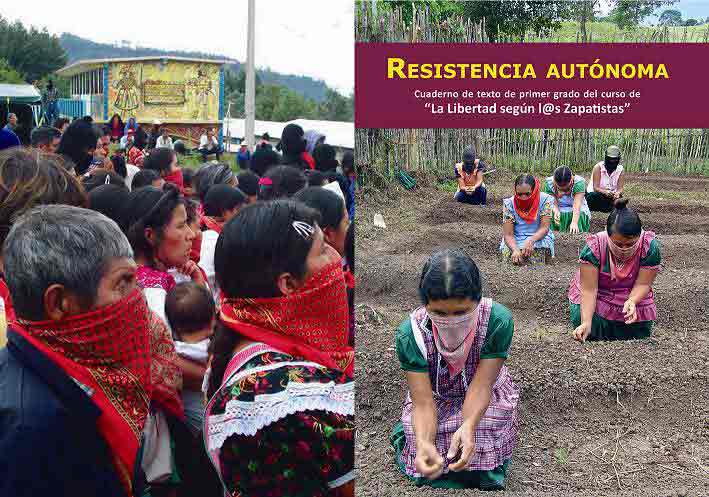
-*-
This is more or less how we are doing our work in the resistance, because we are talking about resistance. And in this work, our compañeros who work in the cornfield or the coffee groves, or who have some cattle, sometimes they sell their animal and so they have a little bit of money left. And the bad government is attacking us with their projects for cement floors, for housing, for housing improvement, and the other things that these PRI brothers receive in other communities.
But the PRI are getting accustomed to the money, their gaze is set on the government and they look to the government to give them more money and projects. So the same thing that some of our compañeros from Garrucha described is happening in the Caracol in Morelia. Sometimes these [PRI] brothers sell the corrugated metal, and because it is a government project, the government thinks that its party is growing, but the reverse is happening, we compañeros who are in resistance are using some of the fruits of our labor to buy these things that party supporters are selling.
We’ll give you an example: to buy a sheet of corrugated metal in the hardware store costs about 180 pesos, but [the PRIs] come and sell them for 100 pesos, or 80 pesos; and they also have cement blocks from the government, which might be 5, 6, or 7 pesos in the hardware store, but they sell them for 3 pesos, or 2 pesos. Our compañeros, who are in the resistance and aren’t accustomed to spending the fruit of our labor, buy these and it may be that one day you will see that in some new population centers there are colored corrugated metal roofs, [vi] but really it came from the work of the [Zapatista] compañeros. That is what is happening there.
But the government has realized where its project is heading. It isn’t benefiting the party followers, the PRIs, but rather is being taken advantage of by the Zapatistas, that is where their housing materials are ending up. Now it’s not just the materials, but also the mason. When the material arrives, the mason is already there because he already realized that the Zapatistas were working on their houses. That is why [the government] is changing the project again, the bad governments have tried many things from 94 up to today.
-*-
All right compas, let’s explain again the resistance to the military, for example what the compañera already explained. It’s my job to explain what happened in 1999 in the ejido of Amador Hernández in the municipality of General Emiliano Zapata.
At that time, on August 11, the military arrived and we compañeras and compañeros resisted their entrance into our community. The military wanted to take over the community, but when the soldiers arrived at a dance hall the compañeras confronted them; they kicked them out of that community and made them retreat to a place outside of it. But we didn’t stop there; we made an encampment. And everyone in the zone participated, which is the Caracol of La Realidad. People from civil society came also and all of those in the resistance had to endure a lot, because it was the season of chaquistes [tiny biting insects] and of mud, as is the rainy season. And through all of this we didn’t yield to their provocations, we didn’t confront them militarily, but rather we came peacefully.
And during this encampment, we organized dances; we danced in front of the soldiers. And the people had religious ceremonies, the compas organized event programs, and sometimes spontaneously we gave talks about the politics of struggle.
What did the soldiers do? It seems we began to convince them, because we were face to face with them, and so what the military commanders did was put out speakers so that the soldiers couldn’t hear our words and withdraw them to a place a little bit further out.
What happened then? The compañeros invented new ideas, I think you have probably heard about the little paper airplanes: we wrote why we were having the encampment on the paper airplanes and threw them at the soldiers and the solders picked them up. That was the Zapatista Army’s first air force, in Amador Hernández, but it was pure paper.
(…)
All of this, compas, happened during the resistance to the military incursion, and once we got into a shoving confrontation with the soldiers—there were compañeros and compañeras standing opposite the soldiers who were in two lines. There was one compa—a short little compa—and as the military pushed us with their shields, they had clubs also, this compa stepped on a soldier’s foot, and then the soldier stepped on the compa’s foot. There was another, much bigger, soldier there, and he curiously began to laugh because the compa was stepping on soldiers’ feet and they were stepping on his. So this big soldier starts to laugh and the little compa said to this jerk “what are you laughing at little guy?” even though the soldier was much bigger and the compa much smaller.
(…)
-*-
This is what I have seen and what we are seeing. There you have the results. We didn’t eat tostadas in vain in order to carry out the encampment; tostadas give strength and wisdom. We depended on collectivism a lot. Why do I speak this way compañeros? Excuse the word, compañeras. We learned there with many compañeros in each community, in each municipality, how to face the fucking soldiers that come into our communities to harass us. There the compañeras learned to defend themselves, with I don’t know what, with sticks they kicked out the soldiers, however they had to do it, with rocks, or with shouts and insults, but they did it. That’s how the compañeras organized themselves, I saw it and I remember clearly that the compañeras were convinced that they must confront [the military]; they demonstrated what they are capable of.
(…)
-*-
The authorities also began to take turns and to hear the needs that we presented to them in each community, in each region, and in each municipal seat. And so we worked, and little by little we advanced. Once the organization was in place, we began to create more, to begin the work of health and education, and now as the compañera mentioned, we already have a health clinic in our municipality, called the “Compañera María Luisa” [the nom de guerre of Dení Prieto Stock, fallen in combat on February 14th, 1974, in Nepantla, Mexico State, Mexico], and one in the ejido of San Jerónimo Tulijá, called “Compañera Murcia-Elisa Irina Sáenz Garza,” named for a compañera who struggled and who died in combat at the El Chilar ranch [in the Lacandón Jungle, Chiapas, Mexico, February 1974], there close to where we are, where they died just borders where we are, that is how we named the clinic.
-*-
|
Dení Prieto Stock |

Elisa Irina Sáenz Garza “Murcia” |

(To be continued…)
I testify.
From the mountains of the Mexican Southeast.
Subcomandante Insurgente Marcos.
Mexico, March 2013.
::::::::::::::::::::
TOP SECRET [English in the original]: Training of the Zapatista Air Force (FAZ by its Spanish Acronym – Fuerza Aérea Zapatista), somewhere in the mountains of Southeastern Mexico.
—————————————————————————
Another example of the warrior spirit passed on to the boys and girls in the indigenous Zapatista communities in resistance: here they are reading “The Ingenious Gentlemen Don Quijote of La Mancha” by one Miguel de Cervantes Saavedra, who must be a foreign soviet military advisor…wait, there isn’t a USSR anymore? I’m telling you, this is just more proof that these indigenous are hopelessly pre-modern: they read books! They must do it to be subversive because with Peña Nieto, reading books is a crime.
—————————————————————————–
A song of suffering and rage by a Mapuche mother upon losing her son who was assassinated by the Chilean armed police.
—————————————————————————
A song for the EZLN Caracoles, by Erick de Jesús. At the beginning of the video: words of the Zapatista Women.
————————————————-
Translator’s Notes:
[i] Soon after assuming the Mexican presidency, Enrique Peña Nieto announced what he calls his “National Crusade Against Hunger,” inaugurated in Las Margaritas, Chiapas, area of Zapatista influence. See the EZLN’s previous mentions of the Crusade in “Them and US III: The Overseers” and “Ali Baba and his 40 thieves.”
[ii] Refers to the “Pact for Mexico,” a political agreement regarding national political priorities made immediately after Enrique Peña Nietos’ inauguration between all three principal political parties, the PAN, PRI, and PRD.
[iii] Refers to Florence Cassez, French citizen accused of participating in a gang-related kidnapping in Mexico in a highly controversial case. She was incarcerated 7 years of a 60-year sentence, before her case was thrown out for breaches of legal procedure. She was released on January 23, 2013 and returned to Paris.
[iv] The Caracoles, literally “shells” or “spirals” were announced in 2003 as the homes of the Juntas de Buen Gobierno, or Good Government Councils. When the EZLN first announced their existence they were described, in addition to being the seats of the self-government system, as “doors to enter into the communities” and “windows to see in and out.”
[v] The Plan Puebla Panama (PPP) was a multi-billion dollar development program launched in 2001 by then president of Mexico Vicente Fox (PAN) “to promote regional integration and development” of Southern Mexico and Central America, and later extended to Colombia. The plan was highly criticized because it laid the groundwork for neoliberal free trade agreements and infrastructure at the expense of people of the region. Today, the “Mesoamerican Project” is basically a remake of the PPP with security elements added from the Mérida Initiative, itself a remake of the controversial drug-war oriented Plan México.
[vi] Government issued corrugated metal for house roofs is orange, so the colored roofs would seem to imply government support.
————————————————————–
Originally Published in Spanish by Enlace Zapatista
http://enlacezapatista.ezln.org.mx/2013/03/08/ellos-y-nosotros-vii-ls-mas-pequens-6-la-resistencia/
*********************************
Traducción del Kilombo Intergaláctico.
*********************************
EZLN: Marcos: THEM AND US VII – The Smallest Ones 5 – The Money
THEM AND US VII
The Smallest Ones 5: 
THE MONEY
March 2013
Note: Money, cash, bills, benjamins, clams, dinero, the economy, the finances, etc. The economic question isn’t only about where the resources come from (some people’s morbid curiosity about this will be satisfied in the little school, don’t worry), but also how they are managed (do the authorities get paid? nobody’s sticking their hand in the cookie jar for personal gain? etc.), and, above all, how do we keep track of everything? Wait a second! The Zapatistas have a banking system? Well, continue to be scandalized because, as we have said, this is what the Zapatistas do, unsettle “decent people’s consciences.” The following are fragments from the “sharing” on the economies of the Juntas de Buen Gobierno [Good Government Councils].
-*-
So, up until now there hasn’t been any monetary support [for the authorities of the JBG], and that is how we came to realize that money cannot do the work of autonomy or the work of governing. We have realized this, because no one is getting paid for the work that they do. It’s true, I’ll tell you, that some do receive support from their community for their work, in the form of basic grains or something similar, whatever the community decides is appropriate, but never money. And that is how we have been working these nine years in the Junta.
(…)
How do the members of the Junta travel to your Caracol [i]?
If there is transportation [usually a bus or smaller collective van], then they go in that, and if there is no transportation, then they walk. The Junta’s limited resources cover the cost of their transport, yes, so they do receive financial support for their transport costs, but nothing more. If it costs 20 pesos then they are reimbursed 20 pesos when they arrive.
The compañeros and compañeras that work in these cargos [ii] of the authority, as was already mentioned, do it out of conscience, of their own volition. But these compañeros also live in communities where there are many compañeros, and so there is also communal work, organizational initiatives to organize resistance. And so these compañeros, some of them, have the right to do their work in their free time, and therefore don’t have to also participate in the collective and communal work in their community.
-*-
Autonomous government manages the different work areas, including education, commerce, health, communication, justice, agriculture, transportation, campamentistas, [people who come to stay in the Zapatista villages for awhile], BANPAZ (the Zapatista Autonomous Popular Bank), BANAMAZ (the Zapatista Women’s Autonomous Bank), and administration. These are the work areas managed within the autonomous government. In the beginning, when the Junta de Buen Gobierno began, there weren’t very many compañeros and so each compañero had three or four work areas, because there were very few of them. By the second period of the Junta there were already 12 compañeros, and so the work that they had to do began to balance out a little better, they only had two or three areas per compañero.
In this third period of the Junta de Buen Gobierno we now have 24 people and the work has balanced out. The different work areas are divided among compañeras and compañeros; the Junta has two teams, and there are 24 of us, so we each cover 15 days per month. In each of these different work areas there are two compañeros and two compañeras, and that is how the Junta de Buen Gobierno functions, those are the areas it manages. That’s all compañeros. So now we’ll move on to the next compañero. (…)
-*-
(…) In the communities—as we were discussing with the compañeros, because we have a little bit of knowledge of the zone—there are collective fields of beans and corn, cattle collectives, collective stores, and chicken collectives. There are small businesses, not permanent businesses that are there all the time, but sometimes when there are small events, people bring their small businesses to them. The compañera said that one community in her region started with a chicken farm business, and every now and then they kill a chicken or two and make tamales, then they sell these tamales and little by little they amassed a fund and ultimately used this fund to buy a corn mill. That is how they created their cooperative work.
Another compañero knows of another community that has another way of doing things, it is a center where many people from other communities come, and there the compañeras organized themselves to make a tortilleria [tortilla store], but not because they bought one of those machines that we see in the cities and are there dispensing tortillas from an assembly line. These compañeras are there with their press, making their tortillas by hand and selling their tortillas to the people who buy them, and that is their collective work.
This is how they organize many other things in the communities. And what is this for? Well it is so that when a compañero in this community, it may be the education promoter or the health promoter, has to go and do their work, the community can give them something to cover their transport costs, so that they can do their work.
(…)
-*-
Here in the Caracol II of Oventic, we receive visitors, national and international. Many of those visitors only come in order to visit the center, the Caracol, but some who come wish to support the community leave a small donation. If they decide to leave a small donation, they don’t leave much, they leave it here with the Junta who receives it, and the donor receives a receipt for their visit from the Vigilance Commission. The Vigilance Commission also sends a receipt to the CCRI [Indigenous Revolutionary Clandestine Committee], the original stays with the Junta, and a copy goes to the donor. The small donations are gathered and the Junta administers them. They use them for whatever expenses we have here in the Caracol center, and that is how we spend the donations, but they are small donations, people don’t leave much, it depends, it may be 40 or 50 pesos or 100 pesos or so. But if it gets spent, it is not only the Junta that knows, because each month the Junta makes a report; we make an end of the month report each month.
When the Junta makes its reports, the Junta members don’t do it alone, but rather all 28 of us members get together to make the report, including some compañeros from the CCRI, so that together we can see how the resources that we have here in the Junta in the caracol have been spent, or how the Junta de Bien Gobierno administers them.
-*-
Another obligation of the autonomous government is to govern with sincerity and honesty all of the economic inputs and outputs in each area of government, because all of the goods and materials are for everyone. As I explained a little while ago, the Junta can’t just manage these resources willy nilly, including those donated by compañeros in solidarity.
Each area of [good] government in the municipalities, in the Junta, makes their monthly report, and our reports are very detailed, even 50 pesos spent somewhere has to be noted, it should be clearly stated how those 50 pesos were spent, and that is how we do our report. As I said a little while ago, it’s not just a couple of members who make the report, but all 28 of us get together, including compañeros from the CCRI, and that is how we work here in the caracol center.
(…)
-*-
Also we have a Funds Commission, here in our zone we have a small fund. As the compañera explained, there are three women’s [work] areas, for example herbalists, [bone] healers, and midwives. One time in this work area they elaborated a project, but it wasn’t only for the herbalists, healers, and midwives, but rather for the central clinic, or the health project, which included the three groups or areas of herbalists, healers, and, midwives. This project had a budget for food, which was 50 pesos per day, and the workshop was for three days, so the course costs 150 pesos for the food, but apart from that there were also transportation costs, which also had a budget that depended on the compañeras’ distance traveled and amount spent. And so it was in this budget, in this project, in the entire zone, that all of the regional authorities, the autonomous councils, realized the importance of creating a fund.
The agreement reached was that we wouldn’t spend the entire amount budgeted for food, but rather just a small contribution, or 10 pesos paid by each compañera. But because it was three days, each course or workshop would cost 30 pesos, and so there was some left over. According to the agreement of the assembly of authorities, the rest would be saved as a fund for the zone, not the region, but the zone. Also regarding transportation, an agreement was reached to only spend 50% of the budget, and the community would contribute 50% also, and so 50% was left over for the fund of the zone.
Why did we do it like this? Because we had seen here in our zone that the economic resources are more and more scarce when we have some kind of movement, and that’s why we decided to save part of the money as a fund. And that is how we created this support, the fund for the zone, and that is why we created the Fund Commission, the Savings Commission. I’m not sure if that answers your questions.
(…)
-*-
Who approves the report on the finances and the general report, if there is no one in charge (sticking their hand in the cookie jar)?
Well, during our time as Junta, we worked all together, there wasn’t anyone else who checked the report, only the entire Junta team. But each time we wrote a report on our spending we sent a copy to the Information Commission; all of the purchase reports as well, we planned the food purchases together with the Information Commission. We all decide together in the office of the Information Commission, with the Vigilance Commission also present; the three offices would meet, and we would come to an agreement regarding whether we were going to buy something, or if we were going to have a commission how much its costs would be, and how to report its expenses to the Junta. Each shift would give an account, because each shift would elect a secretary and a treasurer, who would be responsible for the money, who would keep track of it, we didn’t all control it together. If a compañero were responsible for a quantity of money, for example, 10 thousand pesos, he would be responsible for administrating this money for 10 days, and this compañero would be responsible for managing the economy, the expenses, the secretary, and the treasurer. At the end [of that 10-day shift] we would tally how much was spent and if a compañero was missing 100 or 200 pesos, then he would owe that money because he had been responsible for administrating it during those 10 days. This is what we did during each shift, check to see if the accounts balanced, we didn’t let it pile up until the end, but rather during each shift we would be checking to see if it added up to the 10 thousand pesos that corresponded to that 10-day shift. But the purchases were always made on agreement of the three offices.
The question is, do you have data to ensure that these compañeros are telling the truth? That no money is missing? What facts ensure this?
Compañeros, the response to this question is that this is done with the receipt, the record of money entering. If there is a certain amount, let’s say 50 thousand pesos, taken in during a given time, then the compa whose turn it is, as the other compañero said, will manage this 50 thousand pesos for 10 days. If he spends three or four thousand of that, he has to provide a report regarding what the expenses were along with the receipts for whatever he spent, or for the commissions that didn’t have any expenditures except for food, so that the account is balanced. And it has to add up correctly, because it isn’t only the administrator who is keeping track, but also the Vigilance and Information Commissions, because they also have a list of how much money is being managed.
And if it isn’t delivered with a receipt, how can it be verified?
The way that we do it is that all of the money that comes in must have a receipt, because if a compañero in solidarity comes to give a donation, they have to have a receipt to deliver or to tell their collective or organization how much was donated. Copies of this receipt stay with the Junta and with the Information Commission, so nothing can be lost as all donations are recorded. And the financial outputs are handled by the Junta with the commission that is currently learning how to balance the accounts.
-*-
(To be continued…)
I testify.
From the mountains of the Mexican Southeast,
Subcomandante Insurgente Marcos.
Mexico, March 2013.
————————————–
“Zapatista” by the group Louis Ling and the Bombs, from Paris, France. Anarchist Punk Rock. The track is on the album “Long Live the Anarchist Revolutionaries.” They take their name from Louis Ling, who was born in Germany and migrated to the United States at the end of the 19th century (1885). When he was condemned to be hanged, Louis declared to the representatives of capitalist law: “I despise your order, your laws, your force-propped authority. HANG ME FOR IT!” Dedicated to all of the anarchist compas of the Sixth.
The Group Zamandoque Tarahum, from Chicago Illinois, USA, with this rock music entitled “Zapatista.”
From South Africa, the Shackdwellers Movement (Abahlali BaseMojondolo), which struggles for land and dignified housing, sends greetings to the Zapatista indigenous communities through the Movimento por Justicia del Barrio, in the other New York, USA. Resistance and the rebellion connecting Mexico-United States-South Africa, below and to the left.
[i] The Caracoles, literally “shells” or “spirals” were announced in 2003 as the homes of the Juntas de Buen Gobierno, or Good Government Councils. When the EZLN first announced their existence they were described, in addition to being the seats of the self-government system, as “doors to enter into the communities” and “windows to see in and out.”
[ii] Cargo is like a combination of duty and task, or charge; it refers to a position of responsibility.
****************************
Originally Published in Spanish by Enlace Zapatista
http://enlacezapatista.ezln.org.mx/2013/03/04/ellos-y-nosotros-vii-ls-mas-pequens-5-la-paga/
Traducción del Kilombo Intergaláctico.
****************************
THEM AND US VII – The Smallest Ones 4 – The Compañeras take the “Cargo”
THEM AND US VII.
The Smallest Ones 4.
The Compañeras: Taking on the cargo* *Cargo, a duty or task, refers here to a designated position of responsibility and authority.
February 2013
There is nothing more subversive and irreverent as a group of women from below saying, to others and to themselves: “we.”
Don Durito
Note: Below are more fragments from the Zapatista women’s ‘sharing,’ only now the compañeras are discussing their work and the current problems that they face in their cargos of leadership, the teaching and carrying out of justice, and the managing of resources, along with some reflection on the thorny issue of “gender equity” in the construction of a world that proposes to be inclusive and tolerant, a world where “no one is more, no one is less.”
-*-
(…)
Yes, we have had to settle cases like this. Once we had a case—I will comment here on what the other compañera already mentioned—when we had barely entered the Junta [Good Government Council], they put the two of us in charge of a team and a problem was brought to us. A compañera complained that her husband was mistreating her. It is an incredible story and it was a really ugly situation for us. The compañera said:
“I want a separation from my husband,” but this now ex compa already had two wives.
We investigated the situation. We called the children of the first wife and of the second, and from there we started to come up with a solution. That’s why it took us a while, the situation was really messed up. We had asked the compañera:
“And what is it that he did to you,” thinking that he had only hit her.
No, this darned guy had hung the compañera from by her feet and hit her, same as with two of his other children. And so we had to find a solution. What was our solution? The compañera asked for a separation, so we did this by distributing their belongings between the first wife and her children, because it was the man who had committed the offense and we couldn’t leave her with nothing, and the second wife, because she already had a grown son. We didn’t leave anything to the man, we left the rest to the son so that our decision would be clear to the man. We divided up all of his things, this is how we solved the problem, we decided in favor of the compañera who had come to us to make her complaint.
(…)
-*-

-*-
(…)
Yolanda: We’re going to continue with what I am to talk about, which is a little bit about the law [Women’s Revolutionary Law]. As you know, this law was created precisely to address the situation that the compañeras lived on a daily basis. This is why it was created, because before the law they suffered a lot, as we have already heard and I won’t repeat now. This law is already written; we have it in the five caracoles.
(…)
But we see that it is very important that we study this law well, because if we don’t really understand what it is that this law tells us, as we have discussed a little bit in this zone, the same history can repeat itself again, where it is forgotten that woman is the giver of life, as we have heard happened before. If we don’t understand this law that we Zapatistas have, this could occur again.
This law was not made so that now women could give the orders, it wasn’t so that women could dominate their husbands, their compañeros; this is not what it means. That’s why we need to really study this law, because that is not the reality that we are going to create, nor do we want to follow the history that we have now, where the compañeros who are machistas [chauvinist] give the orders. But if we misinterpret this [law], the same thing could happen but where the compañeras will give the orders and the poor compañeros will be left out, and this is not what we want.
What we are after is something like a construction of humanity, this is what we are trying to change, and this requires another world. It is like the goal of everything we are doing, men and women, because as we have already heard, it isn’t a woman’s struggle and it isn’t a man’s struggle. When we’re talking about revolution they must go together, among all men and women, that is how struggle is made.
It can’t be that the compañeros say we are struggling here, making revolution, but only compañeros take on the cargos and the compañeras stay in the house. That is not a struggle for everyone. What we want is a struggle for everyone, both men and women. This is what we want.
But let’s be clear that we are still learning this first law, it still makes us a little dizzy, because the truth is that as compañeras it is still very difficult for us to take on a cargo, any cargo.
(…)
-*-
(…)
You mentioned that there is a commission of honor and justice. What is its job and what is the role of the compañeras there?
On the question of honor and justice and the role of the compañeras, just like in the municipality we take turns, we have two consejas [female members of the municipal council], two consejos [male members], and one man and one woman assigned to honor and justice. So for example if a compañera has a problem, for example in the case of a rape, she would go talk to the compañera assigned to honor and justice. That compañera from the honor and justice commission then coordinates with the man on the honor and justice commission so that the compañera with the problem doesn’t have to feel uncomfortable with the male compa. That is how the honor and justice commission works.
-*-
(…)
At the zone level, we have another example that is a job done especially by women compañeras. It is a women’s initiative where they created a cafeteria-store, that is, they have a small cafeteria and a small grocery store. They started with a loan of 15 thousand pesos and hatched their idea for this project. The initiative was made by the regional and local leaders in coordination with the Junta, which supported them with tables, dishes, and other useful things for the cafeteria. Various people cooperated to make this happen, but it was these compañeras who had the idea, did the work, and organized it all.
They began with 15 thousand pesos, they have organized their leadership responsibilities, and the compañeras in charge locally take turns at the zone level preparing and selling the food. They reported to us that, in their first business ever, they made a profit of 40 thousand pesos. With this 40 thousand pesos they could pay back the loan that they had taken out, which was 15 thousand pesos, and they had 25 thousand pesos left over.
Then they began to think that they were missing some of the things that they needed to round out the project. The Junta had supported them, as I said, with dishes and tables, but they began to think that with their earnings they wanted to improve things a little, and so they used these profits to better equip themselves. Now they are working like this, they have their leadership, the work rotates among the compañeras, and every year they change the makeup of the leadership. The communities control what is sold there, and they have informed us that they currently have 56,176 pesos in cash according to their last account balance.
All of this is work that we have been doing at the zone level, not with the objective to divide it up among ourselves or to spend these small funds that we are generating, but rather to be prepared for anything that we might need in the zone, for the things that will help us in the struggle.
(…)
We know that in the Tzeltal Jungle zone there are compañeras who are comisariadas (like commissioners), or agentas, how does it work there for these compañeras to be comisariadas and agentas, tell us, share with us how it is. Are there compañeras who function as local authorities? How do they do this? How do these compañeras work? Because there are also compañeros who are comisariados and agentes. What we want to do here is share how it is that we teach ourselves, help ourselves, prepare ourselves. In this case, especially with respect to the compañeras, how do the compañera authorities work in the communities?
What do the compañeras do in their communities as a comisariada or agenta?
The agentas, for example, in my community, are the ones who watch over the community, who keep vigil over certain kinds of problems, things like small interpersonal issues, or problems with animals that cause harm or damages. It is the agente who is responsible for solving these types of problems. They also hold meetings to provide guidance on how to avoid problems with alcohol and drug addiction. These compañeras always participate, in every meeting, providing this guidance to avoid arriving at more serious problems. The comisariadas also hold meetings to discuss land issues—the care of the surrounding lands and the use of agro-chemicals. We planned all of this out as regulations that the comisariadas and agentes administer within the communities to maintain this control.
For the compañeras who have already become agentas, whose job is it to solve problems in the communities, can they already solve the problems themselves, or do they do it with the support of compañeros?
In my community, sometimes the compañeras request the support of a local authority to listen to an issue if they aren’t sure how to participate, so they may ask for counsel. That happens often, but there are times when they [the authorities] aren’t there and the compañeras do it alone. For example, in my community, the agent is a compañera, and so is the substitute agent, and so the two of them have resolved problems themselves. As they have seen it done a few times, they follow this example and create solutions.
(…)
Of the 60 members, are they half compañeras and half compañeros?
Yes compañero, we are half and half, no one is more, no one is less.
(…)
-*-
(To be continued…)
I testify.
From the mountains of Southeastern Mexico.
Subcomandante Insurgente Marcos.
Mexico, February 2013.
“Tierra y Libertad,” by the group “FUGA.” The song begins with a fragment of the EZLN’s words in the Mexican Congress, demanding compliance with the San Andrés Accords. An indigenous woman gave our Zapatista word there. The group FUGA is comprised of Tania, Leo, Kiko, Oscar and Rafa. The song can be found on the album “Rola la lucha Zapatista.”
Mapuche women in resistance against predatory mining companies.
Zapatista women in their cargos in the Junta de Buen Gobierno in La Realidad, Chiapas, in 2008.
****************************
Traducción del Kilombo Intergaláctico.
****************************
Zapatista News Summary for February 2013
FEBRUARY 2013 ZAPATISTA NEWS SUMMARY
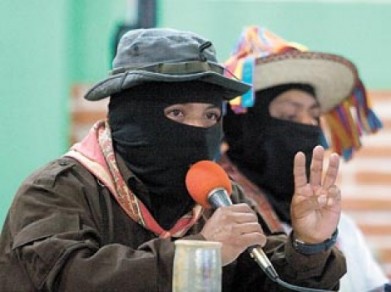
Comandante Moisés
In Chiapas
1. EZLN Introduces Subcomandante Moisés – During February, the EZLN released Part VI, entitled Gazes, of the essay THEM AND US. All 6 parts are translated into English on our blog: https://compamanuel.wordpress.com/
In Part VI, which also has 6 sections, Marcos announces that the EZLN has a new Subcomandante: Moisés, who has been a lieutenant colonel in the EZLN’s military arm for the past approximately 10 years. Moisés is widely believed to be the successor to Marcos and this promotion and appointment would seem to confirm it. The introduction was followed by a letter from Subcomandante Moisés. In the letter, Moisés explains that his role is to be the “door” and the role of Marcos is to be the “window.” Apparently the role of the “door” is to get to know us, the adherents to the Sixth Declaration of the Lacandón Jungle (the Sixth or la Sexta) and the role of Marcos is to look at or watch those on the outside (not part of the Sixth) who continue to look “above,” as well as those who refuse to look above. Moisés also introduced us to the “little schools” where the Zapatista bases will teach us about freedom; in other words Freedom Schools.
2. Zapatistas Talk About Autonomous Government; Invite Us to “Little Schools” – The EZLN next issued Part VII of THEM AND US in February. In the first communiqué of Part VII, titled “The Smallest Ones,” Marcos tells us that the Zapatista support bases are preparing “little schools” where they will teach adherents to the Sixth Declaration about their experience constructing autonomy and government. The course will be called “Freedom According to the Zapatistas.” The next several sections of Part Vii consist of transcriptions of recordings from a conference that Zapatista support bases held to talk about their experiences. Zapatista support bases talk about creating autonomous government and the history of Zapatista women. The women’s voices tell an amazing story! See:
The 4th communiqué in Part VII, also about women’s stories, is not yet translated into English.
3. Zapatistas in San Marcos Aviles In Danger of Eviction – On February 23, the Fray Bartolome de las Casas Human Rights Center (Frayba) issued an URGENT ACTION regarding the threat of imminent eviction to Zapatista families living in San Marcos Avles ejido. Political party members in the ejido have asked the municipal government to evict the Zapatistas for failing to pay a property tax. The on-going harassment from the political parties in the ejido and threats of yet another violent eviction pose a dangerous situation and a hostile environment for all the Zapatistas living there.
4. Chiapas Civil Organizations Call Attention to the Situation in Busiljá – Nine Chiapas organizations, including human rights groupings, denounced the “profound humanitarian crisis” involving the 7 displaced Tzeltal families from the Busilja ejido. The 7 families are members of the Genaro Vazquez Rojas Front of Ejidos and are adherents to the EZLN’s Sixth Declaration of the Lacandón Jungle. Specifically, a little girl remains kidnapped and disappeared by paramilitaries living in Busilja, one of the displaced family members is incarcerated unjustly in a state prison and members of all 7 displaced families have arrest warrants issued for them because of not abandoning their lands or not accepting projects from the government. The nine organizations demand that the state government release the man in prison, Elias Sanchez Gomez (son), cancel the arrest warrants and comply with an Inter-American Commission on Human Rights determination of precautionary measures for the little missing girl, Gabriela Sanchez Morales.
In Other Parts of Mexico
1. Survey Finds that Zapatismo Remains Alive for 44% of Mexicans Polled – “The silent marches realized in some localities in the state of Chiapas last December 21, marked the return of the Zapatista National Liberation Army (EZLN, its initials in Spanish) and of its representative Subcomandante Marcos, to the country’s public and political life” postulates the polling company Parametría in a national study about the theme, effectuated last January, which showed that for 44 (percent) of those polled the movement “continues alive.”
2. U.S. Escalation of Mexico Drug War – On December 31, 2012, before leaving the Pentagon, then U.S. Secretary of Defense Leon Panetta established a new US-based special operations headquarters to teach Mexican security forces how to hunt drug cartels the same way special operations teams hunt al-Qaeda, according to a report from the Associated Press last month. The new headquarters will be at the US Northern Command in Colorado. Navy Admiral Bill McRaven is in charge of the special operations command. This is the latest step in the U.S. escalation of the militarization of Mexico.
___________________________________
Compiled monthly by the Chiapas Support Committee.The primary sources for our information are: La Jornada, Enlace Zapatista and the Fray Bartolome de las Casas Human Rights Center (Frayba).
We encourage folks to distribute this information widely, but please include our name and contact information in the distribution. Gracias/Thanks.
Click on the Donate button of www.chiapas-support.org to support indigenous autonomy.
_______________________________________________________
Chiapas Support Committee/Comité de Apoyo a Chiapas
P.O. Box 3421, Oakland, CA 94609
Email: cezmat@igc.org
http://www.facebook.com/pages/Chiapas-Support-Committee-Oakland/86234490686
EZLN: Marcos: THEM AND US VII. The Smallest Ones 3. The Compañeras
Protected: THEM AND US. VII. – The Smallest Ones 3. The Compañeras – The very long path of the Zapatista women.
THEM AND US
VII. – The Smallest Ones 3.
3. – Las Compañeras – The very long path of the Zapatista women.
February 2013.
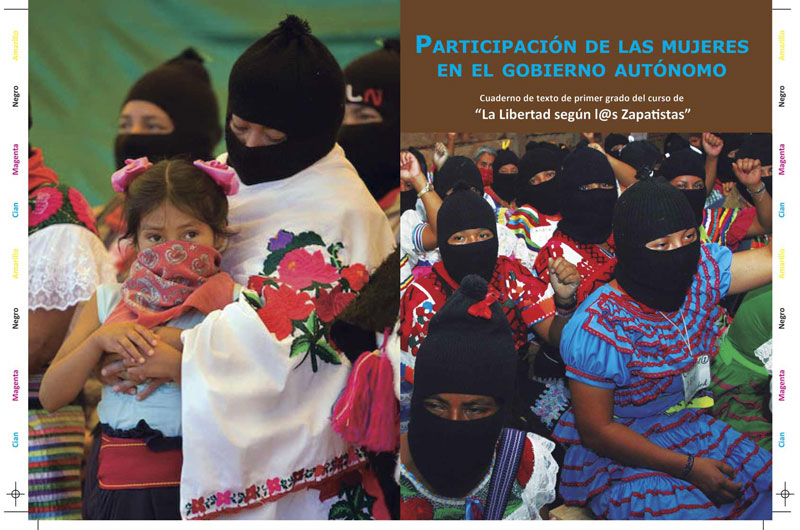
NOTA: We continue with some fragments from the sharing of the Zapatista women, the same ones that make up part of the notebook of text entitled “Participation of women in autonomous government.“ In these fragments, the compañeras talk about how they see their own history of struggle as women and, on the way, bring down some of the sexist, racist and anti-Zapatista ideas that, in all of the political specter, there are about women, about indigenous women and about the Zapatistas.
-*-
-*-
Good morning, everyone. My name is Guadalupe. My town is Galilea in the Monterrey Region. As you heard, there are regions that don’t have an autonomous municipio. I come from a region where there is no autonomous municipio. My position is education promoter and I represent Caracol II “Resistance and Rebelliousness for Humanity” in the Los Altos Zone of Chiapas. To begin I am going to present a small introduction so that we are able to enter the theme.
We know that from the beginning of life women had a very important role in society, in the peoples, en las tribes. Women didn’t live like we live now. They were respected; they were most important for the family’s preservation. They were respected because they give life just like we now respect the Mother Earth that gives us life. In that time the woman had a very important role but with history and with the arrival of private property that was changing.
Upon the arrival of private property the woman was relegated, passed to another level and what we call “patriarchy” arrived with the plunder of women’s rights, with the plunder of land. It was then with the arrival of private property that the men began to command. We know that with this arrival of private property three great evils were presented, which are the exploitation of everyone, men and women, but more the women, as women are also exploited by this neoliberal system We also know that with it came the oppression of men towards women for being women and we also suffer as women at this time discrimination for being indigenous. Then we have these three great evils. There are others but right now we aren’t talking about that.
We inside the organization, with such a lack of rights as women, saw it necessary to struggle for the equality of rights between men and women. It was how our Women’s Revolutionary Law was decided. We know that we here in the Altos Zone perhaps have not had big advances. The advances have been small; they are slow but we are advancing, compañeras and compañeros.
Here we are going to say in the Altos Zone how it is that we have advanced with the different levels, in the different areas, in the different places where we work. We are also going to tell how in the revolutionary law we have seen, we have analyzed, before coming here, between men and women analyzed how we are in each one of these points of the Women’s Revolutionary Law. That is what we are going to say; because it is very important that not only women will participate in this analysis; the men also need to participate to listen to what we think, what we say. Because if we are talking about a revolutionary struggle, we don’t make a revolutionary struggle only with the men or only with the women; it is the task of everyone, it is the task of the people and as people we have boys, girls, men, women, young men, young women, adult males, adult females, elderly men and elderly women. We all have a place in this struggle and therefore we all must participate in this analysis and in the tasks that we have pending.
(…)
-*-
(…)
Compañeros, compañeras, my name is Eloisa, from the town called Alemania, San Pedro Michoacán municipio. I was a member of the Good Government Junta, of Caracol I “Mother of the Caracols. Sea of Our Dreams.” It’s up to us to talk a little about the theme of the compañeras and it’s up to me to talk a little about how it is what the participation of the compañeras was before ‘94 and a little about how we were advancing after ‘94.
As we talk in our zone, we as compañeras did not participate from the beginning. Our compañeras from earlier did not have that idea that we as compañeras are able to participate. We had that thinking or that idea that we as women are only useful for the home or caring for the children, making the food. Perhaps it will be because of the same ignorance of capitalism that that is what we had in our heads. But we also as women felt that fear of not being able to do things outside the home, just as we also did not have that space at the side of the compañeros.
Like we didn’t have that freedom of participating, of speaking, as it was thought that the men were more than us. When we were under the domination of our fathers, our fathers did not give us that freedom to go out because there was a lot of machismo that existed before. Perhaps with the compañeros it’s not because they wanted to do it but rather because they had the idea that the same capitalism or the same system didn’t penetrate into our heads. Also because the compañero is not accustomed to doing the work inside the home, caring for the children, washing the clothes, making the food and that it’s difficult for the compañero to do the work inside the home so its hard for him to take care of the children so that the compañera can leave to do her work.
As I said before, the compañeras that lived under the dominion of our fathers or that still lived with our parents, as we have a respect that when we are with our parents, our parents say whether we are able to do the work, because we’re going away to where we do the work. But if our parents, at times tell us no you are not going to go, it’s that at time a we respect it, also at times we have in our head we respect our parents. Then there are times that our parents don’t take us out. It has also happened that they think that by taking us out of our houses as daughters we are not going to the work that corresponds to us but rather that we are going to do other things and then we involve our parents in problems and our parents already occupy that space to settle our different problems that we have as women. Also at times that is the idea of our parents or of our husbands, those that are already couples, in other words, sometimes the compañeros (men) also have that idea.
(…)
-*-
Compañeros and compañeras, a very good afternoon to all of you present here today. My name is Andrea, my town is San Manuel, my municipio is Francisco Gómez of Caracol III “La Garrucha.” We came representing ourselves as compañeras from the zone of Garrucha. We manage to express ourselves because we don’t bring so many words. The majority there speaks Tzeltal.
I am going to begin first with that we knew before ‘94 that the compañeras had suffered a lot. There were humiliations, mistreatment, rapes, but that wasn’t important to the government, its work is only to destroy us as women. It wasn’t important if there is a woman that was sick or if you ask for help or aid; that is not important.
But we as women, now, no longer can permit than, we must continue forward. We suffered as women in those times, as the compañeras have commented. In those times I said that there were a lot of humiliations that the bad government did and also the finqueros (estate owners). What did they do at that time? It’s that they weren’t taking the compañeras into account.
What did those finqueros do? They had the compañeros in peonage (near slavery). The compañeras were getting up very early to work and it’s still that way. The poor women continued working alongside the men. There was much slavery, but the compañeros, now no longer want that. That’s how it is that our participation as compañeras appeared. At that time there was no participation. They had us as if we were blind, without being able to speak. But what we want right now is that our autonomy functions. Now we want to participate as women, that we are no longer left behind. We will continue forward so that the bad government may see that we no longer let ourselves be exploited as it did with our ancestors. We no longer want that.
It wasn’t until 1994 that we had our Women’s Law. That’s good, compañeros, that now we can participate. Starting with that year they have gone to demonstrations, it has now been seen that the compañeras have participated. For example, the women also went to the National Consultation; they participated. I was also present at that time. I was 14 years old and I was present in the National Consultation. I did not know how to participate or speak, but I got to where I could do it, compañeros.
Women have struggled, have demonstrated their ability to struggle, and the government now realizes that women won’t give up; we will keep going. And now, as I said, we want our autonomy to function. Now that we have rights as women, what we are going to do is build, do our work; it is now our obligation, as they say, to keep going.
So a question for those of us who are present here, maybe for one of the compañeras that follows me: do you know who made the Revolutionary Law? If someone wants to answer they can, because someone fought for this law and defended us. Who was it that fought for us compañeras? It was Comandanta Ramona, she made this effort for us. She didn’t know how to read or write, nor did she speak Spanish. So why don’t we, compañeras, make this same effort? She, who already made this effort, is our example. She is the example that we are going to follow going forward in our work, to demonstrate what we know in our organization.
-*-
It is my job to represent the compañeras who are going to participate on the subject of women, there are 5 compañeras who are going to participate. Good afternoon to everyone. My name is Claudia and I come from the Caracol IV of Morelia. I am one of the bases of support from the pueblo Alemania, region Independencia, autonomous municipality “17 de Noviembre”. I am going to read a short introduction before entering our sub-themes. I am going to read the text, because if I just say it, being up here in front, I’m going to forget what I want to say.
Before, a long time ago, we suffered mistreatment, discrimination, and inequality in the home and in the community. We always suffered. They told us that we were mere objects, that we weren’t good for anything, because that is what our grandmothers had taught us. They only taught us to work in the house, in the field, to take care of the children and the animals, and to serve our husbands.
We did not have the opportunity to go to school, that’s why we do not know how to read or write, much less speak Spanish. They told us that women do not have the right to participate or to complain. We didn’t know how to defend ourselves, nor did we know what rights were. That’s how the bosses, who were the ranchers, educated our grandmothers.
Some of us still today have this idea that we must only work in the house, because that suffering has continued to imprison us in that idea even now, But after December of 1994, the autonomous municipalities were formed and there is where we began to participate, to learn how to do this work, thanks to our organization which gave us a space for our participation as compañeras, but also thanks to our compañeros, to our parents who began to understand that we have a right to do this kind of work.
(…)
-*-
Compañera Ana. It is our turn again, the Zona Norte, the participants who are going to speak on the themes that we analyzed in our Caracol are here. I am going to begin with an introduction.
Many years ago there was equality between men and women, because there wasn’t one who was more important than the other. Inequality began little by little with the division of labor, when the men became those who went to the field to cultivate food, went hunting to complement our food supply, and women stayed in the house to do domestic work, as well as the weaving and spinning of clothes and the making of kitchen utensils like pots, glasses, clay plates. Later another division of work arose when some people began to work in livestock. Cattle began to serve as a form of money. They were used as exchange. With time this activity became the most important, even more so when the bourgeoisie arose, who dedicated themselves to buying and selling in order to accumulate profits. The men did all of this work and that is why it’s men who rule the family, because only the man earned money for family expenses, and the work of women was not recognized as important. That’s why women were viewed as less, weak, incapable of work.
That was the custom, the way of life the Spanish brought when they came to conquer our peoples, as we said before, it was the friars who educated and instructed us in their customs and knowledge. From that point on they taught us that women had to serve men and pay attention to their orders, that women must cover their heads with a veil when they go to church, and that a woman shouldn’t let her gaze wander just anywhere, she must keep her head down. It was believed that it was women who made men sin, and that is why the church did not permit women to go to school, much less occupy positions of responsibility (cargos).
We as indigenous peoples adopted as a culture the way that the Spanish treated their women, that is why inequality between men and women arose in our communities and continues to this day. These are examples:
Women were not allowed to go to school, and if a young girl left to study somewhere she was looked upon badly by the people in the communities. Little girls weren’t allowed to play with little boys, or to touch their toys. The only work women were to do was in the kitchen and raising children. Young single women did not have the freedom even to walk around the community or in the city, they had to be shut up in their house, and when they got married they were exchanged for alcohol or other goods without even giving their word as to if they were in agreement or not, because they did not have the right to choose their spouse. Once they were married they could not go anywhere alone or talk to other people, especially men. Their own husbands mistreated women and there was no concern for justice, this kind of mistreatment happened mostly when men were drinking. Women had to live their whole lives like that, in suffering and abuse.
Another thing that mothers did was instruct their daughters how to serve food to their brothers, so that later on they would live well with their husband and not be mistreated. It was believed that the reason for mistreatment was that the woman did not learn to serve her husband and do everything he said.
But our grandfathers and grandmothers also had good customs that we continue to practice today. They did not worry much when someone was sick, because they knew medicinal plants and they knew how to take care of their health. They didn’t worry about lack of money because they grew everything they needed to feed themselves. That’s why women were strong, they were workers, they made their own clothes, cal [lime], and even though they didn’t know their rights, they could go forward.
(…)
(To be continued…)
I attest.
From the mountains of the Mexican Southeast,
Subcomandante Insurgente Marcos.
Mexico, February 2013.
———————————————————————
Translation: Chiapas Support Committee
Watch and listen to the videos that accompany this text:
En español: http://desinformemonos.org/2013/02/la-comandanta-ramona-y-las-zapatistas/print/
As this is about women, here Violeta Parra sings “Arauco tiene una pena.” 50 years after this voice, the Mapuche People continue to resist and transform this shame into rage.
———————–
Audios and Images from the gathering “La Comandanta Ramona and the Zapatistas,” celebrated in Zapatistas lands in December of 2007. In one part, our compañera Comandanta Susana remembers Comandanta Ramona, deceased in January of 2006.
—————————————
Message from the Zapatista compañeras to the compañeras of the world, in December of 2006. At minute 2:22 the compañera says, “We don’t need a professional to come tell us how we should live.”
EZLN: Marcos: THEM AND US VII – The Smallest Ones 2. How is it done?
Protected: THEM AND US VII. – The Smallest Ones 2. -How is it done?
THEM AND US
VII. – The Smallest Ones 2. 
2. – How is it done?
February 2013.
Note: Compas, at another time (if it comes to pass) we will explain how our EZLN is organized. Now we don’t want to distract you from the “Sharing.“ We just want to clarify that you are going to see something from an “Information Commission.” This Commission is formed by compañeras and compañeros, comandantes and comandantas (The CCRI or Indigenous Revolutionary Clandestine Committee), who examine the work of autonomy, support the Good Government Juntas and keep the Zapatista support bases informed of how everything goes. Here go, then, more fragments from the Zapatista “sharing:”
-*-
(…)
We do the work in this way. Like here in the last one it says: how are problems resolved? Yes, there have been problems in the municipio [1]. Problems of land, problems with threats, problems with electricity, yes it exists and I believe that those problems exist in all the towns, because we don’t live with just those who are support bases, it’s more when we live in the official towns where the enemies are, where those that govern are, where the paramilitaries are, therefore those problems exist. But we have to look at the way in which we must govern, although really learning does cost you because, as some compañeros say, there is no instructive. There is no form from which to guide each other, there is no writing where we must guide ourselves, but we must remember what was useful to our ancestors when they were not named by the officials but rather by the people and they served the people and there was no paycheck. Now the corruption began, the bad service began and it’s when the paycheck entered.
Therefore in this way, the little that I have been in my town, in my municipio, it’s how I have been able to serve although still, as I have said, we continue learning, not because now we age. We continue learning with everyone. I believe that this is the function of the different levels, as well as the commissioners and agents, also have their function but also lack how to resolve a problem. Yes it’s lacking because we are not prepared, because we as campesinos focus more on the countryside, our law is the machete and lime, and the pozol that we carry. Well I don’t know if I am bad, compañeros, but that is what I manage to share with you.
(…)
-*-
(…)
We held many meetings and we made many agreements; not only once was the agreement made, we saw that it is a heavy job. It is not easy to do. Why? Because just as I said a little while ago, we have no guide, we have no book where we can look, to follow; we were working with our people.
-*-
(…)
Compañeros, that is what we are talking about, and no longer is there much that I am going to complete. Just like we were saying about the way in which we want to manage the work. Many times the Junta cannot do it alone, although it passes in our mind, although the thought comes to us, one must be the base of coordination with the councils, comités [CCRI], so that that idea can be made from what we think, because it that way in some cases.
For example, we talked about the positions, the responsibilities; there we see the difficulties that there are many jobs to do. The time when I was in charge we saw that at times the members of the Junta fail and the work exists; for example, at that time there were no drivers for the clinic, the Junta has to be the driver, has to be the cook, has to go looking for firewood, had many jobs and also the work inside of the office has to be done, we have to study what’s pending (lacking), the jobs that remain pending or some work of the municipio that has not been resolved, as there is not enough time. Now I see, and that crossed our mind, that we were indeed in need of help, with another separate driver, because at times it was up to us to go get an urgently sick person at midnight, the Junta has to go, it arrives at three in the morning, at four in the morning. That crossed our mind but we could not resolve it, it was present but we just couldn’t.
An example in my turn, about the municipios, diagnosing the most frequent sickness in the municipios and it couldn’t be defined in the Junta, nor with information. I had to ask for help if it could be done or not, and with help from the commander, which is what was needed. The municipio was asked and some municipios did not act again, some municipios gave that response, consulted the people about what the most frequent illness was, because there was an outbreak of typhoid but the councils didn’t do it. When all the work is done then it functions well. It’s like a machine. When a machine doesn’t function a piston or a cylinder in the car doesn’t rise, it has no power. That is what happens to us in our authority, although the Junta thinks or wants to put its proposal for approval with the assembly at times, many times it can’t be done and it stays there like that.
But it is indeed a need. At that time I saw there was a lot of work in that year because there was no driver. Right now I see that now drivers are rotating for the clinics, apart from their work, that doesn’t work on the Junta, washing its car, checking the tires, filling it with gas are separate.
It’s improving a little more in that step and I believe that way little by little it’s going to be improving, always and when we are thinking and seeing what the necessities are that are being presented, because the work of the zone or of the municipio is increasing little by little. Little by little more compañeras are participating because the work is being born. That is what we see that is very important, the coordination between everyone and taking ourselves into account between everyone to be able get the proposals and new ideas about how to be able to work.
The importance is to not lose contact with the peoples in these times of work. I hear that there are things that were done with analysis from the people and now they can be done without consulting the people, they can change some letters without the people knowing it, then that is also a problem that we can run amok of the people, because when we teach the people, we explain to them and when we suddenly set the people aside, they speak, they discuss.
That can bring non-conformities or they speak ill of the authorities, and many times one needs to explain it to the people, like we were saying today, the Junta has to be clear with the seven principles. [He refers to the 7 principles of govern obeying” that guide the Good Government Juntas, which are: To serve and not Serve yourself; To Represent and not Supplant; To Construct and not Destroy; to Obey and not Order; to Propose and not Impose; to Convince and not Conquer; to Descend and not Climb].
It is convincing the people and not surmount by force whatever an authority wants, he must explain the reason for modifying any rules or agreements, it must be explained to the people; because if I am an authority and I no longer explain to them that no, but that point came from the people? It can bring non-conformity although the people understand it; but with explanation it is trying to convince and not force it on them, so that the people don’t become discouraged, don’t lose control. That is what I can explain a little more, because disagreements are born from that and the people go around demoralized, that’s why I say it, because I saw the problem that way.
One must always be rooted with the people.
There are also towns that also want to do something without a majority, then one must also explain to that town that it cannot be done, because some cases of that type happened to us. There are peoples that come into the office and even raise their voice against the authorities but we cannot accept it because it depends on the majority. One must be clear in that, but it is to explain to the people and try to convince them de, let them understand the reason why these things are done. That’s my opinion, compañeros, and that is what I try to explain about the seven principles, it is what I understood, what I learned a little. I didn’t learn much because I only worked three years and little by little I was learning, at the same time one cannot do the work easy because we entered new without help, but not now, there are compañeros that still remain for one year accompanying the new authorities, so that one is more or less supported.
But not when we started, there was no help like that other than the comités [CCRI] because they were here, we helped each other with that and little by little we learned. I understood a little, it’s the little that I was able to explain, compañeros.
(…)
How were they named?
They were named through the assembly; it is an example of how we are now. Each municipio called the base to an assembly, and then they directly chose that group of compañeros to do the work of autonomy.
What work did they have? What work are those compañeros going to do because we had practically no knowledge? Perhaps some did have, but a majority doesn’t have knowledge. What are we going to do? We are going to work on autonomy; we are going to govern ourselves. The question that emerged is how; what is it we are going to do? It’s just that no one, just that it doesn’t have, didn’t know the answer, but as time passed, when they were already authorities, then the problems came out. There were really problems in each one of our towns, in our municipios.
What are the problems that those who were authorities at that time confronted?
At that time the principal problem that we confronted was alcoholism, family problems, problems between neighbors and some agrarian problems.
Then what did that group of compañeros do when a problem was presented?
What they did is they discuss it. First comes the complainant and later the problem he has is heard, it listened, when they already listened they cite the other party. The two parties are heard. Then what that group of compañeros did is to listen, what they did is that those brothers that have a problem were heard first as to what the problem is that they have and at the same time was heard who is right. As soon as we saw that the complainant was right then one must speak with the other brother with whom he has the problem.
What the authorities did at that time is that they were giving ideas, in other words they were convincing the two parties to reach a peaceful solution without so much fuss.
The authorities did the same thing with other types of problems, they did that in agrarian questions, they also convinced the brothers not to fight with each other, that they not fight with each other over a piece of land; if the brother is really take a piece of land away then one must also give the reason that the other one is taking away land that he should be doing. What it is, it is.
(…)
-*-
(…)
Yes, that so, but then my question is whether it’s necessary to make a rule, and then who proposes the idea? Where is the idea born of how a rule ought to be made? Who is it that says ‘I propose that’? Where is the idea born? And directly then, how do you do it so that it unites the voice of the people, because if it is now appropriately up to the Junta, does it assume that or must it still be supported by the compañeros of the Information Commission? Or who is it that says that one must make a rule here?
Response of another compañero: Thus there may be an initiative purely from compañera authorities, from what comes the initiative how to make a rule, now just from pure compañeras that are functioning from a position of authority, that does not exist yet.
No, compa, my question is as a Good Government Junta, not as compañeras. As the Good Government Junta and it is an example that I am giving, it is not especially about regulation or about law. When they see that there is a need or there is a problem, therefore I give the example of a regulation, because that demands the relationship, because the Good Government Junta is not going to impose a law, then we would like them to speak with us how it is that they do that. Because here is where the play of democracy enters, then what we want to understand, well not all the time, like you told us, it’s not going to be all the time the insurgente commanders either. We understand that one day it won’t be the Information Commission all the time either, in other words the CCRI [Comité Clandestino Revolucionario Indígena]. Then how do you, as the Good Government Junta, make a thing that is needed, that is already law that is now a problem start to go around, about any issue that is necessary to take forward, a project or whatever. What is the relationship between the Good Government Junta, the MAREZ [Autonomous Zapatista Rebel Municipios], the authorities and the towns?
In other words, how does one make democracy?
(…)
-*-
(It will continue…)
I atttest.
From the mountains of the Mexican Southeast,
Subcomandante Insurgente Marcos.
Mexico, February 2013.
:::::::::::::::::::::::::::::::::::::::::::::::::::::::::::::::::::::::::::::
1. Municipio – We did not translate the Spanish word into English. The literal translation is municipality. In Zapatista territory, the autonomous municipios are like rural counties.
Translation: Chiapas Support Committee
Listen and watch the videos that accompany this text:
http://enlacezapatista.ezln.org.mx/2013/02/22/ellos-y-nosotros-vii-ls-mas-pequens-2-como-se-hace/
Alfredo Zitarrosa, maestro perhaps involuntarily of an Eastern generation that still struggles with South American ballads, sad love songs and street dances. Here singing “Adagio in my country” and by country, it’s clear, he refers to each corner in which many worlds abound and run together.
——————————————————————–
Arturo Meza with the song “The Rebelliousness of Light.” In one part of the song maestro Meza mentions each one of the original peoples that, in Mexico, resist and struggle.
——————————————————————–
Daniel Viglietti, our brother and compa, reads a story called “The Story of Noise and Silence” that tries, in vane, to explain the Zapatista silences and glances.
EZLN; Marcos; The Smallest Ones 1. Learning to govern
[Dear Readers: The texts in this communiqué are about how the 4 municipios in the region where we work were founded. It explains who Compañero (Compa) Manuel is and how our partner municipio got its name.]
Protected: THEM AND US VII. – The Smallest Ones 1. Learning to govern and to govern each other, in other words, to respect and to respect each other.
THEM AND US
VII. – The Smallest Ones 1.
1. – Learning to govern and to govern each other, in other words, to respect and to respect each other.
February 2013.
Note: the notebooks with text, which are part of the support material for the course “Freedom according to the Zapatistas,” are the product of the meetings that the Zapatista support bases from all the zones held to evaluate the organization’s work. Tzotzil, Chol, Tzeltal, Tojolabal, Mam, Zoque and mestizo compañeras and compañeros, coming from the communities in resistance of the 5 caracoles, asked each other questions and responded with answers, exchanged their experiences (that are different according to each zone). They criticized, self-criticized, and evaluated how they have advanced and what there is still to do. Those meetings were coordinated by our compañero Subcomandante Insurgente Moisés and were taped, transcribed and worked on for the elaboration of the notebooks with text de.
As in these meetings the compas shared with each other their thoughts, their histories, their problems and possible solutions, they are the ones who put the name to this process: the sharing.“
These are some free fragments from the Zapatista sharing:
-*-
(…)
We are here to share the experience and one of those, our word as Zapatistas, is that we govern each other; we govern collectively. How can sharing give us the form of how you govern together collectively?
The way that we are working is not to be separate from the people. Just as we always do in questions of speaking about regulations or about plans for activities, for work, the information has to reach the people and the authorities have to be present in the plans, in making the proposals.
(…)
There we are working on some things that we consider as part of the obligations of autonomous government, one is that it is the obligation of the autonomous government to attend to any person that goes to the office for different issues, whether a solution to his issue is given or not, he must be heard. Whomever, Zapatista or non-Zapatista, that’s how we are working there, always and when he is not a government person or envoy, if that’s what he is, well those are not attended to, he is not attended to there. But if he is not, if he is with some social organization, he is attended to. We are also working there and always pending that we are complying with the seven principles of “mandar obedeciendo” (govern by obeying) and we think that we must do it like that, it’s like an obligation, so as not to commit the same errors as the instances (agencies) of the bad government and not to keep their same ways, then that which is going to govern us are the seven principles.
-*-
The first Aguascalientes was constructed in Guadalupe Tepeyac and that’s where the first step of our organization and our way of asserting our rights began. This Aguascalientes we said is a cultural, political, social, economic, ideological center, but with the treason of Ernesto Zedillo, he thought with this dismantlement, that offensive that he made, thought that with that he was going to end the politics of our organization. But his policy did the reverse because from right there, in that same year of ‘94, it was declared that five more Aguascalientes would be made.
(…)
-*-
These municipios said where the headquarters is going to be; then they began to look for names for the municipios, what they are going to call them. Once they have the headquarters, they now began to see what they are going to name the municipios. The first autonomous municipio [1] in La Garrucha (the headquarters) said that it is going to be called Francisco Gómez; the other municipio that is now San Manuel, for which Las Tazas was the headquarters, that one we said was called San Manuel; Taniperlas was called Ricardo Flores Magón; San Salvador, Francisco Villa. All these were in honor of the compañeros like Francisco Gómez that we all already know, because he is a compañero that gave his life for our cause, and we already talked about the compañero, who died in combat in Ocosingo on January 1, thus it was called Francisco Gómez. Then San Manuel in honor of Compañero Manuel, who is the founder of our organization. Ricardo Flores Magón, well we know that he is a historic social struggler. And Francisco Villa, well he is likewise a revolutionary that we all know. Then that’s how our municipios were formed, that’s how we decided to make the names of all our municipios and the agreements. All were made in a community assembly, in the regional assembly, that’s where all our municipios were named. Compañeros, it is the few words that I am going to tell you and you are going to pass to other compañeros or compañeras to explain what’s next.
(…)
-*-
The principal problems present from the beginning of [inaudible] were the problems of alcoholism. How is that problem now in your zone?
Look, compañero, in those times, at the beginning of 1994, a little bit after the war well, some entered with fear. The war started, we all crowded together, just as they told us, we got involved and for that we got involved, it can be that it happened like that, the people crowded together. Some, yes they did it consciously but others for fear, then who did it per se because of fear, are not happy doing the work. What is it that they were doing? Although we had the order that we should not take a drink, but what happens is that they were drinking covertly. What is it that we were doing? We were not punishing, what we were doing, for that we have we have the commission of elders; those are the ones in charge of asking why is he doing that and it was explained to him about the damage he is provoking to himself. Then those who obey then practically they are going to follow and those who don’t well they fight with each other. That is the answer.
(…)
-*-
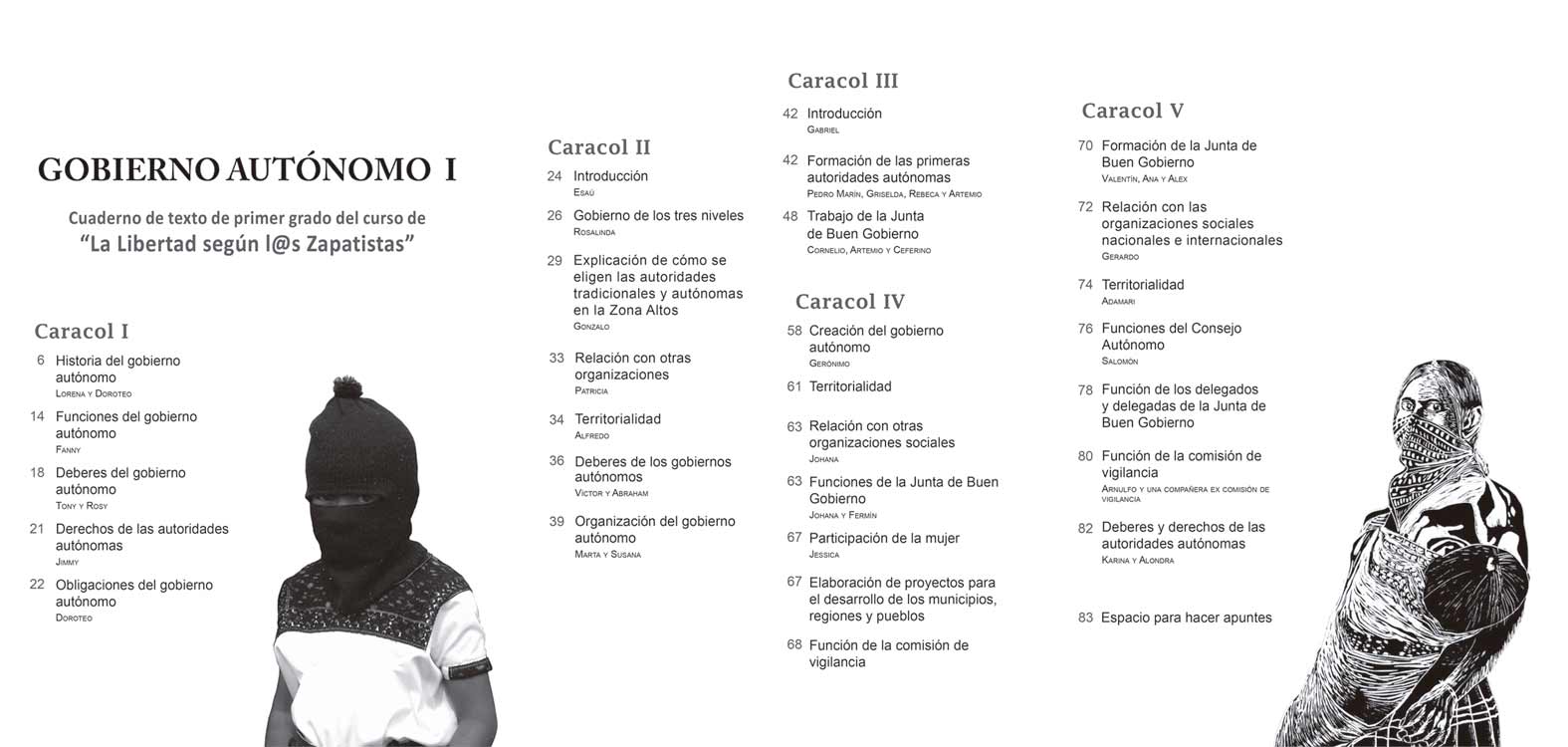
-*-
Compañeros and compañeras, good afternoon to everyone. I come from a village that is called ____, which belongs to the municipio of Francisco Villa. I come to represent the Good Government Junta. My position was Consejo (council member), in the year 2006 to 2009. I am going to explain how the cause of our position that we all have was. It’s not up to me to explain where we started in 1994. I am going to tell a little about how we began after 1994. Before, in 91, 92, what was the reason for the armed uprising? It’s because of the domination, the marginalization and the humiliation, because of the injustices and the rules or laws of the bad governments and of the exploiter landowners. And so before, our parents and grandparents, they were not taken into account, they were suffering and so we didn’t have land to work for the maintenance of our children. That’s why the Zapatista peoples began to organize where they said “ya basta (enough) of so much humiliation.” Then they rose up in arms. It wasn’t important to them to walk at night, or the hunger.
That’s how we were forming and we live organized, united, yes we could and we are going to be able to do more. After the uprising that we made happened, we saw how we are going to advance to form our autonomous authorities in each municipio. Because of that we are here all meeting to talk and share how it was that our autonomous governments began function. Why do I explain to you a little bit about that theme? It’s because what I think is that from there we were starting and advancing to where we are right now. In the theme that we are going to start to see, the word is up to compañero ___. He is going to explain as of today how we are working in our municipios and in the Good Government Junta. It is all of my word, compañeros.
Compañeros, that’s how the other compa talked, now Compañero _____ is going to try to explain to us, because he was the founder of our autonomous government in our Caracol III, over there in La Garrucha, the first authorities were the ones that founded. Now they are going to share how they worked, how they were, how they started and how we are as of now.
-*-
(…)
As it was passed to me to make some comments to you, more or less one month after the beginning of our functions, there with an organization called the CIOAC [of PRD affiliation], they kidnapped a compañero and a truck and we felt obliged to denounce it and we did not have any idea of how to make a denunciation. Members of the Good Government Junta and the municipal councils had to give our word, one or two words, to make that denunciation, as a team, each one was giving his word and so we were making it up that like that and that’s how we were forming, that’s how we made up a denunciation, but we got it out. And therefore we made one a secretary, we made one a cook, we made one a sweeper, because we had to clean our office and all our work area. We did not especially have anyone who does those chores and so we continue doing it as of this date.
(…)
-*-
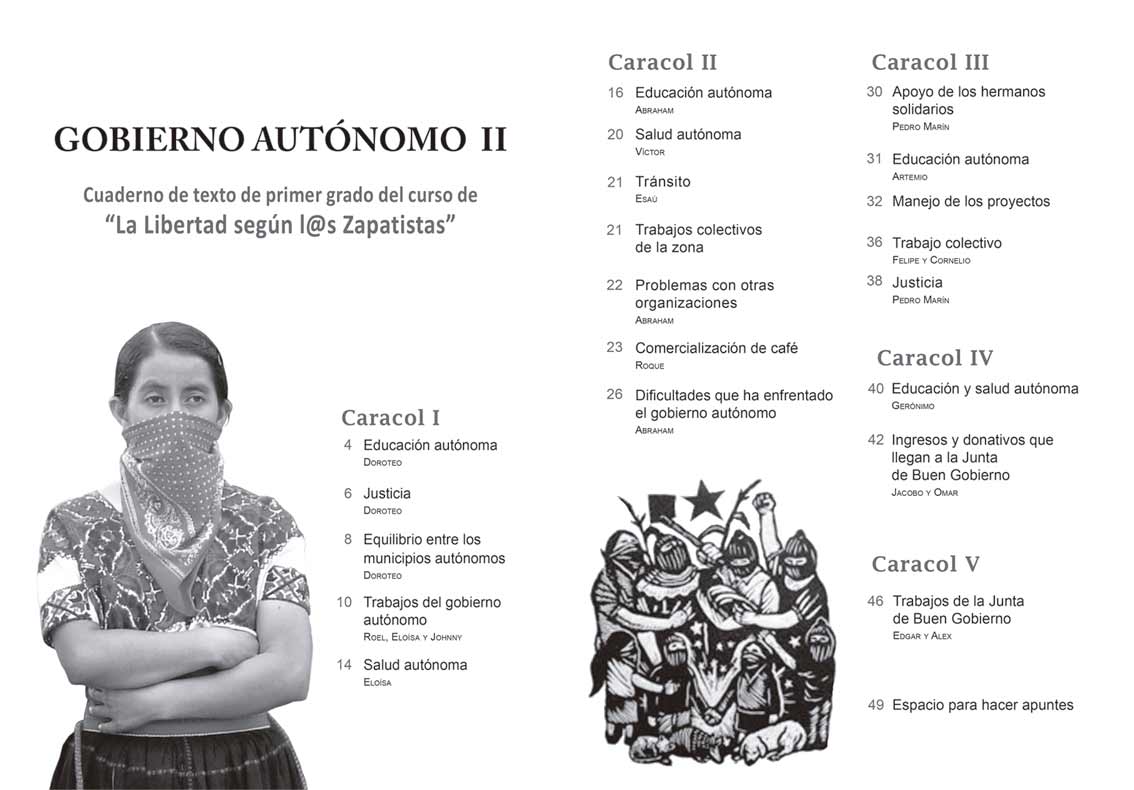
-*-
(…)
That’s how we were working and that’s how we arrived as of 2003, with the formation of the Good Government Juntas. We arrived in the Good Government Juntas, because in that zone, by saying it that way, well we didn’t know no if that directive of the association of municipios would one day be the authorities and would be the government. But in 2003, when the Good Government Juntas happened, the people and the association of municipios decide that those eight compañeros, members of the Directive of the Association of Municipios, should pass to being the authorities of the Good Government Junta. And those eight compañeros then are the ones that take the position on the Good Government Junta, in the first period of the Good Government Junta, which was from 2003 to 2006.
That’s how it happened then, under the same conditions, the Good Government Junta didn’t have an adequate place. Days before the Good Government Juntas became public well the peoples constructed, urgently, a place for the Good Government Junta, as well as a place for each one of the autonomous municipios, in the center of the Caracol. They were constructed with the materials that the peoples had at that time, used wood, used metal roofs and that’s how it began. The construction was done and they were constructed in less than a week. That’s how it started, their offices were ready, August 2003 arrives and they are made public. The peoples meet after the publication, proud of having formed one more instance of government in autonomy. And in a fiesta, in a big celebration they formally install the new autonomous government, then delivering the office, with the materials that they had.
Well we were able to say that it was un chingo (a whole lot), but the town delivered a table and two chairs to the Good Government Junta, that was their material, and a place well a little smaller than this space where we are now, that’s how the conditions were. Days later, someone over there donated a little machine of the oldest kind and with that we started to work. We received an empty space and that’s how we started, they were presenting initiatives for work and we were beginning, fixing up the space.
(…)
-*-
In the work also, as you see in the zone where we work, different ways of being exist, different ways of dressing, different colors, different beliefs, different ways of speaking, and in the work the compañero and compañera is also respected, independently of how he or she is. The only thing that interests us is the will and ability to work and then all that (difference) is not important to us whatever it may be.
(…)
-*-
(It will continue…)
I attest.
From the mountains of the Mexican Southeast,
Subcomandante Insurgente Marcos.
Mexico, February 2013.
1. Municipio – We did not translate the Spanish word into English. The literal translation is municipality. In Zapatista territory, the autonomous municipios are like rural counties.
Translation: Chiapas Support Committee
Listen and watch the videos that accompany this text:
——————————————————————–
“Caracol Power” from Lengualerta/Cuyo, music Taxi Gang. Video of Pazyarte (Peace and Art), images of the Zapatista Caracol of Oventik, Chiapas. In minute 2:42 they ask a 2 international compas what they learned. They answer: “to share”
———————————————————————–
Zach de La Rocha, vocalist of Rage Against the Machine, explains the interest of capital for annihilating Zapatismo (with a small intervention of Noam Chomsky). Zach has been in Zapatista communities, like one more, without boasting of being who he has been and is. He knew how to gaze at us; we learned how to gaze at him. Background music: the song “People of the Sun.”
————————————————————————–
The cut “Song to the Rebellion,” from the group SKA-P, with the letter included. This cut is part of their new disc “99%,” which will come out next month in March 2013, courtesy of Marquitos Spoil. Oh, there is no reason for giving them. All right! Get ready to bust a move!
————————————————————–-
EZLN: THEM AND US VII – The Smallest
THEM AND US
VII – The Smallest of them All.
Introduction.
February 2013.
For several years now, while in the politics of above they fought over the booty of a shattered nation, while the media was either silent or lied about what was happening, while the original peoples of this land went out of fashion and returned to a corner of oblivion, their lands looted, their inhabitants exploited, repressed, displaced, disrespected…
The indigenous Zapatista peoples,
Surrounded by the federal army, pursued by state and municipal police, attacked by paramilitary groups formed and equipped by governments from across the political spectrum in Mexico (PRI, PAN, PRD, PT, PVEM, MC and the other names taken by the parasitical Mexican political class), hounded by agents of the different national and foreign spy agencies, seeing their bases of support, men and women, beaten, displaced, imprisoned…
The indigenous Zapatista peoples
Without a show,
without any imperative other than duty,
without instruction manuals,
without any leaders but ourselves
without any referent other than the dream of our dead,
with only our history and memory as weapons,
looking near and far into calendars and geographies,
with our guide: Serve, not Serve yourself/ Represent, not Supplant/ Construct, not Destroy/ Obey, not Command/ Propose, not Impose/ Convince, not Defeat/ Go Below, not Climb Above.
The Zapatista peoples, the indigenous Zapatistas, the indigenous Zapatista bases of support of the eezeelen, with a new way of doing politics,
We made
We make
We will make
Freedom.
FREEDOM
OUR FREEDOM!
-*-
Note of clarification:
The texts that will appear in this seventh and final part of “Them and Us” are fragments taken from the “First Grade Notebook from the Course: Freedom according to the Zapatistas. Autonomous Government I,” and “First Grade Notebook from the Course in: Freedom according to the Zapatistas. Autonomous Government II.” The Spanish version is ONLY for compas who are part of the Sixth (We hope there will be versions in the original languages as determined by the National Indigenous Congress, as well as in English, Italian, French, Portuguese, Greek, German, Euskera, Catalonian, Arabic, Hebrew, Galician, Kurdish, Aragonese, Danish, Swedish, Finnish, Japanese, and other languages, according to the support of compas of the Sixth around the world who know about the task of translating). These notebooks form part of the support material for the course that the Zapatista bases of support will give to the compas of the Sixth in Mexico and from around the world.
All of the texts are authored by the Zapatista bases of support, men and women, and they include not only the process of the struggle for freedom, but also their critical and self-critical reflections about our path. That is, they demonstrate how we Zapatistas see freedom and how we struggle to achieve it, exercise it, and defend it.
As our compañero Subcomandante Insurgente Moisés has already explained, our compas from the Zapatista bases of support are going to share the little we have learned about the struggle for freedom, and the compas of the Sixth can see what is useful or not for their own struggle

This class in the little Zapatista school, as you now know, is called “Freedom according to the Zapatistas,” and it will be given directly by compañeros and compañeras who are bases of support of the eezeelen, who have carried out the various tasks of government, vigilance, and other diverse responsibilities in the construction of Zapatista autonomy.

In order to be admitted to the little school, in addition to being invited, the compas of the Sixth and special invitees will need to take a few preparatory, previous, or propaedeutic courses (or however you say what comes before kindergarten), before passing into “first grade.” These courses will be given by compas from the support teams of the EZLN’s Sixth Commission and have as their only objective to give you the basic elements of neo-Zapatista history and our struggle for democracy, liberty, and justice.
In geographies where there aren’t compas from the support teams, we will get you the syllabus so that all invitees can prepare.
The dates and times, that is, the calendars and geographies in which the courses will be given by the Zapatista bases of support, will be announced in the appropriate moment, always carefully taking into account the situation of each individual, group, or collective invitee.
All of the invitees to the course will receive it, no matter if they can come to Zapatista territory or not. We are studying the possible forms or ways to reach your hearts, whatever your calendar and geography may be. So don’t worry.
Okay then. Cheers, now just prepare your heart, and, of course, your pencils and notebooks.
From the mountains of the Mexican Southeast.
SupMarcos.
Mexico, February of 2013.
P.S. THAT GIVES LESSONS IN MANNERS. This seventh and final part of the series “Them and Us” consists of various parts and is ONLY for the compas of the Sixth. Along with part V (which, as its numeration indicates, is called “The Sixth”) and the last of part VI. The Gazes 6: We are He,” form part of the private correspondence that the EZLN, through its spokespeople, directs to the compas of the Sixth. In each of these parts, as in the present writing, we clearly signal to whom the texts are addressed.
For those who are not compas and try to mock, enter into polemics, argue, or respond to these texts, we remind you that reading or commenting on the correspondence of others is what is done by gossipers and/or police. So you should keep track of what category you’re in. In addition, your comments only reflect a vulgar racism (you’re so critical of TV and yet you merely repeat its clichés), and reiterate your lack of imagination (which is a consequence of lack of intelligence… and laziness about reading). Although, of course, you will have to broaden your silly little chant of “marcos no, ezln yes” to “marcos and moisés no, ezln yes,” and then later, “CCRI-CG no, ezln yes.” Later on, if you hear the direct word of the Zapatista bases of support (which I doubt will happen), you will have to say “ezln no, ezln neither”), but it will already be too late.
Oh don’t be sad. When we put up music videos by Ricardo Arjona, Luis Miguel, Yustin Bibier or Ricky Martin, you can feel interpellated. Meanwhile, stay seated, keep looking at the calendar from above (those 3 or 6 years pass quickly), move a little to the right (as you are accustomed to doing), and step aside a little, we don’t want to splash [implicate] you…
¡Órales razaaaaaa! ¡Y venga a darle al baile! ¡Ajúa!
:::::::::::::::::::::::::::::::::::::::::::::::::::::::::::::::::::::::::::::::::
Watch and listen to the videos that accompany this text:
http://enlacezapatista.ezln.org.mx/2013/02/19/ellos-y-nosotros-vii-ls-mas-pequens/
“La Estrella del Desello” with Eulalio González El Piporro. The track appears also as a shorter version, in the film “La Nave de los Monstruos” (1959, by Rogelio A. González). It doesn’t have anything to do with the eezeelen, I put it here out of stubbornness, and to greet the compas of the north: don’t give up, even though you’re far away, we’re going to include you in our gaze. ¡Ajúa!
“La Despedida” with Manu Chao and Radio Bemba, in an indigenous Zapatista community.
“Brigadistak” with Fermín Muguruza. In the struggle against Power, there are no borders! ¡Marichiweu! (We will win a thousand times, in Mapuche)
********************************* Traducción del Kilombo Intergaláctico. *********************************
EZLN: Sup Moisés: GAZES, Part 6 “We Are He”
THEM AND US VI.
GAZES Part 6: WE ARE HE
ZAPATISTA NATIONAL LIBERATION ARMY
MEXICO.
February 14, 2013.
 To: The Adherents of the Sixth all over the World.
From: Subcomandante Insurgente Moisés.
The time has come, and its moment too. There are times that all human beings experience, good or bad; one is born, comes into the world, dies, and is gone. Those are times. But there is another time, in which one can decide in what direction to walk, a time when the time arrives to look at time. That is, when one can understand life, how life should be, here in this world, and that no one can be the owner of that which makes up the world.
We were born indigenous and we are indigenous. We know that we came into the world and that we will leave this world, that is the law. We began to walk through life and we realized that we as indigenous people were not doing so well, we saw what happened to our great great great grandfathers and grandmothers, that is, in 1521, in 1810, and in 1910, that we were always used, that we gave our lives so that others could take power, that once in power they forgot about us again and went back to disrespecting, robbing, repressing, and exploiting us.
And we encountered a third time. The third time is where we are now, for a while now we’ve been walking, running, learning, working, falling, and getting back up. This is important because one has to record, to fill a tape that can be reproduced later with more lives from other times. Yes, we have been left a full bag of tapes, even though some of us aren’t here anymore. So others continue on and the process moves forward like that, and what is yet to come is yet to come, until we get to the end and we begin that other work of construction, where another world begins to be born, where they cannot screw us over again and where we are not forgotten as original peoples, we will not allow that again. Now we have learned. We want to live well, in equality, in the city and the countryside, where the people of the city and the people of the countryside rule and the government obeys, and if it doesn’t, it gets kicked out, and another is instituted.
Yes, we are indigenous, we work mother earth, we know how to use tools to harvest the fruits that she provides. We are various peoples with distinct languages. My mother tongue is Tzeltal, though I also understand Tzotzil and Chol, and I learned Spanish in the organization, with my compañeras and compañeros. And now I am what we are, together with my compañeros I have learned what it is that we want in order to live in a new world.
-*-
I write this in the name of all of the Zapatistas, since the Sup’s computer is broken. I saw that he went to get it fixed, and when I asked him what happened to his computer he said the zuich [switch] is fucked up. Ah, I said. He was carrying a chisel and a 5-kilo sledgehammer. That thing is done, I said, it can’t be fixed. So he told me that I should write to you so that you can start to get to know who is responsible for our door, and also so that we start getting to know you through what you write and say to us from everywhere, and what you tell us and have told us as compañeras and compañeros of the Sixth.
I know a little about typing on the computer and somebody gave me one to practice on a while back. Now it’s time for me to write as well, but I’m a little worried that the same thing that happened to the Sup’s computer will happen to me. I have a solution though, a swing of the axe and done, on to pen and paper. Problem solved.
In any case, I have to tell you that the task of peering out the window, which falls to Supmarcos, isn’t finished. That is, what is to come is yet to come, but it will remain pending until the Sup’s computer gets fixed.
Yes, the Sup’s job will be peering out the window at those who watch us, those who say they are “good” and who fight for the people and who have led the people but haven’t gotten anywhere, and who say it’s because the people don’t understand anything and that they understand everything, but that no one will follow them. Why? That is what they don’t understand, and won’t understand, because they only think about above, look toward above, and try to climb up above.
Well, that, and much more, is the Sup’s work, because he’s in charge of the window, he is like the frame of the window.
It is also his job to see what’s going on with the people who don’t follow those who only look above, to understand why those people are the way they are, what they think, and how they think. We think that maybe those people think like we Zapatistas do, that maybe they too think that it should be law that the people rule and the government obeys.
It is also his job to be the target of the critiques, the insults, and the go-to-hells [mentadas], as he says, and the mockery from those on the outside. But he doesn’t worry about those insults and lies, he just laughs, because, of course, we prepared him for that, we made him into steel. So now those insults and such don’t hurt him, well, yes actually sometimes his stomach hurts from laughing so hard at the things they say.
He tells me that they might start mocking me, or anybody else who speaks, also. But oh well, that’s how it goes, it could be that they make fun of me or insult me, or mock me because I am indigenous, just as they mock him for what he is. But we only care about the people that want to fight to end injustice, so as long as they don’t throw bullets or bombs at us, there’s no problem. And if they do throw those things at us, it also won’t be a problem, because there are already other compañeros and compañeras ready for the work that is and will always be the struggle. That is, we’re ready for anything they throw at us and we’re not scared.
These years, the Sup tells me, many people were blocked from the view of our window, but that one can still tell rather quickly who is like us. He wanted to count how many people like that were out there, but he lost count and just did it our way, the indigenous way, and said, there are a shitload. How much is that? I asked him. Many (masculine), many (feminine), he told me. Ah, I said. So that confirms that there will be many like us and that one day we will say along with them, “this is what we are,” without it mattering who is indigenous or not.
And that’s how we organize ourselves, some do some things and others do other things. For example, now Supmarcos’ job is the window, and my job is the door, and others have other jobs.
And it is during these times that we remember an unforgettable compañero for all of us Zapatistas, SubPedro, who in the last days of December 1993, told us: learn compas, because one day it will be your turn. We are going to struggle together, workers, campesin@s, young people, children, women, men, and older people, in Mexico and around the world. It was the truth then, and it is the truth now, even without him. The truth of the truth began when we began to struggle for the people.
Okay compas, now you know that I am in charge of the door, what we haven’t discussed yet is the new way of working with the compañeros who will come to learn what it has taken my Zapatista compañeros years to build, that which we are now.
-*-
Because we believe and trust the people, now is the time to do something about the damages that we have seen and endured for so many years, now is the time to join together in our thinking and learning and then to work, to organize. After so much experience we are ready to do this, and that experience will guide us so as not to repeat the mistakes that have gotten this world to this point.
If we don’t follow the thinking of the people, the people don’t follow us. And we only need to look at those who came before us in order not to fall into the same mistakes. To build something truly new will take word, thought, decision, and analysis, proposed by the people, studied by the people, and finally decided upon by the people.
It is like the 10 years that we worked clandestinely, when no one knew about us. “One day they will know us,” we told ourselves and that’s how we kept working all those years. And then one day we decided that it was time to be known. Now that you have known us for 19 years, you can say if what we are doing is good or bad. My compañeros say that they live better now with their autonomous governments. They realize that real democracy happens with the people, and not just every 3 or 6 years [with elections]. Democracy is carried out in each village, in autonomous municipal assemblies and in the zone-wide assemblies that make up the Juntas de Buen Gobierno (Good Government Councils), when each zone that makes up a Junta de Buen Gobierno gets together in assembly. That is, democracy is carried out every day and in every entity of the autonomous governments, alongside the people, men and women. Democracy addresses every aspect of their lives, they know democracy belongs to them, because they discuss, study, propose, analyze, and make the final decision on each issue.
They [the people] ask us, “how would this country and this world be if we organized with other indigenous brothers and sisters, and also with those brothers and sisters who aren’t indigenous?” Afterwards, they give a big smile, as if to answer this question: happiness. They already know the answer, because they hold the results, the work that they are doing, in their hands.
Yes, that’s how it is, it only requires that we organize ourselves as the poor of the city and the countryside without anyone leading us but ourselves and those that we name, and without those who only want to get into a position of power and once in power forget about us. And again and again, another just like them comes and says now this time it’s for real, this time it will be different, and then, the same tricks. They are not going to honor their word, we know that, it’s really not even worth writing about this, but that’s how it is in this country. It is desperate, exhausting, horrible.
We, the poor, know what the best way of life is for us, we know what we want, but they will not leave us be, because they know that we will get rid of exploitation and the exploiters and that we will build a new life without exploitation. This isn’t hard for us to understand, because we know how things need to change, because everything we have lived needs to change. The injustices, pains, sorrows, mistreatments, inequalities, manipulations, bad laws, persecutions, tortures, prisons, and many other bad things that we have endured, we know very well that we will not repeat the ways that have subjected us to these things. As we Zapatistas say, if we make mistakes, then we had better be up to the task of correcting them ourselves, instead of how it is now, where some people make all the mistakes and everyone else pays for it. That is, those who make the mistakes now are the representatives, senators, and bad governments of the world, and it is the people who pay the price.
One doesn’t have to have a lot of education, or speak good Spanish, or know how to read much. We’re not saying those things aren’t useful, but that we can learn enough to do our work, enough to help us organize our work. These things are like tools for the work of communicating. What we are saying is that we know how to make change, we don’t need someone to come with their campaign telling us that he or she is the change, as if we, the exploited, don’t know what change we want. Do you understand what I’m saying, indigenous brothers and sisters and people of Mexico, indigenous brother and sisters of the world, non-indigenous brothers and sisters of the world?
So, indigenous and non-indigenous brothers and sisters who are poor, join the struggle, organize yourselves, lead yourselves, do not let yourselves be led, or keep careful watch over those you choose to lead you, make sure they do the things that you have decided and you will see that things begin taking shape like they have for us the Zapatistas.
Don’t stop fighting, as the exploiters will not stop exploiting us, fight until the end, the end that is, of exploitation. No one will do this for us, no one other than ourselves. We have to take the reigns, take the wheel and take our destiny where we want it to go. In that destiny, the people are the source of democracy, the people correct themselves and keep going. Not like now, where 500 representatives and 228 senators fuck everything up and millions suffer the deadly pestilence and toxicity that result; that is, the poor, the people of Mexico, are those who suffer.
Brothers and sister laborers, we have you in mind and all others who work, we all carry the same smell of sweat from working for the exploiters. Now that my Zapatista compañer@s are opening the door, if you understand what we mean, join the Sixth and learn about the autonomous government of the EZLN. And you also, indigenous and non-indigenous brothers and sisters of the world, we want you to understand us.
We are the principal producers of the wealth of those who are wealthy. Enough! We know that that there are others who are exploited and we want to organize with them, to fight for the people of Mexico and of the world, which belongs to us, not to the neoliberals.
Indigenous and non-indigenous brothers and sisters of the world, exploited peoples, peoples of America, peoples of Europe, peoples of Africa, peoples of Oceania, peoples of Asia.
The neoliberals are those who want to be the owners of the world, that’s what we say, they want to make all capitalist countries into their own ranches, and their overseers are the capitalist governments of underdeveloped countries. And that’s how they’ll keep it, if all of us, as workers, do not organize.
We know that there is exploitation in the world. We should not let the distance between each of us on our side of the world distance us from each other. We should get closer, uniting our thought, our ideas, and our struggle for ourselves.
Where you are, there is exploitation, just as there is for us.
You suffer repression, just like us.
You are being stolen from, just like us, here they have been stealing from us for more than 500 years.
They look down on you, just as they continue to look down on us.
And that’s where we are, that’s where they have us, and that’s how things will continue if we don’t join each other’s hands.
There are many reasons to unite ourselves and give birth to our rebellion and defend ourselves against this beast that does not want to get off of us and that never will if we don’t throw it off ourselves.
Here in our Zapatista communities, our autonomous governments in rebellion and their organized compañer@s are confronting neoliberal capitalism day and night, and we are ready for anything that comes and in whatever form it may come.
These are now facts, this is how the Zapatista compañer@s are organized. It only takes decision, organization, work, thought, and putting things into practice, and then we must correct and improve without tiring, and if we rest, it is in order to gather strength and go forward. The people rule and the government obeys.
It can be done, brothers and sisters, the poor of the world, here is the example of your indigenous Zapatista brothers and sisters in Chiapas, Mexico.
It is time for us to make the world that we want, the world that we imagine, the world that we desire. We know how. It is difficult, because there are those who don’t want this, and they are precisely those who exploit us. But if we don’t do it now, our future will be even harder and there will never be freedom.
That’s how we understand things, and that’s why we are searching, wanting to find each other, know each other, learn from each other and ourselves.
We hope you will be able to come, and if not, we will look for other ways to see and get to know each other.
We will be waiting for you here at this door that it is my job to take care of, here where you can enter the humble school where my compañer@s want to share the little that we have learned, to see if it is of use to you there where you live and work. We are sure that those who are part of the Sixth will come, or not, but in any case they will enter the little school where we will explain what the Zapatistas mean by freedom, they will see our advances and our failures, which we will not hide, but they will do all of this with the best teachers there are, that is, the Zapatista peoples.
The little school is very humble, it has humble beginnings, but for the Zapatista compañer@s it means the freedom to do what we want for what we think is a better life.
We are making this little school better every day, because it is necessary to do so and because it is in practice that we learn and demonstrate how to move forward. That is, practice is the best form through which to learn how to make things better. Theory gives us ideas, but what gives us form is practice, the practice of how to govern autonomously.
It’s like they say: “When the poor believe in the poor, then we will be able to sing freedom.” Only we haven’t just heard this, but we are doing it in practice. That is the fruit that our compañer@s want to share with you. And yes it is true, just think how many bad things the bad governments have done to us and they haven’t been able to destroy us, nor will they be able to, because what is built is of the people, for the people, and by the people. The people will defend it.
There is much I could tell you, but it’s not the same thing for me to tell you as it is for you to see it for yourselves and have your questions answered in person by my compañeros and compañeras who are bases of support. They may answer with difficulty because it will be in Spanish, but the best answer is the practice of the compañer@s, which will be visible and which they are living out.
What we are doing is very small, but it will be very big for the poor of Mexico and the world. Just like we, the poor of Mexico and of the world, are very big, that is, very many, and we need to construct the world in which we will live for ourselves. We know what it is like when the opposite happens, when it is a ruling group that comes to an agreement, and not the people. We have come to understand what it really means to represent, we now know how to do this in practice, by carrying out the 7 principles of rule-by-obeying.
We can now see the horizon, which according to us is a new world, and which you will be able to see and learn from, so as to give birth to a different world, the world that you imagine wherever it is that you might live. We can share our wisdom with each other and create our worlds differently from the way that things are now.
We want to see each other, listen to each other; this is a great experience for us, it will help us to know other worlds and to choose the best of the world that we want.
We need organization, decision, agreement, struggle, resistance, self-defense, work, practice. If there is something missing here, add it compañeros and compañeras.
So, for now, we are deciding how the little school we are making for you will be, we’ll see if there will be enough space. The point is that we are getting ready. And that any compañero or compañera who we invite and who wants can come and see and feel, and even if they can’t come, we’ll find a way to share it.
We are waiting for you compañeras and compañeros of the Sixth.
We are preparing to receive you, take care of you, and attend to you like the compañer@s that we are, like our compañer@s that you are. And we are also preparing for our word to reach the ear of those who cannot come to our home, we will do this with your help.
And of course, we should tell you that this might take awhile, but that, as our brother and sisters of the Mapuche people says: one, ten, one hundred, one thousand times we will win, we will always be victorious.
So, to finish, next time it will be compañero Subcomandante Insurgente Marcos’ turn to talk to you, we’re going to keep taking turns back and forth, he and I, to explain everything to you. Now it is time for you to hear me too, for while I have been doing this work for many years, this is the first time that it is up to me to sign the following lines publicly…
From the mountains of the Mexican Southeast.
For the Indigenous Revolutionary Clandestine Committee
General Command of the Zapatista Army for National Liberation
Subcomandante Insurgente Moisés.
Mexico, February 2013.
P.S.- I want to take this opportunity also to tell you that the password for the next parts, which will come from the window that Supmarcos is in charge of is “nosotr@s.” And that’s all, because in the school of struggle you can’t copy off a compa, but rather everyone has to generate their own struggle respecting each other, like the compas that we are.
::::::::::::::::::::::::::::
Translation: El Kilombo Intergalactico
Watch and listen to the videos that accompany this text at:
Vídeo taken in CIDECI, San Cristóbal de Las Casas, Chiapas, Mexico, in 2009, when today’s Subcomandante Insurgente Moisés was a Lieutenant Colonel. This is just a fragment of various talks that he gave, but I’ll put it here so that you remember that you already know him, and so that those who didn’t see him can meet him. The video is from Agencia Prensa India, from the series “Generando Contrapoderes” (Generating Counterpowers).
A story called “Los de después, sí entendimos” (We who came later understand) dedicated to those compañeros and compañeras who have fallen over the course of our long path. Read by one of our dear “Abuelas de Plaza de Mayo” (Grandmothers of the Plaza de Mayo), Alba Lanzilloto.
Panteón Rococó with the track “La Carencia,” in a concert in Germany in 2008. Dedicated to all those in all parts of the world who work their asses off and even so, they sing, dance, and dream. To the trampoline with the Panteones!
MARCOS: THEM AND US VI – GAZES, part 5
THEM AND US VI GAZES 5. Gazing into the night in which we are. (From the new moon to the crescent moon)

Them and Us VI Gazes 5.
5. – Gazing into the night in which we are. (From the new moon to the crescent moon)
Many moons ago: under a new moon, brand new, just barely peeking out, barely enough to make shadows below…
We-are-he arrives. Without needing to consult or check notes, his words begin to draw an image of the gazes of those who rule here, and those whom they obey. When he finishes, we look.
The message from the people is clear, short, simple, blunt; as orders should be.
We, male and female soldiers, don’t say anything, we only look, we think: “This is very big. This doesn’t just belong to us anymore, nor just to the Zapatistas. It doesn’t even belong just to this corner of these lands. It belongs to many corners, in all worlds.”
“We must care for it,” we-are-all [feminine] say, and we know what it is that we are talking about, but we are also talking about we-are-he.
“It will turn out well… but we have to be prepared for it to turn out badly, that is our way in any case,” says we-are-all [masculine].
“So then, we have to prepare it,” we-are-all [feminine] say to ourselves, “take care of it, make it grow.”
“Yes,” we-are-all [masculine] respond to ourselves.
“We must speak with our dead. They will show us the time and the place,” we-are-all [feminine] say to ourselves.
We gaze at our dead, below, we listen to them. We take them this tiny stone. We lay it at the foot of their house. They look at it. We watch them looking at it. They look at us and they take our gaze far, far away, beyond where the calendars and the geographies reach. We see what their gaze shows us. We are silent.
We return, we look at each other, we talk to each other.
“We have to prepare far ahead, prepare each step, prepare each eye, prepare each ear… it will take time.”
“We will have to do something so that they don’t see us, and later something so that they do.”
“In any case they don’t see us, or they see only what they think they see.”
“But yes, we will have to do something… It is my turn.”
“We-are-he will take care of what corresponds to the peoples. We-are-all will look out for things, gently, quietly, hushed, as is our way.”
-*-
A few moons ago, it was raining…
“Already? We thought they would need more time.”
“Well yes, but, that’s the way it is.”
“Okay then, think carefully about what we are going to ask: Do they want others to turn and look at them?”
“They do, they feel strong, they are strong. They say that this belongs to everyone, and to no one. They are ready, they say.”
“But, you realize that not only those who are like us will see those who are like us, but that the Bosses from various places who hate and persecute what we are, will also see?
“Yes, we have taken that into account, we know. It is our turn, your turn.”
“Okay then, then it is only a matter of deciding the place and the time.”
“Here,” a hand gestures to the calendar and the geography.
“The gaze that we provoke will no longer be one of pity, of shame, of compassion, of charity, of hand-outs. There will be happiness for those who are like us, but rage and hate from the Bosses. They will attack us with everything they have.”
“Yes, I told them. But they gazed at each other, and this is what they said: ‘We want to see those who we are, to see ourselves with those who we are, even though neither we nor they know that they are what we are. We want them to see us. We are ready for the Bosses, ready, and waiting.”
“When, where then?” Calendars and maps are spread out on the table.
“At night, when winter awakens.”
“Where?”
“In your heart.”
“Is everything ready?”
“Everything is ready, yes.”
“Okay.”
-*-
A few nights ago, the moon sleepless and fading…
“They are ready, that which we look at. The next part will be for other gazes. It’s your turn, we say to we-are-he.
“I’m ready, willing,” says we-are-he.
We-are-all concurs in silence, as is our way.
“When?”
“When our dead speak.”
“Where?”
“In their heart.”
-*-
February 2013. Night. Crescent moon. The hand that we are writes:
“Compañeroas, compañeras y compañeros of the Sixth:
We want to introduce you to one of the many we-are-he that we are, our compañero Subcomandante Insurgente Moisés. He guards our door and through his word the we that we are speaks. We ask you to listen to him, that is, that you look at him and thus see us. (…)”
(To be continued…)
From whatever corner of whatever world.
SupMarcos. Planet Earth. February 2013.
P.S. THAT GIVES NOTICE AND HINTS: The next text, which will appear on the Enlace Zapatista webpage on February 14, the day the we the Zapatistas honor and greet our dead, is principally for our compañeros, compañeras y compañeroas of the Sixth. The complete text can only be read with a password (for which we have given various hints and should be easy to guess) which has already been sent via email wherever we could send it. If you haven’t received it and you can’t figure out the hint (you can find it by reading closely this text and the previous one, “Gaze and Communicate”), you can send an email to the webpage and you will get a response with the password. As we have explained before, the independent media are free to publish, or not, the complete text according to their own autonomous and libertarian considerations. The same goes for whatever compañera, compañero y compañeroa of the Sixth wherever they are. We have no other aim but to let you know that it is you to whom we are talking, and also, importantly, those to whom you decide to extend our gaze.
========================
To read the videos that accompany the text:
“B Side Players” from San Diego, Califas, with the track “Nuestras Demandas” (our demands). “B Side Players” is composed of Karlos “Solrak” Paez – voice, guitar; Damián DeRobbio – bass; Luis “El General” Cuenca – percussion and voice; Victor Tapia – Congas and percussion; Reagan Branch – Sax; Emmanuel Alarcon – guitar, cuatro puertorriqueño, and voice; Aldo Perretta – charango, tres cubano, jarana veracruzana, ronrroco, cuatro venezolano, kena, zampoña; Russ Gonzales – tenor sax; Mike Benge – Trombone; Michael Cannon – drums; Camilo Moreno – congas and percussion; Jamal Siurano – alto sax; Kevin Nolan – trombone and trumpet; Andy Krier – keyboard; Omar Lopez – base.
From Galicia, Spain, the track “EZLN” from the group “Dakidarría,” composed by: Gabri (guitar and lead vocals); Simón: (guitar and vocals); Toñete: (trombone); David: (base and vocals); Juaki: (trumpet and vocals); Anxo: (baritone sax); Charli: (keyboard); Jorge Guerra: (drum set)
A very special version of the “Himno Zapatista” (Zapatista Hymn) music and voices from “Flor del Fango.” The musical group “Flor del Fango” was composed of: Marucha Castillo – vocals: Napo Romero – vocals, guitar, charango and quena; Alejandro Marassi – bass, vocals, choir and guitarrón; Danie Jamer “el peligroso” – flamenco, folk, and electric guitars and cuatro; Sven Pohlhammer – electric, sinte, and electric acoustic guitars, Cavaquinho y Mandolina; Philippe Teboul “Garbancito” – vocals, drum set, percussion, choir; Patrick Lemarchand – drum set and percussion; Martín Longan – conductor.
****************************
Traducción del Kilombo Intergaláctico.
****************************
 Chiapas Support Committee