Chiapas Support Committee
Home of the Compañero Manuel blog on zapatistas & mexico
Guerrero police and Ayotzinapa students clash
Normalistas and police clash on the Chilpancingo-Tixtla Highway

Image of vehicle burned in the zone known as The Tunnels. Photo: José Hernández /Cuartoscuro
By: Sergio Ocampo Arista, Correspondent
Tixtla, Guerrero
A dozen normalistas [1] and six state police, including two women, were beaten, besides a cargo truck burned, during a confrontation that occurred this Tuesday morning on the Chilpancingo-Tixtla federal highway.
The quarrel started in the zone of Los Túneles (The Tunnels) around 8 o’clock in the morning, when the police impeded passage towards Mexico City to a convoy of 11 trucks and some private vehicles in which were traveling the parents of the 43 disappeared normalistas, the majority from the Ayotzinapa Teachers College.
The parents attempted to convince the police, but they said that they would first inspect the vehicles, which the normalistas rejected. The confrontation began at that moment; the youths set fire to a soft drink truck that they had “taken” last Monday and then put it across the highway.
The police that were in the nearby hills started to launch tear gas at the civilians, who answered with stones and large fireworks, which resulted in six state agents and a dozen students injured.
Felipe de la Cruz, spokesperson for the Ayotzinapa families, said that two students were hospitalized with head trauma.
The student José Nava denounced that the women police agents started to push some of the mothers. The students “we made a wall around the parents so that they could board the buses to the school, but the police pushed them and hit them.”
After several minutes of rumpus, the normalistas took four police they detained to the Ayotzinapa Teachers College. The government identified them as: Mariana López Bernal, Alma Delia Rivera Ávila, Lázaro Meza Gutiérrez and David Gil Vázquez. They took away their bulletproof vests, shields and leather straps there, and around 10 o’clock in the morning a student commission transported them to the Tixtla municipal police installations, where they received attention from the civil protection paramedics.
The students accused Governor Rogelio Ortega Martínez of having ordered the operation in the tunnel and nearby hills, where the police intercepted the contingents to impede them passage, first to Chilpancingo, where they would hold a meeting, although it was not specified with which instance, and afterwards to Mexico City.
Around noon, a group of normalistas moved once again to the Tixtla-Chilpancingo highway tollbooth to collect funds from the drivers and finance the parents’ travel to Mexico City.
They plan to realize a fast in the capital, to meet with President Enrique Peña Nieto and march to the Zócalo; activities they announced for commemorating the first anniversary of the Iguala events, when municipal police murdered civilians, including students, and disappeared 43 normalistas from the Ayotzinapa Rural Normal.
Alluding to the demonstrations held yesterday and the attack on the offices of the State’s Attorney General last Monday, Governor Rogelio Ortega warned: “We have now reached a situation in which the limits of extreme tolerance have concluded: each action that is carried out, whoever it may be, will have to face to its legal responsibilities.”
The attorney general’s office, he said, initiated the process for obtaining arrest warrants against las personas identified in the attacks on the institution.
Community police that operate in Tixtla guarded the installations of the Raúl Isidro Burgos Rural Normal (teachers college), at Ayotzinapa, although the state government also installed a police checkpoint in El Molino. The state police were reinforced with one hundred members of the Federal Police and the Gendarmerie (militarized riot police).
[1] In Mexico, the word for a rural teachers college is “normal;” thus students at a “normal” are called normalistas.
———————————————————–
Originally Published in Spanish by La Jornada
Translation: Chiapas Support Committee
Wednesday, September 23, 2015
En español: http://www.jornada.unam.mx/2015/09/23/politica/003n1pol
Zibechi: Red-hot interest in Fanon
THE RED-HOT CURRENCY OF FANON

Frantz Fanon
By: Raúl Zibechi
Frantz Fanon’s thinking has returned. Five decades after his death, his books are being read again in universities and in spaces of the organized popular sectors. Some of his central reflections enlighten aspects of the new realities and they contribute to the comprehension of capitalism in this stage of blood and pain for those below.
The re-publication of some of his works like Black Skin, White Masks (published in Spanish by Akal, 2009), with commentary from de Immanuel Wallerstein, Samir Amin, Judith Butler, Lewis R. Gordon, Ramón Grosfoguel, Nelson Maldonado-Torres, Sylvia Wynter and Walter Mignolo, has contributed to the spreading of his thinking, as well as periodic re-publications of his principal work, The Wretched of the Earth, with a prologue by Jean Paul Sartre. The republication of his book Sociology of a revolution, published in 1966 by Grove Press would also be important.
Nevertheless, the renewed interest in Fanon goes way beyond his books and writings. I believe we’re dealing with an epochal interest, in the double sense of the current period that our societies are crossing through and the birth of powerful anti-systemic movements championed by diverse peoples from below. I want to say that we are seeing a political interest more than academic or literary curiosity.
In my opinion, there are five reasons that explain the currency of Fanon.
The first is that capitalism in its current stage, centered on accumulation by dispossession (or the fourth world war), produces some aspects of colonial domination. The occupation of territorial enclaves by the multi-national corporations and the occasional but important military occupation by the imperialisms of various countries with the excuse of the war against terrorism, are two of those aspects.
There are others that it’s at least necessary to mention. The population has been converted into a military objective, either for their control or their eventual elimination, since it is an “obstacle” to accumulation by dispossession. The war on women, converted into new spoils of the conquest of territories, is another aspect of the new colonialism, as well the growing militarization of popular neighborhoods on the peripheries of the big cities.
To the extent that capitalism accumulates by robbing the wealth of entire peoples, it permits us to say that we are facing neo-colonialism although, strictly, we’re dealing with the decadence phase of the system that no longer aspires to integrate the dominated classes, but simply, to watch them and exterminate them in case they resist.
The second is that it is more evident all the time that current society is divided, as Grosfoguel says based on Fanon, into two zones: the zone of being, where the rights of persons are respected and where violence is exceptional, and the zone of non-being, where violence is the rule. Fanon’s thinking helps us reflect about this reality that places so much distance between XXI Century capitalism with that of the Welfare State.
The third is the criticism that Fanon makes of the world’s left-of-center parties, in the sense that their forms of work are directed exclusively at a working class elite, setting aside the different bellows that in Marxism are disposed of as belonging to the lumpenproletariat. To the contrary, Fanon deposits in the common people of below his greatest hope as possible subjects of their self-emancipation, or emancipación a secas.
In fourth place, Fanon was not an intellectual or an academic, but rather he put his knowledge at the service of a people in struggle like the Algerian, whose cause he served until the day he died. This figure of the thinker-militant, or as he likes to call himself the professional that was unconditionally committed to those from below, is an extraordinary contribution to the struggle of the popular sectors.
In this sense, it’s worth emphasizing the critique of Euro-centrism of the lefts, to the la pretension of mechanically transfer proposals and analysis born in the world of being to that of the non-being. The birth of Indian, Black and popular feminisms on our continent is a sample of the limitations of that first (and fundamental) European feminism that, nevertheless, needed to be reinvented among the women of the color of the earth, based on their own traditions and realities, among them the centrality of the family in the Latin American feminine world.
Although this brief recapitulation leaves out various important aspects of Fanon’s work, like his reflections on the violence of the oppressed, it seems necessary to me to emphasize an additional aspect, which I believe is central to current critical thought. It questions the reasons why the black man desires to lighten his skin, the reasons the black woman desires to be blonde or get a partner as white as possible. The dominated, Fanon says, the persecuted, don’t just seek to recuperate the hacienda appropriated by the master, but rather want the master’s place. It’s evident that, after the failure of the Russian and Chinese revolutions, this consideration must occupy a central place in the anti-capitalist struggle.
I do not share the place that Fanon grants to the violence of those from below in this process of converting themselves into the subjects of their lives, in their liberation from oppression. Violence is necessary, but is not the solution, as Wallerstein reflects in his commentary on Black skin, white masks.
I think that we must deepen this debate. What to do to not reproduce the history in which the oppressed repeat in one way or another the oppression of which they were victims. The way I see it, we’re dealing with creating something new, a new world or new realities, which are not traced and copied from the world of those above, which may be sufficiently powerful as to make the central place that the oppressor, the master or the boss occupies disappear from the collective imaginary. I continue believing that the experience of the EZLN support bases is an example in this direction.
———————————————————————————
Originally Published in Spanish by La Jornada
Translation: Chiapas Support Committee/Comité de Apoyo a Chiapas
Friday, September 4, 2015
En español: http://www.jornada.unam.mx/2015/09/04/opinion/019a2pol
Ayotzinapa; It’s not the garbage dump or the fifth bus
IT’S NOT THE GARBAGE DUMP OR THE FIFTH BUS; IT’S THE C-4

Security forces maintain vigilance in Iguala, Guerrero
By: Rafael Landerreche*
Although the communications media has taken it up a lot, the most important part of the GIEI’s Ayotzinapa Report is not that which refutes the official version about the Cocula garbage dump, or the pointing out of the now famous fifth bus as the possible key for explaining what happened. The key remains in obscurity or even in ambiguity as long as it is not addressed in conjunction with what is really the most important key of the report.
What’s most important is not such and so concrete detail, but rather the big picture. The CIDH’s experts invite and give us elements for grasping the magnitude of the operation, of its duration and, last but not least important, of its complexity: 43 disappeared, six dead and one student brutally tortured and executed are already per se something extremely atrocious. But the GIEI reminds us that it was not all; that there are also 40 injured, dozens more students and citizens in general that survived the attack, despite the fact that they were ambushed, pursued, beaten and subjected to indiscriminate gunfire throughout the three hours that the acts of violence lasted, besides the terror induced in the population as a whole. In other words, the fact that we don’t have at least a hundred deaths to lament instead of those 43 disappeared and six dead was not for a lack of desire of the perpetrators.
Once the foregoing is weighed, felt and closely examined, we are prepared to understand the GIEI’s premises that are the cornerstone of its entire report: 1) As to the motive for the crime: although the taking (commandeering) of buses by the Ayotzinapa students is already part of the region’s uses and customs, they had never been confronted with a “coordinated and massive”** operation of such magnitude. This unusual response requires an explanation: “All that supposes that the action of the perpetrators was motivated by what was considered an action carried out by the students against high level interests.” 2) As to the modus operandi: the “coordinated and massive” character of the actions necessarily implies “a command structure, with operational coordination.” That’s the other key; without it, neither the entirety of the report nor the importance of the fifth bus that could have transported drugs is understood.
We remember that in the events of September 26, 2014 the municipal police not only of Iguala, but also of two other municipalities, the ministerial police, the Federal Police and the Army, –according to the very same official version– as well as Guerreros Unidos gunmen in coordination with the Iguala municipal police (that were coordinated with all the others), participated directly or at least “were present.” Who was coordinating all these instances or groups: José Luis Abarca and his wife? Let’s set aside the science fiction and get to the facts. The GIEI mentions “a structure of coordination and communication,” the C-4, “in which representatives of the state police, Federal Police, municipal police and the Army are present.” But the experts are too scanty as to the nature of this entity. They merely say in passing that the signal comes from the Center for Control, Command, Communications and Computation, and beginning with what they say, the C-4 would seem to be a very inoffensive instance (and inoperative judging from the facts) that receives and channels the calls for aid and denunciation to emergency numbers 066 and 089. The GIEI does not claim that the C-4 had been the structure of command and coordination for the operation that the reality described by them demands. But we are able to go a little bit further, although we must take a certain turn for that.
The Bases of Mixed Operations (BOM, their initials in Spanish) were created during the term of Carlos Salinas. Their specific mission was to coordinate the actions of all public forces from the different levels of government and from the different branches and specialties, from the municipal police to the Army. The importance of this fact should not be overlooked. On the one hand, the doors to the institutionalizing of a historic turn would be opened: the Army, whose eternal destiny was to defend the homeland in the case of that foreign invasion, passed to pointing the roar of its canons not at the external enemy, but also at the internal enemy, at the end of the day the same people that gave a son to the Army to be a soldier; a historic turn we’re still not finished assimilating. On the other hand, the BOM were not a phenomenon exclusive to Mexico, they were rather the common seal of the Latin American neoliberal governments. Despite their rhetoric, those governments knew that they would only be able to maintain their economic model by force.
With the Zapatista insurgence in Chiapas and the counterinsurgency with which the government responded, we were able to see the BOM in action, but with an additional element that was not included in the public version, although it was included in Sedena’s manuals: what they called irregular forces, better known in Chiapas as paramilitary groups. What’s typical of these operations is that the direct action of killing subversives is left to the lowest levels of the hierarchy, while the highest are limited to planning, preparing and supervising the actions (or “being present” like in Ayotzinapa) that touch on the large war strategies. That’s what happened in the Acteal Massacre with the paramilitaries killing people, the state police accompanying them close by and the Army supervising at a distance after having planned and prepared everything. In the attacks on the autonomous Zapatista municipalities that happened after the Acteal Massacre until the Chavajeval Massacre in June of the following year, the mechanics changed a bit. As the paramilitaries were a dead letter after Acteal, direct attacks were assigned to the police, while the Army continued its role of accompanying the lower levels.
We are now prepared to understand the importance of the fifth bus: faced with the risk of losing a shipment of heroin, the whole apparatus of public force, from the Army to the municipal police and their new “irregular forces” (no longer paramilitaries, but rather the gunmen for organized crime) launched “a massive action with indiscriminate attacks, direct attempts on life, extrajudicial executions and enforced disappearances,” in order to preserve their booty. It will perhaps be said that all this about the fifth bus is no more than a hypothesis. Well, if we reject it, what is the alternative? If the coordinated operation is not a hypothesis, is all that done because of counter-insurgency and/or sadism, a narcoterrorist or sadoterrorist State? Not much changes.
________________________________________________________________
* Rafael Landerreche is a writer that collaborates with the Las Abejas education project in the Chiapas Highlands.
** Everything in quotation marks is from the GIEI report
———————————————————–
Originally Published in Spanish by La Jornada
Translation: Chiapas Support Committee/Comité de Apoyo a Chiapas
Saturday, September 12, 2015
En español: http://www.jornada.unam.mx/2015/09/12/opinion/018a2pol
Impunity and provocation of the EZLN
IMPUNITY AND PROVOCATION OF THE EZLN: A GLOBAL OFFENSIVE?
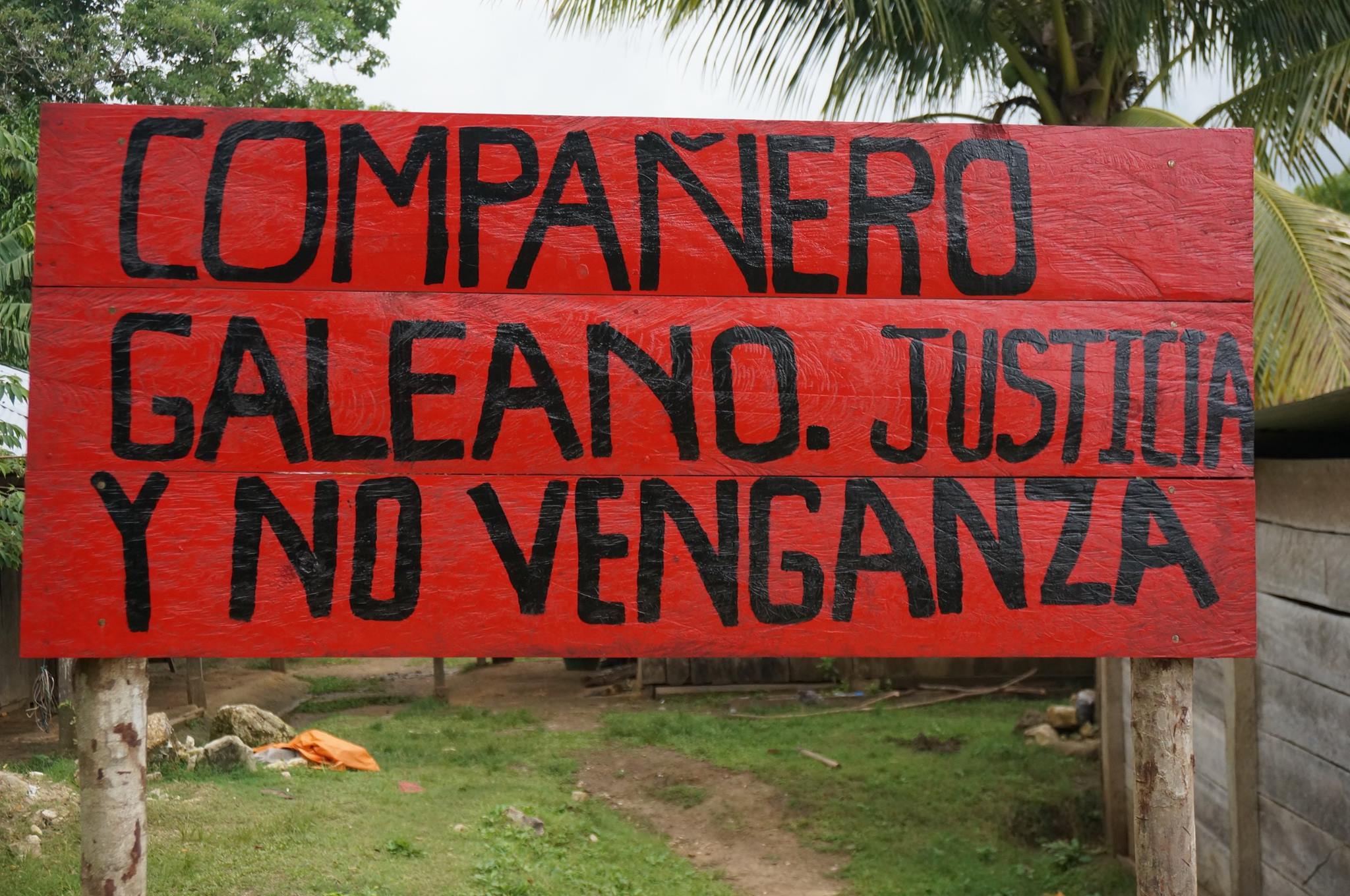
Compañero Galeano. Justice not revenge.
By: Magdalena Gómez
Once again it is demonstrated that we live in times of impunity without concessions. The Zapatista commanders justifiably and indignantly acknowledged that they don’t have any reason to trust in the justice of those above. Justice that lamentably doesn’t have impartiality and objectivity and that, dealing with social movements or sectors extraneous to the political and economic elites, systematically eludes the historic truth or fabricates it, like in the Ayotzinapa case.
In their August 16 comunicado, Subcomandantes Moisés and Galeano reported that: “two of the intellectual authors of the murder of teacher compañero Galeano have returned to their homes in the community of La Realidad. They were supposedly prisoners for the murdering our teacher and compañero. We now know that they have been declared innocent of the crime by the same ones that finance and support them: the federal government and the state government of Chiapas. The self-appointed ‘judge’ Víctor Manuel Zepeda López, of the criminal branch of Comitán de Domínguez, Chiapas, on August 12 of this year, decided that the Señores Carmelino Rodríguez Jiménez and Javier López Rodríguez are innocent, despite the fact that they and their accomplices from the Cioac-Historic know that they are guilty of organizing the crime. They are not the only ones, but they are also guilty.” The director of the Frayba, Pedro Faro, pointed out that both of the indigenous Tojolabales were allegedly released
with the argument that “the witnesses retracted their statements and that the agent of the Public Ministry did not witness the dead body” of the Zapatista ‘little school’ teacher. He asserted that there also exist 10 arrest warrants for members of the Cioac-H –accused of being involved in the events– that have not been executed, despite 15 months having passed (La Jornada, 22/8/15).
We remember that on May 2, 2014, members of the CIOAC-H murdered José Luis Solís López, the teacher Galeano, a Zapatista from La Realidad community, with firearms and machetes. The Zapatista comandancia pointed out at that time that: 1) we’re dealing with a pre-planned attack, militarily organized and carried out with perfidy, premeditation and advantage. And it is an attack inscribed in a climate created and encouraged from above; 2) the directors of the so-called Cioac-Historic, the Green Ecologist Party (the name with which the PRI governs in Chiapas), the National Action Party and the Institutional Revolutionary Party are implicated; and 3) at least the state government of Chiapas is implicated. It lacks determining, they pointed out, the degree of involvement of the federal government. Today, as in the case of Acteal, they once again justify resolutions in counterinsurgency logic under the generally practiced failures of due process.
We cannot assume that we’re dealing with a decision foreign to the political intentionality of provocation towards the EZLN and specifically towards the Zapatista bases in the emblematic La Realidad community. Apparently, they seek to inflame the local confrontation with paramilitary support, in order to impede articulation with other movements that are organized in resistance within the country, like the Yaqui, Xochicuautla, Ostula, Ayotzinapa or the democratic teachers, among many others that the Subcomandantes point to in their comunicado.
Nor is this scenario foreign to the very soon-to-be-announced project that Enrique Peña Nieto will send to Congress as an initiative for authorizing the federal Executive in his decision to create special economic zones in Oaxaca, Chiapas and Guerrero,[1] with the argument of facilitating strategic transnational investment and, according to what the Treasury Secretary said: “One does not observe in those states the positive (sic) effects of the Free Trade Agreement entering into effect and of the insertion of Mexico into globalization.” They add that now welfare and extreme poverty will be overcome. They are going for everything over the territories and their plan against the indigenous peoples is underway.
That is the meaning of re-activating the tension in La Realidad to extend a local circle local around the EZLN; of defending the Army at all costs in the Tlatlaya, Tanhuato, Apatzingán and Ayotzinapa cases; of keeping the Yaquis Mario Luna and Fernando Jiménez in prison, as well as Nestora Salgado and Cemeí Verdía, of concentrating 15,000 members of the Federal Police in Oaxaca to contain the teachers’ protest. All that while the mantle of impunity is extended, self-exoneration and self-forgiveness are announced in the so-called Casa Blanca case and the ineptness and chain of complicity is exhibited in the escape of El Chapo Guzmán, which will not be included in the next Presidential Report. The coming months will be crucial to stopping this offensive. The Zapatistas said well in their recent seminar Critical thought versus the capitalist hydra: things are bad and they are going to get worse.
Note:
[1] Last November (2014), Mexican President Enrique Peña Nieto announced that he would propose the creation of 3 “special economic zones” to Congress. These 3 zones would be: 1) the Inter-Oceanic Industrial Corridor on the Isthmus of Tehuantepec, which will connect the Pacific with the Gulf of Mexico; 2) a second zone at Puerto Chiapas; and the third in the municipalities adjacent to Port Lázaro Cárdenas, Michoacán, which borders on Guerrero. http://www.eldiarioexterior.com/el-sur-de-mexico-nuevo-44907.htm
In July of this year (2015), Peña Nieto reiterated his intent to send this proposal to the new Congress in September. http://mexico.cnn.com/nacional/2015/07/06/pena-propondra-al-nuevo-congreso-crear-zonas-economicas-antipobreza
———————————————————–
Originally Published in Spanish by La Jornada
Translation: Chiapas Support Committee
Tuesday, August 25, 2015
En español http://www.jornada.unam.mx/2015/08/25/opinion/022a1pol
We seek refuge too: Central American migrant children
“WE SEEK REFUGE TOO:” Central American migrant children
By: Ruben Figueroa
Thousands of kilometers divide them but the same misfortune unites them, their eyes are admired on the road, every minute they see unfamiliar faces. They are children displaced by violence and poverty; Europe experiences the worst migrant crisis in its history but Latin America does too. Our continent isn’t left behind but indifference makes the atrocity something common not only for the governments but also for society.

A Central American child and her family rest at the shelter in Chahuites, Oaxaca, before continuing to flee from poverty and violence in her country of origin. Photo: Rubén Figueroa
You don’t hear bombs, but yes blood is spilled
The last time that Zaylin and her husband were together was at a birthday party. Minutes before the party ended, her husband and his cousin said goodbye. Two hours went by when Zaylin received a call insulting her and asking that she be delivered; if not, they would kill her and her son. Moments before, the same criminals had “picked up” [meaning kidnapped] her husband and his cousin for having refused to sell drugs. They “were driven around” in a pickup truck all over the Honduran town.
After Zaylin hung up, she took her children and went to her cousin’s house seeking refuge. The next morning, her mother-in-law arrived to advise her that the two men were found dead. She waited until her husband was buried to flee, as the only option, to one of the most dangerous colonies of San Pedro Sula: “La Rivera Hernández.”
Nevertheless, the killers’ threats reached that place. Zaylin once again took her children –Michael, age 7 and Junior, one and a half- and began the flight towards Guatemala to later enter into Mexico. There, hiding between the mountains and fleeing from operations of the immigration authorities that ignore their misery, her migrant compañeros help her carry Junior, who is the smallest one.
Only like that did she achieve reaching a shelter in Chahuites, Oaxaca. Said shelter opened its doors after the migrants were impeded from climbing onto the train and became victims of the witch hunt undertaken by the Mexican government under the name: “Plan Frontera Sur” (Southern Border Plan). Zeydi and her children asked the Mexican State for refuge because they have much fear of returning to their country. “They will surely finish killing me and my children,” she exclaims with tears in her eyes, while the children play with Katerin and Justin.
The poverty and violence that obliges them to flee
Katerin and Justin travel with their father Marvin from Honduras. Their mother abandoned them because she had a nexus with “La Mara” (a dreadfully violent group of gang members). It was extremely difficult for Marvin to maintain his two children. With a job cleaning a commercial center, his weekly salary was just 1,500 lempiras (around 75 dollars) on a schedule from 7 AM to 7 PM. There were occasions on which Marvin left work late and he was robbed at least three times in his own neighborhood.
They heard shots every day. On one occasion, “two armed men arrived and knocked on our door at midnight,” he narrates. Katerin and Justin, just like their father, lived in an atmosphere of violence and poverty. One day before they started their escape, Marvin’s ex sentimental partner came to their house and threatened to do damage. “It’s better for the mother to leave the children without a father, she said. They left for Mexico the next day.
Nevertheless, violence accompanies and pursues them on the stretch between Arriaga (Chiapas) and Chahuites (Oaxaca). Marvin and his two little ones were assaulted with a luxury of violence. The criminals were carrying machetes and a firearm and during the assault one of the criminals pushed Marvin, because of which Katerin –only 2 years old- got frightened and began to cry very loud, and one of the criminals took out his weapon, pointed it at her father and demanded that he quiet the little girl.
Marvin denounced the acts at the prosecutor’s office and they want the Mexican government to grant them a humanitarian visa for having been victims of a crime. While they wait for a response from Mexican authorities, the shelter in Chahuites, Oaxaca supports them.
Life or “La Mara”
Napoleon didn’t think twice about leaving El Salvador, his birth country, for the purpose of safeguarding the life of his son, who “The Maras” wanted to recruit.
The confrontation between authorities and Salvadoran gang members has renewed the violence in recent years because “The Maras” seek to recruit youth by force.
In spite of that, on their travel through Mexico, alleged police pursued Napoleon and his son. After the pursuit, they approached a house near the highway to ask for water. That was when the inhabitants of that place threw a boiling soup at the body and demanded that they leave.
Like the majority that travel along the Arriaga-Chahuites route, Napoleon and his son were assaulted. Napoleon’s hand was injured during the incident.
“Chahuites” Shelter, a refuge for victims and the displaced
Seven of every ten migrants that arrive at this shelter are victims of assaults (robberies) and aggressions. It’s a humble place and much is lacking, but it’s necessary for the migrants that are now displaced on foot along the migratory route.
From Arriaga to Chahuites it takes from 15 to 20 hours walking. There are immigration agents on that path that pursue the migrants even in the woods.
This shelter is little known but it is an example of solidarity with the migrants. Irineo Mujica, its founder, saw the need for air-conditioning this space that currently shelters victims and displaced persons. It is a few meters from the railroad tracks.
Now the migrants have somewhere to rest in order to continue their journey. If they require it, they can also be accompanied to denounce vexations. This denouncing and accompaniment activity has provoked criminals to have it in their sights.
Nevertheless, the zone’s residents and businesspersons have been in solidarity with the shelter. Beans, corn and lentils is a common menu and fruits and vegetables occasionally arrive by means of a donation. The travelers always receive a hot soup well.
“Two cold iron lines that have witnessed the worst of tragedies guide the way. Only the darkness accompanies them, which is interrupted by flashes of lightening that, for a moment, illuminate the faces full of fear and full of hope. Torrents of water fall on the walking bodies that not only wet the weather-beaten shirts, but that also saturate the heart with emotion, a rare emotion that looks like terror when you hear the sound of nothing, of that oblivion that is more powerful than weapons, of that indifference that assassinates dreams.” RubenFigueroa
————————————————
Photo and text by Ruben Figueroa
Human Rights Defender
South – Southeast Coordinator of the Mesoamerican Migrante Movement
Twitter: @RubenFigueroaDH
Instagram: @rubenfigueroadh
————————————–
Originally Published in Spanish by Chiapas Paralelo
Translation: Chiapas Support Committee
Tuesday, September 8, 2015
Ayotzinapa Report
THEY DIDN’T BURN THEM
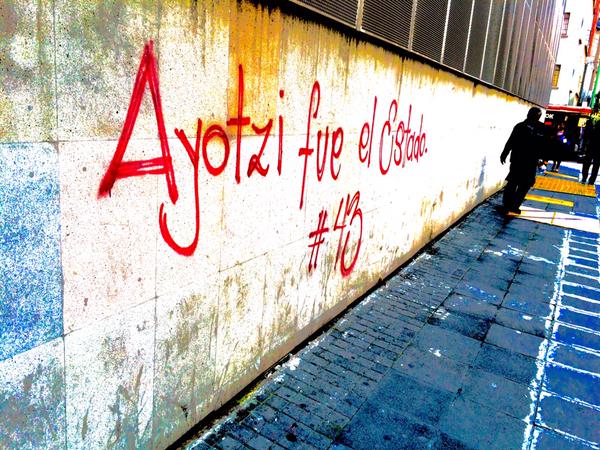
Ayotzi – it was the State #43
By: Blanche Petrich and Emir Olivares
The report containing the alternative investigation that the Inter-disciplinary Group of Independent Experts (GIEI, its initials in Spanish) carried out into the Ayotzinapa Case –43 enforced disappearances, six murdered and more than 20 injured– was delivered yesterday at noon to the three assistant secretaries that signed the agreement in Washington with the Inter-Americana Commission on Human Rights (IACHR) for the formation of this mechanism.
Faced with the severe view of the parents of the disappeared students, the dead and injured on September 26 in Iguala, the assistant secretaries of Governance Roberto Campa and of Multilateral Issues of the chancellery, Juan Manuel Gómez Robledo, and the assistant prosecutor Eber Betanzos went up to the dais to receive their copies of the Ayotzinapa Report: a black tome that displays on the front page the design of a green turtle, the symbol of the Rural Teachers College; more than 500 pages in which are narrated the facts and the possible cause of an aggression that was “massive, rising, disproportionate and senseless.”
In the Ayotzinapa Report, the possible whereabouts of the 43 youths was not determined. Thus, the five experts that make up the GIEI expressed: “it’s necessary to re-propose the investigation and to re-orient the search.” Carlos Beristáin, for his part, said: “That is a proposal of ours; we seek that our report will be a message of transformation.”
The five experts –Claudia Paz y Paz, of Guatemala; Angela Buitrago and Alejandro Valencia, from Colombia; Francisco Cox, of Chile, and Carlos Beristáin, of Spain– took turns speaking. In their presentation each one exposed different inconsistencies, mistakes, omissions and evidence hiding in the greater part of the actions of the police and the prosecutors involved in the investigation of the case.
They demonstrated that assigning probative facts and elements into the records was set aside and they insisted on the need for opening a line of investigation into the shipment of drugs that leave Iguala in modified and loaded buses, in possible collusion with police at the municipal, state and federal levels. As a hypothesis for the motive, they pointed to the intent of the corporations that attacked the retinue of students to impede the buses taken from leaving the city at all costs.
They demonstrated that soldiers and military intelligence agents were present at different times during the operation.
With new experts that the international investigators requested the central piece that former attorney general Jesús Murillo Karam had defended as the “historic truth” was discarded: that no trace remained of the 43 disappeared or the possibility of finding their remains, because they had been executed and later incinerated in an enormous human pyre the Guerreros Unidos gunmen set in the Cocula garbage dump. “We hold the conviction that they were not incinerated at that garbage dump,” Francisco Cox, one of the experts, expressed.
“The truth flees as time passes”
Angela Buitrago, a member of the group and a former Colombian prosecutor, recognized that the formation of this mechanism, which is unprecedented in the Inter-American system, was the product of dialogue. “And the truth –she added– is only obtained through dialogue, not confrontation. But it’s also true that the truth flees as time passes.”
The document, of more that 500 sheets of paper that summarizes six months of study, investigation and diverse independent expert examinations, contains –they assured– “new evidence that changes the perspective of the official record.” It proposes new hypotheses about the motive for this huge attack as well as for determining the whereabouts of the 43 disappeared and pointing out the responsibilities of the perpetrators.
The specialists in different disciplines described the nine scenarios in which successive attacks developed, which were rising: from shots at a bus at its exit from the terminal to the kidnapping of the 43 and the murder with brutal torture of Julio César Mondragón, within a lapse of three hours. Iguala and Cocula municipal police, ministerial police, federal police, soldiers from the 27th Infantry Battalion, military police and military personnel from intelligence services participated in the attack as perpetrators or observers at different times and in different roles.
The GIEI’s report discards the versions contained in official records that the students were confused with a the drug trafficking gang, Los Rojos, a rival for control of Iguala, since all the corporations had precise data about where the Ayotzinapa students were, at what time and how they arrived and what they did at every moment.
[They obtained] all that through different activities and from “information cards,” as well as from the C-4communications, the state coordination system to which all levels of the security forces and the Army have simultaneous access. There are two communications lapses to which the GIEI has not had access: the time after the first attack and during the second attack. It has been reported to them that those communications “are intervened by the Sedena.” It has also been reported to them that three videotapes from the security system, on the highways, “have been destroyed.”
For these and other reasons explained in the report the GIEI has insisted on the necessity that they have access to interview soldiers from the 27th Battalion. “Toward the end of August the answer to our request continued being negative,” they indicated.
The incineration, impossible
In their conclusions, the GIEI discarded sharply the version of five of the incarcerated perpetrators that the 43 youths were incinerated in a fire until being totally pulverized. It deals with a conclusion to which it arrived thanks to the expert test called “fire dynamics,” carried out by the Peruvian expert in fire sciences José Torero, who went to the Cocula garbage dump on July 12, 2015. Francisco Cox, a Chilean, assured: “That event, as it has been described, did not happen.”
Torero, the Peruvian expert, concluded that such action is “scientifically impossible.” His opinion departed from the one saying that the weather is the “most inefficient” environment for cremating a body, since 30 percent of the heat from the fire radiates toward the sides, the rest rises into the air and “only one percent is directed to consumption of the object being burned.” According to his calculation, to burn a body would require 700 kilos of wood or 310 kilos of tires throughout 12 hours. Incinerating 43 bodies would require 30 mil 100 kilos of wood or 13, 300 tires for 60 hours. According to the versions the PGR obtained, the fire in Cocula lasted six hours.
Another Torero calculation demonstrated that what’s needed is a space of 12 by 2.5 meters for incinerating 43 bodies and will produce a flame of at least seven meters, with a plume of smoke of more than 300 meters. Cocula’s residents would have seen a 280-meter column of smoke.
In his analysis the investigator at the University of Queensland, Australia, points out that the radiation from the fire would have reached 15 meters of distance from the nucleus of the heat source. A person would not have been able to approach within those 15 meters. Those allegedly implicated said that after six hours went in to throw on more fuel.
Finally, upon analyzing the vegetation and the quantity of surrounding garbage and the location of the possible bonfire with respect to inside of the hollow of the garbage dump, he decided that, by having existed, “the pyre would have generated a forest fire.”
—————————————————————
Originally Published in Spanish by La Jornada
Translation: Chiapas Support Committee
Monday, September 7, 2015
En español: http://www.jornada.unam.mx/2015/09/07/politica/002n1pol
Esteva: The Storm in Oaxaca
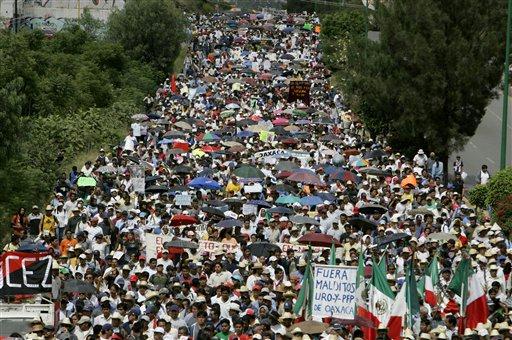
2006 APPO march in Oaxaca to demand that the governor resign.
By: Gustavo Esteva
Wounded, offended and humiliated, Oaxaca prepares the response.
Millions of Oaxacans, those who live in Oaxaca or those that have felt in their own flesh the offense to their native soil although they are very far from it, begin to express their dignified rage.
We suffer, like all Mexicans, the reign of impunity. Its spectacular symbol was El Chapo’s escape, with which the treatment that certain criminals receive was given national and international publicity. The most cynical version of that tonic is the formal exoneration of Peña and Videgaray for their acquisitions of the Casa Blanca and other properties. Its most atrocious expression is without a doubt having set free two of the intellectual authors of the murder of teacher Galeano in La Realidad, on May 2, 2014. “Impunity without concessions,” Magdalena Gómez says upon commenting on this operation, which makes up part of a well-known series that includes Tlataya, Tanhuato, Apatzingán and Ayotzinapa… The plague was manifested punctually in Oaxaca when Gabino Cué extended a certificate of impunity to Ulises Ruiz, while the Truth Commission had still not finished the work of examining his crimes. At the same time, he took away from its members the tutelary protection that they require to carry out their tasks.
The undeclared state of emergency forms part of the offense that is imposed on the country. This use of the law to establish illegality characterizes the creation of the “new Ieepo,” which abandons 30 years of formal commitments and annuls well-constituted rights. It’s the same tonic as new laws on indigenous matters that they just promulgated. They represent a clear setback with respect to what the Indian peoples had obtained in the course of recent decades; among other things, it implies kidnapping their ability to govern autonomously. This process, by which they dismantle step by step, as much by social groups as by geographic groups, all the elements of the state of law, will soon be extended to special economic zones, with which the federal government now threatens Chiapas, Guerrero and Oaxaca. These zones are not a state within the state, as has been said. They are areas in which the state’s formal design is abandoned and no more rights and freedoms remain than those of private property, of capital; in other words, they are areas in which it is shown without veils, in view of everyone, the real nature of the political regime of the Nation-State, which outside of them is dissimulated under the facade of representative democracy. What these zones represent requires careful analysis. It is an outrage even graver than the mining concessions and other forms of dispossession.
Every day it becomes more evident that the teachers were a circumstantial and deceitful pretext for bringing 15,000 militarized police to Oaxaca. It is viewed that their presence is owed rather to the need of preventing and in this case impeding the resistance of the peoples, who defend their territory and their life in the face of all the dispossessions that they are suffering.
Our principal challenge consists in transforming the discontent, more general all the time, and the dignified rage that spreads into wide circles of Oaxacan society in an effective form of organized resistance. And the even greater challenge is to convert that resistance into a capacity for transformation.
It has been stimulating to verify the rapid circulation of whispering. In small groups, even of three friends in a cafe, in broader meetings, in assemblies, in forums, under the most varied circumstances, we have set to analyzing the situation and preparing for what follows. We quickly reached a consensus about the gravity of the situation. The rage that an accumulation of offenses and arbitrary acts provokes in us was demonstrated without reserve. Necessary venting is produced, in the intimacy that is affirmed in the community fabrics. It awakens the sociological and political imagination to conceive forms of response. And, the indispensable articulation to organize the resistance is frequently produced. Collective declarations that define the taking of a position already circulate.
Facing the militarized occupation of Oaxaca and as the governor, the state Congress and the federal government renounce civilized ways of governing, the people get support from deposits of accumulated experience, particularly that of 2006, for organizing actions that permit transcending circumstance. We already know, even through very recent experiences, that it’s not enough to say no, we are opposed to the dispossession, to the militarization and to everything that we don’t want. In order to give backbone to the resistance and to give it meaning we need to express it as the construction of an alternative. We’re doing that, imagining it and trying to give it a reality.
———————————————————–
Originally Published in Spanish by La Jornada
Translation: Chiapas Support Committee
Monday, August 31, 2015
En español: http://www.jornada.unam.mx/2015/08/31/opinion/021a2pol
Taking buildings and building autonomous spaces in Barcelona
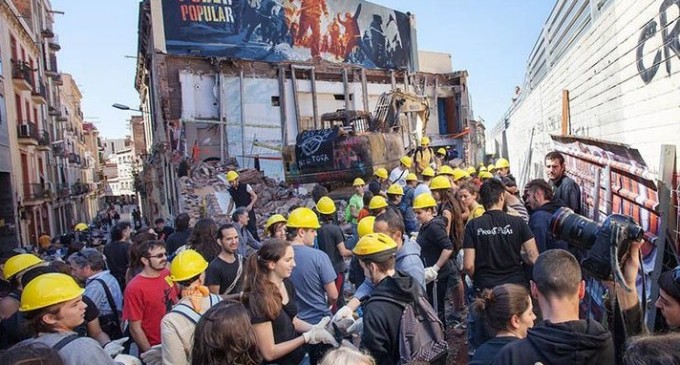
Burning an excavator in the battle for Can Vies. Massive protests stopped the city’s demolition.
Decolonizing critical thought and rebellions II

Artistic illustration of Buen Vivir, living well together.
By: Gilberto López y Rivas/II
The construction of another world in Latin America, according to Raúl Zibechi, is being carried out by means of organizations not state-centric nor hierarchical, which at times don’t even have permanent leadership teams and, as a consequence, tend to overcome bureaucracy, a traditional, elemental and very old form of domination. Women and youth play a new role in these new “modes of doing.”
In a first time criticism of the progressive governments, Zibechi identifies that, despite differences, all the processes have in common the continuity of the extractive model, either open sky mining, hydrocarbons or mono-crops. “In all the cases it’s about the production of commodities, the mode that neoliberalism assumes today in the region,” as well as the expansion of social policies that seek to neutralize the movements and buffer or impede conflict. “The map of the progressive governments and those of the left would have to establish a difference between those countries in which social action made the political system enter into crisis, like Venezuela, Bolivia and Ecuador, and those like Brazil and Uruguay, where stability has predominated, Argentina being in an intermediate situation.” Upon questioning the principal dangers and benefits that the arrival in government of the progressive parties implies, Zibechi makes a remark, in my judgment transcendent, and starting from three scenarios: “The interstate relationships, in other words, the question of the governments, the relationship between movements and states, that is to say, the question of emancipation and the relationship between development and living well (buen vivir) [1], that is, post-development. If we look at the state question, the existence of the progressive governments is very positive, because within them is at play the relationship with the United States and with the big multinationals of the north, the crisis of imperialist domination that these governments accentuate. But, if we observe the question of emancipation or development, these governments have represented a step back. The problem is that there are social and political forces that cannot have any horizon other than being government, which converts them into administrators of the State.”
In the specificity of Latin America, Zibechi emphasizes that on the one hand “we have an official society, hegemonic, with a colonial heritage, with its institutions, its ways of doing things, its justice and all that. On the other hand, there is another society that has property in the remote rural areas and is organized into communities and also in the expanded urban peripheries. This other society has other ways and forms of organizing, has its own justice, its own forms of production and an organization for making decisions parallel to or at the margin of the established one.” Our author maintains that indigenous practice questions various aspects of western revolutionary conceptions and denounces that only the State-centric can be theorized, coinciding with authors like Leopoldo Marmora, who in the middle of the 1980s made note of the Eurocentric roots of Marxism in the treatment of the national question and in the concept of “peoples without history.” “There are various themes that the Indian movement puts on the table. The first is their conception of time, the present-past relationship. The second is the idea of social change or revolution, the Pachakutik… The third is related to rationalism and to the relation between means and ends, which involves the ideas of strategy and tactics, as well as the question of program and of plan.” In all these themes and processes, the role of the intellectual is important. Zibechi rejects being defined as an intellectual, even in the terms in which Lenin and even Gramsci plated them, and he prefers being called an activist/militant and thinker/educator, which in any case doesn’t stop him from being intellectual. He maintains, aptly, that many of the ideas of those who work in the movements are the patrimony of many people. “If people are at the center of the movement, then the intellectual tends to be one more in the movement… therefore the intellectuals must also be in movement and move away from that place of being at the top of the people.”
Zibechi considers that the autonomic anti-systemic movements started a new era of social struggles or classes that is in its first phases. This new era is one of the self-construction of a world, with the necessity of passing over the taking of state power, and concentrating on the territories where these new worlds are being constructed. The most evident case is that of the Zapatista Caracoles, where forms of supra-communitarian power have been constructed, like the Good Government Juntas that each unites hundreds of communities (although the federalism in Kurdistan also shows an unpublished experience in this conflictive region of the world). The Zapatista experience –Zibechi asserts– is a historic achievement that had never existed before in the struggles of those below, except for the 69 days that the Paris Commune lasted and the brief time of the Soviets before the Stalinist state reconstruction.
The reappearance of the EZLN, according to Zibechi, “combines historic positions (among which one would have to emphasize the rejection of the electoral scenario and the construction of homogenous and centralized organizations) with new developments that imply a different relationship with its support bases outside of Chiapas and, above all, a novel mode of intervention in popular sectors, consistent with demonstrating what they have been capable of constructing which, in reality, is teaching a distinctive and different path for transforming the world.”
In our author’s judgment, the Zapatista discourse recuperates the tradition of anticolonial resistance defended by Frantz Fanon, who emphasizes the existence of “two zones,” that of the oppressor and that of the oppressed, “those of above and those of below.” At the same time, Zibechi distinguished Zapatismo from other movements starting with integral autonomy, which leads them to reject aid and social policies from the government; the construction of organs of power on three levels, different from the forms of State power, inspired in the community; being a movement of youth and of women, and being consequently anti-capitalist.
[1] Buen Vivir – (Good living or living well, in English) is rooted in the cosmovision (or worldview) of the Quechua peoples of the Andes, sumak kawsay –or buen vivir, in Spanish– describes a way of doing things that is community-centric, ecologically balanced and culturally sensitive. In the concept of buen vivir, the individual lives in harmony with community, nature and culture.
——————————————————————-
Originally Published in Spanish by La Jornada
Translation: Chiapas Support Committee
Friday, August 28, 2015
En español: http://www.jornada.unam.mx/2015/08/28/opinion/023a2pol
Conversations on community and autonomy

The colors of Zapatismo, a photo taken in La Realidad community.
A Series of Discussions Convened by the Chiapas Support Committee, Oakland
The Chiapas Support Committee is presenting 3 events that will feature speakers who have been involved in or are learning about the creation of community and autonomy in different settings: Barcelona, Mexico City, and the Zapatista Territories of Chiapas. We hope to provoke lots of thoughtful questions and lively discussion following the presentations. Please join us as we discuss the search for alternatives…
- “Taking Buildings & Building Autonomous Community Spaces in Barcelona”
[In English, with Spanish translation available / Traducción en español está disponible]
Friday, September 4, 2015, 7:00-9:00 PM
The Omni Commons, La Commune Cafe & Bookstore
4799 Shattuck Ave., Oakland, CA 94609
Barcelona has been a site of squatting and community building for several decades, and has been especially influential in recent years. In 2009 it was the birthplace of Spain’s PAH (Movement for People Affected by Mortgages), which pursues direct action to stop evictions and secure housing rights. Out of the “indignados” movement of 2011 came Can Batlló, an autonomous community workspace in the Sants district of the city that was the site of an abandoned factory planned for development. Activists took over this multi-block space and have transformed and held it over the past four years, building on earlier projects such as the residential community of Can Vies. This year has seen the recuperation of el Ateneo Enciclopedico Popular, a historical free cultural center in the Raval district. Iban Ek and Aina Gallego are longtime activists in Barcelona who will discuss these projects and the culture of community that has created them.
- “Constructing autonomous (self-governing) urban communities in Mexico City”
[In Spanish and English, with translation / Traducción en español está disponible]
Tuesday, October 13, 2015, 2015, 7:00 – 9:00 PM
The Omni Commons, La Commune Cafe & Bookstore
4799 Shattuck Ave., Oakland, CA 94609
Enrique Reynoso of Mexico City’s Frente Popular Francisco Villa Independiente (FPFVI), also known as “los Panchos,” is on tour with the Mexico Solidarity Network (MSN). The Panchos bring together tens of thousands of people who occupy land and build thriving, autonomous communities in the heart of one of the world’s grittiest cities. They do this without allying with any political party and by going beyond narrow housing demands to promote urban self-government, community safety, and autonomous education, culture, and health. The Panchos are an amazingly inspiring example of people power, and Enrique will share their story, lessons, and dreams.
- “Reflections on the Zapatista Little School: Level 2”
[In English, with Spanish translation available / Traducción en español está disponible]
Tuesday, November 17, 2015, 7:00-9:00 PM
The Omni Commons, La Commune Cafe & Bookstore
4799 Shattuck Ave., Oakland, CA 94609
Recently the Zapatistas launched Level 2 of their Escuelita (“Little School”) for supporters of the Zapatista movement. This “second grade” course was done online for students who passed the first level, which was held in Chiapas in 2013 and 2014. Local participants will discuss what we have learned so far from levels 1 and 2.
===================================
For more information, please contact: Chiapas Support Committee / Comité de Apoyo a Chiapas
Email: cezmat@igc.org
 Chiapas Support Committee