Chiapas Support Committee
Home of the Compañero Manuel blog on zapatistas & mexico
Mexico protects those without papers in word only
“Operations in secret places become human witch hunts”
You can give the government a 10 on its political message, but in fighting crime it doesn’t even attain zero, because it has not even made the attempt, the Jesuit explains. He adds that the country is now the destination for undocumented
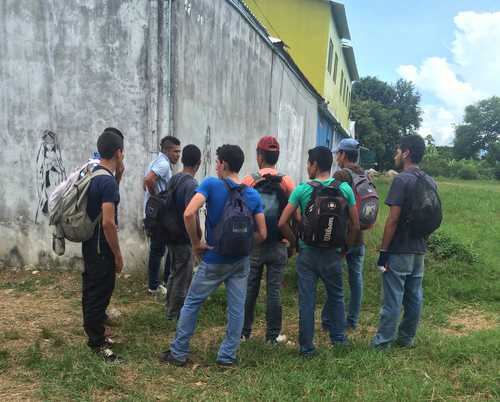
Migrants in front of La 72 shelter in Tenosique, Tabasco. Photo: Arturo Cano
By: Arturo Cano
Tenosique, Tabasco
The Mexican government deserves applause. Alejandro Olayo-Méndez, a researcher that in the past year has toured the migratory routes five times, does not doubt: the human rights discourse that guides politics on the matter, amplified by the media, has achieved fixing in public opinion the idea that the human rights of migrants are respected here: in Mexico they are not arrested but rather “secured” or “rescued;” one is not deported here, but rather “assisted in the return” of the undocumented Central Americans that fill up the migratory stations (they are prisoners, but it doesn’t call them prisons).
Thus, although one cannot congratulate the Mexican government for its success in protecting migrants or for its efficiency in fighting human traffickers, “we can applaud its consistent political discourse.”
Since last September, the Jesuit priest Olayo-Méndez tours the migratory routes that cross Mexico. He does it because of a commitment that, as a religious man, he has to the migrants and also because on that journey he documents the doctoral thesis that he prepares at Oxford University. His theme is just about the migratory routes and the humanitarian aid that an army of civil organisms deploys, a good part of it under the auspices of the Catholic Church, around the country.
The mirage and the Reality
From the highest functionary to the immigration agent that works on the highways, the investigator explains, the Mexican government has a consistent discourse on paper, in words that are utilized in the day-to-day treatment of migrants. That consistency, which is amplified in the media, the Jesuit maintains, has created “the mirage that Mexico is in the vanguard in the matter of the human rights of migrants.”
Nevertheless, “when you go into the field you discover that there is a big gap between the political discourse and the reality. The reality is violent, oppressive. On some occasions, the operations in secret places or at transit sites where there are no witnesses literally become human witch hunts.”
–One component of the Southern Border Program (SBP) is the fight against criminals that attack the migrants.
–If you can give the government a 10 on its discourse, it doesn’t even get a zero in fighting crime, because it has not even made an attempt. The National Human Rights Commission has identified the most dangerous points; all the shelters have located the zones where there is a high level of violence, and the Mexican government has not done anything. If you need to know, you can go to the offices of the Attorney General of the Republic in San Luis Potosí, in Ixtepec, wherever you want, in order to see all the complaints that have been filed. Lamentably all of the Mexican government’s effort has been directed to impeding migrants from climbing onto the train, and not to permitting them to do what they have always done, which is to try to use the means available to continue their path. I encountered people in San Luis Potosí or Saltillo that have walked for 40 or 60 days.
Migrants now come to stay
In his travels, Olayo-Méndez has talked with hundreds of migrants and has observed the conditions of their violent passage. From that experience has emerges his conviction that, although the government doesn’t recognize it, the reality is that “Mexico is now a destination country” for those without papers.
That’s what the field evidence shows and that’s what the Central American migrants state more and more. In La 72, the shelter for undocumented migrants on this border, six out of every 10 of these travelers he talks to have no intention of going to the United States. A good part of them flee from the gang violence that has made Honduras the world’s most violent country, followed closely by El Salvador and Guatemala.
–The migrants come to stay?
–There are some of them that now want to stay in Mexico. It’s a logical option. The Central American migrant starts to embrace staying in Mexico to work as a real option México. It’s becoming more frequent to find migrants that say: “I go where I find work.” It’s lovely for Mexico to talk about the Koreans that want to come, about the Spanish. But these Central American people, who are much more vulnerable, now see Mexico as an option.
Re-naming the Suchiate
–The criticism of the SBP could be summed up in a phrase: they want to rename the Suchiate (River) and call it the Río Grande.
–The expression is not far from reality. In practice, the southern border of the United States has been moved. I would dare to say to Puebla. That is really where the big dyke is that has the control belts that we see in this zone and on the Isthmus. The police deliver the migrants to the immigration agents, so that in some way they may be “rescued.”
“In this phenomenon of externalizing the border, Mexico does the dirty work for the United States or rather seeks to order the flow. The question is for what reason.”
–Why?
–If one reads the Southern Border Program in the context of the National Development Plan that we have, there is the intention of an ordering to facilitate a series of developments. All this effort is for improving the infrastructure and controlling the migratory flow has to do with an extractivist project. Why are they going to invest 58 million dollars for monitoring the train? Well, because it will carry precious cargos.
–The government insists that by impeding them from climbing onto the train it avoids deaths and mutilations.
–The discourse is “we don’t want them to climb onto the train for their security.” But the reality is that when the migrant needs to continue on his way and they don’t let him climb on, then he walks. By having to walk, they are obviously exposed to greater violence, because they use more dangerous routes where they are easy prey for the criminals, although many times they don’t have anything… they take a backpack from them. The stated objective is to offer them security, but paradoxically they are made more vulnerable.
–But they continue crossing, despite everything.
–Calculations of the Pew Hispanic Center indicate that the population of Central Americans in the United States has increased 20 percent in recent years. That means that even with Gatekeeper and all the U.S. efforts, the people continue coming.
“What happens to those that don’t cross? It’s difficult to have solid numbers, but a good part now stay in Mexico. And those are patterns that are seen in Europe. When economic migrants cannot cross into Europe, they see Libya as a second option.”
The Mexican government’s response has been poor in the face of this new reality. Olayo-Méndez underscores the fact that civilian organisms and the Catholic Church maintain the network of shelters that exist at more than 80 points in the country. It’s within that network where he has found that the big shelters, for example in Saltillo, have 20 or 30 migrants waiting that have asked for shelter.
–The scenario of the drama that exists in Europe dominates the media.
–The Southern Border Program is being converted into a reproduction of the national security model of the United States as well as that of Europe. It has a facade of human rights, but in practice it’s nothing but militarizing the border, using all the police bodies to control the flows, it is simply a reproduction of models that have already been put into effect in other regions.
“However, Mexico has a total ambivalence towards the movement of migrants. It cannot openly repress them because it has 11 million undocumented migrants in the United States. It would be very inconsistent to openly repress a migrant population. And on the other side there is a complete inability of the Central American countries to respond to the needs of their citizens in the migrant stations. Each consul has two minutes to attend to a migrant, if that’s what he wants to do.”
———————————————————–
Originally Published in Spanish by La Jornada
Translation: Chiapas Support Committee
Tuesday, October 20, 2015
En español: http://www.jornada.unam.mx/2015/10/20/politica/014e1pol
Tlatlaya Massacre and U.S.Military Support

Warehouse scene after soldiers massacre 22 in Tlatlaya
By: Laura Carlsen
A few weeks ago and for the second time, the Sedena [1] denied a request for access to information that asked for documentation related to training given in the United States to members of the 102nd Battalion.
We remember that the 102nd Battalion leapt to fame, or infamy, after the Tlatlaya Massacre, where 22 youths lost their lives at the hands of members of this Infantry unit. One day after the June 30, 2014 massacre, Sedena issued a communiqué announcing that 22 criminals died in a confrontation in which no armed forces member was killed. Thanks to the investigations of national and international journalists and the great valor of witnesses that told what happened that night, we now know that probably the majority of the victims were executed after surrendering to the Army.
By declaring the non-existence of such documents, the offices of the armed forces attempt to close a bi-national investigation that seeks to bring to public light not only the facts about Tlatlaya, but also the theme of military cooperation with the Pentagon.
The issue is relevant for many reasons. Documents declassified by the National Security Archives, an independent project, show that the Pentagon has been very pending about the Tlatlaya case. In a report dated October 15, 2014, it reads: “Sedena is now investigating the commander (a general on the Estado Mayor) of the military zone in charge of the 102nd Infantry Battalion, and adds: “if he was implicated in a grave human rights violation, the entire military zone and the 10,000 personnel members would not be able to receive U.S. assistance.”
When it is established in the Tlatlaya case —or any other— that a Mexican unit has incurred grave human rights violations, the United States government by law is obligated to suspend assistance to this unit. A January 12 report from the Northern Command confirmed that the 102nd Battalion would not be able to receive assistance.
Nevertheless, the issue stayed at that level. Instead of questioning the military person in charge at Tlatlaya, General José Luis Sánchez León, as part of an investigation of the chain of command, he was removed from his charge and sent to Jalisco. The maneuver on the part of Sedena’s high command, far from relieving suspicions, reinforced the conclusion that the Tlatlaya massacre was not exclusively the fault of a few undisciplined soldiers, but rather the foreseeable result of the modus operandi of the armed forces in the drug war.
A discovery by lawyers from the Pro Human Rights Center — the legal representative of one of the Tlatlaya witnesses – corroborated this hypothesis. In its report on Tlatlaya one year after the events, the center cited the Sedena’s “Order of Relief and Designation of Command” that says: “The troops must operate massively at night and reduce activity in the day for the purpose of taking out (killing) criminals when it’s dark…” It’s dated June 11, 2014 –a few weeks before the massacre.
Mario Patrón, the Center’s director, emphasizes the importance of the Order: “This is convincing evidence that to the Army we are in a state of emergency and a context of informal, undeclared war and, therefore, they order their members to take out criminals.”
In hearings held at the Inter-American Commission on Human Rights (IACHR) this month on extrajudicial executions, national and international organizations presented data about this undeclared state of emergency: more than 10 or 15 civilians to each security agent died in confrontations, more than 4,000 civilian deaths at the hands of the armed forces between December 2006 and December 31, 2014; 3,967 civilians and 209 military members died between 2007 and 2014.
The evidence that the Army vindicates the practice of extrajudicial executions from the high commanders ought to be a parting of waters in the war against drugs. It’s not an isolated act. There are serious questions about the Army’s role in Iguala —its presence was already established at the scene of the events, as well as its negligence in protecting the students from the attacks, and evidence exists of complicity and active participation. The investigations into extrajudicial executions in Apatzingán, Tanhuato and Zacatecas are added to the emblematic Tlatlaya Massacre and undo the version that they are anomalies.
Despite the evidence, the Mexican government as much as the U.S. government continue to defend their war by restricting the responsibility for Tlatlaya to 7 soldiers that now are 3, since 4 were released due to irregularities in their cases. The suspension of U.S. aid ought to be extended to all the armed forces. Not only do cases of grave rights violations accumulate, but the Inter-American Commission on Human Rights and other organizations and instances have also issued formal recommendations for the full withdrawal of the armed forces from public security tasks.
But one must not forget that this war was imported from the United States and has counted on its unconditional support from the beginning. To the Pentagon, it’s a key piece for its hegemony in North America. With the Merida Initiative, the United States’ military-security complex has attained a level of interference in Mexico unprecedented in history. The militarization of the drug war is a big business, the construction of a buffer zone and border control, and is also the protection of its investments under the Free Trade Agreement. Within this framework of interests, the war must be permanent, cost Mexican society what it may.
The intrinsic hypocrisy in being an associate in the war and a self-appointed defender of human rights in Mexico was seen a little while ago, when newspapers announced that the United States government decided to withhold $5 million dollars from the Merida Initiative (MI) because of not being satisfied with the Mexican government’s efforts in the area of human rights. This announcement followed the decision to send funds in addition to the quantity originally requested to the MI, to the same security forces accused of incurring the violations, which, it seems, came out of the game with net profits.
The other reason that human rights organizations in both countries continue investigating the Tlatlaya case and its link with Washington has to do with the type of training that Mexican soldiers and police receive at the Northern Command, the School of the Americas and here in Mexico. In its decision to withhold information about training in the U.S., the Sedena argued that: “the training that military personnel from the 102nd Infantry Battalion received bore no relation to the acts that occurred in said locality as the (request for information) erroneously sought to assert.”
But, how can we be sure? The state of emergency that the Pro Center points to is the description of the United States war in Iraq, the model used in recent years for the training of Mexican officials in Colorado Springs. It resulted in some 150,000 civilian deaths. No one has been able to explain why a model of the war against terrorism that increased violence in the Middle East is now deployed in Mexico, when not a single threat on the part of international terrorism has been documented here, but ample documentation of acts of terror and human rights violations on the part of the State do exist.
The United States government is immersed in human rights scandals like the Doctors without Borders attack in Afghanistan, the use of torture and the killing of civilians with drones. It’s a bad teacher for Mexico.
The Tlatlaya case shows the open contradiction between promoting war and supporting human rights principles. It is one or the other. And the U.S. and Mexican governments bet on war. Now for citizens on both sides of the border, the task is to stop them.
——————–
[1] Sedena is the Spanish acronym for Mexico’s Secretariat of National Defense.
———————————————————————
Originally Published in Spanish by Desinformemonos
Translation: Chiapas Support Committee
Tuesday, November 3, 2015
http://desinformemonos.org.mx/la-masacre-de-tlatlaya-y-el-apoyo-militar-de-eeuu/
Zibechi: The End of the progressive cycle accelerates
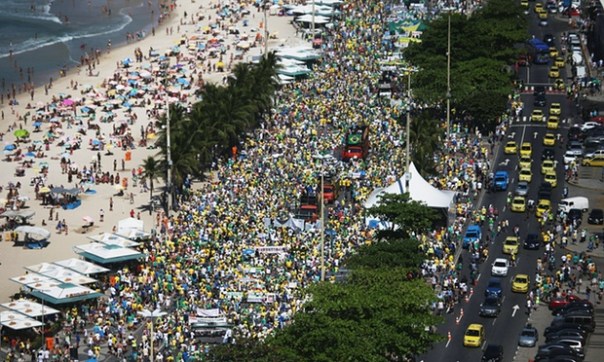
June 2013 demonstration in Rio de Janeiro marches along Copacabana Beach
By: Raúl Zibechi
Each one chooses the place from which she views the world, but that choice has consequences and it determines what she can see and what irremediably escapes her. The point of observation is never a neutral place, as she cannot be what she observes. Moreover, the observer is formed by the place elected for realizing the task, to the point that she stops being a mere spectator and becomes a participant –although she may say she is objective– in the scene that she thinks she is only observing.
The most diverse views are displayed before us: from those located within the states (parties, armed forces, academics), those that are emitted from the powerful countries and from financial capital, to the views anchored in the indigenous and black communities, and in the anti-systemic movements. A broad fan that we can synthesize, with certain arbitrariness, as views from above and views from below.
The views expressed in recent months about the situation that runs through the progressive South American governments say more about the observer than about the political reality that they pretend to analyze. From the popular movements and organizations that resist the extractive model, things are seen very differently than from the state institutions. Nothing new, although that it usually alarms those who think they see the hand of the right in the criticisms of progressivism and in the resistance movements.
To the writer, it’s the activity or inactivity, the organization for the fight, the dispersion or cooptation of the movements, the central aspect to take into account at the time of analyzing the progressive governments. Other considerations only appear in second place, like the economic cycles, disputes between the parties, electoral results, and the attitude of financial capital and of the empire, among a lot of other variables.
More than two years ago we talked about the “end of the Lula consensus” at the root of the massive mobilizations of millions of Brazilian youth in June 2013 (http://goo.gl/lS9K9R). Various Brazilian analysts explained the mobilizations of that year in a similar sense, emphasizing that we’re dealing with a parting of waters in the region’s most important country.
A year ago I said that: “the progressive cycle in South America has ended,” in relation to the balance of forces that emerged from the Brazilian elections, a direct consequence of the June 2013 protests (http://goo.gl/z92152). The Parliament that emerged from the first round was considerably more right-wing that the previous one: the agribusiness defenders got a smashing majority; the “bullet caucus,” composed of police and military members that propose arming against crime, and the anti-abortion caucus, rose to positions as never before. The PT went from 88 deputies to 70.
Many underestimated the importance of June 2013 and of the new correlation of forces in the country, trusted in the charisma of leaders like Lula, in his almost magic capacity for countering a scenario that had turned against them. The results are seen now.
We can see the end of the progressive cycle with greater clarity in light of the new data that recent acts shed on it.
First. We are facing a new phase of movements that are expanding, consolidating and modifying their own realities. We are still not facing a new cycle of struggles (like those that Bolivia experienced from 2000 to 2005 and Argentina from 1997 to 2002), but big actions are registered from those below that can be announcing a cycle. The mobilization of more than 60,000 women in Mar del Plata and the enormous demonstration “Not one less” (300,000 in Buenos Aires alone against chauvinist violence) speak as much of expansion as of reconfiguration.
The resistance to mining is paralyzing or slowing down projects of the transnational corporations, above all in the Andean region. Peru, in which is concentrated a high percentage of environmental conflicts, registered various popular and communitarian uprisings against the mining companies. For the first time in years, mining investment in Latin America is receding. It fell 16 percent in 2014 and in the first half of 2015 it fell another 21 percent, according to the Cepal. The reasons that they adduce are the fall of international prices and the stubborn popular resistance.
Second. The fall of commodity prices is a hard blow to progressive governability, which had settled on social policies that were possible, in large measure because of the excesses that high export prices were leaving. In that way the situation of the poor could be improved without touching the wealthy. Now that the economic cycle has changed, social policies can only be sustained by fighting privileges, something that passes through popular mobilization. But mobilization is one of the biggest fears of progressivism.
Third. If the right capitalizes on the end of the progressive cycle, it’s not the fault of the movements or the popular struggles, but rather of a model that promoted “inclusion” through consumption. An excellent work of the Brazilian economist Lena Lavinas about the financialization of social policy assures that: “the novelty of the social development model is having instituted the logic of the market in the entire system of social protection.” (http://goo.gl/XyrcPF).
The Lula and Dilma governments were able to exploit mass consumption by means of financial inclusion, “conquering the barrier of social heterogeneity that stopped the expansion of the Market society in Latin America.” We’re talking about a setback for the popular sectors, the supposed beneficiaries of social policies: “Instead of promoting protection against risks and uncertainties, it increases vulnerability.”
Consumerism, Pasolini said almost a half-century ago, depoliticizes, strengthens individualism and generates conformity. It’s the breeding ground for the Rights. They’re reaping what they sowed.
—————————————————————-
Originally Published in Spanish by La Jornada
Translation: Chiapas Support Committee
Friday, October 30, 2015
En español: http://www.jornada.unam.mx/2015/10/30/opinion/021a1pol
Raúl Zibechi: Toward a new cycle of struggles

Police confront Indigenous protesters in Peru prior to the Bagua Massacre
By: Raúl Zibechi
The noisy fall in the price of raw materials closes an economic cycle, but also a political one. The illusion that we’re dealing with a momentary decline is giving way to the conviction that the low prices can drag out for a long time, even 20 years, according to specialists cited by Bloomberg (http://goo.gl/fAFktC).
The reasons for such a decline are debatable. There are those who attribute the drop in gas prices to a U.S. maneuver to affect Russia, Venezuela and Iran, while others maintain that it’s impelled by the Saudi monarchy to render extraction by means of fracking infeasible in that country, which threatens to displace it as the prime global producer global. The lesser demand of China is the most plausible explanation about the fall of other merchandise, without discarding the imprint of financial speculation in all commodities.
What’s certain is that the commodities price index elaborated by Bloomberg, which includes gold, oil and soy, has fallen to half of its historic maximum in the first half of 2011. The multinational Glencore-Xstrata, which controls the largest part of the production of minerals and grains in the world, registers losses on the London Stock Exchange greater than 30 percent in recent weeks, totaling a fall of 74 percent so far this year (http://goo.gl/HTi1Wu). Other multinationals in the sector confront similar situations.
In Latin America this change of cycle anticipates grave problems and some opportunities. All the countries confront fiscal and trade difficulties that lead them to reduce State budgets and public expense. In some countries, like Ecuador, a 5 percent reduction in expenses is contemplated, and next year’s budget will be calculated based on the price of oil at 40 dollars.
As the Ecuador economist Carlos Larrea points out in a recent interview, “that’s all good, but the problem is that it’s not enough. That would be a very good strategy if we have a quick recovery of oil prices, but if that doesn’t happen, as is very probable, then this strategy doesn’t work” (http://goo.gl/LFzxYV).
The new economic cycle is already affecting the social policies that were possible thanks to the surplus due to the high prices of exports. In various countries like Ecuador, there was already a reduction of state functionaries (appointed positions). In the opinion of the economist Eduardo Fagnani in the September IHUOnline magazine, a fiscal adjustment in Brazil “is provoking a grave social regression” (http://goo.gl/D9D4oq).
In the opinion of many economists the best social policy is employment. In Brazil the minimum wage grew 70 percent on top of the last decades’ inflation and unemployment attained a minimum of 4.8 percent in December 2014. But today it’s already situated at 7.5 percent (8.6 million unemployed) and it is estimated that it will end the year at 9 or 10 percent. The social indices are starting to erode in the other countries, still slowly, with increases in the levels of unemployment and poverty.
These are, very briefly, some of the problems derived from the change in the economic cycle that will sharpen if, as everything indicates, the United States Federal Reserve raises the interest rate in the coming months. We are facing a crisis that can take two directions: fiscal adjustments or questioning the extractive model.
In the first case, the governments would suffer a strong erosion of their support base, since a good part of the popular sectors that brought them to power will start to desert. Some can attempt to mobilize again to pressure for their demands, but others can gamble on the conservative parties and the right. Something like that seems to be happening in Brazil, where the adjustment that the government of Dilma Rousseff imposes has provoked a sharp decline in her popularity, which fell to 7 percent of the electorate.
A similar situation cannot be settled, in the medium-term, except with an electoral triumph of the rights, which can also obtain the president’s displacement through the parliamentary path.
We are facing an opportunity to leave the current model; in other words growth based on the export of commodities. For that it is essential to break with the policy of inclusion through consumption, to face structural reforms that as of now have not been realized or have been too timid: tax, agrarian, urban and health reforms, as well as reforms to the political system, the latter still pending in Brazil.
But exiting the extractive model presents, at this conjuncture, two great challenges.
The first is that the global scenario walks in an opposite direction. On the one hand, the dominant classes seem to be pushing societies to return to the 19th Century, through de-modernization and de-democratization, as Aníbal Quijano points out, from the hand of financial capital that is promoting a strong re-concentration of global power. On the other hand, the emerging powers like China gamble on the same extractive model as the empire.
The second challenge is inferred from the first: there is no exit from the model without a political crisis. Exiting the model supposes defeating the financial capital that maintains it and the local elites that implement it. It will be a group of tough battles, as the case of Peru demonstrated, where a new massacre against the communities that resist mining is produced these days in the Andean region of Apurímac.
The subjects for defeating extractivism will be the peoples and the communities organized into movements. The governments and the political parties are more worried about maintaining their privileges than facing the battle against the model. The facts say that the new cycle of struggles that will bring down the model is being championed by the indigenous and campesino communities, followed by the poor from the urban peripheries and the youths and women of the popular sectors.
————————————————————
Originally Published in Spanish by La Jornada
Translation: Chiapas Support Committee
Friday, October 2, 2015
En español: http://www.jornada.unam.mx/2015/10/02/opinion/020a2pol
Mexico now deports more Central Americans than the U.S.
THE SOUTHERN BORDER PROGRAM INCREASES DEPORTATIONS and RISKS FOR MIGRANTS
In seven months, 92,889 undocumented detained; The U.S. Migra arrested 70,448

At immigration office in Tenosique the Banner says: “Southern Border Plan, Stop the violence!”
By: Arturo Cano, Envoy
Tenosique, Tabasco
To be a migrant one must have good legs and poor hearing. That’s what the young men know who delay in hearing the purring of the train and climb to the roof of the higher building of “La 72,” as Fray Tomás González baptized it –in honor of the undocumented murdered in Tamaulipas in 2010– at the shelter for those without papers that receives hundreds of walkers every day.
The most agile climb to the roof of the house to see whether the train goes towards Merida or leads northward. If the railroad goes “up,” it immediately sets up a race towards the tracks, some three blocks away. The Central Americans know that their possibilities are few: only the youngest and most daring –who must also have acrobatic qualities– achieve climbing onto The Beast. “Sometimes 10 achieve it, other times no more than two or three,” they say at the shelter.
La Bestia (The Beast) used to stop here, but now not only does it keep going, the operator increases its speed until reaching 40 or 50 kilometers per hour.
José Alexander, a Salvadoran, looks at the hubbub calmly. For him, The Beast is not an option. Even so his gaze passes over his entire body, from bottom to top, to launch a resigned breath: “I am no longer able, I am almost 42 years old;” too old to run like that.
If he ever had the idea of attempting it, he abandoned it last Sunday when he saw a young Honduran lose a leg under the train’s wheels.
So, for José Alexander, as for the majority of the migrants that pass through that shelter –the poorest among the poor, without dollars for a pollero–, there is no other alternative than to continue on foot.
The scene “we’re going to try to climb onto the train” is repeated every day, since the government of Mexico put the Southern Border Program (SBP) into effect, announced by President Enrique Peña Nieto on July 7, 2014, for the purpose of “ordering the migratory flow” and “protecting the human rights” of the undocumented.
The real results have been the explosion of deportations and the increased risks for the poorest migrants that, lacking the train, travel the same way on foot.
Mexico, “an arm of the United States”
Fray Tomás González, the Franciscan founder of La 72, lives in the same shelter where he daily takes the pulse of the effects of the SBP. With those credentials he summarizes: “For the migrants, this program has meant persecution, massive deportation and death.”
González remembers the SBP’s key fact: Mexico now deports more Central American migrants than the United States.
According to official numbers, during the first seven months of fiscal year 2015, Mexico detained 92,889 Central Americans, compared to 70, 448 that were apprehended by the U.S. migra. The numbers correspond to the period that goes from October 2014 to April 2015, and were taken from reports de the United States Office of Customs and Border Protection and from the National Institute of Migration.
As the Washington Office on Latin America (Wola) concluded last June, the numbers illustrate that Mexico is now “the principal arm of the United States for impeding migrants from arriving in their territory.”
For Wola, the above data demonstrate, on the one hand, that the so-called 2014 migratory wave continues and that thousands of Central Americans continue fleeing; the difference is that now the majority of them are being “captured in Mexico instead of in the United States.”
The routes and their polleros
Threats are something habitual in the life of Fray Tomás. There is always a patrol outside of La 72; the municipal police during the day, and the state police at night. Soldiers dressed as civilians that are glued to the door and accompany the religious man wherever he goes complete the cadre of precautionary measures that the Inter-American Commission on Human Rights dictated in April 2013.
There is no abuse or tragedy that escapes La 72. The religious people, the professionals and the volunteers that attend to the migrants have an exact list of the motives, the times that they have attacked them, the causes of the flight and the abuses that the travelers suffered.
Fray Tomas also has at his fingertips the routes that the migrants use. There are three on this border of Tabasco with Guatemala. One goes in the direction of Escárcega, Campeche, where a network of trailers the coyotes make wait for them. Another passes through the area surrounding El Ceibo, the formal immigration entry gate, where the modern installations built by the Mexican government contrast with the shacks where merchants sell clothes and trinkets on ambos sides of the border. The third, perhaps the most used, runs the 60 kilometers that separate Tenosique from El Pedregal, the first village that the migrants come upon when they cross the borderline.
Until 2013, the migrants were accustomed to entering by boat, six hours on the San Pedro River, which comes from the Guatemalan Petén, and that farther ahead flows into the Usumacinta. They used to arrive in a town known as La Palma, one-half of the distance they now have to travel. But that route ended after an operation in which the Mexican Army detained various Guatemalan boatmen.
The migrants continue crossing, although now the boats leave them on the Guatemalan side. That’s how they arrive in El Pedregal, a pollero town where most of the houses are made of wooden planks and weren’t painted until a decade ago. But, there is a pick-up truck in each patio. Most of the vehicles are old and have license plates from other states. They are part of the trafficking network that the polleros –controlled by Los Zetas, according to what they say in a low voice in this region– have constituted in the zone.
The rates vary according to the number of persons and the mood of the traffickers. They charge twenty pesos for the boat, 200 for a motorcycle ride and between 300 and 350 pesos aboard a car or small truck. Many times they let them out mid-way, with the pretext that the migra is coming, and they toss them out on the road to walk only to charge them again farther ahead. “They are advancing them piece by piece,” Fray Tomas explains on a muddy road close to the line.
Since its arrival, the falcons have watched the group of visitors. The spies don’t disguise themselves: first a young man on a motorcycle and later men aboard three vehicles. A green pick-up truck with polarized glass and license plates from the state of Mexico approaches the group of outsiders without any pretext, a few steps from the borderline.
–Where is the border?
–There, just a few steps away, one of the men responds after lowering the window. But only the Toyotas pass by here, no others –he says in reference to the Islamic State’s favorite pick-up trucks.
His truck is not a Toyota, so that they have approached the place simply to verify the identity of the visitors, which they do without dissimulating. One more vehicle, stopped in the middle of the road, verifies that the outsiders won’t make trouble.
On the return path, while the vehicle advances through the long stretch of dirt road, González explains the Mexican migra’s tactic for capturing the undocumented (“securing” them, in the official argot). The zone is full of pastures and marshes. Thus, the modus operandi of the Mexican immigration agents is “exhausting” the migrants: a convoy of vehicles “drives them away from the road” and they have to walk around through the pastures, the reeds or openly through the marshes. Thus, at the time of detaining them, they are tame bodies because of exhaustion. Those that escape usually arrive at the shelter worn out and full of wounds from the barbed wire and thorns.
They need to make adjustments every day in La 72. This morning, for breakfast, there is only one third of what they ate for dinner last night. The rest has followed their path. If you leave Tenosique at night, it’s possible to see them walking along the side of a highway without a ditch, in small groups, all with their migrant “uniforms:” tennis shoes sewn with thread and small backpacks where they carry their entire life.
See also: http://compamanuel.com/2014/06/16/securing-mexicos-border-with-central-america/
And see: http://compamanuel.com/2014/06/20/chiapas-militarization-and-looting-threaten-indigenous/
———————————————————–
Originally Published in Spanish by La Jornada
Translation: Chiapas Support Committee
Monday, October 19, 2015
En español: http://www.jornada.unam.mx/2015/10/19/politica/010n1pol

Victims of Acteal Massacre seek justice
“THE WEAR AND TEAR HAS BEEN STRONG THROUGHOUT THESE 6, 512 DAYS,”

Chiapas, Mexico, October 20, 2015
“They gave us a blow, but now we are here to seek justice,” Juan Vázquez Luna, a member of Civil Society Las Abejas of Acteal, said at the hearing before the Inter-American Commission on Human Rights (IACHR), in Washington DC, to demand justice for the massacre perpetrated against 18 adult women, 4 of them pregnant; 16 adolescents; 4 children and 7 men, on December 22, 1997, 6,512 days ago, in Acteal community, Chenalhó municipality, Chiapas.
Vázquez Luna, a member of the Board of Directors of Las Abejas, who lost nine of his relatives in the massacre, presented a study to the IACHR about the Acteal Massacre, titled: Psychosocial Study of the background, factors associated with the act and management of the emergency, psychosocial consequences and the collective impact on the Acteal community. “Said psychosocial study includes a Forensic Medical Expert Report,” he added.
“The Mexican State planned this massacre,” the indigenous of Los Altos of Chiapas assured in the voice of Vázquez Luna, and therefore they asked the IACHR: “that it emit an in depth report about the Acteal Massacre Case, declaring the State responsible for the violations.” The Fray Bartolomé de las Casas Human Rights Center (Frayba) accompanied Las Abejas de Acteal), as it has done since December 1997.
“The Mexican State continues promoting impunity through its corrupt system,” evidenced Civil Society Las Abejas, upon pointing out that: “Far from punishing those responsible for the massacre, they have rewarded them with lands, homes and even monthly pensions.” “Those directly responsible for the Acteal Massacre have been liberated,” they affirmed.
The representative of the indigenous Tsotsils and the Frayba warned that: “there is no will for guaranties of non-repetition,” and that “the soldiers’ return to Acteal is a time bomb.” “There are military incursions into territory in resistance where peoples construct processes of autonomy,” Las Abejas of Acteal added, and they specified that: “within the territory there are 72 military encampments that are in a war situation.”
For his part Commissioner Ortiz questioned representatives of the Mexican government: “what basis did the Attorney General of the Republic (PGR) have for concluding that the Acteal Massacre was not perpetrated by paramilitaries.” “If the State said that the site of the Acteal Massacre was not preserved, then how can it draw trustworthy conclusions,” the human rights defender asked.
In his participation at the IACHR hearing, the Mexican government’s envoy, Roberto Campa Cifrián, recognized that faced with the massacre in the community of Acteal, the State “was incapable of preventing these acts and of responding adequately afterwards.” Despite everything, “The Mexican State denies the internal armed conflict and the low-intensity war that prevail in Chiapas,” the Frayba pointed out.
“Impunity is part of the counterinsurgency strategy because it wears out and divides the survivors, and that has brought us grave pain. The Mexican State’s policy of integral wear and tear is its weapon for killing our memory, for leaving its crime unpunished,” the indigenous in resistance also expressed in an October 2 communiqué.
After the hearing at the IACHR in Washington, the Civil Society Las Abejas of Acteal organization held a press conference in San Cristóbal de las Casas, Chiapas. “The impact of the Acteal Massacre is manifested by chronic stress, an absence of justice and wear and tear on the community,” the Indigenous Tsotsils shared, in the Frayba installations.
“The majority of those who died in Acteal were women,” emphasized María Vásquez, a survivor of the massacre. “The Mexican government wanted to exterminate us, but we’re here continuing to denounce this State crime,” the indigenous Tsotsil emphasized.
“Two years and nine months after the presentation of observations on the Background on the Acteal Massacre Case (January 30, 2013), the petitioners have not received the Mexican State’s alleged observations,” the Frayba said. “Because of what was said earlier in this hearing, we have asked the IACHR Commissioners to insist that the Mexican State present corresponding observations and that the IACHR emit the Background Report with respect to this case,” the human rights organism added.
“The counterinsurgency stage, during the government of Ernesto Zedillo, consisted in undermine the civilian population’s support for the guerrilla, in the Highlands (Altos) and the Northern zones with police and paramilitary actions, under the command of the Mexican Army and its Rainbow Task Force, commanded by General Mario Renán Castillo,” the Frayba remembered. “This strategy was revealed in the document “Chiapas 94 Campaign Plan,” its representative expanded.
————-
Sources:
Boletín Frayba: http://www.frayba.org.mx/archivo/boletines/151019_boletin_25_cidh.pdf
Audiencia ante la CIDH sobre la Masacre de Acteal: http://www.frayba.org.mx/archivo/boletines/151020_cidh.pdf
NO aceptamos llegar a una solución amistosa con el Estado mexicano: Abejas de Acteal: http://acteal.blogspot.mx/2015/10/no-aceptamos-llegar-una-solucion.html?spref=fb
——————————————————————–
Originally Published in Spanish by: POZOL COLECTIVO
Translation: Chiapas Support Committee
Tuesday, October 20, 2015
En español: http://www.pozol.org/?p=11420
The second level of the Zapatista Escuelita II

By: Gilberto López y Rivas / II
The texts of the Zapatista women included in Chapter 1 of the book Critical thought versus the capitalist hydra, which students of the second level of the Zapatista Escuelita must analyze, are frightening, especially Comandanta Miriam’s narrative about women’s situation before 1994: Since the arrival of the conquistadors we suffered the sad situation of women. They stole our land and took away our language, our culture. That’s where the domination of caciquismo [1] and the landowners came into being, along with triple exploitation, humiliation, discrimination, marginalization, mistreatment and inequality. Because the fucking bosses had us as if they were our owners.” Her extraordinary description of being housed (on the haciendas) touches on the different types of the women’s humiliation and forced work at the hands of the finqueros [2], to the degree that some decided to take refuge in the hills. “They got together, talked and formed a community where they were able to live. That’s how they formed a community. But again, once they are living in the communities, those ideas that came from the boss (or the acasillado) are brought in. It’s as if the men dragged these bad ideas with them and applied them inside the house, like the little boss of the house… It’s not true that the women were liberated. Now it’s the men that are the little boss of the house. And once again the woman stayed at home as if it were a prison. Once again, the women didn’t leave the house, the were shut in their houses again…”
Comandanta Rosalinda tells the story of the recruitment of the first women in the clandestine years, town by town, of the necessity of organizing and that are both milicianas [3] and insurgents, “until ’94 arrives when we appeared in public, when we no longer endured the mistreatment that the fucking capitalists did to us. There we saw that it’s really true that we have courage and strength equal to men, because they were able to confront the enemy, without fear of anyone… Later we realized (that) making a revolution required both women and men.”
Comandanta Dalia continues the narration of women’s work with the EZLN, of the talks in each town, of the problems that they confront when even today some become assholes, of how they passed through all of the jobs with responsibility until they attain being on the Indigenous Revolutionary Clandestine Committee. She asserts that they are going to continue organizing themselves “because there is still sadness, pain, incarceration and rape, as well as the mothers of the 43 disappeared… Men and women must struggle at 100 percent. Having a new society in which the people are the ones that command.”
The young support base Lizbeth and the listener Selena maintain that they didn’t know the life of the haciendas and now they have the freedom and the right as women to express their opinion, discuss, participate in the multiple tasks of the resistance and autonomy, resisting the counterinsurgency and the mirages of capitalism that they show on television, trying to use cell phones and the very same television for their struggle. They distinguish the poor-poor, the party members, materially poor and poor of thought, from the Zapatistas, who are also poor but rich because of their work for the good of the people and so that there are no dominators or exploiters.
For his part, Sub Galeano, in his “Vision of the conquered,” points out how those generations of Indigenous women now say their word in the genealogy of their struggle. “Three generations of rebel Zapatistas –he emphasizes–, not only against the system, also against us… male Zapatistas.” He declares defeat because of that struggle, although like the capitalist hydra he maintains that the males always try to regain lost privileges. He again takes up the origin of that struggle and describes that everything started with the insurgents. He reiterates that non-indigenous women also participate in the EZLN, and in the better part of his singular narrative-testimony the various opinions of these compañeras are transcribed, which refer to the very intimate man-woman relationship and to the characterization of the dominant and violent male, a schizophrenic hunter that as sensitive and receptive as he may consider himself, he cannot be a feminist, because he represents the same system against which he supposedly struggles.
The three parts of the notes on resistances and rebellions, expounded by Subcomandante Insurgente Moisés, constitute key texts for comprehending the Zapatista struggle. He begins by remembering that the Zapatistas make up an armed organization, but contrary to the militarist tradition of some Latin American guerrillas, in this case the arm doesn’t become a fetish, it is seen as one more instrument, like the machete, the axe, the shovel, although one is conscious that each tool has its function, and the function of the arm is to kill.
After the ’94 withdrawal, it was understood that the struggle could involve many forms and that resistance and rebellion could be in various senses. “Resistance is becoming strong, tough, responding to everything, to any attacks from the enemy, from the system; and rebellion is being brave to take actions, or whatever we must do… One must resist the provocations of the Army and the police, the media reports and the psychological bombardments.” They discovered that with resistance and rebellion it’s possible to govern and develop initiatives. In fact, the Zapatistas have not carried out a single armed attack since January 1994. “It doesn’t mean, compañeros and compañeras, brothers and sisters, it doesn’t mean that we are renouncing our arms, but rather that it’s that political, ideological, rebel understanding, which gives us the way to see how one must really convert this resistance into an arm of struggle.” Political work and explanation are required for all this, and that governing is not conducted with orders, but rather agreements.
Notes:
- Caciquismo – Local despotism
- Finqueros – Ranch or estate owners
- Milicianas – Female political organizers with military training that can be called up in an emergency, somewhat like a national guard.
————————————————————
Originally Published in Spanish by La Jornada
Translation: Chiapas Support Committee
Friday, October 23, 2015
En español: http://www.jornada.unam.mx/2015/10/23/opinion/020a2pol
Capitalism, war and counterinsurgency in Chiapas III
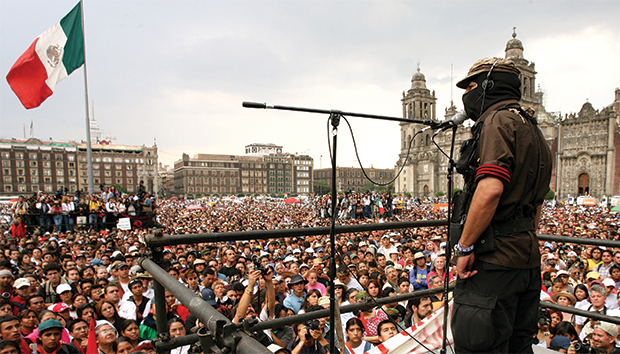
Marcos speaks in the Mexico City Zócalo in 2001.
By: Gaspar Morquecho
In the jungles and mountains of the Mexican southeast 46,000 indigenous families are resisting the most prolonged counterinsurgency war in the recent history of Mexico. They are grandparents, men and women, youths, girls and boys of four generations of those that a half century ago were abandoning the path and long walk of resistance per se to construct another, the Resistance for Itself… The task was not simple… In the Chiapas of the Indians, war has been systematic, practically permanent.
The war strategy that comes from far away… a brief framing
We can place one part of the War Against People in Mexico a half-century ago. The workers and teachers experienced it in 1958. As students, we experienced brutal repression of the Student Movement in the Plaza of the Three Cultures in 1968. The CIA, the federal government and their armed forces were the intellectual and material actors of the massacre. In the 1970s, the federal government and the armed forces created the Halcones (Falcons) paramilitary group that made was present near the Mexico City International Airport the day that a group of exiled Mexicans returned from Chile. They attacked us on two occasions: the first near the Casco de Santo Tomás, and the second in San Cosme, where they murdered dozens of students on June 10, 1971.
Those State crimes encouraged and gave way to a growing number of movements and armed groups in Mexico. In the mountains of Guerrero, Lucio Cabañas commanded the armed forces of the Party of the Poor. On August 6, 1969, on 5 de Mayo Street in Monterrey, N.L., a group of 7 persons founded the National Liberation Forces (FLN, their initials in Spanish), three more witnessed the act. The Cuban Revolution, the guerrillas and the figure of Che, the National Liberation Movements in Asia, Africa and in Latin America and the wars revolutionary wars in Central America were the referents that spirited the armed struggle in Mexico. The United States and the USSR were bottled up in World War III, the Chinese communists were confronted with the Russians and the Yankees were headed to the defeat in Vietnam. To guard its backyard patio, the US imposed the dictatorships, gorilla governments in Latin America.
Within that context, the government of Luis Echeverría Álvarez (LEA) adopted the Counterinsurgent War Strategy in which he conjugated, alternatively, the Dirty War (military and paramilitary violence), the Democratic Opening and the programs derived from the Social Policy. LEA’s international policy was characterized by the defense of the Sovereignty of Nations, Self-determination of the Peoples and political asylum to the persecuted from the military dictatorships. In that way, LEA projected a democratic, humanitarian and Third World image.
With the Dirty War, the federal government and its armed forces disarticulated and/or annihilated the main body of the armed movements, urban and rural, in Mexico. The result of the Dirty War was 10,00 disappeared persons. In Chiapas, the federal government militarized and populated the jungle and the border with Guatemala with Indians, and started the construction of the Border Highway. With those measures, LEA’s government constructed El Yunque for containing the Guatemalan guerrillas.
In the region of Los Altos (the Highlands), with the majority of the population being indigenous, the Social Policy was concretized in the Socioeconomic Development Program of Los Altos of Chiapas (PRODESCH); a preventive program for social containment. United Nations organisms such as the FAO and UNICEF intervened in it, and the three levels of government. The PRODESCH was a product of the global policy designed by McNamara at the World Bank, whose objective was: “avoid the political costs of a rebellion.”
Within that context of war, the National Liberation Forces (FLN, their initials in Spanish) was discovered on February 13, 1974. The police were looking for guerrillas of the Liga Comunista 23 de Septiembre (September 23 Communist League) that had murdered the impresario Eugenio Garza Sada one year before. That operation led them to an FLN security house in Monterrey. They arrested and tortured two of its members. On February 14, the Mexican Army attacked the headquarters in Nepantla. Five combatants died there and two were detained.
The soldiers found data in the Nepantla house about the foco established in Rancho El Chilar in the municipio of Ocosingo Chiapas. Later, 3,000 federal Army members carried out Operation Diamante. Between February and March they extended a circle to locate, occupy and destroy the camp of the FLN’s first primer Emiliano Zapata guerrilla nucleus in Ocosingo, Chiapas. Seven combatants were murdered and disappeared: Elisa Irina Sáenz, Raúl Pérez Gasque, Carlos Vives, Juan Guichard Gutiérrez, Federico Carballo Subiaur, César Germán Yáñez and Fidelino Velázquez. After a very complicated decade, the FLN was in the position to found the second guerrilla nucleus in the Lacandón Jungle.
Meanwhile, the Poverty Programs were grouped together with the violent repression against the indigenous and campesino movements, in Chiapas in which the PRI governments, the federal Army, the police and the private armies of the ranchers known as Guardias Blancas (White Guards) systematically participated.
Here are some cases: 1974, 40 soldiers of the 46th battalion burned 29 huts in the Colonia San Francisco in Altamirano municipality. 1975, Tzotzil leaders of Venustiano Carranza were murdered by pistoleros of the ranchers Augusto Castellanos and Carmen Orantes; 1976, confrontation for several hours between the federal army and comuneros [1] of Venustiano Carranza. The result was 2 comuneros dead, 3 injured, 13 detained, 6 women raped and several dead soldiers; 1977, the federal Army extended a military circle in Simojovel, Huitiupán and Sabanilla, 16 ejidos were evicted and the schools were converted into barracks; 1978, in Ocosingo, the Army evicted the indigenous residents of Nuevo Momón, destroyed and burned 150 homes, resulting in 2 Tzeltals dead and 6 tortured; 1979, paid gunmen carried out attacks on campesinos of Venustiano Carranza and Villa de las Rosas and murdered 7 campesinos; 1980, circle, intimidation and military maneuvers in charge of 9,000 soldiers in the Tojolabal municipio of Las Margaritas; 1981, 45,000 soldiers effectuated counter-guerrilla maneuvers and simulations in the Chol region – Tila and Sabanilla -, in the Lacandón Jungle and on the border with Guatemala; 1982, finqueros and police attack the Tzeltals of Flor de Cacao village; 1983, the indigenous caciques of Chalchihuitán organized the massacre of 11 indigenous and the destruction and burning of homes in the village of Tzakiuc’um.
In that scenario of Social Policy and a war against the peoples, Bishop Samuel Ruiz and the pastoral agents had opted “for the poorest among the poor.” Committed, they accompany their resistance and walking in the Construction of the Kingdom of God. They did not walk blindly. The 1974 Indigenous Congress had profiled a program of struggle that would be in effect for the next two decades. A program that guided their accompaniment and the movement of the peoples: Land, health care, education and housing. In the midst of the war against the indigenous and non-indigenous peoples of Chiapas, the Diocese of San Cristóbal de Las Casas also founded, with the communist, revolutionary, political military social activist organizations that forged the Kiptic ta Lecubtesel, the Independent Central of Workers and Campesinos (CIOAC), the Organización Campesina Emiliano Zapata (OCEZ), the ARIC Union of Unions, Solidaridad Campesina Magisterial (SOCAMA) and the Organización Indígena de Los Altos de Chiapas (ORIACH).
On November 17, 1983 the FLN finally established, after five attempts, the Secondo Emiliano Zapata Guerrilla Nucleus in the Lacandón Jungle. They came with two decades of experience and the teachings that the hard blow of February 1974 taught them. The jungle, the mountains and the canyons gave them cover. Nevertheless, the social movements were the best coverings in the decade of the silent accumulation of forces. With intelligence, they moved under and among the fallen leaves of the social movements, and “they put a trigger to hope.” They had in their favor the triumph of the Sandinista Revolution and the wave of revolutionary wars in Guatemala and El Salvador. The FLN would resolve the challenges that various changes in the juncture imposed within the international ambit and their national and local impact, the differences between the groupings that opted for the mass movement and that of arms and the changes of direction among the pastoral agents and their bishop.
At the beginning of the 1980s, the federal government intervened decidedly in the peace processes in Central America: Contadora Group (1983), in the Mexico Accord prior to the de-mobilization of the Guatemalan guerrilla in (1991); In 1992, the El Salvador Peace Accords were signed in the Chapultepec Castle. Those peace processes fell upon the orientation of the San Cristóbal Diocese and fundamentally estranged it from accompanying the rebels that were preparing for war in the jungle and the mountains of Chiapas. The signs of the times had changed. For sure, the withdrawal from the communities was no minor thing.
Programs derived from the Social Policy continued systematically in the state. If with LEA (1970), the PRODESCH was the point of departure for the preventive programs and for social containment in Chiapas, López Portillo created the General Coordination of the National Plan for Depressed Zones and Marginalized Groups (COPLAMAR) (1976). With Miguel de la Madrid the price of a package of basic products was subsidized (1982); and Carlos Salinas designed the National Solidarity Program – PRONASOL (1988-1994).
On the way to the armed uprising
While the FLN’s guerrilla nucleus moved like fish in the water, we have to take into account that the waters were not quiet; they were turbulent. Other cases: 1984, ranchers and state police attacked Indigenous in Simojovel. Eight people were injured. In 1985, 2,000 police, 35 ranchers and police evicted housed peons from the Medellín and La Soledad fincas that were demanding lost wages. In 1986, Judicial police and Enrique Zardain’s bosses burn and level for the second time 50 houses in Muc’ulum Bachajón in the municipality of Chilón. In 1987, caciques and police burned the town of La Independencia in the municipality of Ocosingo. In 1988, the police kidnapped four campesinos from the CIOAC in Las Margaritas. In 1989, the rancher Roberto Zenteno murdered PMS local deputy and former leader of the CIOAC Sebastián Pérez Núñez. In 1989, Arturo Albores, the founder of the OCEZ was murdered. In 1990, the San Cristóbal Diocese denounced that in the absence of Joel Padrón, the parish priest of Simojovel, several unknown persons set fire to the Parish House. In 1991, ten police detained Father Joel Padrón. He was accused of rebellion, robbery, dispossession, conspiracy, carrying illegal weapons, criminal association, an apology for crimes, threats and gang activity… The priest’s arrest was directed at the Bishop. Patrocinio did that. In 1992, Ocosingo cattle ranchers founded the Union for Citizen Defense in order to defend against the “destabilization” that the pastoral agents promoted. In 1993, the commanders of the XXXI Military Zone reported that an Air Force captain and an Army lieutenant were murdered and later burned on lands of San Isidro el Ocotal in the municipality of San Cristóbal de Las Casas. In May of that year, the federal Army discovered a guerrilla training camp and clashed with a group of combatants in the Sierra de Corralchén.
In 1993, the presence of the guerrilla in Chiapas was no longer hidden. The aggressiveness of PRONASOL in the state was notable because of something. Patrocinio González Garrido had increased the budget for the indigenous municipios and hardened the escalation against the movements, social organizations and, above all, against the Diocese of Samuel Ruiz and the pastoral agents. Carlos Salinas dedicated a Day of Solidarity to Chiapas and inaugurated three hospitals; one of them in Guadalupe Tepeyac…
———————————————————————-
Originally Published in Spanish by POZOL COLECTIVO
Translation: Chiapas Support Committee
Friday, October 16, 2015
Zibechi: New colonialisms and left values
NEW COLONIALISMS and the CRISIS OF LEFT VALUES
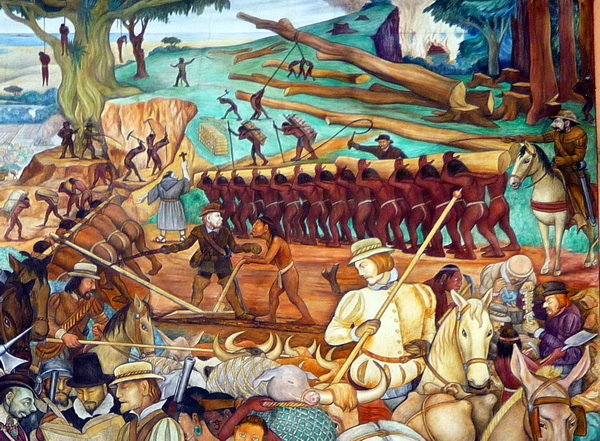
Mural by Diego Rivera, at the Palacio Nacional, Mexico City.
By: Raúl Zibechi
When visibility is minimal because powerful storms cloud the perception of reality, it may be appropriate to enlarge one’s view, to climb slopes to look for broader observation points, in order to discern the context in which we move. In these times, when the world is crossing through multiple contradictions and interests, it’s urgent to stimulate the senses to gaze far and inside.
Times of confusion in which ethics are shipwrecked, basic points of reference disappear and something is installed like “anything goes,” which permits supporting any cause that goes against the bigger enemy, beyond all consideration of principles and values. Shortcuts lead to dead ends, like equating Putin with Lenin, to use a somewhat fashionable example.
The Russian intervention in Syria is a neocolonial act, which places Russia on the same side of history as the United States, France and England. Good, emancipating colonialisms don’t exist. As much as Russian intervention is justified with the argument of stopping the Islamic State and the imperial offensive in the region, it is nothing more than an action symmetric to one using identical methods and similar arguments that is condemned.
The question that I consider central is: Why are voices from the Latin American left raised in support of Putin? It’s evident that many have hung their hopes for a better world, on the intervention of the big powers like China and Russia, with the hope of stopping or overthrowing the still hegemonic powers. It’s understandable in view of the exploits that Washington commits in our region. But it’s a strategic error and an ethical deviation.
I would like to illuminate this especially critical juncture, appealing to a historic document: the letter to Maurice Thorez (secretary general of the French Communist Party), written in October 1956 by Aimé Césaire. The text was born in one of the corners of history, a little after the XX Congress of the Communist Party of the Soviet Union, where the crimes of Stalinism were denounced; the same month as the uprising of the Hungarian people against the pro-Russian bureaucratic regime (which resulted in thousands of deaths) and of the colonial attack Egypt for the nationalization of the Suez Canal.
Césaire renounced the party after a shameful congress in which the leadership was incapable of the least self-criticism before the revelation of crimes that, in fact, it was supporting. He was born in Martinique, like Frantz Fanon, where he was a secondary school teacher. He was a poet and the founder of the blackness movement in the 1930s. In 1950 he wrote Discourse on colonialism, with a big impact in black communities. His letter to Thorez was, in the words of Immanuel Wallerstein, “the document that best explained and expressed the distancing between the global communist movement and the different national liberation movements” (in Discurso sobre el colonialismo, Akal, p. 8).
I find three questions in his letter that illuminate the crisis of left values through which we travel.
The first is the lack of will to break with Stalinism. Césaire turns against the ethical relativism that seeks to exorcise the crimes of Stalinism with “some mechanical phrase.” It’s like that cracking of the whip that is repeated over and over, saying that Stalin “committed errors.” Murdering millions is not an error, even though it supposedly kills in the name of a just cause.
The largest part of the lefts do not make a serious and self-critical balance of the Stalinism that, as has been written in these pages, goes way beyond the figure of Stalin. What gave life to Stalinism is a model of society centered on the State and on the power of a bureaucracy that comes from a State bourgeoisie, which controls the means of production. It continues betting on a socialism that repeats that old and expired model of centralization of the means of production.
The second is that the struggles of the oppressed cannot be treated, Césaire says, “as part of a more important whole,” because a “singularity of our problems exists that cannot be reduced to any other problem.” The struggle against racism, he says, is “of a very different nature than the struggle of the French worker against French capitalism,” and cannot be considered “a fragment of this struggle.”
On this point, the anti-colonial and anti-patriarchal struggles touch the same fibers. “These forces would be faded into organizations that are not their own, made for them, made by them and adapted to objectives that only they can determine.” Even today there are those who don’t comprehend that women need their own spaces, like all oppressed peoples.
It’s about, affirms Césaire, “not confusing alliance and subordination,” something very frequent when parties of the left seek to “assimilate” the demands of the different groups below to a single cause, through the sacrosanct unity that does nothing more than homogenize differences, thereby installing new oppressions.
The third question that Césaire’s letter illuminates, highly topical, is related with universalism; in other words, with the construction of non-Eurocentric universals, in which the totality is not imposed on the diversities. “There are two ways of getting lost: by walled segregation in the particular or by dissolution into the ‘universal.’”
We are still far from constructing “a universal depository of all the particulars,” which supposes the “deepening and coexistence of all the particulars,” as Césaire wrote six decades ago.
Those who bet on powers symmetric with the existing, excluding and hegemonic ones, but of the left; those who oppose the bad bombs of the Yankees with the good bombs of the Russians, follow the path traced by Stalinism of making a clean sweep with the past and with differences, instead of working for something different, for “a world where many worlds fit.”
———————————————————–
Originally Published in Spanish by La Jornada
Translation: Chiapas Support Committee
Friday, October 16, 2015
En español: http://www.jornada.unam.mx/2015/10/16/opinion/020a2pol
 Chiapas Support Committee