Chiapas Support Committee
Home of the Compañero Manuel blog on zapatistas & mexico
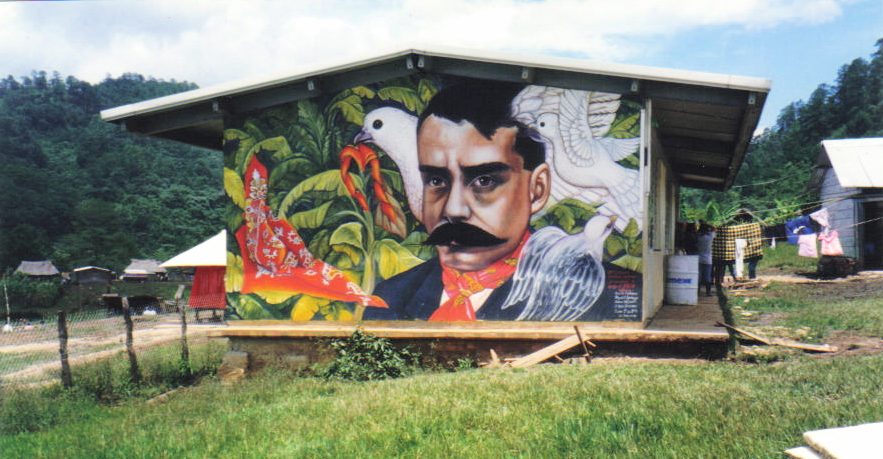
Esteva: Inside Out
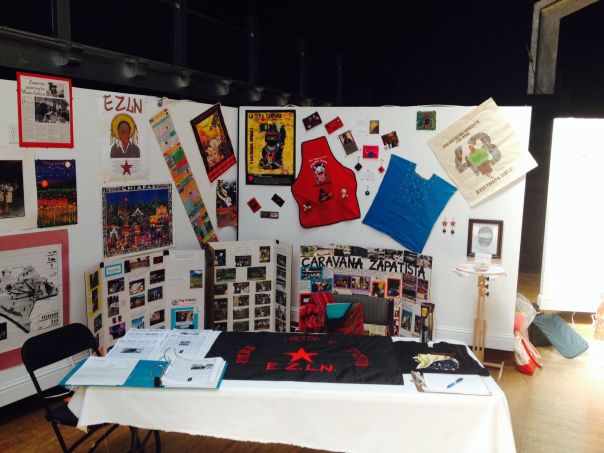
Autonomous Art at the Omni Fair. Interesting day with great food and interesting people.
By: Gustavo Esteva
Once in a while we get a compañero out of prison, stop the machines that come to destroy, stop a megaproject, impede a dispossession… Resorting to the law, to judicial proceedings, still produce results. But that should not be the only reason to continue using them, with all foolishness.
Before anything else, we must recognize that space is closing. In many cases, we only get what we want when we add social and political pressure to the legal. It becomes more difficult all the time to make the law or our rights work. What according to Benjamin was only a tradition of the oppressed is extended to a wider spectrum of the population: the rules of the state of emergency, the situation in which the law is used to establish illegality.
In prison, the nature of power doesn’t need to be dissimulated: it can show itself in all its nudity and crudeness. It thus takes on the sense of John Berger’s observation that prison is the word that best defines the current condition in the world: we are incarcerated. What is experienced now is that power shows its nature without inhibitions. We even see that it is deploying its worst aspects and that it now makes an object of exhibition and spectacle that it previously lied about or hid under the rug. It now forms part of the strategy of intimidation.
Continuing to use judicial proceedings should not have only pragmatic motives. The law should conserve its strength and significance until circumstances like the current ones, when the entire judicial apparatus is contaminated by illegality, corruption and injustice; when it is openly at the service of the privileged; when it is only useful for hanging a curtain over the despotic nature of the regime that administers it.
Those circumstances should not make us discard the very idea of the law, the formulation and application of norms. Judicial proceedings cannot be separated from political proceedings: they are structurally interwoven. Both shape and express the structure of freedom inside of history, and it is that structure which we now need to reconstruct or which we must elevate to where it never existed. It is the key to stopping the horror.
The parties have lost all credibility and the governments have lost the little legitimacy that they had. One another, together with technologies and systems, they have been converted into mere strategic devices of power with which it manipulates and controls us. It seems clearly impossible to save from ruin as whole world that falls violently into pieces around us, causing as much damage to nature as to culture. In this situation, in times so clearly apocalyptic as the present, nothing remains but to resort to reconstruction.
To reconstruct now, as a supreme expression of resistance, is not to repair or remedy institutions that are more counterproductive, threatening and irrational all the time. In rigor, nothing can save them. What we are starting to see is that some of their more astute operators have realized it and are running for safety, like the rats that they are. Others attempt to protect themselves from the multiple collapses in different institutional lairs. Others escape towards the future, and there are many, even at the first levels, those who don’t seem to realize anything and close their eyes tightly so as to not see the disaster of which they are a part.
What must be reconstructed isn’t there, but rather below. It’s true that we have been dispossessed of a good part of what we won in the last 200 years and that they continue mutilating the political liberties on which our conviviality was put in place, but we are still able to resort to ordinary language and to formal proceedings for reconstructing or reformulating our own norms in communities and barrios, within the bosom of our renewed organizations.
From there, in the tight weave of real men and women that are known to each other, who can see what is in the eyes of the other, in the spaces in which being ourselves is a state of things and a way of being, we are able to seriously tell the truth, tell it to each other. There, we are able to denounce the irremediably cancerous and unhealthy character of the formulas and dominant institutions and to nourish, against the desperations of the whole spectrum they germinate around, the hopes that are derived from an authentic autonomous construction.
Those hopes do not represent the triumph of optimism over reality. They are not mere illusion. They emerge from the perception that organized autonomous persistence, which comes from below, which is affirmed in dignity in the face of all disasters and knows that to live is to fight, extends farther all the time and begins to appear as a network of interconnected and self-sufficient shelters in the midst of the storm that announce another possibility.
———————————————————–
Originally Published in Spanish by La Jornada
Monday, April 25, 2016
Re-Published with English interpretation by the Chiapas Support Committee
Chiapas teachers march to show their strength
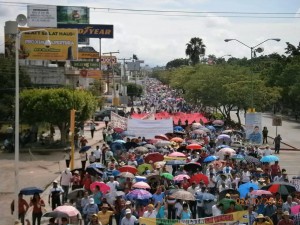
Thousands of Chiapas teachers march in Tuxtla
THE CNTE SHOWS ITS MUSCLE: holds one of the largest marches in its 37-year history
By: Isaín Mandujano
This Friday, tens of thousands of teachers miles of the National Coordinator of Education Workers (CNTE, its initials in Spanish) held one of the largest marches that it has carried out in in its 37 years of existence, in order to protest against the education reform.
Accompanied by members of social organizations, activists and citizens, parents and students, leaders of the teachers’ movement calculated some 100,000 people participated on its long march of several kilometers from the western exit from the state capital to the central plaza. The human column extended for 5 kilometers (3.1 miles).
Adelfo Alejandro Gómez, Secretary General of the SNTE Section, Alberto Mirón, Pedro Gómez Bámaca, Manuel Mendoza, among other leaders of that same union section, as well as the leaders of Section 40 headed by José Armando Falconi Borrás, headed the demonstration that advertised it would be peaceful on the entire trajectory.
They gave orders that no one should commit acts of vandalism and that anyone caught would be bound; that no one would be masked or cover their face; and that if any alleged infiltrator was detected the order was to detain him and take him to the central plaza.
On both sides of the human column the teachers extended a cordon in order to have greater control of who was participating in the demonstration and so that no one could infiltrate, but rather was someone known inside the teachers ranks.
Along the route citizens, parents and students held signs on which they showed their support for the teachers’ movement: “Teacher you taught me to read, now you teach me to struggle,” some signs read.
They reached the central plaza where they held a rally and burned the green school uniforms the government of Manuel Velasco Coello granted and a suspected infiltrator was detected among the crowd, who was apparently identified as a police agent dressed as a civilian.
Adelfo Alejandro Gómez as well as Manuel Mendoza, leaders of the teachers’ movement demanded a table for dialogue and negotiation from the state and federal governments because until now they are the ones that have been closed to opening the doors for that path.
The teachers said that they would continue to protest, and that while this is a very large march, they are preparing marches on Sunday, May 1 and on May 15 that would be a national strike.
On this occasion, the state or federal police bodies were absent along the route of the mobilization. The majority of them were concentrated at the Víctor Manuel Reyna Zoque Stadium. Arriving from their trucks, they complained about the heat and hunger, as well as about the lack of bathrooms for everyone.
The only threat that weighs over the teachers is the docking of salaries about which the Secretary of Education, Sonia Rincón Chanona warned. She is a friend and old disciple of Elba Esther Gordillo Morales.
None of the 18 detained last April 15 were seen in the march, but it was confirmed that the pre-school teacher Yuri del Carmen Pérez, 30, arrived yesterday (Thursday) coming from Mexico City. He is a member of Section 40 of the SNTE and was detained by the Federal Police last Friday (April 15). He was released on bond after paying 28,000 pesos as bail. His family, friends and teacher compañeros, but above all his little daughter received him with joy when he returned home.
The rest of the 17 detainees that were taken to the federal prison in Tepic, Nayarit, arrived today.
Manuel Mendoza, leader of the teachers sector magisterial in the Los Altos region of Chiapas, classified this march as historic, as one of the most important since the CNTE’s founding in 1979.
Pedro Gómez Bámaca, another of the CNTE’s leaders, said that with all the demonstrators from the social organizations there could have been 100,000 people that were mobilized this Friday. The state government said there were 12,000 teachers. What’s certain is that the human column extended for some 5 kilometers.
For its part, the Chiapas Human Rights Commission (CEDH) said this afternoon that it established that this Friday the demonstrators realized their protests in an orderly and peaceful way through the principal streets of the Chiapas capital.
Additionally, the state human rights defense organism witnessed that Chiapas security authorities kept to the side but attentive to possible outbreaks of violence or possible demonstrations outside the law.
The president of the State Human Rights Commission, Juan Oscar Trinidad Palacios, instructed the Visitors General Specialized in Women, Migrants and Indigenous, as well as the Coordinator of Regional Adjunct Visitors, so that during their march and stay the organism’s personnel would accompany the marchers, who had faith that everything would transpire without violence or altercations with civil society.
————————————————————————–
Originally Published in Spanish by Chiapas Paralelo
Friday, April 22, 2016
Re-Published with English interpretation by the Chiapas Support Committee
GIEI: there was no cremation in Cocula
FINAL AYOTZINAPA REPORT
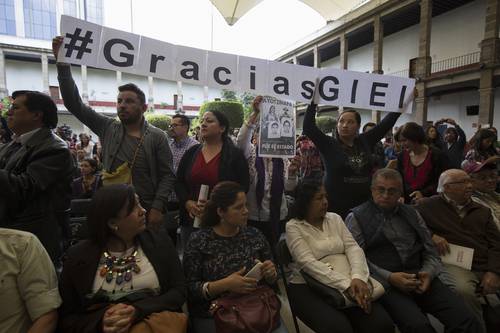
Relatives of the normalistas thanked the Interdisciplinary Group of Independent Experts for their investigative work. Photo: Cristina Rodríguez
By: Emir Olivares Alonso and José Antonio Román
The Interdisciplinary Group of Independent Experts (GIEI) for the Ayotzinapa case did not find “one single piece of evidence” for assuring that the 43 students of that rural teachers college, disappeared since September 2014, were executed and incinerated in the Cocula, Guerrero garbage dump. To the contrary, a year and a half of work confirmed their conclusion –which the group reached seven months ago– that the incineration of these bodies did not take place in that garbage dump.
Upon presenting its 608-page final report on the case yesterday, the experts assured that the authorities have not followed key lines of investigation, evidence has been manipulated, obstructed and investigative work rejected, officials that would have participated in the disappearance protected, and alleged suspects tortured to obtain confessions that support the government’s version. They emphasized that the Mexican justice system only investigates and punishes the material authors of the crime, but is remiss with the intellectual authors. “Investigation into the chain of command does not exist.”
With this report, the experts close their work in Mexico (their work concludes April 30), after the federal government refused to prolong their mandate. They lamented that the principal objective of the GIEI –the location of the students– had not been achieved.
A key element to the investigations, they said, was to obtain direct testimony from the military personnel that were present at several of the scenes of the violent acts in Iguala, which the administration of Enrique Peña Nieto repeatedly rejected.
The soldiers –they pointed out– even had knowledge of the beating and detention of the normalistas, “but took no measures to protect them.” Another fact to emphasize is that relatives of the Los Avispones soccer players directly requested help from the 27th infantry battalion, where they answered that they could not offer aid because “it’s not our jurisdiction.”
The experts concluded that certainty exists that normalistas there was “perfect coordination” in the attack on the students for more than 10 hours between different police corporations and alleged organized crime members, for the purpose of creating “a circle of control” that embraced up to 80 kilometers, to avoid the exit of the buses (taken over by the students) from Iguala.
In contrast, different police, among them the federal police, would have let the so-called fifth bus pass (which according to the GIEI’s hypothesis is key to the investigation, since it could be related to the shipment of narcotics from Iguala to Chicago). This unit, they added, wasn’t even incorporated into initial case record.
Angela Buitrago emphasized: “We’re dealing with a massive and indiscriminate attack on the civilian population, about which no explanation from the PGR exists as of the moment. The fifth bus is an investigative hypothesis that could justify an attack of that intensity. That line is not and cannot be closed.”
In the midst of great expectation to know the content of the report titled: Informe Ayotzinapa II: avances y nuevas conclusiones sobre la investigación, búsqueda y atención a las víctimas, [1] dozens of people, among them relatives of the victims, human rights defenders, the president of the Inter-American Commission on Human Rights, James Cavallaro, politicians and intellectuals, were invited to the principal patio of the University Cloister of Sor Juana.
Official absences
The places remained empty that were destined for the assistant secretaries of Human Rights in the Secretariat of Governance, Roberto Campa; of Multilateral Issues and Human Rights of the Secretariat of Foreign Relations, Miguel Ruiz, and the assistant prosecutor for Human Rights in the Attorney General of the Republic’s office, Eber Betanzos, despite being invited. The argument for that absence was that they were hoping to know the report before its presentation, but it was finished at 10 PM on Saturday, and therefore it was impossible to get it to them.
Down with the “historic truth!”
In a long presentation and a press conference afterwards, which lasted almost four hours, the experts described some elements to throw down, once again, the so-called “historic truth.”
The GIEI found a registry of the activity of the mobile phones from at least seven of the now disappeared students, several hours and even days after September 26 and 27. For example, one of them made a call at 1:26 AM on the 27th, registered on the Huitzuco-Tenango highway. In the official version, the students would already have been murdered and their cell phones destroyed at that time.
One more element that was not investigated despite a request from the relatives and from the GIEI, is that a text message was sent from Jorge Aníbal Cruz Mendoza’s cell phone to his mother asking her “to give his balance; that telephone remained active even months after” the Iguala events.
The GIEI’s report shows that an alleged member of the Guerreros Unidos criminal organization, identified as El Caminante, and that as of now the authorities don’t know who he is, talked about the “critical hours” with at least seven municipal police located at key places, like Cocula and Iguala. One circumstance that is included in the PGR’s case record is that Jonhatan Osorio, one of the detainees blamed for the alleged incineration of the bodies, made a call from his telephone from the Cocula garbage dump, where–according to the experts– there is no signal.
Different testimonies obtained by the GIEI throw out the hypothesis that the 43 students would have been separated and led to different places. Various witnesses affirmed that between 10 and 14 of them were seen on the patio of the Iguala municipal police command post, where they would have spent the night of September 26 and 27. Others indicate that another group was taken to Huitzuco. “They fucked up a compañero and are taking them to Huitzuco, and the boss there will decide what to do with them,” one police agent would have said to the other.
The experts sent by the IACHR accredited acts of torture to at least 17 of the detainees because of the case, among them the five alleged members Guerreros Unidos that gave statements around the incineration of the 43 bodies in the Cocula garbage dump. Of the complaints presented to (Mexico’s) National Human Rights Commission for torture, 15 are from the 17 pointed out by the GIEI.
They condemned the media disqualifying –with which the federal government was complacent– of its work and they added that since January the PGR unnecessarily delayed or rejected the investigative work the group proposed. The report makes a series of recommendations that hoped would be complied with by the Mexican State.
For these facts, they added, there were 180 direct victims and 700 indirect victims. While they are leaving tranquil with the work carried out, Francisco Cox recognized: “We leave with the worst taste” because of not having fulfilled el principal objective: the location of the disappeared normalistas.
[1] Ayotzinapa Report II: advances and new conclusions about the investigation, search and attention to the victims.
———————————————————–
Originally Published in Spanish by La Jornada
Monday, April 25, 2016
Re-Published with English interpretation by the Chiapas Support Committee
Forensic anthropologists publish report on Cocula garbage dump
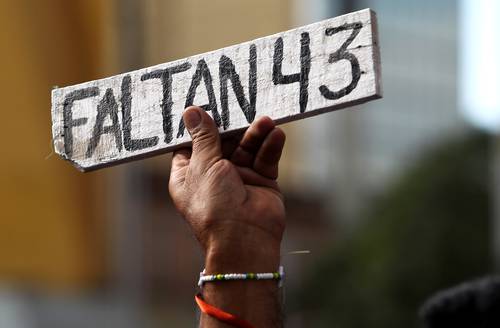
43 Missing
* The objective is to encourage scientific and informed debate about the students’ whereabouts
By: José Antonio Román
The Argentine Forensic Anthropology Team (EAAF, its initials in Spanish) decided to place at the disposition of public opinion the entire report of the expert tests done on the garbage dump in Cocula, Guerrero. The report concludes that: “it’s not possible” that the 43 disappeared Ayotzinapa students were incinerated and executed in that place.
Although the EAAF doesn’t usually publish its work completely, on this occasion it pointed out that the decision seeks “to generate scientific and informed debate” about the acts that occurred on September 26 and 27, 2014 in Iguala, and the disappearance of the young students.
In this way, the judgments of this Argentine team are public and that carried out by the Peruvian expert José Torero, published by the Interdisciplinary Group of Independent Experts (GIEI); consequently only the complete publication of the experts from the Attorney General of the Republic (PGR) remain pending and, especially, the report that contains the judgment that the panel of specialists in fire would have recently formalized, announced by its spokesperson Ricardo Damián Torres last this month (April 2016).
“The publication of all the judgments and technical opinions will permit an open discussion among experts for the benefit of the investigation that occupies us. Only transparency and scientific discussion will permit comprehending the findings in the Cocula garbage dump,” it points out in a communiqué diffused by the Miguel Agustín Pro Juárez Human Rights Center, one of the instances that represent the parents of the 43 disappeared students.
The work carried out by the recognized Argentine team took more than a year of independent scientific work on the physical evidence collected and analyzed from the garbage dump, in which a group of 26 specialists in archaeology, anthropology, criminalistics, entomology and forensic botany, ballistics, fire dynamics, interpretation of satellite images, forensic dentistry, genetics and bone trauma participated. These specialists are from Argentina, Mexico, United States, Colombia, Uruguay and Canada.
———————————————————-
Originally Published in Spanish by La Jornada
Thursday, April 21, 2016
Re-Published with English interpretation by the Chiapas Support Committee
EZLN and CNI: Declaration of Maximum Alert for Xochicuautla and Ostula
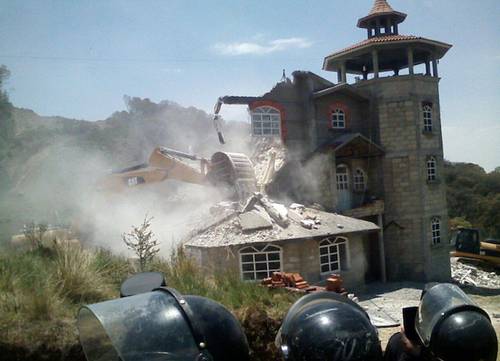
Protected by riot police, construction company’s heavy equipment destroys a house in Xochicuautla. Photo: La Jornada
April 13, 2016
TO THE PEOPLES OF THE WORLD
TO THE ALTERNATIVE MEDIA
Faced with the cowardly betrayal of the Natho indigenous community of San Francisco Xochicuautla, municipality of Lerma in the State of Mexico, in order to impose the project of the highway from Toluca to Naucalpan, and the attack suffered by Community police of Ostula, municipality of Aquila, Michoacán, we, the Indigenous National Congress declare ourselves on maximum alert and call on the people, organizations and those in solidarity to be vigilant and respond to the call made by the community of Xochicuautla.
We denounce that:
On Monday April 11, at around 9 in the morning, more than 1,000 state police of the State Commission of Public Safety (CES) and the Forces of Action and Reaction (FAR), began arriving, entering the community on 3 sides, the Buenavista colonia, down Cuauhtémoc Street to get to the place known as “Lampeni,” and in the place called “Lapondishi” where the Camp of Peace and Dignified Resistance was situated, which was destroyed by the police.
At the place called “Lampeni,” Compañero Armando Garcia Salazar, uncle of David Ruiz García, delegate of the National Indigenous Congress, who attended the sharing between the CNI and the EZLN in August 2014, held in the Zapatista La Realidad, had his house and his children’s heritage. Inside the house about 25 people were gathered to defend the property, mostly women, they were very violently evicted, pushing and pulling the compañera Isabel Hernandez, aged 64, who is part of the Supreme Indigenous Council and at that time was holding a female child in her arms.
Accompanied by police, a letter was handed to Compañero Armando informing him that his house was on federal property and they had to destroy it; they also showed him the expropriation decree against which they had won an injunction.
Without further words, those inside the house were pushed out, and the possessions that were on the first floor were thrown out, leaving documents, clothing and tools inside.
Once again the bad government demonstrates that the laws it claims to represent and the supposed rule of law are nothing more than tools for dispossession which are used as long as and only when they are against the people. Dispossession and repression violate the suspension granted in injunctions (amparos) 1123/2015 and 771/2015 that were granted on February 18, 2016 and the court notified most authorities on 23 February, including SAASCAEM, which is the institution to which the Xochicuautla territory was granted in the expropriation decree.
Meanwhile, on the night of Sunday 10th April, compañero members of the community police of Santa Maria Ostula were attacked, near the town of San Juan de Alima, Michoacán, when, from a moving car, comunero Francisco Grajeda was killed and comunero Abraham Girón was wounded, he is also commissioner of the community to the National Indigenous Congress and a participant in the sharing held in the Zapatista La Realidad.
We denounce the bad government’s attempt to minimize this crime with which it seeks to encourage the return of violence to the region of Michoacán’s coastal sierra, and to put the territory, natural resources, dignity and peace of the region back into the hands of the narco-politicians, their paramilitaries, gunmen and businesses.
We call on the people of Mexico and the world to show solidarity urgently with the actions in defense of the rights of San Francisco Xochicuautla, by physically being present in the community, and mobilizing wherever they are to denounce and demand the cessation of attacks against community, its territory and peoples.
We hold Eruviel Avila and his boss Enrique Peña Nieto responsible for the integrity of our colleagues and of all those who give solidarity to the dignified struggle.
FOR THE INTEGRAL VINDICATION OF OUR PEOPLES
NEVER AGAIN A MEXICO WITHOUT US
APRIL 12, 2016
NATIONAL INDIGENOUS CONGRESS
ZAPATISTA ARMY OF NATIONAL LIBERATION
————————————————————
Originally Published by in Spanish by Enlace Zapatista

Frayba: Repression, torture and arbitrary arrests of Chiapas teachers
CHIAPAS: “ARBITRARY DEPRIVATION OF FREEDOM AND TORTURE OF CNTE TEACHERS,” FRAYBA

Federal Police arrive in Chiapas before teachers’ demonstrations. Photo: Chiapas Paralelo.
The Mexican State’s repression criminalizes social protest in Chiapas.
San Cristóbal de Las Casas, Chiapas, México, April 16, 2016
Press Bulletin
The Fray Bartolomé de Las Casas Human Rights Center (Frayba) documented human rights violations consistent with: the disproportionate use of Public Force, arbitrary deprivation of freedom, torture and cruel, inhuman and degrading treatment that form a pattern of repression and criminalization of social protest. Acts committed in San Cristóbal de Las Casas and Tuxtla Gutiérrez, Chiapas, during the operations for dislodging the demonstrations called by Section VII of the National Coordinator of Education Workers of the State of Chiapas (CNTE) and the National Union of Education Workers (SNTE). Actions perpetrated by members of the Federal Police, the Gendarmería and the State Policía used tear gases and rubber bullets indiscriminately and unjustifiably damaged the salud of those who demonstrated on April 15, 2016, from approximately 10:00 am to 2:00 pm. They also physically injured the population that passed by or those who were at the place of the repression, including girls, boys, women and the elderly.
Testimonies refer to the fact that in San Cristóbal de Las Casas, police aggressions included breaking into private homes and businesses, the use of tear gas damaging the family members sick people that were in the Hospital of Culturas, people beaten although they had nothing to do with the demonstrations, vigilance on the part of soldiers dressed as civilians and the infiltration of shock groups to justify repression and to generate confrontation. At the same time two Federal Police helicopters, without registration, flew over and shot tear gas, and one helicopter from civil protection.

During the protests, the mayor’s offices and several vehicles were set on fire in San Cristóbal de las Casas. Photo: Chiapas Paralelo.
In Tuxtla Gutiérrez they implemented a police circle that started at the La Pochota demonstration point and turned the teachers towards the center, in zones where the attacks with tear gas, rubber bullets and stones affected the population in general. Helicopters also flew over launching tear gas. There were an undetermined number of people injured and with nervous crisis.
In Tuxtla Gutiérrez and San Cristóbal de Las Casas, Chiapas members of the police arbitrarily detained and with cruel, inhuman and/or degrading treatment, without respect for individual guaranties or mediating protocols that safeguard security and integrity, at least 8 female professors, 10 male professors and three people that were passing by the place: a distributor of water, an electricity technician and a gym instructor, also a student that was at a mechanics shop and two other unidentified individuals. These detentions were made between 10:00 am and 12:00 Noon in different places and the people detained were taken to the installations of the Attorney General of the Republic in Tuxtla Gutiérrez, Chiapas.
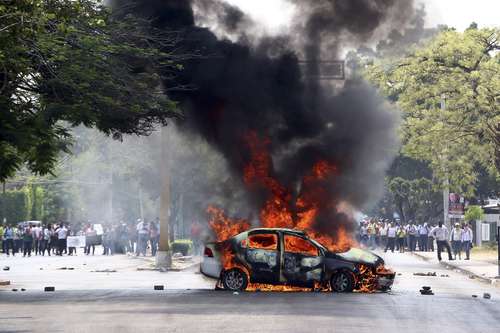
Car set on fire in Tuxtla Gutiérrez. Photo: La Jornada.
Testimonies mention that they knew about the detention of their family member through social networks, but it was not until no 11:00 o’clock at night that they received calls from the individuals detained; thus, they were incommunicado more than 12 hours and they were allowed to see a relative for only 5 minutes each, it being the last visit where they could have contact with their relative at 5:00 am on April 16. The majority said they didn’t know details about the legal situation of the persons detained.
On April 16 in the morning, the 18 teachers were transported in a Boeing 727 airplane, Registration XC_MPF belonging to the Federal Police to the maximum-security prison at Tepic, Nayarit. The teachers are accused of attacking general roadways, damages, terrorism and injuries, typical crimes to inhibit social protest, thereby criminalizing freedom to demonstrate. Lo anterior violates the rights to demonstrate, associate and meet, thought and expression, as well as also wounding the right to personal integrity and security and personal freedom and, in relation to the foregoing, the right to legal due process.
The referenced facts generate a pattern of repression and criminalization of protest in Chiapas and in the country, which puts the general population at risk of being indiscriminately attacked, being that women, boys and girls had specific rights violated.
We place responsibility on the Secretary of Government, Juan Gómez Aranda, who had published his commitment to “privilege dialogue and the un restricted compliance with the law as the only way to con find solutions to the problems of Chiapanecos;” on Manuel Velasco Coello, Governor of the State of Chiapas, on Renato Sales Heredia, National Security Commissioner and on Jorge Llaven Abarca, Secretary of Citizen Security and Protection, who Frayba had informed of the grave situation urging avoiding events and/or damages that are impossible to repair. At the same time, Enrique Peña Nieto and Miguel Ángel Osorio Chong, who are producers of the repressive policy of the current authoritarian regime.
This Human Rights Center urges the Mexican State to: assume the obligation to protect, guaranty and respect human rights; cease the repression and criminalization of social protest; guaranty life, integrity and personal security of those who exercise their legitimate right to demonstrate freely; immediately, efficiently, promptly, seriously, exhaustively and impartially attend to these acts sanctioning those responsible for the human rights violations described; and that it immediately free the individuals arbitrarily detained and unjustifiably moved accused of crimes fabricated as a justification for repressive actions.
Source: http://www.frayba.org.mx/archivo/boletines/160416_boletin_10_represion_estado.pdf
———————————–
Published by: Pozol Colectivo
Saturday, April 16, 2016
Re-Published with English translation by the Chiapas Support Committee
Zibechi: Financial inclusion and full-spectrum domination

Will money as we know it disappear?
By: Raúl Zibechi
Financial inclusion being one of the principal neoliberal initiatives, it’s difficult to accept the scarce debate existing among those who say they are enemies of that model centered on the domination of financial capital. The World Bank (WB) is the principal impeller of financial inclusion, with the objective that all of the world’s population will be dependent on the banking system, which proposes to eliminate physical money.
The initial argument insisted that financial inclusion is necessary to combat money laundering and drug trafficking. Later the same bank was adding new arguments, very similar to those that it utilizes for “fighting poverty.” In 2015, it says on its web page: “Two billion or 38 percent of the adults in the world don’t use formal financial services and an even greater percentage of the poor don’t have a bank account” (http://goo.gl/3Tf0Nt).
The WB defends the thesis that financial inclusion contributes to reducing poverty, to “empowering women” and “impelling shared prosperity.” Among its objectives it figures that all the income and expenses of the popular sectors are carried out electronically and it promotes that social loans not be paid in cash, but rather through the banking system, as is already happening in several countries.
In the short term, the WB proposes: “to reach another billion people that are now excluded from the financial system,” even using the key word “exclusion,” to give the impression that they are disadvantaged people and that access to financial services is the key to their inclusion as citizens (http://goo.gl/NCpYqp). The president of the World Bank, Jim Yong Kim, imposed goals for offering universal access to financial services to all adults of working age no later than 2020.
The objective is to advance the use of banking in the emerging countries and in the world’s South. In the United States and in Europe people that don’t have a bank account are less than 20 percent; a number that climbs in Latina America to 50 percent and in several countries of Africa exceeds 80 percent of the population.
What’s striking, to say the least, is that the progressive governments had adopted this policy without previously opening a debate. In Brazil, the salary grew 80 percent between 2001 and 2015, but individual credit increased 140 percent. The result is an exponential growth of consumerism and of family indebtedness: in 2015, 48 percent of their income was dedicated to the payment of debts; it was 22 percent in 2006.
Financial inclusion is the first step towards the elimination of physical money, with which all of us will be dependent on the bank and the financial system, annulling or making extremely difficult our individual and collective autonomy. It is a “micro” modality of domination of a complete spectrum. In several countries, like Uruguay, limits are already imposed on the amount of money to extract from the ATMs and this year taxi rides will have to be paid with debit or credit cards.
In Germany there is a campaign against the extinction of physical money under the slogan “Cash protects you from the State’s vigilance.” Various political groups condemned the limits on cash money. Konstantin von Notz, a deputy of the Green Party, explained the reasons on Twitter: “Cash permits us to remain in anonymity during day-to-day operations. In a constitutional democracy, it’s a freedom that must be defended” (http://goo.gl/CD53LE).
The data shows a clear difference in the behavior of Germans with respect to citizens of other developed countries. Only 18 percent of payments in Germany were made with cards in 2013, compared to 59 percent in the United Kingdom, 54 percent in the United States and 50 percent in France. They (Germans) pay four of every five invoices with bills and coins (http://goo.gl/CD53LE).
I find two reasons that financial inclusion and the disappearance of physical money are not part of the necessary debates in Latin American critical thought, in the lefts and in the popular movements.
The first reason is the option for not questioning the current basis of capitalism, in other words, putting the one percent in view, although the discourse may say otherwise. Financial capital plays a central role in the current world and disputing power implies playing hard, to the point of putting at risk the conservation of presidential chairs and the benefits that political leaders usually have, since that sector has an enormous capacity to provoke crisis and precipitate the fall of any government.
We’re going through a period of accommodation to the system of the lefts and of progressivism. It’s easier to criticize imperialism abstractly that to work with their social bases that are trapped in consumerism –and therefore with financial capital through the bank– so that they overcome the culture of consumption. The cultural defeat of popular country life has led to underestimating conflict as a source of change and to over-emphasizing the electoral question.
The second completely affects critical thought and the critical thinkers. It can be defined as the inability to go against common sense, to adapt to the reality and to not place in question hegemonic ideas among the popular sectors due to a lack of commitment to them. It is impossible to advance if one isn’t capable of swimming against the current, which evidently implies certain isolation, as much of the state institutions as of the part of the population that still believes in them.
If capital continues consolidating a type of society based on mass consumption, the principal obstacle to its domination will be solved: the existence of structural and social heterogeneities. Although a part of the left believes that they are things of the past, without tianguis [1], tequio [2] and reciprocity we won’t be able to even dream of overcoming capitalism.
[1] Tianguis – outdoor public markets
[2] Tequio – collective work that each member owes to his or her community
———————————————————–
Originally Published in Spanish by La Jornada
Friday, April 15, 2016
Re-Published with Spanish interpretation by the Chiapas Support Committee
Anti-War Caravan in Mexico City
THE WAR on DRUGS HAS LEFT THE POLITICAL POWER WITH ENORMOUS PROFITS
Caravan for Peace: the economic interests of powerful nations are behind it.
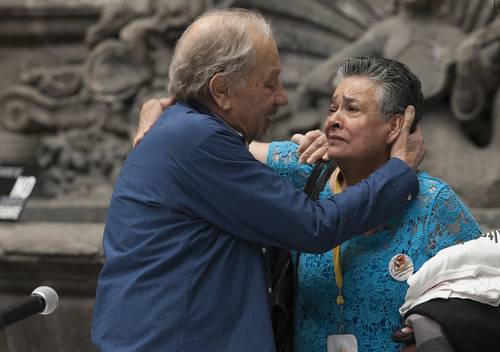
The academic Adolfo Gilly and María Herrera, who is looking for her four sons, during the forum. Photo: Cristina Rodríguez.
By: José Antonio Román
Members of the Caravan for Peace, Life and Justice, to whom are added religious representatives, academics, researchers, intellectuals and activists, asked to put an end “to the war on drugs,” which has left hundreds of thousands of victims, and also left enormous profits for the owners of money and the political power.
They pointed out that this “war,” impelled from the economic interests of the most powerful countries, has left scourges like the militarization of public security, forced internal displacement, disappearances, torture, extra-judicial executions, arbitrary detentions, corruption and impunity in the Mesoamerican nations.
Meeting in a forum organized on behalf of the caravan and specialists, they warned that our societies cannot continue ceding their rights to the “terrible and absurd” fight against drugs, which has placed almost all the countries Central America and Mexico among the most violent nations in the world.
The caravan, which left Honduras on March 28 and since then has traveled through El Salvador and Guatemala to arrive in Mexico, has New York City as its final destination, where it seeks to arrive on April 18, the eve of the special session called by the General Assembly of the United Nations to discuss the theme of international policy on drugs.
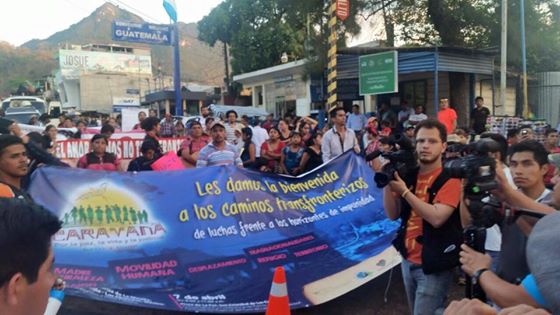
Laura Carlson, director of the Americas Program; Martín Baraona, Bishop emeritus of the Anglican Episcopal Church of El Salvador, and Alex Sierra, of Global Exchange –all members of the caravan– pointed out that the objective is to demand that the UN have an open dialogue that will give way to alternative policies, emphasizing the extremely high social cost that prohibitionist policy and the war on drugs have had. Respect for human rights and diminishing violence must always be prioritized, they all agreed in their talks.
Meanwhile, the Dominican priest Miguel Concha, the historian and intellectual Adolfo Gilly, and the executive director of the Mexican Commission for Defense and Promotion of Human Rights, José Antonio Guevara, emphasized the enormous importance of this caravan for comprehending what is really behind this “war;” in other words, the interests of the owners of money and political power.
“Enough now of death, violence and of military and police control in the territories and over people,” the priest Miguel Concha said, who questioned why President Enrique Peña Nieto doesn’t attend the UN’s special session especial where the theme of the fight against drugs will be broached, despite the fact that he was the president that asked it go forward.
Adolfo Gilly, for his part, pointed out that: “against the arbitrariness and the autistic craziness of power,” the caravan is recuperating solidarity among the peoples and this collective work transcends borders in the spirit of raising our voice before the death and working for peace, justice and dignity.
During the forum, in the Mexico City Museum, they set forth that this movement, as one of defense of land and territory, forms part of society’s reaction in the face of this phenomenon, which is the “terrible civilizing crisis” that humanity confronts.
———————————————————-
Originally Published in Spanish by La Jornada
Tuesday, April 12, 2016
http://www.jornada.unam.mx/2016/04/12/politica/005n1pol
Re-Published with English interpretation by the Chiapas Support Committee
60 Chiapas communities reject dam on the Usumacinta River
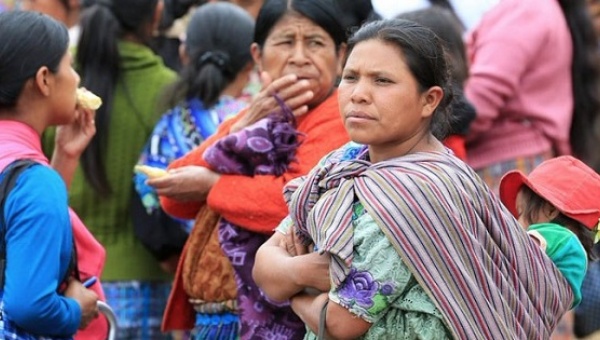
“According to researchers, the construction of dams across Mexico has displaced some 200, 000 people, while advocacy groups warn that the country’s new water law will just continue to make the situation worse. Many of Mexico’s 4, 462 dams registered in official records are in Indigenous and campesino communities.” TeleSur
By: Elio Henríquez, Correspondent
San Cristóbal de las Casas, Chiapas
Representatives of more than 60 communities from seven municipios in the Northern Zone and Jungle regions of Chiapas and from the Petén Front Against Dams of Guatemala issued statements against the construction of the bi-national Boca del Cerro hydroelectric dam, on the Usumacinta River, because it will invade their lands and the communities will be evicted.
In a statement published this Saturday, the almost 300 attendees at the Fourth Forum of resistances and alternatives of peoples of the Northern Zone of Chiapas said that construction work already started on the containment walls on both sides of the Usumacinta, which divides Mexico from Guatemala, for an expanse of 40 kilometers.
The gathering, called by the Peoples Light and Power Civil Resistance Organization of the Northern Region, an adherent to the EZLN’s Sixth Declaration of the Lacandón Jungle, was held on April 6 and 7 in the Victórico Grajales Ejido, Palenque Municipio, Chiapas, one of the municipios affected together with Tenosique, Tabasco, and communities in the Department of El Petén, Guatemala.
The bi-national Boca del Cerro hydroelectric dam is one of the five dams planned on the waterway that divides Mexico from Guatemala. According to data of the Federal Electricity Commission (CFE), the works are planned over four years and will have a maximum height of 55.5 meters (approximately 182 feet).
The total surface of the reservoir contemplates 4,443 acres; 1,746 acres are within the municipio of Tenosique and 2,697 within the municipio of Palenque.
Those who attended the Forum pointed out that the start of the work will immediately provoke that: “the San Carlos Boca del Cerro community, Tenosique, will disappear because it will be converted into the offices and camp of the company that constructs the dam’s curtain.”
Their concern, they stated, is because in addition to all the damage that the dam will cause, “the government will not indemnify us for our lands, the cost of living will increase and we, Chols and Tzeltals, will disappear from the region as indigenous peoples.”
They assured that the federal government imposes the dam on them and violates Article 2 of the Mexican Constitution and Convention 169 of the International Labor Organization (ILO), which refers to the autonomy of Native peoples and their right to consultation.
Due to the above, they committed to applying a work plan for stopping construction of the Boca del Cerro Dam and pledged solidarity “with the actions of sister organizations that are fighting to stop projects for mining, highways, hydroelectric dams and for expelling us from our lands that owners of the big companies have who want to dispossess us of our lands.”
They reported that they agreed to apply actions that permit them to put into practice the control and care of their territory, because said project would contaminate the river and the fish.
They also stated their opposition to the construction of other dams projected for Chiapas territory, because “they would affect the life of the peoples, and the profits that they would generate would be used to enrich foreign companies, the result if the energy reform, at the expense of the eviction of our peoples and of our lands.”
They also demanded justice for the murder of the activist Berta Cáceres Flores, coordinator of the Civic Council of Popular and Indigenous Organizations of Honduras, “and for respect of human rights and the lives of those that fight against the megaprojects and against dams, in Mexico, Central America and other places in the world.”
———————————————————–
Originally Published in Spanish by La Jornada
Sunday, April 10, 2016
En español: http://www.jornada.unam.mx/2016/04/10/estados/024n1est
Re-published with English interpretation by the Chiapas Support Committee
 Chiapas Support Committee