Chiapas Support Committee
Home of the Compañero Manuel blog on zapatistas & mexico
Mexico: the legacy of the left | Pablo González Casanova

Subcomandante Moisés and Pablo González Casanova in the seminario ‘The walls of capital, the cracks of the left.’ Photo: Daliri Oropeza
By: Pablo González Casanova
The EZLN invited the former rector of the UNAM to offer a conference at the seminar ‘The walls of capital, the cracks of the left’, and he explained what left ideology is. He also criticized the closure of Donald Trump with respect to climate change and maintained that the Zapatistas’ intention to participate in the presidential elections is an opportunity to open the consciences of Mexicans.
Here is his complete discourse:
First an excuse, because yesterday I was trying to finish, and I finished, a paper that I was going to read and that now I think that it was best not to read… Because, I had brought three texts to Chiapas, thinking that I was going to speak at the beginning of the meeting, of the gathering, and it turns out that they invited me for the end of the gathering, and what I was thinking about saying wasn’t appropriate. Then I decided to do… agreeing with the teacher Alfonso Reyes, who told me that when I was able to give a conference without reading, it would be much better to give it without reading, and that if I read it I would see more… of the audience than the paper. Here I can see a little, in the midst of the darkness, of the audience, and telling you that I think about the convenience of what the left is to… in part, contradict those who are accusing us of dividing the left. And it seemed to me that that problem is interesting to bring up here, and then it occurred to me to see how the Mexican people have defined the left throughout their history.
I started to think about the rebel priests that fled from the Inquisition and from the Christianity of Carlos V and Felipe II. And those rebel priests are the beginning of a process that corresponds to human emancipation; and that naturally includes a category that didn’t exist in the social sciences, or that wasn’t central in the social sciences, and that is central in human life, which is the category of the exploitation of some men over others.
That category didn’t exist before, but it’s not the only thing that makes emancipating thought, in other words, you can’t have human emancipation if there is exploitation of some men by others; that is absolutely clear, but ending exploitation is not sufficient because human emancipation is much more than that. Then, starting with this position, it seemed to me that those priests; that priest that went up to the pulpit on the island of Santo Domingo and before the fury, the unleashed rage of the conquistadores, declared or said in his sermon that the Indians have a soul; in other words, they are not animals… that priest demanded respect for them, for their human dignity. And the conquistadores became furious, and good, in reality they were the heirs of the Aristotle that managed the Inquisition, the one that recommended Alexander the Great, a disciple of theirs, when he went away to conquer Asia; and told him: “treat the Greeks as citizens and the Barbarians as animals or as plants.”
Then, respecting the human being, respecting the dignity of the human being, is a very big struggle that continues happening even today; and the word, the term dignity, is part of the terminology most dear to us.
I just sent the Marxist Encyclopedia of Social Sciences of Germany a work about dignity, and there I cite those rebel priests that vigorously defended the dignity of the Indians. But as we see, this struggle continued until our time and among the theologians appeared liberation theology with Gustavo Gutiérrez, in Peru; with several notable theologians and political thinkers in Brazil, like Leonardo Boff, or like Frei Betto, who I have met many times in Cuba, and who is now fighting not only for recognizing the human dignity of the Natives, but also for socialism.
A first definition then of left would be: that which struggles for the human dignity of whatever human being that is oppressed and discriminated. A second one is the struggle for independence, a struggle which is not given the importance that it had, and that it has, but until very recently; until some decades ago with Fanon, in which the colonial man –he that lives in the colonial countries- appeared as an oppressed man, and under an oppression and a form of domination and of scorn, and of deprivation, special; and so special, that now we see for example with what is occurring in Africa.
In 7 African countries, several million inhabitants are about to die or have already died of hunger; a thing that will happen if what Magdalena Gómez told us yesterday, according to what they told me, occurs in Mexico, where they are not only taking resources like oil, electricity, etcetera away from us, but also lands, water and subsoil, and where colonial “enclaves” are being created like the ones that she mentioned.
So, it remains a special problem to be against colonialism, which later on is going to link to monopoly capital and is going to acquire another name, that of imperialism, and I will talk about that a little later. The struggle for independence also united the Indian peoples with the leaders of the Independence… When Guadalupe Victoria proposed Morelos to lead the war, Hidalgo, as they told me, answered him: “No, this is a war of the people” and it seems that there were more Indian peoples in the war fighting for independence that mestizos, or whites.
So, the Indians have been inserted in our history ever since this country was born as an independent one, and we must realize that what is now being done is saying that again; again expressing the tight linkage, the total linkage that the Indian and the non-Indian have in Mexico. Also that pair of priests, Hidalgo and Morelos, apart from waging the people’s war, one of them, Morelos, made the first self-governed community, and that is another way of defining the left: with communities and networks of self-governed and self-sufficient communities.
And now I turn to a legacy more about what those who carried on that somewhat fundamental Marxism, with which I don’t agree, said that it was a bourgeois revolution, etcetera; but no, it’s something else, another legacy of emancipation that Don Benito Juárez is going to realize. Emancipation from what! From the use of religion to oppress and from the church hierarchy that together with many of the colonial era’s wealthy were the ones that remained with the power and riches when Spain could no longer retain them. And it was a great virtue of Juárez to make “The Reform” as it’s called, the most profound in all of Latin America, taking their immense properties away from the clergy, and establishing lay education and the right to think without anyone invoking God to tell you that you were wrong. So, that’s another legacy that defines the left and the struggle for human emancipation.
Other forms of emancipation also appear with the liberals. One is that which happens through University Autonomy; the great struggle that occurs throughout the 19th and 20th centuries, and that demands State independence so that official thinking does not intervene in what the professors and students teach and learn. It was and is a marvelous struggle, which continues happening over the years and that will give us up to “’68” much of what human emancipation is.
And in that current someone stands out who wasn’t born in Mexico, but who is Latin American and is one of the most notable writers of the Spanish language: José Martí, who represents a radical liberalism, of a truly extraordinary depth, because on the one hand he gives a strength, a central importance, to the moral as power; and on the other hand, he denounces, with his richest pen, the nascent imperialism; and even more… he organizes a revolutionary struggle in which he invites a communist to form part of the revolutionary leadership. All this radical liberalism at the end of the XIX Century is the antecedent of the only revolution that survives at this moment out of all the struggles that were made in search of socialism. And it means that those who rejected, or even asked us not to speak about morality, didn’t understand that we weren’t talking about morality, as Benedetti correctly called it, but rather we were talking about the spirit of struggle, the spirit of cooperation and of a word that always comes to me in red on the computer because the Spanish Academy still doesn’t accept it and that the Zapatista compañeros invented here, which is what permits us to emphasize the spirit of sharing (compartición)… So, the spirit of struggle, the spirit of cooperation, the spirit of sharing clarify what spirit we are talking about and that we tenaciously seek to practice; and both clarifications finish completely with the absurd proposals, and with the false syllogisms that a large anarchist current suffered, and also finish with the simulation of those who talk about spirit only to deceive and pretend that they are something they aren’t…
Thus, the contributions to the left from the liberal currents are very strong and are going to last until our day when they are enriched a lot with countless experiences and practices that proved their strength in the power of movements and collectivities.
But, I am going to more or less follow the course of history of legacies and I’m going to move to the Mexican Revolution, in which Mexico is also the one that made the most profound agrarian reform in all of Latin America, a revolutionary reform in which the campesinos and the Indian peoples participated very actively, above all with the historic Zapatismo, with the first Zapatismo, and it wad a revolution of those that were overlooked in a certain moment as bourgeois by those who also qualified as bourgeois to the revolutions of State socialism, in a way of thinking using stereotypes that impede us from seeing the evolution of the struggles and of the revolutionary and counter-revolutionary actions. And it’s the struggles in their historic drive that really define the processes… In effect, the Mexican Revolution was not a revolution that the workers would have made alone, and moreover, communism had not spread as much as anarchism among the workers.
But the los workers participated in that war the campesinos, the Indian peoples and the petty bourgeoisie participated, and it became a revolution that achieved that 1917 Constitution, which was much more advanced than that of the Soviet Union, with really extraordinary political principles of free self-determination of the peoples and of non-intervention, and with workers rights and campesino rights… and all that occurred in processes in which it seems that for a moment the bourgeoisie allied with the popular forces for the objectives that they seek, but little by little those alliances were lost, and the bourgeoisie again recuperated its consuming greed and their egotism and the process functions in the most perverse manner… It produces a phenomenon that we have seen recently with the majority of the new progressive governments of Latin America.
It is a phenomenon that is repeated and will be repeated whenever possible, if we are not prepared to confront it as soon as it appears. And that process occurred with the Mexican Revolution of that era, which we see having really extraordinary moments of left definition. Its policy, for example, of receiving Trotsky, was really a very, very great talent for explaining what our position was; because on the other side was the alliance with Lombardo and with the workers, an alliance of classes that Lombardo took too far and that was discredited, but that at a given moment helped him radicalize many of the positions of his own Cardenismo.
Then, in Mexico we see one of the revolutions, which at the global level led to revolutionary nationalism, to the most profound re-structuring of national sovereignty, of the right to land of the campesinos, ejido owners, comuneros and small property owners, of the right of workers to organize to defend their values and interests. And that revolution, like many others, suffers a process of recuperation that leads first to establishing governments of the so-called populist type, with a populism in which the lack of public spirit starts to prevail, but not to the degree that will dominate today. There is really a qualitative leap in shamelessness, and at this moment this leap has taken place and one sees that the impunity and the exhibition of illegally obtained wealth, coincide with the impoverishment of the country and its people.
Then that populism is going to stumble and is going to lose fore and there enters the grand project of domination and accumulation of globalizing neoliberalism on a worldwide scale. And that project has reached a global level because something similar was occurring in the Soviet Union and in China to such a degree that Kissinger organized the so-called ultra-left very well, which ravaged in Peru and finished off many cadres of the Communist Party, which was pro-Soviet.
And in the case of President Allende… I was there when Compañero Fidel Castro was, and the de-stabilization policy was operating in which at the same time that prices went up, supplies were hidden and provocateurs were let loose to agitate; and many of them were genuine, they were not police agents, but believed they were more revolutionaries and had the green light as a consequence of the previous talk with Mao Tse Tung and Kissinger. And so we saw and we see a very, very painful process in which the discourse, reflection and reasoning of Fidel was useless.
I heard him there, I was at several events where Fidel was, and in one of them we were in the City’s Government Palace and they -Allende and Fidel- were on the central balcony, and I was physically a little to their left. Then Fidel gave a marvelous speech, truly, and suddenly when he had now captivated his audience, he said: -“And do you believe, do you think… that the people are wrong?” And then everyone in the plaza shouted: -“No, they are not wrong!” “Well believe it!” That laughter was the loudest that I have heard in my life. And so what he was trying to explain to them is that the correlation of forces that Allende had, were not able to recognize it, and that Allende could not go farther, nor faster, and that they were trying push him to take it farther; because a person that is running, can only be pushed in two ways: by pushing the foot, or by pushing him in the back. And that was what they were doing.
So there we have another problem, another way of defining the left in the sense one has who carefully calculates the kind of alliances that are made, and that there are always possibilities of error, but that thinking in terms of a single current is completely contradictory and unity in diversity is necessarily imposed.
There is one more element to which I want to refer and it’s that which concerns the enrichment of values, or of the goals for which the left struggles. That enrichment takes place in a notable way in the case of Cuba, where it’s authentically certain that the teacher, or the intellectual author of the revolution… is Martí, and where we see that we’re really dealing with another socialism. And it’s enough to see the role that the Cuban Communist Party plays, which is not a party that dominates truth and that is the spokesperson of the conscience of the proletariat; but rather is a party that orient and that learns. And we see there an enormous importance that defines the left with liberation pedagogy of Paulo Freire and with Fidel’s speeches, which are really exemplars for transmitting power to the people; because it’s very, very pretty to think that the people govern, but do they know how to talk, do they know how to listen? No, but they can be taught, and by teaching them, one can also learn. And that’s what happened to the leaders of the July 26 Revolution; they learned a lot. So, there appears a new revolution that we see has a capacity for resistance that the others didn’t have, and that will be the final theme to which I refer; because before I would like to say something more in relation to the new values that define the left and human emancipation.
One of them refers justly to the woman, the homosexual, the trans-sexual, to a series of values that were not recognized and that suddenly emerge in the forefront with appalling sufferings whose existence we had not perceived, and that occurs in “68” with the student movements. And as the population had a much shorter life expectancy before, for example, I would not be speaking here if we were in the 19th Century, because a new and very important figure appears in the revolutions, which is the youth. And the youth play a role of linkage between all ages and brings these new values to the forefront, and brings them, for example, with another extremely original movement of which I am going to speak very carefully because I don’t want to commend my hosts too much, who show me this fraternal hospitality; but what has occurred in the Lacandón, I believe that is the beginning of a project of universal democracy.
If imperialism, if monopoly capital, if the business, military, political and media complexes have a project of neoliberal globalization, I believe that we have a project that was born here in the Lacandón, which is not only national, which is universal and that will be universal if humanity is saved. That is the ultimate problem that I wanted to treat. And it’s that we are seeing a tremendous effectiveness of the new forms of organization that are using two techniques, or two scientific technologies, very efficient. One of them is relates to the communications sciences, of information, of messages, of the reading of the message and of the execution of the message.
Another is linked to the existence, or modeling and staging of systems that are called intelligent and that seek to achieve an objective. And that whole system is dominated by a completely foolish system, which is capitalism, and which is denying the validity, the value of the very sciences that it cultivates as soon as they say that something affect its greed for power, wealth and profits.
The problem is that in academic life there is a fear, an attitude of caution, a fear that prevents its members from saying that there is really no solution for resolving vital problems inside of capitalism. That all the measures that capitalism has taken in the past to solve its crises and the problems it poses to humanity and the earth, to life on earth are in crisis, but many specialists don’t dare to say it and I give you an example: Trump recently denied that climate change was due to industrial gases and returned to the use of coal and other contaminants and ignored the value of science, and the president of the U.S. Academy of Sciences wrote a letter of protest, but at the end of the letter, he says that science opened the Pandora’s Box; in other words, for these people to think that capitalism is the origin of its own death and of the death the death of their own heirs is impossible. They are foolish and impertinent, and they become furious; as you will have seen if you are told something that is absolutely elemental. It’s as if one were angry because the law of gravity exists and one becomes furious.
We encounter a very delicate situation in which movements like the Zapatista movement are of the utmost importance; and for me, as much Cuba as the Lacandón, are the hope for humanity. In both of them there are present all the values of potential human emancipation, and there is a fact that we must carefully repair, and that is that in other countries we believed were going towards socialism, and at least I never imagined that we were going to return to capitalism; and capitalism was restoring and is now governing in Russia, in China and in the West. So, the responsibility of our project is immense because presents elements for passing from the idea of democracy, to the idea of democracy with power distributed among all the people. There is the possibility of going from (the democracy of) pure rhetoric to democracy for all, with everyone and for everyone, and to a world in which all worlds fit. It can become reality that that could remain nothing more in a sentence, in a group of words, in a group of concepts; it can become reality by the techniques that we put in order today and by la spirit of struggle, of cooperation and of sharing that we sustain.
We have an advantage now, and it’s that what before had to remain rhetoric, can now become real and we must take advantage of it and have the capacity to increase it; we must increase our ability to communicate our projects with the rest of the world, beginning with our country. This is why the decision that the EZ has made with the National Indigenous Congress to participate in the elections, and of doing it in the form in which it was introduced, knowing that the electoral processes have served exclusively for intervening in class struggles and the struggles of the peoples; now it’s entering, not to play that intervening role and not to occupy little public posts, but rather to create a space for ideological struggle that opens the conscience of many more Mexicans, of those who speak Native languages, which is how we can best define the Indian peoples, by their languages.
It proposes to us the problem of impeding the restoration, and for that the theoretician Durito told us something that is very important and it’s that one must bury capitalism face down so that if it wants to get out it gets in deeper and deeper and doesn’t come back. Gracias.
———————————————————–
Originally Published in Spanish by La Jornada
Friday, May 12, 2017
Re-Published with English interpretation by the Chiapas Support Committee
The “democratic” dictatorship of the powerful
Xoyep Mural
By: Raúl Zibechi
We’re lacking ideas. The mind doesn’t think with information but rather with ideas, as Fritjof Capra emphasizes in La trama de la vida (The web of life). In this tremendous transition/storm that we experience, we need lucidity and organization to comprehend what’s happening and to construct the exits. When reality becomes more complex and perception is muddied, a characteristic of the systemic storms, clarifying the gaze is an ineludible and vital step.
Thus they stuff us with junk information, because it contributes to increasing the confusion. It is in this sense that the media play a systemic role that consists of diverting attention, making important and decisive things have the same treatment as more superficial things (a highway accident has more coverage than climate chaos) and they treat serious themes as if they were a soccer game.
As we know, there are those who think that there are no major changes, and that the systemic storm is a passing crisis after which everything will continue it’s normal course. But those below need to sharpen our senses, detect sounds and imperceptible movements, because our lives are at risk and any misstep can have disastrous consequences. We don’t have life insurance or private guards, like those above have.
The French historian Emmanuel Todd reflects on the elections in his country, with a very interesting analysis. The first thing is that camps of stable social forces have existed for several decades, which permits him to assure that society is divided into two halves, and that this division remains almost unaltered (goo.gl/p1i6WN).
Secondly, he asks why in the last quarter of a century the rejection of the neoliberal model has not increased (in Europe), despite the increase in unemployment and the failure of the euro. He analyzes the population, a structural fact that analysts tend to minimize. In France, the population got six years older since 1992 and, in fact, the elderly “have lost the right to vote,” because an exit from the euro would lower their pensions.
The second question he contemplates is the educational stratification. He concludes that: “the people with higher education produced a mass oligarchy” and that that elite went from 12 percent of the population in 1992 to 25 percent in just 25 years. The conclusion is upsetting: an aging population coupled with a mayor “oligarchic mass” leads to a growing conformism of half the population, while the other half from below has deteriorated notably since the 1992 Maastricht Treaty.
When Marx wrote the Communist Manifesto, the relation between those below and those above was nine to one. There were no pensions for the elderly and the university was reserved for the elites. It was an unstable system, where 90 percent had an interest in overthrowing it.
The two changes Todd mentioned (demography and higher education) represent profound mutations for those of us who aspire to transform the world. Even in 1960 university students like Che were abundant, disposed to utilizing their knowledge together with the oppressed. The system knew how to comprehend that it had a weak point among university youth and took measures.
Teachers at that level now earn fortunes up to 30 times the minimum wage in several countries. The students have fellowships that permit them to extend their postgraduate studies until they reach the age of 40 and then aspire to enter into the university elite. In the collective imaginary social advancement passes through higher education to which is given a good part of one’s life.
Three decades ago, Immanuel Wallerstein maintained (in Marx and under-development) that under capitalism the upper class went from 1 percent to 20 percent of the world population. The number can now approach the 25 percent that Todd surmises for the “mass oligarchy.” In Latin America the numbers might be a shade less, but we’re getting there.
It’s possible that we are bordering on the “perfect domination:” societies divided into almost equal parts, between those that need to smash the system and those that fear any change. One half conformist and the other half crushed by the fourth world war. Above both, the 1 percent controls state power, material power and the electoral democracies.
“To the extent that the dimensions of the group at the top expands, to the extent that we are making members of the group at the top more equal all the time among each other in their political rights, it becomes possible to extract more from those below,” Wallerstein writes in After liberalism (page 168). And he adds that: “a country half free and half slave can indeed last a long Time.”
The consequences of these changes must lead us to draw some “strategic” conclusions.
First, democracy is felt in that sector that doesn’t want to destabilize the system, while the other half doesn’t feel represented. The half above feels it has electoral democracy, but it’s a prison for those below.
Two, for the disinherited half of the population, the current design of capitalism is an oppressive reality, since the focused social policies tend to neutralize and divide those who need to rise up against the system.
The center-left parties collect the aspirations, and the fears, of that half of the population that only wants cosmetic changes and whose exclusive political exercise is voting every five or six years and attending meetings to applaud their political bosses.
The half below cannot trust in a political system that functions as a “democratic dictatorship.” “A political structure with total freedom for the half above can be the most oppressive form imaginable for the half below,” Wallerstein continues.
Those who live in the zone of non-being, in Fanon’s words, are those who resist and construct other worlds, because of the mere necessity to survive. But they are bombarded by the fantasy that they can change their destiny without breaking the system.
———————————————————-
Originally Published in Spanish by La Jornada
Friday, May 12, 2017
http://www.jornada.unam.mx/2017/05/12/opinion/022a2pol
Re-Published with English interpretation by the Chiapas Support Committee
Closing Words of the Seminar “The Walls of Capital, The Cracks of the Left”
Closing Words of the Seminar on Critical Reflection “The Walls of Capital, The Cracks of the Left”

Words of Subcomandante Insurgente Moisés, Friday, April 15, 2017
Good evening.
Thank you, compañeras and compañeros of Mexico and the world.
Thank you, sisters and brothers of Mexico and the world.
I thank you because you made a great effort to listen to us during these days that we have been here together, you worked hard to get here and to return home, and we know that requires significant effort. We who presented spoke a great deal, and it falls to you to sift through our words to see which will be useful to you in organizing, working, and struggling in the places where you live.
We do want to insist to you that capitalism is going to turn the world into its plantations.
That means we poor women and men of the world have to organize, struggle, and work.
We have already seen, understood, and explained countless times what capitalism does to us in the communities where we live, in the country we live in, or on the continent we’re from.
Today we discovered capitalism’s hidden plans for us, we even discovered the name for it—they already know what they’re going to call it, they say: “The world is my plantation and on it I shall have my indentured slaves.”
This means that we poor people ought to be thinking about organizing ourselves, working and struggling as the guardians of the world that we are, and saying “NO” to capitalism.
Let us think about how to organize ourselves, how to struggle and work in the world that capitalism wants to turn into its plantation. It’s clear now that we must struggle not just for one country, but rather for the world. That’s what we’ve been hearing here, that’s what we’ve been saying here, that that’s what’s happening in Mexico and what’s happening in the other countries in the Americas, and we’re sure that it’s happening on the other continents because it’s the same capitalism that’s fucking things up there too. One doesn’t have to be too much of an expert to know whether capitalism is exploiting people on the other continents, but we think we should be experts on how to destroy capitalism so that these evils never come back again.
All of us should study, but we shouldn’t stop at study; rather we should practice what we have understood through study, studying history to improve our practice, to advance.
And study is not just in books, which are good; study is also thinking about what life is like and what it would be like to do something good, or about how bad life used to be and why and how it should be instead.
We all use the word “revolution” or “change”: that change or revolution should be for all the women and men of the world; it’s not revolution or change if it’s for only a few men and women. It’s like justice, democracy and freedom are for everyone, just like with everything.
Today, the compañeros and compañeras of the National Indigenous Congress are calling on us to organize ourselves to struggle from the countryside and the city against capitalism.
The CNI is not calling on us to seek votes; they are seeking and calling on the millions of poor people in the countryside and the city to organize ourselves and destroy capitalism in the world.
So don’t worry, compañeras and compañeros, whether you vote or not is not the problem; the problem is called capitalism, it’s the exploitation they subject us to, and which we suffer.
What we want, and what the compañeros from the National Indigenous Congress want, is for all of Mexico, countryside and city, to be organized against capitalism.
There’s no other way, no other remedy for the suffering caused by capitalism.
Organizing ourselves: that’s what the journey of the candidate and the Indigenous Governing Council is about; it’s like a commission that’s going to do a national tour to call on us to GET ORGANIZED.
They will listen directly to the women and men of the countryside and the city; that is, the Indigenous Governing Council and the candidate are our eyes and ears so they can tell us, in the living voice of the peoples, how the bad capitalist system-cum-government has not been able to resolve the peoples’ needs, and the peoples know how those needs should be resolved. But there is no organized people that faces that issue, because in this system we are not taken into account. That’s why we have to organize ourselves, without asking anybody for permission.
Just as they didn’t ask permission to exploit us, there’s no reason for us to ask permission for how we’re going to organize ourselves against that exploitation.
We are going to direct our own affairs, let’s not let anyone else rule us; we’ll listen to proposals but not let them be imposed on us, not anymore, we’ve already lived through that. The people rule and the government obeys, as we Zapatistas say.
This is another opportunity to listen to each other, for the people of Mexico from the countryside and the city to put our dignified rage, wisdom, and intelligence together in order to mark the path of our destiny, instead of capitalism marking the path we should walk and where our destiny will go—those evils we have talked so much about.
That’s what the National Indigenous Congress’s effort is about, and that is why the candidate and the Indigenous Governing Council will make a tour. It’s not to win votes; we already know that there will be few votes and that they’ll still defraud us out of those few votes, and that the bad system will revive the dead to vote in its favor. Enough of that already!
We are seeking the path of our destiny. That’s the task of the compañeras and compañeros of the Indigenous Governing Council and of the independent candidate-spokeswoman: to weave the organization of the original peoples, to weave the decision of those peoples. The non-indigenous, too!
The National Indigenous Congress, the Indigenous Governing Council and the spokeswoman should always direct their gaze below; their ear should always be attentive to the sounds of below; not looking and not listening up above anymore—life will not come from there, only death.
Let us construct the world where there will be life. But for that, it is necessary to be organized. We need to organize ourselves, we’re not going to get tired of saying it because that’s all we have left—organizing ourselves is all we have left, with intelligence and wisdom, from the countryside and the city.
Compañeras and compañeros, sisters and brothers from Mexico and the world, this means organizing ourselves around the new justice we want, for the true democracy we want, for how we want to live and create our freedom.
It implies the organization of how we’re going to take each other into account in making new laws born of the peoples.
It means organizing how we’re going to achieve our thirteen demands: land, work, food, housing, health, education, true information, equality between women and men, freedom, justice, democracy, and peace. There’s a lot to say about why we have to get organized, but those who know the most are the poor women and men of the countryside and the city.
We’re saying that we have to get organized.
This is why just organizing votes won’t solve the problem; so whether or not you vote is not the problem.
Get organized, struggle and work, with resistance and rebellion.
Organize yourselves, original peoples of the world.
Organize yourselves, poor people of the cities.
Let’s organize ourselves, poor people of the world.
Don’t forget that, compañeras and compañeros of the National Indigenous Congress.
Don’t forget that, compañeras and compañeros of the Indigenous Governing Council.
Don’t forget, compañera spokeswoman—independent candidate, to call upon the peoples to organize themselves in the countryside and the city.
Thank you.
The era of ungovernability in Latin America
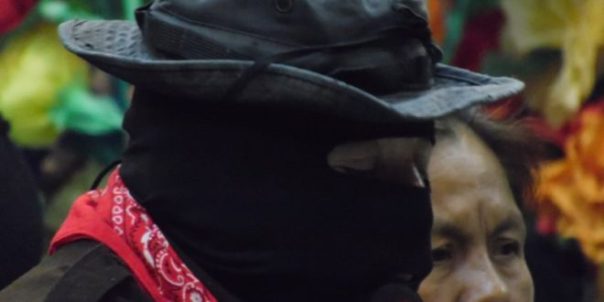
Subcomandante Moisés.
By: Raúl Zibechi
On our Latin American continent the global geopolitical disarticulation translates into a growing ungovernability that affects governments of all political currents. Forces capable of establishing order in each country do not exist, nor do they exist on a regional or global level, something that affects everyone from the United Nations to the governments of the most stable countries.
One of the problems that you observe, especially in the media, is that when they lack analysis to use they appeal to stylistic simplifications: “Trump is crazy,” or similar conjectures, or he is labeled as a “fascist” (not a simple conjecture). They are just adjectives that elude in-depth analysis. We know well that Hitler’s “craziness” never existed and that he represented the interests of the big German corporations, ultra rational in their zeal to dominate global markets.
Something similar happens on the side of critical thinking. All the problems that confront the progressive governments are the fault of imperialism, the right, the OAS and the media. There is no will to assume responsibility for the problems they created all by themselves, nor the least mention of the corruption that has reached scandalous levels.
But the central fact of this period is the ungovernability. What has been happening in Argentina (the stubborn resistance of the popular sectors to the policies of robbery and dispossession of the Mauricio Macri government) is a sign that the rights don’t obtain social peace, nor will they obtain it at least in the short or medium terms.
Argentine workers have a long and rich experience of more than a century resisting the powerful, and so they know how to wear them down, until bringing them down through the most diverse ways: from insurrections like that of October 17, 1945 and December 19 and 20, 2001, to armed uprisings like the Cordobazo [1] and several dozen popular riots.
In Brazil, the right piloted by Michel Temer has enormous difficulty imposing reforms on the pension and labor systems, not only because of union and popular resistance but also because of the internal bankruptcy that the political system suffers. The de-legitimizing of the institutions is perhaps the highest that history remembers.
The economist Carlos Lessa, president of the BNDES with Lula’s first government, points out that Brazil can no longer look at itself in the mirror and recognize what it is, a lost horizon in the torpor of globalization (goo.gl/owd24y). The assertion of this leading Brazilian thinker can be applied to the region’s other countries, which cannot but shipwreck when systemic storms lie in wait. In fact, Brazil is going through a phase of decomposition of the traditional political class, something that few seem to comprehend. Operation Car Wash (Lava Jato) [2] is a tsunami that will not leave anything in its place.
Venezuela offers an identical panorama, although the actors practice opposite discourses. By the way, attending to discourses in full systemic decomposition has scarce usefulness, since they only seek to elude responsibilities.
Saying that Venezuelan un-governability is due only to the destabilization of the right and the Empire, is to forget that the popular sectors also participate in the prolonged erosion of the Bolivarian process, through micro-practices that disorganize production and everyday life. Or maybe someone can ignore that the bachaqueo (ant contraband) is an extended practice among the popular sectors, even among those that say they are Chavistas?
The sociologist Emiliano Terán Mantovani says it without twists: chaos, corruption, tearing of the social fabric and fragmentation of the people, fueled by the terminal crisis of the oil renaissance (goo.gl/DW8wkQ). When the political culture of the most ferocious individualism predominates, it’s impossible to conduct any process of change towards some moderately positive destiny.
In sum, the panorama that the region presents – although I mention three countries the analysis can, with nuances, be extended to the rest– is increasingly ungovernable, beyond the character of governments, with strong tendencies towards chaos, expansion of corruption and extreme difficulty in finding a way out.
Three fundamental reasons are at the basis of this critical situation. The first is the growing potency, organization and mobilization of those below, of Indian and black peoples, of the urban and campesino popular sectors, of young people and women. Not even the Mexican genocide against those below has achieved paralyzing the popular countryside, although it is undeniable that it faces serious difficulties to continue organizing and creating new worlds.
The second is the acceleration of the global systemic crisis and the geopolitical disarticulation, which took a leap forward with Brexit, the election of Donald Trump, the persistence of the Russia-China alliance to stop the United States and the evaporation of the European Union that wanders without direction. The conflicts expand non-stop to border on nuclear war, without anyone being able to impose certain order (though unjust like the postwar order since 1945).
The third (reason) consists of the inability of the regional elites to find any lasting solution, as was the process of import substitution, the construction of a minimum welfare state capable of integrating some sectors of the workers and a certain national sovereignty. On this tripod they established the alliance between entrepreneurs, workers and the State that was able to project, for some decades, a credible national project, although not very consistent.
The combination of these three aspects represents the “perfect storm” in the world-system and in each corner of our continent. Those above, as Subcomandante Insurgente Moisés said a few days ago, they want to convert the world into “a walled finca,” probably because we have become ungovernable. We must get organized in those difficult conditions, and not to change the finqueros (plantation owners), that’s for sure.
[1] The Cordobazo was a May 29, 1969 civilian uprising against the military dictatorship in Cordoba, Argentina.
[2] Lava Jato, (Operation Car Wash in English), is a Brazil corruption scandal involving large corporations giving bribes to government officials in order to get contracts.
———————————————————–
Originally Published in Spanish by La Jornada
Friday, April 28, 2017
http://www.jornada.unam.mx/2017/04/28/opinion/018a1pol
Re-Published with English interpretation by the Chiapas Support Committee
Lessons on Geography and Globalized Calendars
April 14, 2017.
“Nothing has changed,” so they say.
“In Chiapas, the indigenous are doing the same or worse as before the Zapatista uprising,” the for-profit media repeat every time their foreman tells them to.
Twenty-three years ago, “humanitarian aid” arrived from all over the world. We Zapatista indigenous people understood then that what we were receiving was not charity, but rather support for resistance and rebellion. And instead of consuming it all ourselves, or selling it as the partidistas do, we used that support to build schools, hospitals, and projects for self-organization. Little by little and not without problems, difficulties, and errors, we built the material basis for our freedom.
Yesterday we heard Subcomandante Insurgente Moisés tell us that the indigenous Zapatista communities organized themselves not to ask for help, but rather to support other people in another land, with another language and culture, with another face, with other customs, in order that they might resist. He has described for us the process that was followed to achieve this. Anyone who listened to his words can say, and they would not be wrong, that on that long path from the coffee field to the kilo of packaged coffee, there is one constant: organization.
But let’s return to 1994 -1996.
As women, men, and others [otroas] began to arrive from diverse corners of Mexico and the world, Zapatista women and men understood that on that calendar, it was not a particular geography which extended its hand and its heart to us.
It wasn’t arrogant Europe sympathizing with the poor little Indians who, uselessly, it had wanted to exterminate centuries earlier.
It was the Europe from below, the rebellious one, the one that no matter what its size, struggles every day. The one that told us with its support, “don’t give up.”
It wasn’t the turbulent and brutal North that hides Power and government behind the flag of the murky stars and stripes that, simulating humanity, sent us crumbs.
It was the Latino and Anglo community that defends its culture and customs, that resists and struggles, that isn’t dazed with the drug of the “American Dream,” which supported us while murmuring, “don’t sell out.”
It wasn’t the partidista [someone affiliated with a political party] Mexico, the one of the nomenclature of all defeats turned into jobs and positions for the leaders while the base is forgotten, that twice tried to cash in on us: first to cash in on the blood of our fallen, and later to call in our debt on the charity they offered.
It was Mexico from below, the one that organizes itself regardless of whether they are many or few, whether or not they appear in the news, whether or not they are interviewed in the for-profit media; the one that carries its dead, its political prisoners, its forcibly disappeared not as a lament but as a commitment. That Mexico was the one that took from what little it had to give to us while its gaze ordered, “don’t give in.”
From Africa, Asia, and Oceania support and hope also arrived, whispering to us, “resist.”
And since those first years, we Zapatista women and men understood that what they gave us was not aid but a commitment, and since that calendar we have done our best to honor it.
Even with everything against us, harassed by the army and the paramilitaries, slandered by the for-profit media, forgotten by those who realized that they couldn’t take advantage of our suffering, even with all that we have insisted on honoring that debt, every day and everywhere, not without mistakes and failures, not without stumbling and falls, not without deaths.
That man, that women, that other [otroa] who struggles in other corners of the planet, can now say that they struggled at our side. And with no qualms, they can leave to us the errors and the problems and justly make our achievements theirs, achievements which, though small, count.
Thanks to all those people who were and are compañeros perhaps without knowing it, we are not the same as 23 years ago.
Two decades ago, each time our compañeras and compañeros spoke, invariably they finished their words by apologizing for their Spanish.
Today, without forgetting their maternal language, our young men and women affectionately correct the intonation and spelling of more than one man, woman, or other with a university degree.
Two decades ago the EZLN was the organization, referent, and leadership of the indigenous communities. Today it is they who lead us, and we who obey.
Before we directed and organized them; now our work is to see how we can support their decisions.
Before we were out in front, marking the way towards destiny. Today we are behind our pueblos, often running to catch up with them.
We have moved to the background. Some will see this as a failure.
For us, it’s an honorable account we can give to our dead, like SupPedro, like the compañera Malena, who passed away just a few days ago, and about whom we still cannot speak without pain cramping our hands and wetting our eyes and our words.
That’s how important she was to us, we Zapatista women and men.
We’ve faced these days and this meeting with her death on our shoulders and, though not explicitly, her voice has taken ours.
For several days we have wanted to settle a debt of honor with those whom today we miss greatly. We have wanted to make ours the words that we imagine they would say if they were here by our side, as they were all their lives.
But for now we should continue, and make everyone aware that our communities, our peoples, have decided that the moment is right to remind those who have believed in and trusted our flag and our way that we are here, that we are resisting, that we won’t give up, we won’t sell out, we won’t give in.
We want them to know that now they can count on us, the Zapatista communities. That although it might not be much, and that it be from a distance, we support them.
Nor will our support be a handout. For them [ellos, ellas, elloas], for you, it will be a commitment.
Because we hope that you resist until the last. We hope that you don’t give up, that you don’t sell out, that you don’t give in.
We hope that even in the moments where you feel most alone, most defeated, most forgotten, you have in your pain and your anguish at least one certainty: that there is someone who, despite being far away and being the color of the earth, says to you that you are not alone [solos, solas, soloas]. That your pain is not foreign to us. That your struggle, your resistance, your rebellion, is also ours.
We will support you as is our way, that is to say, with organized support.
And you should know and be very clear that this support carries with it our affection, our admiration, and our respect.
The package doesn’t say so, but inside is the work of Zapatista men, women, children, and elders.
Because several years ago we realized that our dreams are not local, nor national: they are international.
We understood that for our efforts, borders get in the way. That our struggle is global. That it always has been, but that those who birthed us didn’t know it and that it wasn’t until indigenous blood took the rudder as well as the motor and marked the course that we discovered that pain, rage, and rebellion don’t have a passport and that they are illegal above, but sisters below.
Today we can call anyone who resists, rebels, and struggles in any part of the planet “compañero,” “compañera,” “compañeroa.”
That is the new geography that didn’t exist in that other calendar.
So, receive our support without shame.
Receive it for what it is: a greeting.
Use it as a pretext to shake up the world, to claw at the walls, to say “no,” to lift up your heart and your gaze.
If it is true that the powerful neither see you nor hear you, know that the Zapatista men and women do see and hear you, and although we aren’t very big, we’ve been rolling for centuries and we know well that tomorrow is born as it should be, that is to say, below and to the left.
-*-
On Individuals and Collectives
There are many things we can’t explain. We know that they are that way, but our knowledge is rudimentary and we can’t explain why.
You can already see, for example, that the talking heads say that we don’t know Marxism (I don’t know if that’s a defect or a virtue); that we’re a fantasy prolonged in time for reasons they can’t explain but which are suspiciousist. [i] Since it’s not possible for a group of indigenous people to think, it must be the white man or some dark force that manipulates us and is taking us who knows where.
Our knowledge, they tell us, is nothing more than voluntarism and good luck in the best of cases, or the simple manipulation of some perverse mind in the worst case.
But it’s not that it bothers them if someone leads and orients us. What bothers them is that they aren’t the ones doing it. It makes them uncomfortable that we don’t obey, that the rebelliousness in these lands isn’t a flag but rather by now a way of life.
In sum, it bothers them or makes them uncomfortable that we are Zapatistas.
And the same incapacity they attribute to our struggle, they extend to the field of knowledge.
They’re still seeing us from above. From their ample and luxurious banisters they look out on us with mockery, pity, and disapproval. Then they return to their spacious first-class cabins to get off thinking about their own prosperity and well-being, exciting themselves imagining the pain, desperation, and anguish of the other [loa otroa].
Because they travel in the upper part of the splendid ship, they sail the great floating plantation that travels the contemporary geographies and calendars.
But if they peer out again and direct their gaze below and to the left, they will look at us more closely and with greater concern.
But no, it’s not because we have grown to catch up to them. It’s not that we’re stretching to try to be like them.
No, we are not them. And we don’t want to be.
If they look at us more closely it is because, plain and simple, their magnificent ship is sinking. It’s sinking irretrievably, and the managers [caporales], foremen [mayordomos] and overseers [capataces] know it, and they have their lifeboats ready to abandon the ship when the catastrophe is so evident that no one can deny it.
But don’t pay me any mind. They’re the great scholars, the ones who handle the new technological marvels with great skill. They’re the ones who, with the click of a finger, can find justifications for their cynicism, their meanness, and their imbecility that, just because it dresses itself up as intellectual, doesn’t cease to be what it is: conceited and cynical foolishness. They are the ones who skillfully sidestep the counter-arguments that are in plain sight, who edit and tamper with words and facts to adjust them to their convenience.
And they aren’t even interested in correcting us. They only want to console themselves in their lowness, in their loneliness. They claim to be individuals, unique and unrepeatable, but they are nothing more than one among millions of flies swarming over shit.
Those who believe they know and don’t. Those who want to win but lose.
Because they think that they are safe from the collapse, and that the pain will always be someone else’s. Do they really think that misfortune will knock on their doors first and ask permission before entering their lives?
Do they think there will be an announcement beforehand, and that there will be a cell phone app that will alert them that tragedy approaches?
Do they expect that the alarm will sound and that they’ll be able to leave work, leave home, exit their cars in an orderly fashion to meet in a designated spot?
Do they expect that, in their miserable worlds, all of a sudden signage will appear indicating the “meeting point in case of apocalypse?”
In their villages, neighborhoods, cities, countries, worlds, do they have a door with an illuminated sign that reads “EMERGENCY EXIT”?
Do they imagine it will be like in TV shows and movies about disasters, where everything is normal until it all goes to hell in an instant?
It could be. They’re the ones who know, the ones who pass judgments and issue sentences.
But, according to us Zapatistas, the Powerful themselves are building the nightmare little by little. More often than not, they present the nightmare as a benefit, an advance; other times they present it as progress, development and civilization.
But you can already see that we are indigenous, which, according to them, means ignorant, manipulated by religion or necessity, or both.
For them, we have neither the capacity nor the intelligence to distinguish one thing from another.
For them, we’re not capable of elaborating even the most minimal theorization.
But, for example, more than twenty years ago we pointed to the collapse that neoliberal globalization would suffer. Now the talking heads discover that, in effect, globalization is shattering, and they write painstaking essays to demonstrate what can be confirmed by turning off the television or the computer, or leaving one’s phone alone for a few seconds, and let’s not even mention going out to the street; it’s enough to poke your head out the window to confirm what’s happening. They cite and re-cite amongst themselves, congratulating each other and exchanging theoretical fawning and foreplay (ok, the carnal kind too, but to each their own).
If there was theoretical justice, it would be recognized that the smallest of the small were the first to sight the ongoing catastrophe and point to it.
They didn’t say if it was good or bad, they didn’t abound and redound in footnoted citations, nor did they accompany their asseverations with references to strange names with many academic titles.
I say this because a few days ago I was telling you all that among SupMarcos’ papers, I found that text which supposedly explains the reasons and motives that caused a beetle by the given name of Nebuchadnezzar to choose a nom de guerre and a profession that were one and the same, to abandon his home and his family, and armed with a cacaté shell as a helmet, a plastic pill bottle lid as a shield, an unfolded paper clip as a lance, and a branch as a sword (which he called, of course, Excalibur), to choose an impossible love, to assign a tortoise with the paradoxical name of Pegasus to be his steed, to choose as a squire a warrior with a prominent nose, and set off to travel the paths of the world.
But I wasn’t looking for that text. Because in recent days I have read and heard studies and analysis saying that it seems, it’s probable, it could be, it’s a guess, that neoliberal globalization is not the panacea promised and, in reality, it’s causing more harm than good.
So I went looking in that trunk because I thought I had read that somewhere before.
And, well, I found it, and now I’ll read it to you. It’s dated April 1996 and it’s a presentation written by a beetle. It’s titled: “PROMISING ELEMENTS FOR AN INITIAL ANALYSIS AS A FIRST STEP TOWARDS AN ORIGINAL APPROACH TO THE PRIMOGENITARY, FUNDAMENTAL CONSIDERATIONS OF THE SUPRAHISTORIC AND SUPERCALIFRAGILISTIC-EXPIALIDOCIOUS BASIS OF NEOLIBERALISM AT THE DECISIVE CONJUNCTURE OF APRIL 6, 1994, AT 01:30 HOURS ON THE DOT, SOUTHEASTERN TIME, WITH A MOON TENDING TO SHRINK LIKE THE WALLET OF A WORKER DURING THE RISE OF PRIVATIZATIONS, MONETARY ADJUSTMENTS, AND OTHER ECONOMIC MEASURES SO EFFECTIVE THEY PROVOKE ENCOUNTERS LIKE THAT OF LA REALIDAD” (first of 17,987 parts).
The presentation is quite concise. In fact, it’s composed of a single phrase that goes like this:
“The problem with globalization in neoliberalism is that the globos [balloons] pop.”
Oh, I understand that in a “serious” publication in the academy or in the limited universe of the for-profit media, you cannot cite “Sir Durito of the Lacandón, op. cit. 1996” in your footnote. Because later you would have to clarify, at the end of the publication, that the author referenced is a beetle who believes himself to be a knight errant and whose trail was lost in La Realidad on May 25, 2014.
But I was saying that there are many things we can’t explain, but which are the way they are.
For example, individuality and the collective.
Collectively is better than individually. I can’t explain to you why scientifically, and you have every right to accuse me of being esoteric, or something equally horrible.
What we’ve seen on our limited and archaic horizon is that the collective can bring to the forefront the best of each individuality.
It’s not that the collective makes you better and individuality makes you worse, no. Each person is who he or she is, a complex handful of virtues and defects (whatever each of those might mean), but in particular situations the virtues or the defects will shine.
Try it, even if it’s just once. Nothing bad will to happen to you. In any case, if you’re as marvelous as you think you are, then it will reinforce your belief that the world doesn’t deserve you. But perhaps you’ll find inside yourselves skills and abilities you didn’t know you had. Try it, and in the end if you don’t like it you can always go back to your twitter account, your Facebook wall, and from there continue dictating to the whole world what it should be and do.
But that’s not why I’m recommending to you now that you work and struggle collectively. The issue is that the storm is coming. What you can see now isn’t even remotely the most decisive moment. The worst is yet to come. And the individualities, as brilliant and capable as they may be, will not be able to survive except with others [otros, otras, otroas].
We have seen how collective work has not only made it possible for the Native peoples to survive several terminal storms, but also to advance when they are in community, and to disappear when each person only has their own individual wellbeing in mind.
As far as the Zapatista indigenous communities are concerned, collective work was not organized by the EZLN, nor by Christianity; neither Christ nor Marx had anything to do with the fact that, in moments of danger, faced with external threats, and for parties, music, and dance, the community in territories of the Native peoples becomes a single collective.
In sum, it’s up to you.
But, in any case, I’d recommend that you make the most of what the National Indigenous Congress is going to do starting in May of this year. We truly hope that the CNI will obey its own mandate and will not fall into the trap of seeking votes and official positions, but rather will carry a brotherly ear to those below who are lonely and in pain, and alleviate that pain with the call to organization.
The path of these compañeras and compañeros is going to make visible neighborhoods, communities, tribes, nations and Native peoples. Approach them, the indigenous. Abandon, if you can, the anthropological lens that sees them as strange and anachronistic creatures. Set aside pity and the position of the evangelizing minister who offers them salvation, help, knowledge. Approach them as a sister, a brother, another [hermana, hermano, hermanoa].
Because, when the time arrives in which nobody knows where to go, those Native peoples, the ones who today are condescended to and humiliated, will know where to put their gaze and their step, they will know the ‘how’ and the ‘when’. They will know, in sum, how to answer the most important and urgent question in these times: “What’s next?”
-*-
Now, to conclude a few brief signposts; a few hints, we could say.
. – When Trump talks about recuperating the US borders, he talks about the Mexican one, but the plantation owner’s gaze points towards Mapuche territory. The struggle of the Native peoples cannot and should not limit itself to Mexico; it must lift its gaze, ear, and word to include the entire continent, from Alaska to the Tierra de Fuego.
. – When, in the voice of Subcomandante Insurgente Moisés, we say that the whole world is turning into a plantation and the national governments are turning into overseers who simulate power and independence when the boss is away, we are not only signaling a paradigm with consequences for theory. We are also signaling a problem that has consequences for struggle. And we don’t mean only the “big” struggles, those of the political parties and social movements, but rather all struggles. Zapatismo, as liberatory thought, does not recognize the Bravo and Suchiate rivers as the limits of its aspirations of freedom. Our “everything for everyone” does not recognize borders. The struggle against Capital is worldwide.
. – Among the options, our position is and has been clear: there is no good overseer. But we understand that some differentiate, usually as a sort of comforting therapy, between the bad ones and the worse ones. Okay well, those who do little are satisfied with little, little or nothing.
But they should try to understand that those who risk everything, also want everything. And for us Zapatistas, freedom is everything.
We don’t want to choose between a cruel boss and a nice boss: plain and simply, we do not want bosses.
Well, that’s it.
Many thanks [Muchas gracias, literally “many graces”]. I mean, besides those that adorn me. [ii]
SupGaleano.
April 2017.
FROM THE CAT-DOG’S NOTEBOOK
- – Images of the global plantation.
They’ve called John McCain and John Kelly to a meeting. The first is a Senator and the second is Secretary of Homeland Security, both in the United States government. The boss reproaches them for having stated publicly that it would be a problem if a leftist candidate became president of Mexico, which several pre-candidates have taken advantage of to promote themselves.
McCain and Kelly exchange confused glances and protest: “But we were talking about what those fucking Indian brown beaners intend to do, they say they can govern not just Mexico but the whole world with their “fucking council” [English in the original]. They are actually a problem, I don’t know why that other guy thought we were alluding to him; he knows as well as we do that he doesn’t represent any threat at all except to himself. [iii]
The boss, that is to say the plantation owner, that is to say the capitalist, listened to them and nodded approvingly. He dismissed them and then called Donald Trump and his mom (who appears here only for the purpose of insults) as well as the principal political leaders to give them instructions.
Hours later, in a solemn session of the United States Congress, Trump decorated Senator McCain and General Kelly with the medal of capitalist merit, the highest honor that the boss can give to managers, foremen, and overseers.
The session was proceeding without incident when there began to be a lot of ruckus in the pressroom, where the correspondents assigned to the White House were getting supremely bored. Suddenly, everyone crowded around one of the monitors.
It turns out that one of their colleagues, more bored than Trump’s hairpiece, started channel-surfing on the web and had arrived at the Zapatista Intergalactic Television System (abbreviated “SIZATI” in Spanish).
The same ceremony was displayed on the screen, but with a camera that captured everything from behind where Trump was standing.
In the image you could see that Trump had a paper stuck onto one of his buttcheeks that said “Kick me”, and another one on the other cheek that read “Fuck me”, and one more, on his left shoulder, on which was printed “We want everything for everyone [todoas]” and was signed by “The fucking National Indigenous Congress.”
The correspondents went nuts and frantically called their editors; the biggest television channels in the world suspended their regularly scheduled programming to link to the SIZATI. Across the whole planet, screens were filled with Mr. Trump’s buttcheeks.
The consequences were not slow in coming: the honorable, discreet and demure Kardashian family suffered a heart attack because their reality show lost 100% of its audience; the whole world didn’t see the culminating scene of “The Walking Dead” where Daryl confesses his love for Rick and, when Rick and “Arrows” kiss passionately, boom! Michone cuts off both of their heads and, sheathing her katana and looking at the camera, says: “I’d be better off going to the fucking Lacandón Jungle to find my true love, fucking SupGaleano. Rosita better not steal him from me!”; nor did they watch the final episode of the Game of Thrones series in which Daenerys kisses Tyrion, demonstrating that the fucking little guy wins when it counts and that, in effect, John Snow didn’t know anything [iv].
From the podium of Congress, Trump observed the agitation among the correspondents and thought to himself that finally the fucking press had understood his greatness, that is, that of Trump himself.
Hours later, the Seventh Fleet of the fucking US Marines and the fucking 101st Airborne Division monitored the seas and skies of the world, waiting for NATO’s intelligence services to detect the fucking SIZATI’s location in order to launch three thousand Tomahawk missiles containing three thousand nuclear warheads, as well as the mother of all bombs. [v]
The information arrives to the boss’s bunker: “The fuckin’ bastards are fuckin’ everywhere!” which, in Spanish, can be translated as “we don’t have any fucking idea where those guys are.”
The weapons industry was already working full steam ahead to supply a new order of missiles, so it was necessary to use up the ones already made: if not, the plantation owner’s fucking society was going to get mad. The boss scrawled a new order. The fucking gringo Secretary of Defense looked worriedly at the boss. The big boss looked back at him with a face that said “do it, or else,” and the soldier went running to transmit the new fucking order.
The three thousand fucking Tomahawks had a new target: the fucking White House (Trump’s—don’t worry, fucking Peña Nieto [vi]).
“Fire!” ordered the fucking boss, “We’ll find another fucking overseer soon enough.”
A few hours later the world’s leaders were expressing their condolences for “their brothers, the people of the United States,” and a long line of suspirantes [vii] waited their turn outside the boss’s big house.
Among those lined up were Hillary, el Chapo [Guzmán], la Calderona [viii], and Aurelio Nuño Ramsey, would-be policeman who was repeating to himself, “it’s pronounced read, not red.”[ix]
Very far away and in the Southeastern Mexican state of Chiapas, in the highest branches of a ceiba tree, with a computer connected to the internet via an antenna that SubMoy and “el Monarca” made out of a pot lid, reeds, masking tape, and a USB modem, a little girl and a little boy look worriedly at each other, and she scolded him: “I told you not to click there.” The boy defends himself, “It wasn’t me!” Between them there was a small animal that looks like a cat… or maybe a dog that wagged its tail happily and smiled with fucking malice.
(fucking fade out)
- Defensa Zapatista and the Rock in the Road
- “Why are fucking men like that?”
The question comes from the door of the hut and Defensa Zapatista, hands on her hips, looks at me severely.
She caught me off guard. I was trying to decipher how 50 North American Tomahawk missiles had provoked only 5 or 6 casualties at the military airbase in Syria. Either those Tomahawks were made in China, or the gringos had told the Russians what they were going to do beforehand so the latter would have time to clear out.
I could have asked Defensa Zapatista her opinion on the issue but it didn’t seem to be the ideal moment. In fact as I am telling you this, this little girl is already inside the hut, standing squarely in front of me. At her side the cat-dog also stares fixedly at me with disapproval.
I was about to respond, “like what?” but the little girl wasn’t waiting for a response, but just making sure I had heard her. She continued:
“Did God make you all that way or do you study to be idiots? Do you train or get coached on being dumbasses? Or do you all start out that way, except that nobody can tell when you’re little and only once you’re grown is it clear that men are idiots and women are smart?”
I was preparing a long discussion regarding gender defense, as they say, but there was a machete too close to the angry little girl and I doubted it would be prudent to even try to move because the cat-dog was growling with hostility at my boots.
I didn’t understand what had provoked the Zapatista fury of the little girl, but she didn’t stop for a breath.
“You think we women don’t know how to use a machete? We do know. And we know how to work the land and when to clear it and when to burn and when to plant. You think we don’t know about animals? I mean other animals, I’m not talking about men.”
When the storm wanes, I ask Defensa Zapatista what happened that got her so pissed off.
Amid threats and gender accusations, the little girl tells me:
Apparently the autonomous commissary came to measure the pasture because they we’re planning to build a stage there for the next CompArte.
Defensa Zapatista wanted the stage to be off to one side, beside the stream. That way, later on, she could receive her trophy there when she had filled up her team and won the championship.
The commissary thought it would be better placed behind the goal where it connects to the main path, and didn’t listen to the arguments of the little girl who, annoyed, decided that the commissary, being a man, was attacking her rights “as the women that we are” and began to subject him to, as we say, a political lesson.
Apparently the situation got pretty serious because the cat-dog felt obliged to intervene and bit the commissary on the ankle. Thus the dog or cat or whatever and the little girl had to go to the school where the education promotora listened scandalized to the “narration of events” explained by the commissary.
The consequence: as a punishment, the little girl and the cat-dog had to go find SupGaleano and listen to his explanation of why art is important to the struggle.
I didn’t see much disposition to learn, we could say, on behalf of the little girl or of the little animal. So I tried to apply my famous pedagogical method of “turning things over” which is based on the philosophical postulate of “there is no problem so big that you can’t turn it over a few times.”
So I told her the following story:
The Rock in the Road
Once there was a community. Every day, very early, the men and women would drink their coffee along with a little bit of beans and then put a ball of pozol [x] and a bottle of water in their bag and go to the collective cornfield. That’s what happened every day, and the path of the indigenous village continued its life of resistance and rebellion.
But one day it rained very hard and a great big rock got dislodged from the mountainside and rolled down to block the path to the cornfield. The whole village went to see it. Yes, it was indeed a very big rock. They tried to move it but it wouldn’t budge.
So they had an assembly right then and there and shared thoughts on what to do.
Some said oh well, we’ll have to look for another place to make a cornfield.
Others say no, that the land was already cleared and all that work would be for nothing if they didn’t plant it.
Others said that the mafia of power had put the rock there as part of a conspiracy against the Indigenous Governing Council of the National Indigenous Congress.
They kept discussing the problem and various groups started to emerge: one group said that they had to pray to god to remove the rock; another group said god pul-lease, that they had to use science; and another group said that they had to investigate and uncover the tracks of the chupacabras [xi] Salinas—de Gortari, [xii] not Pliego. [xiii] Because Salinas de Gortari was the bad Salinas and Salinas Pliego was the good one.
So each group set out to do what they thought was necessary. The ones who thought they should pray brought incense and an image of the patron saint of the village, making a small altar and settling in there to pray their hearts out.
Another group went to get their notebooks and tape measure and started measuring and calculating in order to create a lever out of a stick and move the rock that way.
The other group went to get the detective kit, brand “My Happiness,” and with a magnifying glass and microscope checked the rock carefully to see if the chupacabras had left hoof prints.
There the three groups were, each carrying out what they thought was the best method to solve the problem, when a little girl approached. She came from the cornfield.
They all surrounded her and started asking questions.
The praying group asked her if god had sent an angel that had flown her over the rock, and they began to shout “It’s a miracle! It’s a miracle!” and to sing psalms and praises.
The scientific group asked her how she had resolved the question of the distribution of leverage, strength, and resistance, taking out their notebooks to be ready to take notes.
The third group demanded proof of the participation of the bad chupacabras, while they redacted a document in which the below-signed convoked others to support, with their vote, the current redeemer. The document would be published in the media owned by the good chupacabras.
The little girl was silent and looked at them all strangely.
When they finally stopped talking, she explained that when she had passed by that morning with a little boy, the fucking rock (that’s what she said) was already there, and since they couldn’t get through, she and the little boy had gone to get a machete and made another path around the fucking rock (that’s how she said it). With her hand she gestured to the little path that did in fact go around the obstacle and connect back to the main path on the other side. The little boy beside her was quiet.
Until that moment the three groups had not noticed the little path. They all celebrated and congratulated the little girl because she had solved the problem.
The commissary launched into a speech praising the little girl for understanding the importance of the path to the cornfield and thus making the little detour.
Everyone applauded and asked the little girl to speak.
The girl went to the front of the assembly and explained:
“You think I was thinking about this stuff you’re saying? I just wanted to pick some Chene’k Caribe flowers for my little sister to play with, and Pedrito here wanted to track the badger that tries to steal the corn,” and she showed the assembly the flowers she had picked, while the boy hid behind her.
Everyone was silent and a little embarrassed. Finally the commissary said, “well this calls for a party.”
“Siiiii,” the rest said and went to start the party.
The end.
Defensa Zapatista listened attentively to the story.
The cat-dog went over to the corner where my machete was and, wagging his tail, barked and meowed at the little girl. Defensa Zapatista looked at him and, suddenly, stood up and exclaimed, “Of course!” and she went to pick up the machete.
“You’re going to make another path?” I asked her.
“Path Shmath!” she replied, already in the doorway. “I’m going to go look for Pedrito because collectively we’re going to destroy the commissary’s stage. I’ll put Pedrito on guard duty in case the enemy approaches. And I’m going to make another, much prettier stage than that of the commissary and we’re going to use lots of flowers and colors and it’s going to be so happy that all of the musicians and dancers are going to want to go to our stage and not the commissary’s, which in any case is going to be a sad one because it belongs to the fucking men. And I’m going to tell the musicians to play the song for when we win the game and I’m going to convince the dancers to play on my team and that way there will be more of us, even if it takes awhile, there will be more of us.”
Defensa Zapatista left. I stayed in my hut, thinking about what part of my pedagogical method had failed.
So now I’m sitting outside the hut, waiting for someone to come tell me that Defensa Zapatista is doing her punishment at the school, with the cat-dog asleep in her lap as she writes 50 times in her notebook: “I should not pay attention to fucking SupGaleano’s stories.”
Fucking thank you.
SupGaleano
April 2017
[i] Sospechosista (suspiciousist), from sospechosismo (suspiciousism), a word which does not exist in Spanish, was popularized in 2004 by Santiago Creel, Secretary of Governance under Vicente Fox, who said “I invite you all to leave behind the culture of suspiciousism,” referring to questions about his having awarded several profitable contracts for new gambling halls to owners of Mexico’s major corporate TV networks immediately prior to resigning from his post to run for president on the PAN party ticket. In Creel’s use, the term attempts to discredit any questioning of the political system by dismissing critics as paranoid, if not conspiracy theorists. SupGaleano employs it ironically here to make fun of the fact that a number of academics/”intellectuals” who cannot explain to themselves the continued existence of the EZLN have actually come to believe that there must be some large and dark conspiracy behind it. http://eldiario.deljuego.com.ar/submenunoticiadeldia/1501-creel-el-sospechista.html
[ii] This is a play on words based on an old-fashioned reply to “Muchas gracias” (“Many thanks”). Gracias can also mean “graces”, as in a person’s virtues or charming qualities. Thus, there exists an old-fashioned exchange:
Speaker 1: Muchas gracias.
Speaker 2: Las que te adornan. OR Las que tú tienes.
When the first speaker says “Many [graces],” the second speaker replies, “[Graces are] those which adorn you” or “[Graces are] those that you have.” In this way, the second speaker effectively says “You’re welcome” with an added compliment to Speaker 1, implying that Speaker 1’s “graces” (positive qualities, virtues, or physical charms) are in themselves enough to make up for the favor performed. This response can either be kind and inoffensive or a vulgar double-entendre implying certain more lascivious “virtues” (in either men or women), depending on the context and intent.
In this case, SupGaleano flips and pre-empts this old-fashioned response when he says: “Many [graces]. I mean, besides those which adorn me.”
[iii] “That other guy” is Andrés Manuel López Obrador (AMLO), three-time “leftist” presidential candidate in Mexico. http://www.excelsior.com.mx/nacional/2017/04/08/1156732
[iv] “You know nothing, John Snow” is a recurring line in Game of Thrones.
[v] The “mother of all bombs,” or MOAB, is the largest non-nuclear bomb in the United States arsenal, dropped for the first time April 13, 2017 on a Northeastern province of Afghanistan near the Pakistani border, killing upwards of 94 people. http://www.independent.co.uk/news/world/asia/afghan-death-toll-94-us-isis-mother-of-all-bombs-donald-trump-taliban-a7684731.html
[vi] In 2014, a scandal broke over revelations that Mexican President Enrique Peña Nieto’s wife had purchased a $7 million dollar, all-white mansion known as the “Casa Blanca” or “white house” in one of the most exclusive suburbs of Mexico City. The mansion was connected to a construction conglomerate, Grupo Higa, which had been awarded several lucrative contracts by Peña Nieto’s governments when he was governor of the State of Mexico and as President. http://www.dailymail.co.uk/news/article-3207018/Mexico-s-Lady-returns-7m-mansion-scandal-government-contracts.html
[vii] In Mexican political life, suspirantes (from suspirar “to sigh”) is a humorous play on aspirantes, “aspirants” or candidates for political office, which refers to the dismally uninspiring, sigh-inducing politicians who run for office each election season, especially when many candidates are vying for the same position. Since suspirante can also mean a grieving or sorrowful person, in this case the author is crossing these two meanings to suggest that the mourners are lined up not just to grieve, but also with aspirations to take Trump’s place.
[viii] “La Calderona” is a nickname given by the EZLN to the wife of ex-president Felipe Calderón (2006-2012), Margarita Zavala, a member of the National Action Party (PAN) who announced in June 2015 that she will run for president of Mexico in 2018.
[ix] Aurelio Nuño is the Mexican Secretary of Education under whose direction the brutal repression of teachers opposing Mexico’s so-called “education reform” has been carried out, including the massacre in Nochixtlán, Oaxaca, in which 8 people were killed and more than 100 injured. Regarding the addition of “Ramsey” to his name (as in Ramsey Bolton from “Game of Thrones”), see: http://enlacezapatista.ezln.org.mx/2016/06/24/the-hour-of-the-police-4-from-the-cat-dogs-spoiler-notebook/. He is whispering to himself in this case because of an embarrassing episode widely circulated in Mexico wherein, during a televised appearance, Nuño encouraged children to “ler” and was corrected on stage by a young girl who told him “It’s pronounced read (leer), not red (ler).” The original Spanish text uses “read” and “red” in English.
[x] Ground maize; mixed with water it often serves as a midmorning or midday meal.
[xi] The chupacabras, literally “goat-sucker,” is a mythological and legendary character deemed responsible for the mysterious deaths of livestock. While variations of its activities and appearance circulate in many parts of the Americas, in Mexico it gained particular visibility during the administration of ex-president Carlos Salinas de Gortari (1988-1994) both as rumors of a supposed conspiracy to distract from national problems and policies, and as a nickname (“blood-sucking”) for Salinas himself.
[xii] Ex-president of Mexico, Carlos Salinas de Gortari (1988-1994).
[xiii] Ricardo Salinas Pliego, chairman of the business conglomerate Grupo Salinas and the head of two major Mexican companies, the retail giant Elektra and the second largest TV station in the country, TV Azteca.
En Español: http://enlacezapatista.ezln.org.mx/2017/04/14/lecciones-de-geografia-y-calendarios-globalizados/

Organized Coffee Against the Wall
Words by Subcomandante Insurgente Moisés, Thursday, April 13, 2017
Good afternoon or good morning to those who are listening to us around the world.
What I’m going to talk about, compañeros, compañeras, brothers and sisters who are present here and those who watch us from elsewhere… what I’m going to talk to you about is not what I think, but rather what the compañeras and compañeras who make up the Zapatista National Liberation Army bases of support think.
We compañeras and compañeras here in front [members of the EZLN comandancia] understand that we serve as support for the thousands of compañeras who are bases of support; we support the thousands of compañeros who are bases of support. That’s how we’ve defined it lately because we pass along to them what we see, what we hear, what we come to know. And what is it that we have come to know or hear about? Trump’s wall!
When we started hearing about this, when we began to understand what was going on, we met with the compañeras and compañeros of the Indigenous Revolutionary Clandestine Committee [CCRI] and began to discuss what is happening to our migrant brothers and sisters who are in the United States.
As always, the compañeras and compañeros who are comandantas and comandantes said, “we are part of them.” That’s what they said: “they are the same as us.” But what’s going to happen to them is really fucked up, because these migrant brothers and sisters didn’t leave and go there because they wanted to, they went because life in their communities or on the plantation (to not say country anymore) they were ftom was crushing them.
So now they have nothing. If they had anything to begin with, they had to sell it or pawn it in order to have money to be able to go to the United States, because it is assumed that there is work there.
So they’re already there and now they’re being chased out. How will they go back to the plantation if they have nothing left? So that’s where, through talking, discussing, thinking, studying, and analyzing, we determined that it’s the same as it was before, hundreds of years ago, it’s just like what happened to our great-grandparents. Then the landowners had the best lands. They took them from us, they evicted us, and they sent us to the hills. Now they want to take the hills away from us. Before they didn’t want them, and now they do: there’s something there they want. So now where will we go, those of us who are still living on our land? But [our migrant brothers and sisters] aren’t on their land anymore. They left it behind, they sold it, or they undersold it. So now they have nowhere to go.
So one compañero from the CCRI said: “yes, it’s true,” and gave the example of the Ford factory. That crazy Trump is taking that company back so that the factory is in the United States. Once again, here in Mexico those who were working there will be out of work. The factory will go there and there will be work there. There will be work for those who are from there, but for the migrants there will be no work.
So from there our question was “what are we going to do?” And we said: “we have to support them.” We have to tell them to struggle there because they have nowhere to go.
So we started to remember the year 1994, 1995… at that time we asked civil society, in Mexico and around the world to help us. So we started to say: we think that now it’s our turn, that we have to support them, just like the people in solidarity who helped us because they saw we were in struggle. It’s also up to us to support these communities, to tell them to struggle with resistance and rebellion, because they have no other option.
So we began to shake out our pockets: we don’t have euros, we don’t have dollars, we don’t have anything. But we discovered that we do have the results of the collective work of the communities, of the regions, of the Zapatista Autonomous Municipalities in Rebellion, and of the zones, where the Juntas de Buen Gobierno [Good Government Juntas] work.
We said: yes, there are plantains, there’s yucca, there’s sweet potato…but all that will rot, what are we going to do? Then the idea was born, just like the compa said. The compañero Dr. Raymundo is here, he now has in his hands over three thousand kilos of coffee, already here, ready to be prepared, ready to drink.
So we said that’s how we can help. As a first effort, our brothers and sisters there can organize themselves to sell it, to turn it into dollars, to transform it into struggle, into resistance and rebellion there where they are. Then we said: but we’ll need pretty good coffee, because the thought came up that we might not be able to collect it all so quickly. So then it was a matter of explaining what this was about to the bases of support, about how we thought in those years when they helped us when we were in need.
But then the concern came up that “the coffee will be varied, some really light because it was just roasted golden, some really black because it’s roasted until it’s almost burnt.” All of the coffee is different. So we decided it was better to think about it collectively. The compañeros and compañeras comandantes and comandantas went back to their zones and explained it, and the compañeros there said: Yes!
There are compañeros and compañeras in the communities who grow coffee and others who don’t. So the compañeros said: since we’re organized in a collective, instead of the compañeros or compañeras who grow coffee selling it somewhere else, we’ll buy it from them and use the funds from collective work in the community to pay for it. Others thought that this should be done at the level of the region— what we call a region is composed of 20, 30, 40 communities. These compañeros said: let’s buy our own coffee from what we have already, and the payment will come from the collective work of the region. In some zones they thought we should do it like that. Other zones said: the compañeros and compañeras who are authorities of the Zapatista Autonomous Municipalities in Rebellion should be in charge of it. The money should come out of the funds generated by collective work and they should buy coffee from the compañeros, and also from our brothers and sisters if we don’t have enough, depending on the situation of each zone. Others said: we already have collective work at the level of each zone, that is, in the Junta de Buen Gobierno. So we just need the assembly of authorities, women and men, to reach an agreement and then the Junta de Buen Gobierno will be responsible for buying the coffee from the compañeros and compañeras. That’s how we managed to get it all together within days.
From there, as I told you, we thought that the coffee should be pretty high quality. So we sent the 5,000 kilos of coffee that we had gathered, still as coffee beans in the husk, to the collectives of compañeros in the zone where there is a machine to roast it, a machine to grind the coffee. Now there are 3,791.5 kilos of ground coffee that came from the 5,000 kilos of beans.
We were confident then that it was just up to the machine to roast it and grind it. So the zones got organized to figure out how many workers would go to help run the machine, including compañeras who know how to grind the coffee. We were really happy because at that point it was just up to the machine, and on the first day, the machine fucking broke. The compañeros who were there were saying: “someone sabotaged it.” Other said: “What? No, no it wasn’t sabotage.” We had to see how we were going to fix it.
An insurgent compañero, Sergio, was around, so they called him. “Do you think you could help us out? To see what’s going on.” So the insurgent compañero went to check it out. It turned out that one of the ball bearings was locked. But it wasn’t capitalism’s fault. So then we began to explain: it’s not capitalism’s fault; it’s not the mafia of power. This is our own problem because we didn’t do upkeep on the machine. Then a compañero who was there said: there’s grease here, we have cebo (fat from livestock; without salt, it’s used as grease), so we don’t need to buy grease. The only thing lacking was a good cleaning, regular maintenance.
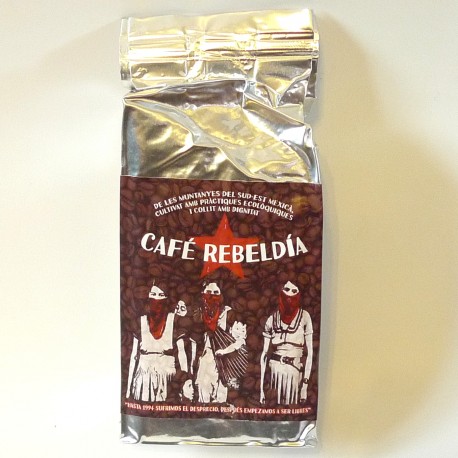
Zapatista coffee cooperatives produce coffee sold in Chiapas, in Mexico and internationally.
In sum, that’s what we needed to do for the work to come out well.
So we started coordinating, because all the compañeros who were in charge of roasting were already there; the compañera was already there, waiting, because the work is organized by days. The compañeros who are the drivers were there too, waiting to load and transport the product. The compañeros who were to bag and seal everything were there. But everything was stalled because the machine sabotaged itself. So that’s when the organization started. There’s a group of compañeros and compañeras from the city who help out, and we had to ask if they could get us another ball bearing and bring it part of the way and we would send a compañero to go pick it up from them.
When we organize and coordinate collectively, it’s like a wheel: it turns evenly. That’s how we immediately resolved this, because everything had been stalled. The insurgent compañero took out the ball bearing and put in the new one…and we got back to work. So, now we have the coffee.
The idea is that this is for the compañeros, compañeras, migrant brothers and sisters in the United States. It’s to support their struggle. It’s how we say to them: it’s necessary for you to organize yourselves where you are and to resist and rebel. How? That’s what they have to think about.
The support we’re offering is unconditional, just like how we supported our brothers and sisters who are teachers here in Chiapas. We supported them not so that they would become our bases of support or so that we could say: “this is what you have to do.” They’re the ones who have to decide that. We learned from what we were taught in the years ‘94 and ‘95. We saw and discovered how resistance and rebellion are weapons of struggle.
This is what we figured out with the compañeros and compañeras who are comandantes and comandantas. We asked ourselves: what if in ’94 we hadn’t listened to the idea of the compañeras and compañeros bases of support, because they said then that as bases of support they had to fight too, but not with weapons like those of the compañeros and compañeras milicianas, milicianos, and insurgentes and insurgentas. Rather, we’re against the government—that’s what they said—and therefore we can’t sell out, we can’t give up, we can’t stray off course. We have to reject their handouts, their leftovers and their crumbs. We understood that and we started to think about how to do it. And thanks to that we’re here speaking today, because we’ve been fighting for 23 years with that weapon called resistance and rebellion.
So, we made this comparison with the compañeros and compañeras who are comandantes and comandantas: if there had been 23 years of shootings, bombings, and ambushes, there would be no Zapatista Autonomous Municipalities in Rebellion. There would be no Juntas de Buen Gobierno. There would be no education, that is Zapatista schools. There would be no Zapatista clinics or hospitals. All the encuentros [gatherings] we’ve held wouldn’t have happened because there wouldn’t have been time. What there would have been was 23 years of gunshots.
But that weapon that we discovered is what has made us who we are today. And in order to use that weapon of struggle, resistance and rebellion, of course we had to organize ourselves. And that’s what has made it possible for us to construct a small world with a new system of government.
Each one has to decide, but we’ve seen that it can be done with this weapon of struggle, with resistance and rebellion. And it’s not that we’re rejecting that other tool that we have—we call our firearms tools. For us, they are one more tool among others, like having machetes, chainsaws, axes; it’s like having many kinds of tools, among which we include our firearms—that is, guns. And when it’s necessary you have to use it, but you have to know how to use it.
Because, as we’ve already heard here, the capitalist enemy is not going to leave us alone. They’re not going to accept that now the people, women and men, are going to rule. They’ll never allow us to do it. They’re not going negotiate or dialogue about their forms of exploitation. They’re not going to say: “okay well, I’m just going to halfway exploit you now.” That’s not going to happen. They’re not going to say: “ah, okay, I’m going to renounce exploitation.” That won’t happen either. The only thing to do is for the people, women and men, to organize themselves.
So, collective work sounds really nice, really lovely. It’s one thing to talk about it in theory, that is, by explaining; it’s another to do it in practice. But theory helps us understand its great importance, the necessity and the why and for what. So when something doesn’t come out right, like it does in theory, you shouldn’t be discouraged by that, because theoretically you know the why, the what for, the from what, and you know its great importance.
Each one has to do it. Collective work is an example. I don’t know how the teachers should do collective work. I don’t know how other workers will do collective work. Everyone, wherever they are, will have to invent it, create it; they’ll have to imagine it and study it, decide on it and put it into practice.
But there is indeed strength in collectivism. And we’ve understood that collectivism isn’t just… we call working the land specifically “collective work,” but there should also be collectivism in how we imagine good health, good education, and the rest of the thirteen demands we’ve put forth. How do we want these things to be? We have to decide as a collective how we want the laws to be where we live. Not for someone who “knows” how to make law to fuck it up and then it’s the people who have to pay.
So, that’s what we mean when we say that collectivism isn’t just about how to work the land. It moves through everything. So this collective work, in this case a specific product—we have it here, the compañero Doctor Raymundo has it—we hope collectively we can figure out how we’re going to deliver it to the migrant brothers, sisters, compañeros, compañeras there in the United States.
So we think that, given how we’re understanding the great importance of struggle, that we have to struggle against capitalism, that we should come up with other things we can do to support the brothers and sisters, the compañeras and compañeros there in the United States. Because they need support, but we think that this support should be unconditional. Because if we make it conditional it will go off in another direction. We need to support each other so that we can demonstrate that we don’t need those others who want to give support, but with conditions.
So the coffee is here. Now we have to see who will say “I’ll take it and deliver it.” It’s not for us to sell, but rather that we want to send it to the United States and for the brothers and sisters there to organize themselves to sell it. Because organization is necessary. Today more than ever we see that we need to organize ourselves against capitalism. To struggle and work.
Once we’ve walked the path that we’ve created through organization, we’re going to realize that we need to reorganize ourselves again. We’ll even have to reeducate ourselves, which is what we’re seeing now, we’re reeducating ourselves. We’re reorganizing what we thought was already organized.
That’s why it’s so important to organize. What does this word—organize—imply? What does it contain? Maybe it has garlic, maybe oil, maybe condiments. That’s what you’ll have to see. What kind of organization? What is this organization about? What is this organization for? That’s up to each of us.
Of course we can’t let ourselves stray off course or sell out or give up. Because this is what is asked of those of us who are against capitalism. Because then you would stop struggling. You can’t say that you don’t want to struggle anymore; you can’t say: “I don’t want poverty and misery anymore.” You can’t: if you stop struggling, the misery will get worse.
These are the things we have to think about. And everyone has to construct what they want to construct, with their struggle, with their organization.
So we offer this coffee to you here so that you can say who is ready and available—understanding that we’re saying that it’s for those brothers and sisters—and so that you all organize to sell it. And we’re thinking we’re going to have to send even more support, but you all have to be resisting there, because if not, we’re not going to send Trump the coffee. We need the migrant people in the United States to be organizing themselves for when we send them coffee from the next harvest.
We hope you’ll accompany us in supporting these brothers and sisters however you are able. You’ll have to see how to do that for yourselves.
Thank you.
—————
The Capitalist World is a Walled Plantation

Words of Subcomandante Insurgente Moisés, Wednesday April 12, 2017
Good evening, good afternoon, good morning, according to wherever you’re listening.
Brothers, sisters, compañeros, compañeras:
What I’m going to talk about today is not what I believe, but rather what our great-grandfathers and grandfathers and great-grandmothers and grandmothers told us.
I talked with one of our great-grandfathers who said he’s 140 years old. According to my calculations he’s around 125 years old. You have to get very close to his ear for him to be able to hear what you ask him.
I spoke with about 20-some of them, of our great-grandfathers and great-grandmothers. We were asking them– the compañeros from the Clandestine Committee were there too–and it turns out that part of what Sup Galeano was saying is exactly what they told us about.
For example, for the bricks that they used to make for the plantation owners—that is, the owners of the haciendas, the hacendados they call them, or the patrón—they had to fill large sacks with horse manure. Then they dried them, and after having dried the sacks of manure, they turned the manure into dust using a heavy club to beat the sacks. Then they mixed that with mud to make the adobe bricks with which they built the plantation owner’s house.
This great-grandfather said that he remembers that the work was organized by quota. Quota means that each one of them had to turn in a certain number of sacks. So each time there was fresh horse manure, they had to bring it, with the water running down their backs. The point is that they had to turn in the number of sacks that the patrón demanded.
They also learned how to make their own houses that way, using the same materials. They called it mud wall; mud construction is what it’s called. So, they learned to build this way, but their houses were much smaller, with just two rooms.
So, what I’m going to explain further here is where our ideas come from, as the Zapatistas we are—what we’re seeing and studying about how we are exploited today. In sum, I’m going to tell you this because this is what is going to help us to understand what happened before and what situation we’re in now, and what the future will hold.
Our grandfathers and great-grandfathers, great-grandmothers and grandmothers tell us that the patrón is the owner of the plantation, of many plantations, many haciendas. All the plantation-owners have their managers [caporales], foremen [mayordomos], and overseers [capataces]: those three, well four with the patrón.
They tell us that there are plantations of fifteen thousand hectares (roughly 37,000 acres), of twenty thousand and twenty-five thousand hectares. There are plantations with different kinds of work, and some plantations that only produce one thing, like coffee. There are others that produce coffee, livestock, corn, beans, sugar, and lots of different things.
They tell us, too, about the methods of exploitation. They tell us that there are plantation owners, landowners, who never paid them anything, and they gave their whole lives to work. Others tell us that Sunday was the only day they had for themselves; all the other days were for the patrón. Still others tell us that they worked one week for the patrón and one week for themselves. But that it was a trick, a swindle, they tell us, because that week our great-grandfathers and great-grandmothers supposedly had for themselves, whatever they harvested that week (whether it was beans, corn, or a few animals they were able pull together), when it came time to sell, they had to give half to the patrón and they kept the other half.
They tell us that when the patrón wants to see if his herd of animals is complete, they had to go and get them, herding the animals and putting them in the corral. They tell us that if one of the patrón’s animals was missing, they had to go look for it and bring it back, dead or alive. How did the patrón, that is, the landowner, require that they prove that it was dead? They had to bring back a piece of its hide so that the patrón would know for sure that his animal was dead. If they couldn’t find it, they had to keep looking until they found it, dead or alive.
When the patrón took the livestock to market, he organized the workers into groups who were responsible for so many heads of livestock. Whether it was ten or twenty people, men, they had so many heads of livestock that they had to transport. The patrón would count them before leaving and he count them again upon arrival at the destination where the animals were taken. Each person had to deliver all of their livestock; if they didn’t account for every single one, they would have to pay for it, or the person in charge of that group would.
They tell us that the corral, if the patrón so desires, is made of stone. If not, it’s made of wood carved with an axe. And they say that it had to be pure heartwood. That means that it’s the hardest part of the wood, so that it doesn’t rot later. The patrón wouldn’t accept softer wood; he would refuse it.
They also tell us that when it was time to take the pigs to market (not the patrón, the animal: the hogs) it was the same process as with the cattle. But there was a difference, say the grandfathers and the great-grandfathers. They say they had to transport the load at night, because the hogs get overheated during the day. So their flashlight, their light source, was a torch made of ocote wood. [i] They carried bundles of ocote as their lamp to walk by night. The same as with the cows, each person was responsible for a certain number of pigs. And if they wanted to advance by day, they had to carry water with them to wet the hogs down, that is, to cool them off so they didn’t suffer in the heat.
The women, the grandmothers and the great grandmothers, tell us that the patrón had his way of how he liked things done. For example, the grandmothers and great-grandmothers say that when the work was difficult, it was always the married women who had to do it. What was their job? They ground the coffee and ground the salt in bulk. They tell us that the mothers went with their children to grind salt, with a flat stone for grinding, a metate. And the managers, foremen, and overseers were right there, as well as the patrón and his wife. The women had their babies on their backs but weren’t allowed to take care of them, even though they cried and cried, because the patrón was watching and the women had to meet their quota. It wasn’t until the patrón or his wife decided to go use the bathroom that the mother would have a chance to breastfeed her child.
They tell us that the patrón would ask for only young women to attend to him in his plantation house, to do different jobs. But one of the patrón’s tricks was to choose a young woman and say, “You, I want you to go and make up my bedroom,” to make the bed. And when the young woman went into the room, the patrón would follow to rape her. So he chose them one by one. And they tell us too that he would grab them whenever he wanted to.
They tell us also about what I already mentioned, that they were there grinding the coffee, grinding the salt, and the pay that the patrón would give them was three pieces of beef, but from animals that were already dead. That was their payment.
They also tell us that the children were given work too. No one escaped it. They called them porteros, keepers, but not goalkeepers like in soccer, they just called the children that. The job of those six-year-old children was to grind the nixtamal [partially cooked maize] without lime; this was for the dogs, the pigs, and the chickens. Once that was done they had to carry water, usually in a barrel on their backs we are told. The barrel was made of wood in which they would make a hole, that is, they would perforate it. The barrel held between 18 and 20 liters, and this is what the children had to carry so the patrón could wash his hands, use it to bathe, or whatever he wanted. Once that was finished, the children had to go and carry wood. After they brought the wood, they had to de-kernel the corn.
The elders tell us also that once the men got old and couldn’t work in the fields, and the older women too…well, nobody was free from work. The older men would go look for a plant that we call “ixchte.” The men would scrape it until a kind of thread was formed. One group would do this part. Another group of older men would then make the thread into a kind of rope. Another group would be responsible for turning that into nets. That was the work of the old men. And the older women? One group would be responsible for unraveling cotton. Another group would turn the cotton into thread and another group would weave the thread into cloth. And then that little piece of cloth is what our great-grandfathers and great-grandmothers would later have to buy to use as clothes. They tell us that the clothes they wore were just to cover the most necessary parts, nothing else, not like we are dressed today.
They also told us about punishment. There were various kinds of punishment. One was that the patrón would have some corn mixed with beans, and he would throw it on the ground and tell you to separate the corn from the beans. And the patrón knew—the elders tell us—that you weren’t going to be able to do it, because he would give you a time limit. He’s say: “I’m going to spit and in the time that it takes my saliva to dry is the time you have to separate the corn from the beans.” But how were you going to pull that off?
Since you couldn’t possibly do this, there close by the patrón would have gathered some little rocks together, prepared a little piece of ground with rocks. That’s where he would make you kneel because you couldn’t separate the beans from the corn. So you had to kneel there and you couldn’t get up until the patrón decided to let you. And if you got up, that meant you were not accepting your punishment. So you had to endure kneeling there and that’s where the whip came in. I’m going to tell you exactly what the grandfathers told me. They said that whenever one of the patrón’s bulls died, he’d have the penis cut off the bull, dried, and that’s what he used to whip the workers. So while you’re kneeling there, the patrón would come whip you and you couldn’t get up because—this is what they tell us—if you got up it would be worse. But they tell us that you had to get up because of the pain from the whip and the pain from your knees—that it was intolerable and you just had to get up.
But the moment you got up, there were the managers, the foremen, and the overseers to grab you and tie your hands and feet to the beams of the house until the patrón got tired of whipping you or until he realized that—as our grandfathers say—you were beaten senseless. In other words, you had fainted or lost consciousness. That’s how he left you.
They tell us that all of the work that had to be done was by quota. There wasn’t any task that didn’t have a quota. And everything was under the watch of the managers, the foremen, and the overseers. They told us for example about the coffee fields. When it was time to harvest the coffee, everyone had a quota for how much coffee they had to turn in. The children who couldn’t pick coffee, who were too small to reach the coffee beans, their work was to pick up everything that fell on the ground. When it wasn’t coffee harvest time, there was other work: one group had to clear the coffee field, that is, the vegetation and weeds; another group was responsible for what’s called “crating,” that is, they had to make a kind of crate for each coffee bush that would hold the composted fertilizer; another group had to tend to the coffee bush, because it gets growths on its trunk which had to be removed. Our grandparents and great grandparents tell us that you couldn’t do it with your hands; you had to burn a corncob—because when you burn a corncob it develops a sharp edge and that’s what you use to clean the trunk. And the overseer would go around checking to make sure it was good enough, and if it wasn’t, you had to start over, if not, then punishment.
They also tell us that another group had to prune the coffee; that there couldn’t be vines or vegetation climbing up the coffee plant. They say there was also a group for “de-shading,” as they call it. That is, if there were trees above the coffee plants, they had to cut them back to remove the shade, only as much as necessary the patrón would say.
They also say that on all the plantations then—and now, because there are still some today—there was always an ermita, as they call it, a chapel. When it was time to go pray, our great-grandparents couldn’t sit on the chairs and benches in the chapel. If they sat there they would be physically pushed off. And the priest would be there watching, but wouldn’t say anything. Only the patrón and other mestizos could sit there. If our great-grandparents wanted to sit down, well then it was on the floor.
In the cities, our great-grandfathers and great-grandmothers tell us, they weren’t allowed to go sell the little they had. They say that they were told that they made the city ugly. They weren’t allowed to go to the center city; what the mestizos would do was close off the entries to the city at the outskirts and either just take everything [the indigenous people] had brought if they felt like it, or pay whatever they wanted for it.
Our grandparents tell us that there were no highways at that time, just wagons pulled by horses. So when the patrón’s wife wanted to go to the plantation, she wouldn’t use the horse and wagon, because “an animal is an animal, it doesn’t think,” and there could be an accident with her on board. So what they had to do was send a group to the city in order to carry the patrón’s wife back. But they also had to bring back goods, so a group would go and they take turns carrying her back. When they arrived at the plantation, the patrón’s wife would be asked if anything had happened to her, and they would ask those who carried her if they had had any accidents. They had to do this all the way to the plantation and all the way back.
They told us many more things. For example, they showed us a cent, which is what they were paid at that time. They say that when the patrón started to actually pay them something, he paid them one cent a day. They showed us the coin. They also said that at some point they couldn’t put up with the mistreatment anymore. So they tried to organize themselves, to look for land where they could live. The patrones found out that they had fled the plantation and begin to investigate where they had gone. Our grandparents say that the patrones dressed up like soldiers and went themselves to evict, destroy, to burn down the little house that our great-grandparents were building where they wanted to live.
That’s what they told us happened. And that’s how they found out that the patrón was disguised as a soldier—because one of our grandfathers had worked on various plantations. They say that [the patrones dressed as soldiers] destroyed the little huts they had built, that they got everyone together who had fled to create a community and asked them, “who headed this up?” That’s what the soldiers said, “whose idea was this? If you don’t tell us who’s leading this, all of you will be punished.” And the people said: “it was so-and-so,” the one who led the escape from the plantation and the search for where to live. So they [the patrones] said to that person: “you have to pay 50 pesos.” Our great-grandparents say that to come up with 50 pesos—at that time, because this great-grandfather is 140 years old, so we’re talking about 140 years ago—at that time it would take a year to come up with 50 pesos.
So they realized that it would be difficult for someone to choose to lead an attempt to flee the suffering. But they also told us that once they realized this, what they did was not name anyone, but rather say that it was the group. They began to rebuild…they found another piece of land and began to build their houses again, but this time, with all of them leading. Nothing more about who would lead. That is, they became a collective. That’s how they began to start a life somewhere else.
So, why are we telling you about this? We as Zapatistas see that today we are re-entering this same scenario. In capitalism there are no countries, that’s how we see it. Capitalism is going to turn the whole world into a plantation. It will break everything up, as it already is—what we call the country of Mexico, the country of Guatemala, but it will all be under a group of governing patrones. All those who say things about Peña Nieto’s government…no, no, we say, it’s not a government, because the person in charge is no longer the person in charge. The capitalist patrón is in charge. What are referred to as the governments of Peña Nieto, of Guatemala, of El Salvador, and elsewhere are just the managers. The governors are the foremen. The municipal presidents are the overseers. All of them act in the service of capitalism.
We see then that it doesn’t take a lot of study to see how things are. For example, this new law on structure, the new structural law that was passed here in Mexico: we don’t think that congressional representatives and senators made this law. We don’t buy it. That law was mandated by the patrón: capitalism. They are the ones who want to do again what their own great-grandparents did. But now it’s even worse.
That’s why we are beginning with this topic. We are talking about, for example, Absalón Castellanos Domínguez, the ex-general, who had plantations here in Chiapas and had or has a plantation in Oaxaca. We’re talking about 5,000, 10,000 hectares. Here, in today’s capitalism, the capitalist patrón says: I’m going to my plantation Mexico, I’m going to my plantation Guatemala, I’m going to my planation Haiti, I’m going to my plantation Costa Rica… all of the capitalist underdeveloped countries are going to be plantations.
This means that the governing patrón, capitalism, is going to turn the entire world into its plantation, that is, if we allow it. Our question here as Zapatistas is: why do they—the capitalists—change their mode of exploitation? And why don’t we change our form of struggle to save ourselves from that?
That’s why I’ve been telling you about what our great-grandparents did, where we indigenous come from. They said that they made a mistake when they said: “so-and-so led us.” But they didn’t give up. They searched for a way to continue struggling, for a way to escape from the patrón and they said, “nobody led us,” “we are all of us.”
So, why all of us now? Because under capitalism today, it is not only we indigenous who are suffering in the world. Now we are suffering in the countryside and the city, that is, indigenous and non-indigenous. So, what are we going to do?
We Zapatistas who live here in the shit of capitalism, we are still fighting, still struggling, and we will continue to struggle… small as we are, but we are showing—just like our great-grandparents taught us—that there is a way. We have our small freedom. We still have to liberate Mexico. But now we say, how will we liberate the world?
Here in this little piece of the world, in Chiapas, the compañeros and compañeras have their freedom, the freedom to do whatever they want to do. They have in their hands what it means to be autonomous, independent. So how are we all going to do it? What are we going to do? Because now we are seeing that the whole world is going to be turned into the capitalists’ plantation.
So then, look at this reality, think about it and analyze it. See how it works where you live, where you are; see if you are also living in the shit of capitalism and what to do about it. Because this is what capitalism is doing now.
Subcomandante Insurgente Galeano is going to continue.
————————
[i] The wood of the ocote pine tree can be used as a light source as it catches fire at the stroke of a match and burns steadily.
KAGEMUSHA: APRIL IS ALSO TOMORROW
Fidel and other Cuban revolutionaries back in the day.
April 12, 2017, Seminar “The walls of capital, the cracks on the left”
A few months ago, el Subcomandante Insurgente Moisés gave me a synthesis of what he has now told you with more extension and support.
Perhaps without proposing to do it, he had detected a line of tension between the past and the storm that is now.
That morning after listening to the stories that, in the voice of SupMoy, told about the most elderly of our compañeros, I returned to my hut. Of all things an out-of- season rain started to lash the sheetmetal roof and it was now impossible to listen to anything except the storm.
I rummaged again in the trunk that SupMarcos entrusted to me because I seemed to have seen a text that might refer to what I just heard.
Believe me! Reviewing those writings is not easy; the majority of the texts that are piled up in disarray inside the trunk range from 1983 to January 1, 1994, and, at least until 1992, it seems that the Sup not only had no computer, he didn’t have a mechanical typewriter either. So, the texts are handwritten on sheets of paper of all sizes. The deceased’s writing was far from legible, so just add to that the gap of time in the mountains, the humidity and the stains and burns from tobacco.
Everything is there. For example, I found the original manuscript of the operational orders for the different Zapatista military units on the eve of the uprising. Not only are there templates for the units, but also every detailed operation with a thoroughness that reveals years of preparation.
Those are not the notes of a poet wandering in the mountains of the Mexican Southeast, or of a teller of stories. They are the writings of a soldier. No, they are rather the writings of a military commander.
But yes, tales and stories abound and overflow; there are very few poems and political and economic analyses are rare.
Well, other than analysis, it deals with schemes and themes like dots, as if they were to be developed later, or completed, o corrected I have identified several of them with some that were later made public, although already polished.
But that’s not what I’m looking for. The stories that I obtained from SupMoy reminded me that there was something in this disorderly pile of papers and ideas, about the genealogy of the anticapitalist struggle.
Here it is. This is definitely after the start of the war because it is printed and the typography is that of a word processor.
He says that it must have been written some 20 years ago, when the Zapatistas made public some most profound analysis about what was happening what they foresaw would follow afterwards. Good, at least the first lines, because something seems like it’s froma later period.
The text has a disconcerting title, but is reconciled consistent with how the reading progresses. It’s called “April is also tomorrow.” And what seem like points to develop follow, although incomplete at that time.
The majority of the points outlined already appeared developed in texts that were made public around 1996-1997, so I won’t bore you again by repeating them. The principal ones have now been grouped into a book called “Writings about war and political economy,” elaborated by the la “Pensamiento Crítico Ediciones” publishing house. If anyone is interested in knowing more about that, this book could be useful. Or you can also consult the Enlace Zapatista website.
The part that I most want to show you doesn’t appear in any of those public writings and, although moderately developed in the writing, it manages to glimpse a series of reflections on social science, in other words, political economy, as well as on the longstanding and current challenge of theory and practice. Here they are:
– Possible stages of capitalism. More than in a scientific definition, the statement that imperialism was a higher phase of capitalism became a plan of action for struggles in the whole world. From being “a higher phase,” it concluded that imperialism was “the last phase” of capitalism.
– On that basis a sort of international division was established, not of work, but rather of anticapitalist struggle. In the so-called Third World countries, which don’t have industrial development and, therefore lack a solid working class, the struggle for socialism had to pass through a nationalist, anti-imperialist, and anti-colonial struggle, and only that way would they be able to aspire to being “anticapitalists.” It established that the struggle against capitalism and for socialism necessarily passes through the struggle for national liberation, at least in the so-called Third World countries. To be able to transition to socialism, nations first had to free themselves from the neocolonial yoke, in that case imposed by North American imperialism. The construction of socialism was not possible in a single country, much less if the country was underdeveloped. Socialist revolution was either worldwide or it wasn’t. Scientific analysis then became a sort of central command of the worldwide revolution and was installed in the USSR. The strategies and tactics for anticapitalist struggles in the whole world started there. One who complied with the orders, received approval from the global “vanguard.” For anyone who didn’t comply, for anyone who sought to construct his own path, in other words, his own struggle, there was condemnation, ostracism and the disqualifying label of the day.
The science of history, political economy, stopped being science and abandoned scientific analysis, substituting slogan for science. If reality didn’t coincide with the Central Committee’s vision, reality was catalogued as reactionary, petty bourgeois, divisionist, revisionist, and many similar “ists.” Critical thought went from analysis to justification, and the mishaps and errors were covered up with the excuse of the confrontation with North American imperialism. The simplicity of a bipolar world invaded social science and, just like the political forces and the governments, it took part through one of the two great and only contenders. Intelligence was defeated and mediocrity was comfortably installed.
– In the middle of the XX Century, all were content and tranquil. The so-called evil “socialist bloc” was engrossed in what we Zapatistas call the third world war. In Asia, Africa and particularly in Latin America, struggles occurred without major relevance to that war, which was important, and party organizations on the left then were under threat of punishment to direct their principal efforts to the support of the Socialist Block. Todo attempt at struggle had to have the approval of the tanks, thinking and non-thinking, which, in the Union of Soviet Socialist Republics, edited manuals that, more than simplifying, muzzled the development of social science. As if it were in the Olympics, social science was competing not for a better understanding of what occurred and what would come, but rather to raise its own flag higher and more often, be it that of the starts and stripes or that of the hammer and sickle.
In the global scenario everything seemed foreseeable and simple… but Fidel arrived in that. And “la problem,” as the compas say, is that he didn’t come alone, but rather that he brought with him one such Camilo that carried the definition in his last name; and, with that tremendous pair, also came an Argentine doctor, photographer, asthmatic, without a relevant name on the genealogical tree of global revolution and without any position in any structure. Just a few months later the entire planet knew him with only three letters: Che.
Afterwards what happened happened, and the light that illuminated the Caribbean in those first years of the 1960´s unintentionally became a virus that contaminated the continent. After a long calendar of defeats in that pain called Latin America, an entire people organized and changed the its destiny and extended its name.
Since the failed mercenary invasion with North American sponsorship, Cuba has been called Fidel and Fidel Castro had “Cuba” as a surname of resistance and rebellion, of struggle.
The smallest country país, the most despised country, the most humiliated country, rose up and, with its organized action, changed the global geography.
The statesman that the Cuban people put in front, in a few years practically erased the rest of the “world leaders” and, as it should be, the extremes were called around his figure: a few to flatter, most to attack.
Only a few watched and understood that something new had emerged and that the Cuban revolution not only had broken the domination that the empire of the stars and stripes, the “turbulent and brutal North,” imposed on all of America.
It had also smashed to pieces the then gutted social theory that was shepherded by managers that, on the entire political spectrum, are the constant and never the exception.
Still, almost 60 years later, we’re not lacking some old manager that, “heroically” entrenched in academia and not with the social networks as a weapon, seeks to dictate to the Cuban people what they should or should not do and undo.
Foreign to the theoretical masturbations of lukewarm academia, the Cuban people started their long path of resistance, and were advancing in unprecedented adverse conditions.
Still today they continue suffering the most extensive and intense economic blockade in the world’s history. And not only that, they have also resisted terrorist attacks, have been invaded militarily, have administered his first defeat on the continent to the arrogant Uncle Sam, and, with everything against them, have constructed their own destiny.
But they have not just received attacks from the global right, the well behaved left has also attacked the Cuban people, aided by cliches and commonplaces that obviate not only the Cuban reality, but also and above all their heroic effort to lift themselves up from their errors and failures.
With the sole objective of being agreeable to the right, the institutional left around the world has attacked the Cuban revolution repeating the words of the right and following the current style.
The Cuban people’s resistance is so consistent that the intelectual hysteria that abounds and redounds in this broken country called “Mexico,” would surely say that it has been maintained because it’s a Salinas creation, which the “mafia in power” supports.
Days after that lightning strike of military ability and conviction that gave new meaning to a small territory and placed the name of “Playa Girón” [1] on the almost empty shelf of global left victories, on that May 1, 1961 the people of Cuba said, through the voice made hoarse by an old man with a thick beard stuffed into his olive green combat suit, the following words:
“If Mr. Kennedy doesn’t like socialism, fine, we don’t like imperialism and we don’t like capitalism. We have as much right to protest the existence of an imperialist and capitalist regime 90 miles from our coast, as he is able to consider the right to protest the existence of a socialist regime 90 miles from his coast.
Now then, it would not occur to us to protest about that, because that’s a question that is incumbent on them, a question for the people of the United States. It would be absurd for us to pretend to tell the people of the United States what government regime they should have, because in that case we would be considering that the United States is not a sovereign people and that we have the right over the interior life of the United States.
Size doesn’t give it the right, the fact that one people is larger than another doesn’t give it the right, that’s not important! We only have a small territory, a small people, but our right is a right as respetable as that of any other country, whatever their size may be. It doesn’t occur to us to tell the people of the United States what kind of government they should have. So it’s absurd that it occurs to Mr. Kennedy to say what kind of government he wants us to have here, because it’s an absurd thing; eso nada más se le ocurre al señor Kennedy, because he has no clear concept of what international law and the sovereignty of peoples are.
The text continues with an extensive reflection on social science and critical thinking. But I stop now to point out that you can very well exchange the name of “Kennedy” for that of “Trump” and you will see that in those words there was not a conjunctural statement, but rather a statement of principles.
I stopped reading and then I looked at the hourglass.
It occurred to me that perhaps it’s not just any kind of sand that it contains. And perhaps it’s not just any kind of sand because this sand perhaps came from a beach repeated in the history of the struggle and resistance of humanity against capitalism.
Maybe the sand that flows from one side to the other of this clock comes from a place on the American continent and its geography anchors it on an island that stretches into the Caribbean, like a rebel alligator that refuses to be subjected and therefore hardens its skin and its gaze.
Perhaps, it occurs to me now, the sand arena in this hourglass is sand from Playa Girón that is thus called that crack in the wall of Capital and that, with its persistence, taught us all that the great and powerful can be defeated by the small and weak when there is organized resistance, impertinent determination and horizon.
Let me tell you that the late SupMarcos, and not only him, felt a great admiration for the people of Cuba and a profound respect for Fidel Castro Ruz.
In that informal chat that we had hours before his death, the word turned recaló en the military theme. He told me that he considered that the military history of the peoples’ struggle was little known. He then referred to the Battle of Zacatecas and the Taking of Ciudad Juárez, both conducted by Francisco Villa. He told me that he borrowed the concept that General Villa implemented for taking Ciudad Juárez and with it he designed the start of the Uprising. “For the Battle of Zacatecas I didn’t lack cavalry,” he said jokingly, “but rather level ground.”
In the internacional, against the commune of the left, his reference was not the Battle of Leningrad, but rather the Battle of Santa Clara, headed by Che, that of Cuito Cuanabale that Fidel Castro led, and that of Playa Girón, also commanded by Fidel Castro.
I took the opportunity to ask him why he said the name Fidel Castro, and he didn’t say “Comandante” if all the Latin American left did it. Here’s how he answered me:
“That everyone would call him that could be enough, but that’s not why. We are an army and when we say “comandante” we say command. And no one commands us, except our own peoples. But Fidel Castro doesn’t need us to talk about him that way. His people have given him that rank and he doesn’t need more.”
He continued telling me about Playa Girón and, with admiration, narrated the occasion on which Fidel Castro discussed and moved his hands with his officials because they didn’t let him advance towards Playa Girón to fight against the mercenaries. “Imagine,” he told me laughing with good humor, “Fidel against his whole Military Staff (Estado Mayor). Obstinate, in that he wants to be on the battlefront and the others don’t want him to be there, that he has to take care of himself. And, you know, Fidel Castro didn’t argue that it was his duty, he told them it was his right.” The deceased lit his pipe and, after the first pull lifted it as if he were toasting and said: “Of course Fidel won the discussion.”
Then, finishing the theme, he added: “Fidel Castro is the Maradona of international politics. And they are never going to forgive him for the goals he scored against those who dared to confront him.”
I remembered the words of the late SupMarcos when I read about what the famélico political spectrum of Latin American opined about the death of Fidel Castro. The reiteration on the right, and on the well-behaved left, of reproaches and supposed criticisms. The right that will never forgive him for the defeats he gave them, and the institutional left that won’t absolve him for having been everything that it, in its mediocrity, will never be.
They are also mediocre, the ones that now dictate judgments and sentences and simply cannot explain why, if he was a dictador, the world’s largest power wasn’t able to organize a popular rebellion, and opted for terrorist attacks to frustrate him.
Far from fiction films and television series, where the North American secret services finish off the bad guys armed with only a mechanical pencil, they failed in Cuba simply because “Comandante Fidel” was the name, the image and the voice that that people took to reaffirm what all the time and against everything it constructed: their freedom.
And money sought and seeks and always finds psychopaths willing to sell their thirst for blood and destruction. You will always find the Mas Canosa, the Posada Carriles, although, in another geography and calendar, they are called Felipe Calderón Hinojosa around here or like his former wife and now a beloved [presidential] seeker Margarita Zavala; or like Mauricio Macri in Argentina; or like Temer in Brazil, or Leopoldo López in Venezuela. All of them are politicians, psychopaths and corrupt, always willing to let others die and they collect.
I tell you this not only because the theme touches the small one that rebels and rises up breaking imposed molds, for that reason I also tell you now: it fell to me to report to Subcomandante Insurgente Moisés at one of our positions, precisely a few days after Fidel Castro’s death.
When I arrived, Insurgenta Erika told me without being able to contain her tears: “Fidel Cuba” died. That’s how she said it. The Cuban Revolution has 58 years resisting everything, Insurgenta Erika must be around twenty something, has never left these lands, learned Spanish in a mountain camp español, battles with mathematics and “hard” words, and, despite that, or precisely because of that, has synthecized in two words an entire history of struggle, of resistance and rebellion.
And I come to talk to you about Cuba, in other words, about Fidel Castro, and about Fidel Castro, in other words, about Cuba, for the simple reason that they no longer talk about him. Perhaps because they think that he has died and, with him, rebel Cuba. In what refers to Fidel Castro Ruz, we only tell you: “if they couldn’t kill him when he was alive, they will be less able now that he has died.”
All this comes to the point, accordingly, because it’s certain, the late SupMarcos was right: Abril is also tomorrow.
Returning to that occasion, as time dragged on, I continued chatting with the late SupMarcos when he wasn’t yet dead. Time in Zapatista La Realidad had entered into that rhythm in which it seems that the day is in a hurry to leave and the night follows lazily. It seems to me that Subcomandante Insurgente Moisés was solving the whole operation on May 24, 2014, because no one approached SupMarcos with reports or questions. It was as if SubMoy would be doing everything posible so that SupMarcos would spend his last minutes peacefully.
As we continued there, waiting, I asked him why he said that he was the personage and not Durito, old Antonio and the other beings that populated his stories sus. Of course, not I, or anyone, knew the text yet that he would read the following early morning that is titled “Between light and shadow.”
Before answering me, the Sup looked at both watches.
He had never done that before. He always consulted one or checked the other, always depending on the situation.
After facing both watches, he sighed deeply and asked me:
“What is it that you don’t understand?”
“That,” I answered, “because then who are you? Or better, who have you been?”
Then he squared himself and bowed his head, paradoxically trying to imitate the tone of voice of the serious and formal Samurais of Akira Kurosawa, he said:
“Kagemusha.”
And I say that paradoxically because Sup Marcos joked about everything and made fun of everything, especially of himself.
I put on the same face that you are putting on now.
“What the hell is that Kagemusha stuff?”
“A decoy,” he answered, “a distraction, a shadow, the shadow of a warrior.”
Then I understood why, in his last texts, a new character had suddenly appeared: “Sombra, el guerrero” (Shadow, the Warrior).
“And then,” I asked.
“Then nothing, someone had to do it and it fell to me.”
“So what are you going to do,” I insisted.
“I’m going to die,” he answered while arranging his ski mask. He then adjusted his cap, lit his pipe and, talking to the guard that was guarding the door, ordered for the last time: “Tell SubMoy that I’m ready.”
-*-
The storm is coming.
Time after time, money will try to break the history that matters. And time after time, it (money) will be defeated. Like in the month of April 56 years ago, in Playa Girón, entire generations will begin the games at once and will rise up challenging the destiny that is imposed on them.
That day will be heard again, although with another voice, the words that the people of Cuba directed to those who sought to bend them:
“Nor will they escape history’s veredict, which will not be a simple verdict de palabra, but rather the verdict that inexorably marks the fate of exploiters around the world, like a clock that tells you: “your days are numbered, the end of your exploitive system approaches.“
Cuba will survive. The original peoples will survive. Humanity will survive.
And when one says “Patria,” one will say “world,” one will say “home,” one will say “life”
Sure, there will be no fiercer lightning bolts, no bigger storm, but in the end, this land will rise up and with its women, its men and those who are what they are without being either one.
Memory will not forget, but there won’t be celebrations.
Not because it isn’t worth it, but rather because one’s entire life will then be what it should always be, in other words, a celebration.
And when that tomorrow comes, I, the new nomadic Kagemusha, will only lament not being present to look at them scoffing and say to them:
“I hate to say I told you so, but I told you so.”
Thanks, not many, but always enough.
SupGaleano
Abril del 2017
—————————————————————–
Translator’s note:
Playa Girón is a beach on the Bay of Pigs, Cuba, where, on April 17, 1961, 1400 Cuban exiles launched a failed invasion of Cuba.
—————————————————————-
Originally Published in Spanish by Enlace Zapatista
En español: http://enlacezapatista.ezln.org.mx/2017/04/12/kagemusha-abril-tambien-es-manana/
 Chiapas Support Committee