
By: Yessica Morales, Editor
On June 21, 2023, the hearing will be held before the Inter-American Court of Human Rights (IACourtHR) on the case of “Antonio González Méndez vs. México.” Antonio was disappeared in 1999 for belonging to the civilian bases of the Zapatista National Liberation Army (EZLN, Ejército Zapatista de Liberación Nacional), an act carried out by the paramilitary group Paz y Justicia (Peace and Justice), which came to be known as the Desarrollo, Paz y Justicia (Development, Peace and Justice) organization in the northern zone of Chiapas.
This hearing is a historic moment, since it is the first case that the Inter-American Court hears about the counterinsurgency actions of the 1990s-2000s in the State, according to the Fray Bartolomé de Las Casas Human Rights Center (Frayba).
Frayba, who accompanies and represents the family of González Méndez, hopes that the process will result in a conviction against Mexico from recognizing the truth about this episode of history, in addition to forcing reparations to all the victims of its criminal policy.
To date, he indicated that no action has been taken to search for González Méndez, nor have lines of investigation been considered in accordance with the internationally recognized counterinsurgency context.
On the other hand, Zonia López, wife of the disappeared man, has assumed the role of defender since his disappearance, demanding his search before local and national instances.
The process has been tortuous, re-victimizing and full of discrimination against the women of the Ch’ol Maya people, Frayba added.
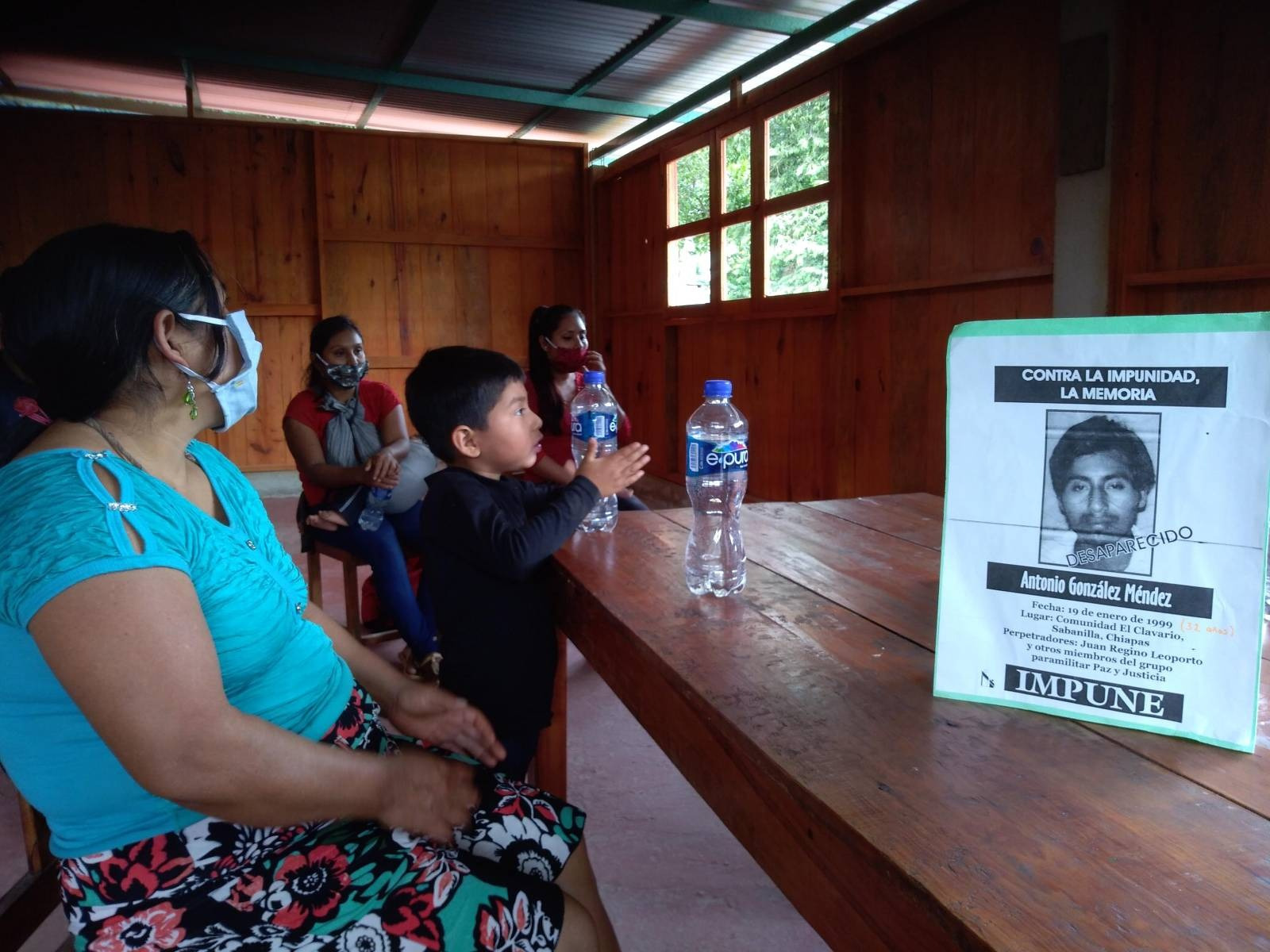
In the absence of adequate search and investigation in Mexico, she and her family decided to turn to the Inter-American Human Rights System in 2000.
The Inter-American Commission on Human Rights (IACHR) issued its merits report in 2019, a far-reaching decision for the case and the search for the truth. It recognizes the participation of the Mexican State in the formation of paramilitary groups, including Paz y Justicia, in addition to demanding to investigate the facts and search for Antonio under that context of terror and criminality.
However, the Mexican government of Andrés Manuel López Obrador gave minimal compliance with the recommendations of the IACHR report.
The public apology in 2022, by Alejandro Encinas, undersecretary of Human Rights, was interpreted by Antonio’s relatives as a simple protocol, given the lack of search and investigation.
Given the continuity of the State’s omissions, the case was presented to the Inter-American Court, where the government of the “fourth transformation” has denied the State’s policy of counterinsurgency where serious human rights violations occurred.
This attitude makes him one more accomplice of previous governments, and responsible for the psychosocial effects that continue to occur due to the lack of justice and truth towards the victims, said the Frayba.

The counterinsurgency actions designed by the Secretariat of National Defense (SEDENA) in its “Chiapas 94 Campaign Plan” included the formation of paramilitary groups following the 1994 Zapatista Uprising.
The Mexican Army and paramilitaries committed crimes against humanity directed at the indigenous population, such as extrajudicial executions, disappearances, forced displacements, among others.
These attacks were largely directed against civilians, aimed at provoking a state of terror that would prevent the support of the communities to the insurgency.
The Frayba documented that Paz y Justicia, just one of paramilitary groups operating in Chiapas, disappeared 37 people and executed 85 more in the region.
Therefore, they demanded that the government of Mexico recognize its responsibility and respond to this demand of historical significance that has to do with serious human rights violations, committed during the nineties, such as the Forced Disappearance of González Méndez.
Therefore, it must comply with an exhaustive investigation and search taking into account the context of political and generalized violence in the framework of an internal armed conflict.
Also, it must fully comply with its obligations in terms of integral reparation of the damages, so that Antonio’s family has the possibility of a life project, which was truncated.

Originally Published in Spanish by Chiapas Paralelo, Wednesday, June 20, 2023, and Re-Published with English interpretation by the Chiapas Support Committee
 Chiapas Support Committee