By: Raúl Zibechi
Reality is not how we would like it to be, not even how it was decades ago. Ever since capital declared war on the peoples to appropriate the commons (water, land, air and everything alive), it converted the nation-states into the shield of the powerful, to use and abuse the armed apparatus, legal and illegal, to contain and discipline the popular sectors.
Contrary to what much of the left maintains, neoliberalism is not less, but more state. If we look at it as a whole, militarization is the structural response of capital to proceed with dispossession, control the peoples who resist it and encourage violent and predatory accumulation. It is the State that militarizes the territories where the peoples live; Therefore, without this devastating state presence it would not be possible for capital to realize its misdeeds.
Those who argue that progressivism is not neoliberal because it increases the presence of the state in society and the economy, deliberately overlook the phenomenon of militarization, which transcends governments and political colors to become a suffocating reality throughout Latin America. In Peru, Amnesty International (AI) acknowledges in a February 16 report that state violence against peasants and indigenous people during protests in recent months is a sign of “contempt for the population” (amnesty.org/es).

Érika Guevara, Americas director at AI, said that “it is no coincidence that dozens of people told AI that they felt the authorities were treating them like animals and not like human beings.” What indigenous, peasant or person from the popular sectors has not felt something similar in their dealings with the authorities and in particular with the armed apparatuses of the State?
We must reject the idea of particularism if we want to understand the system. Peru, Mexico, Guatemala, Honduras, Chile, Ecuador, Argentina, Brazil, Venezuela, are going through situations in which similarities and underlying trends are much more important than specific differences. We are moving towards increasingly authoritarian regimes, in all geographies, with differences in times and modes.
The latest example occurs these days in Brazil. President Lula promised the indigenous people during the election campaign that he would legalize their territories, as mandated by the Constitution approved in 1988. He will not be able to because agribusiness blocks any initiative in favor of indigenous peoples and peasants, and it has been preventing solid progress in agrarian reform for years.
A recent report on page Sumauma.com, entitled “Can Lula fulfill what he promised to the indigenous people?”, explains that during the neoliberal administration of Fernando Henrique Cardoso (1995-2002) 145 indigenous territories were legalized in eight years, and that with Fernando Collor (1990-92) 112 legalizations were reached in only two and a half years of government. In contrast, during Lula’s two governments (2003-10) only 81 indigenous territories were legalized and under Dilma Rousseff (2011-16) only 21 territories. It’s shocking that conservative governments have comfortably surpassed the Workers’ Party government both in the legalization of indigenous territories and in the delivery of land to peasants.
We must explain this reality, understand that we are facing a shift of capital and the State. The problem that we do not want to see, partly because of the immediate interests of the left, but also because of the inertia that drags all political culture, is that the State has mutated, that it has been hijacked by the 1% to shield its power and wealth. This mutation of capital, from accumulation by extended reproduction to accumulation by dispossession, is at the basis of the current “States for dispossession” that force peoples to protect themselves in various ways, from indigenous and black guards to autonomies and territorial self-governments.
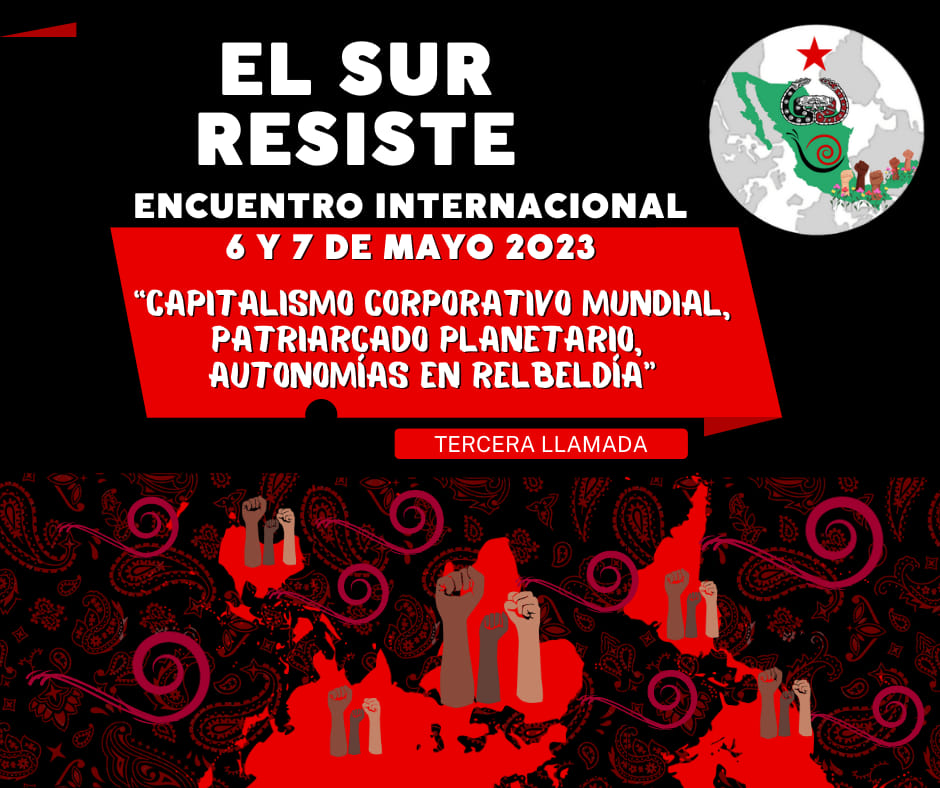
At the recent El Sur Resiste | The South Resists international meeting, convened by the National Indigenous Congress and held in Cideci (San Cristóbal de las Casas), we explained that the war of dispossession is just beginning, because almost 40 percent of the continent’s lands are still in the hands of indigenous and black peoples, small farmers, fishermen and all those families that produce food. according to annual reports of the Institute for Rural Development of South America (http://sudamericarural.org).
The dispute on the continent is over those territories that capital does not yet control. Contrary to Max Weber, we must say that today the State is the institution that articulates violence against the peoples: military, paramilitary, narco and the most diverse gangs. Betting on the State as a tool for transformation means abandoning the peoples to armed herds.

Originally Published in Spanish by La Jornada, Friday, June 2, 2023, https://www.jornada.com.mx/2023/06/02/opinion/015a2pol and Re-Published with English interpretation by the Chiapas Support Committee
 Chiapas Support Committee