By: Ángeles Mariscal
“Andrés Manuel López Obrador said ‘hugs not bullets’, but we are not receiving the hugs, we are receiving pure bullets,” point out residents of the border zone of Chiapas with Guatemala.
Terror is experienced in the town of Lajerío, located in the border area of Chiapas with Guatemala. There are burned vehicles in the central park, dozens of shells from high-caliber weapons on the floor, there are walls with shots; and unexploded ordnance in some homes.
They are the remnants of the confrontation between the Cartel Jalisco Nueva Generación and the Sinaloa Cartel, according to how they name themselves on the canvases and graffiti that they leave in their wake.
That’s why the entire population fled on May 24, and that is why now, although elements of the Mexican Army, the National Guard and the state police arrived in the area, not everyone wants to return.
According to the report from Enrique Arévalo, delegate of the Secretariat of Civil Protection, the displaced population was not only from Lajerío, but also from the neighboring communities like Candelaria and Flor de Lis, among others.
There is no precise number of how many there are, because they fled to various places, some to the mountains and others to neighbor communities; but they calculate between 3,500 and 4,000 people.
The security forces arrived in Lajerío a week after the displacement. On behalf of Chiapas authorities, they searched for the displaced population and invited them to return. For now, only some accepted.
In the town of Josefa Ortíz de Dominguez, just over 600 people took refuge. Of those 600, 163 decided to return. The rest considered that there are still no security conditions and fear a new confrontation between the cartels, or between these groups and the military forces.
“We fear that at any moment another shooting could break out. We don’t owe anyone anything and if we left it was for our children. What need do we have to leave our homes when we don’t owe anything?” responds one of the displaced women who decided not to return home yet.
He insisted that there is no guarantee that the security forces will remain in the community to ensure that armed groups do not return, which, according to the inhabitants of the area, only retreated to the mountains and nearby places. “Right now, maybe they’re going to support us for three or four days, but if they leave, they’re going to leave us stranded,” he explained.
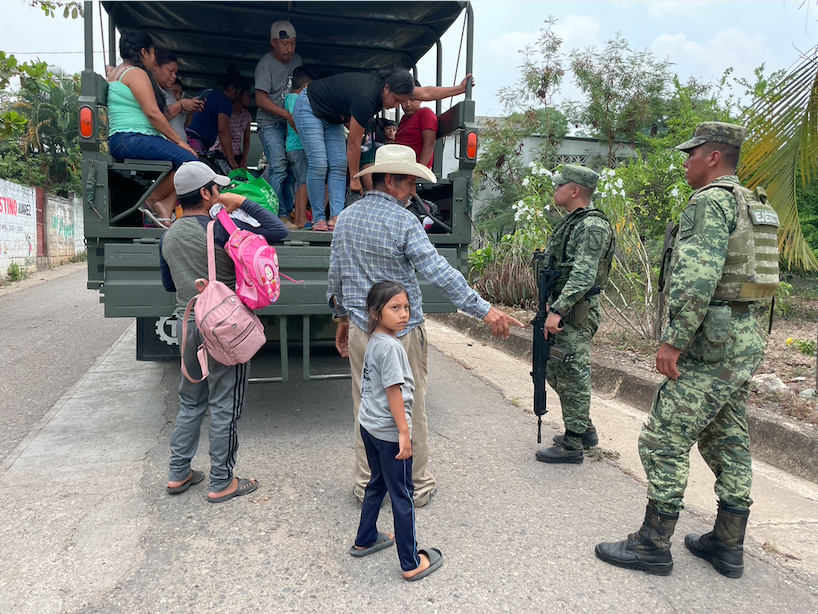
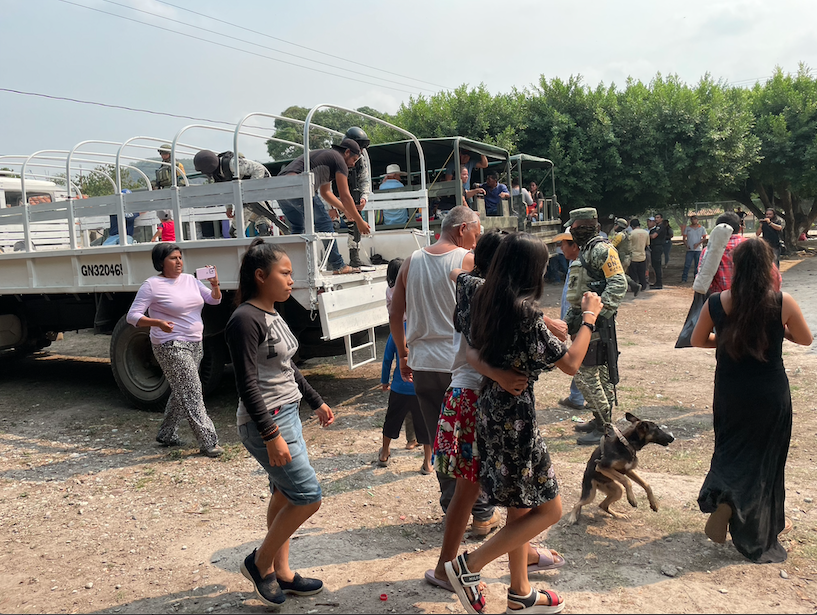
On the morning of June 1, soldiers and members of the National Guard, in addition to Civil Protection workers of the Chiapas government, arrived in the Josefa Ortíz de Domínguez community with trucks. The displaced residents were waiting there, carrying their belongings in sacks and bags.
Before the trucks arrived, they talked about what they had experienced. “We put the tables and beds on top to defend my children because the simple truth is, the shooting was hard. There were bombs too,” says Oralia Morales Robledo, a woman in her 40s who left with her minor children and a young woman eight months pregnant. They left for the mountain and now their daughter is at risk of a miscarriage.
“With much of God’s miracle, all the common people left together in a row (…) We said: now we are all going to die, without cause, because we are not committing anything. We are not to blame for being in this place,” said Mariana, a mother who left with three children.
While the people who decided not to return looked on, the rest got on the Army trucks and headed for their community.
An hour’s drive aboard the trucks and they arrived. In Lajerío, closed houses and remnants of the battle awaited them. While some opened their homes and closed their doors immediately, in fear, others gathered under the Central Park dome.
There the authorities left them some food pantries, and then an Army colonel named Oronel told them to feel safe because the uniformed men were there.
He also told them that they had found explosives in homes, so he asked them to check the houses to defuse them, to warn if they saw strangers in the community.
At that time several of the residents asked him to tell them how long they were going to be there, “the fear of the people is that they can return (the armed people) because we know that those people withdrew temporarily, but since there is no security here, they will return again.” Colonel Oronel replied that they were still in the process of defining it.
“Andrés Manuel López Obrador said ‘hugs not bullets’, but we are not receiving the hugs, we are receiving pure bullets,” (…) If you don’t give us a guarantee, what need do we have to leave here running. All the patrimony that took years for people to make, they were leaving here for fear of the insecurity of organized crime,” said a resident who demanded that the three levels of government stabilize the area.
The soldier’s response was: “We know how to carry out various analyses and we know that it’s an area in conflict, between members (of different organized crime groups), we are going to try to establish permanent security here.”
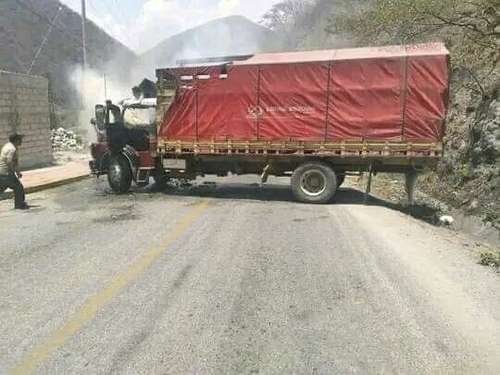
The situation in the border zona between Chiapas and Guatemala remains tense. One of the organized crime groups placed a trailer across the highway that connects with Comitán municipality, at the village of Chamic and it has been there since May 30, in order to prevent the Army from passing.
The vehicle remains there, partially burned. Also, on this road, armed men appear at times. An unknown number of people have disappeared on this road. The population tries to recover its daily life, open its shops and restaurants; However, traveling along the road and through this region without running into any checkpoint of organized crime groups, is a challenge.

Originally Published in Spanish by Chiapas Paralelo, Friday, June 2, 2023, https://www.chiapasparalelo.com/noticias/chiapas/2023/06/retorno-parcial-de-desplazados-por-los-carteles-de-la-droga/ and Re-Published with English. interpretation by the Chiapas Support Committee
 Chiapas Support Committee